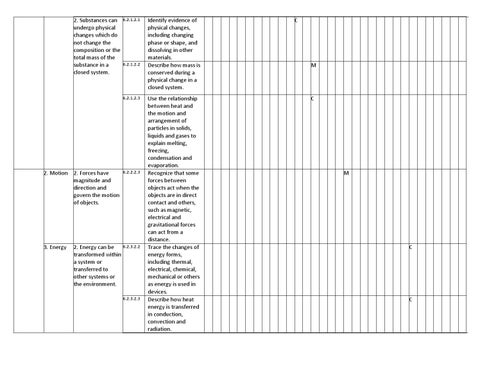
2. Substances can 6.2.1.2.1 undergo physical changes which do not change the composition or the total mass of the 6.2.1.2.2 substance in a closed system.
Identify evidence of physical changes, including changing phase or shape, and dissolving in other materials. Describe how mass is conserved during a physical change in a closed system.
6.2.1.2.3
Use the relationship between heat and the motion and arrangement of particles in solids, liquids and gases to explain melting, freezing, condensation and evaporation. Recognize that some forces between objects act when the objects are in direct contact and others, such as magnetic, electrical and gravitational forces can act from a distance. Trace the changes of energy forms, including thermal, electrical, chemical, mechanical or others as energy is used in devices. Describe how heat energy is transferred in conduction, convection and radiation.
2. Motion 2. Forces have magnitude and direction and govern the motion of objects.
6.2.2.2.3
3. Energy 2. Energy can be 6.2.3.2.2 transformed within a system or transferred to other systems or the environment. 6.2.3.2.3
C
M
C
M
C
C