NEWS | 2
Thursday, April 3, 2014
Opposition to new housing project continues Aja Frost @ajavuu More than 100 San Luis Obispo residents attended a city forum in mid-March to discuss the Housing South residence hall project, which would be constructed near the Grand Avenue entrance of Cal Poly’s campus. Of the attendees, 40 protested the project and only one supported it. The meeting came after the San Luis Obispo City Council received several requests from citizens who wanted to voice their opposition to the proposed residence halls. The main concern, attendees said, was the arrival of almost 1,500 additional freshmen, which would likely lead to more
Robots continued from pg 1. God from the machine “Could we grant a predator drone the ability to determine when to fire its hellfire missiles? Yes, we could,” Cal Poly ethics professor & group co-founder Keith Abney said. “The question is whether or not we should, and that’s what we hope to explore.” Machines still need humans to operate, but not as much as you’d think. Modern unmanned aerial vehicles (UAVs), otherwise known as drones, have the ability to take off, navigate and land on their own. But for a robot to be considered truly autonomous, it needs to meet three standards: It must have the ability to detect information coming from the external world (sense), process that information (think) and use
noise, traffic and partying in the adjacent neighborhood. “This is a recipe for disaster,” resident Paul Allen said, according to the San Luis Obispo Tribune. The project has been controversial since the university announced it last year. A group of residents have repeatedly said they want the residence halls farther away from their neighborhood. Though Cal Poly has considered two other locations — a site along Via Carta and a site along California Boulevard — both have been rejected because of expense, location and construction length. “The residents seem to understand — I can’t speak to whether they accept it or not — but they seem to understand my rationale that (the Grand
Avenue location) is really the only place we can add firstyear housing,” Cal Poly President Jeffrey Armstrong said in a January statement announcing his intention to move forward with the project. Councilman Dan Carpenter
it to make decisions (act). Technology has already advanced far enough to grant robots the ability to complete certain tasks without direct human manipulation, but the biggest impediment to the deployment of fully autonomous machines — especially weapon systems — might be public trust. “Humans are currently kept in the loop when killing decisions are made, but this is not a technological necessity,” Abney said. “Before we take that step, robots need to be at least as good, if not better, than humans at not committing war crimes.” Skepticism of artificial life forms dates back centuries. In the fifth century, it was written in a Jewish holy book that, as man drew closer to God in wisdom, he would divine the ability to forge life-forms of his own,
called golems. Created from mud and clay, golems could act independently but were clumsy and unintelligent. In the 1970s, Israel spearheaded the development of the first UAVs designed for reconnaissance, which would be heavily deployed in wars with Egypt and Lebanon. Constant conflict has pushed Israel to the forefront of drone research in concert with the United States. But as UAVs collect more hours of reconnaissance footage than any human can monitor, it has created a push for the development of drones equipped with facial recognition software and automated targeting systems, though the technology for this is still a ways off. “Right now we have things like the Predator drone flying around Pakistan and Afghanistan that are being piloted at an air force base in Nevada,”
asked the council for a resolution against the residence hall project. Councilwoman Kathy Smith agreed with him, saying she would do whatever it took to change the residence hall location. Her words were greeted with a standing ovation.
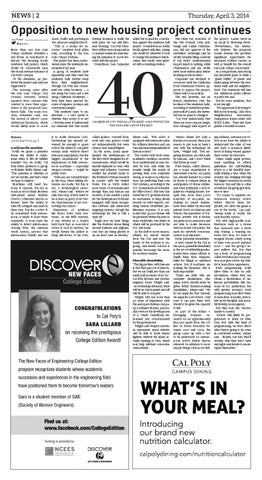
40
NUMBER OF CITY FORUM ATTENDEES WHO PROTESTED THE HOUSING SOUTH PROJECT
Abney said. “The robot is equipped with automatic radar for collision detection and can turn and land independently of human control.” The Jewish holy book states mankind’s creations can never be as sophisticated as ones created by God. And while the Israelis weigh the merits of proving their own scriptures wrong, as many as 74 other nations are perfecting their own UAV systems, according to the U.S. Government Accountability Office (GAO). The GAO has stated the U.S. government has no mechanism to keep timely records on UAV exports, creating serious worldwide proliferation concerns. It is estimated that 35,000 drones will be produced within the next 10 years worldwide, two-thirds of which will be produced by the U.S. and Israel. As the shift to move responsibility for armed drones from the CIA and into the hands of the military is ongoing, unmanned combat is quickly becoming the norm for modern warfare. Plausible deniability “The big problem with humans is that they pass out at nine Gs, but we can build jets than can easily pull an excess of 50 Gs,” Cal Poly lecturer and systems engineer Bruce Wright said. “As technology advances, there will be no way manned aircraft will be able to compete.” Wright, who has more than 30 years of experience with the aerospace defense company Lockheed Martin, personally oversaw the development of 11 “black” (unofficial) unmanned jets commissioned by the government. Wright said weapon systems in unmanned aerial vehicles will be able to track enemy fighters without the plane actually needing to turn, which may help alleviate communication delays.
The other two members of the City Council, John Ashbaugh and Carlyn Christianson, did not approve of the resolution. Ashbaugh said he would consider filing a lawsuit if Cal Poly’s environmental impact report is lacking, while Christianson said she would need more information before deciding on the location. Carpenter has declined to comment until the California State University trustees approve or oppose the project, which will occur in May. The city, however, has no formal jurisdiction over the location of the residence halls; according to university spokesperson Matt Lazier, the university has no plans to change it. “Cal Poly understands that there are some campus neighbors unhappy with aspects of
the project,” Lazier wrote in an email to Mustang News. “Nevertheless, the university believes the proposed Grand Avenue site provides significant opportunity for increased student success as well as benefit for the overall San Luis Obispo community.” As a compromise, Armstrong has described plans to build a “green buffer” of plants and landscaping between the residence halls and the neighborhood. The university will hire two additional police officers to patrol the area. But for some residents, that is not enough. “We appreciate Poly trying to find more housing,” Alta Vista Neighborhood Association chairperson Karen Adler told KCBX Radio. “They just have picked a horrible location.”
“Sensor delays last only a fraction of a second; there is no reason to put man in harm’s way with the technology we have,” Wright said. “But targeting decisions are still made by humans, and I don’t think that’ll ever go away.” Such delays, called latency, are a major impediment to unmanned combat. Al-Qaeda has already learned to scatter its forces to outpace delays in anticipation of drone strikes, and even published a how-to guide for evading drones. Despite this, more than 3,000 members of Al-Qaeda, including 50 senior leaders, have been killed by remotely piloted UAVs in Pakistan and Yemen, the epicenters of U.S. drone activity. But if drones are given more autonomy and are able to make decisions with on-board computers, the need for network communications may diminish. Enter plausible deniability. A term coined by the CIA in the 1960s, plausible deniability is the act of withholding information from senior officers to shield them from responsibility for illegal or unethical actions. But if machines are making the decisions, who is held responsible? “There are folks who are complete abolitionists, who argue robots should never be given lethal decision-making capabilities,” Abney said. “We do not argue for that. Instead, we argue for a set of tests. Only once it can pass these tests should it be given the capacity to kill.” As part of the Ethics + Emerging Sciences’ research on an approximately $90,000 grant from the Office of Naval Research between 2007 and 2009, the group came up with a test to be performed on autonomous robots before they’re released. In addition to more simple things such as not kill-
ing civilians, autonomous robots must have the ability to understand the rules of war and have a minimal likelihood of being turned against their owner by terrorists. Critics might argue government spending on ethical guidelines for self-thinking robots is a bit fanciful, especially during a time when the country was trudging through the biggest recession in recent memory. Lin said this is a line of criticism his group gets from time to time. “It’s easier to regulate autonomous military robots before they’ve been deployed, not after the genie is out of the bottle,” Lin said. “Being early is really the only feasible option.” But with high-profile malfunctions such as a drone that slammed into a Navy ship during a training exercise last year, it’s hard to imagine drones safely acting of their own accord anytime soon — and the group’s report reflects this. But they say a form of programming called evolutionary computation may give robots the ability to learn from experience. Such programming could allow them to rely on selfsimulations, where they can obtain a distribution of unknown probabilities like humans do (i.e. prediction), but with greater accuracy. Such programming may allow them to learn from mistakes, formulate novel thoughts and possibly develop moral agency. But they may also become harder to control. “Robots will likely be programmed to learn on their own. But with this kind of programming, we don’t know what they’re going to do, even in a restricted context,” Abney said. “Maybe, one day, they’ll wonder why they don’t have any rights and decide to emancipate themselves.”