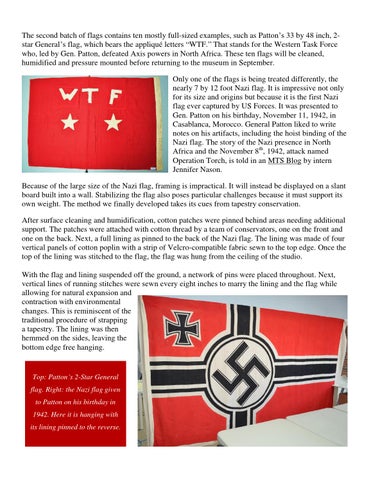
The second batch of flags contains ten mostly full-sized examples, such as Patton’s 33 by 48 inch, 2star General’s flag, which bears the appliqué letters “WTF.” That stands for the Western Task Force who, led by Gen. Patton, defeated Axis powers in North Africa. These ten flags will be cleaned, humidified and pressure mounted before returning to the museum in September. Only one of the flags is being treated differently, the nearly 7 by 12 foot Nazi flag. It is impressive not only for its size and origins but because it is the first Nazi flag ever captured by US Forces. It was presented to Gen. Patton on his birthday, November 11, 1942, in Casablanca, Morocco. General Patton liked to write notes on his artifacts, including the hoist binding of the Nazi flag. The story of the Nazi presence in North Africa and the November 8th, 1942, attack named Operation Torch, is told in an MTS Blog by intern Jennifer Nason. Because of the large size of the Nazi flag, framing is impractical. It will instead be displayed on a slant board built into a wall. Stabilizing the flag also poses particular challenges because it must support its own weight. The method we finally developed takes its cues from tapestry conservation. After surface cleaning and humidification, cotton patches were pinned behind areas needing additional support. The patches were attached with cotton thread by a team of conservators, one on the front and one on the back. Next, a full lining as pinned to the back of the Nazi flag. The lining was made of four vertical panels of cotton poplin with a strip of Velcro-compatible fabric sewn to the top edge. Once the top of the lining was stitched to the flag, the flag was hung from the ceiling of the studio. With the flag and lining suspended off the ground, a network of pins were placed throughout. Next, vertical lines of running stitches were sewn every eight inches to marry the lining and the flag while allowing for natural expansion and contraction with environmental changes. This is reminiscent of the traditional procedure of strapping a tapestry. The lining was then hemmed on the sides, leaving the bottom edge free hanging.
Top: Patton’s 2-Star General flag. Right: the Nazi flag given to Patton on his birthday in 1942. Here it is hanging with its lining pinned to the reverse.