Before Installation • Remove old gasket, and clean flange surface of all debris. For best results, use a metal flange scraper, an aerosol gasket remover and a wire brush, then inspect the flange for damage. Be sure surface finish and flatness are satisfactory. • Use the thinnest possible gasket. However, flanges that are warped, bowed or severely pitted require thicker gaskets. • Whenever possible, use ring gaskets. Full face gaskets have more surface area, requiring additional compressive load on the gasket. • Use dry anti-seize, rather than wet. Talc is best, while graphite and mica are also acceptable. Never use metalbased anti-seize, since particles may accumulate in the surface imperfections, thereby creating a flange surface that is too smooth to be effective.
Gasket Assembly Stress Recommendations The minimum recommended assembly stress for Garlock compressed sheet, GYLON® and GRAPH-LOCK® products differs from "M" and "Y" values. "M" and "Y" do not take factors such as flange condition and blowout resistance into account. Garlock offers the following minimum assembly stresses as rules of thumb to use to calculate installation bolt torques. Operating Minimum Assembly Stress Recommended Pressure psi (N/mm2) in psig 1/32" (0.8 mm) 1/16" (1.6 mm) 1/8" (3.2 mm) (bar) Thick Thick Thick Up to 2,500 3,600 4,800 300 (21) (17) (25) (33) Up to 4,800 5,400 6,400 800 (55) (33) (37) (44) Up to 7,400 8,400 9,400 2,000 (140) (51) (58) (65)
Maximum recommended compressive stress for: ■ Compressed fiber and GYLON® gaskets = 15,000 psi ■ Multi-Swell™ Style 3760 = 10,000 psi ■ GRAPH-LOCK® gaskets = 10,000 psi ■ STRESS SAVER® gaskets = 600 - 1,200 psi ■ Rubber gaskets to 60 duro = 600 - 900 psi ■ Rubber gaskets to 70 duro and higher = 600 - 1,200 psi
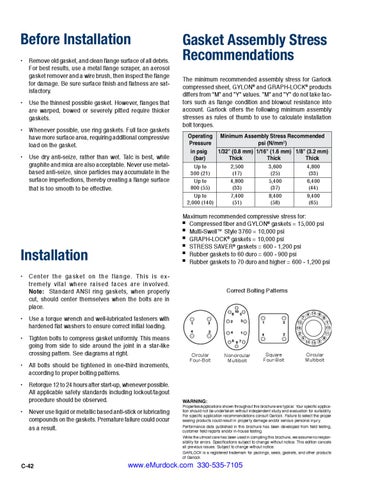
Installation • Center the gasket on the flange. This is extremely vital where raised faces are involved. Note: Standard ANSI ring gaskets, when properly cut, should center themselves when the bolts are in place. • Use a torque wrench and well-lubricated fasteners with hardened flat washers to ensure correct initial loading. • Tighten bolts to compress gasket uniformly. This means going from side to side around the joint in a star-like crossing pattern. See diagrams at right. • All bolts should be tightened in one-third increments, according to proper bolting patterns.
Correct Bolting Patterns
Circular Circular Four-Bolt Four-Bolt
Noncircular Noncircular Multibolt Multibolt
Square Square Four-Bolt Four-Bolt
Circular Circular Multibolt Multibolt
• Retorque 12 to 24 hours after start-up, whenever possible. All applicable safety standards including lockout/tagout procedure should be observed.
WARNING:
• Never use liquid or metallic based anti-stick or lubricating compounds on the gaskets. Premature failure could occur as a result.
Performance data published in this brochure has been developed from field testing, customer field reports and/or in-house testing.
Properties/applications shown throughout this brochure are typical. Your specific application should not be undertaken without independent study and evaluation for suitability. For specific application recommendations consult Garlock. Failure to select the proper sealing products could result in property damage and/or serious personal injury.
While the utmost care has been used in compiling this brochure, we assume no responsibility for errors. Specifications subject to change without notice. This edition cancels all previous issues. Subject to change without notice. GARLOCK is a registered trademark for packings, seals, gaskets, and other products of Garlock.
C-42
www.eMurdock.com 330-535-7105