3
Clipper
®
Wire Hook System
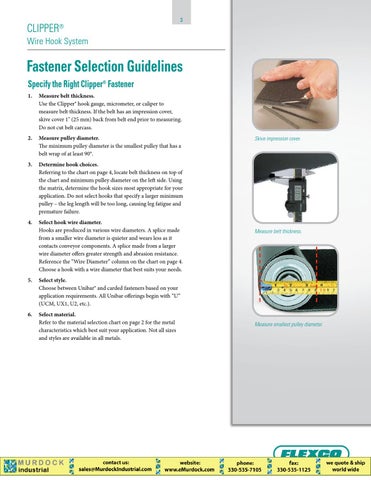
Fastener Selection Guidelines Specify the Right Clipper® Fastener 1. Measure belt thickness. Use the Clipper® hook gauge, micrometer, or caliper to measure belt thickness. If the belt has an impression cover, skive cover 1" (25 mm) back from belt end prior to measuring. Do not cut belt carcass. 2. Measure pulley diameter. The minimum pulley diameter is the smallest pulley that has a belt wrap of at least 90°.
Skive impression cover.
3. Determine hook choices. Referring to the chart on page 4, locate belt thickness on top of the chart and minimum pulley diameter on the left side. Using the matrix, determine the hook sizes most appropriate for your application. Do not select hooks that specify a larger minimum pulley – the leg length will be too long, causing leg fatigue and premature failure. 4. Select hook wire diameter. Hooks are produced in various wire diameters. A splice made from a smaller wire diameter is quieter and wears less as it contacts conveyor components. A splice made from a larger wire diameter offers greater strength and abrasion resistance. Reference the “Wire Diameter” column on the chart on page 4. Choose a hook with a wire diameter that best suits your needs.
Measure belt thickness.
5. Select style. Choose between Unibar® and carded fasteners based on your application requirements. All Unibar offerings begin with “U” (UCM, UX1, U2, etc.). 6. Select material. Refer to the material selection chart on page 2 for the metal characteristics which best suit your application. Not all sizes and styles are available in all metals.
www.flexco.com
Measure smallest pulley diameter.