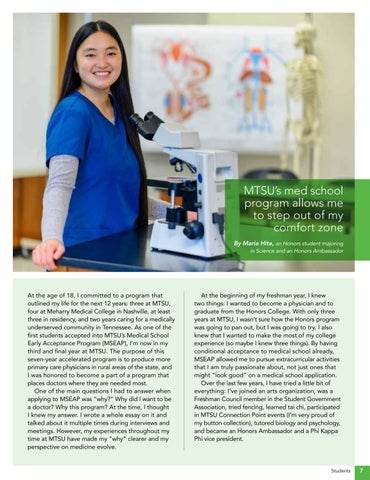
MTSU’s med school program allows me to step out of my comfort zone By Maria Hite, an Honors student majoring in Science and an Honors Ambassador
At the age of 18, I committed to a program that outlined my life for the next 12 years: three at MTSU, four at Meharry Medical College in Nashville, at least three in residency, and two years caring for a medically underserved community in Tennessee. As one of the first students accepted into MTSU’s Medical School Early Acceptance Program (MSEAP), I’m now in my third and final year at MTSU. The purpose of this seven-year accelerated program is to produce more primary care physicians in rural areas of the state, and I was honored to become a part of a program that places doctors where they are needed most. One of the main questions I had to answer when applying to MSEAP was “why?” Why did I want to be a doctor? Why this program? At the time, I thought I knew my answer. I wrote a whole essay on it and talked about it multiple times during interviews and meetings. However, my experiences throughout my time at MTSU have made my “why” clearer and my perspective on medicine evolve.
At the beginning of my freshman year, I knew two things: I wanted to become a physician and to graduate from the Honors College. With only three years at MTSU, I wasn’t sure how the Honors program was going to pan out, but I was going to try. I also knew that I wanted to make the most of my college experience (so maybe I knew three things). By having conditional acceptance to medical school already, MSEAP allowed me to pursue extracurricular activities that I am truly passionate about, not just ones that might “look good” on a medical school application. Over the last few years, I have tried a little bit of everything: I’ve joined an arts organization, was a Freshman Council member in the Student Government Association, tried fencing, learned tai chi, participated in MTSU Connection Point events (I’m very proud of my button collection), tutored biology and psychology, and became an Honors Ambassador and a Phi Kappa Phi vice president.
Students
7