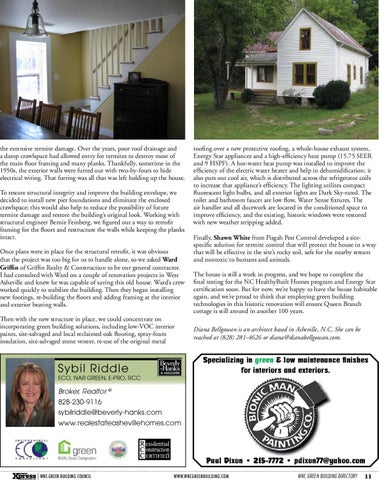
the extensive termite damage. Over the years, poor roof drainage and a damp crawlspace had allowed entry for termites to destroy most of the main floor framing and many planks. Thankfully, sometime in the 1950s, the exterior walls were furred out with two-by-fours to hide electrical wiring. That furring was all that was left holding up the house. To restore structural integrity and improve the building envelope, we decided to install new pier foundations and eliminate the enclosed crawlspace; this would also help to reduce the possibility of future termite damage and restore the building’s original look. Working with structural engineer Bernie Feinberg, we figured out a way to retrofit framing for the floors and restructure the walls while keeping the planks intact. Once plans were in place for the structural retrofit, it was obvious that the project was too big for us to handle alone, so we asked Ward Griffin of Griffin Realty & Construction to be our general contractor. I had consulted with Ward on a couple of renovation projects in West Asheville and knew he was capable of saving this old house. Ward’s crew worked quickly to stabilize the building. Then they began installing new footings, re-building the floors and adding framing at the interior and exterior bearing walls. Then with the new structure in place, we could concentrate on incorporating green building solutions, including low-VOC interior paints, site-salvaged and local reclaimed oak flooring, spray-foam insulation, site-salvaged stone veneer, re-use of the original metal
roofing over a new protective roofing, a whole-house exhaust system, Energy Star appliances and a high-efficiency heat pump (15.75 SEER and 9 HSPF). A hot-water heat pump was installed to improve the efficiency of the electric water heater and help in dehumidification; it also puts out cool air, which is distributed across the refrigerator coils to increase that appliance’s efficiency. The lighting utilizes compact fluorescent light bulbs, and all exterior lights are Dark Sky-rated. The toilet and bathroom faucet are low flow, Water Sense fixtures. The air handler and all ductwork are located in the conditioned space to improve efficiency, and the existing, historic windows were restored with new weather stripping added. Finally, Shawn White from Pisgah Pest Control developed a sitespecific solution for termite control that will protect the house in a way that will be effective in the site’s rocky soil, safe for the nearby stream and nontoxic to humans and animals. The house is still a work in progress, and we hope to complete the final testing for the NC HealthyBuilt Homes program and Energy Star certification soon. But for now, we’re happy to have the house habitable again, and we’re proud to think that employing green building technologies in this historic renovation will ensure Queen Branch cottage is still around in another 100 years. Diana Bellgowan is an architect based in Asheville, N.C. She can be reached at (828) 281-4626 or diana@dianabellgowan.com.
Specializing in green & low maintenance finishes for interiors and exteriors.
Sybil Riddle
ECO, NAR GREEN, E-PRO, RCC
Broker, Realtor ® 828-230-9116 sybilriddle@beverly-hanks.com www.realestateashevillehomes.com
Paul Dixon • 215-7772 • pdixon77@yahoo.com WNC Green Building Council
www.wncgreenbuilding.com
WNC Green Building Directory
11