N E W S
Holding on Local child services weather funding cuts
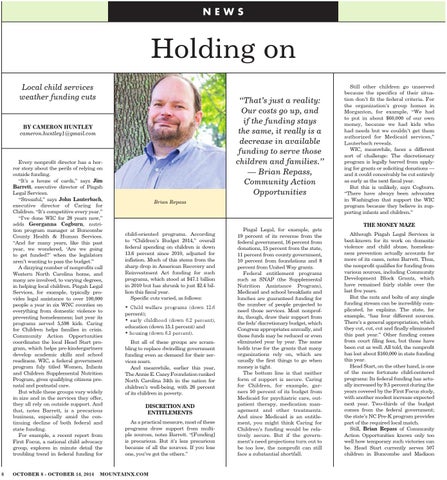
“That’s just a reality: Our costs go up, and if the funding stays the same, it really is a decrease in available funding to serve those children and families.” — Brian Repass, Community Action Opportunities
BY CAMERON HUNTLEY
cameron.huntley1@gmail.com
Every nonprofit director has a horror story about the perils of relying on outside funding. “It’s a house of cards,” says Jim Barrett, executive director of Pisgah Legal Services. “Stressful,” says John Lauterbach, executive director of Caring for Children. “It’s competitive every year.” “I’ve done WIC for 28 years now,” adds Georganna Cogburn, nutrition program manager at Buncombe County Health & Human Services. “And for many years, like this past year, we wondered, ‘Are we going to get funded?’ when the legislators aren’t wanting to pass the budget.” A dizzying number of nonprofits call Western North Carolina home, and many are involved, to varying degrees, in helping local children. Pisgah Legal Services, for example, typically provides legal assistance to over 100,000 people a year in six WNC counties on everything from domestic violence to preventing homelessness; last year its programs served 5,598 kids. Caring for Children helps families in crisis. Community Action Opportunities coordinates the local Head Start program, which helps pre-kindergartners develop academic skills and school readiness. WIC, a federal government program fuly titled Women, Infants and Children Supplemental Nutrition Program, gives qualifying citizens prenatal and postnatal care. But while these groups vary widely in size and in the services they offer, they all rely on outside support. And that, notes Barrett, is a precarious business, especially amid the continuing decline of both federal and state funding. For example, a recent report from First Focus, a national child advocacy group, explores in minute detail the troubling trend in federal funding for
8
OCTOBER 8 - OCTOBER 14, 2014
Brian Repass
child-oriented programs. According to “Children’s Budget 2014,” overall federal spending on children is down 13.6 percent since 2010, adjusted for inflation. Much of this stems from the sharp drop in American Recovery and Reinvestment Act funding for such programs, which stood at $47.1 billion in 2010 but has shrunk to just $2.4 billion this fiscal year. Specific cuts varied, as follows: • Child welfare programs (down 12.6 percent); • early childhood (down 6.2 percent), education (down 15.1 percent) and • housing (down 6.3 percent). But all of these groups are scrambling to replace dwindling government funding even as demand for their services soars. And meanwhile, earlier this year, The Annie E. Casey Foundation ranked North Carolina 34th in the nation for children’s well-being, with 26 percent of its children in poverty. DISCRETION AND ENTITLEMENTS As a practical measure, most of these programs draw support from multiple sources, notes Barrett. “[Funding] is precarious. But it’s less precarious because of all the sources. If you lose one, you’ve got the others.”
MOUNTAINX.COM
Pisgal Legal, for example, gets 19 percent of its revenue from the federal government, 16 percent from donations, 15 percent from the state, 11 percent from county government, 10 percent from foundations and 8 percent from United Way grants. Federal entitlement programs such as SNAP (the Supplemental Nutrition Assistance Program), Medicaid and school breakfasts and lunches are guaranteed funding for the number of people projected to need those services. Most nonprofits, though, draw their support from the feds’ discretionary budget, which Congress appropriates annually, and those funds may be reduced or even eliminated year by year. The same holds true for the grants that many organizations rely on, which are usually the first things to go when money is tight. The bottom line is that neither form of support is secure. Caring for Children, for example, garners 50 percent of its budget from Medicaid for psychiatric care, outpatient therapy, medication management and other treatments. And since Medicaid is an entitlement, you might think Caring for Children’s funding would be relatively secure. But if the government’s need projections turn out to be too low, the nonprofit can still face a substantial shortfall.
Still other children go unserved because the specifics of their situation don’t fit the federal criteria. For the organization’s group homes in Morganton, for example, “We had to put in about $60,000 of our own money, because we had kids who had needs but we couldn’t get them authorized for Medicaid services,” Lauterbach reveals. WIC, meanwhile, faces a different sort of challenge: The discretionary program is legally barred from applying for grants or soliciting donations — and it could conceivably be cut entirely as early as the next fiscal year. But this is unlikely, says Cogburn. “There have always been advocates in Washington that support the WIC program because they believe in supporting infants and children.” THE MONEY MAZE Although Pisgah Legal Services is best-known for its work on domestic violence and child abuse, homelessness prevention actually accounts for more of its cases, notes Barrett. Thus, the nonprofit qualifies for funding from various sources, including Community Development Block Grants, which have remained fairly stable over the last five years. But the nuts and bolts of any single funding stream can be incredibly complicated, he explains. The state, for example, “has four different sources. There’s a general appropriation, which they cut, cut, cut and finally eliminated this past year.” Other funding comes from court filing fees, but those have been cut as well. All told, the nonprofit has lost about $160,000 in state funding this year. Head Start, on the other hand, is one of the more fortunate child-centered programs: Its federal funding has actually increased by 9.5 percent during the years covered by the First Focus study, with another modest increase expected next year. Two-thirds of the budget comes from the federal government; the state’s NC Pre-K program provides part of the required local match. Still, Brian Repass of Community Action Opportunities knows only too well how temporary such victories can be. Head Start currently serves 507 children in Buncombe and Madison