FAR M & GA R DEN large undertakings develop on the property this fall, says Taylor. Between 5 and 8 acres near the Corn Maze that currently serve as an underused golf range are slated to become farmland within the next six to 12 months. The parcel will be divided into multiple small plots to be cultivated in the relatively small-scale, marketgarden style popularized by Canadian farmer Jean-Martin Fortier. This method of agriculture calls for hand tools and walk-behind tractors rather than large-scale equipment. “In this way, we can actually take the children and begin to have them involved in farming,” says Taylor. With some of Eliada’s residential students coming from metropolitan areas like Charlotte and Raleigh, “a lot of the kids have never seen a tomato plant,” say Rainwater. “They come from the inner city, so it’s great exposure for the kids on campus.” But another objective, in addition to eventually growing enough food to sustain Eliada’s residents, is to create a revenue stream. Using connections to Asheville restaurants nurtured through the Eliada Students Training for Advancement workforce development internship program, Taylor aims to sell Eliada Farms produce to local chefs. This idea got a test run during Eliada Farms Week in August, a fundraiser in which veggies and herbs from the Grow Dome were used as ingredients in special dishes and cocktails at local restaurants and bars. “We’re going to grow in a targeted manner,” Taylor says. “So, you’ll see a lot of root vegetables, different kinds of lettuces, tomatoes, then you’ll see things that are more exotic, specialty items.” Ruckman adds that Eliada is also in the process of planting an orchard of around 100 fruit trees, including heirloom varieties of peaches, pears and apples. As the trees mature, beehives will be added as well as chickens, she says, which will be kept “in a chicken bus, which will move from place to place, fertilizing the ground as it goes.” Taylor says produce raised at the farm — as well as, eventually, Eliada Farms-brand value-added products such as pepper sauces and pestos made in Eliada’s commercial kitchen — will be available to the general public through a farm stand that will be the first stage of a multiphase plan for the property. The design, which is still being developed, calls for a deck with a seating area where guests can view the maze and farm plots while sipping coffee or apple cider. “It’ll be a nice place 32
SEPT. 12 - 18, 2018
during meals or selected alternative options such as peanut-butter-and-jelly or grilled cheese sandwiches. “It was an amazing transformation for us when our kitchen started making scratch-made meals,” he says. “The number of PB&Js we made plummeted, our students were eating homemade foods and loving it. Students were eating their vegetables and even asking for seconds. They were excited for salads because they had a hand in growing the tomatoes, salad greens and cucumbers.” GROWING POTENTIAL
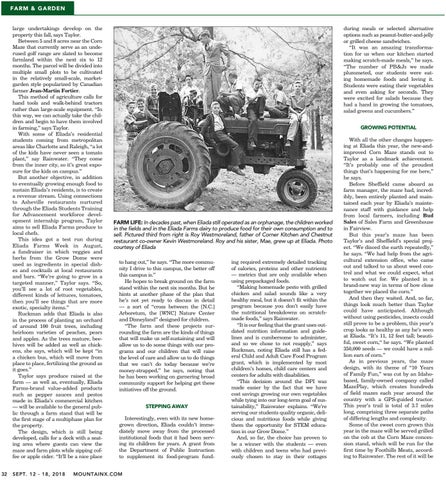
FARM LIFE: In decades past, when Eliada still operated as an orphanage, the children worked in the fields and in the Eliada Farms dairy to produce food for their own consumption and to sell. Pictured third from right is Roy Westmoreland, father of Corner Kitchen and Chestnut restaurant co-owner Kevin Westmoreland. Roy and his sister, Mae, grew up at Eliada. Photo courtesy of Eliada to hang out,” he says. “The more community I drive to this campus, the better off this campus is.” He hopes to break ground on the farm stand within the next six months. But he hints at another phase of the plan that he’s not yet ready to discuss in detail — a sort of “cross between the [N.C.] Arboretum, the [WNC] Nature Center and Disneyland” designed for children. “The farm and these projects surrounding the farm are the kinds of things that will make us self-sustaining and will allow us to do some things with our programs and our children that will raise the level of care and allow us to do things that we can’t do today because we’re money-strapped,” he says, noting that he has been working on garnering broad community support for helping get these initiatives off the ground. STEPPING AWAY Interestingly, even with its new homegrown direction, Eliada couldn’t immediately move away from the processed institutional foods that it had been serving its children for years. A grant from the Department of Public Instruction to supplement its food-program fund-
MOUNTAINX.COM
ing required extremely detailed tracking of calories, proteins and other nutrients — metrics that are only available when using prepackaged foods. “Making homemade pesto with grilled chicken and salad sounds like a very healthy meal, but it doesn’t fit within the program because you don’t easily have the nutritional breakdowns on scratchmade foods,” says Rainwater. “It is our feeling that the grant uses outdated nutrition information and guidelines and is cumbersome to administer, and so we chose to not reapply,” says Ruckman, noting Eliada still has a federal Child and Adult Care Food Program grant, which is implemented by most children’s homes, child care centers and centers for adults with disabilities. “This decision around the DPI was made easier by the fact that we have cost savings growing our own vegetables while tying into our long-term goal of sustainability,” Rainwater explains. “We’re serving our students quality organic, delicious and nutritious foods while giving them the opportunity for STEM education in our Grow Dome.” And, so far, the choice has proven to be a winner with the students — even with children and teens who had previously chosen to stay in their cottages
With all the other changes happening at Eliada this year, the new-andimproved Corn Maze stands out to Taylor as a landmark achievement. “It’s probably one of the proudest things that’s happening for me here,” he says. Before Sheffield came aboard as farm manager, the maze had, incredibly, been entirely planted and maintained each year by Eliada’s maintenance staff with guidance and help from local farmers, including Bud Sales of Sales Farm and Greenhouse in Fairview. But this year’s maze has been Taylor’s and Sheffield’s special project. “We disced the earth repeatedly,” he says. “We had help from the agricultural extension office, who came out and talked to us about weed control and what we could expect, what to watch out for. We planted in a brand-new way in terms of how close together we placed the corn.” And then they waited. And, so far, things look much better than Taylor could have anticipated. Although without using pesticides, insects could still prove to be a problem, this year’s crop looks as healthy as any he’s seen at Eliada. “It’s 11, 12 feet tall; beautiful, sweet corn,“ he says. “We planted 350,000 seeds — we could have a million ears of corn.” As in previous years, the maze design, with its theme of “10 Years of Family Fun,” was cut by an Idahobased, family-owned company called MazePlay, which creates hundreds of field mazes each year around the country with a GPS-guided tractor. This year’s trail is total of 3.7 miles long, comprising three separate paths of differing lengths and complexity. Some of the sweet corn grown this year in the maze will be served grilled on the cob at the Corn Maze concession stand, which will be run for the first time by Foothills Meats, according to Rainwater. The rest of it will be