Paddling for Planetary Health H o w n i b i ( w at e r ) c a n connect & heal us
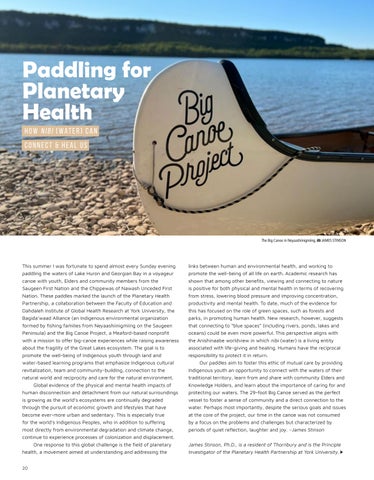
The Big Canoe in Neyaashiinigmiing.
This summer I was fortunate to spend almost every Sunday evening paddling the waters of Lake Huron and Georgian Bay in a voyageur canoe with youth, Elders and community members from the Saugeen First Nation and the Chippewas of Nawash Unceded First Nation. These paddles marked the launch of the Planetary Health Partnership, a collaboration between the Faculty of Education and Dahdaleh Institute of Global Health Research at York University, the Bagida’waad Alliance (an Indigenous environmental organization formed by fishing families from Neyaashiinigmiing on the Saugeen Peninsula) and the Big Canoe Project, a Meaford-based nonprofit with a mission to offer big-canoe experiences while raising awareness about the fragility of the Great Lakes ecosystem. The goal is to promote the well-being of Indigenous youth through land and water-based learning programs that emphasize Indigenous cultural revitalization, team and community-building, connection to the natural world and reciprocity and care for the natural environment. Global evidence of the physical and mental health impacts of human disconnection and detachment from our natural surroundings is growing as the world’s ecosystems are continually degraded through the pursuit of economic growth and lifestyles that have become ever-more urban and sedentary. This is especially true for the world’s Indigenous Peoples, who in addition to suffering most directly from environmental degradation and climate change, continue to experience processes of colonization and displacement. One response to this global challenge is the field of planetary health, a movement aimed at understanding and addressing the 20
JAMES STINSON
links between human and environmental health, and working to promote the well-being of all life on earth. Academic research has shown that among other benefits, viewing and connecting to nature is positive for both physical and mental health in terms of recovering from stress, lowering blood pressure and improving concentration, productivity and mental health. To date, much of the evidence for this has focused on the role of green spaces, such as forests and parks, in promoting human health. New research, however, suggests that connecting to “blue spaces” (including rivers, ponds, lakes and oceans) could be even more powerful. This perspective aligns with the Anishinaabe worldview in which nibi (water) is a living entity associated with life-giving and healing. Humans have the reciprocal responsibility to protect it in return. Our paddles aim to foster this ethic of mutual care by providing Indigenous youth an opportunity to connect with the waters of their traditional territory, learn from and share with community Elders and Knowledge Holders, and learn about the importance of caring for and protecting our waters. The 29-foot Big Canoe served as the perfect vessel to foster a sense of community and a direct connection to the water. Perhaps most importantly, despite the serious goals and issues at the core of the project, our time in the canoe was not consumed by a focus on the problems and challenges but characterized by periods of quiet reflection, laughter and joy. –James Stinson
James Stinson, Ph.D., is a resident of Thornbury and is the Principle Investigator of the Planetary Health Partnership at York University.