design
Photography by Luisa Zanzani.
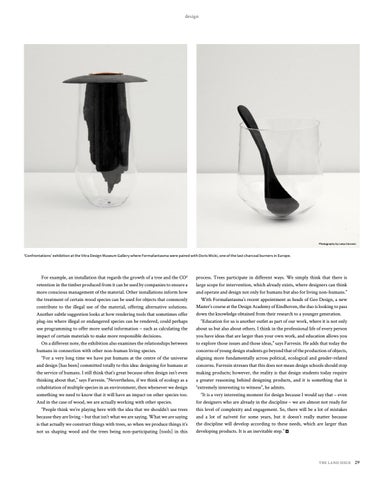
‘Confrontations’ exhibition at the Vitra Design Museum Gallery where Formafantasma were paired with Doris Wicki, one of the last charcoal burners in Europe.
For example, an installation that regards the growth of a tree and the CO2 retention in the timber produced from it can be used by companies to ensure a more conscious management of the material. Other installations inform how the treatment of certain wood species can be used for objects that commonly contribute to the illegal use of the material, offering alternative solutions. Another subtle suggestion looks at how rendering tools that sometimes offer plug-ins where illegal or endangered species can be rendered, could perhaps use programming to offer more useful information – such as calculating the impact of certain materials to make more responsible decisions. On a different note, the exhibition also examines the relationships between humans in connection with other non-human living species. “For a very long time we have put humans at the centre of the universe and design [has been] committed totally to this idea: designing for humans at the service of humans. I still think that’s great because often design isn’t even thinking about that,” says Farresin. “Nevertheless, if we think of ecology as a cohabitation of multiple species in an environment, then whenever we design something we need to know that it will have an impact on other species too. And in the case of wood, we are actually working with other species. “People think we’re playing here with the idea that we shouldn’t use trees because they are living – but that isn’t what we are saying. What we are saying is that actually we construct things with trees, so when we produce things it’s not us shaping wood and the trees being non-participating [tools] in this
process. Trees participate in different ways. We simply think that there is large scope for intervention, which already exists, where designers can think and operate and design not only for humans but also for living non-humans.” With Formafantasma’s recent appointment as heads of Geo Design, a new Master’s course at the Design Academy of Eindhoven, the duo is looking to pass down the knowledge obtained from their research to a younger generation. “Education for us is another outlet as part of our work, where it is not only about us but also about others. I think in the professional life of every person you have ideas that are larger than your own work, and education allows you to explore those issues and those ideas,” says Farresin. He adds that today the concerns of young design students go beyond that of the production of objects, aligning more fundamentally across political, ecological and gender-related concerns. Farresin stresses that this does not mean design schools should stop making products; however, the reality is that design students today require a greater reasoning behind designing products, and it is something that is “extremely interesting to witness”, he admits. “It is a very interesting moment for design because I would say that – even for designers who are already in the discipline – we are almost not ready for this level of complexity and engagement. So, there will be a lot of mistakes and a lot of naïveté for some years, but it doesn’t really matter because the discipline will develop according to these needs, which are larger than developing products. It is an inevitable step.” id
THE LAND ISSUE
29