Book Review
Franklin’s Indians
Irish motorcycle racer Charles B. Franklin, designer of the Indian Scout and Chief Authors: Harry V. Sucher, Tim Pickering, Liam Diamond, Harry Havelin Foreword by George Hendee Wells New paperback edition in the Veloce Classic Reprint Series. Previously published by Panther Publishing in 2011. Published by Veloce Publishing Ltd, Veloce House, Parkway Farm Business Park, Middle Farm Way, Poundbury, Dorchester DT1 3AR Email: sales@veloce.co.uk Tel: 01305 260068 Softback, 248mm x 192mm, 340 pages, approximately 160 photographs and illustrations. ISBN 978-1-787112-23-0 £30, $50 USA Charles Franklin, the first Irish motorcycle racing superstar, was born in Dublin in 1880 where he quickly became involved in motorcycle racing during the pioneer years. He rapidly established himself as both a rider and tuner, particularly of Indian machines. One of the instigators of the Isle of Man TT races, Charles consistently finished in the top eight and in 1911, riding an Indian, he claimed second place, a remarkable achievement in itself. But it was when he moved in 1916 to the Indian concern in Springfield, US, where he later became the chief design engineer, that his genius really became apparent. His design catapulted Indian back into the forefront of motorcycle design in the 1920s and 30s and his racing engines and motorcycles won much glory for Indian. The Indian Scout and Chief are two of the best known and best loved of all classic American motorcycles. The man who designed them, Charles was responsible for many advanced design concepts including remarkable improvements in side-valve combustion chamber design that pre-dated the work of Ricardo. Franklin’s 600cc Scout of 1920 was an all-new integrated design. Ground-breaking features included its double-loop full
10
cradle frame, unitised semi-unit construction engine with enclosed valves, and geared primary drive. On a ‘works’ Indian Freddy Dixon took second place in the 1923 Senior TT in the Isle of Man. Intending to stay in the US for only six months, Franklin never returned to Ireland, being joined by his wife and daughter in 1920. Tragically, this refined, enigmatic man died of cancer in 1932 at the age of 52. Charles was in the thick of all the engineering activity at Indian. He was still in charge of design engineering at the time of his death. The design work he performed or co-ordinated during the 1930-32 period laid the foundations for the new, modern Indians that would see the company out to the end of its day in 1953. This excellent book not only chronicles Franklin’s fascinating family history and life and times in Ireland, but also contains detailed descriptions of early TT races. Much new light is also shed on the history of Indian motorcycles and the often turbulent times of the Indian Motocycle (Sic) Company itself. It is an absolutely essential book for Indian enthusiasts and motorcycle historians alike. This is, in my opinion, one of the best motorcycle history books in recent years. Reviewed by Jonathan Hill.
THE CLASSIC MOTORCYCLE | NOVEMBER 2018
Readers’ Letters YOUR VOICE & YOUR OPINIONS
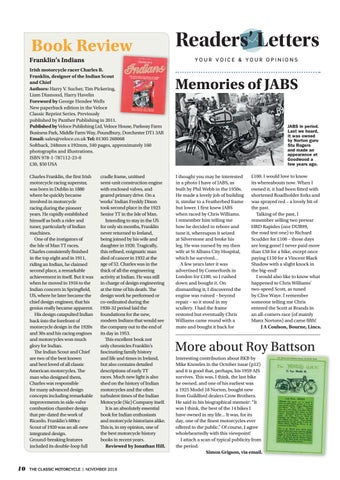
Memories of JABS JABS in period. Last we heard, it was owned by Norton guru Stu Rogers and made an appearance at Goodwood a few years ago.
I thought you may be interested in a photo I have of JABS, as built by Phil Webb in the 1950s. He made a lovely job of building it, similar to a Featherbed frame but lower. I first knew JABS when raced by Chris Williams. I remember him telling me how he decided to rebore and tune it, whereupon it seized at Silverstone and broke his leg. He was nursed by my then wife at St Albans City Hospital, which he survived… A few years later it was advertised by Comerfords in London for £100, so I rushed down and bought it. On dismantling it, I discovered the engine was ruined – beyond repair – so it stood in my scullery. I had the frame restored but eventually Chris Williams came round with a mate and bought it back for
£100. I would love to know its whereabouts now. When I owned it, it had been fitted with shortened Roadholder forks and was sprayed red – a lovely bit of the past. Talking of the past, I remember selling two prewar HRD Rapides (one DUR99, the road test one) to Richard Scudder for £100 – those days are long gone! I never paid more than £50 for a bike, except once paying £150 for a Vincent Black Shadow with a slight knock in the big-end! I would also like to know what happened to Chris Williams’ two-speed Scott, as tuned by Clive Waye. I remember someone telling me Chris entered the Scott at Brands in an all-comers race (of mainly Manx Nortons) and came fifth! J A Coulson, Bourne, Lincs.
More about Roy Battson Interesting contribution about RKB by Mike Knowles in the October issue (p12) and it is good that, perhaps, his 1959 AJS survives. This was, I think, the last bike he owned, and one of his earliest was a 1925 Model 18 Norton, bought new from Guildford dealers Crow Brothers. He said in his biographical memoir: “It was I think, the best of the 14 bikes I have owned in my life... It was, for its day, one of the finest motorcycles ever offered to the public.” Of course, I agree wholeheartedly with this viewpoint! I attach a scan of typical publicity from the period. Simon Grigson, via email.