Cathedral of Notre Dame © iStock; Sainte-Chapelle © David Bordes – Centre des monuments nationaux; Samson and the Lion, Stained glass from the Sainte-Chapelle, Musée de Cluny - musée national du Moyen Âge © RMN-Grand Palais / Franck Raux
Feature
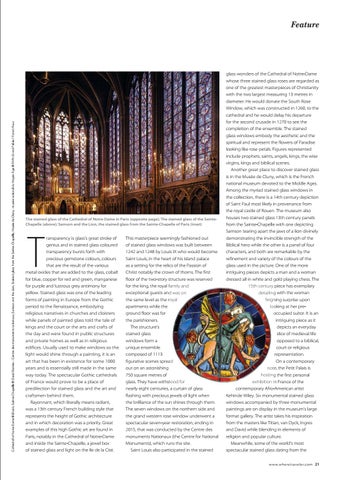
The stained glass of the Cathedral of Notre Dame in Paris (opposite page); The stained glass of the SainteChapelle (above); Samson and the Lion, the stained glass from the Sainte-Chapelle of Paris (inset)
T
ransparency is glass’s great stroke of genius and in stained glass coloured transparency bursts forth with precious gemstone colours, colours that are the result of the various metal oxides that are added to the glass, cobalt for blue, copper for red and green, manganese for purple and lustrous grey antimony for yellow. Stained glass was one of the leading forms of painting in Europe from the Gothic period to the Renaissance, embodying religious narratives in churches and cloisters while panels of painted glass told the tale of kings and the court or the arts and crafts of the day and were found in public structures and private homes as well as in religious edifices. Usually used to make windows so the light would shine through a painting, it is an art that has been in existence for some 1000 years and is essentially still made in the same way today. The spectacular Gothic cathedrals of France would prove to be a place of predilection for stained glass and the art and craftsmen behind them. Rayonnant, which literally means radiant, was a 13th century French building style that represents the height of Gothic architecture and in which decoration was a priority. Great examples of this high Gothic art are found in Paris, notably in the Cathedral of Notre-Dame and inside the Sainte-Chapelle, a jewel box of stained glass and light on the Ile de la Cité.
This masterpiece seemingly fashioned out of stained glass windows was built between 1242 and 1248 by Louis IX who would become Saint Louis, in the heart of his island palace as a setting for the relics of the Passion of Christ notably the crown of thorns. The first floor of the two-story structure was reserved for the king, the royal family and exceptional guests and was on the same level as the royal apartments while the ground floor was for the parishioners. The structure’s stained glass windows form a unique ensemble composed of 1113 figurative scenes spread out on an astonishing 750 square metres of glass. They have withstood for nearly eight centuries, a curtain of glass flashing with precious jewels of light when the brilliance of the sun shines through them. The seven windows on the northern side and the grand western rose window underwent a spectacular seven-year restoration, ending in 2015, that was conducted by the Centre des monuments Nationaux (the Centre for National Monuments), which runs the site. Saint Louis also participated in the stained
glass wonders of the Cathedral of Notre-Dame whose three stained glass roses are regarded as one of the greatest masterpieces of Christianity with the two largest measuring 13 metres in diameter. He would donate the South Rose Window, which was constructed in 1260, to the cathedral and he would delay his departure for the second crusade in 1270 to see the completion of the ensemble. The stained glass windows embody the aesthetic and the spiritual and represent the flowers of Paradise looking like rose petals. Figures represented include prophets, saints, angels, kings, the wise virgins, kings and biblical scenes. Another great place to discover stained glass is in the Musée de Cluny, which is the French national museum devoted to the Middle Ages. Among the myriad stained glass windows in the collection, there is a 14th century depiction of Saint Paul most likely in provenance from the royal castle of Rouen. The museum also houses two stained glass 13th century panels from the Sainte-Chapelle with one depicting Samson tearing apart the jaws of a lion divinely demonstrating the invincible strength of the Biblical hero while the other is a panel of four characters, and both are remarkable by the refinement and variety of the colours of the glass used in the picture. One of the more intriguing pieces depicts a man and a woman dressed all in white and gold playing chess. The 15th century piece has exemplary detailing with the woman feigning surprise upon looking at her preoccupied suitor. It is an intriguing piece as it depicts an everyday slice of medieval life opposed to a biblical, court or religious representation. On a contemporary note, the Petit Palais is hosting the first personal exhibition in France of the contemporary Afro-American artist Kehinde Wiley. Six monumental stained glass windows accompanied by three monumental paintings are on display in the museum’s large format gallery. The artist takes his inspiration from the masters like Titian, van Dyck, Ingres and David while blending in elements of religion and popular culture. Meanwhile, some of the world’s most spectacular stained glass dating from the w w w.w h e re t r ave l e r. c o m 21
WP DEC STAINED GLASS.indd 17
14/11/2016 15:27