NEWS DESK
Lasting ‘impacts’ of European arrival THE impact of European settlement on Australia’s Indigenous people, from Queensland to the Mornington Peninsula, was outlined in historic and personal terms when Peter Aldenhoven delivered this year’s Human Rights Oration in Mornington. His talk incorporated a series of stories illuminating the impacts of European “invasion” of his own people (the Nughi tribe from Quandamooka, Moreton Bay, Queensland), family experiences of racism and dislocation, and provided an historical context for the Bunurong and Aboriginal community now living on the Mornington Peninsula. Mr Aldenhoven, president of Willum Warrain Aboriginal Association and director of indigenous education at Woodleigh School delivered the Human Rights Oration at Peninsula Community Theatre on Thursday 14 December. The event – attended by 120 people and organised by the Mornington Peninsula Human Rights Group and supported by the Mornington Peninsula Shire – is held each year on the date most convenient to 10 December, the day in 1948 when the United Nations made the Universal Declaration of Human Rights. His oration also covered the “problematic nature” of Aboriginal identity in an assimilated world; the enduring impacts of the Stolen Generations; the Northern Territory emergency intervention (now named Stronger Futures); the Royal Commission into Youth Detention and the federal government’s recent rejection of the
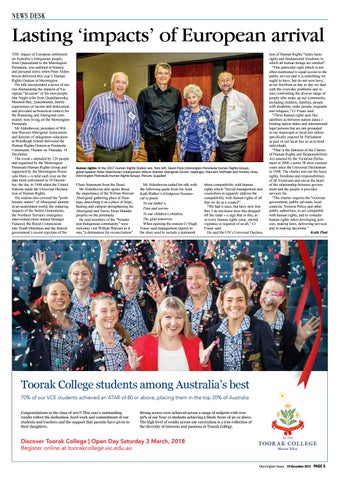
Human rights: At the 2017 Human Rights Oration are, from left, David Price (Mornington Peninsula Human Rights Group), guest speaker Peter Aldenhoven (chairperson Willum Worrain Aboriginal Centre, Hastings), Maureen McPhate and Andrew Viney (Mornington Peninsula Human Rights Group). Picture: Supplied
Uluru Statement from the Heart. Mr Aldenhoven also spoke about the importance of the Willum Warrain Aboriginal gathering place at Hastings, describing it as a place of hope, healing and cultural strengthening for Aboriginal and Torres Strait Islander peoples on the peninsula. He said members of the “broader non-Indigenous community” were welcome visit Willum Warrain as it was “a destination for reconciliation”.
Mr Aldenhoven ended his talk with the following quote from his Aunt Kath Walker’s (Oodgeroo Noonuccal’s) poem: To our father’s, Pain and sorrow To our children’s children, The glad tomorrow. When opening the oration Cr Hugh Fraser said management reports to the shire used to include a statement
about compatibility with human rights which “forced management and councillors to squarely address the compatibility with human rights of all that we do as a council”. “We had it once, but have now lost this. I do not know how this dropped off the radar – a sign that in this, as in every human rights issue, eternal vigilance is required of us all,” Cr Fraser said. He said the UN’s Universal Declara-
tion of Human Rights “states basic rights and fundamental freedoms to which all human beings are entitled”. “One particular right which is not often mentioned is equal access to the public service and it is something we ought to have, but do not now have, at our forefront as day to day we deal with the everyday problems and issues confronting the diverse range of people who make up our community, including children, families, people with disability, older people, migrants and refugees,” Cr Fraser said. “These human rights spin like satellites as between nation states – binding nation states and international legal persons but are not grounded in our municipal or local law unless specifically enacted by Parliament as part of our local law so as to bind individuals. “That is the function of the Charter of Human Rights and Responsibilities Act enacted by the Victorian Parliament in 2006 – some 58 slow careless years since the Universal Declaration in 1948. The charter sets out the basic rights, freedoms and responsibilities of all Victorians and sits at the heart of the relationship between government and the people it provides services for. “The charter requires the Victorian government, public servants, local councils, Victoria Police and other public authorities, to act compatibly with human rights, and to consider human rights when developing policies, making laws, delivering services and in making decisions.” Keith Platt
Toorak College students among Australia’s best 70% of our VCE students achieved an ATAR of 80 or above, placing them in the top 20% of Australia Congratulations to the class of 2017! This year’s outstanding results reflect the dedication, hard work and commitment of our students and teachers and the support that parents have given to their daughters.
Strong scores were achieved across a range of subjects with over 50% of our Year 12 students achieving a Study Score of 40 or above. The high level of results across our curriculum is a true reflection of the diversity of interests and passions at Toorak College.
Discover Toorak College | Open Day Saturday 3 March, 2018 Register online at toorakcollege.vic.edu.au Mornington News 19 December 2017
PAGE 5