Global Going
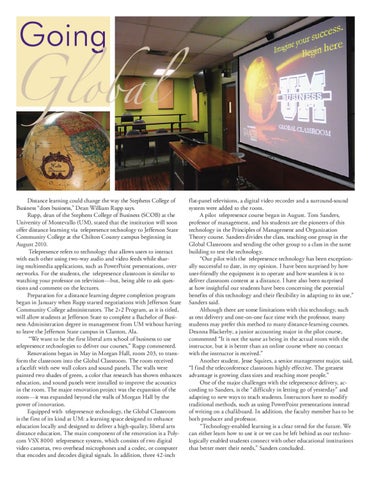
Distance learning could change the way the Stephens College of Business “does business,” Dean William Rupp says. Rupp, dean of the Stephens College of Business (SCOB) at the University of Montevallo (UM), stated that the institution will soon offer distance learning via telepresence technology to Jefferson State Community College at the Chilton County campus beginning in August 2010. Telepresence refers to technology that allows users to interact with each other using two-way audio and video feeds while sharing multimedia applications, such as PowerPoint presentations, over networks. For the students, the telepresence classroom is similar to watching your professor on television—but, being able to ask questions and comment on the lectures. Preparation for a distance learning degree completion program began in January when Rupp started negotiations with Jefferson State Community College administrators. The 2+2 Program, as it is titled, will allow students at Jefferson State to complete a Bachelor of Business Administration degree in management from UM without having to leave the Jefferson State campus in Clanton, Ala. “We want to be the first liberal arts school of business to use telepresence technologies to deliver our courses,” Rupp commented. Renovations began in May in Morgan Hall, room 203, to transform the classroom into the Global Classroom. The room received a facelift with new wall colors and sound panels. The walls were painted two shades of green, a color that research has shown enhances education, and sound panels were installed to improve the acoustics in the room. The major renovation project was the expansion of the room—it was expanded beyond the walls of Morgan Hall by the power of innovation. Equipped with telepresence technology, the Global Classroom is the first of its kind at UM: a learning space designed to enhance education locally and designed to deliver a high-quality, liberal arts distance education. The main component of the renovation is a Polycom VSX 8000 telepresence system, which consists of two digital video cameras, two overhead microphones and a codec, or computer that encodes and decodes digital signals. In addition, three 42-inch
flat-panel televisions, a digital video recorder and a surround-sound system were added to the room. A pilot telepresence course began in August. Tom Sanders, professor of management, and his students are the pioneers of this technology in the Principles of Management and Organization Theory course. Sanders divides the class, teaching one group in the Global Classroom and sending the other group to a class in the same building to test the technology. “Our pilot with the telepresence technology has been exceptionally successful to date, in my opinion. I have been surprised by how user-friendly the equipment is to operate and how seamless it is to deliver classroom content at a distance. I have also been surprised at how insightful our students have been concerning the potential benefits of this technology and their flexibility in adapting to its use,” Sanders said. Although there are some limitations with this technology, such as test delivery and one-on-one face time with the professor, many students may prefer this method to many distance-learning courses. Deanna Blackerby, a junior accounting major in the pilot course, commented “It is not the same as being in the actual room with the instructor, but it is better than an online course where no contact with the instructor is received.” Another student, Jesse Squires, a senior management major, said, “I find the teleconference classroom highly effective. The greatest advantage is growing class sizes and reaching more people.” One of the major challenges with the telepresence delivery, according to Sanders, is the “difficulty in letting go of yesterday” and adapting to new ways to teach students. Instructors have to modify traditional methods, such as using PowerPoint presentations instead of writing on a chalkboard. In addition, the faculty member has to be both producer and professor. “Technology-enabled learning is a clear trend for the future. We can either learn how to use it or we can be left behind as our technologically enabled students connect with other educational institutions that better meet their needs,” Sanders concluded.