A WORD FROM ENERGY NETWORKS AUSTRALIA ANDREW DILLON
CHIEF EXECUTIVE OFFICER – ENERGY NETWORKS AUSTRALIA
DEMAND SIDE RESPONSE – GIVING ENERGY SOME FOOTROOM
L
ow demand days are a waste of energy. High demand days are a pain. We need to rebalance our system to avoid high demand peaks because this is where money is wasted, both in higher power prices and the need for peak demand infrastructure.
Given storage technologies such as batteries and hydrogen are still in development, the best answer in the short term is demand response.
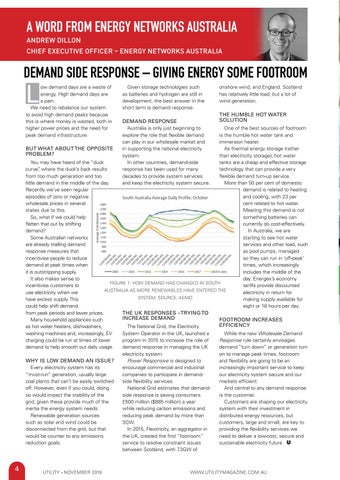
DEMAND RESPONSE Australia is only just beginning to explore the role that flexible demand can play in our wholesale market and in supporting the national electricity system. In other countries, demand-side response has been used for many decades to provide system services and keep the electricity system secure.
onshore wind, and England. Scotland has relatively little load, but a lot of wind generation.
THE HUMBLE HOT WATER SOLUTION
One of the best sources of footroom is the humble hot water tank and immersion heater. BUT WHAT ABOUT THE OPPOSITE As thermal energy storage (rather PROBLEM? than electricity storage), hot water You may have heard of the “duck tanks are a cheap and effective storage curve”, where the duck’s back results technology that can provide a very from too much generation and too flexible demand turn-up service. little demand in the middle of the day. More than 50 per cent of domestic Recently we’ve seen regular demand is related to heating episodes of zero or negative and cooling, with 23 per wholesale prices in several cent related to hot water. states due to this. Meeting this demand is not So, what if we could help something batteries can flatten that out by shifting currently do cost-effectively. demand? In Australia, we are Some Australian networks starting to see hot water are already trialling demand services and other load, such response measures that as pool pumps, managed incentivise people to reduce so they can run in ‘off-peak’ demand at peak times when times, which increasingly it is outstripping supply. includes the middle of the It also makes sense to day. Energex’s economy FIGURE 1: HOW DEMAND HAS CHANGED IN SOUTH incentivise customers to tariffs provide discounted AUSTRALIA AS MORE RENEWABLES HAVE ENTERED THE use electricity when we electricity in return for SYSTEM. SOURCE: AEMO have excess supply. This making supply available for could help shift demand eight or 18 hours per day. from peak periods and lower prices. THE UK RESPONSES –TRYING TO INCREASE DEMAND Many household appliances such FOOTROOM INCREASES EFFICIENCY as hot water heaters, dishwashers, The National Grid, the Electricity washing machines and, increasingly, EV System Operator in the UK, launched a While the new Wholesale Demand charging could be run at times of lower program in 2015 to increase the role of Response rule certainly envisages demand to help smooth out daily usage. demand response in managing the UK demand “turn down” or generation turn electricity system. on to manage peak times, footroom WHY IS LOW DEMAND AN ISSUE? Power Responsive is designed to and flexibility are going to be an Every electricity system has its encourage commercial and industrial increasingly important service to keep “must-run” generation, usually large companies to participate in demandour electricity system secure and our coal plants that can’t be easily switched side flexibility services. markets efficient. off. However, even if you could, doing National Grid estimates that demandAnd central to any demand response so would impact the stability of the side response is saving consumers is the customer. grid, given these provide much of the £500 million ($885 million) a year Customers are shaping our electricity inertia the energy system needs. while reducing carbon emissions and system with their investment in Renewable generation sources reducing peak demand by more than distributed energy resources, but such as solar and wind could be 3GW. customers, large and small, are key to disconnected from the grid, but that In 2015, Flexitricity, an aggregator in providing the flexibility services we would be counter to any emissions the UK, created the first “footroom” need to deliver a low-cost, secure and reduction goals. service to resolve constraint issues sustainable electricity future. between Scotland, with 7.3GW of
4
UTILITY • NOVEMBER 2019
WWW.UTILITYMAGAZINE.COM.AU