ROAD SURFACING AND DESIGN
ROADS
EXTREME WEATHER
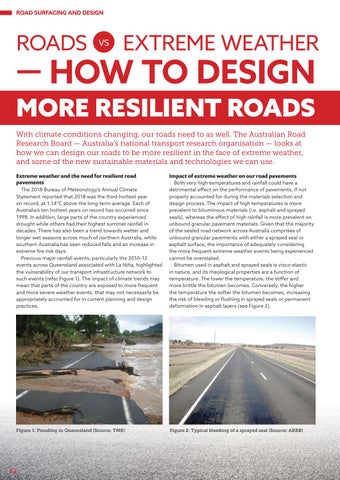
— HOW TO DESIGN MORE RESILIENT ROADS With climate conditions changing, our roads need to as well. The Australian Road Research Board — Australia’s national transport research organisation — looks at how we can design our roads to be more resilient in the face of extreme weather, and some of the new sustainable materials and technologies we can use. Extreme weather and the need for resilient road pavements The 2018 Bureau of Meteorology’s Annual Climate Statement reported that 2018 was the third-hottest year on record, at 1.14°C above the long-term average. Each of Australia’s ten hottest years on record has occurred since 1998. In addition, large parts of the country experienced drought while others had their highest summer rainfall in decades. There has also been a trend towards wetter and longer wet seasons across much of northern Australia, while southern Australia has seen reduced falls and an increase in extreme fire risk days. Previous major rainfall events, particularly the 2010–12 events across Queensland associated with La Niña, highlighted the vulnerability of our transport infrastructure network to such events (refer Figure 1). The impact of climate trends may mean that parts of the country are exposed to more frequent and more severe weather events, that may not necessarily be appropriately accounted for in current planning and design practices.
Impact of extreme weather on our road pavements Both very high temperatures and rainfall could have a detrimental effect on the performance of pavements, if not properly accounted for during the materials selection and design process. The impact of high temperatures is more prevalent to bituminous materials (i.e. asphalt and sprayed seals), whereas the effect of high rainfall is more prevalent on unbound granular pavement materials. Given that the majority of the sealed road network across Australia comprises of unbound granular pavements with either a sprayed seal or asphalt surface, the importance of adequately considering the more frequent extreme weather events being experienced cannot be overstated. Bitumen used in asphalt and sprayed seals is visco-elastic in nature, and its rheological properties are a function of temperature. The lower the temperature, the stiffer and more brittle the bitumen becomes. Conversely, the higher the temperature the softer the bitumen becomes, increasing the risk of bleeding or flushing in sprayed seals or permanent deformation in asphalt layers (see Figure 2).
Figure 1: Flooding in Queensland (Source: TMR)
Figure 2: Typical bleeding of a sprayed seal (Source: ARRB)
62