Issue 11 June 2019
ROAD - RAIL - AIRPORT - PORT - URBAN - UTILITY
MEET AUSTRALIA’S NEW INFRASTRUCTURE CHIEF
The future
OF FLEXIBLE PAVEMENT
Asset management:
REMOVING THE ROADBLOCKS TO SUCCESS
MINIMISING NOISE AND VIBRATION AT MELBOURNE METRO
WE’RE PROUD TO BE THE SPECIALIST EQUIPMENT PARTNER OF THE CONTRACTORS THAT ARE LEADING THE WAY FORWARD.
NORTH QUEENSLAND
QUEENSLAND
671 Ingham Road 147 Archerfield Road Mount St John QLD 4818 Richlands QLD 4077
NSW & ACT
VICTORIA & TAS
45 Eastern Creek Drive 415 Fitzgerald Road Eastern Creek NSW 2766 Derrimut VIC 3026
SOUTH AUSTRALIA 9-11 Hakkinen Road Wingfield SA 5013
Vermeer surface miners and track trenchers have been part of methodologies proven on numerous Australian infrastructure projects. Whether it’s lowering the bench in a road tunnel, a box cut for a train station, or trenching a comms channel, we have the equipment and team to support your project. Contact your local Vermeer team to learn more.
Australia
VERMEER.COM.AU | 1300 VERMEER / VermeerAustralia Vermeer and the Vermeer logo are trademarks of Vermeer Manufacturing Company in the United States and /or other countries. Š 2019 Vermeer Equipment Holdings Pty Ltd. All Rights Reserved. .
Issue 11 June 2019
D A Y.
BIGGER.
ROAD - RAIL - AIRPORT - PORT - URBAN - UTILITY
INFRASTRUCTURE
E E R E.
MEET AUSTRALIA’S NEW INFRASTRUCTURE CHIEF
The future
OF FLEXIBLE PAVEMENT
EDITOR’S WELCOME
Asset management:
JUNE 2019
ty
TRACTA_JCF62166_AU_ThinkBigger_IM
REMOVING THE ROADBLOCKS TO SUCCESS
MINIMISING NOISE AND VIBRATION AT MELBOURNE METRO
8,648 This publication has been independently audited under the AMAA’s CAB Total Distribution Audit. Audit Period: 1 October 2018 – 31 March 2019
Published by
Monkey Media Enterprises ABN: 36 426 734 954 204/23–25 Gipps St Collingwood VIC 3066 P: (03) 9988 4950 F: (03) 8456 6720 monkeymedia.com.au info@monkeymedia.com.au infrastructuremagazine.com.au news@infrastructuremagazine.com.au Editor Jessica Dickers Assistant Editor Kim Ho Journalists India Murphy Siobhan Day Business Development Manager Alastair Bryers Rima Munafo Senior Designer Alejandro Molano Designers Jacqueline Buckmaster Danielle Harris Publisher Chris Bland Managing Editor Laura Harvey Operations Manager Kirsty Hutton Digital Marketing Manager Sam Penny ISSN: 2206-7906
W
e’ve reached the end of another election campaign with the Liberal-National Coalition now holding majority government for the next three years. While this result may have been a surprise for some commentators, what is clear is that infrastructure was one of the issues at the forefront of debate. In particular, infrastructure played a strong role in the Liberal-National Coalition’s campaign, especially since its promise of $100 billion in infrastructure investment in the 2019–20 Budget released in April. As with all election campaigns, there was a flurry of promises, funding announcements and major project promises in the lead up to the polls, including projects such as $2 billion for the Fast Rail Link between Melbourne and Geelong; $1.6 billion for road and rail infrastructure across Western Australia, and the establishment of a freight data hub; national water grid and Road Safety Innovation Fund, among others. The big question now is whether these can all be delivered, and we’ll be watching closely for any new developments. Here at Infrastructure, we cover all the major new project announcements across Australia and while those stories are always interesting and popular with industry, the topic of how best to manage these assets once completed also remains a key issue. So much so that several years ago we created the event Asset Management for Critical Infrastructure to provide the sector with practical applications and a look at what others in the field are doing when it comes to asset management. The event is back again for 2019, running from 20–21 August in Sydney, and this year features the addition of two new targeted streams, plus a new expert line-up of speakers. We’ve
given you a peak into some of these topics in this issue, with articles on the use of drones in railways and bridge management, as well as mitigation works to prevent noise and vibration issues during construction. The management of our roads and pavements is also a significant issue, and one that is allowing the sector to come up with some pretty innovative solutions. In particular, one council we’ve profiled is recycling plastic and glass into its road materials — a move that is becoming increasingly common to try to help with current problems around waste and recycling. Infrastructure Victoria is also currently providing advice on recycling and resource recovery to the Victorian Government. This issue will be distributed at the 18th AAPA International Flexible Pavements Conference and Exhibition, an event that will delve even further into new materials and innovations like this in the road sector. You’ll also see this issue at the AFR National Infrastructure Summit; Ports Australia's Business and Operational Conference, and Asset Management for Critical Infrastructure. I hope to see you all at these events, as well over the coming months and get your thoughts on where the sector is heading for the rest of 2019. Jessica Dickers Editor
Drop me a line at jessica.dickers@monkeymedia.net.au or feel free to call me on 03 9988 4950 to let me know what you think.
NO LIMITS FOR THE RAILWAY INDUSTRY
WAGO can make vibration proof fast maintenance free connections in local and long-distance transport possible with spring pressure connection technology. We offer comprehensive range of Railway approved solutions.
EN 61373
Vibration and Shock Resistance
TOPJOB®S Rail Mount Terminal Blocks
• New Tooless Lever and Push-button TOPJOB®S versions • Push-in CAGE CLAMP® Spring Pressure Technology • For all conductor types
EN 50155
EN 50121.3.2
Isolation and Immunity to Interference
PFC200 XTR Controllers
• Controls for eXTReme environmental conditions • Linux® real-time operating system • Integrated IT security standards
Worldwide Railway Standard
Low Profile Power Supplies
• Protective conformal coating for PCB • 110 VDC and 72 VDC versions • Ideal for distribution boards or distribution boxes
EN 45545
Fire Protection Conformity
High Current Rail-Mount Terminal Blocks
• Conductor cross-section upto 185 mm2 • Rated current up to 353A • Time-saving no ring terminals of ferrule required WAGO is a registered trademark of WAGO Verwaltungsgesellschaft mbH.
EN 61010
Safety Requirements
Pluggable Modules for TOPJOB®S Terminals • Available as Relay, SSR and switching modules • Easy retrofitting applications • Extended temperature range from -40°C ... +70°C
sales.anz@wago.com | (03) 8791 6300 | www.wago.com.au
CONTENTS
Preamble
A WORD FROM INFRASTRUCTURE AUSTRALIA
18
MEET AUSTRALIA’S NEW INFRASTRUCTURE CHIEF
ASSET INSPECTION & DRONES/UAVS
36
REMOTE TRACK INSPECTIONS USING DRONES
As she takes the reins as Chief Executive of the nation’s independent infrastructure advisor, Romilly Madew AO outlines her vision for Infrastructure Australia and the challenges ahead for the sector.
EARTHMOVING OUTLOOK INDUSTRY INSIGHTS
22
BREAKING BARRIERS FOR WOMEN IN CONSTRUCTION
Construction has long been a male dominated industry, with the archetypal construction worker synonymous with masculinity. But when most industries are striving to dismantle these gender norms and are moving towards equality, why is the construction industry gender gap getting worse?
26
40
IMPROVING PRODUCTION ON TUNNELLING PROJECTS WITH SURFACE MINERS
42
EARTHMOVING INDUSTRY OUTLOOK 2019/2020
46
THE NEXT LEVEL OF DOZER GPS MACHINE CONTROL PERFORMANCE
48
PREPARING THE SITE FOR AUSTRALIA’S LARGEST INTERMODAL TERMINAL
ELECTION 2019: WHAT ROLE DID INFRASTRUCTURE PLAY AND WHAT DOES THE RESULT MEAN FOR THE SECTOR?
The Liberal-National Coalition, led by Scott Morrison, has won the 2019 Federal Election. Having campaigned on strategic infrastructure investments, the question arises: what role did infrastructure play in the outcome of the election, and what does a Coalition victory mean for the sector going forward?
NOISE AND VIBRATION
50
MELBOURNE'S METRO TUNNEL WORKING TO MINIMISE DISRUPTION
54
QUIET CONFIDENCE: CUSTOM-ATTUNING ACOUSTICS ON THE SYDNEY METRO
FLEXIBLE PAVEMENTS
ASSET MANAGEMENT
4
28
GETTING ASSET MANAGEMENT RIGHT: A NEW FRAMEWORK
32
BIGGEST NAMES IN ASSET MANAGEMENT RETURN TO SYDNEY
June 2019 // Issue 11
56
THE FUTURE OF FLEXIBLE PAVEMENTS
60
RECYCLING PLASTIC AND GLASS INTO ROAD MATERIALS
www.infrastructuremagazine.com.au
CONTENTS
SUSTAINABILITY
62
MAKING AUSTRALIA’S AIRPORTS GREENER
66
BUILDING A SUSTAINABLE FUTURE: A NEW ERA OF GREEN INFRASTRUCTURE
REGULARS 02 EDITOR’S WELCOME 06 CONTRIBUTORS 80 ADVERTISERS’ INDEX 80 FEATURES SCHEDULE
SMART INFRASTRUCTURE
70
NEW FRAMEWORK FOR THE INTERNET OF THINGS
72
SMART CITIES: THE NEW PARADIGM FOR THE PLACES WE LIVE, WORK AND PLAY
NEWS 08 THREE CROSS RIVER RAIL CONTRACTS AWARDED 10 NORTH EAST LINK SHORTLISTS TWO CONTRACTORS
BRIDGES
74
REVOLUTIONISING BRIDGE HEALTH MONITORING
PORTS
10 MELBOURNE AIRPORT EMBRACES SMART SECURITY TECHNOLOGY 11 SEVERAL FIVE-YEAR ROAD MAINTENANCE CONTRACTS AWARDED 12 2019 SMART CITIES AWARD WINNERS ANNOUNCED 14 VERSATILE, RELIABLE ANCHORS
76
ARE OUR PORTS CONNECTED AND EFFICIENT ENOUGH?
15 DOUBLE-DECKER SUBSTATION IN MELBOURNE CBD 16 CHANGING THE IMAGE OF SEWAGE TREATMENT
www.infrastructuremagazine.com.au
June 2019 // Issue 11
5
Contri Romilly Madew AO CEO, Infrastructure Australia
Recently awarded an Order of Australia in acknowledgment of her contribution to Australia’s sustainable building movement, Romilly is recognised around the world as a leader and advocate for change in the property and construction sector. She led the Green Building Council of Australia for 13 years, representing over 650 companies with a collective annual turnover of $40 billion, and presiding over the Green Star rating system which has seen more than 2250 projects certified across the country. Romilly holds Board positions with Sydney Olympic Park Authority and Chief Executive Women, and has sat on numerous ministerial panels including the Cities Reference Group, National Urban Policy Forum and the China/Australia Services Sector Forum.
Rami Affan Executive Director, Asset Management at Infrastructure NSW Rami has over 14 years of experience in asset management in the infrastructure sector. During the last five years, Rami has specialised in capital investment and asset management strategies for the NSW State Government and across various public sector organisations in the United States. Rami is now the Asset Management lead at INSW and will be delivering, in collaboration with NSW agencies, a new statewide Asset Management framework as a critical part of the State Infrastructure Strategy 2018–2038 recommendations.
Ravi Ravitharan
Director, Institute of Railway Technology, Monash University, Australia Ravi Ravitharan has 30 years of experience in railway research. He is the Director of the Institute of Railway Technology (IRT) at Monash University in Australia. From 2006 to 2008, Ravi was the National Executive Chairman of Engineers Australia’s Railway Technical Society of Australasia (RTSA). For his outstanding contribution to the Australian and international rail industry, the RTSA Life Membership (2011) and the coveted RTSA Individual Award (2014) were awarded to him. Ravi has also been awarded the prestigious Australian Academy of Technological Sciences and Engineering (ATSE) Clunies Ross Award in 2014 for the application of science and technology for the benefit of Australia. Ravi is a Fellow of Engineers Australia, Chartered Professional Engineer and Engineering Executive. Ravi is a Technical Advisory Panel member of Singapore SMRT and an advisory board member of Industrial Transformation Training Centre for Advanced Technologies in Rail Track Infrastructure in Australia.
6
June 2019 // Issue 11
www.infrastructuremagazine.com.au
butors Carlos Rial
Chief Executive Officer, AAPA Carlos brings over 20 years of road industry experience paired with over ten years as a senior organisational leader, working in partnership with both the public and private sectors. He is a broadly experienced senior organisational engineering manager who has demonstrated the ability to lead diverse teams of professionals to new levels of success across public and private sectors. He is a recognised road industry leader with strong technical and business qualifications, and an impressive track record of hands-on experience in strategic planning, business unit development, project and product management while maintaining strong technical engineering skill and aptitude.
Dr Phillippa Carnemolla Senior Research Fellow at UTS
Dr Phillippa Carnemolla is an industrial designer specialising in the design and evaluation of inclusive environments, products and information. Her research investigates the breadth of health, care and social impacts resulting from inclusive design approaches, including smart cities, aging in place and disability housing models. In her role as Senior Research the Fellow in Faculty of Design Architecture and Building at UTS, Dr Carnemolla is working on a diverse range of projects which investigate the impact of the inclusive and participatory design practice on service provision, caregiving and quality of life for older people and people living with disability. Dr Carnemolla was the recipient of the 2018 NAWIC International Women’s Day (IWD) Research Scholarship. Awarded annually since 2009, and generously sponsored by CULT, the $20,000 scholarship prize enables research that improves, benefits and empowers women in the construction industry.
Leigh Gapp
Sustainability Manager, Adelaide Airport Leigh has 15 years’ experience across the waste, infrastructure construction, mining and aviation sectors, and is passionate about delivering value and efficiency through a data driven approach. Leigh serves as a member of the Airports Council International – Asia Pacific Regional Environment Committee and the GRESB Infrastructure Benchmark Committee.
www.infrastructuremagazine.com.au
June 2019 // Issue 11
7
NEWS
THREE CROSS RIVER RAIL CONTRACTS AWARDED
T
he Queensland Government has chosen its preferred consortia for two major packages for its $5.4 billion Cross River Rail Project, as well as its European Train Control System. The successful consortia were: Tunnel, Stations and Development (TSD) public-private partnership Preferred – Pulse A CIMIC Group-led consortium, including Pacific Partnerships, CPB Contractors, UGL, BAM, Ghella and DIF Rail, Integration and Systems (RIS) alliance Preferred – Unity Alliance Including CPB Contractors, UGL, Jacobs, AECOM European Train Control System Preferred – Hitachi Rail STS
CIMIC GROUP EMERGES AS A BIG WINNER The CIMIC Group said the Pulse consortium will deliver tunnelling works, new underground stations and ongoing maintenance services for the project. CIMIC Group has led the development of Pulse’s proposal. Pacific Partnerships is the lead sponsor and will provide 49 per cent of the equity finance, with 51 per cent to be provided by DIF, BAM PPP PGGM and Ghella Investments & Partnerships. CPB Contractors will deliver the design and construction in a joint venture with Ghella and BAM International with UGL delivering the mechanical and electrical (M&E) works. UGL will also provide maintenance services for the project over 24 years. Revenue to the CIMIC Group companies will be approximately half of the project value and will be finalised at contract execution which will occur mid-2019. RIS CRUCIAL FOR INTEGRATING THE CROSS RIVER RAIL The RIS package will provide critical operational, signalling and other support systems for the new 10.2km Cross River Rail link. Crucial to the overall delivery of the Cross River Rail Project, it will deliver the design, supply and installation of the supporting rail systems and brownfield works to integrate Cross River Rail into the wider Queensland Rail train network.
8
June 2019 // Issue 11
The package includes: An upgrade of the existing Exhibition Station Augmentation of Mayne Yard Rail operational systems, signalling and telecommunication works across the Cross River Rail Project ♦♦ Revenue to the Alliance will be confirmed at contract execution
♦♦ ♦♦ ♦♦
A MAJOR ECONOMIC IMPACT Collectively, these investment decisions mark a major milestone for the project and the Delivery Authority and its specialist advisors should be congratulated on advancing procurement to this stage. IAQ’s Chief Executive Officer, Steve Abson, noted that a project of this scale will have a significant impact on the economy, with spending in the construction and operating phases generating income and employment for hundreds of Queenslanders. “Organisations in the preferred consortia have a track record of delivering complex rail and transport projects and have the know-how to leverage local content. We expect the benefits of the project will flow to many local suppliers and businesses throughout Queensland.” While the project is scheduled for opening in 2024, Mr Abson noted the ramp up in effort needed to bring the project ‘on-line’ into the Queensland Rail network has already begun. Lessons learnt from similar complex projects around the world show that operational readiness has to start early. “Operational readiness doesn’t grab the headlines like a huge tunnel boring machine does, but it’s perhaps the most crucial aspect of any mega project being spliced into an existing busy inner-city network,” Mr Abson said. “This activity will necessitate high levels of collaboration across government organisations such as the Delivery Authority, Queensland Rail, Transport and Main Roads, and TransLink, and it’s worth acknowledging the enormous effort already going on behind the scenes to get this right.”
www.infrastructuremagazine.com.au
WAT E R
SCIENCE
TECHNOLOGY
NEWS
NORTH EAST LINK SHORTLISTS TWO CONTRACTORS
T
he Victorian Government has shortlisted two major construction firms to deliver the first package of works on the North East Link. The works package will start in 2020, once planning approvals are in place and deliver a range of power, water and other utility works to pave the way for major construction on the $15.8 billion project. The biggest road infrastructure project in Victoria’s history, the North East Link will include: ♦♦ A 6km tunnel under Banyule Flats and the Yarra River ♦♦ An upgrade to the Eastern Freeway to streamline traffic flow and reduce congestion ♦♦ A busway down the middle of the Eastern Freeway
The North East Link will create the missing link between the Eastern Freeway and the M80 Ring Road, slash travel times, take more than 15,000 trucks a day off local streets and create 10,300 jobs. The Victorian Government has not announced the names of the shortlisted contractors. However, it confirmed both builders have now received tenders, with their proposals for the work expected back by mid-2019. The State Government will finalise which builders will get the chance to compete for the $7–9 billion primary package. This includes detailed design and construction for Victoria’s longest twin road tunnels. The global search continues and bidders will be shortlisted later in 2019. Construction will start in 2020 and the North East Link will open in 2027.
MELBOURNE AIRPORT EMBRACES SMART SECURITY TECHNOLOGY
I
n an Australian first, Melbourne Airport has unveiled a fully integrated security screening point aimed at making the process easier and more efficient for travellers. The redeveloped T2 security screening zone includes eGates plus Smart Security lanes that feature new body scanners and automated tray return systems. Three additional screening lanes, dedicated fast track lanes, and a staff and goods lane have also been installed, generating 35 per cent more capacity. Melbourne Airport’s T2 security screening point also includes a new façade with a prominent ‘Melbourne’ sign, plus brighter signage to guide travellers towards departures. The interior has also improved with additional lighting and artwork by local artist Britt Salt, lifting the space through optical effects. Melbourne Airport Acting Chief of Aviation, David Hall, said he was proud that Melbourne is leading the way in its approach to security. “We are thrilled to be the first airport in Australia to introduce a
10
June 2019 // Issue 11
security screening zone that is fit out with world leading Smart Security technology, creating enhanced security outcomes while improving the traveller experience,” Mr Hall said.
“Victorian travellers and visitors alike will reap the benefits through spending less time in queues, creating a more streamlined experience at what can often be one of the most stressful parts of the traveller journey. “By using eGates we can review multiple boarding passes at any one time, reducing queues at the entrance to
the hall. The eGates also have the ability to integrate with facial recognition technology in future.” Mr Hall said that automated tray return systems would permit travellers to essentially overtake slower passengers, by encouraging multiple people to place their luggage into trays on any one lane. “The area overall is a lot more welcoming through its design and aesthetics and we look forward to our travellers using the space.” Each security screening lane contains around $1 million in equipment, ensuring security outcomes and customer service is aligned with world standards. The T2 screening hall meets the government mandated increases to aviation security. Mr Hall said the future of travel is trending towards automation. “At Melbourne, we’re embracing change and preparing for the future by not only making improvements to security technology, but also through introducing self-service check-in zones and automated bag drop facilities, giving travellers more control of their journey.”
www.infrastructuremagazine.com.au
NEWS
SEVERAL FIVE-YEAR ROAD
MAINTENANCE CONTRACTS AWARDED
T
he Queensland Government has awarded minimumfive-year contracts to maintain the 2,500km road network of the South East Queensland (SEQ) region. Contracts were awarded for the Brisbane Metropolitan region (Fulton Hogan Industries), Gold Coast region (Ventia) and Sunshine Coast region (Downer Works EDI) to maintain statecontrolled roads for the Department of Transport and Main Roads (TMR). Queensland Minister for Transport and Main Roads, Mark Bailey, said SEQ is home to about 2,595km of statecontrolled roads and that the management and maintenance of these roads would be a huge and demanding job. Mr Bailey said previous contracts were awarded in 2013, giving TMR an opportunity to learn from those agreements
and build in innovations to the new contracts to improve services across SEQ. The new contracts will run over an initial five years and sustain more than 380 jobs across the region over that initial contract period. The Queensland Government has a $46 billion infrastructure program that is supporting 38,000 jobs in 2019. Mr Bailey said the renewed contracts would also create a single point of contact for responsive maintenance works to ensure TMR reacts quickly to incidents to minimise road closures across the region. ‘‘The responsive maintenance contract has been awarded to RoadTek, which will specialise in technically difficult, hard-to-scope, high risk and short-leadtime maintenance activities,” Mr Bailey said.
As a leading engineering and consulting company in the rail sector, we offer sustainable, made-to-measure mobility and transport solutions. From light rail to high-speed traffic, from industrial railway to complex logistics concepts – as a full-service provider we take care of consulting, design and realization, from the idea to operations. No matter what challenges you face – we will find the best solution. We always keep the goal in mind: to make your project a success. www.db-engineering-consulting.com
www.infrastructuremagazine.com.au
June 2019 // Issue 11
11
NEWS
2019 SMART CITIES
STED
AWARD WINNERS ANNOUNCED The winners of the 2019 Smart Cities Awards have been revealed at a Gala Cocktail Party and Awards Ceremony as part of the Smart Cities 2019 Conference in Melbourne. Six awards were handed out celebrating the greatest achievements in the development, technological advancement and interconnection of cities around Australia. The aim of these awards is to gather some of the best ideas and talent when it comes to the development and enhancement of our cities, so that we can all learn and benefit from the exciting work already being undertaken across the sector.
ties 019
THE WINNERS ARE: Smart City of the Year - Metropolitan City of Newcastle City of Prospect Smart City of the Year - Regional Latrobe City Council City of Darwin Best Integration of an Individual Technology City of Wanneroo - RailSmart Planning Support System Best Residential Innovation Solar Analytics Smart Innovator of the Year David Klingberg Young Smart Innovator of the Year Oliver Lock
, Melbourne
The awards were judged by Leigh Osterhus from the Cities Leadership Institute; Sean Holden from the Local Government Association of South Australia; Dr Jonathan Spear, Executive Director and General Counsel at Infrastructure Victoria; Professor Mark Burry AO, Founding Director of the Smart Cities Research Institute at Swinburne University of Technology; and Lorraine Tighe, Smart Cities and Innovation Consultant. The awards proved to be a great opportunity for delegates to learn about some of the incredible things that are happening in the industry; and also allowed the shortlisted companies and winners to showcase the work they are doing in the smart cities space.
The winning entries were deemed the best in smart cities for 2019, and were among high-quality finalists in each category. The finalists were: Smart City of the Year – Metropolitan City of Newcastle Moreland City Council Lake Macquarie City Council Randwick City Council City of Prospect Townsville City Council Smart City of the Year – Regional Southern Grampians Shire Council Broken Hill City Council Latrobe City Council City of Darwin Best Integration of an Individual Technology Woollahra Municipal Council – 3D modelling platform City of Wanneroo – RailSmart Planning Support System RACV – Smartphone application integrating Melbourne’s public and private transportation options Brimbank – Suite of smart bin sensors, barbeque failure sensors, park utilisation mobotix cameras, air quality and weather stations, and facility use counters at Buckingham Reserve Sydney Metro – Driverless (advanced signalling) train technology SAGE Group – Matilda the smart transit hub Best Residential Innovation Solar Analytics – Solar monitoring software City of Canterbury Bankstown – Closing the Loop on Waste Project SMEC – Atherstone Estate City of Gosnells – Cool Roofs Project Smart Innovator of the Year Peter Auhl, Chief Information Officer, Central Coast Council David Klingberg, Director and Principal, Smart City Strategies and Solutions Jagpreet Walia, Sustainability Lead, City Of Melville Young Smart Innovator of the Year Oliver Lock, PhD Candidate, UNSW Rebecca Jacobs, Smart City Lead, Randwick City Council
International keynote speaker, Mark Dowd, with Infrastructure Editor, Jessica Dickers
12
June 2019 // Issue 11
www.infrastructuremagazine.com.au
ECOSYS Portfolios Projects Contracts
STRATEGY
The EcoSys enterprise projects performance platform consists of three products with integrated business processes to support portfolio, project, and contract management.
EXECUTION
EcoSys from Hexagon PPM is designed to improve performance throughout the full project lifecycle. With built-in industry best practices and flexibility to support organization and project-specific requirements, EcoSys is the ideal platform for: • • • • • • • • •
Capital Efficiency Project Portfolio Management Resource Planning & Management Project & Program Management Project Controls Cost Management Earned Value Management Construction Management Turnaround Management
For more information visit ecosys.net
Ineffective project practices could be costing you millions. Complete a 10-minute project performance maturity assessment, based on PMI’s OPM3 framework, to understand how effective your organisation is at managing project performance. Once completed you’ll receive an in-depth report tailored to your organisation’s maturity levels in three key areas: process, human capital, and technology. Discover how to better deliver projects - on time and budget. Take the assessment today at https://connect.hexagonppm.com/maturity-assessment/infra2019 © 2019 Hexagon AB and/or its subsidiaries and affiliates. All rights reserved. 08/18 PPM-US-0448A-ENG
NEWS // PARTNER SOLUTIONS
VERSATILE, RELIABLE ANCHORS Anchorage is crucial to ensuring the stability of key infrastructure as well as safety on construction sites. Given the enormous range of assets requiring anchoring — trees, walls, moorings, towers, sheet piles and cranes, both on land and underwater — it is not enough for anchor systems to be trustworthy and reliable. They must also be versatile.
T
he AncorLoc system offers a range of tried-and-tested anchors to suit all sizes and applications across civil and structural infrastructure, including bridges and roads. Honed through years of technical and practical experience across a range of industries, the anchors deploy a simple, innovative solution to deliver maximum stability with minimum soil disturbance. Most anchoring products use concrete, grouts and screw type fixtures which require additional costs and time to install. The AncorLoc system is different as it works alone. Anchors are driven into the ground using a drive rod and once it reaches the required depth, the rod or cable then rotates the anchor into undisturbed soil like a toggle bolt, ensuring optimal grip. The combination of the anchor’s size and the depth that it can go allows it to have a strong holding capacity
14
June 2019 // Issue 11
in every soil type. Even if the soil has been affected by things like flooding, AncorLoc’s products can be driven to depths below the affected topsoils or poor soil groups.
SPECIFIC ANCHORING SOLUTIONS FOR DIFFERENT PROJECTS The Duckbill – the smallest in the range – is a cabled anchor designed for smaller loads, from trees through to civil and structural applications. Duckbill anchors can be cabled with a variety of tendons, from galvanized aircraft cable for normal usage to stainless steel for superior corrosion resistance, making them highly adaptable.
The Manta Ray and Sting Ray anchors are perfect for larger tonnages such as towers, retaining walls (including sea walls), moorings and assisted footings. They can be used both on land and underwater. Once they are driven into the ground, AncorLoc anchors are tipped and loadlocked with Foresight’s Anchor Locking Kit. This provides an immediate proof test of each anchor. The simplicity of AncorLoc’s applications allow for quick installation, saving labor costs and reducing the amount of concrete and steel needed on a project. In addition to infrastructure projects, these anchors have provided solutions for utilities, port authorities, portable buildings, shade structures and landscape design.
For more information on which anchoring solution is right for your project, visit ancorloc.com.au.
www.infrastructuremagazine.com.au
NEWS
DOUBLE-DECKER SUBSTATION IN
I
MELBOURNE CBD
n order to maximise space and prepare for High Capacity Metro Trains, a custom-designed, multistorey substation has been installed in Melbourne’s CBD. In the heart of Melbourne’s Central Business District, a team of engineers and construction workers installed Victoria’s first ever modular traction substation to boast a ‘double-decker’ design. The substation was custom designed to squeeze onto a narrow strip of land near the major transport hub of Southern Cross Station. Along with several others along the Cranbourne/Pakenham line, the Southern Cross ‘subbie’ forms part of a major upgrade being carried out in preparation for bigger High Capacity Metro Trains. Multi-storey substations are rare in Australia. This structure was built off-site using prefab technology. Two separate modules, each more than 25m long, were delivered to site all the way from South Australia, with one lifted on top of the other in a complex twelve hour operation. The double-decker design aims to maximise space and help transport infrastructure keep up with Melbourne’s burgeoning population. Rail substations take electricity from the existing power network and convert it into a form that can be fed through to trains. Due to its location, the Southern Cross facility is electrically larger than most,
www.infrastructuremagazine.com.au
containing around twelve kilometers’ worth of cabling compared to the average of eight or nine. Humble from the outside, modern substations are built to high-spec standards, incorporating fail-safe mechanisms and vital communications connections to allow them to ‘talk to’ network control centres. Substations are also weather and fire proof.
PREFABRICATION TO SAVE TIME Contractors were able to design and build the structure within a relatively short timeframe. Power Manager, Evan Broughton, said the use of prefab technology meant the substation could be built off-site at the same time as the foundations, saving time and eliminating the potential for weather delays. “We were originally looking at constructing a traditional building in this locale, but the tight timeframe meant that the modular building method was the way to go,” Mr Broughton said. “This substation was custom designed for the footprint, to make optimal use of the space while allowing room for an access road.” Mr Broughton said while he had seen a lot of prefabrication in construction throughout his career, a multi-storey substation in the inner city takes it to a new level. “Rail environments pose unique challenges and we need to monitor the
movement of people, machinery and construction with absolute precision,” he said. Dean Chaplin, a project manager for LAI Switchboards, one of Australia’s leading switchroom and substation providers, said the superstructure was essentially 100 per cent completed on arrival to site in Victoria and had to be centimetre-perfect. LAI has delivered a series of new substations along the Cranbourne/ Pakenham line and rates the Southern Cross job as the company's most complex, but also among the most efficient construction projects. “The team effort was phenomenal. Every piece of communication had to be on point, and every action had to be quick,” Mr Chaplin said.
CONSTRUCTION SNAPSHOT ♦♦ Prefab substation module makes a 2.5-day journey from South Australia to Melbourne on the back of a 16 axel expandable platform trailer, measuring 31m long ♦♦ Trailer enters site and positions itself over crushed-rock foundation ♦♦ Foundation legs drilled and chem set in place ♦♦ Trailer removed in sections from underneath the buildings (as there wasn’t room to remove it all in one piece) ♦♦ Second module is delivered to site and subsequently lifted in place
June 2019 // Issue 11
15
NEWS // PARTNER SOLUTIONS
CHANGING THE IMAGE OF SEWAGE TREATMENT
Integrated Fixed Film Activated Sludge Plants (IFAS) rely on the use of a media on which a bio-film is grown, which results in a compact footprint as a majority of the biomass is fixed to a high surface area as opposed to being suspended.
A
recent development of this process by Organica Water has been to combine naturally occurring plants with engineered media. To put simply, a botanical garden is placed on top of the IFAS reactors, with the plant roots penetrating into the reactors. The interaction of enzymes and various organic acids from the plant roots to the bio-media creates a diverse biology, leading to increased process stability, less sludge production and lower energy demand when compared to conventional activated sludge plants. And the sewage treatment plant looks like a botanical garden. Large-scale installations in Europe have been in operation for over ten years. Bio-film technology in wastewater treatment has been around since the 1970s, available as moving bed bio-film reactor (MBBR) systems or integrated fixed film activated sludge processes (IFAS). In general, the bulk of the developments in this field relates to increased surface area, scouring and bio-film growth. Generally the media used in either MBBR or IFAS is a non-metallic surface. Both systems provide benefits such as reduced reactor size, high total available biomass inventory, high tolerance
16
June 2019 // Issue 11
against biomass washout during storm events and simultaneous nitrificationdenitrification within the bio-film layer. Organica’s Food Chain Reactor (FCR) combines the use of naturally occurring plants, such as bulrushes or marsh reeds, together with an IFAS-based process. A greenhouse is typically used to house the process, resulting in an aesthetically pleasing treatment system. For warmer climates, a shaded structure is used.
EIGHT YEARS OF REFINEMENT
Figure 1: Food Chain Reactor (FCR) – Cross section of the reactor process
Pilot work for the FCR process was conducted in 2001, and was mostly based on the use of plants, to provide a high surface area for biomass growth. Full-scale wastewater treatment plants were then constructed for 2000 and 5000EP systems, based on sequencing batch process.
Over the next eight years, the process was refined to enable the use of the technology in larger scale wastewater treatment plants, and to improve energy efficiency and with lower biomass yield. The combined use of the natural plants and engineered media meant that there was no limit on size for the FCR process.
REACTOR CONFIGURATION The sequential batch process was then configured to a continuous multistage cascade process. Similar to MLE, an anoxic zone with internal recycle from the last stage was incorporated as part of the nitrogen removal loop. OBSERVED OPERATIONAL BENEFITS The multi-stage cascade FCR was observed to provide a number of operational benefits. What was found in the pilot scale has been verified in full-scale installations that have been in operation for several years. Key observations include: ♦♦ Independent development of biomass and ecology within each stage ♦♦ A significant increase in the diversity of biomass speciation due to the interaction of the natural plants and biomass
www.infrastructuremagazine.com.au
NEWS // PARTNER SOLUTIONS
Figure 2: The multi-stage Food Chain Reactor (FCR) process
♦♦
Very high total biomass inventory, due to the bio-film growth ♦♦ Very high observed sludge retention time (SRT) ♦♦ Reduced biomass yield, due to a predatory effect and higher SRT ♦♦ A low MLSS in the water phase of 300 mg/L ♦♦ Increased alpha factor within the aeration system, due to the lower free MLSS ♦♦ Relatively odour free ♦♦ No need to return activated sludge (RAS) in process design The lower free MLSS means that the phase separation step post FCR can be designed with a lower loading. Rather than using secondary clarifiers, phase separation can occur in a horizontal disc filter which has a tenth of the footprint as compared to a conventional clarifier. In addition, the lower MLSS results in a higher diffuser alpha factor, meaning that less air is required to deliver and process the oxygen needed. This results in a lower energy demand. Diversity of biomass speciation results in adaptive ecologies forming in each FCR stage. As opposed to 300 to 400 species commonly present in activated sludge plants, the FCR exhibits up to 3000. This diversity creates a very stable process, which is tolerant to shock loads and in the last stage, the presence of eukaryotes results in the consumption of decayed bacteria. Operating data from several facilities has demonstrated the robustness of the FCR system, as well as consistent effluent quality. The discharge quality that can be achieved can be designed to match any conventional activated or MBR process. The total observed biomass within the FCR system is typically 16,000 mg/L, which is three to four times that of conventional systems. Although MBR systems exhibit similar high MLSS, the energy demand associated with FCR is significantly less due to a simplified secondary clarification phase. www.infrastructuremagazine.com.au
AESTHETICS The FCR can be housed within a greenhouse structure, or provided with a shading structure. The selection is generally based on minimum temperatures in the winter period. The end result is a wastewater treatment plant that resembles a garden or greenhouse facility, with low odour emissions and a very aesthetically pleasing look. In some European installations, buffer zones around the treatment plant have been reduced from 350m to 50m, freeing up additional land for development and providing a net positive attitude from local communities.
more dense bio-film is created, when compared to other IFAS systems or MBBR processes. With an observed total biomass concentration that is three times conventional systems, a reduced footprint of up to 65 per cent can be achieved. Savings in energy demand and sludge disposal are two other key benefits of the process, particular over MBR-based systems that exhibit similar space saving features. Full-scale installations as large as 80MLD have demonstrated the technology’s application within the municipal and industrial wastewater field.
Figure 3: Le Lude STP – France. A view of the integrated process
UPSCALING YIELDS ECONOMIC BENEFITS The use of bio-film technology provides a number of advantages with regard to footprint and biomass inventory. The combination of natural plants and IFAS results in a process that has been scaled up to full size treatment facilities, that provides a number of capital and operational cost savings. The natural plants do not actually treat the wastewater, but provide nutrients, organic acids and enzymes that create a highly diverse biology within the plant roots and IFAS modules. A much
The aesthetically pleasing look of the Organica FCR has changed local community attitude towards wastewater treatment, and has provided a place for communities to interact with process in a very positive way. As rapid urban growth continues in many cities around the world, this technology has demonstrated its use as a decentralised facility that can be constructed in the middle of a dense urban landscape, to relieve load on existing sewer systems and enable water reclamation in these environments.
Hydroflux Epco is the exclusive Australian and New Zealand representative for Organica Water’s Food Chain Reactor process. Contact Hydroflux Epco on 1300 417 697 or visit www.hydrofluxepco.com.au. June 2019 // Issue 11
17
A WORD FROM INFRASTRUCTURE AUSTRALIA
MEET AUSTRALIA’S NEW INFRASTRUCTURE CHIEF
18
June 2019 // Issue 11
A WORD FROM INFRASTRUCTURE AUSTRALIA
As she takes the reins as Chief Executive of the nation’s independent infrastructure advisor, Romilly Madew AO outlines her vision for Infrastructure Australia and the challenges ahead for the sector. WHAT ATTRACTED YOU TO THIS ROLE AT INFRASTRUCTURE AUSTRALIA? After 13 years leading the Green Building Council of Australia, I wanted to take on a role that drew on my long-held passion for creating more sustainable, productive and liveable communities. I am looking forward to turning my focus to ensuring Infrastructure Australia continues to provide the advice, research, advocacy and collaboration needed to deliver better infrastructure for all Australians. This is an organisation that I am incredibly passionate about and proud to be leading, because infrastructure is fundamental to our quality of life. It connects us to economic, education and social opportunities. It supports our health, safety and security. It provides us with the essential services we rely on — from energy, water and telecommunications, to social infrastructure such as hospitals, schools and parks, and access to fresh produce and other goods that most Australians could not imagine living without. However, too often, our infrastructure doesn’t meet community expectations. Congestion, overcrowding, rising bills, outages and declining service standards are undermining public confidence in our infrastructure. These are also signals that our infrastructure needs to work harder to support Australia into the future. When Australia’s governments invest well, there is a clear opportunity to unlock the nation’s potential, reduce congestion on our infrastructure networks, and raise the standard of living in our cities and regions. Infrastructure Australia’s independent, evidence-based advice is crucial to achieving this future. We have a responsibility to take a longer-term view of our collective needs as a nation — one that enables our leaders to look beyond elections and budgetary cycles to pursue the infrastructure investments that will improve our quality of life. WHAT ARE YOU HOPING TO ACHIEVE IN YOUR TENURE AS CHIEF EXECUTIVE? Since its establishment, Infrastructure Australia (IA) has played an important role in championing best practice in the infrastructure sector, advocating improvements in infrastructure and promoting public awareness. I plan on continuing this focus, working with the team and stakeholders to deliver advice and support to drive transformation in the sector. Infrastructure Australia works closely across government jurisdictions on the feasibility and quality of major infrastructure proposals. This is on the basis of rigorous analysis of costs and benefits from an economic, environmental and land use perspective, and includes business case development and project selection.
www.infrastructuremagazine.com.au
Infrastructure Australia has developed an assessment process for major infrastructure, with one clear aim — to ensure that public funds are directed towards projects that will deliver the best outcomes for Australians. Quality business case development is critical to ensure public funds are spent where they are needed most, and this remains an important focus for the organisation. As part of working with jurisdictions to support the improvement of business case quality, Infrastructure Australia hosts Business Case Improvement workshops across the country. Over the past year this has been attended by more than 300 project proponents, government officials and their advisors. Through this process, we have seen a real improvement in the number and quality of proposals submitted for inclusion on the Infrastructure Priority List. However, it is critical that we remain focused on selecting the right projects, and ensuring public infrastructure funds are spent where they are needed most. Well-developed business cases, supported by early project development studies, such as strategic options analysis, feasibility studies and cost-benefit analysis, help ensure that the right infrastructure solution is selected. Another area of focus will be to continue the already groundbreaking work Infrastructure Australia has done through providing advice on Australia’s current and future infrastructure needs and priorities through the Reform Series and Infrastructure Priority List. I am also focused on driving greater collaboration with our stakeholders across government, industry and the community. This collaboration could include considering the sectors capacity and capability to identify opportunities to increase this to deliver the number of projects currently underway and planned. Likewise, the Infrastructure Australia I lead will seek to be a valued collaborator to ensure that infrastructure decisionmakers are always planning for the future, and our investment and reform agenda is evolving to meet the challenges ahead.
June 2019 // Issue 11
19
A WORD FROM INFRASTRUCTURE AUSTRALIA
WHAT ARE CURRENTLY THE KEY CHALLENGES YOU SEE FOR THE INFRASTRUCTURE SECTOR? Infrastructure has been fundamental to Australia’s economic success to date, supporting a world-class standard of living that is rightly a source of national pride. However, when it comes to delivering the infrastructure we need, the sector is facing a period of unique uncertainty. What makes Australia unique is: ♦♦ Our population is growing and changing ♦♦ The structure of the economy is shifting away from manufacturing and resources towards knowledge-based industries ♦♦ Our communities and natural environment are experiencing weather extremes ♦♦ Rapid technological change is fundamentally reshaping our day-to-day lives Looking to the future, it is clear that as the needs of our communities evolve, our infrastructure will likely look very different to what we have experienced in the past. Access to appropriate skills at all levels is also a key challenge for the sector. For major projects in our faster growing cities, the largest skill constraints are among professional project managers, bid teams and skilled labour. Our research has also found that professional skills in the rail sector, electricity network maintenance and emerging technology sectors face long-term constraints. In regional centres and remote areas, attracting and retaining a semiskilled construction work force is a key challenge for industry.
20
June 2019 // Issue 11
WHAT ARE SOME OF THE CURRENT TECHNOLOGIES OR INNOVATIONS THAT YOU THINK WILL HAVE THE BIGGEST IMPACT ON THE SECTOR? Rapid technological change is fundamentally changing how people interact with infrastructure, and how services are delivered. In particular, smarter mobility through electrification, automation and rapid improvements in communications technology is having a transformative effect on our cities. New service models such as on-demand, rideshare and carshare are disrupting the transport market in particular, and these trends are being complemented by improvements in digital communications, which allow access to real-time information and new user experiences. The pace and scale of technological change today provide profound opportunities for the Australian infrastructure sector — to improve quality of life, provide better access to services, enhance productivity and grow new industries. However, technological advancements and data generation also create new challenges around control and privacy of data, and raise questions around how to ensure the benefits of technological advancement are available to all Australians. Infrastructure Australia’s forthcoming release, the 2019 Australian Infrastructure Audit, will take stock of the most important issues facing the sector as we prepare for a changing future, and work towards better leveraging Australia’s technological expertise.
www.infrastructuremagazine.com.au
A WORD FROM INFRASTRUCTURE AUSTRALIA
WHAT SHOULD INDUSTRY EXPECT FROM THE 2019 AUSTRALIAN INFRASTRUCTURE AUDIT? The 2019 Australian Infrastructure Audit covers transport, energy, telecommunications, water and — for the first time — social infrastructure. It highlights the key issues and trends impacting each sector, as well as the challenges requiring action in the near future. It’s the second Audit Infrastructure Australia has undertaken, after the first was published in 2015, and focuses on outcomes for users in terms of access, quality and cost. The Audit is crucial to ensure Australia’s infrastructure not only keeps pace with demand, but also helps to unlock future growth. Rather than adopt conventional state and territory boundaries, it will frame infrastructure needs by the type of community or area they serve. We have identified the different needs and challenges of fast-growing cities, smaller cities and regional centres, small towns, remote communities, and developing regions. The 2019 Audit also takes a user-based approach, with an emphasis on increasing access and understanding of Australia’s infrastructure at all levels. It will focus on understanding the role infrastructure plays in supporting Australians’ diverse lives, now and into the future.
What’s next for Infrastructure Australia following the release of the 2019 Audit? The 2019 Audit provides governments, industry and the community with an evidence-based view of the challenges and opportunities facing our infrastructure. It will also become the foundation of Infrastructure Australia’s future research program, and help us to identify the most pressing opportunities for investment for the 2020 Infrastructure Priority List. Following the release of the Audit, we will invite all stakeholders and the public to provide feedback and submissions. The results of this three-month consultation will inform the development of the next Australian Infrastructure Plan.
Romilly Madew AO is a keynote speaker at the 2019 Asset Management for Critical Infrastructure Conference where she will further explore the industry insights from the 2019 Infrastructure Audit and look into comprehensive resilience strategies to ensure optimal lifecycle of Australia’s assets. For more information, visit assetmanagementevent.com.au.
www.infrastructuremagazine.com.au
June 2019 // Issue 11
21
INDUSTRY INSIGHTS
BREAKING BARRIERS
FOR WOMEN IN CONSTRUCTION by Siobhan Day, Journalist, Infrastructure magazine
22
June 2019 // Issue 11
www.infrastructuremagazine.com.au
INDUSTRY INSIGHTS
Construction has long been a male dominated industry, with the archetypal construction worker synonymous with masculinity. But when most industries are striving to dismantle these gender norms and are moving towards equality, why is the construction industry gender gap getting worse?
I
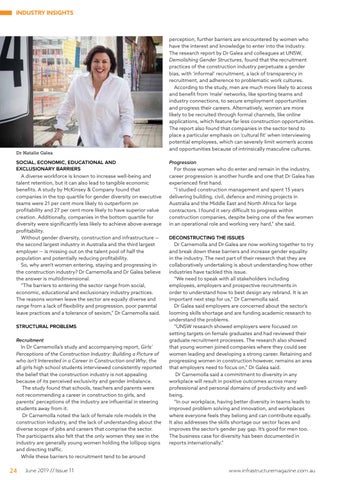
nfrastructure spoke with Dr Phillippa Carnemolla, a Senior Research Fellow at the University of Technology Sydney, and Dr Natalie Galea, a Postdoctoral Fellow at the University of New South Wales, to find out about current industry perceptions and barriers to women entering and progressing in the construction industry. Dr Phillippa Carnemolla was the 2018 recipient of the National Association of Women in Construction (NAWIC) International Women’s Day scholarship. This scholarship required her to spend 12 months undertaking a research study, with the scholarship funding the research. Dr Carnemolla’s research involved investigating the perceptions of the construction industry by female high school students. Keeping in mind that women entering and remaining in the construction industry sits well below parity, Dr Carnemolla’s research examines how construction is portrayed and perceived by the very women it hopes to attract, as well as where they come from. She’s now working closely with Dr Galea, also a past recipient of the NAWIC scholarship, whose research focuses on the barriers to women’s recruitment, retention and progression in construction. The Australian Bureau of Statistics’ research on gender participation in the construction industry — the most male dominated industry in Australia — shows the significant disparity between men and women in the sector, particularly when looking at middle and upper management. The stats show a staggering 97 per cent of CEOs and 88 per cent of senior managers in the industry are men. “This is proportionately greater than the male dominance found in Australian business generally,” Dr Carnemolla said. Perhaps more telling however is that women’s participation in construction is actually falling, decreasing from 17 per cent in 2006 to 12 per cent in 2018.
Dr Phillippa Carnemolla
www.infrastructuremagazine.com.au
June 2019 // Issue 11
23
INDUSTRY INSIGHTS
Dr Natalie Galea
SOCIAL, ECONOMIC, EDUCATIONAL AND EXCLUSIONARY BARRIERS A diverse workforce is known to increase well-being and talent retention, but it can also lead to tangible economic benefits. A study by McKinsey & Company found that companies in the top quartile for gender diversity on executive teams were 21 per cent more likely to outperform on profitability and 27 per cent more likely to have superior value creation. Additionally, companies in the bottom quartile for diversity were significantly less likely to achieve above-average profitability. Without gender diversity, construction and infrastructure — the second largest industry in Australia and the third largest employer — is missing out on the talent pool of half the population and potentially reducing profitability. So, why aren’t women entering, staying and progressing in the construction industry? Dr Carnemolla and Dr Galea believe the answer is multidimensional. “The barriers to entering the sector range from social, economic, educational and exclusionary industry practices. The reasons women leave the sector are equally diverse and range from a lack of flexibility and progression, poor parental leave practices and a tolerance of sexism,” Dr Carnemolla said. STRUCTURAL PROBLEMS Recruitment In Dr Carnemolla’s study and accompanying report, Girls’ Perceptions of the Construction Industry: Building a Picture of who isn’t Interested in a Career in Construction and Why, the all girls high school students interviewed consistently reported the belief that the construction industry is not appealing because of its perceived exclusivity and gender imbalance. The study found that schools, teachers and parents were not recommending a career in construction to girls, and parents’ perceptions of the industry are influential in steering students away from it. Dr Carnemolla noted the lack of female role models in the construction industry, and the lack of understanding about the diverse scope of jobs and careers that comprise the sector. The participants also felt that the only women they see in the industry are generally young women holding the lollipop signs and directing traffic. While these barriers to recruitment tend to be around
24
June 2019 // Issue 11
perception, further barriers are encountered by women who have the interest and knowledge to enter into the industry. The research report by Dr Galea and colleagues at UNSW, Demolishing Gender Structures, found that the recruitment practices of the construction industry perpetuate a gender bias, with ‘informal’ recruitment, a lack of transparency in recruitment, and adherence to problematic work cultures. According to the study, men are much more likely to access and benefit from ‘male’ networks, like sporting teams and industry connections, to secure employment opportunities and progress their careers. Alternatively, women are more likely to be recruited through formal channels, like online applications, which feature far less construction opportunities. The report also found that companies in the sector tend to place a particular emphasis on ‘cultural fit’ when interviewing potential employees, which can severely limit women’s access and opportunities because of intrinsically masculine cultures.
Progression For those women who do enter and remain in the industry, career progression is another hurdle and one that Dr Galea has experienced first hand. “I studied construction management and spent 15 years delivering building, civil, defence and mining projects in Australia and the Middle East and North Africa for large contractors. I found it very difficult to progress within construction companies, despite being one of the few women in an operational role and working very hard,” she said. DECONSTRUCTING THE ISSUES Dr Carnemolla and Dr Galea are now working together to try and break down these barriers and increase gender equality in the industry. The next part of their research that they are collaboratively undertaking is about understanding how other industries have tackled this issue. “We need to speak with all stakeholders including employees, employers and prospective recruitments in order to understand how to best design any rebrand. It is an important next step for us,” Dr Carnemolla said. Dr Galea said employers are concerned about the sector’s looming skills shortage and are funding academic research to understand the problems. “UNSW research showed employers were focused on setting targets on female graduates and had reviewed their graduate recruitment processes. The research also showed that young women joined companies where they could see women leading and developing a strong career. Retaining and progressing women in construction however, remains an area that employers need to focus on,” Dr Galea said. Dr Carnemolla said a commitment to diversity in any workplace will result in positive outcomes across many professional and personal domains of productivity and wellbeing. “In our workplace, having better diversity in teams leads to improved problem solving and innovation, and workplaces where everyone feels they belong and can contribute equally. It also addresses the skills shortage our sector faces and improves the sector’s gender pay gap. It’s good for men too. The business case for diversity has been documented in reports internationally.”
www.infrastructuremagazine.com.au
INDUSTRY INSIGHTS
REBUILDING THE SECTOR As a result of her research findings, Dr Carnemolla made a series of recommendations that will enable NAWIC, employer groups, leading companies and broader construction networks to better engage with high school girls and to communicate the potential for a construction career. These recommendations include: ♦♦ Construction needs to reposition itself as a career for both women and men. The construction sector’s employer groups and leading companies should undertake a campaign that rebrands construction as an aspirational career. Students, parents and schools need to be convinced ♦♦ The industry needs diverse role models and champions to communicate the potential and diversity of roles within a construction career ♦♦ Further research into the role that schools play in supporting careers in construction for girls is recommended. This will enable a better understanding of how schools can be better informed about opportunities within the construction industry for all female students, across all levels of academic achievement ♦♦ The construction industry should be encouraged to review its recruitment practices to include non-school leavers — warranting further research into exactly where interest in construction training comes from and how it can be encouraged from an early age. Further research is needed into how construction training and tertiary education is marketed/targeted to understand why particular schools are drawing more interest Dr. Carnemolla is optimistic about the future of the construction industry pointing to the opportunities created by the fourth wave of industrial revolution and Australia’s increasing commitment to inclusive workplaces. “The introduction of new technologies, coupled with the important work already underway in understanding women’s experiences throughout the entire work cycle, offers new ways to renegotiate assumptions around gender preferences — not just in the construction industry, but a variety of industries,” Dr. Carnemolla said. Dr Galea was more cautious in her response regarding the journey ahead, “I am less optimistic. I think the sector — clients, contractors and unions — have a lot of work to do. They first must acknowledge the problem and their responsibility to address it. “We hope that this most recent NAWIC Report will encourage construction and infrastructure companies to stop, reflect and act on how the industry is perceived by people outside it — including the women it hopes to recruit, their families and their educators.”
To learn more about NAWIC, the IWD Scholarship or to download a copy of Dr Phillippa Carnemolla’s report Girls’ Perceptions of the Construction Industry: Building a Picture of who isn’t Interested in a Career in Construction and Why, visit nawic.com.au.
www.infrastructuremagazine.com.au
June 2019 // Issue 11
25
INDUSTRY INSIGHTS
ELECTION 2019: WHAT ROLE DID INFRASTRUCTURE PLAY AND WHAT DOES THE RESULT MEAN FOR THE SECTOR? By Kim Ho, Journalist, Infrastructure Magazine
The Liberal-National Coalition, led by Scott Morrison, has won the 2019 Federal Election. Having campaigned on strategic infrastructure investments, the question arises: what role did infrastructure play in the outcome of the election, and what does a Coalition victory mean for the sector going forward?
I
n a fiercely fought election campaign, the Federal Government and Opposition both ran on platforms of job creation and economic security. Infrastructure was often at the forefront of debate, with discussions around planning for growing urban populations and the underutilised potential of Australia’s regions. The Liberal-National Coalition’s victory can perhaps be attributed to its 2019–20 Budget, founded on the exciting promise of $100 billion in infrastructure investment. Whether it can deliver on that promise over its next term will be the next test for the Morrison Government.
A BUDGET FULL OF POLICY… BUT NOT JUST YET So what role did infrastructure play in determining this outcome? For a start, the Budget gave the Coalition a chance to launch its re-election campaign with a detailed vision of Australia’s future. Crucially, however, the Federal Government did not commit to implementing this suite of investments immediately. Only a small percentage of funds will be made available for projects like the Melbourne-Geelong Rail Link in early forward estimates. The Coalition leveraged the Budget to articulate a clear narrative around how its transport infrastructure investments would kill two birds with one stone, easing urban congestion and overpopulation, and helping struggling regional economies. This dual commitment was reflected in its cabinet, having portfolios for both Infrastructure and Regional Development, held by Nationals Leader, Michael McCormack, and for Cities,
26
June 2019 // Issue 11
Urban Infrastructure and Population, held by Alan Tudge. By placing their investments as part of a broader picture, the Federal Government was able to make a case for why their investments might be necessary.
QUEENSLAND: THE DECIDING STATE It is clear that Queensland’s rejection of Labor was instrumental in returning the Morrison Government to power. And with Queensland receiving $4 billion in infrastructure funding in the Coalition’s Budget, the second-best funded state, it is tempting to put this down to strategically-placed election promises. And with funding announcements in Queensland well before the Budget was released or the election was announced, it appears the Federal Government began its election campaign early. www.infrastructuremagazine.com.au
INDUSTRY INSIGHTS In the months leading up to the April Budget announcement, the Federal Government announced a swathe of transport infrastructure projects across the state. These included: ♦♦ Millions of upgrades for the Warrego Highway, Lindsey Highway, Carnavon Highway and Bruce Highway ♦♦ Over a billion dollars for transport projects through the Northern Australian Infrastructure Fund, which Labor promised to replace ♦♦ Upgrades to ease congestion in Brisbane, attended by the Prime Minister himself ♦♦ Major milestones and positive data on Inland Rail, for which Labor announced it would launch an Inquiry ♦♦ Millions on road safety as part of the Black Spot Program ♦♦ A City Deal for South East Queensland ♦♦ $200 million for Townsville’s water infrastructure before its devastating floods
Cumulatively, these projects may have laid the groundwork for Queensland’s swing towards the LNP. In addition, the Coalition also went hard on water infrastructure, announcing plans to expand the National Water Infrastructure Development Fund, establish a new Future Drought Fund, the North Queensland Water Infrastructure Authority and a National Water Grid. With Adani’s controversial Carmichael mine’s groundwater management plan getting the green light just in time for the election, Queenslanders may have seen both job security and water security despite major criticism over the project’s environmental impact. In an election where sustainable planning, renewable energy and zero-emissions vehicles were major topics of debate, swinging a state towards roads and the Adani mine was a remarkable feat.
WHAT DOES A COALITION VICTORY MEAN FOR THE SECTOR? While the re-elected Federal Government has flexibility to dictate policy in a range of areas, the Budget’s $100 billion infrastructure pledge means that it will be judged on its ability to meet key funding commitments. Some of the high-profile projects the government has pledged include: ♦♦ $2 billion Fast Rail Link between Melbourne and Geelong, designed to cut travel times in half to thirty minutes and open up the regional city ♦♦ $1.6 billion for road and rail infrastructure across Perth and regional Western Australia ♦♦ $1 billion for upgrades to the Princes Highway over Victoria, NSW and SA
www.infrastructuremagazine.com.au
♦♦
$1.14 billion to the Suburban Roads Upgrades in Melbourne, designed to reduce congestion on suburban arterial roads in south-eastern and northern areas of the city ♦♦ An additional $1 billion for the Roads to Recovery program ♦♦ $3.5 billion for Stage 1 of the Western Sydney North South Rail Link ♦♦ $3 billion for the second round of Urban Congestion Fund (including a Commuter Car Parking Fund) ♦♦ $1.5 billion for the North-South Corridor in South Australia ♦♦ $550 million for the Black Spot Program, which delivers vehicle safety infrastructure at high-risk areas and crash spots ♦♦ An additional $275 million each for the Heavy Vehicle Safety and Productivity Program, and the Bridges Renewal Program ♦♦ Funding for the National Heavy Vehicle Regulator The Federal Government has also pledged to establish the following authorities and bodies: ♦♦ A national Office of Road Safety ♦♦ A Road Safety Innovation Fund ♦♦ A freight data hub ♦♦ A National Faster Rail Agency to identify and support the development of fast rail connections between capital cities and key regional centres ♦♦ A National Water Grid to deliver strategic planning and water management for water policy and water infrastructure across Australia
INFRASTRUCTURE TO REMAIN A KEY POLICY ISSUE Questions still swirl around the future of Australian infrastructure. Without federal support, the Victorian Government is facing a $10 billion hole in its budget for the Suburban Rail Loop in Melbourne. At the same time, Federal Treasurer, Josh Frydenberg, has already suggested that his government will be prepared to wholly fund the controversial East-West Link road to encourage concurrent construction with the North-East Link road. Labor’s major policy proposal to provide $1 billion to begin securing the corridor for a High Speed Rail Link between Brisbane and Sydney also appears to be shelved indefinitely. It is also unclear whether there will be a Federal Inquiry into Inland Rail. Nevertheless, with Shadow Minister for Infrastructure, Transport, Cities and Regional Development, Anthony Albanese, being a strong contender for Labor leadership, it is highly likely that infrastructure will continue to be a battleground of federal policy in the years ahead. June 2019 // Issue 11
27
ASSET MANAGEMENT
GETTING ASSET MANAGEMENT RIGHT:
A NEW FRAMEWORK by Rami Affan, Executive Director, Asset Management, Infrastructure NSW
The management and use of NSW’s assets must become smarter, more productive and efficient to manage the upward pressure on maintenance requirements and expenditure, and the 2018 NSW State Infrastructure Strategy has recommendations for how best to do this.
T
he 2018 NSW State Infrastructure Strategy recommendations demonstrate the critical asset management response by the NSW Government, which currently manages assets worth more than $340 billion, to the challenges of population growth, climate change, expectations of level of service offered by infrastructure and the age profile of assets. A strong asset management framework is critical to extract maximum benefit from the asset portfolio of NSW and to ensure that the state’s infrastructure spending remains sustainable to meet future service demand. This article outlines the whole of NSW Government approach, as led by Infrastructure NSW, to develop a new modern NSW Asset Management Framework that is focused on improving the asset management capability and accountability of the NSW public sector. This approach was in response to the anticipated challenges of population growth, climate change, expectations of level of service offered by infrastructure and the age profile of assets as outlined in the NSW State Infrastructure Strategy 2018–2038.
achievable, affordable, and that deliver the highest economic, employment and liveability benefits to the people of NSW. This strategy is less about a recommended list of projects — NSW already has a healthy pipeline of capital works — and more a set of policies and strategies required to make more efficient use of existing and new infrastructure with a focus on optimising efficiency, better asset management and managing peak demands while delivering essential infrastructure in the most cost-efficient way. As outlined in the State Infrastructure Strategy 2018–2038, the demand for infrastructure to meet growth is increasing, but governments alone cannot afford to build its way out of demand. Population growth, climate change and increasing service expectations (as shown in Figure 1) offered by infrastructure are placing risks on asset performance and the NSW economy, which is forecast to grow from $539 billion today to $1.4 trillion by 2056.
THE NEED FOR CHANGE In February 2018, the State Infrastructure Strategy 2018–2038 (Infrastructure NSW, 2018) was released. This strategy set out a 20–year vision for the state to have the right infrastructure in the right places, that is well managed and put to good use, Figure 1 – Forecast of demand on services in the next 20 years (Infrastructure NSW, 2018). boosting productivity, global competitiveness and improving the quality of people’s lives. In response to these challenges, the State Infrastructure NSW currently has the largest state infrastructure Strategy 2018–2038 makes recommendations for the NSW investment program in the nation (over $87 billion from Government to introduce an asset management policy that 2018/19 to 2021/22), supported by the strongest state includes a new assurance model managed by Infrastructure economy in Australia (NSW Treasury, 2018). Unlike prior state NSW by the end of 2018 to transition NSW state agencies infrastructure strategies, this strategy looked beyond existing into a new asset management framework in line with modern infrastructure needs. accepted asset management standards and practices. The recommendations in the State Infrastructure Strategy At the 2018–19 NSW State Budget (NSW Treasury, 2018), an 2018–2038 identify investment and policy priorities that are anticipated growth of 22 per cent in assets from the significant
28
June 2019 // Issue 11
www.infrastructuremagazine.com.au
ASSET MANAGEMENT
level of investment noted previously by 2022, is placing significant pressure on maintenance funding. In addition, the current age profile of assets and service expectations is placing significant upward pressure on maintenance requirements and expenditure in the near term. Further compounding these challenges is the current asset management capability in the NSW public sector and industry. In April 2018, the Asset Management Council of Australia (Asset Management Council, 2018) surveyed a cross section of organisations from a variety of industries throughout Australia and determined that the state of asset management capability within the industry remains a current challenge across Australia, as summarised in Figure 2.
agencies was a significant lack of investment in their asset management capabilities. In response to these challenges, and the asset management recommendations contained in the State Infrastructure Strategy 2018–2038, a new Asset Management Policy for the NSW public sector is being developed by Infrastructure NSW in collaboration with NSW Treasury and in consultation with NSW state agencies. The NSW Asset Management Policy is designed to achieve a consistent approach to parts of the asset management cycle across the NSW public sector in line with industry accepted asset management standards, enabling agencies to:
Figure 2 - Asset Management Council Industry Survey (Asset Management Council, 2018).
Without the right kind of investment in asset management capability and improved efficiencies in the NSW public sector we may end up in a very similar situation to the US. During my time consulting in the US across various states and cities, I encountered many public sector agencies without visibility of their asset portfolio and limited understanding of asset risks and challenges in service delivery, as summarised in Figure 3. The one common thread within these US public sector
♦♦ ♦♦
♦♦ ♦♦
Make better use of their existing assets Adopt clear and consistent definitions and methodologies to report and manage the size of any maintenance backlog in their sector Broaden assessments of asset performance to take into account economic, social and environmental outcomes Develop a whole–of–asset lifecycle and whole–of– government approach across interconnected
All dollars are in USD
Figure 3 – Current asset management experience in the US (American Society of Civil Engineers, 2017).
www.infrastructuremagazine.com.au
June 2019 // Issue 11
29
ASSET MANAGEMENT infrastructure networks to drive an integrated vision of infrastructure provision and management that creates value, reduces costs, manages risks, and improves the performance of assets ♦♦ Adopt innovative, contemporary technologies and innovative approaches to improve the operations and maintenance of infrastructure ♦♦ Use quality data that will support evidence-based decision-making the NSW Government to balance cost, risk and performance Importantly, in addition to supporting a consistent and improved approach across state agencies, the policy demonstrates value to the state, communities and customers through the core focus to build and sustain a level of asset management capability in the NSW public sector that aims to deliver the following improvements to state outcomes in response to the relevant strategic challenges identified (above) as outlined in Table 1.
APPROACH AND IMPLEMENTATION The success of a new NSW Asset Management Policy in delivering on its strategic goals is critically dependent on a robust and effective implementation program across all NSW state agencies. Outlined below in Figure 4 is Infrastructure NSW’s implementation framework for a whole–of–government approach to adopt this critical change. At first glance the approach may look similar to that taken by Victoria in developing and implementing its Asset Management Accountability Framework (Department of Treasury and Finance Victoria, 2016). However, many of the lessons learnt from Victoria’s implementation (in consultation with the Department of Treasury and Finance of Victoria), have been incorporated by Infrastructure NSW.
Strategic Challenge
Target Improvement
Growth in new infrastructure
Increase the level of asset management maturity of NSW public sector agencies in line with accepted industry standards.
Asset use and resilience
Demonstrate and increase economic and social benefit of current assets through evidence based and transparent asset planning and prioritisation.
Financial sustainability
Decease lifecycle operating costs through risk-based preventative maintenance regimes. Increase return on assets through improving commercial value and performance of assets.
Maintenance backlog
Prospectively identify the optimal asset maintenance regime and any upfront expenditure required with consideration to criticality and economic outcomes.
Table 1 – Response to key strategic asset management challenges for NSW
Figure 4 – The pathway to improving asset management practice in NSW
30
June 2019 // Issue 11
www.infrastructuremagazine.com.au
ASSET MANAGEMENT THE FOUR KEY COMPONENTS OF NSW’S APPROACH (FIGURE 4): 1. Determine an understanding of current state This step involved obtaining detailed insight in collaboration with NSW Asset Managers and Executives on the current asset management challenges faced within agencies including the use of a formal industry accepted asset management maturity assessment and benchmarking (as provided by the Asset Management Council). This initial diagnostic established a baseline of current asset management practice across NSW state agencies. 2. Establish NSW Asset Management Policy requirements The requirements of the NSW Asset Management Policy will be aligned to current accepted industry standards (ISO55000) so that the overall asset management practice in NSW state agencies can be improved, and includes: ♦♦ Agencies to have a fit-for-purpose Asset Management Framework which includes Strategic Asset Management Plan (SAMP), an agency-level Asset Management Policy, Asset Management Plans (AMPs), and an Asset Register ♦♦ Accountable Authority of each agency attest annually to compliance with the policy ♦♦ Agencies undertake a periodic assessment of their asset management maturity 3. Leadership commitment and recognition of incremental improvement The evolution of asset management practice by state agencies starts with the level of commitment by their leadership. Only then can there be a genuine understanding of what their organisation will need to change through improving current asset management capabilities or consideration of organisational reform to support creating the right culture within their organisation for asset management to thrive. The policy recognises this and outlines transitional arrangements for agencies through the adoption of maturity road maps that aim to improve asset management practice over a period of time (through interim states), moving towards full compliance with the policy. 4. Infrastructure NSW Influence and Support The NSW Government expects agencies to demonstrate strong transparency and accountability as part of their role as stewards of public assets. The attestation process and the independent asset management assurance is to be led by Infrastructure NSW (under its role as the independent strategic advisor to the NSW Government). This process provides a level of confidence to the NSW Government that agencies are meeting their obligations in relation to asset management, and that their performance remains relevant, consistent and reflects contemporary and good asset management practice. Further to this, the partnership with the Asset Management Council of Australia has been critical in enabling Infrastructure NSW to provide policy implementation support to state agencies through: ♦♦ Availability of accredited asset management training for agencies ♦♦ Availability of a formal industry recognised Asset Management Maturity Assessment ♦♦ Quarterly NSW Asset Management Community of Practice events www.infrastructuremagazine.com.au
The quarterly NSW Asset Management Community of Practice forums (as chaired by Infrastructure NSW) commenced in May 2018 and has grown to over 70 members across NSW agencies. This forum alone has been key to the success of developing and implementing the new NSW Asset Management Policy as each event provided: ♦♦ A dedicated asset management forum for NSW Government agencies and asset management practitioners focused on improving the understanding, capability and application of asset management knowledge and practice in NSW Government ♦♦ Opportunity for Infrastructure NSW to collaborate across NSW Government on the development of the NSW Asset Management Policy and Asset Management Assurance Framework ♦♦ Alignment, improvement and efficiencies in cross-sector and agency relationships on key challenges and priorities for NSW
NEXT STEPS AND OPPORTUNITIES The NSW Government Asset Management Policy will drive a whole-of-life approach to asset management by agencies, which will minimise the long-term cost of service provision. The policy also specifies that agencies have in place robust and defensible Asset Management Plans, supported by clear evidence on asset performance, cost and outcomes to the state. This approach will be supported by promoting the adoption of new technology innovations that reduce whole– of–life costs. Further, the introduction of an Asset Management Assurance Framework, managed by Infrastructure NSW, will assist the NSW Government in determining the maintenance requirements of agencies by objectively assessing the maturity of an agency’s asset management framework and evidence base. This critical function previously did not exist in NSW. Infrastructure NSW has also commenced a review to establish a consistent methodology for the state to best quantify, understand and manage the NSW maintenance backlog. As outlined in the 2016 NSW Audit Office reports (Audit Office of NSW, 2017), there is no consistent definition for backlog maintenance and measurement methods across NSW Government agencies. This lack of consistency renders it difficult to determine the actual levels of future maintenance expenditure required, risk and quantum of the current maintenance liability, and the relationship to social, economic and financial outcomes. MORE EFFICIENT MAINTENANCE PRACTICES Asset management in the NSW public sector has focused primarily on individual infrastructure sectors to date, with an emphasis on inputs. The new Asset Management Policy will now for the first time mandate consideration of environmental, social and economic outcomes, as well as interdependencies between infrastructure sectors. Through this policy, the management of NSW assets is anticipated to become smarter, more mature, more productive and more efficient to avoid infrastructure spending increasing unsustainably and risk impacting the delivery of services to communities.
June 2019 // Issue 11
31
ASSET MANAGEMENT
BIGGEST
NAMES IN ASSET MANAGEMENT
RETURN TO SYDNEY Australia’s fastest growing asset management event returns to Sydney from 20–21 August, bringing together leading experts across the utility and infrastructure sectors to discuss the most pressing issues in asset management.
T
he infrastructure and utility sectors are in the middle of major changes and growth. Construction of new infrastructure projects is booming across Australia while existing assets are implementing a range of emerging technologies to ensure they remain in optimal condition. With the Liberal–National Coalition returning to power at the recent Federal Election we can expect an even bigger focus on infrastructure as it sets out to fulfill the $100 billion infrastructure funding it promised in the 2019-20 Budget. Combined with the continued uptake and creation of new technologies, changing industry standards and increased levels of public scrutiny, plus the constantly changing nature of the infrastructure and utilities sectors, it’s essential for asset managers to have access to the latest information. In its third year, the Asset Management for Critical Infrastructure Conference and Exhibition will once again be the place to be for updates on technologies, projects and processes that help to better manage critical assets in Australia. Over two days in August, the event will feature individual presentations, industry panels, networking sessions and targeted topic streams, providing attendees with practical applications to improve the way assets are managed.
32
June 2019 // Issue 11
The event is created by the team behind Infrastructure magazine, as well as other industry events including Digital Utilities and Smart Cities. This means that all the latest industry news and sector issues that are covered in the magazine and online are bought into a live format, with senior managers from power and water utilities and infrastructure asset owners around Australia, including the rail sector.
WHAT’S NEW FOR 2019? This year, we’re introducing two new targeted streams to the program — A closer look at inspection and condition monitoring; and Case studies and the implementation of ISO 55000. We asked our past delegates and readers what are some of the biggest issues facing them as asset managers or topics that they want to explore more in depth and these are two topics that regularly came up. These streams will join our other established streams: Asset management in the rail sector; and Managing renewable and energy assets, with the energy stream expanding beyond last year’s focus on renewables. We have, of course, also created a new program of industry experts to explore these topics through individual presentations and panels.
www.infrastructuremagazine.com.au
ASSET MANAGEMENT
www.infrastructuremagazine.com.au
June 2019 // Issue 11
33
ASSET MANAGEMENT
Romilly Madew
Tammy Falconer
Some of this year’s speakers include:
ROMILLY MADEW
CEO, Infrastructure Australia
Recently awarded an Order of Australia in acknowledgment of her contribution to Australia’s sustainable building movement, Romilly is recognised around the world as a leader and advocate for change in the property and construction sector. She led the Green Building Council of Australia for 13 years, representing over 650 companies with a collective annual turnover of $40 billion, and presiding over the Green Star rating system which has seen more than 2,250 projects certified across the country. Romilly holds Board positions with Sydney Olympic Park Authority and Chief Executive Women, and has sat on numerous ministerial panels including the Cities Reference Group, National Urban Policy Forum and the China/ Australia Services Sector Forum. Her achievements have previously been recognised with national and international awards, including the 2015 International Leadership Award from the US Green Building Council and the 2017 World Green Building Council Chairman’s Award. An honorary fellow of the Planning Institute of Australia, Romilly has been named one of the ‘100 Women of Influence’ by the Australian Financial Review and Westpac, and is a National and NSW winner of the Telstra Business Women’s Award.
TAMMY FALCONER
Head of Asset Knowledge, Sydney Water
With a strong desire to make a difference for customers and her community, Tammy has carved out a successful career working for and driving change in state-owned corporations and public sector organisations. As Head of Asset Knowledge for Sydney Water, Tammy leverages her expertise in asset management, data and analytics to place trusted information into the hands of decision–makers to deliver customer-centric solutions for Sydney Water's 4.9 million customers. She is a leader with impact, passionate about developing teams with a culture of collaboration, achievement and fun. Her achievements span unique and diverse work experiences including increasing fare compliance and customer satisfaction across all modes of public transport in Sydney; leading the implementation of GIS and asset management information systems, and improving asset management practices delivering power, water and wastewater services to 72 remote indigenous communities across the Northern Territory.
34
June 2019 // Issue 11
Brian Green
BRIAN GREEN
General Manager Asset Management, The Australian Rail Track Corporation
Brian is responsible for asset management, project delivery and maintenance of ARTC’s Interstate Network, which covers some 7,500km from Kalgoorlie in Western Australia to Port Augusta, Broken Hill, Adelaide, Melbourne, Sydney, Coffs Harbour and Brisbane. Brian has an Honours degree in Electrical Engineering and a Masters in Business Management, and commenced his career in the coal mining industry in the UK and is an indentured time served mining electrical craftsman. Brian’s career has spanned 39 years with 20 years in senior executive and general management positions. He has extensive experience in the mining, electricity generation and distribution, and rail industries in asset management, engineering and project management. Over the years, Brian has been involved with, and has been responsible for, delivering millions of dollars of electrical and rail infrastructure across New South Wales, Victoria and South Australia. Brian was recipient of Engineers Australia, National Professional Electrical Engineer of the Year Award in 2013.
DR COLLETTE BURKE
Chief Engineer of Victoria and Director at VicTrack
Dr Collette Burke is the inaugural Victorian Chief Engineer, with more than 25 years of engineering and construction industry experience in roles such as Site Engineer, Executive Manager and Managing Director. Having completed a PhD in risk management at RMIT and value for money on major infrastructure projects, she is also an internationally acknowledged researcher. In addition to her role as the Victorian Chief Engineer, she acts as the Managing Director of Exner Group and Karsta in the Middle East and has been appointed as a Director for VicTrack. Formerly, Dr Burke was the National Director of the National Association of Women in Construction (NAWIC). Dr Burke has a drive for greater operational outcomes, a focus on strategic and forward planning, people development, effective delivery and commercial strategy.
DR ANDREW O’CONNOR
Partner - Engineering and Asset Management, KPMG Australia
Andrew is passionate about bringing information and structure to how asset management decisions are made. Andrew is an asset management and reliability engineering professional with over 20 years' experience in the defence,
www.infrastructuremagazine.com.au
ASSET MANAGEMENT
Dr Collette Burke
Dr Andrew O'Connor
aviation, maritime, mining, utilities and nuclear sectors. Andrew has a PhD in reliability and risk, authored a book on statistical modelling of asset systems and is a Certified Asset Management Assessor (CAMA). Andrew co-founded two engineering businesses winning the Telstra Business Awards and BRW Fast 100 company before joining KPMG as a lead partner in the company's engineering and asset management practice.
STEVE DORAN
Director of Infrastream Event MC
Steve Doran is the Director of Infrastream, a firm established in 2008 that specialises in supporting clients for better asset management outcomes. Steve was previously the Chair of the Asset Management Council’s Sydney Chapter. He holds separate globally recognised certifications as an ISO 55001 Asset Management Assessor and as an organisational coach with the Institute of Executive Coaching and Leadership. Steve developed a strong passion for innovation as an Engineer and Manager in over 20 years with Sydney Water in positions such as Asset Management Process Improvement Leader, and Maintenance Analysis & Innovation Manager, and as a Consultant in the United Kingdom for Halcrow’s Management Sciences division.
WHO WILL ATTEND? The event brings together senior leaders and C-suite level decision-makers from Australian utilities, infrastructure asset owners, industry associations, consultancies and government. Last year’s event saw delegates from Sydney Water, Ausgrid, V/Line, Queensland Urban Utilities, Powerlink, Transport for NSW, Jemena, Port Authority NSW, Ergon, Energy Queensland, Pacific National, Essential Energy, Sunwater, City West Water, Origin Energy, SA Water, Port of Melbourne, KPMG, Infrastructure Australia, nbn co, TransGrid and WaterNSW, among others.
Steve Doran
THE BIGGEST ISSUES IN ASSET MANAGEMENT In addition to the four targeted streams, we will also take a closer look at new asset management technologies and digital solutions including data collection and analytics, Internet of Things, machine learning and digital engineering, and other innovations. Conference Program Manager, Jessica Dickers, said her vision for the program is to outline specific practical solutions that can be implemented in an organisation. “We also plan to look at a risk-based approach to decision making, measurement of outcomes, how it all fits in with CapEx budgets, challenges surrounding maintenance priorities, and the latest in proactive condition assessment and preventive maintenance,” Ms Dickers said. Other topics that will be covered include strategic asset management plans, planning best practice, new assets vs maintaining existing assets, skills of the future — future asset manager capabilities, dealing with skills shortages and workforce mobility, and much more. LEARN FROM OTHER SECTORS It’s one thing to be pushing the boundaries of innovation at your own organisation and learning from your own experience, but sometimes to truly overhaul current practices and operations, it’s essential to see what others in the sector are doing. This is a big focus for Asset Management for Critical Infrastructure as it’s the only event that sees different sectors — from water to power, rail, roads and transport — come together to give delegates the opportunity to hear about each other’s successes and learn from their mistakes. Not only can you network with other people in your field, but hearing how other industries are dealing with a similar asset management problem, often gives delegates new perspectives and ideas to take back to the office.
Head to assetmanagementevent.com.au to learn more about the event and to buy tickets. If you’re interested in sponsoring or exhibiting at the event, you can download the prospectus on the website or email events@monkeymedia.com.au.
www.infrastructuremagazine.com.au
June 2019 // Issue 11
35
ASSET INSPECTION & DRONES/UAVS
REMOTE
TRACK INSPECTIONS
USING DRONES
With over 40,000km of track, Australia has the sixth largest railway network in the world. Current railway track inspections involve costly and occasionally dangerous practices, which are especially difficult in remote areas, but developments by Monash Institute of Railway Technology in multi-rotor Unmanned Autonomous Systems (UAS) are set to change this.
36
June 2019 // Issue 11
www.infrastructuremagazine.com.au
ASSET INSPECTION & DRONES/UAVS
CONDUCTING AUTONOMOUS TRACK INSPECTIONS Current railway track inspection practices typically involve either the use of dedicated vehicles or converted road vehicles that require a train path to operate. In other instances, personnel are required to be located within the rail corridor to perform visual inspections where, in some cases, inspections in a railway environment can be inherently dangerous. Monash University’s Institute of Railway Technology (IRT) has been developing Unmanned Autonomous Systems (UAS), commonly known as drones, to help assist the transition to autonomous inspections, especially where railway infrastructure inspections are conducted in remote areas. The deployment of UAS creates an alternative remote railway track inspection tool and removes the requirement of additional safety training and human resources. Regular maintenance and inspections are necessary to keep Australia’s vast transportation network moving, however, rail infrastructure inspections often require personnel to be within the rail corridor to perform visual inspections. A range of safety protocols have been introduced to minimise risks, but this can involve costly track possession or occupation to inspect the track sections and sometimes these track sections do not have clear accessible safety zones. Other assets, such as culverts, are defined as confined spaces and additional safety training and human resource requirements need to be met before inspections can take place. This can often make culvert inspections both time consuming and costly. Previously, ground robots were used for remote inspections, but were faced with difficult terrain or limited mobility. The UAS have the advantage of being aerial, and by utilising Global Navigation Satellite Systems (GNSS), the UAS can fly above the railway track to capture observational data. The acquired information is then used to reconstruct 3D digital models of the infrastructure to identify critical deterioration and maintenance requirements. The UAS are also specifically designed by IRT to handle confined spaces such as cuttings, tunnels and culverts in a semi-autonomous nature. Employing the application of various sensors including an on-board Light Detection and Ranging (LiDAR) scanner, the UAS can measure the shape and surface conditions of constrained infrastructures in real time. CONQUERING THE REMOTE Heavy haul railway networks in areas like the Pilbara region of Western Australia, are often remotely located in harsh environments with limited access and phone coverage. The UAS can inspect the track in addition to the state–of–the–art technologies like Instrumented Revenue Vehicles (IRV) which were also designed, developed and installed by IRT, and are able to identify visible rail and track defects, as well as missing components such as clips and fasteners. www.infrastructuremagazine.com.au
The reconstructed 3D point cloud images created by the data collected by the UAS provides additional information, which enhances decision-making and assists in the preparation of any required remedial works. The data captured can be compared to previous inspections of the track infrastructure and surroundings. This enables automated monitoring of the changes occurring over time using smart analytics without significant investments in resources and inspections. Topographical maps are also able to be created from the UAS data which is spatially geolocated. Operators will have access to up-to-date satellite imagery of their networks at a centimetre level accuracy.
PROTOTYPE HYBRID FOR INSPECTIONS A prototype hybrid of a UAS is being developed by IRT, enhancing its capability to remotely land on the track and drive along the rail using vision-based 3D reconstruction. The prototype currently has the flying and landing speed of 5–10m/s and can hover for around 20 minutes. After detecting any possible abnormalities, the hybrid UAS can take off and land at a safe location. A prototype of the driving system has been developed by using Computer-Aided Design (CAD) software and is specifically designed for the after-landing track inspection. The driving system consists of a lightweight sensor suite weighing less than five kilograms, a body transformation frame, and has special landing gears. The body transformation frame allows the cart to unfold itself to fit various rail sizes. Several different prototypes were designed using different folding techniques. The landing wheels enable the whole cart to self-align on the rail after rotation. ACQUIRING ACCURACY IN RAILHEAD MEASUREMENTS Multi-View Stereo (MVS) algorithms can reconstruct 3D geometry from several images obtained by the UAS, with the accuracy of such models comparable to those acquired by 3D laser scanners. This provides the possibility of high accuracy models in the very near future. A trial by IRT compared the MVS reconstructions with a CAD model using the Iterative Closest Point (ICP) method. The accuracy of the cross-sectional shape of each reconstruction was compared with the actual cross-sectional shape of a 60kg rail. A 3D CAD model of the railhead was created and 200 reference points along the cross-section were sampled. The comparison indicates that the cross-section shape of the reconstruction result and the ICP result are nearly the same with a minimal RMS (root mean square) error of 0.67mm. It is also interesting to note that the ICP results can be used as a measure to evaluate the status of the rail head wear.
June 2019 // Issue 11
37
ASSET INSPECTION & DRONES/UAVS The magnitude of the RMS error grows as the rail wear becomes more severe. These findings demonstrate the strong potential of 3D reconstructions which use only a few images in supplementing the traditional manual railhead measurements.
INSPECTING TIGHT TUNNELS AND CULVERTS As part of IRT’s trials, a tunnel inspection was undertaken using a custom designed quadcopter platform. The latest prototype is 550mm in length motor-to-motor diagonally and its weight is about 2.4kg with 10–minutes flight time. The UAS contains an on-board system consisting of processors, and a sensing system. The processors include a computer and an external GPU, which are used for controlling the on-board components and processing sensors information. The sensing systems consist of a LiDAR sensor and a stereo camera. The LiDAR can acquire cross–sectional data of the tunnel while the stereo camera enables the UAS to perform simultaneous localisation and mapping (SLAM). The LiDAR is capable of generating a point cloud while monitoring the location of the UAS. A relative localisation method, which utilises the geometrical centroid of the tunnel cross section, can be used as an alternative for the control system of the quadcopter platform to achieve self-stabilisation within a tunnellike environment. Flight experiments by the IRT found that a 300mm size quadcopter platform seems to be close to the maximum size that can traverse through the average Australian railway culvert in a relatively stable fashion with acceptable oscillation during flight. The latest prototype is able to stably travel through tunnels of diameter greater than 2.5m when flying at the centroid of the tunnel cross section, however, flight stability is still not guaranteed when hovering near the sidewall. Greater development and a more robust controller is the next step for improved stability for the system when UAS are flying in narrower confined spaces. FIELD TRIALS AT A YARRA VALLEY RAILWAY TUNNEL To evaluate the performance of IRT’s UAS, several trials were carried out in a Yarra Valley railway tunnel in Melbourne. Since the dimensions of this railway tunnel were much larger than the quadcopter platform, the confined space aerodynamic disturbance had a less significant impact on the stability of the system. There were only minor oscillations due to the occasional wind gusts during the flights. Overall, the UAS was able to navigate through the vintage railway tunnel semi-autonomously, with only pilot input to control its longitudinal motion. To demonstrate the system’s capabilities as an inspection tool, a 360-degree camera was installed on the UAS to provide an immersive visual feedback. Hence, the UAS was only required to perform a single flight to gather the full view of the tunnel. Another main objective for the trials was to collect LiDAR data to reconstruct a 3D point cloud of the railway tunnel. Although the on-board stereo camera can provide visual SLAM, the SLAM output suffers from position drift over time and as a result, the position of the UAS in the tunnel’s longitudinal axis is not exactly known.
38
www.infrastructuremagazine.com.au
ASSET INSPECTION & DRONES/UAVS As a first pass, the reconstruction of the point cloud assumes that the UAS is travelling at a constant speed, which is unlikely to be the case in practice. However, with the adoption of improved localisation, the reference position can be tracked which will result in improved reconstruction accuracy. An example application for the tunnel 3D point cloud is to perform a time series comparison of the point clouds. The point cloud data collected from each inspection can then be compared to the reference point clouds from previous inspections, to monitor the deformation of the tunnel infrastructure over time with minimum effort and time. Set of points are computed by taking the average dimensions of the tunnel point cloud. In practice, this averaged point cloud would be obtained either from static measurements or from the UAS measurements with improved localisation applied. Improved localisation can be implemented via a range of approaches including the use of wireless beacons or lasers located near the entry/exits of the tunnel. A point cloud analysing and visualising tool is also developed to provide a more interactive way to post process the point cloud data. Users are able to select different view perspectives such as the first-person view of the tunnel point cloud using the custom visualisation tool. The user can navigate through the sections of the tunnel while visualising the highlighted features (cave-in or caveout section etc.). Such tools introduce different ways for inspectors to analyse the infrastructure and allow more efficient and effective inspections.
REGULATORY FRAMEWORK FOR USE OF UAS IN RAILWAYS IRT in collaboration with the Transport Division of the United Nations Economic and Social Commission for Asia and the Pacific (UN ESCAP) is researching the unique challenges
associated with the use of Unmanned Aerial Vehicles (UAVs) in and around operational railways for the monitoring and maintenance of railway infrastructure. This research involves knowledge capturing of experiences and concerns of rail operators and others working in the railway environment in relation to deployment of UAVs. The findings of the research are expected to help articulate the safety requirements for UAVs to operate safely at rail sites and analyse the current regulation and procedures in place that govern the use of UAVs in the Asia Pacific region.
AN AUTONOMOUS FUTURE FOR DIGITAL RAILWAY The application of multirotor UAS are becoming increasingly attractive and more viable for railway inspections, especially in remote locations due to their manoeuvrability, which permits safer operations normally regarded as high risk. The multirotor UAS allows railway operators to conduct regular inspections and collect dimensional and surface measurements without personnel needing to enter the railway corridor. The information collected not only reduces the heavy reliance on manual inspections, but also facilitates the transition to a safer, more economical and flexible inspection regime. The 3D point cloud data collected from each inspection can be compared to reference point clouds from previous inspections, to autonomously monitor changes in infrastructure over time and assist in the planning of maintenance and remedial actions in a timely manner. As the development for UAS continues to progress, the railway industry should expect to rely more and more on autonomous machines to perform infrastructure monitoring maintenance checks in the future.
Digital Twin
Reality Capture Asset Management
To find out how you can
For your turn-key spatial data solution contact www.infrastructuremagazine.com.au
enquiries@taylorsds.com.au June 2019 // Issue 11
39
EARTHMOVING OUTLOOK // PARTNER SOLUTIONS
IMPROVING PRODUCTION ON TUNNELLING PROJECTS WITH
SURFACE MINERS 40
June 2019 // Issue 11
www.infrastructuremagazine.com.au
EARTHMOVING OUTLOOK // PARTNER SOLUTIONS
When undertaking excavation works on civil projects, speed and precision are vital to keeping the project on time, reducing costs and keeping disruption to the community to a minimum. Surface miners can be ideal for such projects where there is often hard rock involved, and drill and blast methods are not viable. Surface excavation machines like Vermeer’s range of Terrain Leveler Surface Miners help contractors manage noise levels, vibration and air quality for a safer and more productive worksite.
S
urface miners are used for a number of civil applications, including roads and site levelling. They are also frequently used on tunnelling projects to assist with lowering bench levels where the cross section of a tunnel is being increased, whilst simultaneously cutting the bench and levelling the floor during construction of new tunnels. Originally used for selective ore extraction in the mining industry, Jeff Lawson, General Manager of Sales at Vermeer Australia, said surface miners are now being utilised regularly in civil applications due to their power to cut through hard rock at depths of around 50cm at a time. “Surface miners are a great alternative to drilling and blasting because it is cheaper and disruption to the community is reduced. Also, if the machine features the onboard dust suppression system then the safety of operators and workers onsite is improved as there is less chance of flying rock and dust inhalation,” Mr Lawson said.
A TOP-DOWN APPROACH The Vermeer range of Terrain Leveler Surface Miners has been developed for top-down cutting for greater efficiency and productivity. “Top-down cutting allows the cutter teeth to gain penetration without using the machine’s tractive effort to drive the teeth into the material,” Mr Lawson said. “As the machine travels forward and the drum rotates, the teeth on the drum are positioned over the material surface, and the top-down cutting action of the teeth instantly creates a consistentsized product. This can then be handled more efficiently than the product generated by drilling and blasting. “The product size produced by surface miners greatly reduces the need for primary crushing and can be controlled by increasing or decreasing the depth of cut for smaller material or reduced fines.” www.infrastructuremagazine.com.au
The top-down method also allows the machine to cut through harder materials than competitive models which cut in an upward direction. The cut depth, controlled by either laser or GPS, produces a smooth floor for increased production, and easier loading and hauling.
DUST SUPPRESSION FOR IMPROVED PRODUCTIVITY The range of surface miners are also designed to be compatible with Vermeer’s on-board dust suppression system, eliminating the need for a separate trail-behind dust system unit. “The on-board dust suppression system is ideal for hard rock and tunnelling application to increase productivity and reduce overhead costs,” Mr Lawson said. “It is hydraulically driven and features both a left and right unit, which become part of the machine, reducing the need for an external power source or operator and, in turn, the amount of diesel consumption, emissions and labour costs. “Its superior maneuverability means you can work in confined or closed-in spaces and while cutting high walls, perfect for tunnelling projects.” A RANGE OF OPTIONS The T1255 Terrain Leveller SEM is available with either a chain drive or direct drive drum attachment, depending on the job needs, allowing you to get the most out of the machine. The chain drive drum is ideal for the removal of ground surface or creating a smooth, level area for site preparation, road construction or soil remediation. “When you need to get in and extract material to form a high wall, the chain drive drum gives you the capability to cut along a vertical high wall. It has a maximum cutting depth of 68.6 cm (27 inches). The chains are driven by lowspeed, high-torque hydrostatic motors,” Mr Lawson said. On the other hand, with the drive motor mounted directly to the cutter drum, the direct drive drum maximises
work efficiency and reduces wear costs associated with other types of transmissions. Hydraulic low-speed, high-torque motors on each side of the cutter head provide more direct drive power for improved productivity. The direct drive attachment offers a maximum cutting depth of 53.3cm (21 inches).
DESIGNED WITH OPERATORS IN MIND The range of surface miners has also been designed for the safety and comfort of operators. “These machines have an elevated enclosed cab to provide operators with a productive vantage point, which is also equipped with a filtered air system, self-contained cooling and heating systems, sound attenuating foam, and more features to improve comfort—and in turn productivity—all day long. “It is also designed with a rollover protective module (ROPM) which is rated to withstand the impact of a rollover in such environments. It also serves as a falling object protective structure (FOPS),” Mr Lawson said. It comes with the TEC® Plus operating system to improve ease of operation. This system, proven over many years in the Vermeer Track Trencher range, allows the SEM to communicate with the various control modules located throughout the machine. The load control feature allows the machine to automatically adjust ground speed to use full engine horsepower, thus maximising productivity, and protects the engine from operator error to prevent stalling the engine under load. “Our machines are proven in civil applications, having been used on a number of tunnelling projects throughout Sydney,” Mr Lawson said. “If you’re interested in finding out more about surface miners, I’d encourage you to contact your local Vermeer team. We can help you develop a methodology based upon our Australian project experience and to select the surface miner solution that is right for your application.” June 2019 // Issue 11
41
EARTHMOVING OUTLOOK
EARTHMOVING INDUSTRY OUTLOOK
2019/2020 By Kim Ho, Journalist, Infrastructure Magazine
42
June 2019 // Issue 11
www.infrastructuremagazine.com.au
EARTHMOVING OUTLOOK
With record funding pledged for infrastructure investment around Australia, the earthmoving equipment market is set to continue to enjoy strong demand. But as the infrastructure boom shows early signs of slowing, there are still challenges ahead for the construction and earthmoving space. Here, we have a look at the sector’s current trends and future opportunities over the next 12 months.
www.infrastructuremagazine.com.au
June 2019 // Issue 11
43
EARTHMOVING OUTLOOK
I
n February 2019, Infrastructure Australia identified a record $58 billion pipeline of 121 projects as priority initiatives. In April, the Federal Government announced $100 billion worth of infrastructure investments. And in May, Australia reelected the Liberal–National Coalition, holding them to that commitment. The infrastructure boom that has defined the past decade seems to be forging ahead, keeping demand healthy for earthmoving machines on all kinds of construction, upgrade and maintenance projects. But how will this boom play out in the year to come? And most importantly, can this growth last?
INVESTMENT IN MAJOR PROJECTS KEEPING THE SECTOR BUSY First sods are being turned all over the country. The following are just some of the projects currently in the design, early investigation or construction phases: NSW ♦♦ Sydney Metro Northwest and City and Southwest ♦♦ Western Sydney Airport and rail link VIC ♦♦ Melbourne Metro Tunnel ♦♦ North-East Link ♦♦ Regional Rail Revival ♦♦ Melbourne Airport Rail Link QLD ♦♦ Cross-River Rail ♦♦ Major highway upgrades and duplications, such as the Bruce and Warrego highways WA ♦♦ $4.2 billion for road upgrades and construction in May State Budget ♦♦ Perth METRONET
44
In addition, construction forges ahead on Inland Rail across Queensland, NSW and Victoria. South Australia has commenced planning an overhaul of its entire road network, and the re-election of the Liberal–National Coalition means that technical investigations for key Budget commitments, such as the Melbourne-Geelong Fast Rail Link, may soon be underway. It’s no secret these massive projects require serious machinery. The Western Sydney Airport bulk earthworks will involve the excavation of 22 million cubic metres of earth, and a similar amount of embankment construction. Vying for large civil construction contracts, many private firms will increase spending on machinery and equipment for a competitive edge. Major transport infrastructure projects are also expected to generate spin-off projects for companies aimed at housing, utilities and smaller civil construction. Graham Murphy, Director of Equipment Sales - Corporate Accounts at Semco, said the various tunnel, rail, road and airport projects underway in Sydney are essential for distributors. “The airport in particular is going to revolutionise the Western Sydney area,” Mr Murphy said. Geotechnical drilling has also begun on the Melbourne Airport Rail Link, which is set to open up the city’s western suburbs, like Sunshine. With construction to start in 2022 and expected to take up to nine years, the sector can be confident the project will yield spin-off benefits for the coming decade. “We can say for sure that if State and Federal Governments can manage to keep the infrastructure ball rolling along, we will all benefit,” Mr Murphy said.
ENSURING ENOUGH PROJECTS IN THE PIPELINE Deloitte Access Economics’ (DAE) Investment Monitor Report, released in February, predicted that infrastructure spending would peak in the 2019 calendar year, followed by slower growth for the sector. DAE noted several major projects (Sydney Metro Northwest and CBD light rail, Pacific Highway upgrades and NorthConnex) are scheduled to wrap up in 2019–2020, while others (WestConnex and Stage 1 of METRONET) are near the mid-point of their construction cycle. DAE argued the factors that have supported the current surge in infrastructure spending are beginning to wane, with fewer assets left to privatise and a slowing housing market weighing on property tax collections. It also found that the value of projects in its database fell by almost one per cent from the previous quarter, placing this value at a near decade low. However, the analysis excluded new projects that may enter the Investment Monitor database in the coming years, any upward cost revisions, changes in scope of projects or delays to development timelines. Despite all this, in its assessment DAE found a number of factors that suggest a more hopeful outlook. DAE found that state governments — particularly New South Wales and Victoria — are spending record amounts on infrastructure. One challenge for policymakers now is to maintain a consistent pipeline of projects to ensure job stability and assist the industry in planning for the future.
EARTHMOVING OUTLOOK
A MATTER OF SCALE The outlook for businesses operating in a smaller civil construction context is generally positive. Semco specialises in more compact construction equipment — the ‘toy department”, Mr Murphy jokes — with its largest excavator being the TB2150R Takeuchi.
“Whilst the high-rise and medium density industry has taken a hit lately, the greenfield subdivisions are still rolling along okay, so that’s a good thing for us,” said Mr Murphy. “But whether that remains so over the next year or so depends upon so much. Interest rates, negative gearing, jobs and pay rises all influence the outcomes.” The Housing Industry Association (HIA) found that while 2018 was a record year in new dwelling completions, the building cycle is moving into a modest slowdown. Though projects currently under construction are reaching completion, HIA expects fewer new projects in the pipeline behind them.
A BRIGHT FUTURE FOR TECHNOLOGICAL INNOVATION “Technology is marching ahead very rapidly in every facet of industry, including ours,” Mr Murphy said. “We will see some really impressive new innovations coming through, which have the potential to stimulate sales." Mr Murphy said that since
www.infrastructuremagazine.com.au
everyone wants more productivity, lower fuel consumption, safer machinery and fewer emissions, manufacturers are busy responding to these drivers with all sorts of innovations. “Tiltrotators are a good example — 20 per cent more productivity, maybe more,” he said. “Dry break coupler systems like EC-Oil is another. You can change tools on an excavator in seconds without leaving the operators seat. 2D and 3D grade control systems are yet another that is sweeping into vogue.” The cost of labour is not getting any cheaper, even internationally, so all makers are designing machinery that requires less maintenance (longer service intervals). Since machines are relatively inexpensive in relation to the big cost of manpower, Mr Murphy believes robotics will ultimately become commonplace. “We are already seeing it in mining applications where robots work two or three shifts. But even in the smaller machinery I predict we will see more automation and even driverless machines. Electrical drivetrains are already making an impact.”
June 2019 // Issue 11
45
EARTHMOVING OUTLOOK // PARTNER SOLUTIONS
THE NEXT LEVEL OF DOZER GPS MACHINE CONTROL PERFORMANCE
Digwright had been using Topcon 3D-MC2 systems from Position Partners on its dozers since 2009 and had always found the 3D-MC2 systems to be more responsive and smoother than other systems on the market, so when the opportunity to implement the Topcon 3D-MCMAX mastless machine control system arose, Digwright jumped at it.
A
ndrew Wright, Director and Owner of Digwright, said when the opportunity came for them to install a [3D-MCMAX] mastless system on one of their new CAT D6T VPAT machines they were keen to give it a go. “The rate of speed the machine was able to trim at in higher gears is impressive.” WHY DID DIGWRIGHT CHOOSE THE TOPCON 3D-MCMAX MACHINE CONTROL SYSTEM? Mr Wright found that the Topcon 3D-MCMAX machine control system from Position Partners took Digwright’s dozer GPS machine control to the next level of performance. “This system saves our business time, fuel and money through making our dozer more efficient in bulking and trimming to grade applications,” Mr Wright said. “The system works well in all types of materials especially when densities and compacted material change frequently. It reduces the blade ride on harder surfaces and seamlessly reacts to softer material, where the blade would normally bite in, the Topcon 3D-MCMAX from Position Partners will correct the blade lighting fast to leave a smooth level finish.” Another benefit that Mr Wright has noted since implementing the 3D-MCMAX machine control system is improved safety due to the system being mastless. “Removing the mast pole from the blade has also improved safety through better visibility and no need for the operator to stand on the blade to remove the GPS antennas at the start and end of a shift,” Mr Wright said.
46
THE IMPORTANCE OF SERVICE AND SUPPORT DURING PURCHASING AND IMPLEMENTATION Product support is an important part of Mr Wright’s decision-making process when researching new technology and equipment to implement: minimising the downtime of Digwright’s machines is critical. “If it’s not working, it’s not making money,” Mr Wright said. “In the past ten years of dealing with Position Partners, we have found them to be proactive, helpful and responsive to a fix, repair or to come with a solution that will keep us moving.” The team at Digwright also implemented Position Partners’ Tokara Link, an Australian-designed telematics solution created specifically to improve efficiency and productivity for earthworks and civil construction projects. Using a modem installed in the machine, Tokara Link connects your machines to the office, provides access to Position Partners' technical support and links you to any GPS network required for the job. “Our 3D-MCMAX dozer linked with a T-MESH and Tokara Support allows Position Partners to better support our machine with remote access by their support team to fix any issues or upload files from hundreds of kilometres away. Meaning no need to wait for a technician to come to site in most cases,” Mr Wright said. ”Overall, we are extremely happy with the 3D-MCMAX and the install of the system by Position Partners. It looks just like a factory integrated system and not a tacky bolted on after market system. “If you are looking to get more efficiency out of your dozer, and save time and money on your next project, I can thoroughly recommend a Topcon 3D-MCMAX system,” Mr Wright said.
The Intersection of Infrastructure and Technology
Growing infrastructure demands around the world are creating tremendous challenges and opportunities. Topcon works to stay a step ahead, by creating solutions that incorporate technology advancements into the way you work today and tomorrow, transforming the way infrastructure is built. Our integration of high-accuracy positioning, high-speed imaging, cloud-based information management and down-to-earth simplicity creates higher productivity, enhanced quality and improved sustainability. With Topcon, you can stay ahead of your competition and meet the challenges of Infrastructure growth. Watch Topcon Positoning Systems President and CEO Ray O’Connor’s Bloomberg “NEXT INFRASTRUCTURE” interview: www.topconpositioning.com/Infrastructure.
Let’s discuss your next project: 1300 867 266 | www.positionpartners.com.au
EARTHMOVING OUTLOOK // PARTNER SOLUTIONS
PREPARING THE SITE FOR AUSTRALIA’S LARGEST INTERMODAL TERMINAL Tasked with preparing the site of the Moorebank Intermodal Terminal for construction, Liberty Industrial was faced with unexpected challenges and an increasing project scope. The team was forced to think outside the box in the process, resulting in an award-winning, integrated approach to demolition and remediation.
S
ituated in Western Sydney, the Moorebank Intermodal Terminal is to be Australia’s largest intermodal terminal, and a major piece of transport and logistics infrastructure for NSW. A former Department of Defence Military School and Logistics Terminal, the site required significant demolition and remediation work before construction could proceed. Liberty Industrial was engaged by Qube Logistics to deliver three separate demolition, remediation and site preparation work packages associated with the construction of the terminal. Each package comprised a large and diverse scope of work by itself; when combined and executed concurrently, they formed an extensive and complex undertaking.
A VAST SCALE OF WORK Liberty Industrial deployed a sizeable fleet of plant and equipment: more than 20 excavators ranging from 20 to 120 tonnes; seven 40-tonne dump trucks; and a range of compactors, dozers, graders, drum rollers, water carts and service vehicles. Liberty Industrial demolished approximately 300 individual buildings and large structural warehouses including slabs and footings exceeding 300,000m² in total. 140,000 tonnes of concrete was pulverised for reuse on site. Liberty Industrial developed and implemented a comprehensive environmental management program. Environmental controls included sediment fencing, tree exclusion zones, surface water runoff capture and containment, contaminated soil stockpile areas and dust suppression. Almost 200,000 tonnes of demolition material was recycled over the course of the project including brick, concrete, asphalt, steel, mulch and other materials. Since the site was formerly a military complex predating World War 2, the presence of unexpected finds, including potential unexploded ordnance, created a complex, significant risk. Liberty Industrial’s specialist team removed asbestos dust from 14 separate 5000m² warehouses and extracted hazardous chemical tanks. The project team also encountered over 200 unexpected finds of asbestos lagging and asbestos cement pipes.
48
June 2019 // Issue 11
Over 150,000 tonnes of contaminated soil was excavated and remediated, utilising various techniques such as sorting and segregation, bioremediation, asbestos hen-pecking, and haulage and disposal. As works progressed, the team encountered a further 30,000 tonnes of asbestos-impacted soil. This large quantity of unexpected finds required Liberty Industrial to accelerate efforts in order to meet the pre-agreed target dates. At the project’s peak, Liberty Industrial had up to 100 personnel onsite, with more than ten separate work fronts operating concurrently. Despite dramatic increases in the program’s scope, the team ensured early handover for commencement of construction works by breaking the site into priority areas.
RECOGNITION FOR INTEGRATED APPROACH In November 2018, the project was awarded Best Remedial Project (>$1 million) at the Australian Land and Groundwater Association’s (ALGA) 2018 Annual Industry Excellence Awards. It was also shortlisted as a finalist in the 2019 Civil Contractors Federation Earth Awards, in the Excellence in Civil Construction (>$75 million) category. The winners of this award will be announced on 14 June 2019. Liberty Industrial’s General Manager, David Wood, said the project exemplified the value that an integrated solutions project delivery model is able to provide clients. “There is tremendous synergy in our fully integrated demolition, remediation and civil works offering. Continuity of works, accelerated delivery schedule and cost savings are just some of the benefits,” he said. “An early works contracting arrangement, particularly for large scale multi-stage projects can have significant advantages. Engaging an enabling works contractor not only allows for efficient staging of a development project, it is likely to result in substantial cost savings and improvements to programming. “Specialist demolition and remediation expertise in the early stages of a project can add significant value and minimise risk.”
www.infrastructuremagazine.com.au
Liberty Industrial is a leading provider of demolition and remediation services Liberty Industrial provide integrated solutions for large scale and technically complex demolition and remediation projects, offering a comprehensive range of integrated capabilities including demolition, dismantling, asbestos and hazardous materials removal, contaminated land remediation, site rehabilitation and site preparation services. We challenge the status quo and leverage technology to deliver innovative and resourceful solutions that create value for our project partners and stakeholders. The company has set itself apart by developing a solid reputation with clients based on integrity and technical capability and has earned a strong reputation for delivering large and challenging projects.
NOISE AND VIBRATION
MELBOURNE’S METRO TUNNEL WORKING TO MINIMISE DISRUPTION by India Murphy, Journalist, Infrastructure magazine
50
June 2019 // Issue 11
www.infrastructuremagazine.com.au
NOISE AND VIBRATION
The Metro Tunnel is the biggest public transport project in Victoria’s history and is anticipated to be completed by 2025. With new rail tunnels being built under the city, temporary noise and vibration caused by construction is a potential concern for residents, businesses and others in this busy urban environment. Here’s how the project is working to mitigate construction impacts.
T
he Metro Tunnel Project involves the construction of five new underground rail stations and twin 9km tunnels that link the city's south-east to the west, and major excavation works are well underway. The new end-to-end rail line will run from Cranbourne/Pakenham in the south-east to Sunbury in the west. The project will ease congestion in the heart of the rail network by freeing up space in the City Loop with high–capacity trains and five new underground stations at North Melbourne, Parkville, State Library, Town Hall and Anzac. PROJECT CURRENTLY ON TRACK Two of the four massive tunnel boring machines (TBMs) which will build the twin 9km tunnels have arrived in Melbourne and will soon be prepared for launch from the new North Melbourne Station construction site in Arden later this year. The machines will head towards the western tunnel entrance in Kensington. Once they have reached Kensington, the cutterheads and shields will be dismantled and trucked back to their starting point, to be reassembled and then launched towards Parkville and the CBD. Excavation of the station box is underway in Parkville, with a temporary deck being installed over the work site to minimise noise and dust impacts while excavation is carried out underneath. Three road header machines are currently excavating deep under the northern end of Swanston Street where the new State Library Station will be located. These machines have a rotating cutterhead that can cut through rock three times harder than concrete. A total of seven road headers will be used to construct the stations in the CBD — four for State Library Station and three to build Town Hall Station, at the southern end of Swanston Street. At Federation Square, one of three entrances to the future Town Hall Station, piling is underway ahead of www.infrastructuremagazine.com.au
excavation. An acoustic shed, one of six to be used across the project, will be constructed over the site to minimise noise and dust impacts. An acoustic shed is also planned for the Anzac Station site on St Kilda Road. The area will serve as the launching site for the remaining two TBMs which will head towards South Yarra, where major works to build the eastern tunnel entrance are underway following two major construction blitzes.
PROBLEM-SOLVING STRATEGIES As it is being built in the heart of Melbourne’s CBD, managing the impacts of noise and vibration from construction is one of the biggest challenges facing this massive infrastructure project. Making special considerations to reduce noise and air pollution is critical in areas such as Parkville, as several hospitals and research institutions located there use highly specialised equipment which could be affected by vibration and dust. Due to the sensitive nature of work carried out by the hospitals, and in particular researchers at the University of Melbourne, these potential problems require a tailored management approach. The Metro Tunnel Project is working closely with the neighbouring institutions in the precinct to identify ways to mitigate the impacts of construction. As part of the robust Environment Effects Statement process and construction planning, all Metro Tunnel sites were rigorously assessed for noise and vibration impacts. Rail Projects Victoria (RPV) spokesperson Michael Scanlan said, “We've been working with councils, hospitals, universities, businesses, residents and other relevant stakeholders since 2015 to ensure any concerns are addressed as early as possible. “The Metro Tunnel Project contractors build on this work by undertaking their own analysis of potential impacts
from construction, including noise and vibration, and are implementing appropriate mitigation measures.” Extensive piling in Parkville for the station box — successfully completed in 2018 — used cutting–edge technology to break back the piles to reduce noise, vibration and air quality impacts. The method involved the use of expanding mortar to create pressure and generate a perfectly horizontal cut, so the top layer of concrete can be easily removed by a crane. This phase of work normally requires excavators and jack hammers to break back the ‘head’ or top section of the pile. To further reduce disruptive noise and vibration, industry best practice measures such as acoustic sheds, noise walls and blankets are in place on Metro Tunnel construction sites.
COOPERATING WITH THE COMMUNITY Rail Projects Victoria acknowledges that a project of the scale and complexity of the Metro Tunnel Project will create some unavoidable disruption while it is being built, so an extensive and robust public planning and stakeholder engagement process was undertaken to understand, mitigate and manage impacts. “We are working with affected businesses and residents to manage impacts and provide practical support,” Mr Scanlan said. Environmental Performance Requirements (EPRs), developed as part of the public Environment Effects Statement planning process, require noise and vibration levels to be monitored and appropriately mitigated. “Should Metro Tunnel construction noise exceed noise guidelines set out in the relevant EPRs, our construction contractors work with affected residents and offer respite measures. “We will continue to work closely with residents, businesses, commuters and others affected by construction impacts as we get on with delivering the critically-needed rail infrastructure.” In addition, noise and vibration June 2019 // Issue 11
51
NOISE AND VIBRATION monitors are installed on all sites. Modelling and monitoring of potential construction impacts is undertaken throughout construction to inform on–site mitigation measures and ensure all site activities are within the EPRs. Property condition surveys of heritage listed buildings and other residential and commercial properties are also undertaken prior to Metro Tunnel works starting nearby to understand building conditions and inform construction methodology. These surveys provide a reference should a property owner believe their property has been adversely affected by construction works and assists in resolving any issues further down the track. Five Community Reference Groups (CRGs) have been established by RPV to consult with residents, businesses and other stakeholders in proximity to the future tunnels, underground stations and tunnel entrances, and manage issues within these areas. “These reference groups further strengthen the consultation and engagement framework for the delivery of the Metro Tunnel Project,” Mr Scanlan said. “Regular engagement with local residents and businesses has enabled the project to inform the community of any changes to construction activities and manage expectations surrounding noise and vibration impacts.”
METRO TUNNEL OPERATIONS The project’s contractors are required to design and construct the tunnels in accordance with stringent environmental performance requirements for noise and vibration once the Metro Tunnel is operational. The contractor also has a 25-year maintenance contract to maintain the tunnel structures. Before the Metro Tunnel is fully operational, it will undergo an extensive testing and commissioning phase of up to two years. This process will verify the design and determine if any additional mitigation measures are required to address noise and vibration. The tunnels are being designed to accommodate any such measures. LESSONS LEARNT GLOBALLY The Metro Tunnel Project is fortunate to benefit from a significant number of experts with overseas experience within the project team, who can draw on their work on rail projects all over the globe including Singapore, the UK, Hong Kong, India and Taiwan. “Attracting this world–class experience to Victoria is not only shaping the Metro Tunnel but is helping to upskill the next generation of local rail experts to deliver future projects in Australia,” Mr Scanlan said. FULL SPEED AHEAD The project team will continue to implement any practical measures available to reduce the unavoidable noise and vibration caused by construction. Acoustic sheds, noise walls and blankets, as well as technology to break back the piles will continue to be used to mitigate noise and dust. “The Metro Tunnel Project is a major step towards transforming Melbourne's rail network into an internationalstyle ‘turn up and go’ metro system and is scheduled to open in 2025, a year ahead of schedule,” Mr Scanlan said.
52
June 2019 // Issue 11
www.infrastructuremagazine.com.au
With over 30 years of experience in environmental monitoring, EMS is the world leader you can rely on. We’re trusted by governments and hundreds of Tier 1 clients across various industries and backed by Macquarie Corporate and Spectris Plc.
The world leader in continuous environmental monitoring
Tailored SaaS solutions for construction to monitor:
Noise
Vibration
Dust & Air
Stakeholder Engagement
Optimise operations. Minimise risk.
Improve efficiency
Lower project risk
Operate longer
Less complexity
Utilise actionable insights to optimise operating hours and locations, and improve performance
Manage compliance obligations; protect workers and maintain data indefinitely
Extend hours and days of operations and avoid site shutdowns from complaints
Monitor a range of environmental elements with best in class technology to scale fast
Contact EMS to help with your projects
Adam Woodhead Director - Business Development Adam.woodhead@emsbk.com
NOISE AND VIBRATION // PARTNER SOLUTIONS
QUIET CONFIDENCE: CUSTOM-ATTUNING ACOUSTICS ON THE SYDNEY METRO
On 26 May, the first stage of Australia‘s largest public transport project was opened; the Sydney Metro Northwest. The immense project demanded unique specifications for noise minimisation and required an innovative solution. Combining locally-supplied resources and global knowledge, Pyrotek custom-built a new material with the requisite properties.
R
unning from Rouse Hill to Epping, Sydney Metro Northwest includes a 4km elevated skytrain, a 270m cable-stayed bridge, and twin 15km tunnels — the longest constructed in Australia. To ensure passenger comfort and safety, the tracks and walls of these tunnels had to be lined with an absorbing material to reduce reverberation created by wheel–rail impact. The materials had to meet three specifications: 1. Noise level: when operating in the tunnels, noise within passenger areas of carriages had to be a maximum of 78 dB(A) 2. Non-combustibility: to ensure a fire safe environment, it was crucial the material would not emit smoke or toxic fumes in the case of an emergency 3. ‘Trafficability’: with the area around the tracks made a designated pathway, materials needed to be ‘trafficable’, i.e. durable enough to be walked on during an emergency or routine maintenance
DEVELOPING A CUSTOM SOLUTION Pyrotek secured the contract to develop the required material for track absorption and tunnel walls, working alongside Northwest Rapid Transit (NRT), which was awarded the operations, trains and systems contract. Finding a material for the tunnel walls was straightforward. Having been applied in tunnel projects worldwide, Reapor had a track record of reliable noise mitigation. Manufactured from recycled glass, the material is completely non-combustible. Developing a track absorber for the area on the tunnel floor, however, posed a unique challenge. Even with more than 40 years’ experience developing noise control solutions, Pyrotek had never encountered a need for ‘trafficable’ material. Materials applied in the past lacked the composition and vitreous strength required for the Sydney Metro tunnels. In response, Pyrotek’s technical team engineered a new
material with the correct properties, performing tests in the company’s reverberation room alongside independent facilities. Engineers were able to ‘attune’ the material to target the specific frequencies associated with the noise challenges experienced, facilitating optimal acoustic absorption. The material was customised to Sydney Metro to reduce noise from moving trains. The resulting product, Viterolite 900, is a durable concretelike material with high impact resistance, a broad range of frequency absorption and 100 per cent non-combustibility. Viterolite and Reapor panels also reduce the radiation of sound at tunnel openings, lessening community impact. In aiming for compliance with acoustic and design specifications, the materials actually exceeded expectations, reducing tunnel noise levels to under 78dB(A). Results are expected to further improve as the rail tracks flatten.
MANUFACTURING IN A TIME LIMIT A new plant and equipment were designed to locally produce the large volume of custom-sized panels required. Pyrotek upscaled manufacture capacity to cast over 100 tonnes of material each day. As the Australian manufacturing branch of the global company, Pyrotek was able to combine the convenience of local materials supply and innovation (easier transactions, better responsiveness) with global knowledge resources, logistics and capital strength. Simon Tibbet, NRT Area Manager, said being local and flexible made Pyrotek invaluable to logistics and installation. “Their ability to meet the delivery program for the panels was critical to NRT completing this project on time,” Mr Tibbet said. “The final outcome far exceeded our expectations.” By developing the capacity to test and custom-attune its products’ acoustics, Pyrotek surpassed the benchmark for passenger comfort and safety criteria in noise mitigation.
Working in Australia and internationally to develop innovative noise mitigation solutions, Pyrotek has been specified by the world’s leading acoustic consultants. For more information, visit pyroteknc.com
54
June 2019 // Issue 11
www.infrastructuremagazine.com.au
PROTECT IN TUNNELS
NOISE & VIBRATION
Acoustic absorption panels for wall and floor applications
Sydney Metro - Northwest Rail Tunnel
• • • • •
Non combustible systems with zero smoke emissions Durable & designed for quick, easy install Custom designed panels to suit all applications Internationally tested & certified for tunnel applications Manufactured in accordance to ISO9001 Pyrotek® provides innovative noise control products and tailored acoustic insulation solutions to designed specifications for global rail and infrastructure markets.
To find out more about Reapor and Viterolite or other products
visit pyroteknc.com
FLEXIBLE PAVEMENTS
THE FUTURE OF
FLEXIBLE PAVEMENTS India Murphy, Journalist, Infrastructure Magazine
The constant changing demands of society and transportation technology has created the need for the Australian flexible road, asphalt and pavement industry to be, well, flexible. And nobody knows this better than the CEO of the Australian Asphalt and Pavement Association (AAPA), Carlos Rial, who has more than 20 years of industry experience. Infrastructure spoke to Mr Rial about the biggest industry trends, current challenges, and what the future holds for flexible pavements.
56
June 2019 // Issue 11
www.infrastructuremagazine.com.au
FLEXIBLE PAVEMENTS
T
he AAPA prides itself on leading the way in technology, research, training and innovation within the industry. As a peak body representing the industry, it is critical that the AAPA keeps ahead of the curve on current trends, technological advances and vision for the future. WHAT’S TRENDING IN FLEXIBLE PAVEMENTS? According to Mr Rial, the two biggest trends in flexible pavements are circular economy policies and the shift to performance-based specifications. The introduction of the Chinese National Sword regulation, which restricts the importation of solid wastes, has escalated Australia’s need to accelerate strong circular economy policies and practices across the nation, including the roads sector. In a circular economy, materials keep circulating within the economy at their highest value for as long as possible. This is through upcycling, reuse, recycling and remanufacturing. Flexible bituminous pavements (such as asphalt) are one of the most recyclable products on the planet, with the product able to incorporate certain waste while maintaining strong engineering performance. Because of the ripple effect of the regulation, the AAPA is currently working with its members nationally across industry and government to see the increased use of crumb rubber (addressing waste tyres), glass and recycled asphalt. The AAPA is also supporting increased research into the future responsible use of plastics as a polymer to modify bitumen in Australia, without harmful environmental impacts.
Carlos Rial, AAPA CEO
www.infrastructuremagazine.com.au
“This is an exciting time for Australia as this work is driving improved sustainability practices across our sector,” Mr Rial said. The second biggest trend is the shift of road owners wanting to align with international best practices by using performance-based specifications and moving away from unnecessarily prescriptive engineering specifications. “This approach allows clients to take advantage of the intelligent contractors we have in our country. “Specifying the operational requirements of the product through performance-based specifications fosters an innovation environment that allows contractors to showcase their smart technologies and practices. “This is a shift nationally that AAPA supports and is working with members through the transition,” Mr Rial said.
EXCITING INNOVATIVE TECHNOLOGIES According to Mr Rial, there is a variety of advanced materials, processes and technologies currently being implemented in the construction of roads and pavements, but EME2 is the standout technology. Introduced in recent years, EME2 asphalt is a new high modulus asphalt technology. EME2 asphalt has the potential to reduce base course layer thickness of heavily trafficked road by up to 30 per cent and be stronger and longer lasting than traditional asphaltic pavements. The AAPA is working with its members and key stakeholders such as the ARRB Group and Austroads to ensure it is progressively being adopted nationally. Perpetual Pavements are also revolutionising flexible pavement design through the introduction of the perpetual pavement design method. The AAPA supported the introduction of “perpetual pavement” design concepts which both reduce the cost of the pavement and simplify the maintenance obligations to just surface wearing course upgrades. On many of the pavements, investing in the base course strength shifts the pavement from a structural failure in 20 years, to almost no need to replace the pavement structure.
June 2019 // Issue 11
57
FLEXIBLE PAVEMENTS “The long-term benefits to Australia, and potential savings over time through reduced rehabilitation and reconstruction costs are significant with the introduction of this new concept,” Mr Rial said.
THE FINANCIAL CHALLENGES FACING THE INDUSTRY Mr Rial said funding essential infrastructure is a significant challenge that the road and pavement sector is currently facing. “One of our most renowned economists, Mr Bernard Salt, noted that the current and future challenge for government to fund Australia’s essential infrastructure (such as roads), given our tax base, is an increasing challenge.” “This is reflected in the accumulated backlogs in road network maintenance across Australia — up to four times the annual maintenance budget in some states. “Government is looking more and more to industry to support this growing challenge,” Mr Rial said. The government and the private sector are currently working in partnership, shifting away from the traditional “master-servant” relationship to help solve the funding challenge. Through long-term partnerships, which manage, build and maintain the roads, the industry will foster new financing and innovation opportunities. “We need to shift away from the short-term boom/bust funding cycles and adopt more sustainable longer-term funding arrangements over multiple years,” Mr Rial said. “These increased funding arrangements will also drive
58
June 2019 // Issue 11
efficiencies in the planning and delivery of works on our roads.” Mr Rial said that the industry is prepared to do its part through innovation and construction reliability, however the delivery environment in Australia needs to continually mature to allow our smartest and best performing contractors to showcase this innovation. “The industry does struggle in each jurisdiction with the boom/bust funding cycles in our sector. This is a challenge for not just industry, but also government and their associated departments to reliably deliver access for all our road users. “I have not yet met a road owner that had more funding than its needs. “It is only by working in partnership that industry and government can establish alternative more sustainable delivery and funding models.”
THE EFFECTS OF THE CIRCULAR ECONOMY The global economy is currently transforming, evolving towards a more circular model. Australia is also transitioning towards this and moving away from a predominantly linear approach, where products are typically made using virgin raw materials, used and then thrown away. “The shift to a circular economy approach for bituminous products in the flexible pavements industry has been seen as a part of good business practice,” Mr Rial said. Pavement products which are upcycled (old granular basecourses improved with foamed bitumen) and waste, such as old tyres, that is ground up and added to bitumen, outperform and are of lower cost.
www.infrastructuremagazine.com.au
FLEXIBLE PAVEMENTS Recycled asphalt pavements (RAP, one of the most recyclable products on the planet) reuse the aggregates, extending the lives of quarries and reusing the available bitumen as well. Mr Rial said while this is a good news story for Australia, more is still needed. “International best practice shows we can do more in the roads sector to drive sustainable circular economy outcomes for Australia. “Through improved engineering practice in our bituminous roads and surfacings, we can right now use more crumb rubber and percentages of RAP on our highways (lowering project costs) and incorporate higher percentages of glass. “Road owners have to understand their responsibility in moving to the circular economy.” This responsibility includes promoting innovation and generating the market demand for this sustainable practice. “I am currently seeing this increased focus across all road stewards nationally, which is great to see,” he said. It is also important to understand that at present, market drivers may not support the policy objectives of a circular economy. For example, it is cheaper to import crumb rubber from overseas than use local supplied product, and it is cheaper to import glass than recycle it in Australia. The AAPA has supported the “perpetual pavement” design concept and also supports circular economy practice. Increasing the durability of the asset is more easily justified in circular economy thinking. Accommodating the reuse of products in the waste stream is a key driver. But, taking glass and plastics out of the industrial and domestic waste stream requires research, changes to specifications and investment by industry to incorporate them. This requires coordination and collaboration which the AAPA is fostering amongst its members who include the state road authorities, local government and the providers of bitumen, asphalt and spayed sealing in Australia.
THE FUTURE IMPLICATIONS OF EVS According to Mr Rial, the effect on road infrastructure from the implementation of electric and autonomous vehicles remains somewhat uncertain at present, especially as the needs may differ between urban and rural environments. “In urban environments the evolution of autonomous connected vehicles should allow greater vehicle capacity on our existing road network, as vehicles will commute closer to each other safely. This may result in delaying the need to upgrade certain roads for a time.”
Some predict that with tighter controls of vehicle travel paths, there will be a need for stronger pavements due to wheels having less lane wander and loading in one path. There are current engineering solutions which could solve this issue, should this come to play. “One thing is for certain, as the degree of autonomy of vehicles progressively increases, the need for reliable wellmaintained road infrastructure is essential as vehicles will not just be communicating with each other, they will be sensing and communicating with our road infrastructure. “Internationally there is significant research on how infrastructure will communicate with the vehicles and adapt to the new expectations of users. “This includes self-healing roads through nanotechnology, solar roads, pavements that charge vehicles as they drive, and so on. It is an exciting future,” Mr Rial said. The introduction of electric vehicles also poses a significant funding challenge for government. As the demand for fuel reduces so does the fuel tax applied to each litre of fuel. This links to the funding challenge mentioned earlier and further highlights the need for government to establish new transport infrastructure charging mechanisms. “What reduced fuel usage means for bitumen volumes remains uncertain.”
THE ROAD AHEAD Mr Rial sees the future of Australia’s road and pavement sector facing significant developments in their current practices and approaches to industry issues. Infrastructure will be required to be more resilient when faced with the predicted climate change implications such as natural disasters, sea level rise and increased global temperatures. Mr Rial said Australia will adopt sustainable circular economy practices, driving a new generation of flexible pavements through greater use of renewable materials. Given the tax base of Australia and the backlog of infrastructure needs, Mr Rial sees a continued progression towards innovative private sector investment and partnerships to deliver and maintain roads. “With the current trend towards increased use of electric cars and governments reduced tax from fuel excise, new charging models for road use will be needed. These funds will in part be dedicated back to roads. “Significant investment into transport infrastructure over the next 20 years will support an efficient economy and also the continual transition towards fully autonomous vehicles.”
59
FLEXIBLE PAVEMENTS
RECYCLING PLASTIC AND GLASS INTO ROAD MATERIALS
A fast-growing council in Melbourne’s outer west is exploring new ways to deliver the city’s infrastructure needs, and overcoming recent recycling plant closure challenges, through the use of soft plastics in road resurfacing, and using glass to build new footpaths. 60
June 2019 // Issue 11
www.infrastructuremagazine.com.au
FLEXIBLE PAVEMENTS
W
yndham City Council has recently launched two new trials which use recycled materials to resurface roads, and also build new footpaths. The footpath trial, in partnership with Swinburne University, has seen crushed glass and recycled plastics used in the mixture to build footpaths. Wyndham City Mayor, Cr Mia Shaw, said the newly developed cement mix formula included plastic and glass fines for the base and top layers of the footpath. “At Wyndham City, we’re very interested in exploring new and innovative ways to deal with waste,” Cr Shaw said. “We have partnered with Swinburne University for this trial, which explores the potential of using recycled plastics and glass in the aggregate materials for concrete footpath construction. “The concrete was laid in early March at Geddes Crescent Reserve in Hoppers Crossing, and the research team from Swinburne will now monitor the performance of the concrete and conduct tests on the samples collected.” The 200m long concrete footpath contains more than 199,000 recycled glass and plastic bottles. Monitoring over the coming months will assess compliance with Australian construction standards, with the concrete mix design hopefully made available for use in other council infrastructure across Victoria. Cr Shaw also thanked the State Government for a Sustainability Victoria grant of $72,000 that made this trial possible.
SAVING PLASTICS FROM LANDFILL In a separate trial, Wyndham City has resurfaced three busy roads with repurposed soft plastics. “Again, this trial is all about being innovative and sustainable in delivering infrastructure for our residents,” Cr Shaw said. “In these sections of road we’ve used the equivalent of 705,000 plastic bags, 50,000 glass bottles, toner from 16,000 printer cartridges, and 250 tonnes of reclaimed road asphalt.
www.infrastructuremagazine.com.au
“All materials used for this trial are sourced from the metropolitan Melbourne region, which also saves us on transportation costs.” Normally, glass fractions of a certain size cannot be recycled, so they are sent to landfill. Downer, the contractor who Wyndham City engaged to deliver these works, secured these fractions which are crushed to a smaller size. This glass is then used as a sand replacement material in asphalt. Glass asphalt is basically the same as conventional hot-mix asphalt, except that between five and ten per cent of the rock or sand aggregate is replaced by crushed glass. “The benefits of using glass over sand are exciting,” Cr Shaw said. “Glass is readily available in most locations, and has a lower moisture content than sand, which requires less energy to dry and heat. “It also alleviates the requirement to dredge or mine limited natural resources.”
ENVIRONMENTAL AND COMMUNITY BENEFITS At present, in Victoria, between 50,000 and 60,000 tonnes of crushed glass is sent to landfill. Cr Shaw said working with contractors to reduce the amount going to landfill is not only beneficial locally, but for the environment more broadly. “This is a way of repurposing our waste into upgrading our existing assets, while reducing wastage. “With our population growing at such a rapid rate, not only is our need for improved road infrastructure on the rise, but the amount of waste and recyclables coming out of households is also on the rise. “That’s why we’re exploring different ways of meeting these demands, and finding new and innovative ways to repurpose these recyclables. “Imagine a city where all our roads are upgraded using recyclables. Ten recycled bottles per household a week based on our population equates to about 2.5 million bottles. This could deliver 10,000 tonnes of asphalt for our local roads.”
June 2019 // Issue 11
61
SUSTAINABILITY
MAKING AUSTRALIA’S AIRPORTS GREENER
SUSTAINABILITY JOURNEY Like most Australian airports, Adelaide Airport has undergone considerable transformation since privatisation over the past two decades with the opening of its new domestic and international terminal in 2005, and significant passenger growth and the development of new infrastructure. This is set to continue at an increasing pace, with air travel forecast to double over the next 20 years. Adelaide Airport is currently undertaking a $165 million expansion of its main terminal to significantly upgrade international arrivals and departures, and create more retail and dining options for both domestic and international travellers in response to this growth. The expansion will significantly improve the arrivals and departures experience for international passengers, with improved screening and expanded dining and retail options. The retail areas will be expanded and refurbished throughout the terminal, resulting in a more than 80 per cent increase in the
62
June 2019 // Issue 11
overall size of the terminal’s retail and dining precinct across domestic and international areas. Adelaide Airport Managing Director, Mark Young, said ensuring that this growth was achieved in a sustainable way was at the top of the airport’s agenda. “Adelaide Airport is about connecting South Australia. Our vision is to be a top tier airport business in Asia Pacific, recognised for delivering exceptional outcomes to our customers, partners, shareholders and community. This highlights our approach to delivering long–term value to all stakeholders,” Mr Young said. “This vision and approach is underpinned by the recognition that creating long–term shareholder value is inextricably linked to, not at the expense of, creating value for other stakeholders. "Adelaide Airport Limited (AAL) has had a long–term commitment to all pillars of sustainability. In recent years, we have recast our language around what sustainability means to explicitly connect the full spectrum of
Adelaide Airport Sustainability Manager, Leigh Gapp.
Environmental Social and Governance (ESG) factors and tie these into our financial and operational considerations. “We are aware that this is a journey and believe the value placed on sustainability helps our business to respond to, and get ahead of, the complex social, environmental, market and technological influences that we operate within.” Adelaide Airport has a solid track record in sustainability, achieving sector leader status on the global sustainability benchmark GRESB in both 2017 and 2018. Adelaide was also the first Australian airport to achieve level 3 (optimisation) under Airports
www.infrastructuremagazine.com.au
SUSTAINABILITY
In recent years, airports have come under a higher level of scrutiny for their operations as the community and industry moves towards being more sustainable. In response, Adelaide Airport has placed a strong emphasis on sustainability and was recognised for its efforts by Airport Councils International (ACI) Asia-Pacific Green Airports Recognition initiative. Here’s how the airport achieved its industry recognition and some of its current sustainability projects including ‘cool’ pavements, airside irrigation, SMART building analytics and terminal waste recycling.
www.infrastructuremagazine.com.au
June 2019 // Issue 11
63
SUSTAINABILITY
Council International’s Airport Carbon Accreditation program and secured Platinum awards for its waste program and SMART building analytics initiative in the Airport Council International – Asia Pacific Green Airports Recognition in 2018 and 2019 respectively.
CURRENT PROJECTS AND INITIATIVES Adelaide Airport Sustainability Manager, Leigh Gapp, said the current focus was on reducing carbon emissions, understanding and adapting to the effects of climate change and addressing the waste challenge inherent with large multi-user infrastructure assets such as terminal buildings. “We have a number of interesting projects and initiatives underway to address and manage these challenges, including the implementation of a SMART building analytics initiative, airside irrigation and ‘cool’ pavement trials, and terminal lease agreements that require tenants to transition to compostable food service ware and recycle,” Mr Gapp said. SMART BUILDING ANALYTICS Consistent with most airports, the majority of energy at Adelaide Airport is consumed by terminal buildings. Outside air temperature is the biggest influence on how much energy Terminal 1 (the main terminal) consumes (81 per cent determinant), through demands placed on heating, ventilation and air conditioning (HVAC). With the addition of a $165 million extension, and the prospect of climate change driving hotter, drier summers that will drive HVAC assets to work harder, Adelaide Airport’s facilities maintenance and sustainability
64
June 2019 // Issue 11
departments teamed together in early 2018 to look to emerging Australian Prop-Tech Innovations to identify new innovations that deliver a greater environmental impact for a more costeffective outlay. A mobile phone-sized data acquisition device has been installed on the building management network which allows the platform to scan every pump, fan and valve across Terminal 1, every 15 minutes, instantly detecting, diagnosing and prioritising live faults for onsite teams to fix, ensuring emissions-saving opportunities will be achieved within days, not months or years. The most complex of faults that are contributing to higher emissions are now being identified in real time. Teams are being notified of where to go and how to fix them as they occur. Live emissions saving potential is now being ranked across the terminal, allowing maintenance activity to be prioritised and directed based on maximum emissions reduction.
IRRIGATION AND ‘COOL’ PAVEMENT TRAILS Adelaide Airport and SA Water have been running a trial using stormwater to irrigate a four-hectare site within the airport boundary to understand the potential benefits that maintaining appropriate vegetative cover and reducing surface and air temperatures can provide airport operations. The trial has been running since 2015 and the data collected to date has demonstrated that irrigation can lead to an air temperature reduction of over 3°C on hot days when compared with non–irrigated areas.
Temperature significantly influences aircraft performance including fuel use, thrust requirements and the capacity to carry passengers and freight. The impact of extreme heat on aircraft and airport operations was demonstrated in the US city of Phoenix in 2017 when 48.3C temperatures saw airlines cancel and reschedule flights because of difficulties taking off. Whilst Phoenix was an extreme example, there are incremental impacts on fuel use and passenger and freight loads as temperatures increase to this point. “When the Adelaide Airport trial first started it was really aimed at cooling the air to reduce the strain on the terminal HVAC systems. However, as the trial proceeded, it became evident that the potential benefits to aircraft performance could be significant,” Mr Gapp said. “We are now commencing the second phase of this project, which includes the expansion of the trial area to a seven-hectare site and further research into the extent of cooling required (horizontal and vertical) to impact on aircraft performance and to quantify the potential benefits to aircraft performance from this cooling. Mr Gapp said they are also looking at other ways to mitigate the urban heat island effect and reduce local temperatures, including investigating the use of ‘cool’ pavement applications. “Our airport engineer Jessica Westthorp is undertaking a trial with a lighter coloured Fuel Resistant Membrane (FRM). This product is traditionally a black pavement protection application, but we identified that areas treated with the application were hotspots often prone to damage, such as rutting, and so started looking at what we could do to address this. “Our initial research indicated that lighter coloured pavements can reduce surface temperature up to somewhere near 30°C, which can translate to a reduction in ambient temperature of around 2°C. Through monitoring both the impact on ambient temperature as well as pavement performance, we expect to see less rutting on the areas treated with ‘cool’ pavement applications,” Mr Gapp said.
www.infrastructuremagazine.com.au
SUSTAINABILITY
TERMINAL WASTE Waste management at airport terminals is complex with many stakeholders, operational constraints and specific waste streams. After a 2016 waste audit indicated that around 62 per cent of the general waste from the terminal was organic and that a further 15 per cent of the general waste stream was food service ware including coffee cups, Adelaide Airport developed a strategy to divert this fraction of the waste from landfill. Adelaide Airport has been working with its tenants to facilitate this transition and has developed a cost analysis tool for tenants to assess the cost or saving of transitioning to compostable food service ware. “The cost of compostable food service ware has reduced significantly over the past five years and we have actually demonstrated that some of our tenants will achieve savings by transitioning to compostable alternatives. The engagement with our tenants has been overwhelmingly positive,” Mr Gapp said. “To underpin the engagement work, Adelaide has included specific clauses within its terminal tenancy lease agreements that will require terminal tenants use either durable or compostable food service ware. “There is a significant investment in infrastructure required to facilitate the transition to compostable food service ware and support the diversion of organic waste including organic waste compactors, bin lifters and the conversion of public space bins to replace the paper stream, which is no longer a relevant public waste stream within our terminal, to an organic stream. “We expect to transition to a compostable food service ware site over the next five years and are looking forward to engaging with our tenants and the public on this initiative.” ESG LINKED LOAN In addition to these initiatives, Adelaide Airport recently signed a $50 million seven-year Sustainability Performance Linked Loan with ANZ Bank, the first loan in Australia that incentivises a borrower to even further improve its performance against a set of Environment, Social and Governance (ESG) criteria. Adelaide Airport Manager Corporate Finance, Joshua Golding, said Adelaide Airport strived to be a leader in sustainability and would always work hard to embed the principles of sustainable business practice throughout its operations. “Creating an explicit link between our financing and long-term sustainability credentials — including risk management, governance, our culture, the value we place upon our people and our relationships with our customers and stakeholders — is a key milestone for our business as we seek to further integrate sustainability within our day-today operations,” Mr Golding said.
www.infrastructuremagazine.com.au
June 2019 // Issue 11
65
SUSTAINABILITY
BUILDING A SUSTAINABLE FUTURE: A NEW ERA OF GREEN INFRASTRUCTURE by Kim Ho, Journalist, Infrastructure magazine
As industry, markets and governments respond to global climate change agreements, how we deliver a more sustainable economy is a necessary and increasing focus of industry, the public and governments. As the Green Building Council of Australia (GBCA) transitions to a new Chief Executive and continues the delivery of its strategic priorities, Infrastructure spoke with GBCA’s Interim CEO, Jonathan Cartledge, about what we can expect on the horizon for sustainable infrastructure. A PIVOTAL TIME FOR THE SECTOR This month, GBCA’s incoming CEO, Davina Rooney, will pick up the reins after 13 years of Romilly Madew’s muchlauded leadership. In the interim, Head of Public Affairs & Membership, Jonathan Cartledge, has stepped into the role as the organisation moves toward finalising a number of major policy works, including the next evolution of its Green Star rating tools. Ms Madew, Ms Rooney and Mr Cartledge have all described the current period as a pivotal time for the sustainability sector — across business, government and the community. Mr Cartledge said wholesale transformation and change is underway, driven in large part by the Paris Climate Change Agreement in 2015 and the UN Sustainable Development Goals in 2016, which outlined a range of targets and indicators for governments and industry worldwide to deliver a more sustainable future. “In the years since those initiatives, we have seen Australia responding at national, state and local levels with clear commitments to net zero emissions,” Mr Cartledge said. “Our current national commitment aims to reduce our carbon emissions to 26–28 per cent below 2005 levels by 2030. “When we look at that commitment in the context of the built environment and infrastructure, where buildings represent nearly a quarter of carbon emissions, it’s clear there’s an opportunity for us to be a big, cost-effective part of the solution. Our advocacy is about getting governments at all levels to realise and seize this opportunity. Industry, generally, is leading decision–makers in this space.” Mr Cartledge stressed that whilst small wins and recent advances should be celebrated, we should not lose sight of the point of all those commitments; to stop the change that would follow if global warming exceeded one and a half or two degrees Celsius. A SURGE IN RESPONSIBLE INVESTMENTS Markets have responded globally to these governmental sustainability commitments, causing a massive shift in the way businesses operate.
66
June 2019 // Issue 11
“Investors are demanding greater transparency and assessing risks through a sustainability lens for the assets in which they’re investing,” Mr Cartledge said. “That’s where the Task Force on Climate-Related Financial Disclosures comes in. Established in 2015, it is changing the way businesses report on their sustainability at a global level. We’re seeing a whole new raft of climate-related financial disclosure reporting that is having a huge influence over investment decisions.” This enormous growth in sustainability-themed investment and climate-related risk assessment over such a short time offers not only a competitive advantage for businesses, but a broader opportunity for them to reshape themselves in the new environment. Mr Cartledge noted that as measured by the Responsible Investment Association Australasia, socially responsible investments have increased 39 per cent in the last two years in Australia. 2016 saw $622 billion go towards responsible investments and in 2017, it was $866 billion. “These are massive increases in the investor demand for assets and products that meet sustainability benchmarks, because that’s where the future lies for governments and for business,” he said.
BEYOND GREEN STAR: SOCIAL INFRASTRUCTURE The GBCA’s purpose is to lead the sustainable transformation of the built environment to support its vision: ‘Healthy, sustainable, and positive places for people’. Its strategic plan responds to that vision across four priorities: 1. Reduction in carbon emissions 2. Supporting the delivery in the residential sector of better homes in Australia 3. Social infrastructure 4. Working closely with around 650 members in the delivery of that vision and its value proposition for members The organisation is currently undergoing a consultation process with industry to consider the evolution of its Green Star rating system. ‘Green Star - Future Focus’ will transition the rating tools to better respond to a lower carbon future.
www.infrastructuremagazine.com.au
SUSTAINABILITY
Melbourne School of Design, The University of Melbourne. 6 Star Green Star - Communities rating. Jonathan Cartledge, Interim CEO, GBCA
Building on a success that has seen more than 2,250 projects certified since 2003, it aims to promote ambitious action on carbon emissions with a drive towards net zero carbon and carbon positive buildings. Green Star is just one of many initiatives and priorities underway at the Council. “I think the GBCA is really strongly associated with our success across the commercial office space, but we’ve actually got huge depth of experience in others sectors too, particularly in social infrastructure,” Mr Cartledge said. Social infrastructure is an incredibly broad sector, encompassing community-shaping projects in such varied areas as education, healthcare, community and sports facilities, transport oriented urban regeneration and cultural precincts — anywhere that assets have an interface with the community that benefits from their presence. Scarborough Pool in WA, the Queensland Showgrounds, 22 universities, and a number of private and public schools, healthcare facilities and distribution centres are among the diverse array of GBCA projects that fall under this category. “Social infrastructure projects can deliver better outcomes for their owners and operators in terms of the efficiency and productivity of the assets, and better outcomes for the community and the people that use them,” Mr Cartledge said. GBCA’s work in social infrastructure involves collaboration with all levels of government — who are often the lead procurers or investors, and who currently make up ten per cent of the GBCA’s membership. This support aims to not only deliver the best possible value for investments, but also to embed sustainability and
www.infrastructuremagazine.com.au
better outcomes in a holistic sense across the business cases, designs, construction and operation of what are, in many cases, public assets.
HOW INFRASTRUCTURE CAN IMPLEMENT SUSTAINABILITY For Mr Cartledge, the key to delivering sustainability in infrastructure is simple; engage with it as early as possible. This means that developers are, during a project’s initial evaluation phase, starting to consider sustainability frameworks and outcomes, and adopting a holistic approach. This holistic approach involves understanding the implications of sustainable mandates through all stages of the process: evaluating strategic options for the project, building the business case, supporting value for money through the procurement process, undertaking tender evaluations, communicating the benefits, and moving into construction. Mr Cartledge believes success is achieved by asking the right questions throughout the process to ensure that the best possible outcomes are going to be delivered. “I think it is about understanding that sustainability is a core part of the whole lifecycle of the infrastructure being considered, and then, as you progress through the project, really understanding the value proposition, and embedding it within the business case.” THE RISKS OF LATE OR INADEQUATE INTEGRATION Early engagement and holistic sustainability may be key to ensuring genuine, long-term sustainability outcomes, but it is also the biggest challenge regarding sustainable infrastructure. For example, the specificity of any given project must be taken into account. June 2019 // Issue 11
67
SUSTAINABILITY
Northern Beaches Hospital, NSW. 4 Star Green Star Healthcare As Built v1 rating.
“It’s important to understand that the development, design and delivery of infrastructure will differ depending on the project. Different sub-sectors within infrastructure have different requirements and different procurement methodologies. When we look at how we deliver sustainability through a project, we need to account for all of those unique attributes,” Mr Cartledge said. Moreover, the risks are great. Without proper consideration, a project suffers. “When these sustainability factors are considered too late in the process, they’re not properly informing the business case, and become vulnerable to being value engineered out later in the process, when project managers need to cut costs. That’s a missed opportunity.” Mr Cartledge cited Infrastructure NSW and Building Queensland as leading examples of how independent agencies could advise governments on these complex considerations of sustainable infrastructure procurement and delivery.
WHAT’S THE COST OF SUSTAINABILITY? Sustainability is all well and good, but project managers have a duty to investors and stakeholders to minimise costs where possible. What will the integration of sustainable design and construction cost them? “I think there’s a myth in the market that these types of initiatives cost more,” Mr Cartledge said. “In reality we know, for example, that a Green Star rating can be delivered for around 2.5 per cent of the project cost, even less depending on the project. That’s without taking into account all of the commercial benefits and improved outcomes and efficiencies that come with that investment in the project over its lifecycle. “So the business case, conceived early enough, will undoubtedly stack up, but we want to engage with it as early as we can to get the best possible value from these investments.” And with growing international momentum towards sustainability, projects that do not adequately factor in sustainability may lead to greater costs down the road. “These are assets built for a lifetime, so they need to be responsive, not just to the world that we’re living in today, but to a more uncertain future, perhaps, in terms of carbon transition and climate change,” Mr Cartledge said. “The Infrastructure Australia audit from 2015 was emphatic about the importance of considering these issues — reducing greenhouse gas emissions, enhancing resilience and the need to transition to a low-carbon economy. So why wouldn’t you?”
68
June 2019 // Issue 11
THE RISE OF TRANSIT-ORIENTED DEVELOPMENTS To achieve its vision of transforming the built environment to one which is sustainable, the GBCA’s remit must span beyond buildings. The organisation is already moving into the transport infrastructure space in a number of ways. First, the GBCA enjoys a collaborative relationship with the Infrastructure Sustainability Council of Australia (ISCA) and its IS Rating tool. When considering where those transport infrastructure projects interface with communities at the station level, or in the urban redevelopment that happens around those stations, the two authorities work closely together. Mr Cartledge cites Sydney Metro, Melbourne Metro and Victoria’s Level Crossing Removal Project as examples of successful collaborations. “We’ve been really pleased to be rating those station redevelopments through our Green Star tool,” he said. In April, the GBCA released a new custom tool, Green Star Railway Stations, in pilot form, which builds on the work it has done on those projects. Mr Cartledge said this intersects with the council’s work on Green Star - Communities, which involves the conception and delivery of more sustainable ‘master-planned’ communities, because land value is a growing consideration in the creation and expansion of public transport hubs. “I think what we’re seeing increasingly is a better appreciation of the value of transit-oriented developments,” he said. “A lot of the big station redevelopments need to be realised through a framework of sustainability that delivers best value to the communities in the long term.” POLITICAL MOMENTUM: WHAT’S THE NEXT FRONTIER? With climate change one of the major topics of debate in the May federal election, there was a renewed focus on sustainability initiatives in Australia’s political landscape: electric vehicles, renewable energy, emissions reduction and sustainable infrastructure. Mr Cartledge said the Federal Government can look to emulate, and build upon the success of Australian industry, which leads the world in many of these areas, driving sustainability in property, real estate and infrastructure. “Over the last eight years, Australia has led global real estate benchmarks of transparency and sustainability internationally,” he said. Mr Cartledge cited many heartening examples at a state and local level, and across government agencies, where industry is working in partnership with government to deliver sustainability outcomes in Australian projects with great success. For him, good sustainability governance would be contingent on balance; policy leadership that delivers not only certainty, but also ambition that incentivises rather than inhibits the innovation visible across industry. “That will deliver better outcomes for all of us on the ground in our communities, now and into the future.” To have your say on the future of the GBCA’s Green Star rating tools and learn more about the Future Focus project, visit: www.gbca.org.au/futurefocus.
www.infrastructuremagazine.com.au
SMART INFRASTRUCTURE
NEW FRAMEWORK FOR THE INTERNET OF THINGS by Nam Nguyen, Author of IoT Reference Framework and contributing member of Enabler Workstream 3 (eWS3) – Cybersecurity and Network Resilience; Managing Principal, INFYRA.
The rapid rise of Internet of Things (IoT) technologies across many different industries, has created the need for a common framework or ‘language’ that enables a wide variety of people using it to be able to discuss important issues using consistent terms. The Internet of Things Alliance (IoTAA) enabler Work Stream 3 (eWS3) – Cyber Security and Network Resilience recently released an IoT Reference Framework that will help bridge this divide.
T
he Cyber Security and Network Resilience enabler workstream within the IoTAA recognised that it would be impossible to create a specific reference security architecture for each and every unique combination of the billions of potential IoT devices the world may see deployed. A straightforward “generic” framework per se was required. WHAT IS THE IOT REFERENCE FRAMEWORK? The Internet of Things continues to drive “smart” innovation in many industry sectors including smart cities, manufacturing, utilities, agriculture, transportation, healthcare and smart homes, to name a few. The uptake of IoT across many industry sectors means that the participants in an IoT ecosystem are extremely diverse: from low everyday consumers with low knowledge of technology to technology specialists; from manufacturers and developers of the technology and solutions to users, including individual consumers and company executives. There is a need for a common framework and language that enables this diverse array of participants to discuss important aspects such as security, privacy, safety, maintenance and interoperability across all sectors and user types, from consumers to industry. It is only through a common language and framework that the participants in the IoT ecosystem will be able to understand their role and accountability in these aspects. An internet search for IoT Reference Architectures returns many different
70
June 2019 // Issue 11
interpretations of what constitute an IoT Reference Architecture. These IoT Reference Architectures tend to be either vendor-specific, narrow in scope, or limited to a single implementation/ solution, therefore making it difficult to apply to other industries/ implementations. Alternatively, they are too high-level, over-simplified or conceptual in nature, therefore making it difficult for users to have a sufficiently detailed conversation on real world application aspects such as security, privacy, safety or operability to determine responsibilities. The IoT Reference Framework, shown in Figure 1, bridges that gap. It is a Framework, rather than an architecture, which is vendor-neutral and selfexplanatory. The framework presents generic building blocks that are common for all IoT solutions. Organisations can use the framework, as their reference building blocks to design their own IoT solution architecture, and specific to their industry sector.
WHAT IS THE PURPOSE OF THE IOT REFERENCE FRAMEWORK? The IoT Reference Framework: ♦♦ Facilitates a common terminology (we call it ‘language’) for describing the elements of an IoT ecosystem ♦♦ Is a layered structure that enables an IoT solution to be viewed from different perspectives (which we call ‘lenses’) i.e. contextual, business, users and architectural implementation ♦♦ Enables participants in the IoT ecosystem to: 1. develop an understanding of the ecosystem and their role(s) 2. design their IoT solution, and 3. to plan for implementation, across aspects such as IoT solution (across devices, network, systems, applications etc.) security, solution resiliency and reliability, data and user privacy, safety, user security awareness and education, business processes, operational
Figure 1. Illustrates the 10 layers view of the IoT Reference Framework.
www.infrastructuremagazine.com.au
SMART INFRASTRUCTURE
♦♦
♦♦
♦♦
♦♦ ♦♦
readiness and so on Clearly identifies relationships between participants in the IoT ecosystem so accountability can be understood and assigned Facilitates the implementation of IoT solutions in a timely manner as all necessary components/layers can be identified upfront Ensures security, privacy, safety, reliability and other aspects to be ‘placed front of mind’ from solution conception, rather than being added as an afterthought Provides a generic IoT solution building blocks that are common for all IoT solutions Is a foundational framework that organisations can utilise to further develop their own IoT solution framework, architecture and roadmap
Figure 2. The IoT Reference Framework can be used as a foundational framework for the planning of any IoT solution, across a number of aspects such as security, privacy, safety and so on.
HOW IS THE IOT REFERENCE FRAMEWORK APPLICABLE TO INFRASTRUCTURE? The infrastructure industry encompasses a wide cross section of industry sectors, including smart cities, smart utilities (water, electricity, gas), transportation, construction, smart buildings and so on. IoT applications are a core component across many aspects of infrastructure, including asset and safety monitoring, predictive maintenance, real–time feedback quality control, supply chain management, security, smart environment measurement, risk measurement, etc. The key drivers for adopting IoT in infrastructure include cost reduction, improved operational efficiency, and productivity, worker safety and security, and reduced defects due to improved quality control, are just a few to name. The IoT Reference Framework has been formally adopted by the IoT Alliance Australia, the peak industry body representing IoT in Australia. The IoT AA has over 450 participating For more information on how to adopt the IoT Reference Framework for organisations and 850 individual participants, your organisation, visit iot.org.au or contact Nam Nguyen at all working to accelerate the adoption of nam@infyra.net, or Chair of Enabler Workstream 3 (eWS3): Cyber security IoT across the Australian economy and and Network Resilience, Matt Tett, at matt@testlab.com.au. society.
www.infrastructuremagazine.com.au
June 2019 // Issue 11
71
SMART INFRASTRUCTURE
SMART CITIES: THE NEW PARADIGM FOR THE PLACES WE LIVE, WORK AND PLAY Our cities, and the way we live and move about in them, are changing. Thanks to new technologies, such as energy efficiency optimisation in buildings, interconnected transport modes and digitised utilities optimised based on actual consumption patterns, there are so many ways our cities can be smarter, better places to live. Recognising this, Infrastructure recently hosted the inaugural Smart Cities conference, aimed at educating delegates about the latest technologies being deployed across all aspects of a city — from buildings to transport and utilities — and showcasing the ways organisations can work with related industries to maximise the benefits for residents.
T
he conference took place from 30–31 May at the Pullman Albert Park in Melbourne, and was attended by a cross-section of city makers, including federal, state and local government representatives; town planners; owners of critical infrastructure; product and service providers; and many more. What distinguished this conference from others in the smart cities space was the incredibly high calibre of speakers who addressed delegates, sharing their expertise in a wide range of areas. Kicking things off on day one of the conference was International Keynote Speaker, Mark Dowd, the Executive Director of Washington D.C.-based Smart Cities Lab. As the former Smart Cities Advisor to Barack Obama, Mark’s experience at the highest levels of government proved to be invaluable to delegates. His presentation centred around his extensive experience in policy development and implementation relating to smart cities, technology, mobility, public-private partnerships, energy and environmental issues. As well as providing the International Keynote, on day two of the conference, Mark hosted the “Council Challenge Roundtable”, where 20 delegates were able to work through some of their critical smart cities-related issues with Mark in an intimate setting.
Our Domestic Keynote Speaker, Vi Le, Stakeholder Engagement Manager at Standards Australia, was able to provide practical advice for delegates on the Smart Cities Strategic Roadmap that Standards Australia is currently developing. This roadmap is being developed in recognition of the increasingly important role smart cities-related technologies will be playing in Australia, and is aimed at identifying a framework for different levels of government to develop their smart cities strategy around. These keynote presentations were supported by five interesting and informative presentations: ♦♦ Peter Colacino from Infrastructure Australia spoke about smarter mobility and its role in addressing Australia’s future infrastructure challenges ♦♦ Craig Lawton, IoT & Smart Cities Specialist, A/NZ Public Sector at Amazon Web Services, discussed the IoT implications for smart cities ♦♦ Sarah Barns from ESEM Projects asked delegates what kind of smart city they want to build ♦♦ Michelle Price, CEO of the Australian Cyber Security Growth Network, provided strategies for keeping our cities smart and secure ♦♦ Lucinda Hartley from Neighbourlytics discussed whether smart cities can actually help make us happier
MC Lorraine Tighe, Smart Cities and Innovation Consultant
72
June 2019 // Issue 11
www.infrastructuremagazine.com.au
SMART INFRASTRUCTURE
Day one also included the council panel session, where Adam Mowlam, Manager, Smart City Office at Wyndham City Council; Stephen Rufus, Chief Executive Officer at City of Port Lincoln; and Shweta Babbar, Chief Transformation Officer at Glen Eira City Council discussed some of the critical issues around smart city implementation at the local government level. Some of the topics covered in this session included the challenges of metropolitan versus regional councils, what councils need to do to develop a smart city plan that is truly cohesive, and the things councils should focus on over the next 12 months to best progress their smart city initiatives.
PANEL DISCUSSIONS OFFER INDUSTRY INSIGHT The second day of Smart Cities 2019 featured four panel sessions, split into morning and afternoon streams. All roads lead to home: the new paradigm for road travel saw panellists including Dr Jonathan Spear, Executive Director and General Counsel, Infrastructure Victoria; and Gavin Hill, General Manager Strategy and Delivery at Transport Certification Australia discussing the significant changes ahead for the roads sector, thanks to the emergence of new electric and driverless vehicle technologies. During the session The critical role essential services will play in smart cities, Tim Nichols, Product and Strategy Manager, Jemena Electricity Network; Michael Gomez, Manager - Asset Knowledge and Systems, Melbourne Water; and Hannah McCaughey, Executive General Manager, People and Transformation, Ausgrid, discussed the impact smart cities technologies will have on the utilities sector. Panellists noted that in the cities of the future, users won’t just expect access to these services — they will expect their usage to be optimised, their customer experience to be enhanced, and their utility provider to help them be more efficient in their usage.
www.infrastructuremagazine.com.au
Our first afternoon panel, Easy, efficient, connected: a future blueprint for public transport, saw experts including Dr Frank Heibel, Director, Doc Frank Rail Services; Jeff Kasparian, Programs Director, iMOVE CRC; and Dr John Stone, Senior Lecturer in Transport Planning at the University of Melbourne discussing the changes we can expect to see in the transport sector of the future. They pointed out that the sector has a unique opportunity to transform the way people move around, and between, our cities, reducing reliance on roads as well as emissions. And in Designing the cities of the future, Mark Burry AO, Founding Director of the Smart Cities Research Institute; Nicola Smith, Founding Director of Niche Planning Studio; and Sandra Qian, Senior Advisor - Policy and Government Relations at the Green Building Council of Australia led a discussion on how we can make our buildings smarter — from lighting to Building Automation Systems (BAS) in HVAC, elevators, access control, CCTV, lighting, water and energy systems.
CONNECTING WITH THE INDUSTRY One of the highlights of Smart Cities 2019 was the opportunities delegates had to network with colleagues in similar fields. As well as the informal networking opportunities offered during meal breaks, delegates also enjoyed two structured “speed networking” sessions, which allowed them to meet around 15 other delegates during the two-day event. Delegates from digital and technology related companies were also there to showcase the latest innovations in the sector, helping delegates gain a better understanding of how to integrate digital solutions within their organisation.
The second annual Smart Cities event will be held again in the first half of 2020 — keep reading Infrastructure in print and online so you can stay up to date with all the details as they are announced.
June 2019 // Issue 11
73
BRIDGES
REVOLUTIONISING
BRIDGE HEALTH
MONITORING by Dr Maria Rashidi, Lecturer, Centre for Infrastructure Engineering at the School of Computer, Engineering and Mathematics (SCEM)
B
ridge inspection is an essential element of any Bridge Management System (BMS) particularly for aged and deteriorated bridges and a pathway to condition rating. The accuracy of condition assessment is relied heavily on the quality of inspection. The ever-changing dynamics of infrastructure asset management and the success of accommodating to these changes is mainly in credit of adopting different technologies and methods of construction, inspection and maintenance. Remotely Piloted Aircrafts (RPAs), commonly known as drones, have been heralded as one of the next big developments in technology. However, until recently, very limited research has been done to investigate the benefits of the technology for use in bridge inspections. The use of drones is one such technology, favoured for their features of safety, functionality and sustainability in the processes of infrastructure inspection. Building this bank of proof is necessary for government organisations and transportation agencies looking to move bridge inspection into the 21st century.
TECH FEATURES THAT NEED TO BE CONSIDERED RPAs have become an increasingly familiar technology and have become smaller, more capable and less expensive because of both military investment in the RPA industry and improved technology. Current generation of RPAs can be transported in small vehicles and launched from a road
74
June 2019 // Issue 11
or a small truck but are still large enough to be equipped with cameras and sensors that can provide low-cost aerial information. These aircraft are capable of flying autonomously and completing pre-set flight paths. Bridge inspection drones need to have advanced safety features considering that they fly over traffic, are subject to gusts of wind and weak GPS signals. Furthermore, the drone needs to be quite robust in resisting magnetic fields, as a bridge inspection drone will get close to big masses of metal elements e.g truss bridges. Another issue is that almost all the drones in the market have a camera that is attached underneath of the drone, which limits its ability to look overhead, a major problem when carrying out bridge inspections.
TESTING THE EFFICIENCY OF THE TOOL The Structural Assessment and Health Monitoring (SAHM) team at the Centre for Infrastructure Engineering (CIE), led by Dr Maria Rashidi, has collaborated with Road and Maritime Services RMS to trial remotely-piloted aircraft (RPA or drones) for bridge inspections. As part of this feasibility study, qualified pilots from our team and RMS used a high-end drone to examine the effectiveness of RPAs for bridge inspection. Four bridges with various features and configurations have been tested to determine the efficiency of RPAs as bridge inspection tools. This research has already sparked interest across Australia, www.infrastructuremagazine.com.au
BRIDGES
There are now over 900,000km of roads and over 50,000 bridges in Australia, with millions of commuters relying on the transportation network. The reliability and safety of these infrastructure elements are crucial to the Australian economy, especially when it comes to the structural health of the country’s bridges.
Figure 1. Drone Inspection of Peats Ferry Bridge
including other states’ transportation departments. Drone images from multiple locations and point clouds can be used to construct 3D models using the photogrammetry tools and techniques. These drone models can be employed for virtual inspection and also as-built model development of bridges. Figure 2 shows the constructed point cloud of Cedar Point Bridge in NSW.
FASTER AND SAFER INSPECTIONS THAN EVER BEFORE When comparing RPA inspections to conventional methods, one of the major benefits is the higher degree of safety. RPA inspections provide a mechanism that insure the bridge inspectors and the relevant crew aren’t exposed to higher risk situations. RPAs today are capable of capturing images from under bridge regions without the need of man lifts and potentially closing down roads. This has dramatically increased the safety aspect of bridge inspections, as there are many risks that come into place when ropes and cherry pickers are used for underbridge inspections in conventional methods.
With the use of RPA’s technical abilities today, complex and large bridge inspections can be completed at a significantly faster time than conventional methods. For example, it only took 40 minutes to complete a full bridge inspection on the 116m long St Alban Bridge through the use of RPAs. The 40 minutes consisted of 18-minute setup time, 22-minutes flight. Besides the safety and speed of operation, cost effectiveness is another advantage; many of the cost savings are associated with time reductions and safety. Our pilot study for large-scale bridges, showed that RPA inspection was 46 per cent faster and 61 per cent cheaper than the conventional inspection. Remotely Piloted Aircrafts (RPAs) offer substantial potential in undertaking visual inspection with high accuracy and reduced risk to bridge crew, allowing bridges to be visually inspected without the need for inspectors to walk across the deck or utilise costly and often heavy underbridge inspection units. This can significantly reduce the overall inspection costs and disruption caused to the general public. In addition to this, the use of air borne Aerial Photogrammetry enables asset managers and engineers to better understand a situation through the 3D spatial context offered by RPA systems.
Figure 2. Point Cloud of Cedar Point Bridge.
www.infrastructuremagazine.com.au
June 2019 // Issue 11
75
PORTS
by Ash Sinha, Policy and Operations Director, Ports Australia
The story of growth is one that people in the logistics, freight and supply chain sector know too well. Every day our sector is discussing and planning how to move more for less and how to do that faster.
76
PORTS
O
ur sector knows better than any other that Australia's population is forecast to grow from 25 million at present to 30 million by 2030; that's five million in around ten years. According to ABS data, that's the same size growth we experienced from 1999 to 2015. We know this growth comes with challenges. For many this election has highlighted that while freight is undoubtedly more on the agenda than ever before, there are worrying signs that we are not prepared for the inevitable growth. However, unlike other sectors, we have uniqueness and advantage. In many ways, the infrastructure, freight and supply chain sector is a team. Yes, we all have our competitors, but an investment in one area generally benefits the whole system. After all, we are called the supply chain. So through us may be the key to not just growth but better growth, sustainable growth. EFFECTIVE PORT OPERATION For Ports, we know container movements are projected to increase by 165 per cent by 2031, while non-containerised trade is expected to grow by 138 per cent. These are not small numbers, so do we have the infrastructure to keep up with this growth? Australian Ports have heeded the projections and invested in upgrading their infrastructure including through automation. Ports such as Fremantle have installed truck management systems to reduce congestion at and into the Port while providing information to drivers and transport operators to make timely and informed decisions. Other ports such as Newcastle have ship scheduling systems focused on optimising port calls and management of berths. DP World at the Port of Botany has seen a shift to automation result in increased truck grids, a safer work environment and increased operational efficiency. The Victorian International Container Terminal (VICT) at the Port of Melbourne has seen similar benefits from automation including shorter Port stays for ships and trucks, and increased market share for its services. VICT also boasts innovative x-raying technology for containers which has contributed to its operational efficiency. All this adds to an effective operation within the port boundary. It's planning and investment such as these that are helping improve the productivity of our nation and keeping up with its growth. Such stories need to be told broadly so that the supply chain shares the knowledge of these innovations and potentially applies some solutions in their businesses. VICT will be sharing more details at the upcoming Ports Australia Business and Operations Conference in Townsville. SOLVING PORT CONNECTIVITY HELPS TO SOLVE CONGESTION However, what about outside the port gate, is our infrastructure efficient in getting goods to Australian households? Can we move stock from business to global markets at a globally competitive price? Ports are the trade gateway of this country, moving over 98 per cent of Australia's physical trade. How do we take advantage of growth? Port connectivity is a significant issue that is adding to the congestion story that is being played out in our cities. The
June 2019 // Issue 11
77
PORTS configuration of the roads around many of our major ports and intermodal terminals do not support the use of high productivity vehicles. This leads to smaller and many more trucks on the road leaving the Port which eventually results in productivity loss along the full corridor and the full logistics task, increases in overall transport costs and end costs to consumers, our goods being less competitive in the global market, poor environmental outcomes and greater congestion. Urban transport congestion in Australia's capital cities itself is costing $13.7 billion and is forecast to increase to $53.3 billion by 2031. Congestion increases pollution, the cost of living and decreases livability. Clogged roads with slow moving traffic which include large visible trucks that do not all have to be there is one of the problems. Some of this could easily be moved by ship through improved coastal shipping legislation that does not require any government investment.
BUILDING BETTER FREIGHT CORRIDORS Alternatively, governments could invest in securing and building freight corridors that support the efficient movement of freight. Infrastructure Australia's Corridor Protection report found that Australian governments could save $10.8 billion in land purchases and construction costs with adequate corridor protection. One example highlighted in the report is a future alternative freight rail connection to the Port of Brisbane. Infrastructure Australia estimates we could save up to $66 million if appropriate corridor protection mechanisms are established now, ensuring freight reaches the port gate. The current Inland Rail plans stop well short of the Port requiring significant double handling in moving freight on to trucks on roads. The present $1.5 million government study looking at the feasibility of options for improved rail freight connections to the Port of Brisbane from Acacia Ridge will tell us shortly whether Infrastructure Australia is right and how we can potentially save millions by moving freight efficiently to/from the Port of Brisbane. Building better freight corridors is also necessary and entails planning for first/last mile issues, turning performance, entry length onto main roads, approach visibility for drivers, vertical clearance restrictions, etc. Industry estimates indicate that an exporter using a semi-trailer instead of a B-Double due to first/last mile issues could gain up to 50 per cent in freight productivity is able to use B Doubles for the entire journey. The use of smaller trucks or double handling resulting from the lack of planning and investment is a cost, one that is at the heart of port connectivity.
INVESTING IN INFRASTRUCTURE SOLUTIONS So what about rail as an alternative for some of the goods on these trucks? Rail facilitates the most efficient movement of freight but can be limited for various reasons including, port-rail interface issues (e.g. a lack of adequate below-rail infrastructure, lack of flexibility in train windows and unreliable train departure and arrival times), conflicts with passenger movements on the same lines, and maintenance and investment costs that are not always supported by required utilisation rates. Many of our key ports also do not have dedicated freight rail lines. Accordingly, some businesses choose to move their freight along less restrictive transport modes. For example, only four per cent of freight is moved by rail from the Port of Brisbane, a port that imports the majority of Queensland's goods and some for Northern New South Wales. Governments have started to hear our sector's concerns and more importantly beginning to act and plan. Elections also do bring out the best in proposed infrastructure investment. The Port Botany Rail Duplication is a much-needed investment for now and the future, easing congestion, improving efficiency and securing the supply chain to/from the Port. The Port will see the current handling of 2.3 million twenty-foot equivalent units (TEU) containers triple to seven million TEU per year by 2040. That's a lot more containers ending up on trucks on our roads without such an investment. Another good news story is the recent planned $100 million investment in Gladstone to provide road trains access straight into the Gladstone Port without any decoupling of trucks while ensuring connection to the Bruce and Dawson highways. The current lack of port connectivity at Gladstone sees some bulk grain goods driven past the Port of Gladstone through to the Port of Townsville. This results in estimated increased transport costs of traversing an additional 900km (circa) to be around $3,000 per day for a B Double road train (this includes no adjustment for a backhaul movement). More is needed if we are to keep up with a rapidly growing population and its demands for goods. Infrastructure development is not an overnight result but takes years of planning, investment and building. Time frames of 2030 and 2040 are not that far away in the eyes of infrastructure planners. This story of growth and it's challenges is not a new one. However, it does require new ideas, courage and partisanship. For a start, the much anticipated National Freight and Supply Chain Strategy needs not just to be released, but to be rigorously discussed with a holistic approach to Australia's future freight and supply chain management.
Ports Australia is holding its first Business and Operations Conference in Townsville this June. Discussing the different strategies and technologies that increase efficiency inside and outside the Port gate.
78
AUSTRALIAN PORTS BUSINESS AND OPERATIONAL CONFERENCE T O WNS VIL L E JUNE 26-27 , 2019 F o r th e pe o ple wh o ru n P or t s a n d th o s e wh o c o nne ct t o th e m. Age nd a an d re g i s t r at i o n at : p o rt sa us tr al i a .co m. au
FEATURES SCHEDULE September 2019 Tunnels
Deadline: 26 July 2019
Energy infrastructure
Cranes and heavy lifting
Concrete
Safety and risk management
Culverts
Intelligent Transport Systems (ITS)
November 2019
Deadline: 4 October 2019
AusRail
IoT & cloud communication
Airports
Construction standards and codes
Land access
Corrosion
Security and critical infrastructure
Land access
Freight and logistics Landscaping and vegetation management
DISTRIBUTION
THE ROADS & TRAFFIC EXPO 2019 AUSTRALIAN ITS SUMMIT 2019
AUSRAIL DISTRIBUTION
AUSTRALIAN AIRPORTS ASSOCIATION CONFERENCE CORROSION AND PREVENTION
March 2020
Deadline: TBC
June 2020
Deadline: TBC
Software, communications and connectivity
Signalling, tracking and control systems
Sustainability
Smart infrastructure
Rail Equipment
Condition monitoring and maintenance
Asset Management
Earthmoving outlook
Spatial & GIS
Mobility as a Service
Noise and vibration
Investment and financing
Public private partnerships
Road surfacing and design
Bridges
Asset inspection and drones/UAVS
SMART CITIES
DISTRIBUTION
Flexible pavements
LOCATE 20 MOBILITY AS A SERVICE 2020 MELBOURNE (MAAS)
DISTRIBUTION
ASSET MANAGEMENT FOR CRITICAL INFRASTRUCTURE
ADVERTISERS’ INDEX Ancor Loc ������������������������������������������������������������������������������������������������ 14
Liberty Industrial �����������������������������������������������������������������������������������49
Deutsche Bahn ���������������������������������������������������������������������������������������11
Ports Australia ����������������������������������������������������������������������������������������79
EMS Bruel & Kjaer ���������������������������������������������������������������������������������53
Pyrotek .....................................................................................................55
Hexagon PPM ���������������������������������������������������������������������������������������� 13 Taylors.......................................................................................................39 Hydroflux ��������������������������������������������������������������������������������������������������9 AusRail.................................................................................................... IBC
80
Vermeer ............................................................................................IFC - 1
Intelligent Transport Systems ����������������������������������������������������������69
WAGO ......................................................................................................... 3
John Deere.......................................................................................... OBC
West-Trans ���������������������������������������������������������������������������������������������� 14
June 2019 // Issue 11
www.infrastructuremagazine.com.au
Delivering Growth; Creating Opportunity; Embracing Technology
THE LARGEST RAIL EVENT IN THE SOUTHERN HEMISPHERE RETURNS TO SYDNEY WHAT TO EXPECT, BESIDES THREE DAYS OF HIGHLY BENEFICIAL ENGAGEMENT WITH YOUR PEERS, SUPPLIERS AND SERVICE PROVIDERS... • 1000+ senior rail sector, government and academic leaders participating in the conference • Plenary and technical streams across three informative days • 400+ exhibiting organisations from a diverse range of suppliers and service providers • 13 catered functions for a cross range of attendees over three days of premium networking including Welcome Reception, Networking Drinks, 2 major Gala Dinners, Luncheons • And more
ARE YOU AN ARA MEMBER? ARA Members receive a 20% discount on conference attendance, sponsorships and exhibitions (conditions apply)
YOUNG RAIL PROFESSIONALS – AUSRAIL SHINES A SPOTLIGHT ON TOMORROW’S LEADERS • Young Rail Professionals Pitching Competition – ENTRIES OPENING SOON! • Next Generation Scholarships • NEW FOR 2019 – Mentor 50% discount rate now available for those 35 years and under (conditions apply) • Visit www.ausrail.com for full information.
OUR SPONSORING PARTNERS INCLUDE: PREMIUM PLATINUM AND GALA DINNER SPONSOR
EXHIBITION NETWORKING DRINKS SPONSOR
PREMIUM GOLD AND RTAA YELLOW TIE DINNER SPONSOR
LANYARD SPONSOR
GOLD SPONSOR
INNOVATION HUB SPONSOR
SILVER SPONSOR
SUPPORTING SPONSOR
To promote your organisation, secure a networking package, exhibit or advertise, email: Deborah.Bocock@informa.com.au
JohnDeere.com.au/ANewDay
A N E W D A Y.
THINKING BIGGER. A N E W D E E R E.
Big-time machines and a broader product line. The same reliability and durability that made the Deere name. And just wait until you see what machines are on the horizon. It’s a New Day and a New Deere. TRACTA_JCF62166_AU_ThinkBigger_IM