PRODUCTION PROFILE: Fleetwood Mac
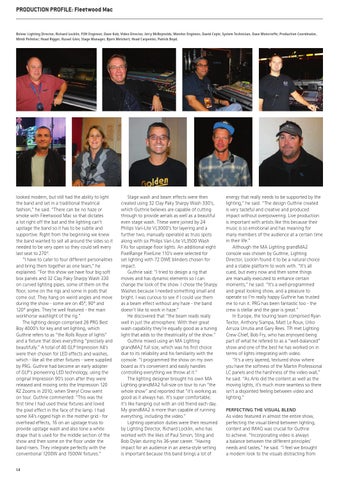
Below: Lighting Director, Richard Locklin; FOH Engineer, Dave Kob; Video Director, Jerry McReynolds; Monitor Engineer, David Coyle; System Technician, Dave Moncrieffe; Production Coordinator, Mindi Pelletier; Head Rigger, Russel Glen; Stage Manager, Bjorn Melchert; Head Carpenter, Patrick Boyd.
looked modern, but still had the ability to light the band and set in a traditional theatrical fashion,” he said. “There can be no haze or smoke with Fleetwood Mac so that dictates a lot right off the bat and the lighting can’t upstage the band so it has to be subtle and supportive. Right from the beginning we knew the band wanted to sell all around the sides so it needed to be very open so they could sell every last seat to 270°. “I have to cater to four different personalities and bring them together as one team,” he explained. “For this show we have four big soft box panels and 32 Clay Paky Sharpy Wash 330 on curved lighting pipes, some of them on the floor, some on the rigs and some in pods that come out. They hang on weird angles and move during the show - some are on 45º, 90º and 120º angles. They’re well featured - the main workhorse washlight of the rig.” The lighting design comprised 26 PRG Best Boy 4000’s for key and set lighting, which Guthrie refers to as “the Rolls Royce of lights” and a fixture that does everything “precisely and beautifully.” A total of 40 GLP Impression X4’s were then chosen for LED effects and washes, which - like all the other fixtures - were supplied by PRG. Guthrie had become an early adopter of GLP’s pioneering LED technology, using the original Impression 90’s soon after they were released and moving onto the Impression 120 RZ Zooms in 2010, when Sheryl Crow went on tour. Guthrie commented: “This was the first time I had used these fixtures and loved the pixel effect in the face of the lamp. I had some X4’s rigged high in the mother grid - for overhead effects, 16 on an upstage truss to provide upstage wash and also tone a white drape that is used for the middle section of the show and then some on the floor under the band risers. They integrate perfectly with the conventional 1200W and 1500W fixtures.” 58
Stage wash and beam effects were then created using 32 Clay Paky Sharpy Wash 330’s, which Guthrie believes are capable of cutting through to provide aerials as well as a beautiful even stage wash. These were joined by 24 Philips Vari-Lite VL3000’s for layering and a further two, manually operated as truss spots along with six Philips Vari-Lite VL3500 Wash FXs for upstage floor lights. An additional eight PixelRange PixelLine 110’s were selected for set lighting with 72 DWE blinders chosen for impact. Guthrie said: “I tried to design a rig that moves and has dynamic elements so I can change the look of the show. I chose the Sharpy Washes because I needed something small and bright. I was curious to see if I could use them as a beam effect without any haze - the band doesn’t like to work in haze.” He discovered that “the beam reads really well in just the atmosphere. With their great wash capability they’re equally good as a tuning light that adds to the theatricality of the show.” Guthrie mixed using an MA Lighting grandMA2 full size, which was his first choice due to its reliability and his familiarity with the console. “I programmed the show on my own board as it’s convenient and easily handles controlling everything we throw at it.” The lighting designer brought his own MA Lighting grandMA2 full-size on tour to run “the whole show” and reported that “it’s working as good as it always has. It’s super comfortable; it’s like hanging out with an old friend each day. My grandMA2 is more than capable of running everything, including the video.” Lighting operation duties were then resumed by Lighting Director, Richard Locklin, who has worked with the likes of Paul Simon, Sting and Bob Dylan during his 36-year career. “Having impact for an audience in an arena-style setting is important because this band brings a lot of
energy that really needs to be supported by the lighting,” he said. “The design Guthrie created is very tasteful and creative and produced impact without overpowering. Live production is important with artists like this because their music is so emotional and has meaning for many members of the audience at a certain time in their life.” Although the MA Lighting grandMA2 console was chosen by Guthrie, Lighting Director, Locklin found it to be a natural choice and a stable platform to work with. “It’s all cued, but every now and then some things are manually executed to enhance certain moments,” he said. “It’s a well-programmed and great looking show, and a pleasure to operate so I’m really happy Guthrie has trusted me to run it. PRG has been fantastic too - the crew is stellar and the gear is great.” In Europe, the touring team comprised Ryan Textor, Anthony Siampa, Matt Le Roux, Urko Arruza Urrutia and Gary Rees. TPi met Lighting Crew Chief, Bob Fry, who has enjnoyed being part of what he refered to as a “well-balanced” show and one of the best he has worked on in terms of lights integrating with video. “It’s a very layered, textured show where you have the softness of the Martin Professional LC panels and the harshness of the video wall,” he said. “As Arlo did the content as well as the moving lights, it’s much more seamless so there isn’t a disjointed feeling between video and lighting.” PERFECTING THE VISUAL BLEND As video featured in almost the entire show, perfecting the visual blend between lighting, content and IMAG was crucial for Guthrie to achieve. “Incorporating video is always a balance between the different principles’ needs and tastes,” he said. “I feel we brought a modern look to the visuals distracting from