IN THE SPOTLIGHT: TAIT
TAIT’S CONSTELLATION SERIES TAIT’S CONSTELLATION SERIES OF CONSOLES WERE LAUNCHED AT LAST YEAR’S LDI SHOW IN LAS VEGAS TO AN ENCOURAGING RECEPTION. 10 MONTHS ON, THE CONSOLE DESIGN HAS GONE FROM STRENGTH TO STRENGTH. TPi’S KELLY MURRAY SPOKE TO KEVIN TAYLOR, PRESIDENT OF AUTOMATION AND JIMMY LOVE, DIRECTOR OF R&D, PRODUCT DEVELOPMENT, TO GET THE BEHIND THE SCENES VIEW ON THE AUTOMATION WORLD’S LATEST CONTROLLER. The Constellation Control Console was developed around the idea of modularity and the ability to serve small to large-scale applications in various markets. The basic console includes a QNX server, Windows GUI, a console and an E-stop controller combined into one product. Based on the architecture of the Navigator system, the console serves as a user-friendly tool for communicating with other control nodes on the network. It contains two computers that utilise separate power systems to provide redundancy. The concept for the Constellation control console series arose because TAIT wanted to improve on its previous automation system. “The console is the first product in the new automation control line and offers many new key features. We included more efficient realtime feedback, an upgrade of our safety features, a sleek new modular / scalable design enclosure, and touchscreen interface with 68
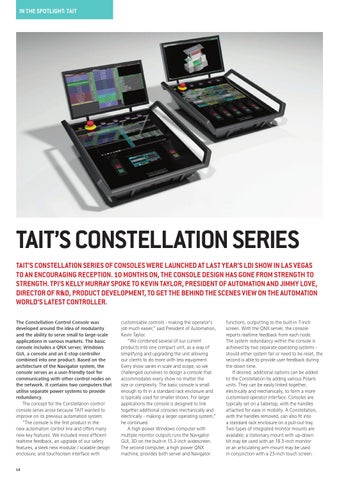
customisable controls - making the operator’s job much easier,” said President of Automation, Kevin Taylor. “We combined several of our current products into one compact unit, as a way of simplifying and upgrading the unit allowing our clients to do more with less equipment. Every show varies in scale and scope, so we challenged ourselves to design a console that accommodates every show no matter the size or complexity. The basic console is small enough to fit in a standard rack enclosure and is typically used for smaller shows. For larger applications the console is designed to link together additional consoles mechanically and electrically - making a larger operating system,” he continued. A high power Windows computer with multiple monitor outputs runs the Navigator GUI, 3D on the built-in 15.3-inch widescreen. The second computer, a high power QNX machine, provides both server and Navigator
functions, outputting to the built-in 7-inch screen. With the QNX server, the console reports realtime feedback from each node. The system redundancy within the console is achieved by two separate operating systems should either system fail or need to be reset, the second is able to provide user feedback during the down time. If desired, additional options can be added to the Constellation by adding various Polaris units. They can be easily linked together, electrically and mechanically, to form a more customised operator interface. Consoles are typically set on a tabletop, with the handles attached for ease in mobility. A Constellation, with the handles removed, can also fit into a standard rack enclosure on a pull-out tray. Two types of integrated monitor mounts are available; a stationary mount with up-down tilt may be used with an 18.5-inch monitor or an articulating arm mount may be used in conjunction with a 23-inch touch screen.