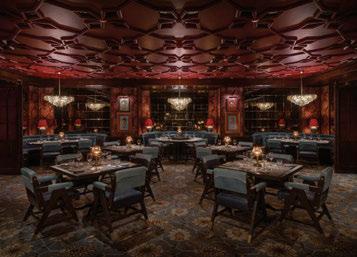
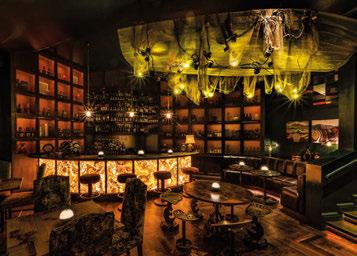
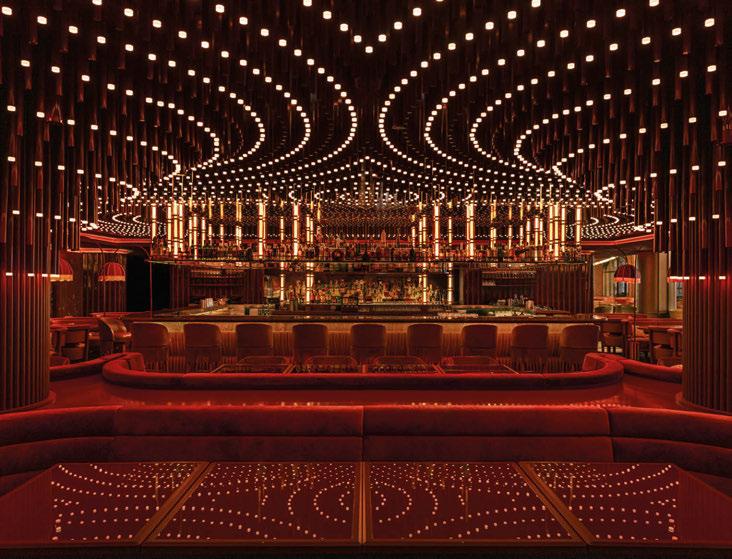
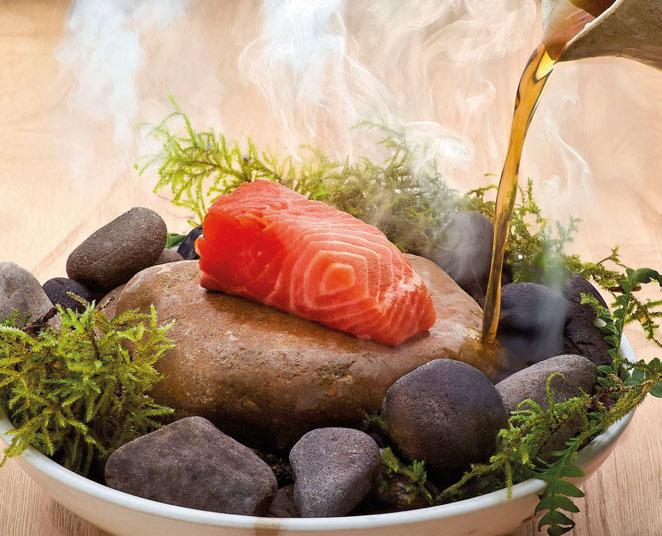
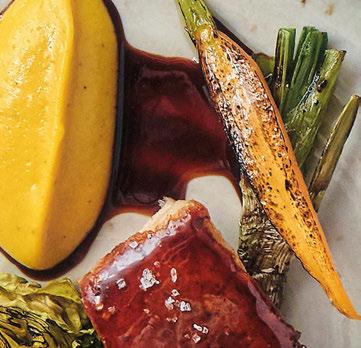
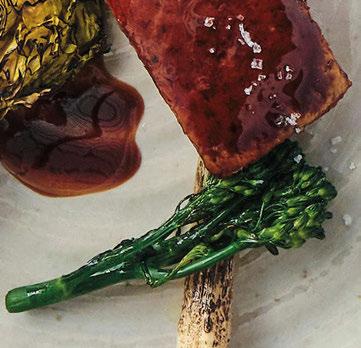
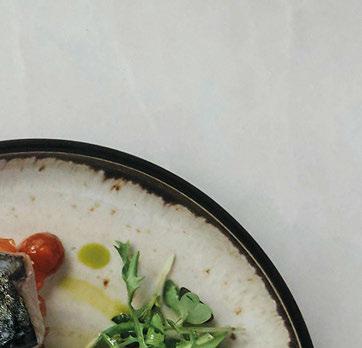
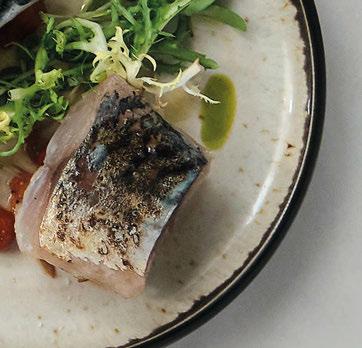
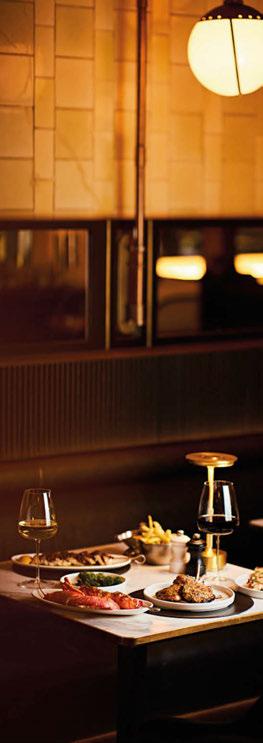
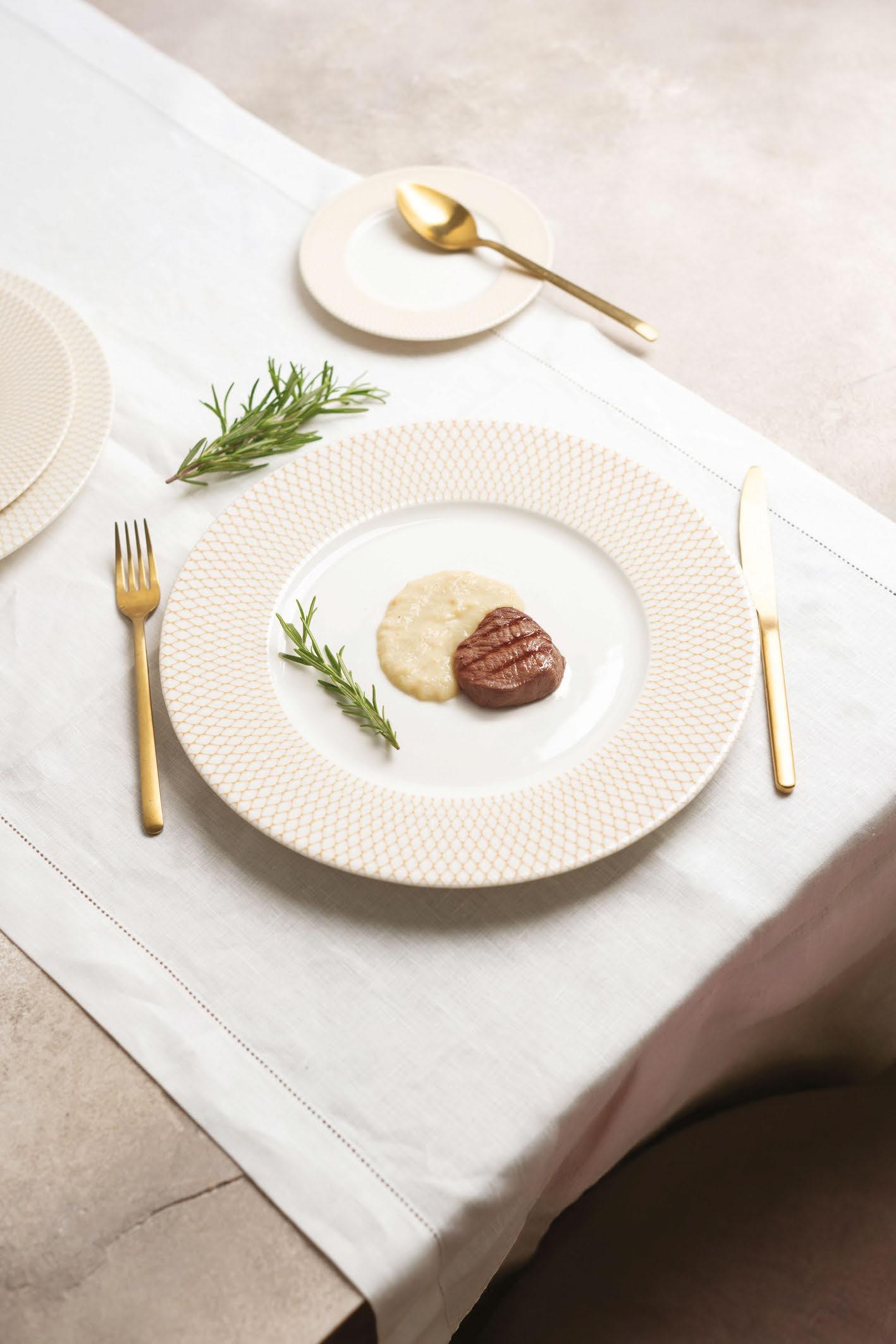
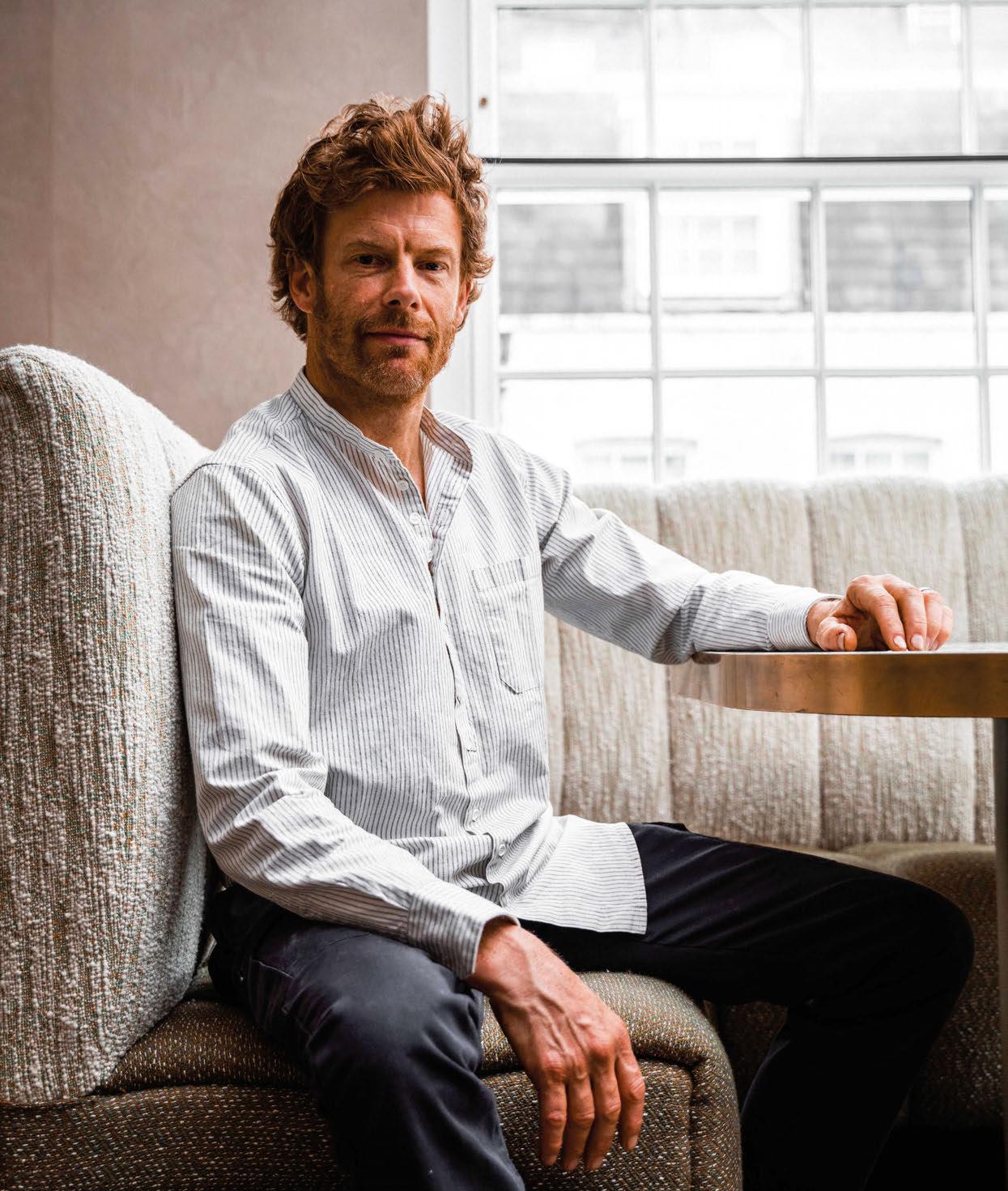
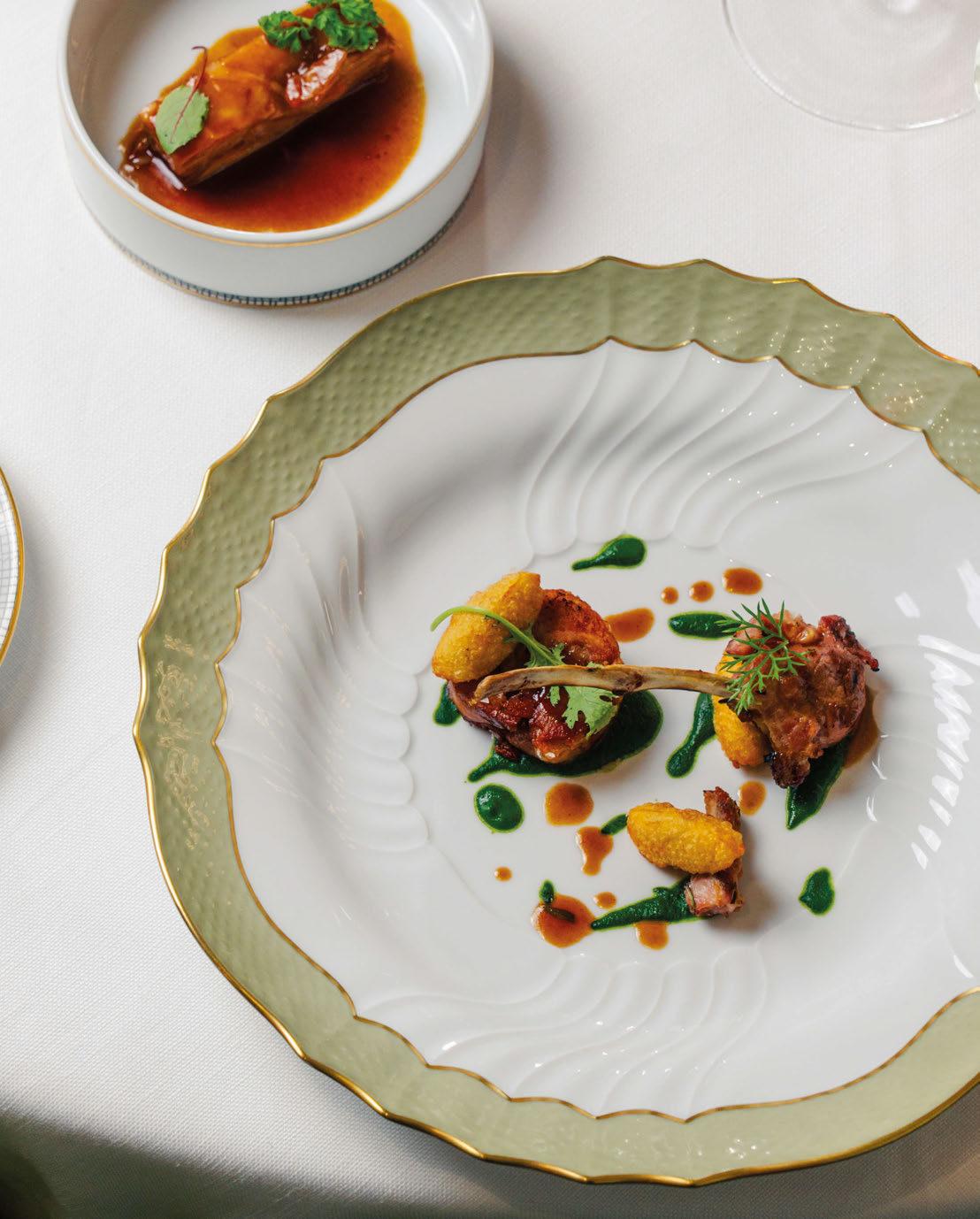
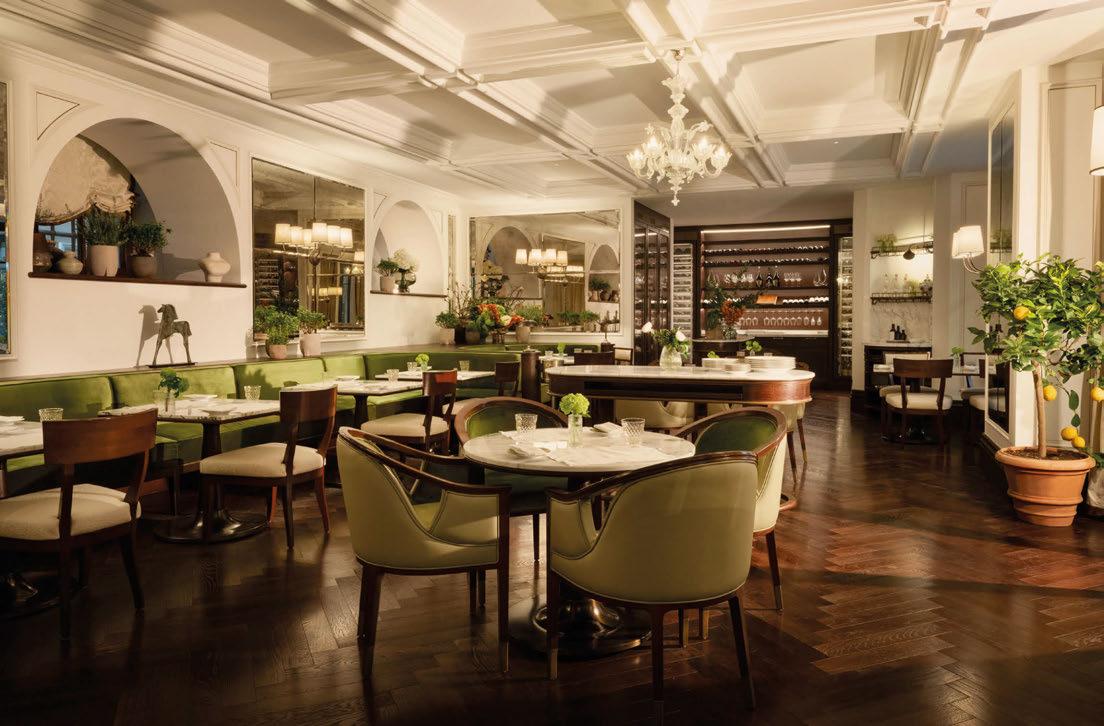
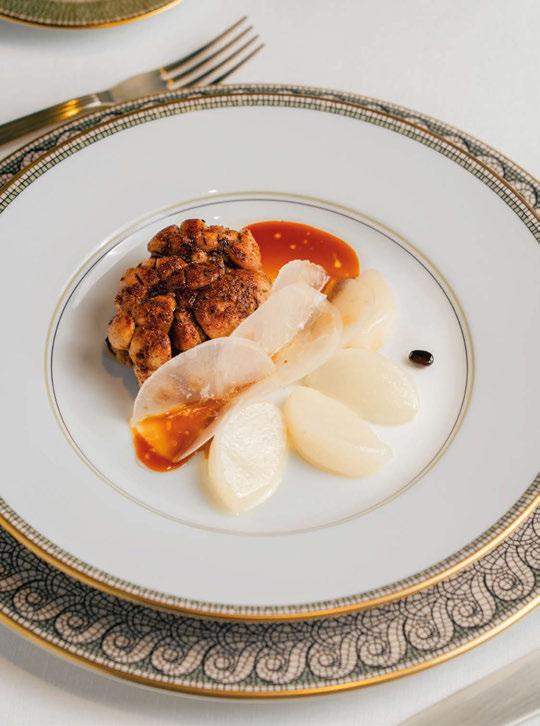
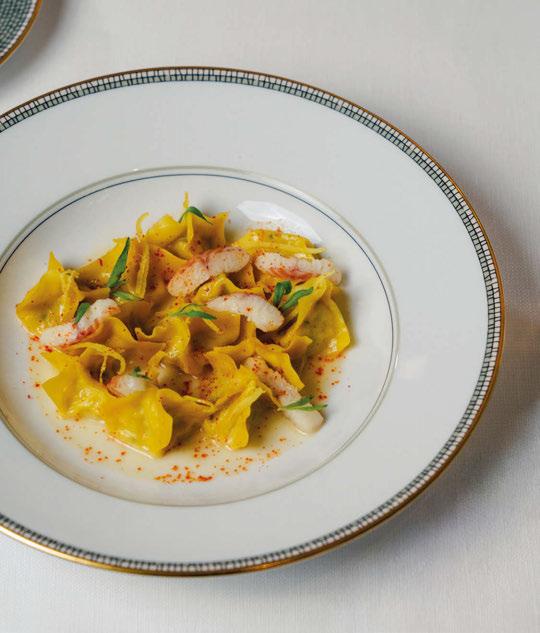
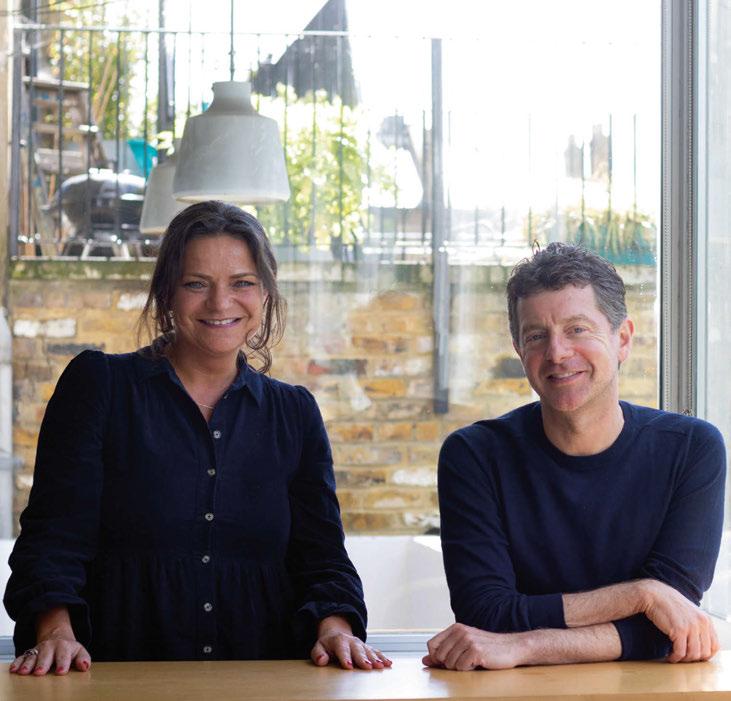
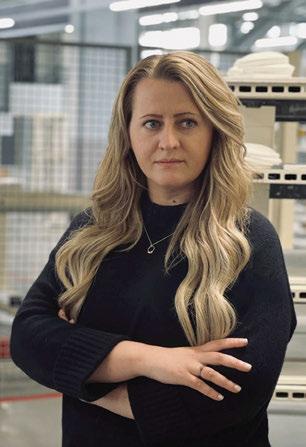
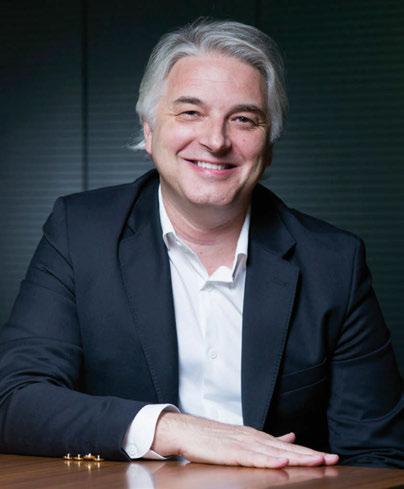
The Chef Patron of Muse by Tom Aiken recalls how a Norfolk childhood surrounded by homegrown produce sparked a lasting respect for seasonality.
Pastry Precision
040
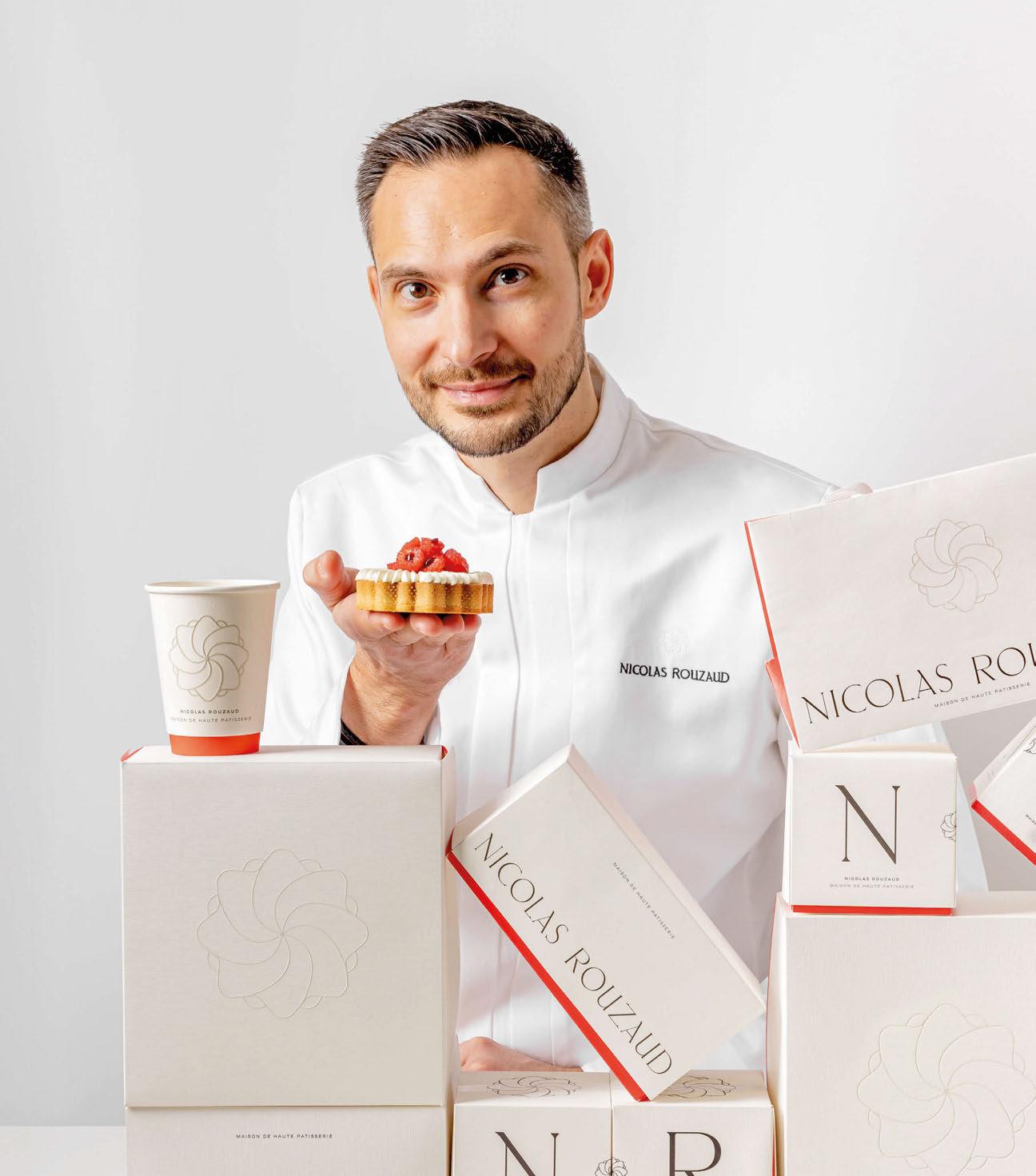
Fêted master pâtissier Nicolas Rouzaud expands his empire translating haute pâtisserie into an accessible and fun-filled ritual.
Family Affair
046
The master of Asturian gastronomy Nacho Manzano expands his geographic focus with a new hotel project on Porto’s River Douro, where the culinary heritage of the Iberian coast takes centre stage.
The Heat is On
052
Opening the UK’s first Hell’s Kitchen is just the start for Clermont Hotel Group, as it turns up the heat with a portfolio-wide push on distinctive and compelling F&B.
DINING
Food For The Soul
094
Zoe and Layo Paskin’s hospitality journey began with one of the best clubs in the world, but today they’ve swapped dance floors for dining.
SIPPING
Aurélie in Paris
110
The founder of CopperBay tracks her journey from Brittany to bartending and reveals how unrivalled hospitality rules the bar.
Get Your Kicks
126
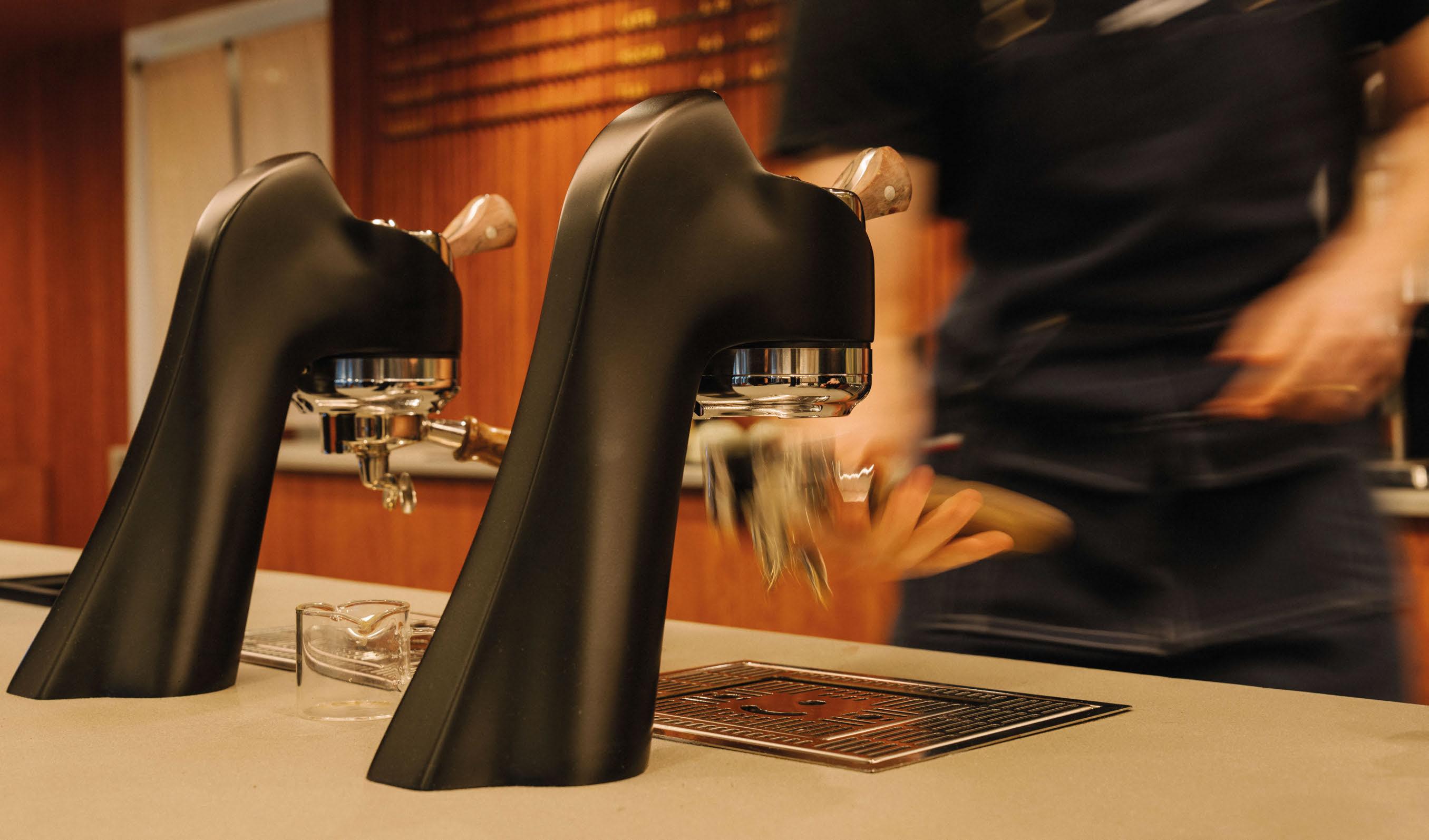
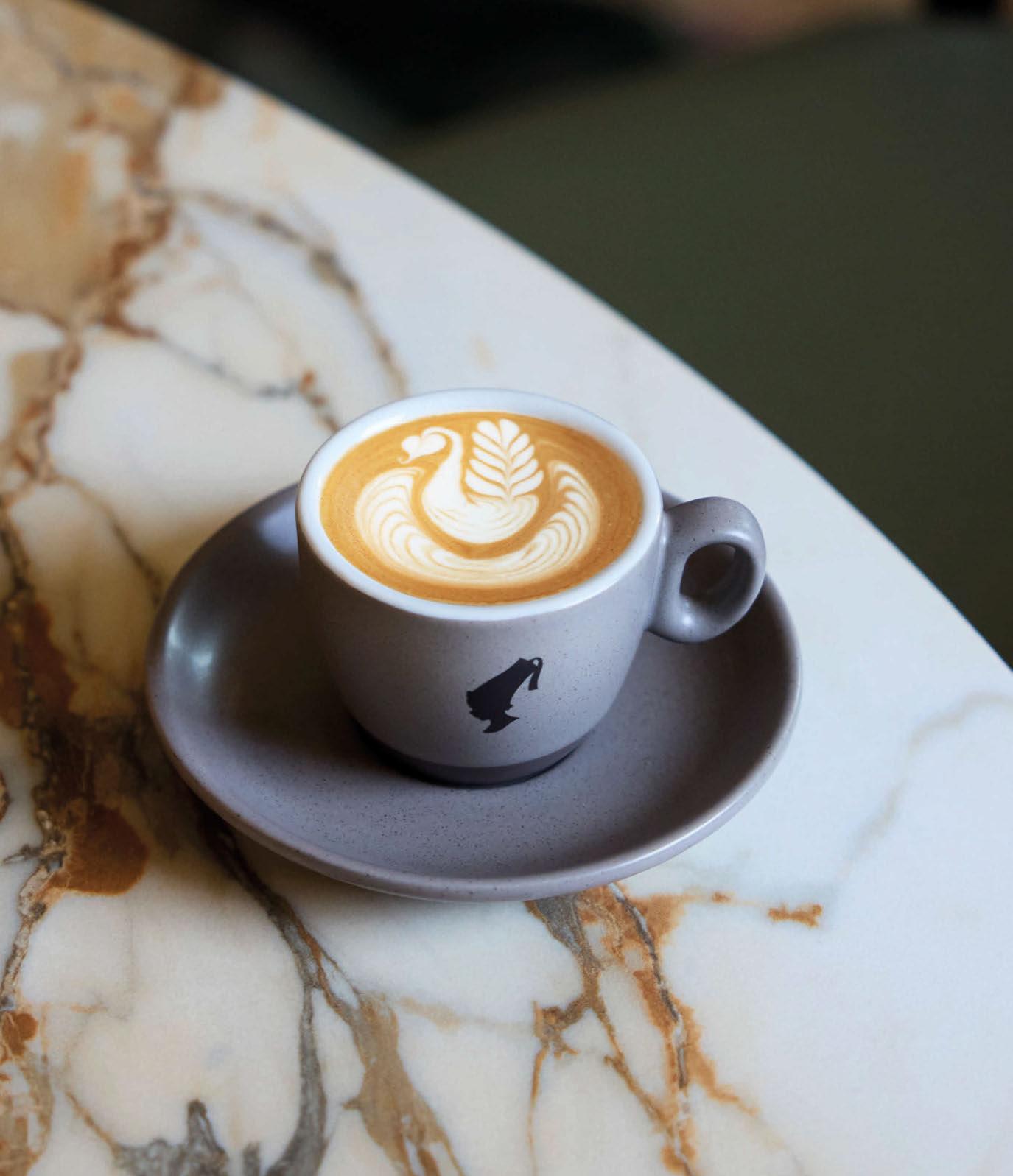
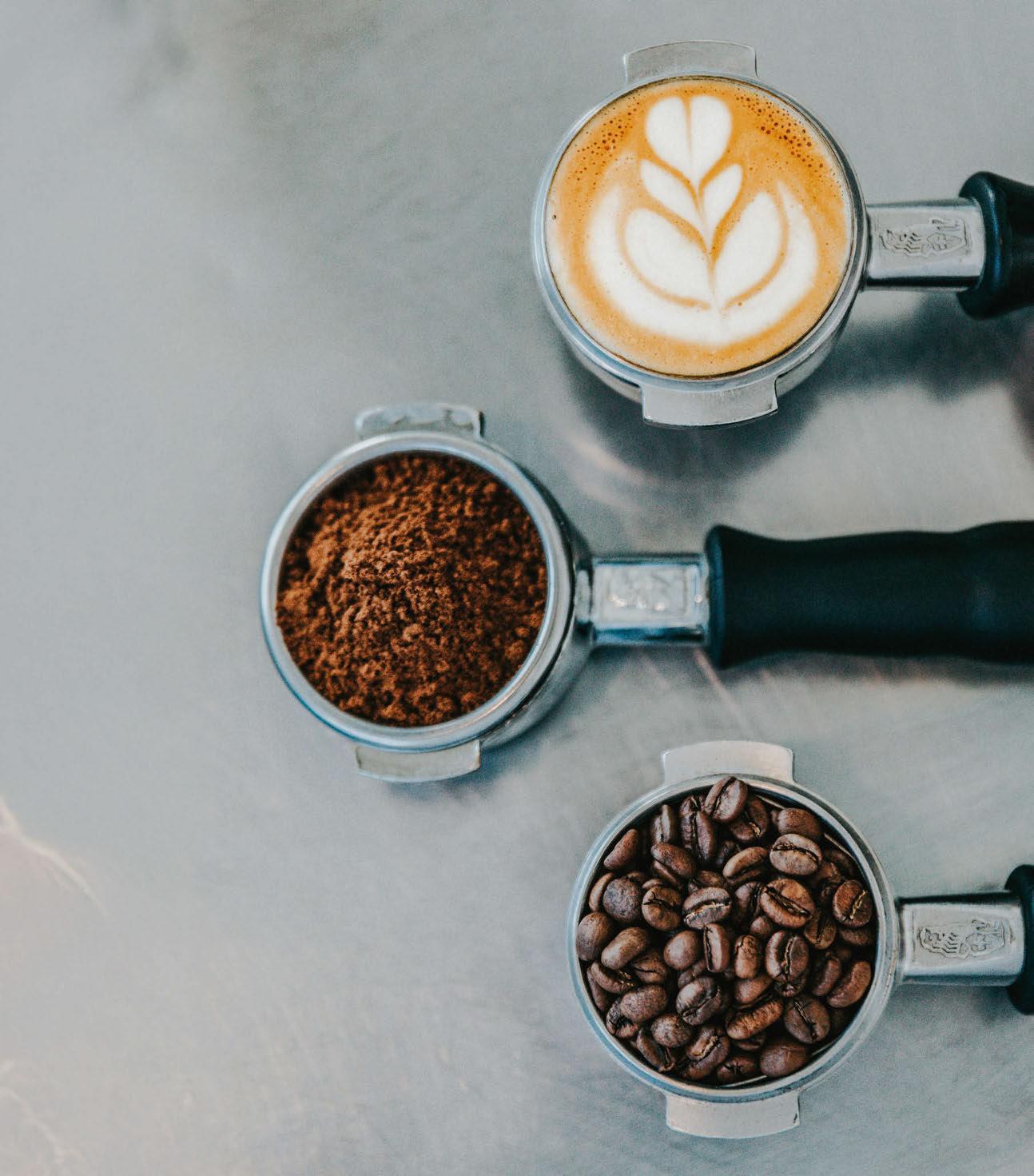
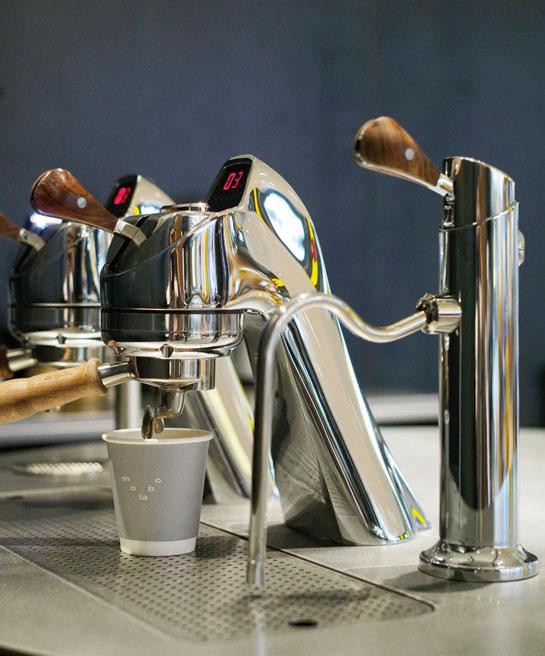
Sustainability, wellness and hyper-personalisation are redefining what people demand from their coffee, turning a formerly simple provision into a ritual that can embed guest loyalty.
Where English Craftsmanship meets Contemporary Luxury
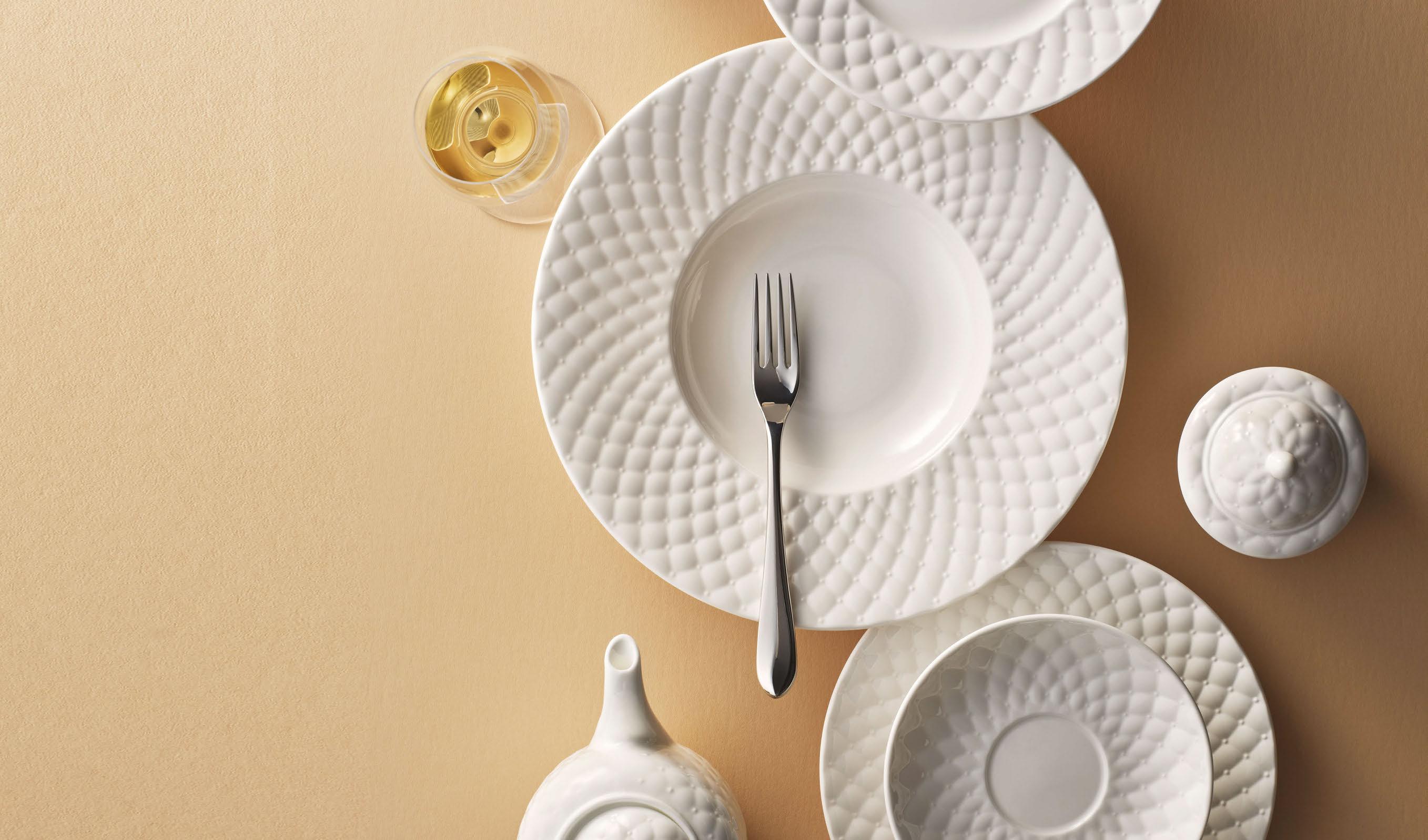
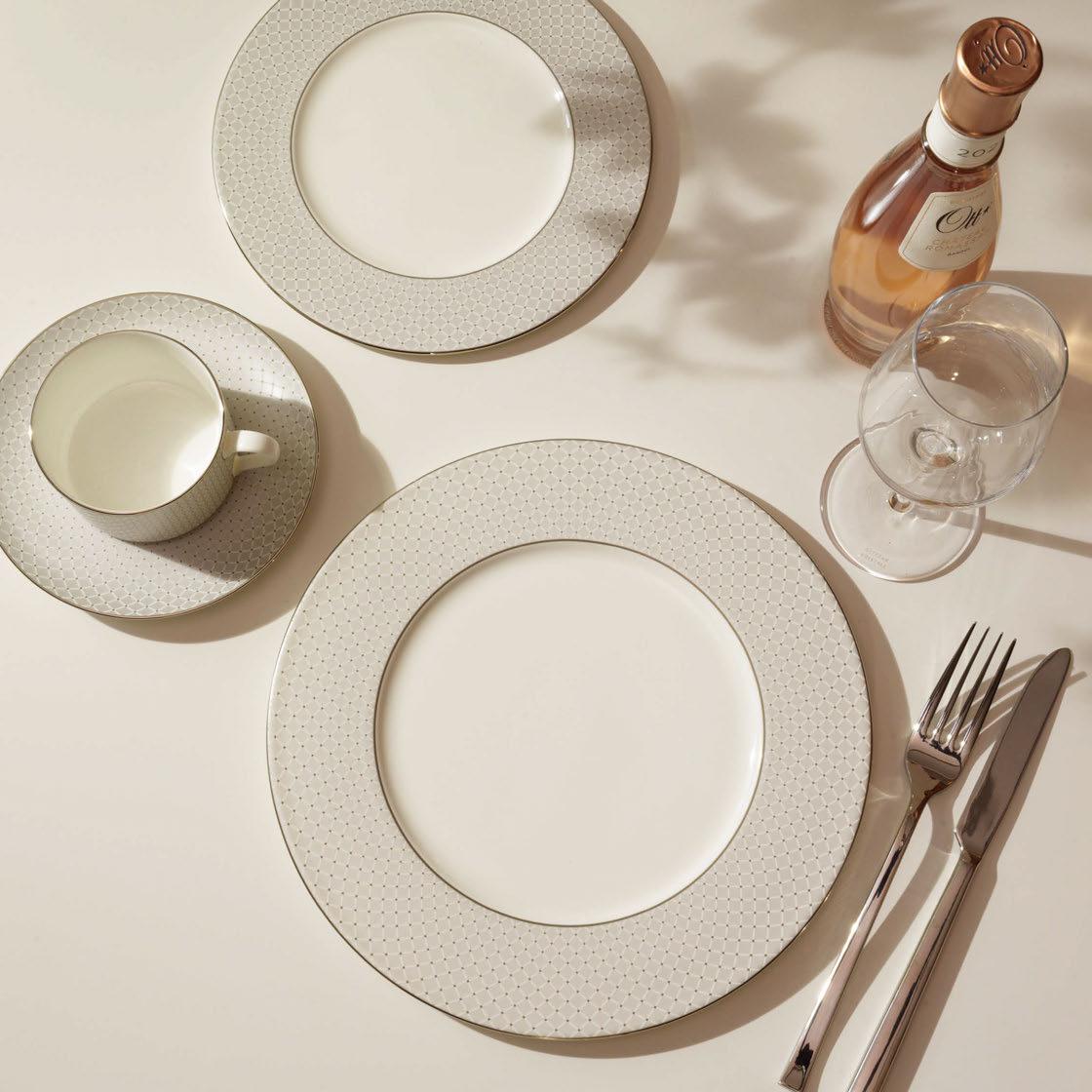
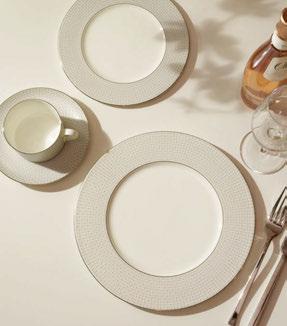
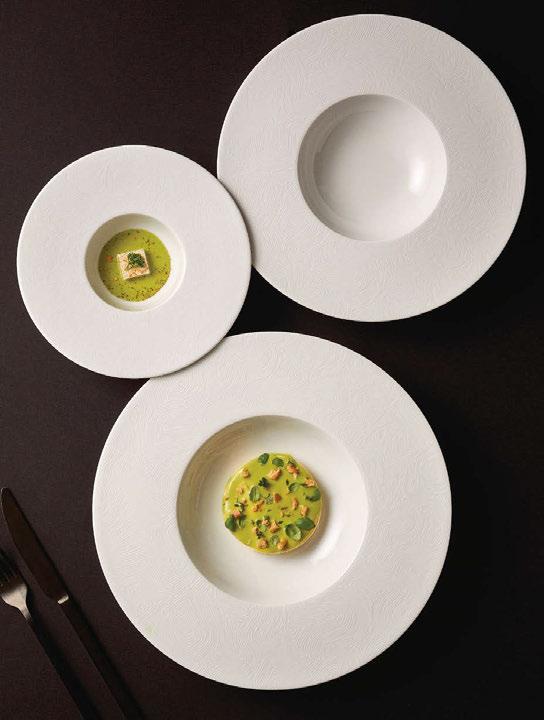
Echoing the tailored precision of classic 18th century furniture, Chesterfield introduces a finely quilted embossment that brings together sculptural clarity and a quiet sense of opulence. Staged upon a pristine bright-white canvas, each piece is meticulously crafted to reflect the essence of British heritage design—refined in character, luxurious in detail, and unmistakably sophisticated. Thoughtfully created for distinguished hotels, restaurants, and hospitality environments, Chesterfield lends an atmosphere of understated grandeur to every dining occasion, offering a statement of enduring elegance and elevated craftsmanship.
William Edwards ° Fine Bone China
Steelite International • Booth #6612 • National Restaurant Association Show Chicago, IL • May 16-19, 2026 • www.steelite.com
A PERFECT CUP FOR EVERY PREFERENCE
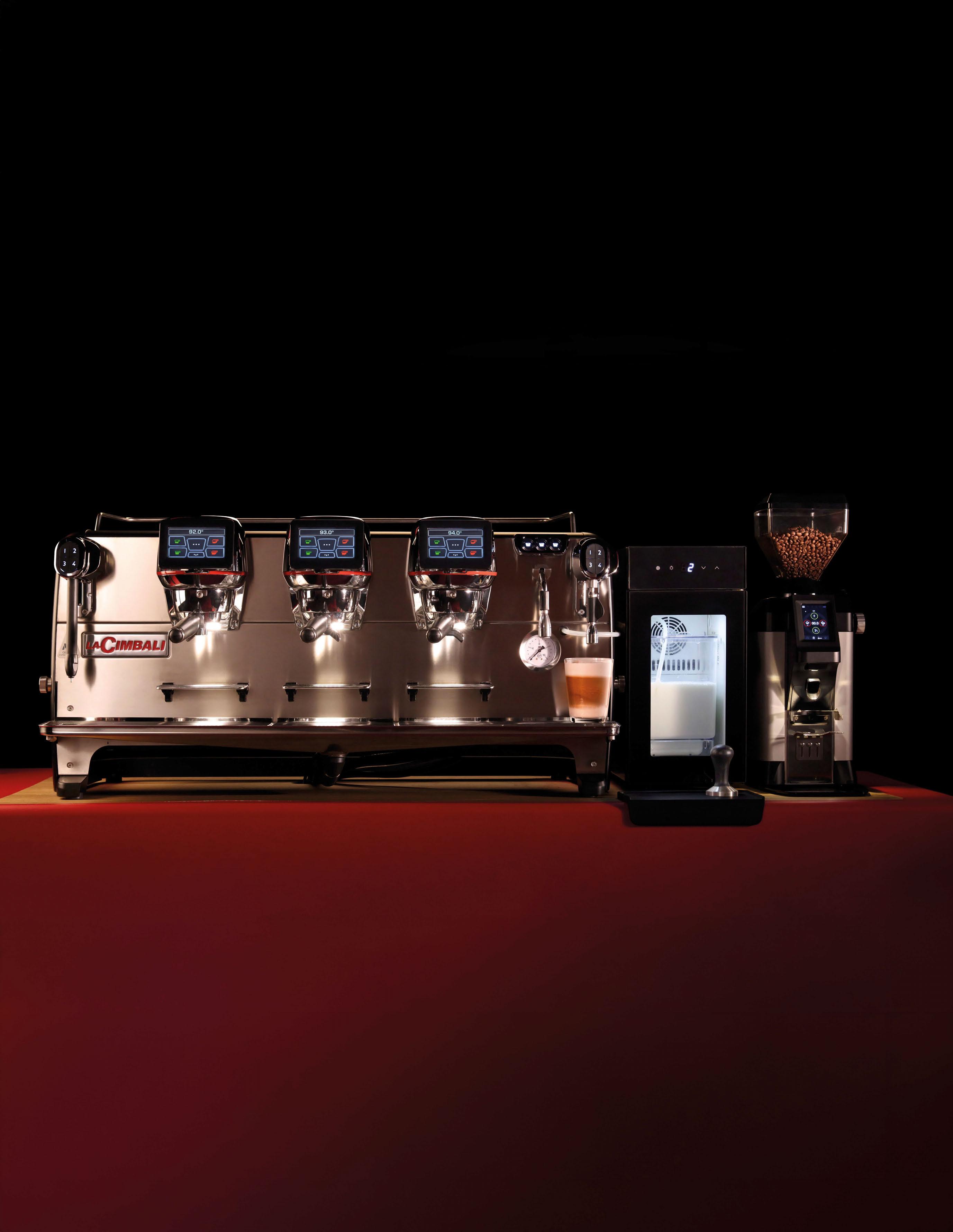
The New A Line
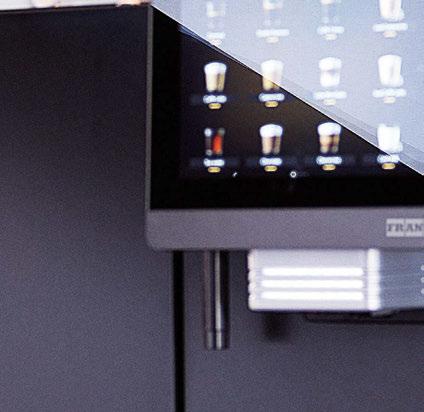
A quality coffee experience can make or break a hotel review. The New A Line lets guests choose exactly what they want - from bold espressos to creamy lattes with perfect foam - turning every order into a personalized moment worth remembering. It’s all about the moment.
HELIA COLLECTION
Collection not available for USA and Canada.
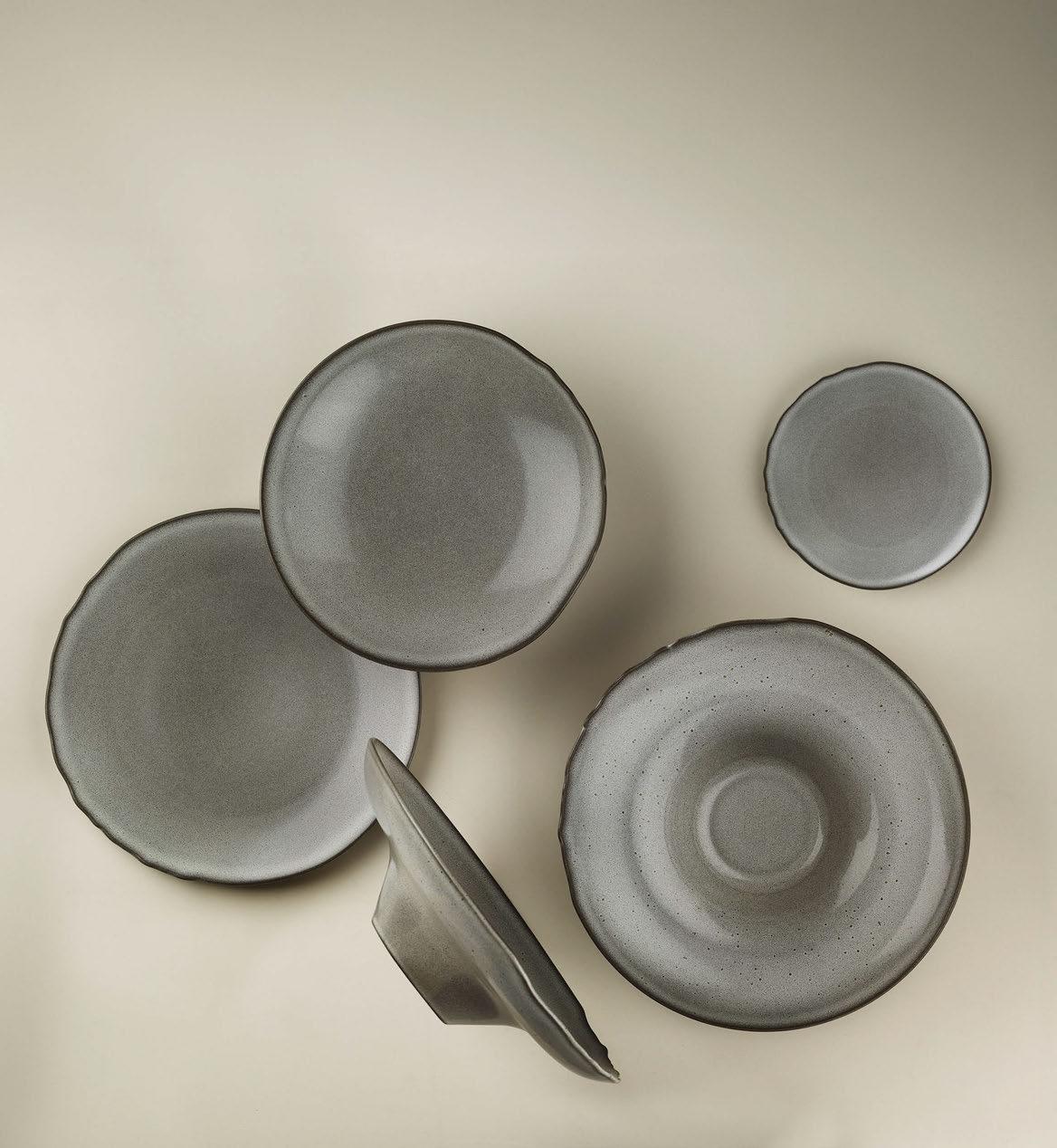
NORDIC IRON
Nordic history was written in iron and wood, molded in the wilderness, among dense forests, tundra and rough seas. These features of strength and resistance combined with a practical spirit are present in the shape and colors of the Nordic Iron collection, ready to conquer any table with the requirements of functionality, style and sobriety.
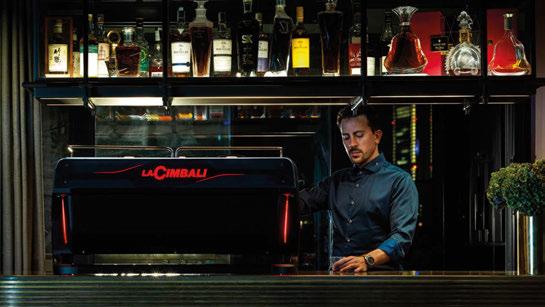
La Cimbali M200 High Quality Milk is designed to support baristas with intelligent automation that enhances skill, not replaces it. At its core is HQM — High Quality Milk — a built-in feature of the Automated Perfection system, delivering elevated milk performance with speed and precision for both hot and cold milk beverages.
The integrated milk management system produces perfectly textured milk in seconds, ensuring consistent temperature — hot or cold depending on the recipe — silky microfoam and exceptional in-cup quality with minimal effort. The result? Signature beverages with flawless taste, cup after cup — because when performance is constant, creativity can truly shine.
Discover more at lacimbalim200.com
Next trade shows:
New York Tabletop Show | April 14-17 | 41 Madison, Floor 7
F&B@Sea | April 15-16 | PP-6
NRA | May 16-19 | North Building 7445
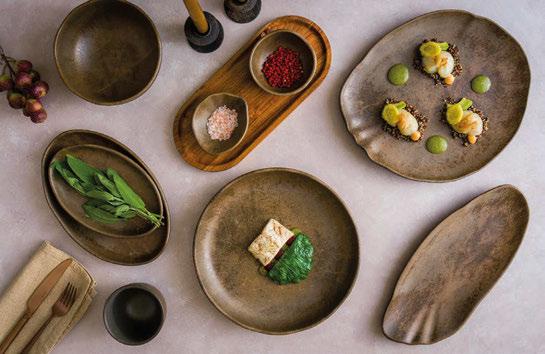
PORCELAIN
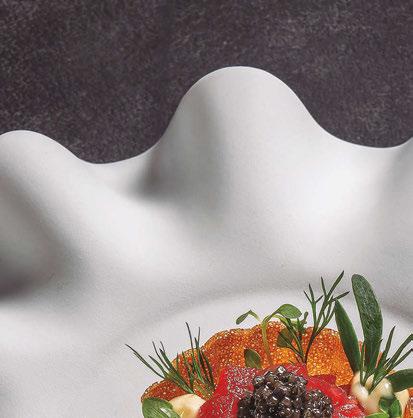
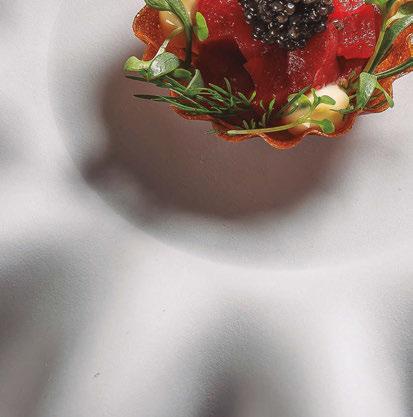
Resonance collection
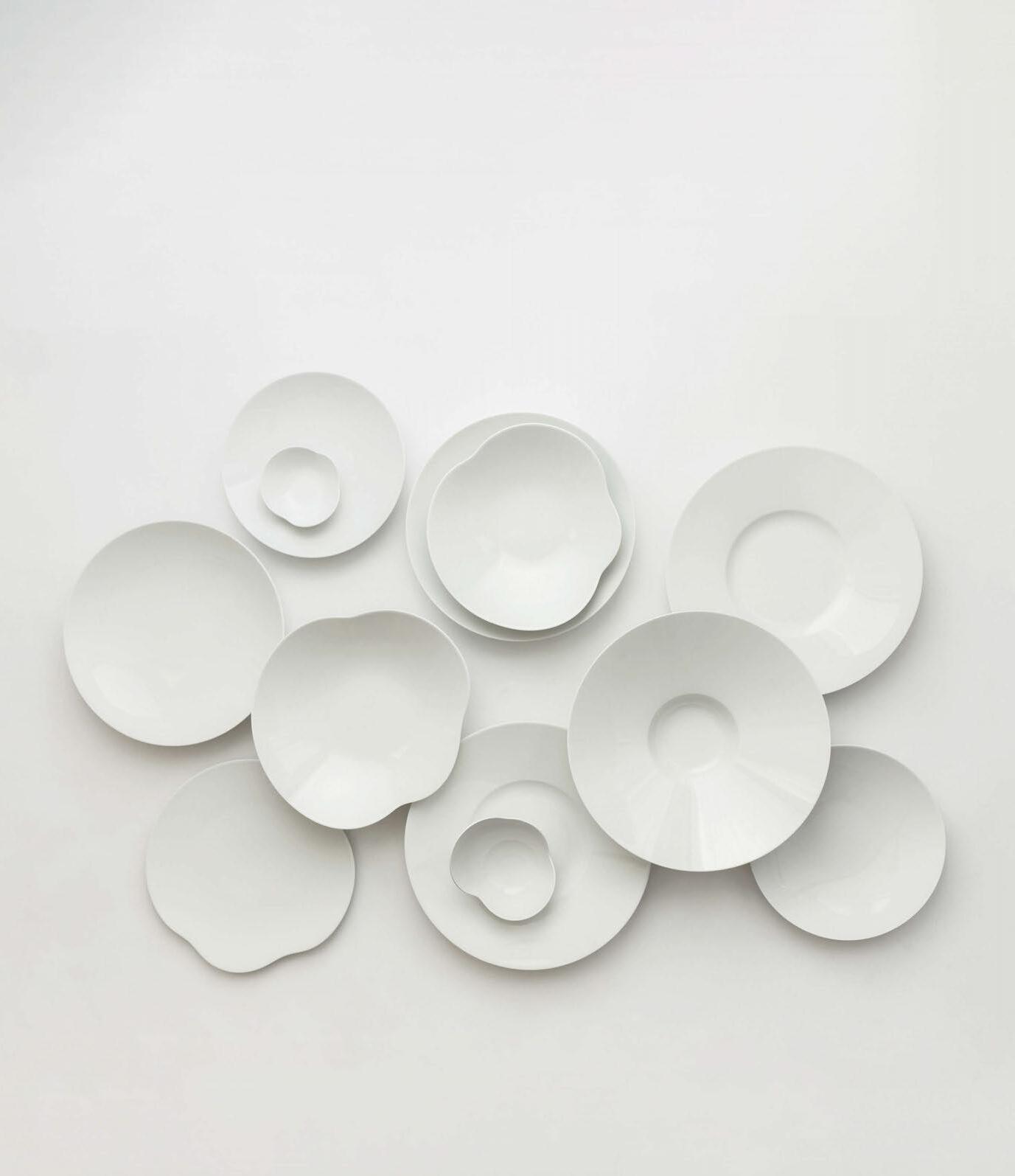
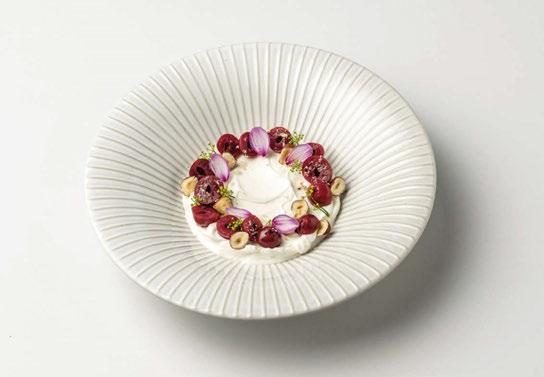
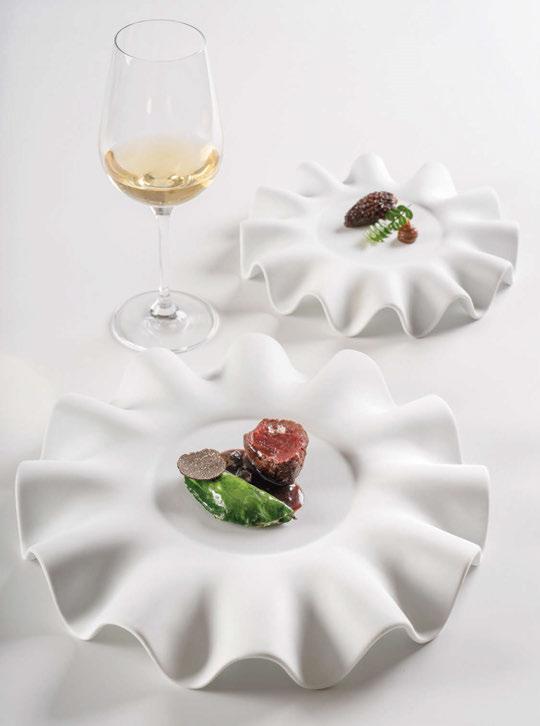
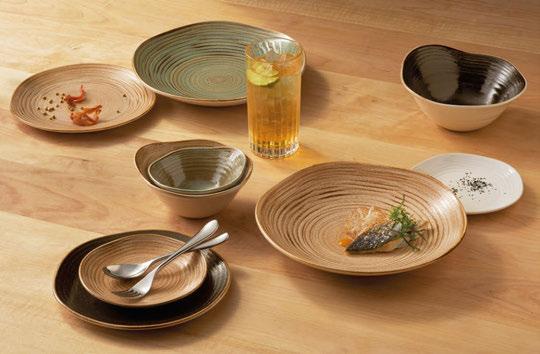
Resonance, designed by Carsten Gollnick, merges porcelain and stoneware in a harmonious collection that invites you to push the boundaries of table setting creativity. Soft and smooth textures, waving patterns, and innovative shapes make this collection perfect for mix and match.
costanovaprofessional.com
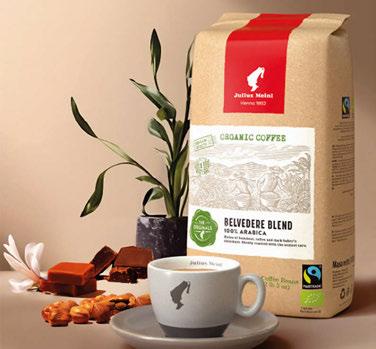
COFFEE THAT’S BETTER IN EVERY WAY.
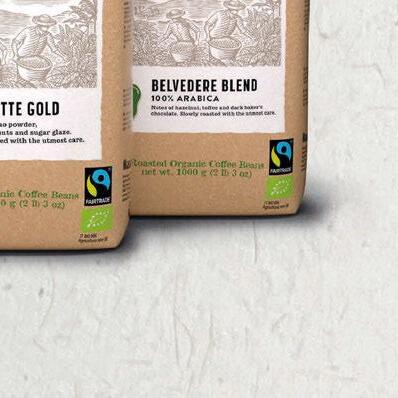
THE ORIGINALS BIO FAIRTRADE .
DOUBLE CERTIFIED
Where every single bean is nurtured through responsible organic agriculture and Julius Meinl’s trademark Vienna craftsmanship. Three exquisite blends available in whole beans and ground. TIFIED
2 W ARRANTY YEARS
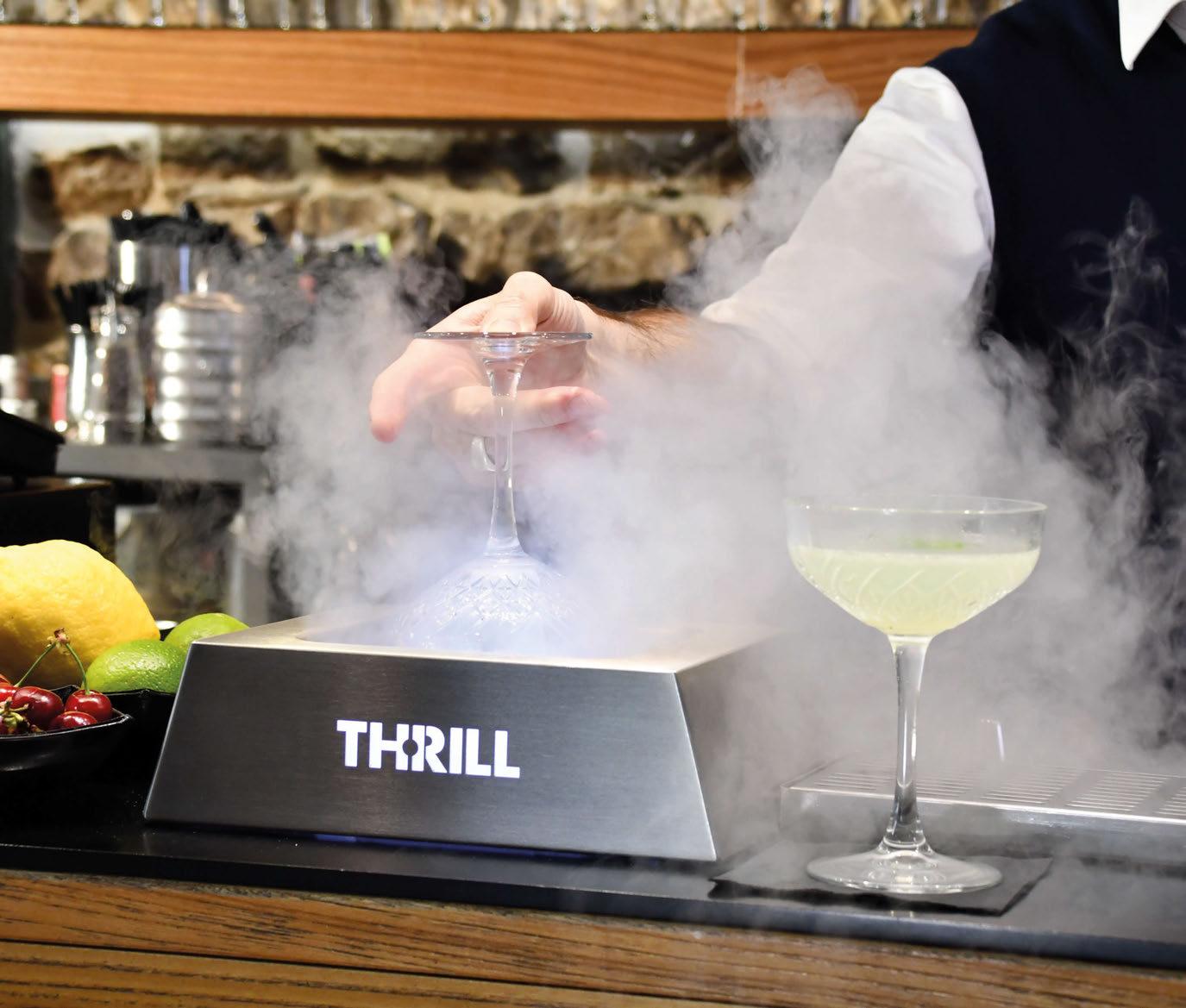
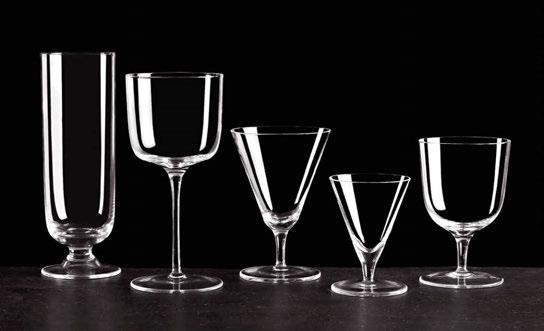
Our latest sleek and slimline product design for chilling and sanitizing glasses instantly.
ENTRÉE
Weather The Storm
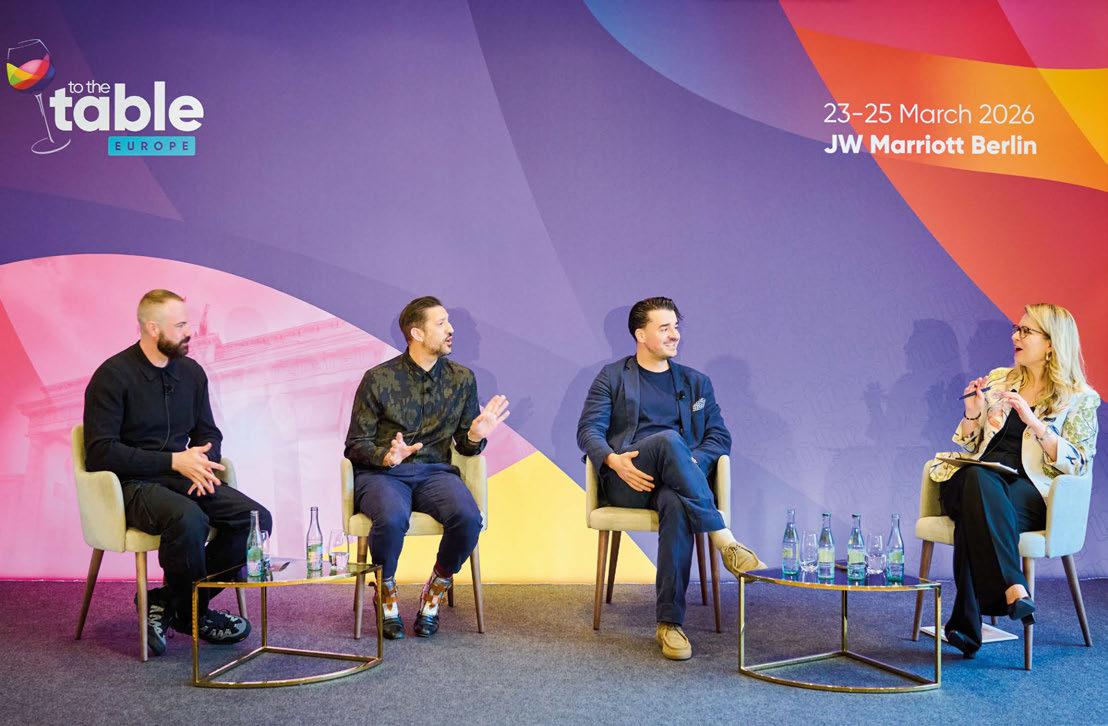
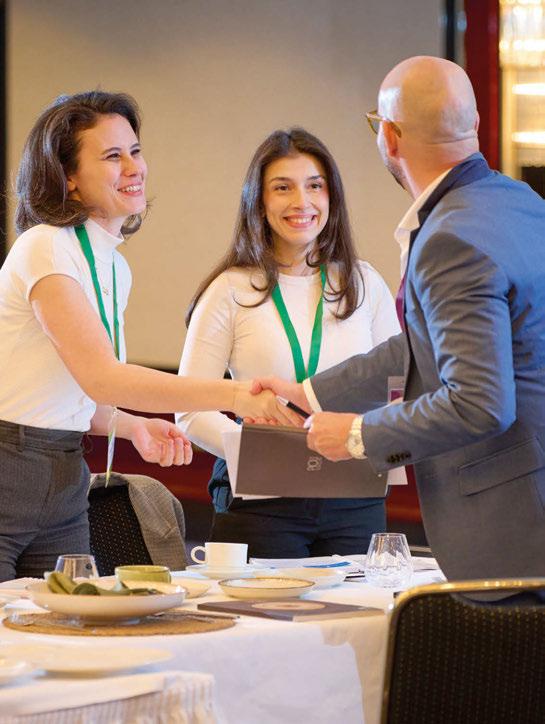
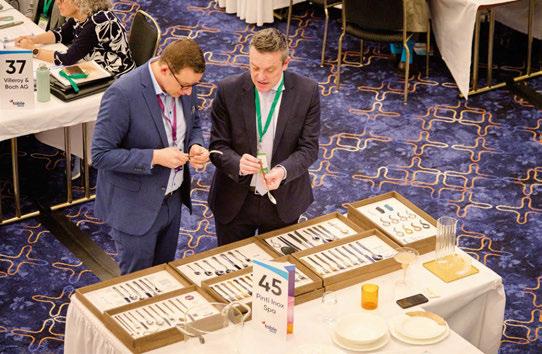
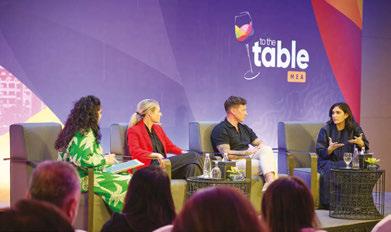
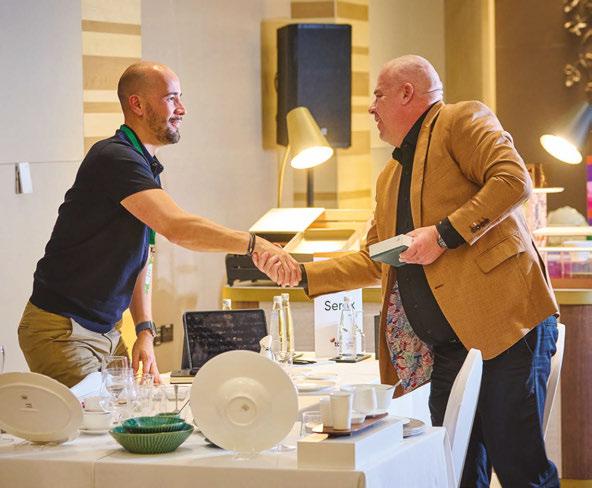
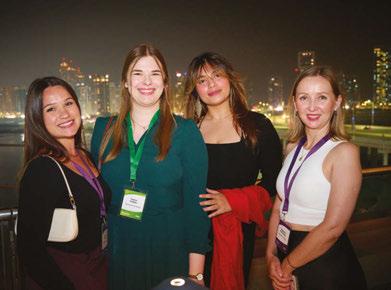
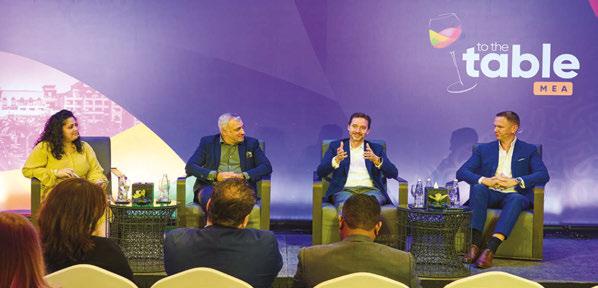
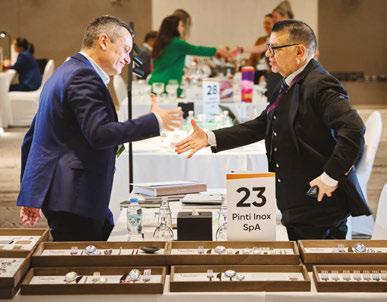
It is tricky to avoid the seemingly relentless stream of bad news broadcast on every platform at the moment – from multiple wars and the cost of living crisis to rising energy prices and the erratic actions of a notorious American President who shall remain nameless. Certainly, the multipronged challenges facing the hospitality industry were a hot topic of conversation at this year’s To The Table Europe, which took place across an uncharacteristically warm and sunny few days in Berlin back in March.
But despite the inevitable concern among both buyers and suppliers, the mood was relatively upbeat. Perhaps it was the unseasonal springtime weather (or the free drinks) adding a boost to everyone’s step, or maybe it was just the collective awareness of a room full of people who’ve seen, experienced and weathered similar or worse, and still managed to come out the other side.
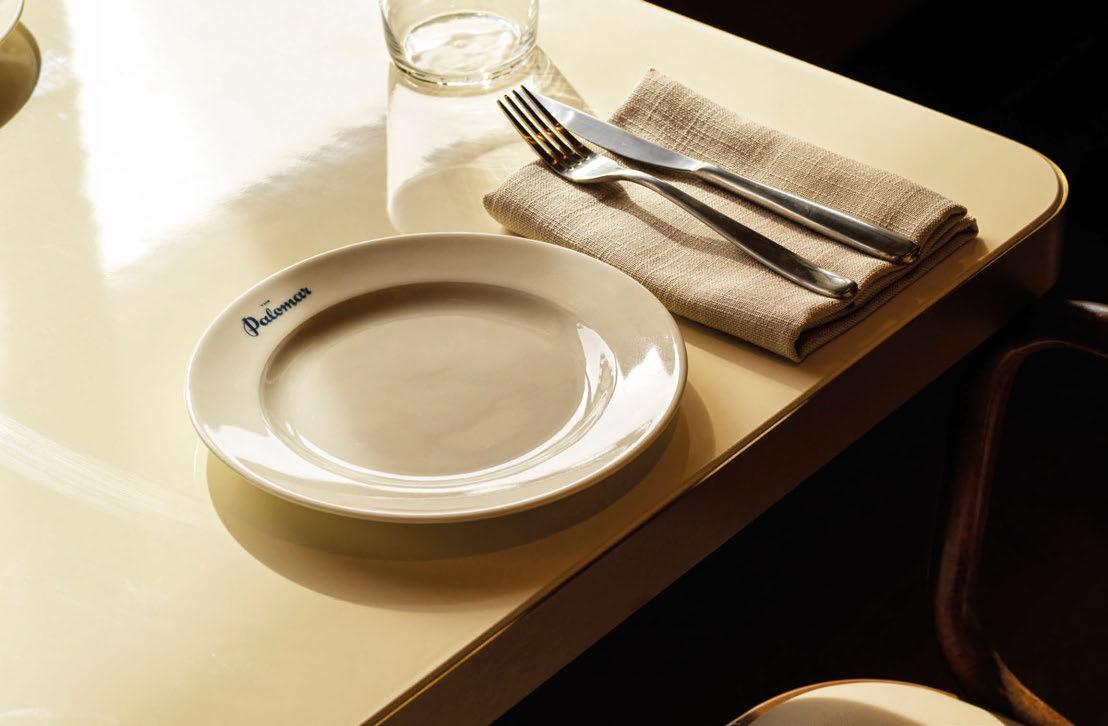
I say all this not to conjure more doom and gloom, of which there is plenty already, but rather to emphasise the sector’s ability to overcome hurdles that threaten to stand in its way. In a conversation I shared with creative hospitality duo Zoe and Layo Paskin, founders of Studio Paskin, they recalled how they opened their inaugural Soho restaurant The Palomar in in 2014, noting that it was a rich period of rebirth for London’s foodie scene after the ravages of teh recession. Their most recent projects have taken them Down Under to Sydney, and you can read more about that in our interview on page 094.
Elsewhere, and signs of how the hospitality industry continually evolves abound, not least in our interview with master pâtissier, Nicolas Rouzaud, whose meticulously created pastries have reached new audiences as the notion of ‘treat culture’ has gained pace, especially with Gen Z, who seek out
and share their next small indulgences on TikTok. Indeed, his precision sweet treats are the perfect example of how to engage and retain new consumers, meeting their needs with high-end yet affordable extravagances that can be enjoyed by everyone rather than the elite few.
There are signs of this in our annual coffee feature too, in which we highlight the trends affecting the industry. This year, it’s sustainability, wellness and personalisation making the greatest impact on what and how people source their caffeine kicks. And suppliers are responding at speed, developing new products that appeal to today’s savvy sippers, who demand quality over quantity and drinks tailored to their individual preferences.
And then of course, there’s examples of people doing brilliant things in beautiful places on every page throughout the magazine, from José Andrés finding a new and stunning Las Vegas home at The Venetian Resort for Bazaar Meat, to The Zetter Group, whose new opening in London’s Bloomsbury marks the beginning of a big expansion push in the UK capital and beyond.
So, yes there are uncharted waters to navigate, but there’s also a group of talented, bright minds at the helm of the ship, with both the capacity and the capabilities to continue to bring people together and to bring hope, just like all the best F&B experiences should.
Data & Marketing Adam Cymbaluk a.cymbaluk@mondiale.co.uk
DESIGN
Design Manager David Bell
Production Mel Capper Dan Seaton
CORPORATE
Chairman Damian Walsh
Chief Operating Officer
Amanda Giles Accounts ar@mondiale.co.uk
SUSTAINABILITY
Natural • Renewable • Recyclable
Supper is printed by Buxton Press on FSC Mix-certified paper using 100% vegetable-based inks. Magazines mailed from Spatial Global are packaged in FSC-certified wrap that is fully recyclable.
As hotel F&B continues to tap into popular culture and nostalgic storytelling in the creation of memorable guest experiences, JW Marriott Grosvenor House London is bringing Enid Blyton’s The Magic Faraway Tree to life with a whimsical, limited-edition afternoon tea.
Timed to celebrate the highly anticipated film adaptation of a family’s adventures across fantastical lands, The Magic Faraway Tree Afternoon Tea recounts the story through an imaginative menu crafted by Head Pastry Chef Anthony Hurst.
The focal point is a sponge tree encased in milk chocolate and topped with candy floss, featured alongside Moonface’s Mandarin Mousse, which pairs a
creamy base with a ginger snap and caramelised biscuit. Other highlights include Woodland Whispers, a white chocolate toadstool with cherry preserve; The Land of Dreams, a chocolate mousse crowned with a vanilla marshmallow cloud; and Silky’s Sparkling Granita featuring a spiced version of the Sicilian dessert finished with a sprinkle of fairy magic. The chef also offers up a selection of delicate finger sandwiches, freshly baked scones with clotted cream and preserves, and an extensive range of Newby’s teas.
An exclusively illustrated menu by Mark Beech, illustrator of The Magic Faraway Tree series is gifted to guests as a special keepsake.
Feast Mode
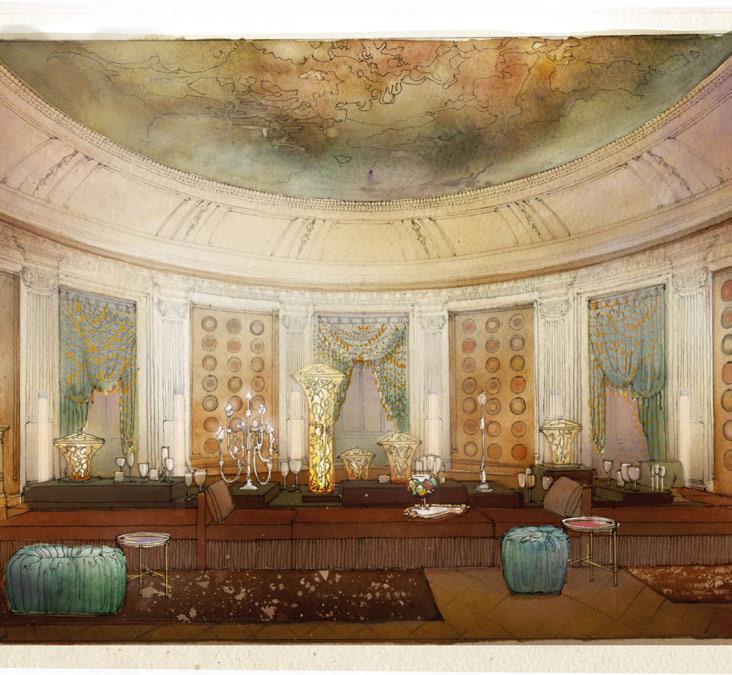
To mark the fourth edition of Artemest’s L’Appartamento at Milan Design Week, Rockwell Group recently transformed the oval dining room of Palazzo Donizetti on Via Gaetano Donizetti.
The concept preserved the palazzo’s historic features, including boiserie, frescoed ceiling and a carved marble fireplace, while reimagining the room as a contemporary Naples eatery. Entitled Bacchanalia: A Ritual in Pleasure, it drew on the ancient Roman triclinium – a U-shaped table arrangement seen in upper-class homes, which blurs the boundaries between architectural spectacle and leisure.
Rockwell Group interpreted this as a loungestyle environment with sculptural seating, daybeds, poufs and layered tables, encouraging diners to relax and linger. Evoking the aftermath of a feast, table settings were deliberately askew, carpets suggested spilled wine and plates were mounted as paintings, while framed artworks
became trays for food and ornamental vessels formed drinkware skyscrapers.
Naples’ volcanic spirit informed the material palette, inspired by the treasures of Tesoro di San Gennaro and the dramatic works of Caravaggio. Gold-toned metals shimmered alongside deep mineral hues and oceanic blues, while white marble punctuated darker surfaces.
Wine and seafood stations reinforced a sense of abundance and conviviality associated with Neapolitan hospitality, where custom resin nesting tables designed for Artemest mimicked seafood towers and stacked wine glasses, adding height and refracting light through the objects displayed above them. Custom lighting added the final touch, with inverted chandeliers appearing to fall from the ceiling and concealed lamps eliciting the glow of ancient oil lights, creating a warm, atmospheric setting fit for the grandest of celebrations.
Recipe for Happiness
From unemployed and bad at baking to a thriving pastry chef and social media personality, Will This Make You Happy: Stories & Recipes from a Year of Baking (Chronicle Books) recounts the highs and lows of self discovery while learning how to bake. Written by Tanya Bush, the 344-page tome begins with a disaster cake – a reminder of the pleasure of following a recipe, the joys of getting messy and reaching the finish line, no matter the result.
The culinary memoir also tells the story of how Bush, the co-founder of Cake Zine, progressed from her tiny New York kitchen to working at an Italian farm stay, and finally landing a job in a Brooklyn bakery. The gastronomic journey unfolds through a collection of 50 seasonal recipes, offering words of encouragement to engage with the chaotic yet more humorous side of baking. From orange almond cake and Earl Grey compote to the cruller that was named New York magazine’s best pastry, she regales falling back in love with both the craft and relationships. And despite assuring readers that she still has baking fails to this day, Bush charts a course to becoming more selfassured in the kitchen and beyond.
Michelin-starred chef Heiko Nieder invites a lucky few into his kitchen at The Dolder Grand in Zurich.
Fine dining today is a blend of personal touch and precision cuisine, a delicate balance that’s made chef’s tables a growing and popular trend across the world.
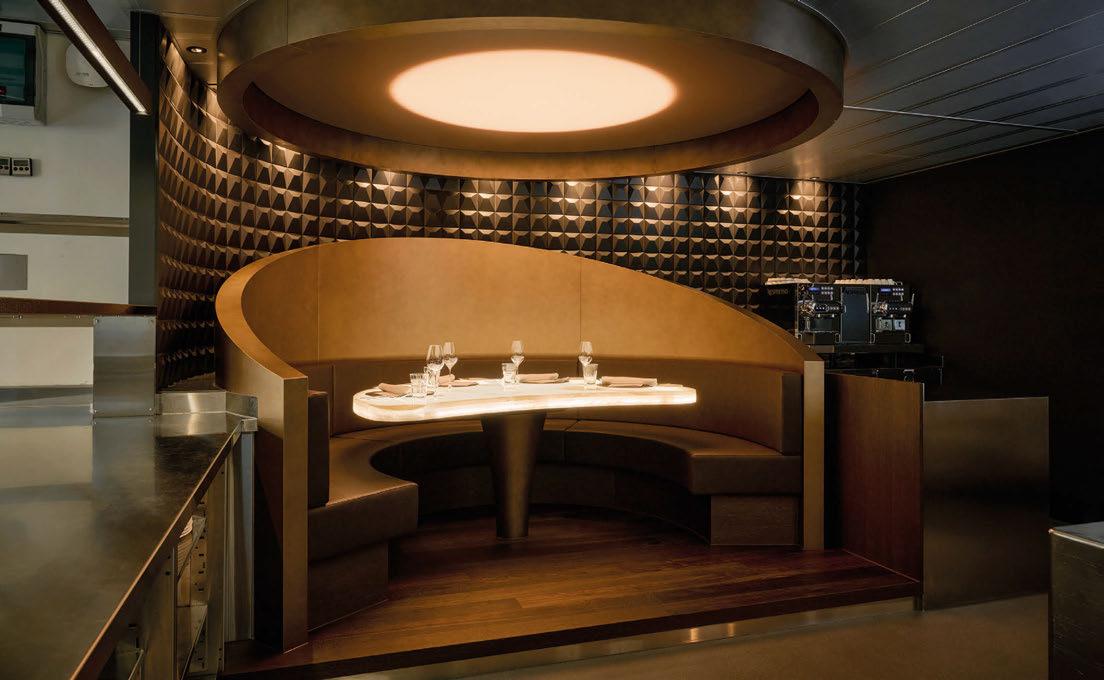
Few gastronomists understand this attention to detail better than Heiko Nieder, who has introduced The Chef’s Table at The Restaurant within The Dolder Grand, inviting a select number of guests to step into his kitchen at one of Zurich’s most awarded restaurants to observe the culinary artistry of each dish first-hand.
Designed by Swiss architect Florian Studer, the bespoke raised seating area accommodates just four to five guests, offering an intimate, behindthe-scenes perspective on a kitchen recognised with 19 Gault & Millau points and two Michelin stars. Diners can watch as Nieder and his ninestrong brigade craft every course with meticulous precision and creative flair.
Offered upon request during regular opening hours, the experience follows The Restaurant’s usual seven-course menu with vegetarian options
available, allowing a small group to engage directly with the techniques and creativity that define Nieder’s approach.
Menu highlights include Brittany lobster flavoured with citrus, ginger and avocado, as well as hake and caviar served alongside sauerkraut beurre blanc. There’s also a meltin-the-mouth beef brisket and fois gras paired with Savoy cabbage and Périgord truffle, and for game lovers, a cut of pigeon accompanied by red cabbage, beetroot, pomegranate and liquorice.
At The Dolder Grand, Neider’s influence extends beyond the main restaurant, shaping the culinary direction of the property’s four eateries and dynamic pop-up concepts. With his two cookbooks: The Restaurant, and Private Dining – Fine Dining at Home, he has already brought his expertise out of the kitchen and into people’s homes. Now, diners in Switzerland can experience the magic in person, making the invisible work of a fine-dining kitchen both tangible and immediate.
Faced with tighter budgets, growing concerns over global stability and changing lifestyles, today’s guests are reassessing the meaning of value, a shift that’s being felt across every aspect of the hospitality industry, according to TGP International’s F&B and Hospitality Trends Report 2026. Guests are more intent than ever on choosing venues and experiences that align with their ideals, so hotel groups are being forced to rethink their role in guest stays, with F&B playing a central role. “In uncertain times, familiarity becomes a form of luxury,” explains Simon Wright, founder of TGP International. “The brands that win are those that secure the balance between comfort and discovery.”
Core Values
Meaningful experiences that align with guest values are key to the success of future hospitality projects, according to TGP International’s latest trends report.
But even as people become more cautious over spending, the report notes that dining remains one of the most resilient discretionary splurges. Perhaps as a result, the micro-indulgence trend is gaining pace, with guests seeking to participate in intentional pleasures rather than excess, and indulging in treats for a day or even just a moment. It’s a move towards more deliberate, purpose-driven interaction with brands. “People are increasingly willing to pay, but for experiences that feel personal, cohesive and emotionally engaging,” Wright confirms.
To keep ahead of the curve, hospitality venues are responding with new models: think menus showcasing more mindful portion sizes thanks to the Ozempic effect, increased focus on the minimalism, discretion and sensory refinement associated with quiet luxury that many guests seek today, and specifically within the hotel F&B sector, a focus on elevating and adapting traditional dining formats, from rejigged breakfast buffets to signature restaurants. “The
most relevant spaces today are those that can flex,” Wright notes. “They shift seamlessly between work, socialising and dining throughout the day.”
It’s a modification that’s showing signs of success, but doesn’t come without its operational challenges, not least because of the increased demand for agility behind the scenes, whether it’s adaptable kitchen systems or scalable teams. Even so, with F&B increasingly considered a strategic asset rather than a peripheral service, it’s a move that decision-makers are deeming worthwhile. “F&B has moved from being a support function to becoming one of the most powerful drivers of identity, revenue and guest
loyalty in hospitality,” Wright says. “Rooms may bring guests in, but it’s F&B that gives them a reason to stay, and to return. That’s exactly why the sector has become the anchor of mixed-use environments, turning spaces into destinations and transactions into experiences.”
According to the report, this notion gives further cause for exploring the role that wellness plays in hospitality today, citing that 80% of global consumers name wellness as a top life priority (Global Wellness Institute, The Global Wellness Economy: 2025 Report, 2025). “Value is no longer defined by what guests receive, but by how deeply an experience resonates with them,” Wright confirms. As a result, there’s been an uptick in guests actively seeking out menus that support balance, nourishment and everyday wellbeing, leaving operators no choice but to respond. As Wright concludes: “In future, we’ll see hotel F&B operating less as individual outlets and more as integrated, experiencedriven platforms.”
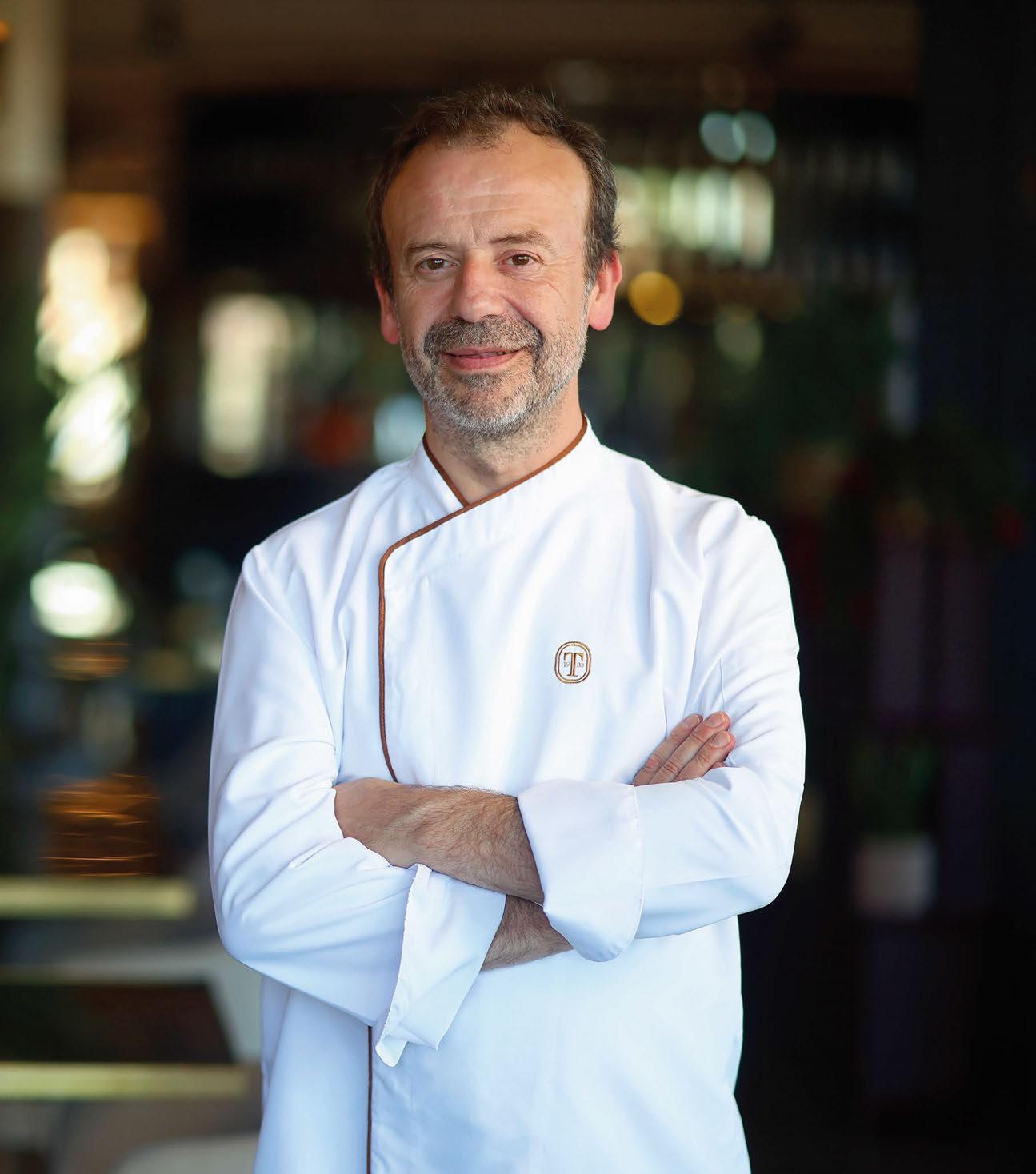
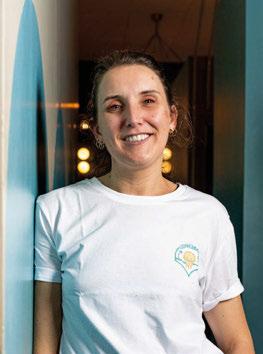
The Chef Patron of Muse by Tom Aikens recalls how a Norfolk childhood surrounded by homegrown produce sparked a lasting respect for seasonality.
When did you first fall in love with cooking?
I got my passion for food from both of my parents. My twin brother and I used to help my mother out in the kitchen – she would involve us in home baking and weighing ingredients. Living in Norfolk, we had a large back garden where we grew our own fruits and vegetables, and as a result, I learnt about seasonality from a young age. I was also fortunate enough to travel to France for family holidays, which allowed me to discover French cuisine. I remember going into amazing pâtisseries and delicatessens, and visiting the vineyards and cellars with my father, who was in the wine business.
Tell us about your most memorable meal?
On one particular trip to France, my father booked us into a Michelin-starred hotel restaurant by complete accident. He only realised when we arrived to find our car surrounded by four guys wearing white gloves and bow ties. That evening, I had the most amazing meal: a beautiful tomato salad with fragrant olive oil, basil, finely diced shallots, coarse sea salt, black pepper and chives, followed by a fillet steak that melted in my mouth and an accompanying stack of perfectly cooked chips in beef dripping. I remember it like it was yesterday.
Do you have a favourite dish, and who cooks it?
I still think about the dishes that I ate at El Bulli before it closed. My wife and I had a seemingly endless tasting menu that was magical from start to finish. Each course had a unique temperature and texture, and I kept thinking, how did he do that? Ferran Adrià was creating
the impossible with food and he made it look so effortless. I was visiting El Bulli as far back as 1996, and each time, the standard got better and better. The evolution of his cooking and technique was spell-binding, he’s a true genius; even the explanation of how to eat each course was fascinating.
And your favourite drink?
I am a lover of the whisky sour and I often use it as a benchmark to judge how good a bar is. One of the best is at The Connaught in London.
What’s your favourite hotel restaurant?
The settings at One & Only Resorts are always exceptional. I’ve cooked in their kitchens a few times and they consistently create genuinely exciting collaborations. The combination of the surroundings, strong culinary ambition and attention to detail always makes it special.
Which new restaurant are you eager to try out?
I am really interested to try Plates London by Kirk Haworth – it’s plant-based, and Kirk is so creative in the way he prepares vegetables, from the cooking to the fermenting and pickling.
Are you an easy-going or a demanding restaurant customer?
I’m very much there for the food, first and foremost. I understand the demands of a busy kitchen, so I’m always respectful of the process and the team behind it. I look for honesty, flavour and a sense of care, rather than perfection. Sitting on the other side of the table is a privilege - I never forget that.
It’s Sunday evening at home: who’s cooking? Sunday is family time. I make pancakes or waffles with the kids, then we go to feed the chickens. In summer, I do BBQs or make pizzas on the Gozney oven outside, which they love!
And what’s the soundtrack?
I have a whole collection of old LPs, so it could be anything from Aretha Franklin to David Bowie, Sting, The Beatles, Run DMC or Michael Jackson. Even classical music, sometimes.
Where do you get your creative inspiration?
Inspiration can come at any time or place, however, it is more often when I’m away from the kitchen. Since the pandemic, I’ve spent more time in the countryside - I’m a country boy at heart, so ideas often come when I’m foraging with my two daughters and my dog, Dottie.
Which chefs have inspired you?
The chefs that have given me the most inspiration are Pierre Koffmann and Joël Robuchon. Pierre taught me skill, speed and organisation, and from Joël, I learnt about attention to detail – his style was very intricate, so everything had to be in the right place.
Which city is food heaven for you, and why?
Paris. The depth of culinary heritage, the respect for technique and the sheer quality of ingredients at every level is extraordinary. You can have a life-changing meal in a grand restaurant or a simple bistro, and both are approached with the same seriousness and pride. It’s a city that constantly inspires me.
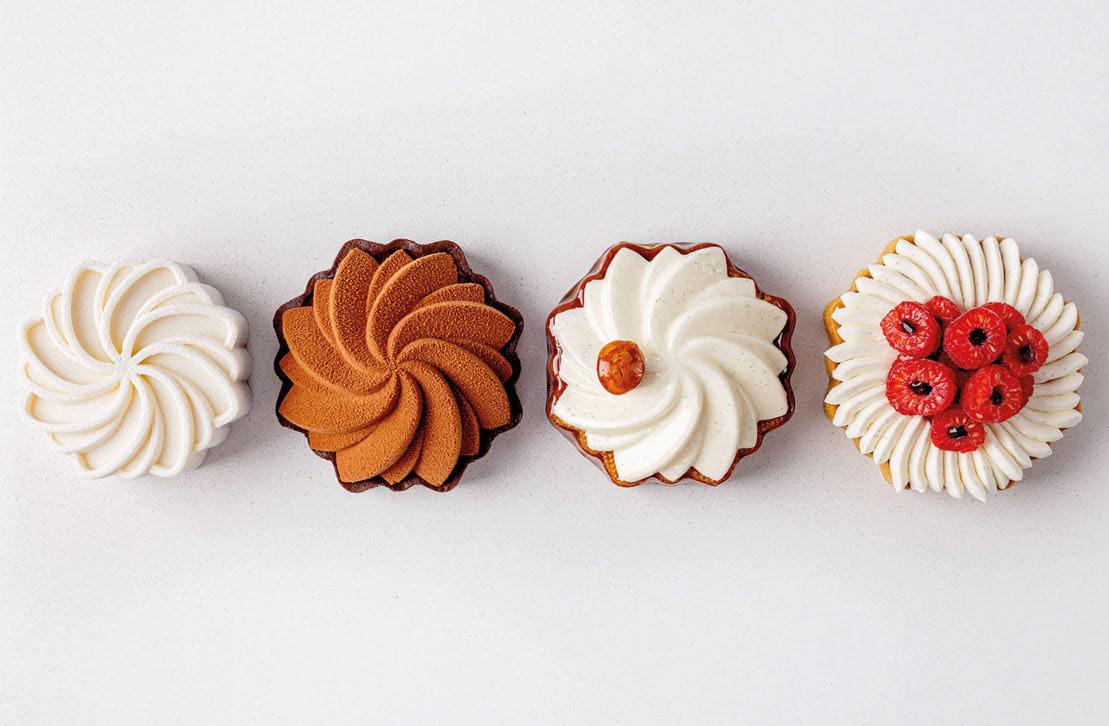
Pastry Precision
Fêted master pâtissier Nicolas Rouzaud expands his empire, translating haute pâtisserie into an accessible and fun-filled ritual.
Sitting in his gleaming new café beneath the arches of Mayfair’s Burlington Arcade, dressed in equally immaculate chef whites, Nicolas Rouzaud pores over his earliest memories of falling in love with food with disarming enthusiasm. The story begins near Toulouse, in France’s Occitanie region; a landscape abundant in orchards and agriculture, and, as it transpires, fertile ground for the imagination. “I can remember picking a raspberry straight from the garden, still warm from the sun, perfectly ripe and eaten immediately,” he muses. “Thinking about that first bite takes me right back to being a child.”
A simple memory, perhaps, but one that has shaped a two-decade career at the highest level.
“Being French, I was naturally drawn to the kitchen as a youngster,” he continues. “Maybe
because I wanted to do the opposite of my parents. They worked very hard and didn’t have much time for meals during the week. But we spent a lot of time in the garden, which being in the South of France, was overflowing almost all year round. I remember picking raspberries, strawberries, figs from the tree, then making very simple cakes, always topped with fresh fruit.” It’s a style the chef has barely deviated from since. His fruit-laden pastries – delicate tarts glazed to a mirror, ingredients arranged with near-mathematical precision – may be technically complex, but remain anchored to that same lightness of touch, nostalgia and reverence for produce.
Trained by the prestigious Compagnons du Devoir, Rouzaud completed a traditional Tour de France, mastering the techniques and heritage of French baking. A stint in fine-dining kitchens
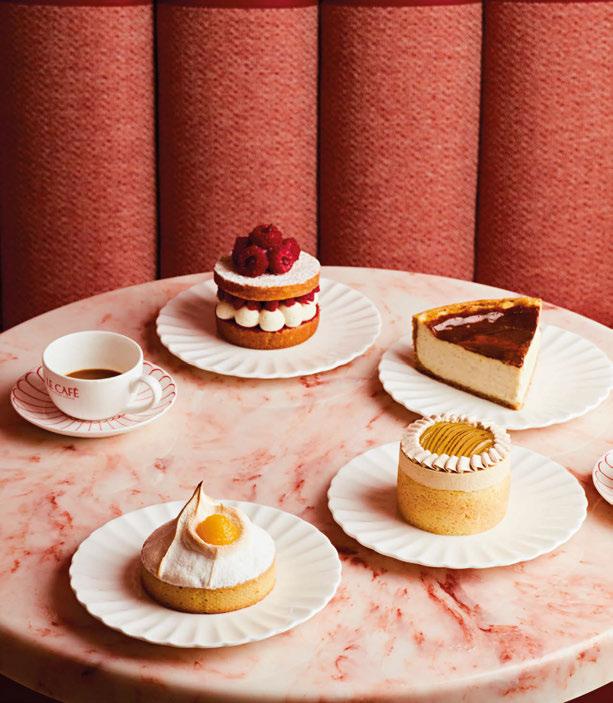
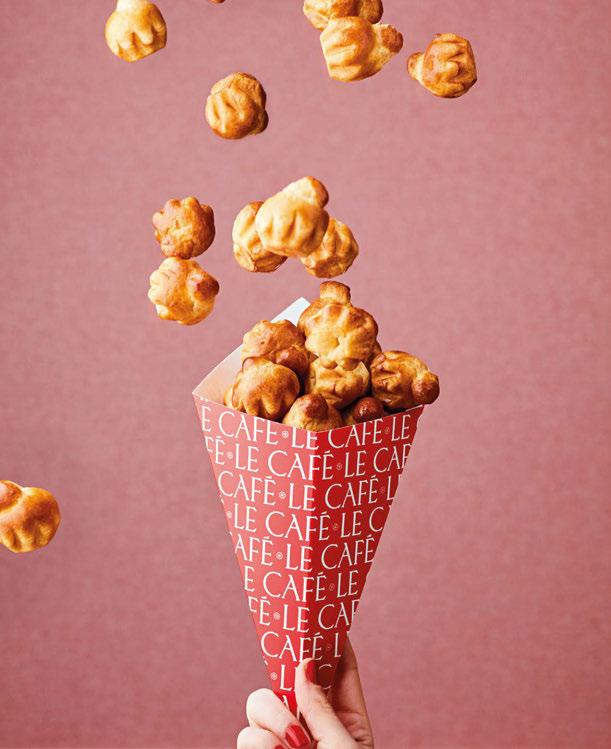
Le Café is a more approachable take on Rouzaud’s luxury pâtisserie, with a menu designed for all-day enjoyment
followed, leading him to Le Bristol Paris, a hotel where he spent eight years working under three-Michelin-starred chef Éric Fréchon and the late Laurent Jeannin, and where Rouzaud’s understanding of ingredients truly developed.
“Before, a strawberry was just a strawberry,” he says. “Now I think about its variety, its origin, its season. The same with raspberries, mangoes, chocolate and vanilla. Every ingredient has its own story and that story matters.”
London came calling via Oetker Collection, with a move from Le Bristol to The Lanesborough. From there he joined Maybourne and The Connaught, where he would spend six years shaping one of the city’s most influential pastry operations. The culmination was Nicolas Rouzaud at The Connaught, an Ab Rogers-designed boutique serving beautifully boxed celebratory cakes to pick up on the way home or enjoy for a post-supper treat. “After lockdown, we were one of the only places open in Mayfair,” he recalls. “People were queuing for cake. It became a destination, and we were bringing joy at a difficult time.” That joy, in the guise of fine pâtisserie, was something he felt was missing in London. “We wanted to create true luxury in pastry, with layers, texture, precision and exceptional ingredients, which was a bit of a risk,” he says. “It’s almost like a jewellery shop. Everything has to be considered: the lighting, the packaging and the service.”
Such meticulousness extends to the creations themselves.
Signature pieces include the Connaught Hound, a chocolate hazelnut cake shaped like the hotel’s canine mascot, adapted seasonally. Most recently, for Valentine’s Day, it appeared as an almond pain de Gênes sponge coated in white chocolate, paired with dark chocolate mousse and raspberry confit, finished in
“I want people to understand the human side of pastry, the identity and the emotion behind every creation they are eating.”
red velvet with a white heart collar. Rouzaud is also known for the textural NR Pecan & Vanilla, with its crunchy base, soft sponge and rich praline wrapped in Madagascar vanilla mousse, along with the Pistachio Paris-Brest, filled with silky pistachio cream and crowned by a delicate cigarette tuile.
With a growing reputation, Rouzaud made a deliberate move to put his name to this work. Launched in 2025, Maison de Haute Pâtisserie Nicolas Rouzaud is a refined brand showcase, one he has recently extended to Doha at Four Seasons Resort & Residences at The Pearl, and plans to launch in an unnamed Paris hotel in the near future. “Having my name above the door is important to me,” he explains. “I want people to understand the human side of pastry, the identity and the emotion behind every creation they are eating.” While signatures such as fruit tartelettes will remain on every menu, local influence has its place. In Doha, inspiration comes from traditional Arab dessert, kunafa, reimagined as a Rose des Sables with orange blossom, pistachio biscuit and a delicate chocolate mousse, its aesthetic drawn from the forms of local architecture and the shape of the desert rose flower.
With his latest project, Rouzaud moves slightly away from such elaborate recipes. Le Café in Burlington Arcade feels like a natural progression, translating his fine craft into a more accessible ritual. “Not everyone wants a luxury pastry,” he says. “Sometimes it is the price, sometimes it is just a little intimidating. That is why I wanted to create a concept that works for everyone, from morning until the evening.”
Luxury is still expressed in the service, with a team led by Timea Rambacs, whose experience spans The Emory, The Dorchester and The Savoy, bringing an approachable,
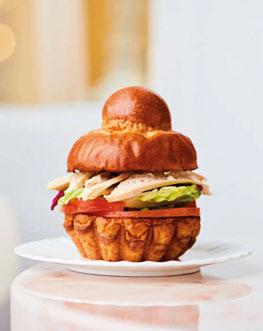
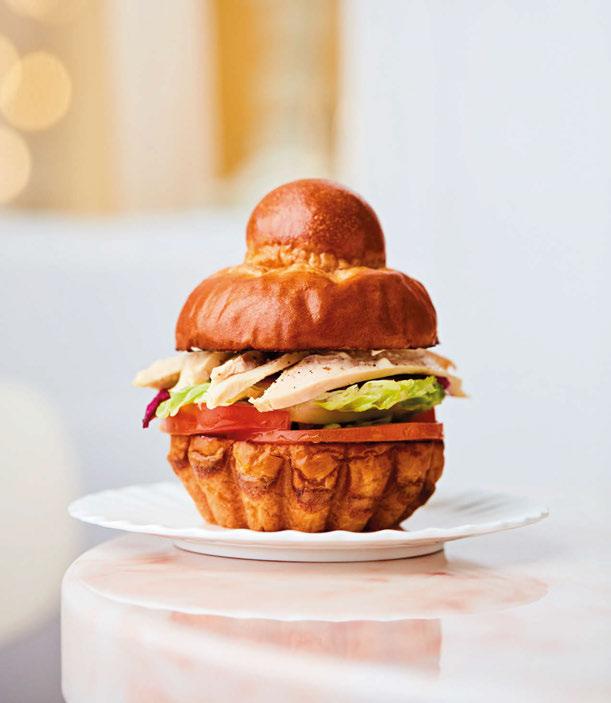
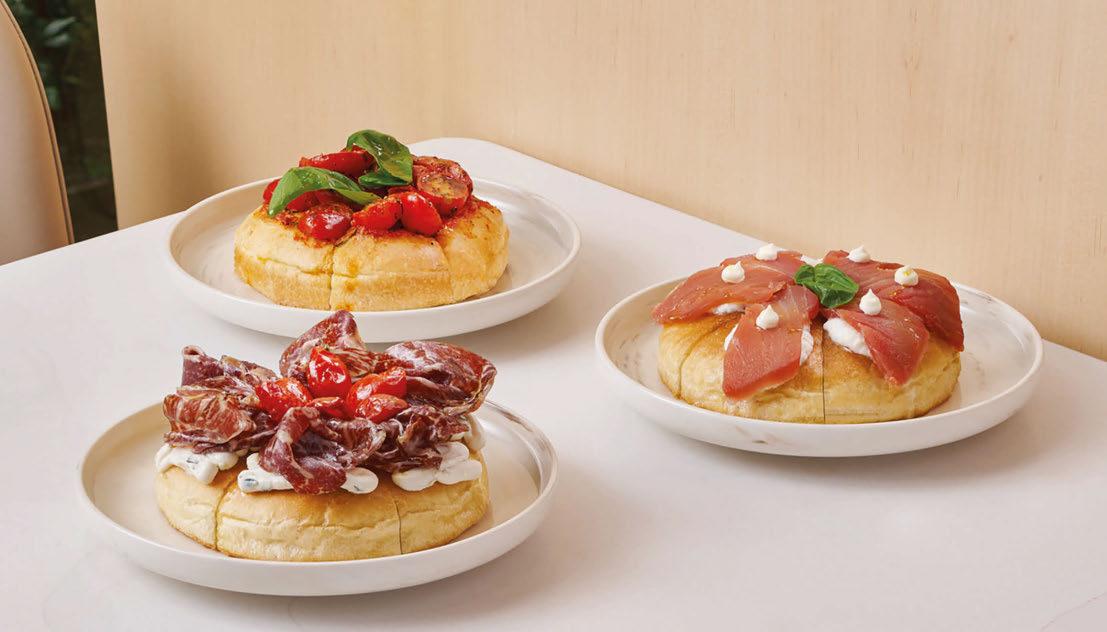
hotel-led sensibility to café culture. Rouzaud’s focus on personal storytelling is also evident, particularly in the venue’s speciality, brioche à tête, a deeply personal reference. “After work, my father used to come home hungry, hollow out a brioche, fill it with simple Friday ingredients of ham, cheese and egg, then bake it again,” Rouzaud explains of its inspiration. “You open it up and everything melts. It is one of my favourite memories of being at home and I wanted to share it.”
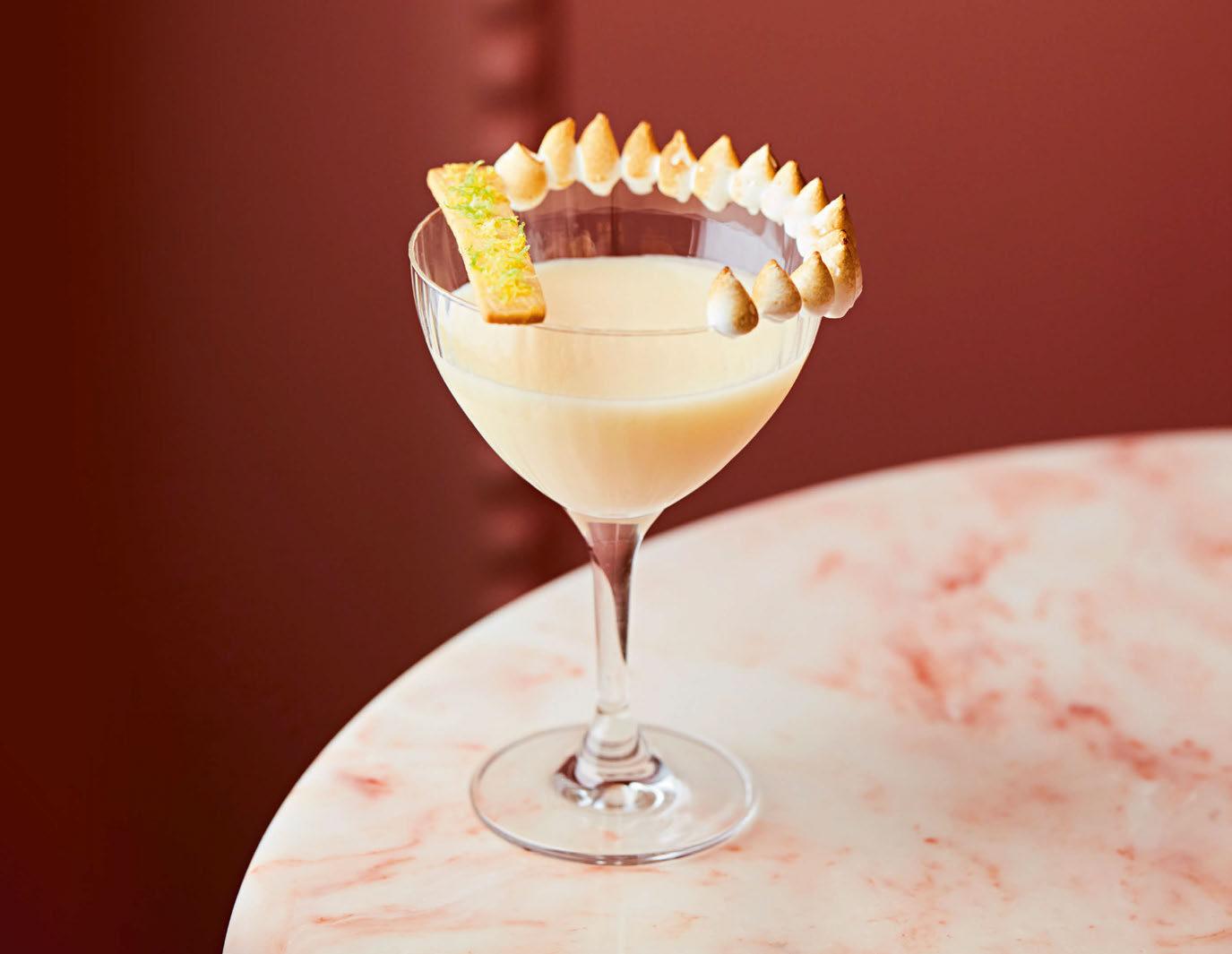
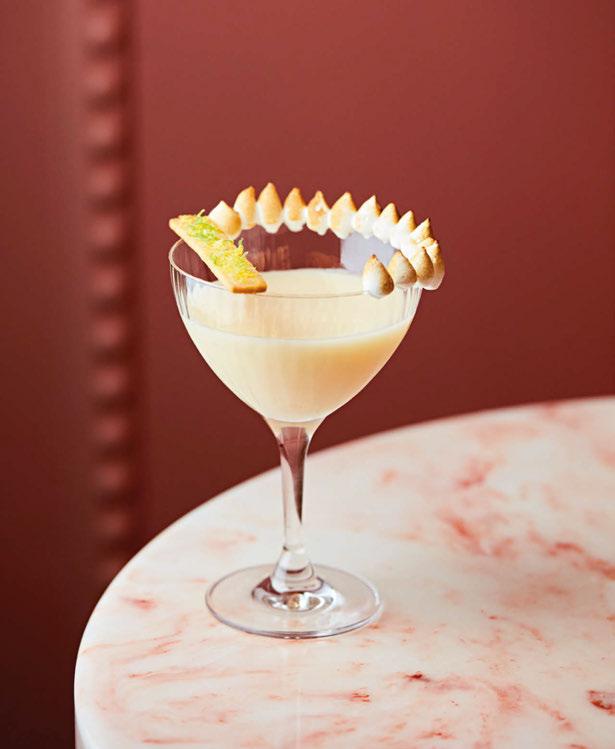
The recognisable brioche shape is reimagined in both savoury and sweet forms, with fillings of raspberry crémeux, Madagascar vanilla curd with pecan and caramel, and chocolate, tonka and hazelnut. As ever, fruit is left largely unprocessed and sugar used sparingly. Drinks follow suit. Coffee is handled with precision, while cocktails mirror the pâtisserie, from Lemon Pie inspired by Rouzaud’s citrus tart to a pear and cranberry champagne creation built around his fixation on texture.
Conceptualised by Sabrina Caisson Design,
the space also reflects a tone shift. Rouzaud’s signature red, inspired by ripe raspberries, still runs through the interiors. A lacquered ruby counter gleams like freshly glazed pastries, but softer blush tones across each floor create a more relaxed atmosphere. This is complemented by playful brioche à tête motifs, which appear on packaging, wall art and waiters’ uniforms. “The interiors are the opposite of Haute Pâtisserie,” he confirms. “There, it is mostly white with a touch of red; very elegant. Here, it is more fun.”
It’s a concept with wide appeal, and as such, the goal is to expand. “We plan to open a few more in London, whether that’s Covent Garden or Notting Hill,” Rouzaud says. “We’ve been open a few months, but already people are coming back.” He’s confident that with this in mind, Le Café is on track to become a place for Londoners to linger, whether for a morning coffee, an afternoon pastry or a late-night cocktail, drawn by the simple pleasures that first sparked the chef’s imagination, and a sense of everyday indulgence.
Rouzaud’s signature creations at The Connaught suggest a lightness of touch and reverence for produce developed in childhood
Family Affair
The master of Asturian gastronomy Nacho Manzano expands his geographic focus with a new hotel project on Porto’s River Douro, where the culinary heritage of the Iberian coast takes centre stage.
Words: Shanna McGoldrick
Nacho Manzano isn’t in a hurry.
The Spanish chef, who has three Michelin stars and five restaurants to his bow, has learned that good things come to those who graft.
This mindset wasn’t crafted in the world’s great culinary capitals, but rather in La Salgar, the rural village in Asturias, where Manzano has spent his life working alongside his family in the very house in which he was born and raised. His parents ran a small shop from home, which doubled as a local bar and general cardplaying spot. Then, as Spain’s socio-economic boom made eating-out more popular in the 1980s, the business model expanded to include food, with guests ordering in advance and his mother cooking to accommodate them.
Today, decades of vision, persistence and a deep respect for regional produce have transformed that house into Casa Marcial, a three-Michelin-starred temple to Asturian cuisine run by Manzano and his sisters, Esther
and Sandra. “The house evolved as Spain evolved, it changed with the times,” he reflects. Manzano was drawn to the joy of hospitality as a child. “When people came to my house to eat, the house would be dressed up; it would feel like a party,” he remembers. “On those days, it became a new universe. It was the part I liked most; festive, glamorous and interesting.”
He decided early on to dedicate himself to cooking, heading to the coastal city of Gijón to spend seven formative years working at a respected seafood restaurant. He returned home in 1993 to join forces with his sisters and take the reins at Casa Marcial, named after their late father, where he chose to honour both regional and familial influences. “I didn’t think it was loyal to copy what I’d learned in Gijón,” he says. “And it didn’t make sense in my village.” Instead, he turned inward – towards memory, landscape and instinct. “I didn’t have much technique, so I focused on expressing flavours that I had inside me,” he says. “I began to create my own combinations, always based on
things that felt familiar to me.” He believes his approach was considered slightly old-fashioned; his peers were the young guns of an avantgarde Spanish cuisine that was pushing the boundaries of molecular gastronomy to global acclaim. But his hyper-focus on seasonality and provenance has stood the test of time.
Manzano’s gastronomy is almost reverential, rooted firmly in the rhythms of Asturias and its produce, climate and traditions. It also speaks to a more universal experience. “Food connects us to personal stories,” he says. “And that connection is the most important thing. The cuisine at Casa Marcial tells stories that are familiar to me – but what I’ve realised is that even people without those references can still connect with the dishes.” He and Esther, who is co-Head Chef, devise menus to spotlight the specialities of a region that runs from ocean to mountains, ranging from seaweed and razor clams to wild boar and oxalis.
“Working with Nacho is both very exciting and challenging,” says Esther, a central player in the family business and herself the first woman in Asturias to win a Michelin star (for the now-closed restaurant La Salgar). “He is creating all the time, and he is always ahead, thinking of new challenges when we are just getting ready and comfortable with the ones that we have on our plate.”
Today, the Manzano family empire has spread across Asturias, encompassing the restaurants Gloria in Oviedo and Gijón, the Narbasu Restaurant & Hotel (awarded a green Michelin star), and Manzano Catering. At its heart remains Casa Marcial, which was awarded its first Michelin star in 1999, with the second arriving in 2009 and a third completing the set in 2024. Although the accolade has elevated the siblings’ childhood home to the realm of the gastronomic elite, it hasn’t altered their approach. “We feel proud but also calm,” says Manzano. “The restaurant is still the same.”
“I focused on expressing flavours that I had inside of me. I began to create my own combinations, always based on things that felt familiar to me.”
waterway in the hot sun. Asturias feels a world away – yet Manzano has always felt an affinity with the city, not least for its overlapping culinary traditions. Kopke’s heritage is omnipresent – diners can sample its ancient and rare white and tawny port wines, and the hotel’s corridors feature internal windows that look into the cool, dark cellars stocked with resting barrels.
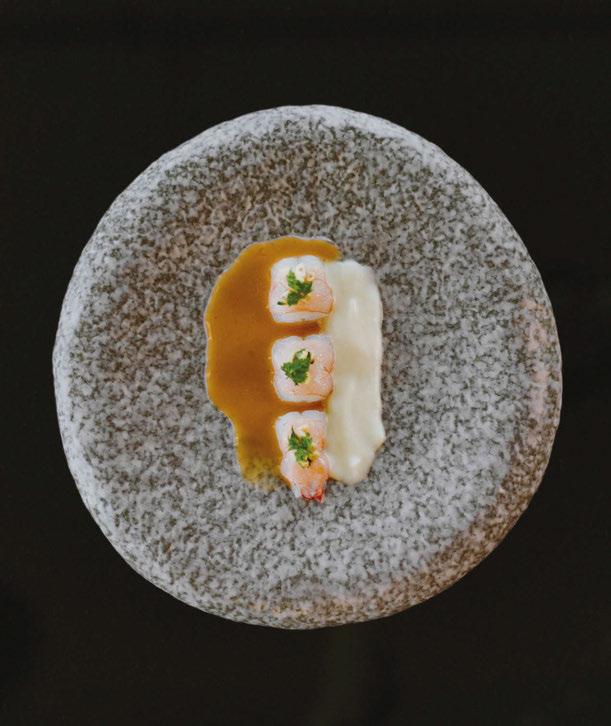
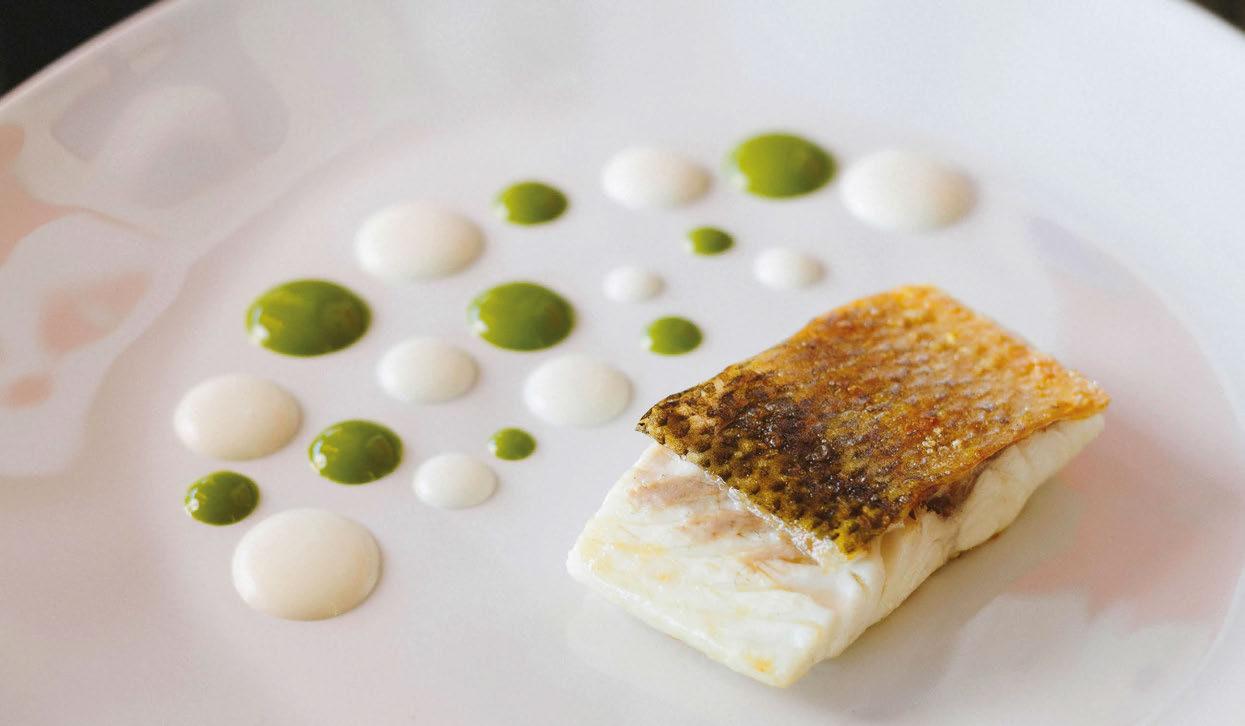
Manzano taps into this strong sense of place with his flavours – an aromatic dessert of rice pudding with black truffle and caramel crystal features a sublime Kopke port wine jelly, while a dish of sea bass, bilbaína sauce and herb gel invokes the heady flavours of the Douro. Asturian and Portuguese favourites of cod and sardines often feature, championing shared Iberian traditions with precision and nuance. His current favourite dish at 1638 is shellfish served with a codium cream and tomato water, nodding to the Atlantic’s abundance and its importance to Porto and Northwestern Spain.
Change is nonetheless in the air. In 2025, Manzano launched a solo project and his first collaboration with a major hotel group: Tivoli Hotels & Resorts. At the sprawling new Tivoli Kopke Porto Gaia Hotel, he leads the culinary concept at casual eatery Boa Vista Terrace, as well as fine-dining spot 1638 Restaurant & Wine Bar, whose name references the founding year of Kopke, the world’s oldest port house. Here, he highlights the heritage of the Iberian coastline through an elegant, blind 10- or 12-course tasting menu that once again emphasises flavour, provenance and emotional resonance. Sitting atop Kopke’s fabled port cellars, 1638 offers sweeping views over Porto’s jumbled hillsides and soaring bridges. It’s an ideal vantage point for taking in the industrious activities of the River Douro, with its traditional rabelo boats ferrying tourists up and down the
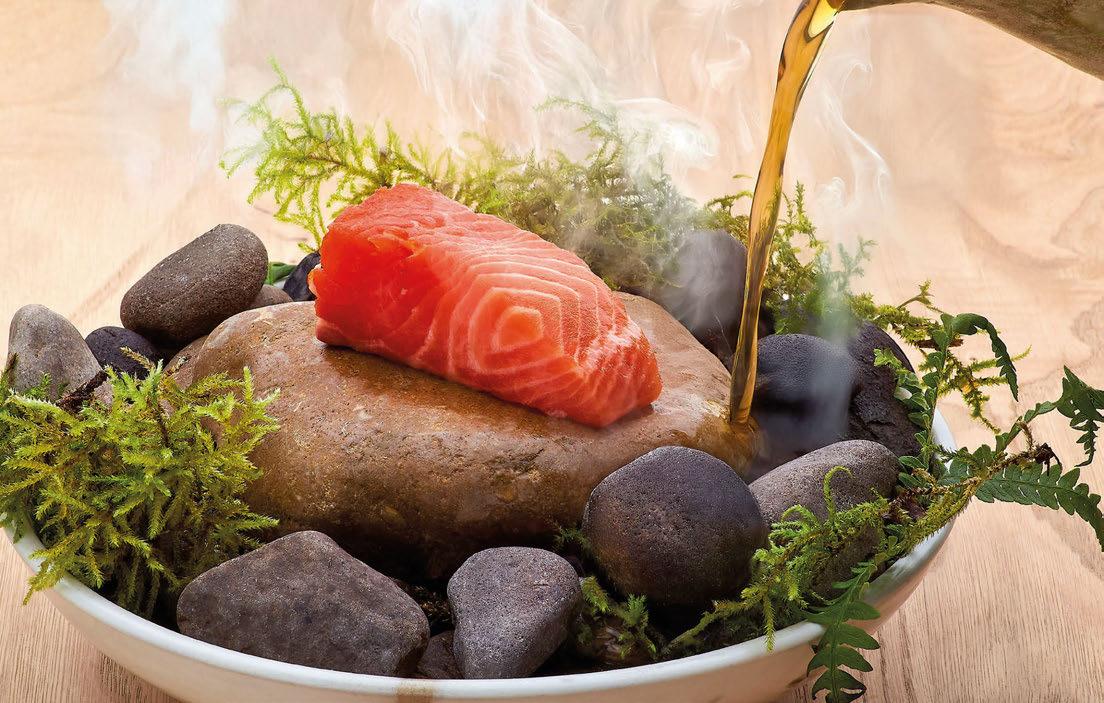
“We want to promote the connection between Asturian and Portuguese cuisine,” says Esther. One of her favourite dishes at Casa Marcial –trout in its habitat, spring broth, seed and yeast crisp – also appears on the menu at 1638. “It is representative of both Porto and our town Arriondas, as the river is part of our landscape and our culture,” she explains.
For Manzano, however, the food always takes precedence. “I don’t design dishes based on wine,” he clarifies. “First comes the dish, then I find harmony with the wine.” Luckily, he adds, “they go hand in hand naturally.”
For a chef so rooted in his terroir, how does it feel to cook away from home? “For me, the ingredients are important, but more important is the philosophy; the way of cooking,” he says. “When you take dishes out of their context, they still connect – maybe even more so.”
And he still has the support of his siblings. Though they aren’t officially part of the Tivoli
At 1638, Manzano flies solo for the first time, highlighting the abundance of the Iberian coastline on the plate
“Ingredients are important, but more important is the philosophy; the way of cooking.”
partnership, he laughs when I ask how it feels to go solo. “They are still here! We are always connected,” he says. Esther elaborates on their symbiotic working relationship. “We are not that involved, but at the same time we are always involved!” she laughs. “Sometimes we participate in the design of the dishes or the menu, or we might be cooking a dish and think ‘this would be perfect for Porto’ and suggest ideas for dishes to him.”
It is proving to be a successful approach so far, with Michelin honouring 1638 with a recommendation in its 2026 guide. If Manzano was hoping for a star, he won’t be drawn on the topic – but given his reputation for quiet consistency, his insistence that it isn’t the immediate goal is believable. “Recognition is fantastic,” he says. “But it’s not an obsession.”
How does working with Tivoli differ from working in his own family-run venues? Naturally, he doesn’t have quite the same freedom and agility, but he stresses that the
hotel has been a supportive partner, and he’s delighted to have a presence in Porto. “There are challenges; it’s not in the city centre, and it’s in a hotel,” he observes. “But the hotel brings clients, so we must ensure the offer strong enough for them to dine in.” His goal is to create a destination restaurant in its own right, through his trademark consistency and hard work. “Building recognition in the city takes time; it’s a gradual process, but we’re used to that,” he says. In a way, it’s a natural partnership: like the port slowly ageing in the barrels beneath us, his blend of patience, consistency and respect for tradition will surely yield valuable results.
His dream, he jokes, is to open a beachside restaurant in his hometown of Asturias, where he can cook casually in flip-flops. As long as he can continue to connect and share moments with his guests, he’ll be satisfied: “There is something in food that connects us, wherever we are from.”
Manzano’s Asturian heritage is woven into every plate at Casa Marcial
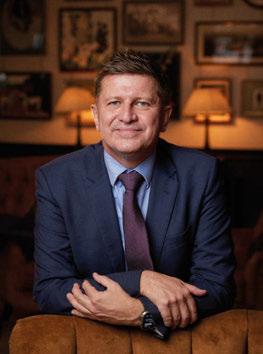
Andy Goss Group Head of Food & Beverage Clermont Hotel Group
Leading the strategic direction and performance of food and beverage across Clermont Hotel Group’s 14-strong London portfolio, Andy Goss has more than 25 years’ experience in hospitality, spanning multi-site operations, concept development and commercial leadership. He is currently involved in the delivery of the UK’s first Gordon Ramsay Hell’s Kitchen restaurant, located at The Cumberland in Marble Arch. Prior to Clermont, he held senior roles at Compass Group, Hummingbird Bakery and HMS Host, a subsidiary of Avolta, where he oversaw complex, high-volume operations.
The Heat is On
Opening the UK’s first Hell’s Kitchen is just the start for Clermont Hotel Group, as it turns up the heat with a portfolio-wide push on distinctive and compelling F&B.
Words: Hannah Currie
Occupying more than 4,000 rooms across the capital, Clermont Hotel Group is one of London’s largest owner-operators. Spanning a portfolio of 14 centrally located properties and servicing a broad mix of business and leisure travellers from breakfast through to dinner, there are a lot of potential mouths to feed. It’s no surprise, then, that in recent years the company has invested heavily in F&B to ensure there are ‘spaces for all’ that deliver memorable dining and imbibing experiences.
This strategy has sharpened in recent months with the appointment of Andy Goss as Group Head of Food & Beverage. With a background spanning procurement, concessions and contract catering, including time with travel hospitality giant HMS Host, Goss’ career in recent years has moved closer to the restaurant floor. “There are a lot of skills that are transferable, but hotels are very different,” he says of the challenge. “One of the biggest adjustments was understanding that the majority of revenue comes from rooms. That means you have to work harder to ensure that a food and drink programme gets noticed.”
Clermont drew him in with a clear commitment to its F&B offer, which ranges from casual delis to glitzy rooftop bars. “I’m fortunate because it isn’t just a means to an end for us – there’s real investment and a belief in its future,” he says. “That’s exciting to be part of.”
This continued development is taking place across multiple segments. The Thistle brand caters to a largely domestic, corporate crowd, with classic dining offerings as well as stand out experiences such as VU from The Tower, a cocktail bar with panoramic views over the River Thames. Clermont lifestyle properties and the premium Royal Horseguards Hotel lean into a more luxury experience, exemplified in The Green Parlour, a new heritage afternoon tea lounge nodding to London’s Victorian pleasure gardens. Meanwhile, high-volume sites such as The Cumberland in Marble Arch demand a broader, almost “resortstyle” approach to F&B, according to Goss, with multiple options that cater to all occasions.
GIVE ‘EM HELL
In a competitive city like London, the ongoing evolution of every concept is critical. “Guests can step outside any of our hotels and find almost anything they want to eat on their doorstep,” Goss continues. “My focus is on ensuring our brands stand out, have a strong sense of place and offer a point of difference. That means constantly staying on top of trends, understanding what competitors are doing and always looking for the next new concept.”
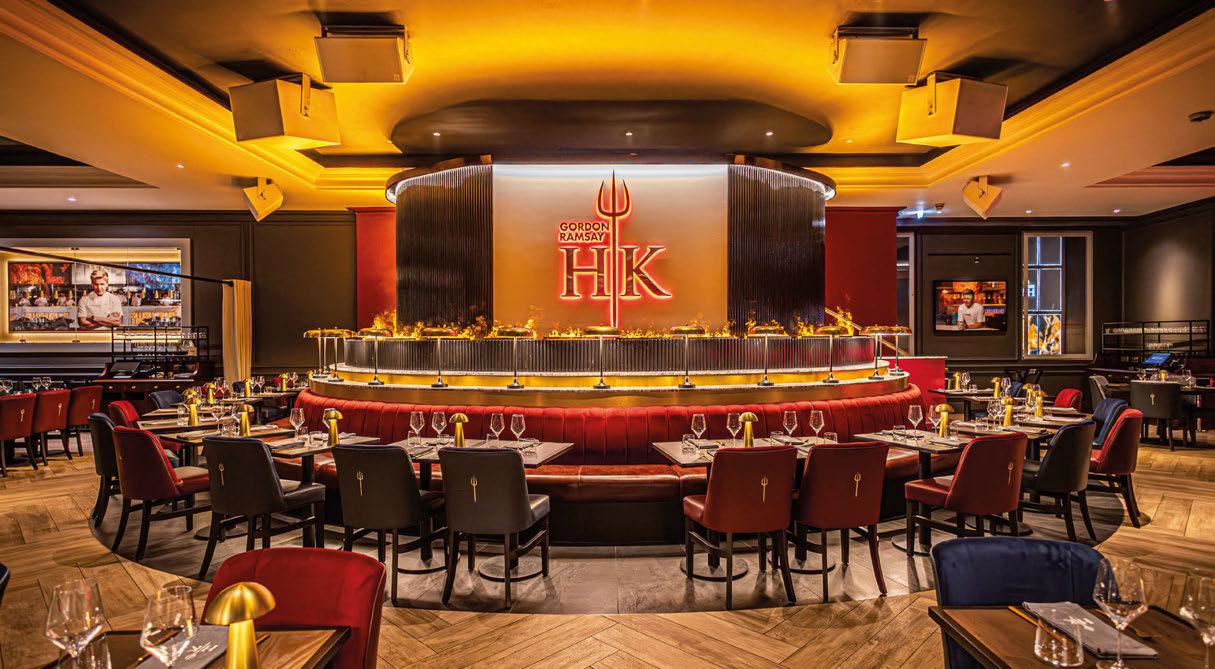
Nowhere is that strategy more visible than at The Cumberland, where the group has just launched the UK’s first Hell’s Kitchen as part of
a multi-site partnership with Gordon Ramsay Restaurants Global.
Since debuting its flagship in Las Vegas in 2018, Hell’s Kitchen has expanded to eight restaurant locations across the United States and Europe, building on the popularity of Ramsay’s global television series. In London, the concept takes the form of a stylish bar and open kitchen serving a mix of the chef’s signature favourites alongside London-centric dishes. Think Ramsay’s famous beef Wellington, seared scallops and lobster risotto, followed by classic desserts such as sticky toffee pudding and apple butterscotch cheesecake. The cocktail list takes similar cues and includes Notes from Gordon, a refreshing blend of Plymouth Dry Gin and green tea, topped up with lemongrass, peach and lemon.
“The F&B space at The Cumberland is significant, so we needed a concept that would attract attention and truly resonate,” Goss says of the dining room, which in a previous life was helmed by Gary Rhodes and later housed a Hard Rock Café. For Goss, Hell’s Kitchen, with its high-energy, theatrical format, delivers on many fronts. “It’s a bold concept that appeals to people and can generate the covers needed to fill the space consistently,” he says. “It also aligns with broader trends around experiential dining and fine-casual concepts.”
Early indicators are promising. “It’s the first
Hell’s Kitchen in the UK, which is a big deal. And of course, this is Gordon’s homeland,” Goss notes. “The timing has been good too, with renewed interest following his new Netflix documentary. From a recruitment and bookings perspective, we’re seeing very positive signs.”
PRIME POSITION
The move speaks to a broader strategic direction for the hotel group, centred on premiumisation.
“The casual-dining middle market is squeezed, but there’s clear opportunity in premiumcasual dining – which is exactly where Hell’s Kitchen sits,” he confirms. “Guests might be more selective, but when they do spend, they want it to feel worthwhile. We need to extend that opportunity to our other hotels; creating concepts that feel distinctive and compelling.”
For the F&B specialist, it’s not just about differentiating from external competitors, but also ensuring its own restaurants feel distinct from one another and cater to guests’ evolving needs. At The Cumberland, Spanish-inspired venue Lírica has been introduced partly for this reason. The space offers a more relaxed counterpart to Hell’s Kitchen, with sharing plates and tapas inspired by the gastronomic bounty of Spain: from sun-drenched vegetables and heritage tomatoes to Ibérico ham, wild mushroom croquetas and grilled tiger prawns,
alongside Spanish wines from Valmiñor Albariño and Gómez Cruzado. “Lírica offers something relaxed and accessible. Not every experience needs to be high-energy or high-spend,” says Goss. “Here we focus on simple, high-quality tapas, providing an alternative for guests who want variety during their stay. We’re already seeing strong performance, and the two concepts work well together because of their differences.”
This plan to leverage the variety among its existing estate is also behind new initiative, Thistle Connect, which allows guests staying at Thistle properties to access benefits across Clermont’s wider restaurant portfolio. “It’s a way of showcasing the breadth of our food and drink offering across London while encouraging guests to explore beyond their base hotel,” he continues. “Given the proximity of many of our properties, it’s a natural opportunity to connect them and operate in a more cohesive way.”
As these new initiatives bed in, and with a compelling pipeline on the horizon for the group, the focus remains clear for Goss. “It’s about ensuring that F&B adds real value for our hotel guests and visitors,” he confidently concludes. “That means providing meaningful moments, and making sure that F&B at Clermont works for everybody. It has to be thoughtfully done, so that guests don’t just come to us once, but they keep coming back.”
Hell’s Kitchen at The Cumberland, London
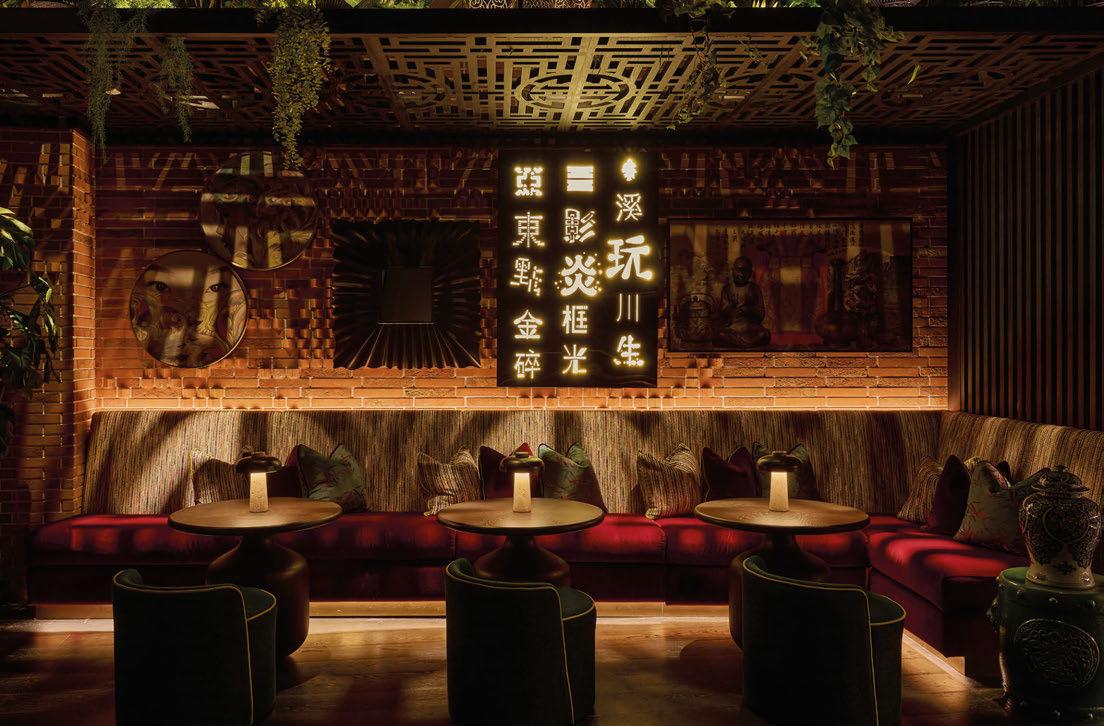
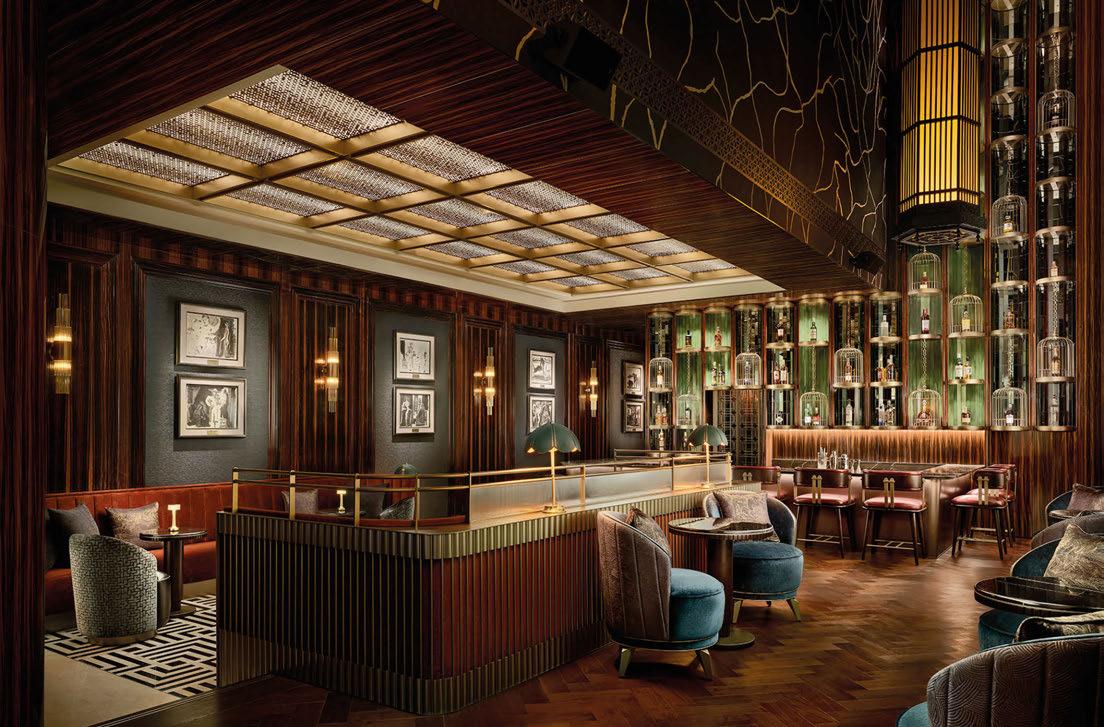
An ode to the golden age of 1930s Shanghai, Yu & Mi at Mandarin Oriental Downtown Dubai introduces intrigue, glamour and playful contradiction high above the Emirate.
Drawing on the Art Deco establishments of the era, the design reflects the cultural exchanges that once defined Shanghai, blending Anglo Chinese influences with a modern interpretation of heritage. “The concept looks to an age when the city was Asia’s most cosmopolitan metropolis,” says Pooja Shah Mulani, Managing Partner of Creative at LW Design. “It was a period shaped by jazz clubs, late night bars and a certain effortless decadence.”
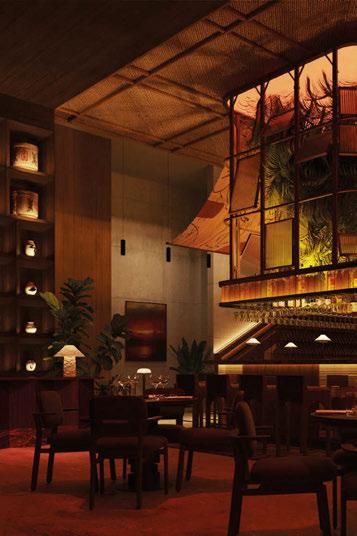
On the 36th floor, beauty lies in juxtaposition, evident in refined furnishings set against raw, urban-inspired finishes and amplified through bold colour-blocking. Flooring shifts between dark wood and exposed concrete creating a shifting streetscape, while teal lavastone tiles and angled brickwork are softened by plush red velvets, silks and aged leather. An assortment of antique furniture reinforces a collected narrative
that celebrates the eclecticism of Shanghai’s golden age.
One of the most distinctive examples of this glamour is the bar gantry. Conceived as a dramatic birdcage with period-inspired patterns in rich magenta lacquer, it forms a captivating focal point, channelling the theatrical spirit of the times. Behind the bar, traditional cabinetry resembles carefully preserved artefacts, while an adjoining counter evokes a Chinese apothecary table, where herbs, medicines and elixirs inspire contemporary cocktails showcasing the nation’s whiskies and tea infusions.
For Mulani, the desired effect must be transportive. “Instead of a typical hotel lounge, the aim was to create somewhere intimate and slightly concealed, where guests feel they have stepped into a different world the moment they arrive,” the designer concludes. “Combined with a moody atmosphere and carefully curated furnishings, the interiors create a setting where the act of having a drink becomes part of a broader immersive experience.”
Yu & Mi Mandarin Oriental
Rascal Wilde Aparthotel
VIENNA FLEISCHMARKT
Words: Hannah Currie
Rascal, a destination brasserie in Vienna’s first district, has opened its doors at Wilde Aparthotel, offering a modern interpretation of the Austrian coffeehouse in one of the city’s most historic settings.
IN A BITE
Owner: StayCity Group
Operator: Wilde
Main Contractor: Tenbrink
Interior Design: Stephanie Barba Mendoza
Project Manager: Reinhard Groscurth
Menu and Graphic Design: Studio 97, Briugu
Head Chef: Tamas Kiss
F&B Consultant: Briugu
F&B Manager: Aykut Erdem
www.wilde.com
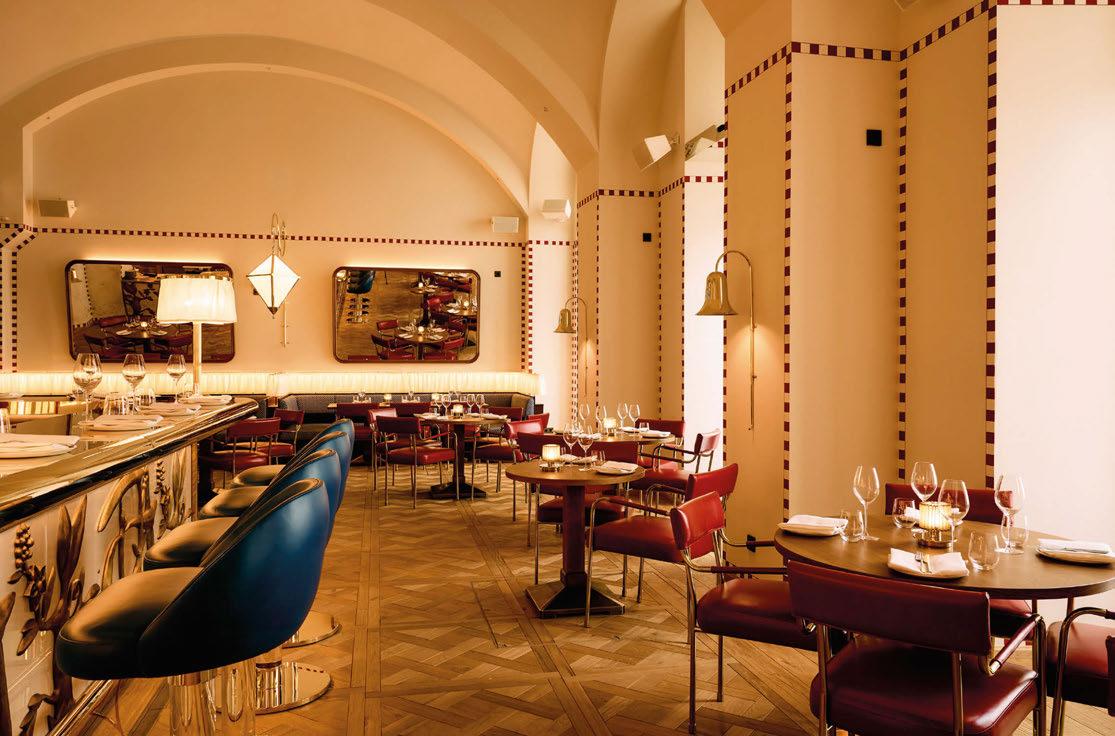
Curated by Stephanie Barba Mendoza, the interiors draw inspiration not only from the rebellious curiosity of the capital at the turn of the 20th century, but also from the landmark aparthotel building itself, which served as the district’s main communication hub for over 150 years. “The concept taps into the wider narrative of the property and its history as Vienna’s Grand Post Office,” explains Mendoza. “We looked to radical artistic movements such as the Viennese Secession and Wiener Werkstätte to inform our approach, channelling their progressive spirit into a setting where art and gastronomy come together in a fluid, expressive and slightly unexpected way.”
Chequered geometry, a hallmark of Secessionist designers like Josef Hoffmann and the wider Jugendstil movement, informs
key elements of the space, including a handpainted chequered border that threads through the restaurant and onto upholstered banquettes. The intricate fretwork of the bar front also references Secessionist-era jewellery, complemented by deep gem-toned leather in rich reds and blues seen across bar stools.
Sculptural brass wall lights and polished wood tables set the stage for a dining experience defined by Austrian and Eastern European staples, while each booth is framed by a playful reinterpretation of classic café curtains, custommade from a textural fabric traditionally used for Austrian blinds - an additional nod to Viennese café culture.
The final flourish is a canopy of living artwork by Sha.Art, a light installation that evolves with the hours and seasons. “Rascal is the beating heart of the building,” concludes Mendoza. “So it’s important that the space caters to the different rhythms of the day, offering guests a home away from home as it shifts from breakfast through to dinner.”
Gymkhana has crossed continents to arrive at Aria Resort & Casino, bringing JKS Restaurants’ Michelin-starred dining concept to the heart of Las Vegas.
Designed by North End, the UK-based studio led by Samuel Hosker, the space builds on the spirit of the original London eatery to explore India’s historic gentlemen’s clubs and grand private residences. “Gymkhanas are sporting clubs, where high society wine, dine and socialise,” Hosker explains. “They are spaces that exude old-world charm and glamour, all while staying rooted in Indian tradition.”
In Las Vegas, the team refined the style of the UK outpost while being conscious of the oftencavernous scale of The Strip’s restaurants. “We retained the intimate residential feel by scaling down room proportions to create comfortable and convivial pockets of space,” he reveals.
A sense of discovery begins at the threshold, as guests enter through signature green doors into a interior defined by jade tones, dark polished wood and brushed brass evocative
of a colonial Kolkota mansion. “The design of the entrance, which hides the interior from the outside world, creates a sense of privacy and intrigue,” Hosker continues. “The guest is immediately transported away from the hotel lobby, straight into the world of Gymkhana.”
This universe opens up through shifting tonal zones, with the main dining room framed by saturated Kashmiri red ceilings, teal paisley carpets and walls wrapped in textured green Anaglypta, a palette that extends to custom dinnerware by Costa Nova. Statement Rajasthani cut-glass chandeliers disperse the light, while joinery features rattan and stained bamboo, inspired by antique steamer trunks to suggest a distant era of exploration.
Tucked inside, The 42 Bar completes the picture, with a soft yet opulent palette of coraltoned marble and burgundy crocodile skin. Finally, The Vault leaves a lasting impression with a design scheme of timber panelling and velvet banquettes, creating a sumptuous, secluded space.
wo worlds converge in Astet Studio’s latest project, a Japanese restaurant within Aethos London Shoreditch. Drawing on the East London enclave’s textile heritage, street culture and rich tradition of reinvention, alongside the vibrancy of East Tokyo’s izakayas and the country’s renowned approach to craftsmanship and materiality, it proposes a distinct East-East dialogue. “The restaurant feels deeply connected to its London context while also expressing a uniquely Japanese sensibility through space, atmosphere and experience,” explains Ala Zreigat, co-founder of Astet Studio. “The result is a space imbued with contemporary language, where rawness and precision coexist.”
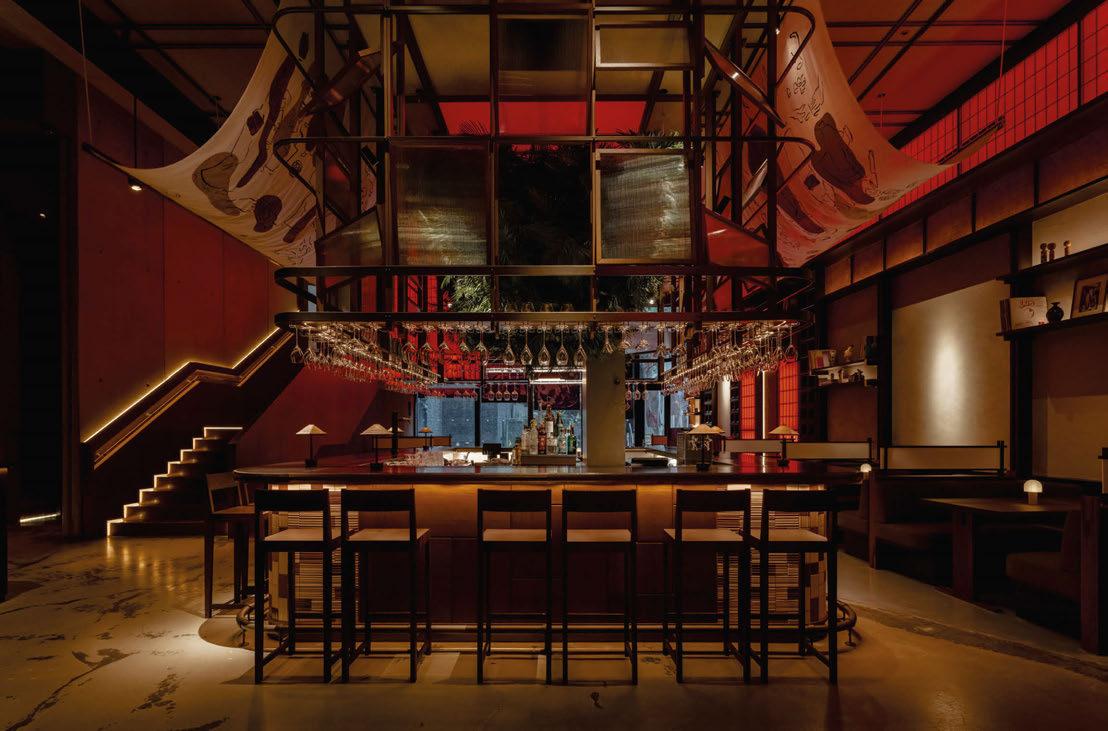
Set beneath the streets of Shoreditch and accessed through a pristine Japanese garden, on entry, natural materials and a colour palette of golden amber offset by greenery and warm woods combine to create a grounding atmosphere. But the eye is immediately drawn to the dramatic bar, conceived as an architectural and social
centrepiece, and built to reference traditional sake containers. Above, a suspended textile installation inspired by Japanese Noren curtains creates a constantly shifting threshold within the room, while textured ceramics, latticework and an illuminated stairwell add depth, rhythm and a strong sense of identity.
“Details such as these turn the restaurant into both a dining and nighttime destination, with the design used to deliberately choreograph a gradual shift from calm to vibrancy,” adds Oscar Engroba, co-founder of Astet Studio. Lighting, music and layered textures also play a role in setting the day-to-night tone, but it’s the integration of the DJ box and bar as focal points that transforms the space into a visceral social and sensory experience, where guests share Japanese plates prepared on a robata grill. “The result is an atmosphere that feels intimate yet dynamic, and deeply rooted in tradition but unmistakably urban,” Zreigat concludes. “It’s a restaurant where dining, conversation and nightlife merge seamlessly.”
Mitsu Aethos
Bazaar Meat by José Andrés
The Venetian Resort
LAS VEGAS
The famed Spanish chef finds a new venue for his revered steakhouse brand, bringing his unique style of theatrical cuisine to a bigger audience than ever.
From the historic institutions frequented by Elvis and the Rat Pack to the glitzy reinventions that line The Strip today, the steakhouse has long been a cornerstone of the Las Vegas dining scene. But when acclaimed Spanish chef José Andrés introduced Bazaar Meat to the city in 2014, it quickly became the must-visit steakhouse in town. Meat aficionados would make the trip to Sin City just to pay the restaurant a visit, hoping to be dazzled by Andrés’ winning combination of traditional Spanish flavours, inventive technique and playful showmanship. “A steakhouse must have incredible steak, of course, but it is much more than that, especially in a place like Las Vegas,” Andrés says. “It has to be larger than life, with high energy, tableside service and a sprinkling of showmanship.” He also cites “wonder, magic and joy” as key ingredients of the unique offering. Over a decade later, Bazaar Meat Las Vegas has made its most strategic move yet with a much larger, 20,000ft2 space within The Palazzo tower at The Venetian Resort (its predecessor was tucked away in the lesser-known Sahara Hotel & Casino). Here, Andrés has teamed up with Executive
Chef Frank Medina to treat over 400 nightly diners to an arresting new design and an array of theatrics. “Beyond the expanded footprint, the new home at The Palazzo has allowed us to fully realise the vision of Bazaar Meat in a way we simply could not before,” Medina explains. “The kitchen infrastructure is more advanced, which gives us greater flexibility and precision in execution, and the dining room offers a more refined sense of theatre.” Most importantly, he adds, the additional space allows the team to elevate the guest journey. “From the moment of arrival to the pacing of service, tableside interaction and overall energy of the room, everything feels more immersive and luxurious.”
Interior designer Alessandro Munge, renowned for his dramatic spaces and elaborate design storylines, was enlisted to tell the tale of Bazaar Meat’s exciting new chapter. He started in a place that struck a personal chord with Andrés. “We dug deep and found out that his wife was from Andalucia, which led us to the discovery of an annual event called Feria de Jerez,” Munge says of the vibrant Festival of the Horses, which celebrates livestock with the very best in food, drink, flamenco and bullfighting. The energy of this occasion was fitting of Andrés, who is well-known for his passion and enthusiasm. “José really believes in delivering phenomenal food in a great environment, so the kind of narrative, nuance and texture that he demands can be traced back to the fact that he’s so colourful and full of life himself,” Munge continues.
Guests enter through a round portal anchored by murals of livestock wearing sunglasses that flank a life-size sculpture of a charging bull adorned in the
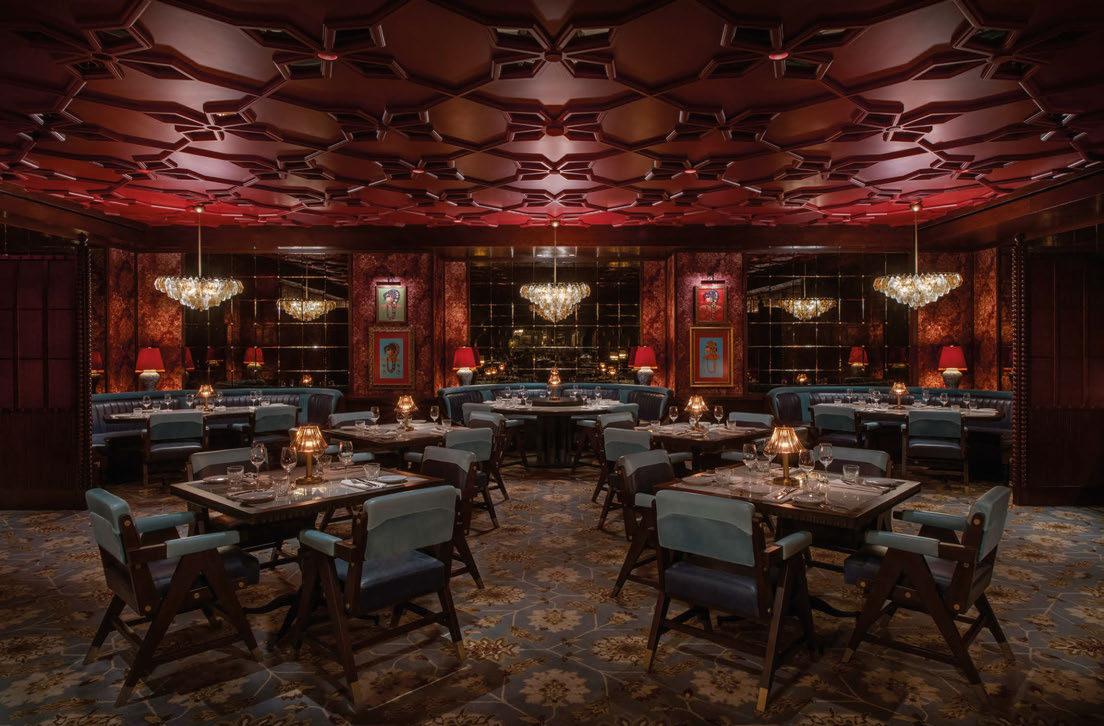
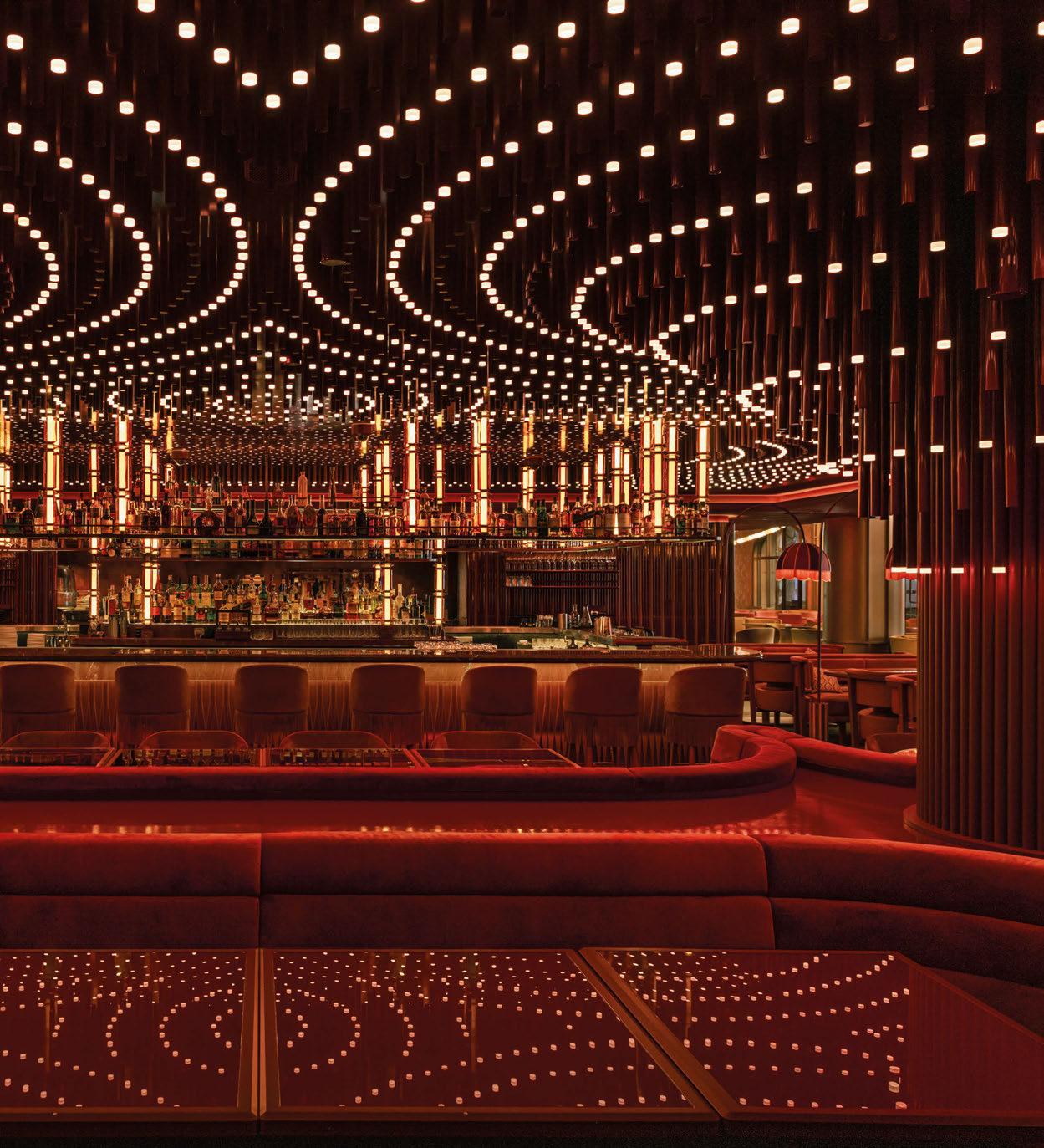
finest jewellery, exactly as it would be in southern Spain. This leads to a sultry, rust-toned dining room, where carved leather tables and oxblood velvet banquettes are presided over by a dazzling display of lights arranged in a series of concentric circles. Custom wallpaper reveals a subtle yet stylised group of flamenco dancers and merrymakers, who look on as guests partake in elaborate tableside cocktail preparation and meat-carving. Flanking a display kitchen complete with the requisite live fire, the floating bar bottle display features blown-glass lanterns that combine with the overhead lighting to add another dimension to the carnival ambience. In an adjacent private dining room, swathes of fabric lining the walls conjures the dynamism of a flamenco dancer’s dress, while in another room, a central pendant light fixture resembles the sweeping whip of a bullfighter.
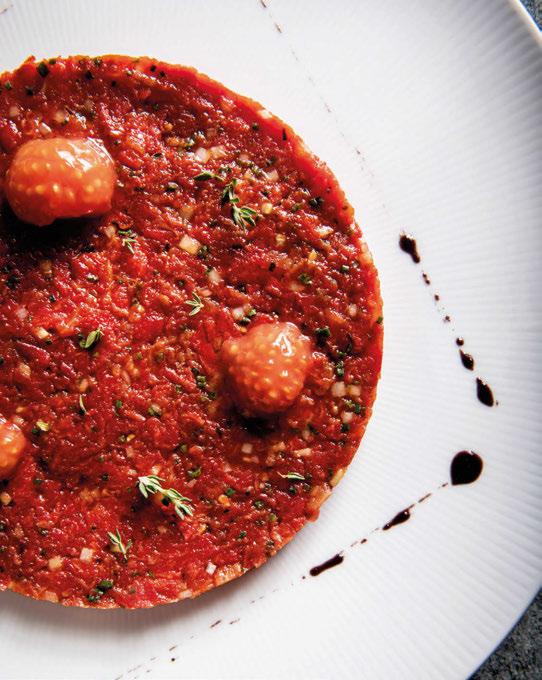
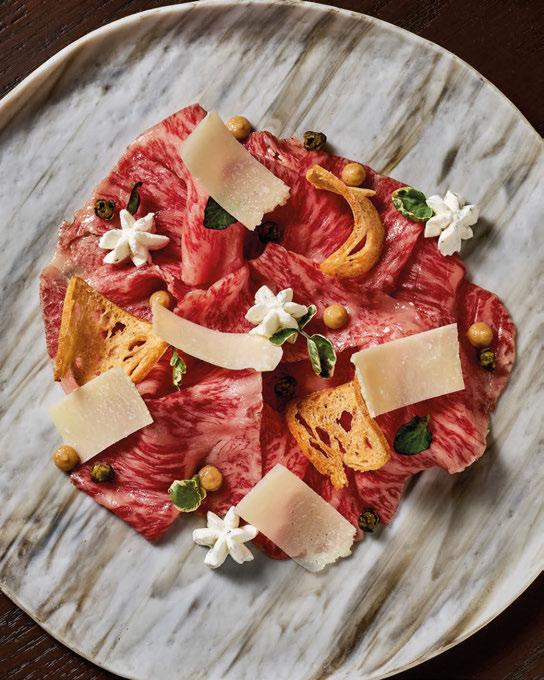
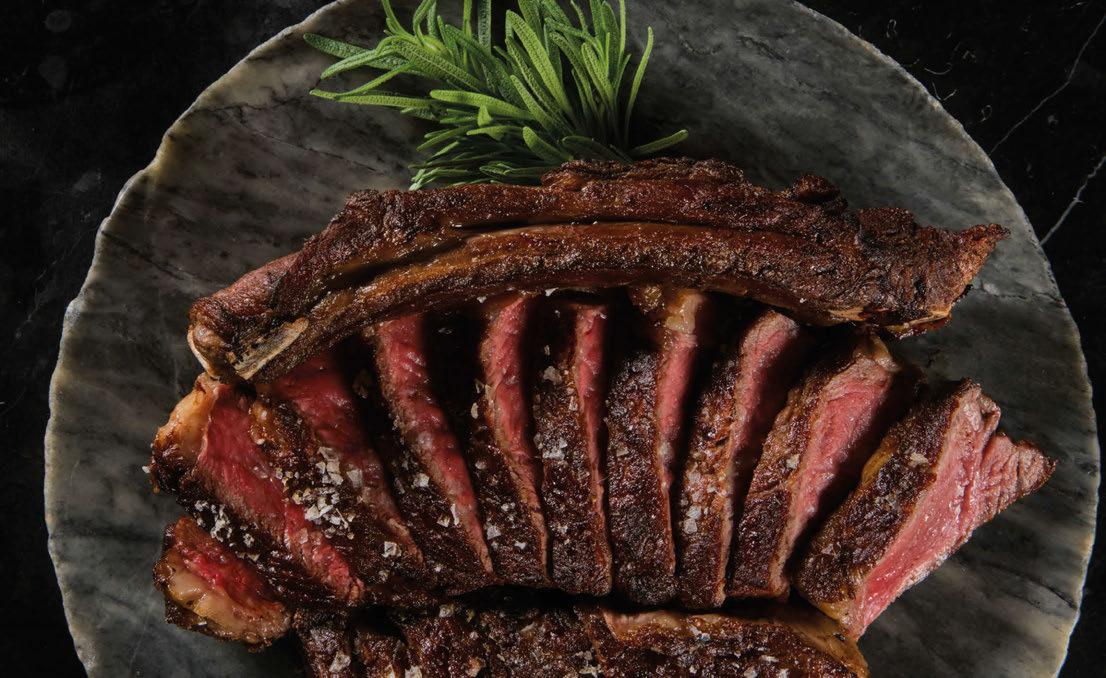
The dining experience begins with a bevvy of inventive small plates, from beef tartare to foie gras wrapped in a delicate swirl of cotton candy, progressing to Andrés’ favourite – an interpretation of a Philly Cheesesteak, which replaces the typical ingredients with a thin and crispy ‘air bread’ and a lighter-than-air Spanish Manchego Espuma, all topped with paper-thin A5 wagyu. Other highlights include crispy Oscietra caviar cones with refreshing horseradish crème fraiche, and Neptune’s Pillow, a delicate bluefin tuna pastry with a bite of wasabi. With the mains, Andrés truly proves his prowess with meat. “I will never tell you not to get a Bone-in Txuleton Ribeye from the wood fire,” he says of his signature main, which is best paired with the equally
Bazaar Meat elevates classic steakhouse fare with authentic Spanish ingredients and playful showmanship
acclaimed potato purée of “butter, butter and more butter with some potatoes”.
“The Vaca Vieja is also delicious because the cows have developed so much flavour over the course of their lives,” the chef continues. “And you can’t go wrong with any of our American wagyu hybrids or the certified wagyus from Japan. In fact, who am I to stop you from trying them all?”
Beverage pairings are as well-honed as the menu. One of the more elaborate tableside presentations is the fully customisable martini that is served, in Andrés’ words, “very, very, very cold” and can be tweaked according to type of liquor, aroma and garnish – anything from rosemary and peppercorn to a host of olive varieties. In typically elaborate fashion, the dessert menu features a replica of the iconic entertainment venue, The Sphere, which guests shatter with a mallet to reveal a smattering of additional mini desserts. Equally theatrical is the Baba Queimada, a traditional Galician dessert prepared tableside with fire and rum.
Andrés is so taken with the uproarious success of the Bazaar Meat concept that he’s replaced his array of existing Bazaar restaurants with new design schemes and meat-centric menus, rebranding outposts in Washington DC and New York to join their Chicago counterpart that debuted in 2021.
This year will see the opening of a brandnew venue in Miami Beach and perhaps the most anticipated Bazaar Meat yet, located in the iconic, Frank Gehry-designed The Grand LA shopping, dining, residential and hotel development in downtown Los Angeles. “The city welcomed me so warmly when we first opened and I can’t wait to return,” Andrés says of the place where the Bazaar concept first began. And although each destination and design ethos will be different, one theme captured perfectly by Chef Medina will remain constant: “At Bazaar Meat, we always believe dining should feel like more than dinner,” he concludes. “It should feel like entertainment, celebration and craftsmanship all in one.”
IN A BITE
Operator: José Andrés Group
Interior Design: Studio Munge
Chef Patron: José Andrés
Executive Chef: Frank Medina www.venetianlasvegas.com
Corinthia ROME
Corinthia’s Italian debut lands in the capital with culinary ambition, appointing Carlo Cracco to shape an offering that balances local identity with a globally informed perspective.
Tucked into a quietly commanding location between Piazza Navona, Mausoleum of Augustus and the Spanish Steps, Corinthia Hotels has made its debut in Rome. Occupying a historic palazzo that once served as headquarters of the Bank of Italy, the 60-key hotel boasts an enviable culinary offering too, with three inspired venues curated by celebrated chef Carlo Cracco.
A project that was six years in the making, the design approach is one of quiet, classic luxury and, entirely reimagined by GA Design, there is little to suggest the building’s past life. “It was gutted in the sixties, so there was nothing of historical value left when we took it over,” says Simon Abela, interior architect and design consultant for the London-based studio. Instead, the team looked to opulent Roman palazzi for inspiration, shaping the interiors to conjure the atmosphere of a refined private residence in keeping with Corinthia’s home-away-from-home ethos. The sole exception is the Theodoli Heritage Suite, which preserves 1920s frescoes by Giulio Bargellini and a ceiling by Guglielmo Janni.
Throughout the interiors, materials and makers are predominantly Italian, from Rubelli and Medea fabrics to family-run furniture producers, while marble, sourced largely from the north of Italy, features in as many as 20 varieties across the hotel. “There were moments when we were forced to look further afield in sourcing products, but we always tried to stay within Europe,” notes Abela. Rooms and suites increase in luxuriance according to their category,
with more intricate inlays and mosaics as the scale climbs, while a spa comes set within the former bank vault, drawing on ancient Roman bathing rituals.
This latest opening marks not only a Roman debut for Corinthia, but also for Cracco – a protégé of Gualtiero Marchesi who has trained under Alain Ducasse, and eagleeyed diners may recognise from MasterChef Italia and the docuseries Dinner Club. He began his career at Marchesi’s in Milan, the first in Italy to be awarded three Michelin stars, before moving on to the likes of Enoteca Pinchiorri, another restaurant that held three Michelin stars during his tenure. He later went on to open his own venture, Ristorante Cracco, in Milan. At Corinthia Rome, the chef has built on his experience to open three venues. The pièce de résistance is fine-dining restaurant Viride – named after the Latin for green – which draws inspiration from Rome’s hidden gardens. Its design follows suit, defined by tactile, greenhued velvet and sage leathers, alongside dark timber in a nod to the wood used throughout the hotel.
With a focus on contemporary Italian cuisine shaped by the seasons, sourcing exceptional ingredients is central to Cracco’s philosophy, and underpinned by relationships with local producers, who respond well to the chef’s flexible, quality-first approach. “We work closely with small producers from Lazio, but we don’t limit ourselves ideologically,” he explains. “The key is quality and respect for the ingredient.”
The result is a menu that moves seamlessly between
tradition and innovation. Starters include fried egg yolk with artichoke salad, pecorino fondue and dried anchovies, and sole ballotine in vaccinara style. First courses meanwhile, span from ricotta and pear gnocchi with asparagus and chanterelles, to crab ravioli with eel, lemon and tarragon. Decadent dishes such as blue lobster with white pepper and vinegared pearls, and a rich, aptly named ‘lamb on lamb’ special are among the stand-out mains.
A tasting menu showcases additional signatures, from Cracco’s much-loved Russian salad encased in crisp guanciale, to a hearty hosomaki stew made with oxtail. “Many of the dishes are inspired by Roman recipes using ingredients like artichokes, carbonara and oxtail,” the chef explains. “The idea is not to replicate tradition, but to use it as a starting point, enhancing flavours and textures to create a contemporary reinterpretation that still carries forth the identity of Rome.”
Interestingly, the tasting menu is conceived as a journey through diverse landscapes rather than recipes. “There are references to Roman traditions, but also unexpected twists and turns,” he continues.
“I didn’t want a didactic narrative; instead, it’s something more emotional, where each dish opens a new perspective.”
Wine at Viride is equally considered, with an impressive 500-label wine list compiled by Head Sommelier Stefania Ruggeri, which spans everything from Clochard La Calcinara Chardonnay by the glass to Burgundies bottled at the end of the 19th century.
“We’ve built a well-equipped, high-level cellar, with a selection that includes important labels and several verticals designed to satisfy a wide range of tastes,” explains Cracco. “At Viride, pairings are a natural extension of the cuisine, accompanying the dishes and contributing to a more complete and balanced dining experience.” The wine is also a key part of the design, with Abela insisting on displaying a range of bottles: “It is the heart and soul of any Italian dining experience, after all.”
For a more casual dining experience, Piazzetta is widely considered the epicentre of the hotel; originally enclosed, it has now been opened up to create a social outdoor courtyard. Drawing on the character of Rome’s piazzas, it’s designed for al fresco
The interiors at Viride draw inspiration from Rome’s clandestine courtyards, while the menu showcases elevated Italian dishes
gatherings among lush plantings. “This space has a different energy,” continues Cracco. “We wanted to create something more immediate and accessible, yet still coherent within the overall project. The menus are lighter, but you can still recognise the same ingredients and attention to detail.” This translates to an à la carte menu that features fresh salads, the mandatory club sandwich and plenty of classic Italian staples including aubergine parmigiana, tonnarelli cacio e pepe and 40 day-aged bistecca alla fiorentina, plus a selection of pizzas.
Both pre-dinner drinks and nightcaps are best enjoyed at Ocra Bar, which feels both cosy and opulent. “Although there is continuity in the design, we wanted to create distinct spaces, and the bar has its own feel, offering something a little different to the restaurant, living room and other public areas,” explains Abela. Again, Italian marble and timber flooring sourced in Italy set the tone, while the ceiling is covered in lavish gold mosaics that draw comparison to shiny coins. “It’s a nod to Rome being the
capital of mosaics, but also a nod – the only nod, in fact - to the building’s past life as a bank,” he adds.
Drinks at Ocra were also created under the direction of Cracco, together with Head Mixologist Andrea Pace, whose travels inspire a creative yet compact cocktail list. Highlights include an Elderflower Bloom comprising vodka, orange liqueur, blueberries and elderflower cordial, and a unique take on the negroni flavoured with rocket and passionfruit.
Ultimately, Corinthia Rome is as much about place as it is about cuisine – an approach that reflects a deeper, longstanding connection to the city and a desire to create a destination that resonates beyond the plate. “Rome has always been a city I felt deeply connected to,” Cracco concludes. “So, when the opportunity to collaborate with Corinthia came up, it wasn’t just about opening a restaurant, it was about becoming part of a larger vision. This project has international scope but a strong local soul, and I find that balance very compelling.”
IN A BITE
Owner: Reuben Brothers
Operator: Corinthia Hotels
Architecture and Interior Design: GA Design
Chef Partner: Carlo Cracco
Head Sommelier: Stefania Ruggeri
Head Mixologist: Andrea Pace www.corinthia.com
The Zetter
BLOOMSBURY
The third London outpost from The Zetter is its most ambitious yet, with eccentric spirit woven into the interiors and F&B.
Strolling along the idyllic streets of Bloomsbury, where leafy gardens brush up against Georgian townhouses, it’s easy to get a sense of the cultural clout the central London borough possesses. Ceramic blue plaques, the historical markers commemorating significant figures and events across the UK capital, seem to be plastered to every other building’s façade. There are tributes to famous writer and feminist Virginia Woolf, prominent hotelier and theatre producer Richard D’Oyly Carte, 19 th century watercolour painter William Henry Hunt, and prolific novelist Charles Dickens, whose body of work includes some of the most iconic British characters ever brought to life on the page. This gaggle of revolutionary thinkers and creative minds would no doubt have felt right at home at The Zetter Bloomsbury, The Zetter Group’s third and largest property to date, set just moments away from the British Museum. Wild and wonderful, the hotel’s idiosyncratic décor has seemingly been conjured from the imagination of a grand, welltravelled eccentric who has collected curio on crisscrossing global sojourns. “We approach hospitality in a way that to makes you feel like a guest at a beloved friend’s house,” explains Joe Harper, F&B Director of The Zetter. “That feeling is stitched into everything we do.”
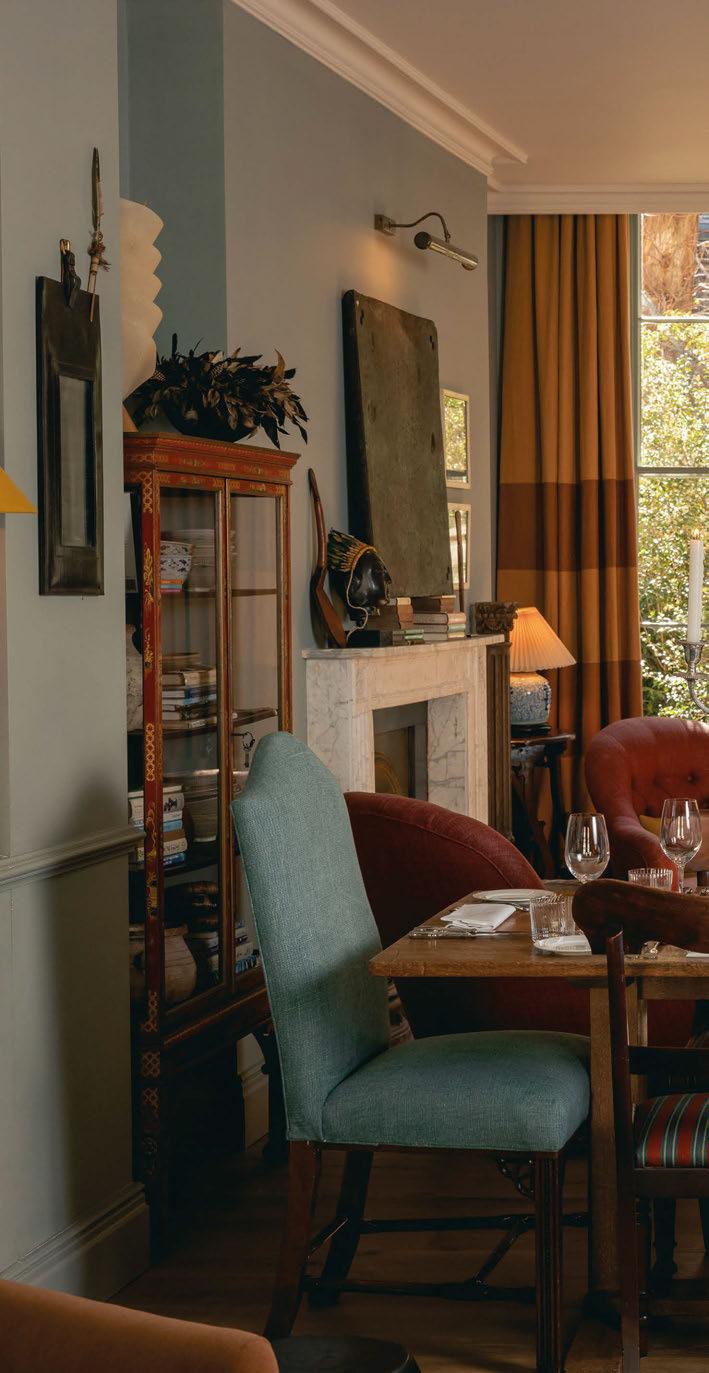
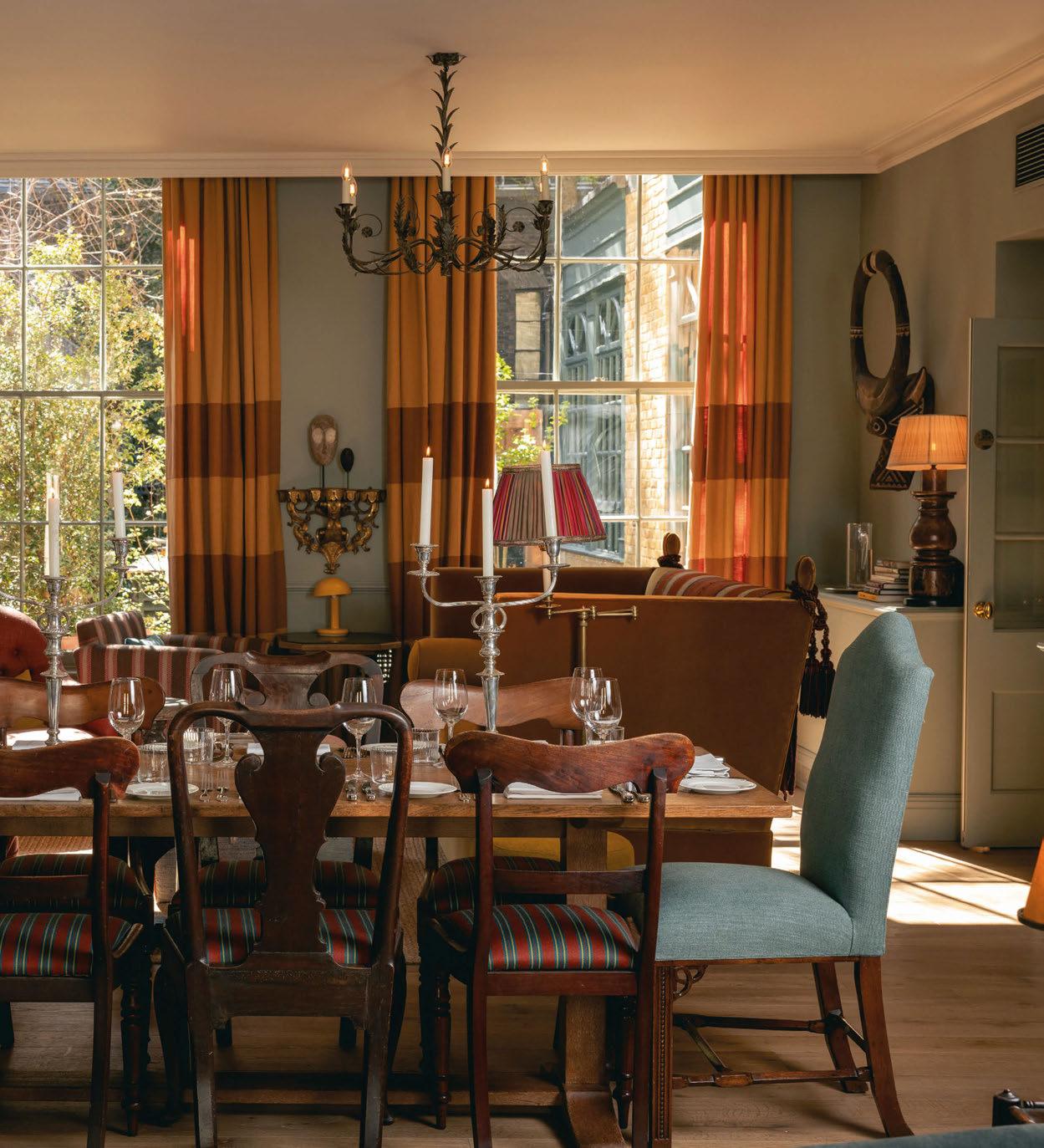
The resulting residential vibe is woven into both of the hotel’s F&B spaces. Signature eatery The Parlour brings together carefully sourced antiques, specially crafted textiles and bespoke rugs alongside handpainted faux-marbling, a japanned bar front and a roaring fireplace that begs to be the backdrop to cosy nightcaps. “It’s reflective of the hotel’s eclectic sensibilities, which are expressed through a global layering of references, from African and Oceanic artefacts to Asian decorative pieces,” explains James Thurstan Waterworth, who led on the design. “The breadth of influence is unified through a curated, domestic lens, ensuring the space feels cohesive while still retaining a sense of discovery and individuality.”
Over in The Orangery, the hotel’s main dining space and setting for breakfast and afternoon teas, light floods into the glass conservatory and doors lead out into a newly planted garden – the first in The Zetter portfolio. The palette is warmer here, with blue and rust-hued upholstery, green-tinted window frames and red Lloyd Loom chairs, but the homeaway-from-home essence remains. “Antiques and curiosities continue throughout the space, maintaining a connection to the wider design language of the hotel,” Thurstan Waterworth adds. “We paid very close attention to the evening lighting, creating a soft, ambient glow to retain the same sense of intimacy found in a private residence.”
The very British sensibility continues through to the succinct yet considered menus, overseen by
Executive Head Chef Debjit Dass, whose experience includes four years across Four Seasons properties in Abu Dhabi and Mumbai, and stints at Anantara Dubai Palm Jumeirah and The Savoy Grill by Gordon Ramsay. Nevertheless, any international inclinations were left at the door when he joined The Zetter, replaced by a microfocus on local sourcing and seasonality. “There is so much excellent produce in the UK that there’s no need to look elsewhere,” Dass confirms. “So, I just use what Mother Nature provides that’s available on our doorstep.”
This isn’t hyperbole – Dass has made it his personal mission to build relationships with every supplier, and once forged, those connections are watertight. “I like to work with people who take pride in what they do, because I take pride in what I do,” he explains. “It’s important to me to know the story behind every product that I use.” On the verified list are Mayfield Farm in Oxfordshire, which supplies free range rich yolk eggs; Ellie’s Dairy in Kent, which produces goat’s cheese with a distinct feta-like texture; and Broadland Hams in Norfolk, whose streaky bacon is a breakfast fry-up showstopper.
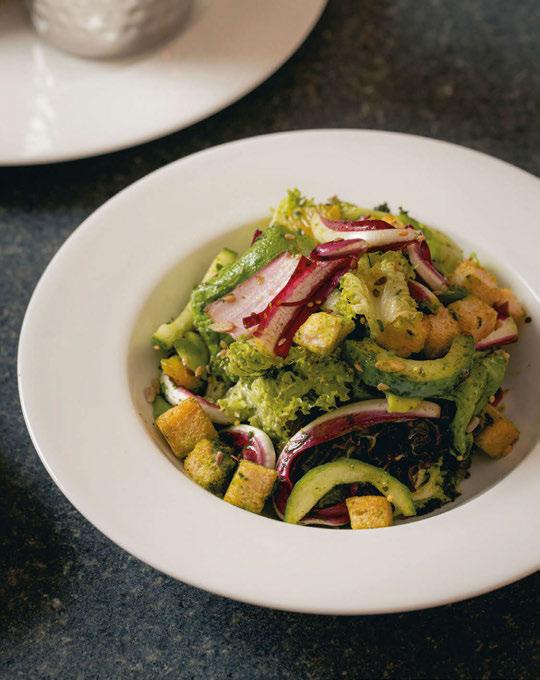
There are also scallops from the Isle of Skye, lobsters plucked from the icy cold Scottish seas, asparagus from the Midlands and tomatoes from the Isle of Wight. All of this is ploughed into a menu featuring elevated classics like Welsh rarebit made with Snowdonia Black Bomber and stout and served with pickled walnut ketchup; Cornish crab and Chapel
Provenance and seasonality are the primary drivers behind every dish at The Parlour
& Swan smoked salmon crumpet with pickled cucumber and crème fraiche; and The Zetter cheeseburger, featuring homemade beef shin and bone marrow smashed patties, Croxton Manor cheddar and a caper and mustard relish.
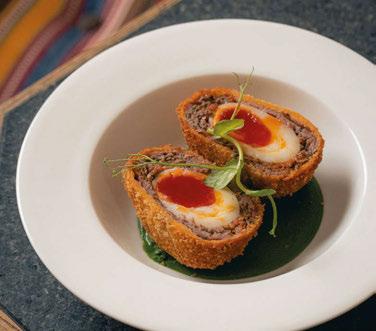
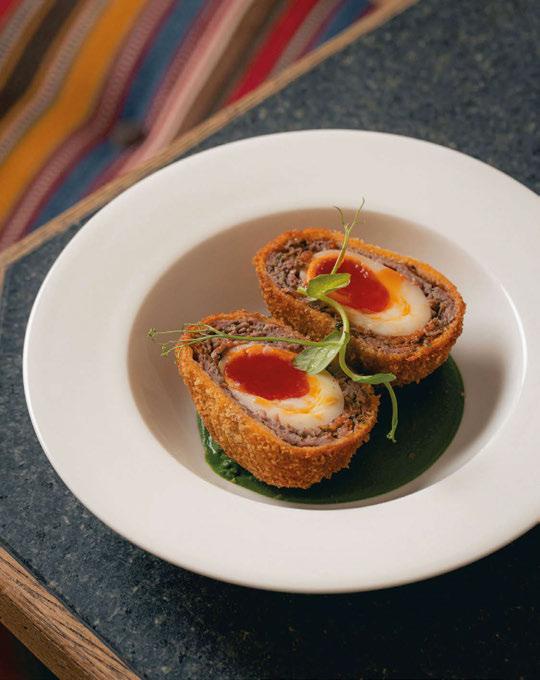
Perhaps the standout though, is a humble Scotch egg, in which the traditional pork has been replaced with lamb. “In springtime, lamb is unbeatable,” Dass says. “And I had the opportunity to stamp my Indian heritage on the dish by adding some spice, so it also includes some elements of an Indian lamb kofta.”
This nicely sums up the hotel’s gastronomic offering, which isn’t lofty or high-end, but is incredibly well done. “It is opulent comfort food,” confirms Harper. “And when you taste a product at its peak, the flavours and textures are just so much bigger and better. It really dials up the experience.”
The same philosophy has been applied to the cocktail list, featuring 10 lesser-known classics have been enlivened with a typical The Zetter spin, and the afternoon tea, which
has been scaled down in size, but ramped up in quality, with Dass taking a zealous-like approach in the admirable quest to make the perfect scone. “I admit I have changed the flour four times already,” he reveals, laughing. “But it’s been worth it because I’ve now hit on the ideal fluffiness.” And with every afternoon tea experience currently pre-booked, the good news for guests is that they arrive at the table fresh from the oven, warm and ready to soak up silly amounts of jam and cream.
The attention to detail is palpable, and as Harper notes, essential to countering the varying challenges presented by today’s turbulent market. “With everything going on in the world, the call to action needs to be really strong, we have to excite people,” he confirms. This is especially pertinent with an expansion drive set to see more properties open across London, as well a move into mainland Europe. “Bloomsbury is the beginning of the journey,” he says. “And we hope it will serve as our best blueprint yet for what’s to come.”
Owner: The Zetter Group
Interior Design: Thurstan
Executive Head Chef: Debjit Dass
F&B Director: Joe Harper www.thezetter.com
St Regis
Singapore
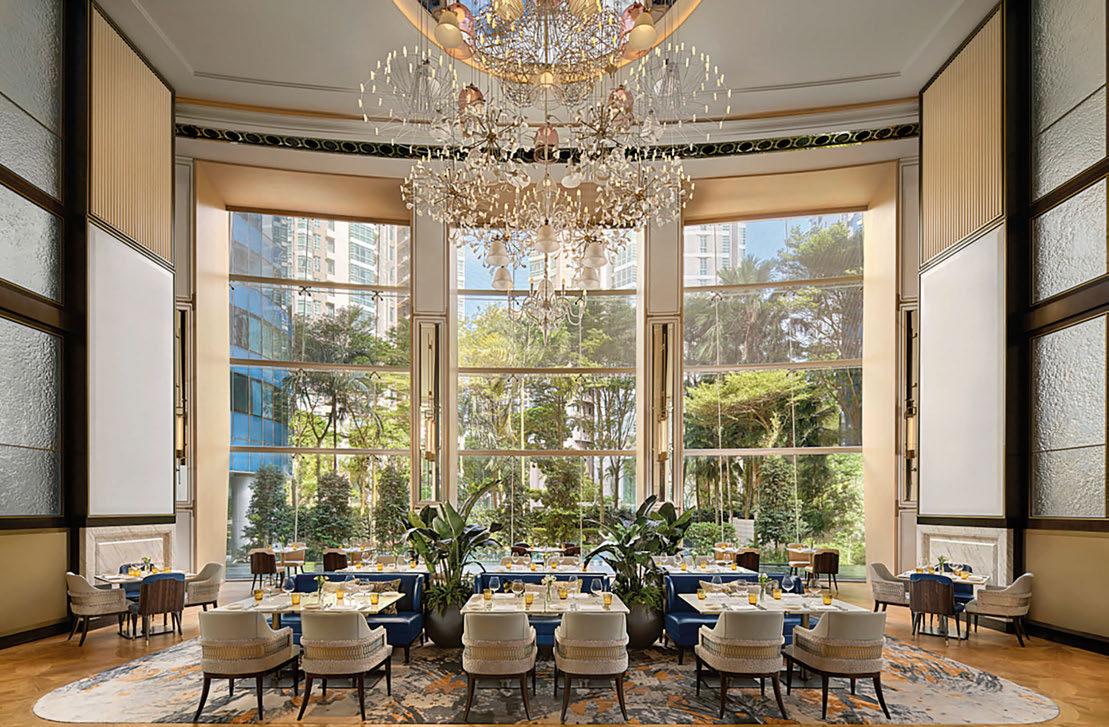
After a multi-phase renovation, St Regis Singapore introduces a range of new F&B concepts, with an Italian venture by chef Angelo Sergio at its heart.
Words: Jingmei Luo • Photography: Courtesy of Marriott International (unless otherwise stated)
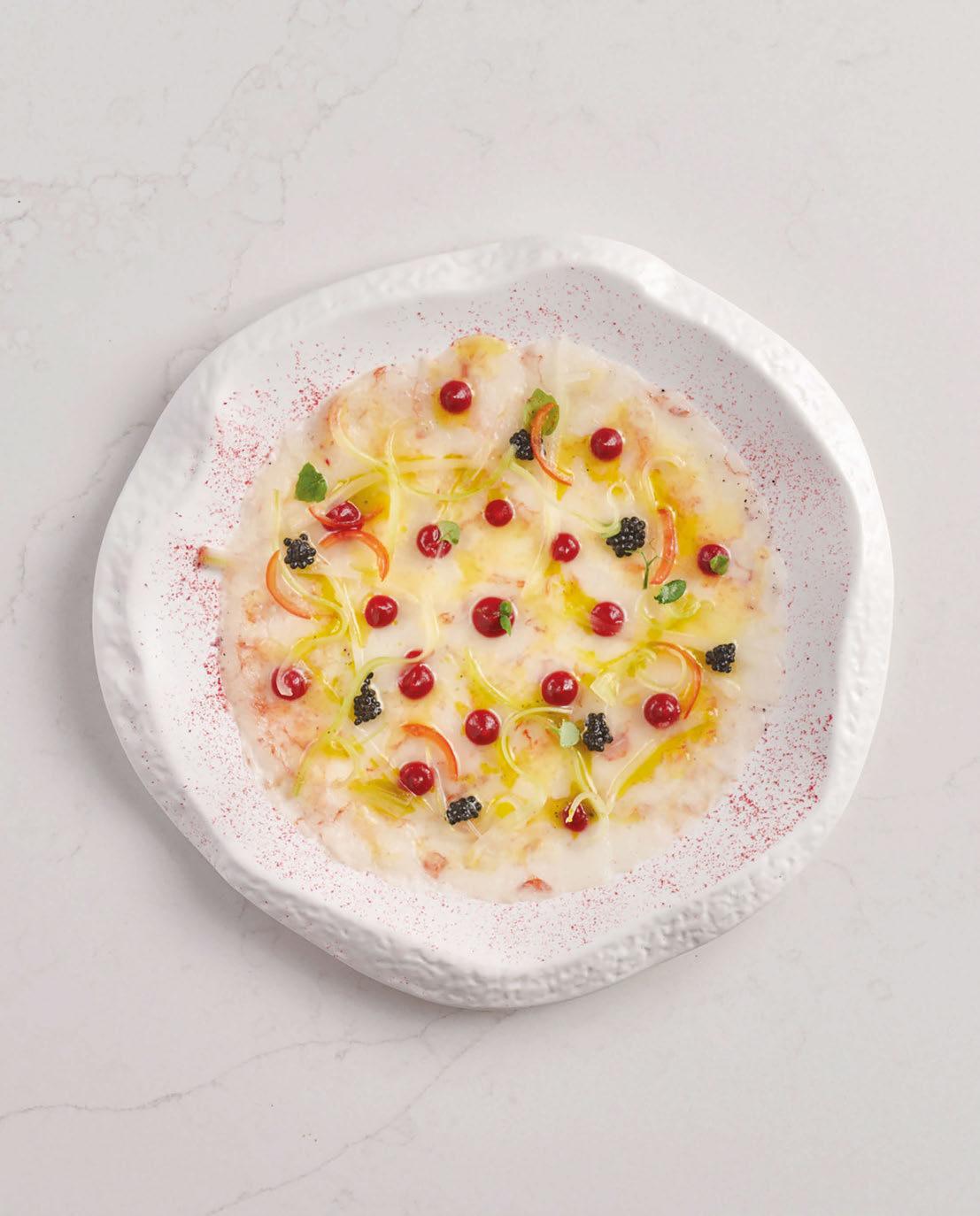
When Angelo Sergio was a child, his ‘toys’ included pasta dough. “My parents both worked so I spent a lot of time with my grandmother, and her mission was to cook for everyone. She used to wake up early to make fresh pasta and bread every day,” shares the Puglia native, who, alongside his sister, was a permanent fixture in the family matriarch’s kitchen.
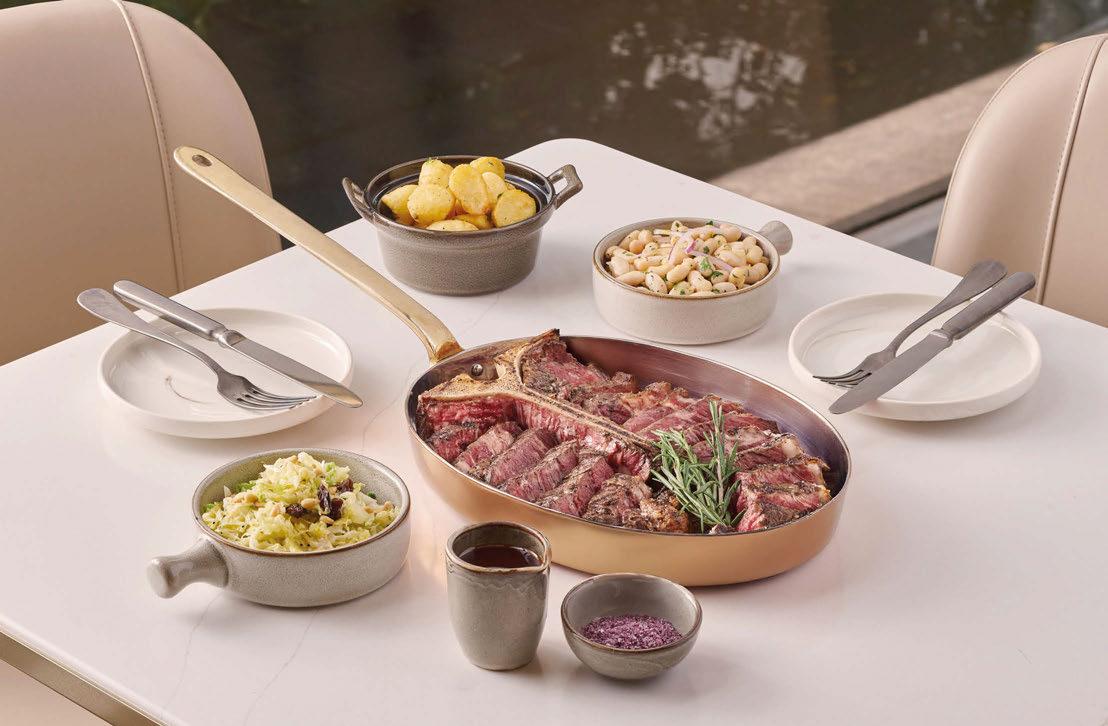
Thus it is a kind of homecoming that Sergio has revived his grandmother’s recipes as Chef de Cuisine of Sophia, the new Italian restaurant at St Regis Singapore. Replacing the former Astor Grill, which Sergio also helmed, the venue is named after the legendary Italian actress Sophia Loren, and though it still showcases the chef’s mastery of meat, the menu sees the addition of authentic Italian dishes.
This change is part of the hotel’s multi-phase renovation, led by design studio FBEye International, which brings a lighter, botanical-inspired palette to the lobby, guestrooms, meeting spaces and John Jacob Ballroom, as well as new F&B venues including Sophia, The Tea Room and St Regis Bar, formerly Astor Bar. The redesign takes its cue from the nearby Singapore Botanic Gardens, a UNESCO World Heritage Site. These transformations follow renovations to the St Regis Spa and Yan Ting Cantonese restaurant by Avalon Collective in early 2024.
“Recognising the need to reposition St Regis Singapore to secure enduring relevance, the renovation introduces a contemporary expression that is both current and timeless,” says Warren Foster-Brown, founder and Creative Director of FBEye International. “The design shifts away from traditional formality toward a softer, more residential sensibility, one that is intuitive, intimate and quietly refined.”
Transparency, fluidity, light and biophilic elements come together with greenery and botanical motifs in the creation of a more welcoming hotel. Its earth-friendly ethos also expands in parallel through energy-efficient strategies like LED lighting and in-room filtered water dispensers replacing single-use plastic bottles. Likewise, selected materials such as timber veneers, engineered wood, composite stone and low-VOC paints are endorsed by the Singapore Green Building Council.
The refreshed F&B concepts and menus were given equal amounts of consideration. “The Tea Room is a new concept primarily designed to elevate the signature St Regis Afternoon Tea ritual for today’s guests,” says Sushant Rege, Director of Food & Beverage. A tea sommelier prepares tea tableside, which is served alongside a scone trolley of housemade jams and clotted creams. Heartier dishes available include a club sandwich with pork char siu instead of chicken breast,
reflecting a more intentional merging of eastern and western influences. Recent collaborations, such as that with Mandy Siu of Finesse Patisserie in Hong Kong, who prepares treats like black lemon honey gateau, also offer something new for returning guests.
This space, together with a new takeaway patisserie, precedes the journey into Sophia.
Shuttered doors at the entry’s grand staircase take the place of a solid wall “to flood the transition with natural light and a renewed sense of energy,” describes Foster-Brown, on evoking the atmosphere of an Italian glasshouse.
The seating layout now accommodates both intimate dining and larger groups, with each seat oriented toward the view of the external fountains. Timber marquetry is brought to life by delicate floral motifs of abstract fallen petals and floral wallpaper, while tactile timber-andleather seating is flanked by potted plants. “The original scheme – characterised by heavy drapery and carpeted floors – prioritised inward focus, inadvertently obscuring its connection
to the exterior landscape,” says Foster-Brown. “The redesign seeks to reverse this condition entirely. A comprehensive reconfiguration of the layout introduces a more intuitive and welcoming spatial flow, where the permanent buffet set-up is now repositioned to operate with greater discretion, allowing the dining experience to unfold with a sense of calm refinement rather than an overt display.”
This sophisticated yet warm setting is Sergio’s new playground. As a child, family trips around Italy in a caravan acquainted him with each region’s distinctive dishes. At 14, he spent “17 hours a day cutting mozzarella cheese” in an Italian restaurant. Post-culinary school saw extensive stints abroad in Switzerland, the USA, Japan and China before the chef settled in Singapore, working at several established Italian restaurants, including the beloved Ristorante da Valentino, patronised by Singapore’s first prime minister, Lee Kuan Yew.
For the past 16 years, Sergio has led the culinary direction at St Regis Singapore. The
The interiors at Sophia take inspiration from the nearby Singapore Botanic Gardens, while the menu reimagines Italian classics
chef describes his dishes at Sophia as “authentic Italian with a modern touch”. For example, the salame di cioccolato – a dessert from Southern Italy – mimics sliced salami using chocolate, pistachio and biscotti. This, like many of the signatures on the menu, is a story plucked from his memory and translated into culinary form.
Another childhood recollection has been revived with the capaccio di gamberi – an aesthetically pleasing antipasti of Mazara prawn with celery, raspberry gel, plankton oil and avruga pearls – a replication of Sergio’s first taste of the highly prized, deep-sea red prawns on a childhood holiday to Sicily. And while he was hesitant about adding the rigatoni alla carbonara, made with authentic ingredients like guanciale (cured pork cheek), egg yolk and pecorino romano, the classic dish from Rome has become very popular, with chef friends flocking to Sophia to enjoy it.
Guests can expect part of the menu to be refreshed every few months. Most recently, the filetto di branzino was added, with sea bass fillet
shipped from the Mediterranean twice weekly. Meanwhile, Sophia’s Sunday brunch is a classy, vivacious affair complete with a mozzarella bar, gelato cart, tiramisu trolley and free-flowing R de Ruinart Brut champagne, served to the tune of a live jazz band.
Post-dinners, an evening at the refreshed St Regis Bar comes highly recommended. Melding early 20th century Manhattan glamour with tropical touches, it once again pays tribute to the Singapore Botanic Gardens. Brass, marble and rich woods form the backdrop for head bartender Kelvin Saquilayan’s new Time After Time cocktail menu. Tracing the drinks zeitgeist from New York to Singapore over five decades, concoctions include The Velvet Underground, made with Mente-Pastille, crème de cacao and salted ice-cream; the iconic Bloody Mary, which was invented in 1934 at the first St Regis in New York City; and The Straits Mary, spiced with umami gochujang and chilli padi. Blending past and present, it’s a fine representation of St Regis Singapore 2.0.
Operator: Marriott International Interior Design: FBEye International Graphic Design: Years Months Day Chef de Cuisine: Angelo Sergio
Russell Sage Studio channels the folklore of a remote Scottish island into immersive F&B in partnership with The Glenmorangie Company.
Words: Hannah Currie
Drawn by its abundant coastal larder and the promise of strong community on the Atlantic’s edge, people have gathered on Islay since at least 10,000 BC. Vikings once arrived in the Inner Hebrides as raiders and stayed as settlers, while at Finlaggan, the Lords of the Isles convened to feast and debate. Today, with its 3,000 residents and ten distilleries exporting millions of bottles of single malt across the globe each year, the Scottish island remains one shaped as much by its produce as the people who call it home.
It is this spirit that forms the foundation of Ardbeg House, a boutique hotel developed by LVMH-owned The Glenmorangie Company, the parent of Ardbeg Distillery and widely regarded for creating the world’s smokiest Islay whisky. In 2022, the brand acquired The Islay Hotel in Port Ellen, with an ambition to set itself apart as a hospitality destination worthy of the thousands of whisky tourists who pilgrimage to the remote isle each year, as well as establishing a year-round gathering place for the local community.
From the outside, the building remains deliberately understated: a whitewashed corner property facing the harbour in keeping with the town’s modest architecture. Inside, however, a multi-million-pound redesign led by Russell Sage Studio, working alongside fit-out specialists Thomas Johnstone and more than 20 Scottish artists and makers, many from Islay itself, transforms it into something more immersive, even otherworldly.
“The island is rich in historic tales, which we loved hearing
when we visited the local pubs and bars,” muses Sage, a designer often admired for his unbridled creativity when it comes to conceptualising hospitality spaces - most recently for chefs Jason Atherton, Gordon Ramsay and Matt Abé. “Local stories became a central feature of the design. Some accounts were completely mad, others gave a flavour of the island’s people: unique, quick-witted, spirited and full of fun.”
Nowhere is this rich character more evident than inside Signature Restaurant. The space is moody and materially abundant, with bespoke wallcoverings that echo the burnished tones of copper stills and their evolving patina over time. Adding to the rugged feel of the 31-cover space is a central table reimagined from an old fireplace and flanked by forged metal sculptures designed to resemble giant strands of sea kelp. Tables are topped with marble or patchwork wood, while tactile leather green banquettes and a scattering of reclaimed, re-upholstered vintage chairs reflects the resourcefulness embedded in island life.
Whisky, of course, becomes part of the furniture with rare Ardbeg expressions displayed within the original brass cages that surrounded distillery stills, now illuminated by vivid lighting that intensifies as evening emerges.
Island-based makers also help tell the brand story in the private dining area, where a wooden and copper sideboard has been transformed by local artisans into a whisky library displaying prized bottles, and a piece of experimental art by Michelle Currie depicts magnetised iron filings suspended in Scotch. But it’s an unwieldly, handcarved octopus chandelier courtesy of 1Revolution Forgeworks that truly makes a statement, flaunting Sage’s surreal aesthetic with aplomb.
Across the property, artwork and sculpture serve as an extension of place rather than decoration, set against a tactile backdrop of handpainted Fromental wallpapers. Island photographs taken by Mark Unsworth are framed by Islay Celtic Craft and elsewhere, abstract works by Big Nose Workshop sit
Weird and wonderful interiors by Russell Sage set the stage for Islay-inspired dining at Signature Restaurant
Bespoke products for front-of-house
Guests are invited to The Islay Bar to sample whisky-inspired cocktails and Ardbeg Badger Juice, a small-batch malt exclusively to the property
alongside glass pieces by Elin Isaksson to reflect the craggy shorelines beyond the window.
The tale continues at The Islay Bar, a much-loved watering hole that has been revived as a welcoming space where residents and visitors alike can sidle up to the bar and trade in well-worn stories of island life. Aside from the striking green marble bar that evokes the colours of local moss and peatland, the room offers plenty of places to perch. Five tables, shaped like mechanical cogs, nod to the distillery’s engineering heritage, while chairs, crafted from repurposed agricultural items such as tractor seats, reinforce a rural sensibility. The pièce de résistance hangs overhead once more: an immense boat-shaped chandelier, custom-designed and drenched in fishing nets with the green glass of Ardbeg bottles hanging from its hull. Completing the seascape, a wall-wide tapestry depicts a recognisable view across the bay inspired by an original artwork by Sarah Macfarlane, who spent her childhood on Islay. Crafted with help from the Islay Quilters, it bears a Harris Tweed skyline and a tiny stitched icon of Shortie, the distillery’s Jack Russell mascot.
“For us, The Islay Bar is about warmth, generosity and an unmistakable sense of place,” summarises Stuart Smith, Head of Brand Homes at The Glenmorangie Company. “It’s built to bring people together, whether you’re a dedicated Ardbeg fan, someone who’s new to whisky or a local dropping in.” This inclusivity becomes clear on the menu. Whisky flights sit comfortably alongside Islay Ales craft beers and cocktails with a smoky edge – including the Toothache Stone, a rich concoction of Ardbeg Uigeadail and Amaro Nonino topped up with Cocchi Torino and chocolate bitters. Drams start at £3.50 but range to rare pours and island exclusives like Ardbeg Homecoming. For those interested in a deeper dive into the peaty liquid, a daily distillery tour is complimentary
WHERE OTHERS ARE MADE FOR SEASONS, WE ARE MADE FOR A LIFETIME.
for overnight patrons and there’s even hidden drams within the 12 story-driven guest rooms, to continue the journey of discovery.
At 18:15, a nod to the brand’s founding year, all guests are invited for a special toast to sample Ardbeg Badger Juice, a small-batch malt made to an exacting secret recipe and poured directly from the barrel atop the bar. In the hours that follow, live music by local artists flows into the open air of The Courtyard with its handcrafted smoker and grill fashioned by distillery technician Daniel Branson.
For the less whisky-inclined, the dining experience is equally compelling. Think hand-dived scallops collected by the distillery stillman, island-reared meats from Islay Estate and vegetables sourced from Nerabus Farm, as well as the chef’s own allotment. Starters include Islay duck cannelloni and pickled allotment carrots; Bolsa Bay crab paired with blood orange and fennel; and Highland goat’s cheese tart flavoured with beetroot and hibiscus.
Main courses reflect land and sea. A lobster
duet pairs smoked and butter-poached tail with grist-coated claw, while Islay lamb is presented as roasted loin and braised belly with a crispy potato cake. The smoked venison pie, braised in red wine and juniper, brings depth with Ardbeginfused onions. Desserts also take on a subtle whisky lilt to include salted caramel and dark chocolate tartlette served with a touch of Ardbeg An Oa gel aside a maple crème diplomat.
“Ardbeg House is designed to be welcoming, whether whisky is a passion or simply part of discovering Islay,” Smith concludes. “For enthusiasts, there are plenty of exclusives, but for more general visitors, the experience stands on its own.”
The intention is shared by Sage, whose interiors are an obvious pull for those seeking a one-of-a-kind hospitality destination, and who is confident diners will leave Ardbeg House with a sense of having experienced something different. “It’s a highly unusual restaurant,” he concludes. “In an unusual building, on an unusual island.”
Zoe and Layo Paskin’s hospitality journey began with one of the best clubs in the world, but today they’ve swapped dance floors for dining.
Words: Abby Lowe
When it comes to the creation of vivid hospitality experiences, it’s fair to say that if you’re responsible for some of the most iconic clubbing events of all time, you’re probably in possession of a solid framework for understanding what makes something memorable, regardless of the industry. So it is for brother and sister duo, Zoe and Layo Paskin, co-founders of Studio Paskin, the London-based hospitality group well-known for famed Soho eateries and drinking dens including The Palomar, The Blue Posts and its Michelin-starred downstairs counterpart, Evelyn’s Table. “There are many differences between music and hospitality, of course, but many transferable elements too,” Layo confirms on an overcast day in the capital. “The energy, the atmosphere, delivering the goods – it all has to come together in the end.”
Fittingly, The End is a good place to begin,
as this was the name of the nightclub that launched the Paskin siblings onto the dance music scene. Located at the top of Drury Lane on the edge of London’s West End, the former stables were launched as a music venue in 1995, becoming a legendary institution in the 13 years that followed, and securing an eternal spot among the hallowed realms of clubbing lore along the way. “The concept was built around hedonism, but it was also very creative,” Layo explains, who co-founded the club with Mr C of The Shamen. “It was bittersweet when it finished. We were left wondering what we were going to do with the second half of our lives.”
For a brief time, that meant going their separate ways, with Zoe continuing to work in hospitality in various forms, while Layo travelled the globe as an in-demand DJ. It took a few years, but eventually they reunited, buoyed by their independent life experiences and the prospect of a new venture, only this time in the restaurant world.
The Palomar opened in 2014, quickly becoming a favourite haunt of London’s most discerning foodies. “It felt like a logical step,” Zoe confirms. “It brought together all our experiences from over the years, and we were still taking care of people, just in a different way – it was something we were excited about again, in a white-knuckle sort of way!”
Shaped by their time in the music industry, and the get-your-hands-dirty spirit of running a successful club, their high hopes for the venue remained rooted in humility. “We always kept our feet on the ground,” Layo nods. “Having already had one career that went very well, we were fortunately able to leave our egos at the door, and we’ve discovered that’s very useful in this industry.”
It’s proven an astute approach, with Studio Paskin responsible for a cascade of standalones during the ensuing years. Then, during the pandemic, the pair were approached by Ennismore to work on the new Gleneagles Townhouse in Edinburgh, a spin-off to the
original Gleneagles. A boutique hotel and private members’ club, they were tasked with bringing three of the restaurant concepts within the property to life – all-day dining venue, The Spence; members-only rooftop bar, Lamplighters; and exclusive lounge, The Note Burning Room. They describe their process as largely intuitive. Firstly, getting a sense of a venue’s location, its attributes and quality of available nearby produce. Then there’s research into the local market, before diving back into the past for inspirational nuggets to help form the creative foundations of a new identity. “We looked back on the history of the building – the different names it had been given and the ways it had been used,” Layo explains. “That gave us a starting point, and from there, the different identities began to take shape.”
The Spence, for instance, was built around its storied heritage as the former home of the British Linen Company, with the notion of a thread woven quite literally through every element of the branding materials, while Lamplighters was
www.candpceladon.com
“There are lots of differences between music and hospitality. But many transferable elements too.”
LAYO PASKIN
constructed around the legacy of Edinburgh’s Leeries, the Scottish term Robert Louis Stevenson coined for workers who wandered the streets lighting lanterns, illuminating the night skies for the city’s residents.
Meanwhile, culinary offerings were developed in collaboration with the hotel’s general manager and head chef, and the illustrious history of Gleneagles itself also played a role. “It was due to celebrate its 100th anniversary, so we had to keep that sense of layered tradition in mind – there needed to be some elements that harked back to the original itself.”
But the studio’s next project took them to different realms entirely – the southern hemisphere and the opening of another Ennismore project, 25Hours Hotel The Olympia in Sydney, where they were charged with reimagining a snippet from their own past: The Palomar, and intimate wine and cocktail
bar, The Mulwray. Designed to honour the originals while aiming to satisfy the demands of a new, sunnier city, retaining the essence of the venue’s existing DNA remained paramount. “Our locations have an intoxicating, visceral feel,” Zoe says. “So, it’s not just about great design, it’s about recreating that same warmth and authenticity throughout every element.”
It’s a bid that’s paid off, with The Palomar enthusiastically received by the city’s residents, and recently nominated for Best Restaurant in Time Out Sydney’s Food & Drink Awards 2026. Even so, there’s no rest for the Paskins, who, just like back in their dance music heyday, continue to strive in the creation of unforgettable memories for their patrons. “Both of these industries demand craft perfection and repetition,” Layo concludes. “You can have the best weekend in the world in a club or a restaurant, but on Monday, it all starts again.”
Siblings Zoe and Layo Paskin recently completed projects at 25Hours Hotel
The Olympia in Sydney
Dover Sole Alex Dilling
Hotel Café Royal
LONDON
Renowned for his modern, luxurious interpretations of French haute cuisine, Alex Dilling presents Dover Sole with confit potato and shellfish blanquette as part of the new menu available at his eponymous restaurant within Hotel Café Royal in London. A reimagining of Clam Chowder, one of the Michelin-starred chef’s signature dishes that was inspired by his San Francisco childhood, it brushes alongside the original in terms of colour palette and ingredients, but as a main course version, delivers more bang for buck per forkful.
Outstanding British seafood sits at the heart of the dish, with Dover sole and Dorset cockles sourced from the south coast of England, a reflection of Dilling’s commitment to using the
best seasonal produce available, while precise, considered techniques are used to coax the most intense flavours from each ingredient. “The clams are cooked gently to preserve their delicate texture, and we undertake a complex glazing process to form a gelée on the potatoes,” the chef explains. True to Dilling’s style, the result is defined by elegance and restraint, yet still with a smattering of theatricality, as the shellfish blanquette – a velvety ragout that’s a twist on the classic creamy veal stew – is poured tableside onto fine French porcelain. Some subtle final flourishes are all that’s required: “We finish with the placement of some select micro herbs,” he adds. “And of course, a few carefully placed beads of Kaluga Caviar.”
Mauro Colagreco’s respect for nature and the environment continues to shine through with Rosa di Branzino, a dish initially showcased at his three-Michelin-starred restaurant, Mirazur, and reimagined for Cetino at The Lake Como Edition. Following the natural rhythms of sea and land, Colagreco blends the iodised finesse of sea bass with the crisp freshness of radish and vibrancy of citrus, allowing the quality of the ingredients to fully express themselves in their purest form.
Using the finest seasonal produce, the dish is based on a combination of contemporary techniques that aim to preserve the intrinsic quality of each ingredient while revealing its unique texture and flavour. The sea bass undergoes a process of light maturation in brine before being cooked sous vide at low temperature, while an array of gels are made using the concentrate of citrus juices, introducing variations in structure and perception in the mouth.
Presented in the form of a precisely arranged rose that’s made using thin slices of sea bass and white radish, and finished with fleur de sel and fresh herbs, the dish balances intensity and delicacy while embodying Colagreco’s prowess for combining simplicity with depth. “My cuisine is based on an identity that is deeply linked to the environment between lake and nature,” he says. “This dish is a creation that speaks immediately to the guest thanks to its balance between precision and elegance, leaving a lasting impression.”
10-12 May 2027
Le Meridien Split, Croatia
Join us for TO THE TABLE Europe 2027 taking place at the Le Meridien Split on the spectacular Croatian coast, where senior decision makers from major European hotel groups, cruise lines and restaurant groups will come together to discuss their latest projects and requirements with the most innovative and capable suppliers. TO THE TABLE Europe 2027 will keep you connected in this dynamic industry and forging relationships at the highest level.
Mid-strength alcohol was a key talking point at Northern Restaurant & Bar in Manchester, where mindful drinking specialists Club Soda and hospitality research agency KAM spotlighted new data pointing to a major shift in how – and how much – consumers are drinking.
Forming part of the show’s talks programme, a presentation by KAM’s Account Director Jo Lynch, in collaboration with The Mid-Strength Collective, explored a new report, revealing that half of UK consumers prefer to enjoy two midstrength ABV drinks over a single full-strength pour, giving venues an opportunity to increase orders while supporting moderate drinking.
so, the appetite is there, as proven by the fact that 55% of those surveyed say they are interested in exploring mid-strength drinks as an alternative to full-strength options. Unsurprisingly, interest is even higher among younger drinkers – rising to 71% among 25-34-year-olds, 61% for 18–24s, and remaining strong among 35–44s.
In the on-trade sector specifically, however, there is still work to do. Just 31% of consumers say they would consider a mid-strength drink in a pub, bar or restaurant when moderating. That compares to 65% who would choose a soft drink, 34% water and 32% an alcohol-free option. It seems a lack of mid-strength options is actively impacting customer experience, with the data
Meet Me Halfway
Mid-strength alcohol is becoming the growth category pubs and bars can’t afford to miss.
In fact, 73% of respondents are now reducing their alcohol consumption in some way, pointing to a wider shift in behaviour. Though importantly, moderation doesn’t mean abstinence. Instead, consumers are adapting how they drink. While 21% are still having fewer alcoholic beverages per occasion, 19% are ‘zebra striping’ – alternating between alcoholic, mid-strength and alcoholfree drinks within the same occasion. Meanwhile, 13% are ‘coasting’. “This phenomenon is where consumers opt for mid-strength drinks throughout the entirety of the social occasion,” explains Lynch. “But they’re drinking the same number of drinks, if not more, because they can continue to enjoy the experience without destabilising the equilibrium.”
Despite these clear shifts, the research shows that mid-strength remains largely underdeveloped as a category. Awareness is still relatively low, with fewer than half of consumers familiar with mid-strength beer, and even lower recognition across wine, cider and spirits. Even
demonstrating that one-in-three people have either left a venue early or felt disappointed in the last three months due to a poor selection of mid-strength choices. But there is an upside, because if bars improve the visibility of midstrength options, 20% of respondents say they would visit more often, 27% would spend more per visit and 17% would order more drinks.
“It’s clear that the growth of mid-strength drinks has begun, driven by the same consumer behaviours fuelling the rise of alcohol-free options - a strong desire to moderate alcohol consumption without compromising social experiences,” Club Soda’s Laura Willoughby concludes. “Moderation does not have to be a binary choice. The goal is to encourage a more intentional drinking culture - one where we pay attention to what we drink, not just when we choose to abstain from alcohol, but also when we choose to enjoy it.”
A flurry of hotel venues have jumped aboard the trend for showcasing premium drinking experiences inspired by today’s wellnessinformed guest. Among them is Thompson Hotels, part of The Lifestyle Group by Hyatt, which has unveiled a nationwide partnership with Bero, the alcohol-free beer brand founded by British actor Tom Holland.
The year-long activation centres on moments of intention and celebration, with both businesses confident that meaningful moments arise when guests are fully present, preferably with a glass, or can, of ice-cold Bero in hand.
“Guests today are seeking more than just a stay; they want experiences that align with how they live,” explains Amar Lalvani, President and Creative Director at The Lifestyle Group by Hyatt. “Partnering with Bero gives Thompson Hotels the opportunity to meet the need for premium non-alcoholic drink options, elevating
everything from morning meetings to late-night celebrations through curated menus, immersive programming and bespoke brand moments, all while staying true to Thompson’s culture-driven approach to hospitality.”
From check-in to check-out, Bero is aligned with every step of the guest journey through product integration, signature events and curated collaborative content, alongside a dynamic calendar of launches and immersive guest moments across multiple properties and venues.
“We are creating a lifestyle brand that is unique in the space, and one that is grounded authentically to our consumers’ lives,” concludes John Herman, CEO and co-founder of Bero. “The shared belief in creating memorable experiences for a modern consumer with a focus on elevated, social and intentional living makes this partnership with Thompson Hotels perfect for surprising and delighting our communities.”
From the theatrical spin of the bottle to the roar of the crowd, the art of flairing has shaped the careers of generations of bartenders, yet its story has never been definitively documented in one place. The Flair Bartending Book is set to change that.
After four years of painstaking research by internationally recognised bartenders Marco Canova and Tom Dyer, the tome traces the discipline’s humble origins, celebrates its golden years and plots its modern evolution into a global cultural movement.
Spanning over 500 pages, the premium coffee-table edition is designed by beverage marketing agency Liquid-Hub. Illustrated with rare archival imagery, and featuring exclusive interviews and personal stories from top industry figures, its innermost pages reveal the hidden world behind the bottles, bars and legends of the art.
“Flair isn’t just about throwing bottles. It’s about creativity, confidence and connection,” Dyer comments on the book’s recent release. “This is a tribute to everyone who has had the courage to step behind a bar and perform. I’m proud that, together with Marco, we’ve created something that honours the past while motivating the next generation of bartenders.”
Debonademeo and Adrenalina create a ‘softclubbing’ bar to engage visitors at Milan Design Week.
As trade fairs continue to evolve from the transactional to the experiential, product manufacturers are increasingly turning to design studios to showcase their wares. At this year’s Milan Design Week, interactive booths and live demonstrations engaged visitors on a deeper level, while an immersive installation at MoscaPartners Variations within the historic Palazzo Litta provided an opportunity to relax.
Designed by Debonademeo, Bar Adrenalina was conceived as a ‘soft clubbing’ experience with a focus on sound, where interiors transcended a simple display of furniture. The concept comprised three adjoining rooms of differing colour palettes, lighting schemes and acoustic characters, curated to explore their influence on human emotions and behaviour. Every product –be it an Adrenalina armchair, fabrics or surfaces – was selected for its acoustic properties. Velvet curtains and panelled wall cladding softened tonal reverberations, while recycled foam cushions absorbed low frequencies. Each promoted a state
of low brain activity, enabling visitors to become more attuned to social cues.
With the help of Michele Spanghero, an internationally renowned sound and visual artist, Bar Adrenalina was also fitted with microphones to record the vibrations and micro-movements of the space. These will now be used to create a unique sound database, which will be transformed into a new collection of furniture designed by Debonademeo for Adrenalina.
“We realised that the creative process tends to seek answers externally without considering that, sometimes, the furniture is observing us,” explain Luca de Bona and Dario de Meo, co-founders of Debonademeo. “We therefore chose to listen to the sofas. The idea is to go far beyond the clubbing experience; we don’t bring the sound into the bar, but capture it from within. We listen to the voices, the laughter and the movement of bodies in order to translate those sounds and vibrations into a collection of upholstered furniture.”
Stars Align
The astrology inspired cocktail trend is enjoying a renaissance at McRae Bar within Capella Sydney, where the Arcana & Alchemy menu presents a tarot themed collection with a distinctly local feel.
The experience begins the moment guests arrive, when they are invited to draw a tarot card rather than ordering from a list, turning the act of choosing a drink into a ceremony guided by intuition and chance. Bartenders then interpret the card and prepare the corresponding cocktail.
At the heart of the new menu is Major Arcana, the symbolic backbone of the tarot deck, while each pour is inspired by a named card and coupled with one of 12 Sydney buildings designed by George McRae, the original architect of the edifice that now houses the hotel. The pairings draw clear connections between tarot archetypes and McRae’s designs, from The Empress aligned with the Queen Victoria Building, to The Fool matched with St James railway station. The Capella Sydney building itself, originally designed by the architect in the early 1900s as the Department of Education, also features.
Beyond the physical bar, the experience extends online via a bespoke micro site, where each card is animated and accompanied by storytelling visuals and subtle soundscapes by digital studio, Miroma Project Factory.
“Every flavour, colour and garnish has been carefully considered to reflect the personality of the building and its archetype,” says Samson Li, Director of F&B at Capella Sydney. “We have created a ritual that surprises and delights, where each drink becomes a memorable moment connecting guests with the history, craft and soul of our city.”
Ocean Proof
The maturation of fine spirits has historically been a land‑based ritual guided by air, oak and the passing of time. But now, NH Collection Maldives Reethi Resort has partnered with Planteray Rum to shift the tradition seaward, becoming the world’s first resort to achieve the certified process of ageing rum underwater in glass bottles.
For 12 months, while the property was undergoing a redesign, the rum matured in a gentle rocking motion, being shaped by hydrostatic pressure, slow currents and the constant cold temperatures of the deep. Resting 10 metres beneath the surface in custom‑designed metal cages, a selection of bottles lay undisturbed in an ocean cellar, at a site identified by resident dive experts as sheltered from harsh currents, protected from excessive sunlight and calm enough to let time do its work uninterrupted.
Brought ashore for the property’s reopening, the sunken treasure, still bearing the fingerprints of marine life that had embraced it during its underwater repose, reveals a distinct character. By choosing to surrender control to nature and allowing the process to works slowly and in silence, with only occasional dives to check the integrity of the cages, the spirit became inseparable from its setting in the UNESCO‑protected Baa Atoll.
Planteray Rum has already entrusted the resort with new varieties, now undergoing their own year‑long transformation beneath the waves. The programme is set to become a permanent feature of the resort’s mixology offering. At Handhuvaru bar, guests can experience the new maritime vintage neat or in cocktails such as Chai on the Rocks, which combines aged XO rum with warming chai spice and subtle tropical sweetness, or Mocha Molasses, an intense expression of overproof rum layered with espresso and dark chocolate.
Hyper-local sourcing and regional storytelling continue to shape the UK bar scene, and Refuel at The Soho Hotel is bang up-to-date with a terroirled cocktail concept designed to spotlight England’s independent drinks producers.
The Firmdale property has unveiled the Nine Regions menu: a libational journey across the country where each serve is crafted exclusively from ingredients sourced from small, independent makers from each respective region. “The menu is created to showcase what can be found across England,” says Kevin Fry, F&B Manager at The Soho Hotel. “We work with many small producers, some still making their products at home, and our London base gives us a platform to share and celebrate their stories.”
The North East features traditional method sparkling mead from Northumberland Honey Co, while the West Midlands spotlights blackcurrant cordial from Pixley Berries. For the South East, Pleasant Land Distillery contributes a small batch walnut liqueur, and the South West cocktail pairs Cornish rum with mulled apple from Country Cordials. The North West, naturally, is a smooth blend of Lancashire English breakfast tea and Broken Clock vodka, topped with an individual shortbread finger - the ultimate tea and biscuits!
Cream of the Cask
Whisky remains the top dollar ticket of the spirits world, with rare bottles frequently hitting the headlines for their hefty price tags - levels of scarcity reflected in Scotch at The Balmoral’s £60,000 experience centred around a bespoke 1945 Glen Grant Scotch from Gordon & MacPhail.
The world-exclusive offering invites collectors and connoisseurs to access one of the country’s most exceptional whiskies – among the oldest and rarest in existence and distilled at the close of wartime Britain – through a series of uniquely curated moments across Scotland.
The journey begins with a behind-the-scenes look at Gordon & MacPhail’s headquarters for a private tour and bespoke tasting, followed by an exclusiveuse overnight stay at Rothes Glen House, a gourmet dinner and chauffeured travel through Speyside.
A private visit to Johnstons of Elgin’s mill follows, offering insight into Scotland’s textile heritage, before a return to Edinburgh and two nights in The Balmoral’s Scone & Crombie Suite. The stay includes a fine-dining meal, a personal wine cellar tasting hosted by the Head Sommelier and a whisky tasting led by Scotch’s Whisky Ambassadors.
The final touch is a choice of signature Suites & Beyond moments at The Balmoral, from a bespoke session with the hotel’s Poet in Residence or Scent Butler, to a private bagpipe lesson.
“This experience represents the pinnacle of what Scotch and Scotch Club provide,” says Bar Manager Ross Barr. “Anchored by the acquisition of one of the world’s rarest whiskies, it grants unparalleled access to cultural heritage, master custodians and exceptional hospitality across Scotland; culminating in a refined legacy-defining journey we are proud to represent.”
Bartender and culinary-trained mixologist Aurélie Panhelleux began her hospitality career studying hotel management before moving to bartending. She honed her craft in luxury hotel bars including Four Seasons Hôtel George V and W Paris Opéra, becoming the first woman in decades to work at the historic Le Forum in Paris. In 2014, she joined forces with Julien Lopez and Elfi Fabritius to launch CopperBay, a maritime-themed bar concept known for its Mediterranean-inspired, food-driven approach to mixology.
Current Projects:
CopperBay Lancaster at Hôtel Lancaster, Paris; CopperBay, Paris
Aurélie in Paris
The founder of CopperBay tracks her journey from Brittany to bartending and reveals how unrivalled hospitality rules the bar.
For Aurélie Panhelleux, the road to becoming one of Paris’s most respected bartenders began with a dream far removed from mixing cocktails. Raised in a small village in Brittany, France, Panhelleux imagined a life travelling the globe competing as an equestrian. But after an injury forced her to stop riding, that future disappeared almost overnight. “I didn’t have a back-up plan,” she recalls. “So, I had no idea what to do next.”
With several seasoned chefs in her family, hospitality seemed like a natural direction to follow, even if it wasn’t a passion at first. “I thought the hotel industry looked great, because once you get your qualifications you have the opportunity to work all over the world,” she explains. “I ended up doing seven years at hotel school, and while I was there, cooking was what I really fell in love with.”
Despite excelling in the kitchen and being encouraged by teachers to pursue roles at Michelin-starred venues, something was missing for the outgoing Breton. Drawn to the gregarious energy of her fellow bartending students, Panhelleux decided to extend her studies for another year. It was during this time, learning how to interact with guests and seeing first-hand the joy her cocktail creations could bring, that she realised bartending was her true calling.
After a stint behind a bar in Cannes was
cut short when the hotel changed ownership, Panhelleux stuck a pin in the map and sent her curriculum vitae to Paris. “I thought if I want to work in a proper hotel bar, it has to be in Paris,” she laughs. “I’d never even been to the city before, but now it’s been my home for almost 20 years.”
Moving into a tiny flat with a friend she met at hotel school, roles at Hilton Arc de Triomphe, Four Seasons George V and W Paris Opéra followed, and after several years learning the finer details of running a hotel bar, she received an offer many bartenders dreamed of at the time: a position at Le Forum, a local institution run by the Biolatto family since 1931. “I learnt the right way there; it was a perfect experience,” she says. “I also realised that there’s no secret. If you want something, you have to work for it. Even now, with a greater spotlight on the industry, if you don’t keep working, the opportunities simply won’t come.”
It was a piece of wisdom that she internalised quickly, especially as a woman in a sector that was largely male-dominated at the time. “Moving from a hotel environment to an independent bar required a different way of working,” she recalls. “I was one of the first females to be behind the bar at Le Forum, with 30 cocktails on the menu, 250 whiskies and generations of family regulars. It was not always easy - I had to hold my own.”
When she first began applying for jobs in Paris, Panhelleux recalls that the responses could be blunt: “Some bars told me they don’t take women.” Those experiences were part of the industry she entered in the early 2000s, but two decades into her career, it’s an issue she still encounters. “I was lucky because compared to many women who arrived in the industry, I have always been surrounded by the right people,” she explains. Still, Panhelleux is cautious about letting the conversation become polarised. “There is still a lot to be done, but gender shouldn’t matter. Everyone has a place.”
That mindset went on to shape the way she approached building a bar of her own.
DUAL DNA
In 2014, Panhelleux co-founded CopperBay with partners Julien Lopez and Elfi Fabritius. Their first venue opened in the Porte SaintMartin district, bringing a distinctly maritime energy to the neighbourhood. Like its Bretoncome-Parisian founder, the venue’s identity is twofold. “We are distinctly Mediterranean,” she explains. “My business partners are both from Marseilles and even though I’m from Brittany, my attachment comes from many family travels to Greece.” The European region’s produce and culinary traditions have, in turn, became a natural starting point for the bar’s creativity. “It
also impacts our house philosophy, which is that bars should be social spaces - it doesn’t matter if you come for a wine, a beer or a cocktail, you should feel welcome.”
The second influence is tied to Panhelleux’s school years and the techniques she picked up in the kitchen like infusions and sousvide preparations. “We have become known for our food-flavoured drinks,” she adds. “We never build a drink from a spirit-first standpoint, the ingredient always comes first.” The surprising results range from banana and cauliflower syrup to anchovy-infused tequila and powdered olive.
One of Panhelleux’s best-known menus illustrates this dual approach perfectly. Entitled Mediterranean Cuisine, every drink on the list is an interpretation of a well-loved snack, dessert or national dish from the sun-soaked region. Tiramisu emulates the Italian dessert with notes of cocoa nibs, vanilla and cold brew coffee, while other popular imitations include liquid versions of Spain’s famous pan con tomate and Portugal’s beloved pastel de nata.
COCKTAIL CHRONICLES
CopperBay’s latest, and somewhat unexpected chapter began inside the historic Hôtel Lancaster in Paris, marking the brand’s third bricks-andmortar site. The bar team was originally invited to run a short festive pop-up at the 18th century
townhouse hotel just off the Champs-Élysées, but what followed was the birth of CopperBay Lancaster, a ground-floor sanctuary designed by Jean-Philippe Nuel and run by CopperBay’s dedicated team while remaining sensitive to the hotel’s DNA.
True to this vision, and to mark the property’s centenary, Panhelleux and her colleagues have created a menu celebrating the building’s storied yesteryears. “We worked closely with Christophe, the former Guest Relations Manager, who held the role for 25 years,” she says. “Together we explored the archives, finding handwritten check-in notes, newspapers and even the old purchase coupon used to buy the hotel.”
That research unearthed stories of several famous guests, many of whom made Hôtel Lancaster their Parisian home. “That’s how I discovered Elizabeth Taylor made her own chocolate martini,” Panhelleux grins. “And that Marlene Dietrich drank Old Fashioneds with Canadian Club and orange bitters.” Another cocktail, Émile Wolf, honours the man who purchased the building and transformed it into a luxury hotel.
Current staff are also well accounted for. Christophe has his own tipple, of course, as does the chef – a serve inspired by tzatziki and built around a bold mix of peppers, tomatoes, lemon and pink garlic-flavoured Metté Brandy,
“People started putting technique before hospitality. You can make the best drinks in the world, but if you don’t look after your guests, that doesn’t matter.”
delicately blended with Worcestershire sauce. “Places are people, and the 100-Years menu reflects that,” says Panhelleux, of her creations. “It makes a personal connection, and it is amazing to be able to dedicate a drink to some of the team. Hotel life is intense, people work really hard, so personal touches go a long way.”
HOSPITALITY WITH HEART
While managing the many challenges that come with operating more than one site, Panhelleux and her partners have been resolute in remaining deliberately hands-on. Acclaim, she says, has never meant stepping far away from the bar. “We have no big investor in the background, which is very rare,” she explains. “I still do regular shifts behind the bar.” That closeness with guests reflects the values that first drew her to the industry all those years ago. “The human aspect and daily interaction that we value so much in the bartending industry is key,” she says.
For Panhelleux, the fundamentals are simple. “At some point, people started putting technique
before hospitality,” she says. “You can make the best drinks in the world, but if you don’t look after your guests, that doesn’t matter. Bars are social places whether it’s a high-end cocktail bar or a neighbourhood local, so we have to be there for our guests. You can compromise on the drinks, but never on hospitality.”
This characteristic warmth extends beyond the bar counter to the close-knit circle of fellow bartenders she has grown up alongside, personally and professionally. “For me, the French and Parisian bar community is one of the strongest in the world,” she declares with pride. “Most of us who started at the same time 20 years ago have worked together at some point. We don’t see each other as competition because we feel like family, and we know that we are stronger together.”
While Panhelleux is still travelling the world like she dreamed of as a young girl, it’s this sense of connection and shared passion inspired so clearly on display in Paris that anchors her love for the hospitality industry.
The latest menu at CopperBay Lancaster celebrates Hôtel Lancaster’s history with cocktails inspired by its iconic staff and guests
Carnival
Bar Les Ambassadeurs
Hôtel de Crillon
PARIS
Inspired by the vibrant colours, sparkling lights and joyful spirit of its namesake, Carnival translates the energy of festive celebrations into a bright and effervescent highball.
Exclusively served at Bar Les Ambassadeurs within Hôtel de Crillon in Paris, the cocktail combines Hendrick’s Gin with the delicate floral notes of St-Germain elderflower liqueur, elevated by nuanced fruit elements including Brana raspberry eau-de-vie and organic coconut flakes - all prebatched and gently carbonated to achieve a light, sparkling texture. Presented in a tumbler over crystal-clear ice, the libation is enriched with shimmering silver glitter and finished with a fresh raspberry.
“Carnival invites guests to relive the exhilaration of a seasonal celebration through a drink that is both uplifting and indulgent,” says Head Bartender Henry Genneson. “Every element is crafted to evoke the lively energy, luminous hues and carefree delight of a carnival moment suspended in time.”
Hope
Múzsa Bar
Four Seasons Hotel Gresham Palace
BUDAPEST
The human capacity for emotion has long been one of the most powerful forces in creativity, and it’s one that has recently inspired the team at Múzsa Bar within Four Seasons Hotel Gresham Palace.
Feel, the Budapest property’s latest cocktail launch, offers six serves that guide guests through life’s most formative moments, organised across three emotional chapters: Contact, Connection and Grounded. Bar Manager Ádám Rédli shaped the concept as a way to explore how taste can unlock sentimentality, while Head Bartender Anett Schurina led the creative direction having taught herself 3D
design, collaborating with a Hungarian printing company to craft each serving piece.
The menu’s showstopper is Hope: a work of design as much as mixology. Presented on stacked marble discs fractured with fine glowing seams of LED light, sits a blend of Bobby’s Schiedam Dry Gin and quince, freshened up with a touch of thyme falernum and cucumber.
“With Feel, we set out to create a menu that explores the relationship between sense and memory,” explains Rédli. “Our hope is that guests will revisit these formative memories together, bond over them and experience feeling through taste.”
DRINKS
Acosta Tequila
Founded by Frank Acosta, a Mexican-American entrepreneur, Acosta Tequila is an ultrapremium tequila brand. Rooted in the volcanic highlands of Jalisco, where 100% blue Weber agave takes a decade to reach its peak and piñas are slow-baked in traditional stone ovens for 42 hours, each tequila is aged in hand-selected French cognac barrels sourced personally by Acosta on trips to Europe.
The full range comprises four distinct expressions. Joven is clean and vibrant, capturing the pure character of the agave at its most immediate. Reposado is gently rested, drawing warmth and subtle complexity from the cognac oak, while Añejo, aged for up to 18 months, delivers the full depth of the barrel. Finally, Extra Añejo represents the pinnacle of the brand’s craft, offering exceptional richness and a considered finish.
Every Acosta Tequila has no added sugars. The company supports sustainability and jaguar conservation, highlighted in its handcrafted pyramid bottle, which bears the jaguar emblem. www.acostatequila.com
Tequila Ocho La Paloma Ocho
The Paloma, widely celebrated as the national drink of Mexico, has long held a place at the heart of tequila culture, today standing as one of Tequila Ocho’s signature serves. While its exact origins remain a mystery, the drink’s creation is often attributed to Don Javier Delgado Corona of Jalisco.
With the cocktail’s name translating to ‘dove’ in English, La Paloma Ocho also symbolises everything good and pure in tequila, according to the brand. At the centre of this celebration is Tequila Ocho itself, an agave-forward Highlands tequila created ‘a mano y corazón’, or ‘by hand and heart.’
To honour the Paloma’s legacy, Tequila Ocho announces the return of World Paloma Month, its largest global celebration of the cocktail to date. What began as a single day in 2024 expanded to a week in 2025, and now spans a month-long tribute. For drink recipes, stories and more, follow World Paloma Month on social media at #FlyLaPalomaOcho and @TequilaOcho.
ochotequila.com
BCB Brooklyn
BCB Brooklyn is where the global bar and beverage community comes together to connect, discover and grow. Taking place in the heart of Industry City, the event brings together thousands of bartenders, bar owners, distributors and brand leaders for two days of meaningful networking, product discovery and education.
Attendees can explore a diverse show floor featuring premium domestic and international brands, including emerging names in no- and low-alcohol. Beyond the exhibits, BCB Brooklyn offers a robust conference programme with over 50 sessions across multiple stages, covering everything from industry trends and innovation to business strategy and professional development.
With hands-on tastings, live demonstrations and curated experiences throughout the venue, BCB Brooklyn delivers a dynamic environment designed to spark ideas, build relationships and drive the future of the bar and beverage industry. www.barconventbrooklyn.com
Pernod Ricard
Absolut Tabasco
Absolut Tabasco has arrived on the market, delivering a bold, chilli pepper flavour profile designed to ignite the taste buds and add sensory depth to every serve.
Built on the classic combination of Absolut vodka, tomato juice and Tabasco in a Bloody Mary, the launch formalises a combination that has been a staple of brunch culture for decades. The result is a spirit that balances spice with the distinctive tang of Tabasco, offering a more streamlined way to build the signature sip.
Positioned with brunch in mind, Absolut Tabasco lends itself naturally to a spicier take on the Bloody Mary, mixed with tomato juice, Worcestershire sauce, lemon juice and salt and pepper. Alternatively, it can be served simply as a Spicy Lemonade, combining one part Absolut Tabasco with four parts lemonade and finished with a lemon wheel and a dusting of cajun spice. www.absolut.com
Three Cents Pink Grapefruit Soda
Three Cents Pink Grapefruit Soda is expertly crafted to capture the unique aroma and flavour of the citrus fruit. Among the first of its kind to be produced outside of Mexico, it plays a key role in the rising popularity of the Paloma cocktail across Europe. Created with bartenders in mind, the distinctive soda blends carbonated spring water with fresh pink grapefruit, delivering a crisp and intense fizz that lasts even to the last sip.
www.threecents.com
Champagne Cattier
Blanc de Blancs Premier Cru
The Champagne Cattier story officially began in 1625, but likely even earlier, when the family began tending vines on the northern slopes of Montagne de Reims in Chigny-les-Roses.
The turning point came in 1916, when Jean Cattier returned from the warfront, wounded but resolute, and decided to craft his own champagne. By 1918, as World War I drew to a close, the first bottles were released. Today, under Alexandre Cattier, the maison remains fiercely independent, something increasingly rare in the champagne industry.
Across 33 hectares of predominantly Premier Cru vineyards, the family cultivates not just vines, but a precise philosophy: respect for terroir, meticulous craftsmanship and a style defined by generosity and freshness. Among its standout land is Clos du Moulin, a 2.2-hectare walled vineyard planted equally with Pinot Noir and Chardonnay.
While Cattier has been producing its own cuvées for over a century, one of its contemporary expressions, Blanc de Blancs Premier Cru, is a standout. Sourced away from the Côte des Blancs from top parcels in the Montagne de Reims, it delivers a finely-tuned expression of bright citrus, crisp white fruits and subtle pastry notes, all lifted by a persistent freshness. Refined yet unforced, it captures Cattier’s essence, where heritage meets chalky excellence and a modern edge. www.cattier.com
To The Table Europe
23-25 March 2026
BERLIN
The German capital plays host to F&B’s brightest minds and best suppliers.
After what felt like the northern hemisphere’s longest ever winter, what a pleasure it was to reemerge in Berlin for the 2026 edition of To
The Table Europe, where the region’s brightest hospitality minds rejoiced at the long overdue sight of sunshine and familiar smiles. Drawn to the German capital by the promise of productive one-to-one business sessions, inspiring talks and a programme of evening soirées, this was the event’s 26th and largest outing yet, with a host of influential figures appearing alongside a clutch of new faces, all keen to set F&B plans in motion for the coming years.
Held at JW Marriott Hotel Berlin, just steps from the historic Tiergarten, guests first congregated at the welcome dinner within the hotel’s Grand Ballroom Gallery. Buyers from Accor, Marriott International, Edyn, Ennismore, Mélia and more were in attendance, alongside suppliers specialising in everything from tableware and kitchen equipment to glassware, linen and mobile buffet stations. A spirited affair, in which catch-ups were fuelled by free-
flowing drinks and a live station buffet crowned by king prawns, it marked the commencement of many fruitful days to come.
As is custom, day one began in the seminar room, where experts convened to discuss F&B as a Leading Revenue Stream in the Hotel Space. Ever-astute host Heleri Rande was joined on stage by an all-star panel including Johannes Hartmann, Global F&B Director at Ennismore; Ciarán Hickey, Head of F&B Development and Operations at Zest Inc; and Nelum Gunewardane, Director of Commercial, Northern Europe at IHG Hotels & Resorts.
The trio emphasised the significance of an aligned vision and strong concept, and how to respond to shifts in guest behaviour. “Hotels are a fragile F&B offering because people vote with their feet. If you don’t convert them inhouse, they’ll see what’s nearby,” Hickey noted. “There’s an assumption that guests may not get what they want in a hotel, so you have to capture your audience from the beginning, while keeping it compelling for locals too.”
The first set of curated, one-to-one meetings followed, with buyers and suppliers rendezvousing in the hotel’s glamorous Grand Ballroom beneath a ceiling of chandeliers. Foundations laid for future projects, delegates enjoyed lunch before returning for the day’s second seminar: The Rise of Luxury AllInclusive Resorts in Europe and the Impact on F&B Operations.
Alexander Hugot, Vice President of Operations at Sani and Ikos Group, and Douglas Taylor, Vice President of Guest Experience at Carnival UK revealed the challenges of maintaining consistency across a large number of restaurants. “F&B is the experience,” Hugot stressed. “So if it’s average, so is your brand.”
An afternoon of business meetings ensued, before delegates were whisked away for dinner at Hotel Adlon Kempinski, within touching distance of the iconic Brandenberg Gate. Guests lined up to sample truffle-infused carbonara, lobster-filled white fish and more. Conversation and conviviality continued long into the night,
with some breaking self-inflicted curfews by heading straight to the Marriott bar on return instead of sensibly going to bed.
Arising with the weight of their decisions from the night before, delegates gathered the next morning to ponder the seminar: Navigating the Journey from Concept Design to Guest Experience. Debate flowed between Jordan Kiziuk, Head of Design at Edyn; Alessio Nardi, Founder and Director at A-nrd Studio; and Maximillian Scheller, Director of F&B Design and Development for Marriott International. All agreed that focusing on detail is the best way to counter the challenges faced in engaging today’s guests. “Trends come and go quickly, that’s why timelessness is back,” Scheller confirmed. “That doesn’t mean you have to be boring, you can add flair in layers.”
After another successful meetings session and lunch, attendees reconvened for the final seminar, a lively discussion titled Harnessing the Latest Hospitality Technology. Weaving together nuggets of useful information with
witty one-liners were Tobias Koehler, Chief Communication Officer at Onsai; Tomáš Holan, Chief Digital Officer at Orea Hotels; and Florian Montag, Vice President Business Development at Apaleo. The key takeaway? Making use of AI and data doesn’t need to be complicated. “For hoteliers, technology can be a solution and an enabler,” Montag explained. “You just have to be strategic.”
Business concluded, the final hurrah took place in the hotel’s Market Restaurant. A sitdown feast brought to life by a roving brass band who roused guests out of their seats, it was a fittingly buoyant end to a busy few days. “What a great finale,” said one supplier. “It’s easy to enjoy yourself when you know you’ve spent the past few days getting in front of all the right people.” And everyone agreed, their work here was done.
The next To The Table takes place in Abu Dhabi from 17-19 November 2026. www.tothetablemea.com
Get Your Kicks
Sustainability, wellness and hyper-personalisation are redefining what people demand from their coffee, turning a formerly simple provision into a ritual that can embed guest loyalty.
Words: Abby Lowe
In an increasingly tempestuous world, there are few small indulgences as comforting as a hot cup of expertly brewed coffee. Small wonder then, that in the F&B sector, providing a satisfying caffeine kick has evolved from the simple provision of a standard amenity into a strategic driver of guest satisfaction. This is particularly pertinent at four and five-star properties, with 89% of guests surveyed by Nestlé Professional revealing that high-quality coffee impacts the overall rating of a stay. Hotel groups are taking note, with the beverage playing a key role in the continued push to emphasise F&B as a primary revenue driver.
And there’s substance behind the surge, largely thanks to Millennial and Gen Z consumers, who no longer hope for premium options, but demand them. Today, baristalevel skills are essential in hotel settings, alongside a range of origins, flavour profiles and artisanal presentation of the product. Furthermore, according to a report by coffee roasters, Lincoln & York, 75% of 18-34-year-olds now customise their coffee with plant-based milks, syrups and ice. The message is clear: the era of coffee purists is over, replaced by a new wave of drinks that are fun, unique and experience led.
Giffard is ideally placed to tap into the trend. Helmed by the Loire Valley-based Giffard family for five generations, their unique savoir faire has led to uncompromising standards and the use of whole, natural ingredients in the creation of Giffard Syrups.
Offering an array of flavours, from caramel, chocolate and cinnamon, to hazelnut, vanilla and white mint, each one is made from real spices, nuts, botanicals and pure sugar, delivering clarity, structure and true-to-source flavour in a cup. Designed to integrate seamlessly into both hot and cold beverages, the syrups enhance without overpowering, and – fundamentally for today’s discerning coffee devotees – support the coffee’s true character rather than masking it.
This is music to the ears of the team at The Coffee Brewmasters, who have spent two decades perfecting what great coffee should taste like. Years of tried-and-tested research has resulted in The TCB Process, a proprietary all-natural liquid extraction that captures close to 100% of available flavour solids directly from the bean, using only coffee and water, and without the requirement for additives, preservatives or stabilisers.
Consistent in flavour, caffeine and Brix across every batch, the shelf-stable liquid extract holds at ambient temperature for up to 12 months, which for food service and hospitality operators, means exceptional cold brew, iced coffee, affogatos, espresso martinis and desserts, delivered with zero compromise or waste.
And while excellence in flavour remains paramount, so too does origin transparency and ethical practices – nonnegotiables for today’s savvy sippers. Established brands like Julius Meinl excel here. Founded in 1862, it’s one of the oldest coffee roasters in the world, yet engages modern
audiences with considered products like The Originals Bio Fairtrade Belvedere Blend (100% Arabica).
Carrying both the fairtrade and organic seal of approval, Belvedere Blend is made from 100% washed Arabica beans that in the cup, reveal a toffee-like sweetness and soft hazelnut notes, rounded by a smooth, creamy body and a finish of dark chocolate with a clean hint of crisp red apple. The drinking experience is further enhanced by the knowledge that smallholder coffee farmers receive a fair premium and an organic differential from the brand, providing additional income that directly supports better yields, higher quality beans and long-term sustainability, and demonstrating that responsible sourcing requires no compromise on taste.
Elsewhere, Franke Coffee Systems continue to lead the charge for seamless service interactions, an essential pillar of today’s coffee experience prescribed by guests. The brand’s fully automatic New A Line enables hotels to deliver consistently high, in-cup quality across multiple touchpoints – from breakfast service and bar to conference environments.
Combining intelligent extraction technology with
intuitive user interfaces, the machine allows both staff and guests to prepare beverages with ease while supporting smooth, reliable workflows in busy service environments. Recognised with an iF Design Award 2026, the New A Line brings together performance and aesthetics, and crucially, integrates into contemporary hotel spaces while supporting the consistent, elevated coffee moments that guests crave.
Indeed, the shift towards experience-led offerings specifically created to entice a younger audience to hotels, is strong, with F&B playing a central role in the design of immersive environments that connect guests to a specific feeling or lifestyle.
Discerning brands are taking note, not least Modbar, which showcases a sleek, under-counter system developed in partnership with La Marzocco. With the core technology for espresso, steam, tea and pour-over equipment kept out of sight and only a minimalist tap on display, there’s more time for natural interactions between barista and guest to unfold. And by removing the barrier usually presented by traditional espresso machines, a window opens for conversation to flow.
The approach empowers hospitality professionals,
Giffard Syrups by Giffard
The TCB Process – Liquid Coffee Extract by The Coffee Brewmasters
Angelina by Made in Italy
The Originals Bio Fairtrade Belvedere Blend byJulius Meinl
allowing them to shape extraordinary spaces and experiences with a unique concept defined by modular machines and distinctive aesthetics.
Elegant, compact design and sustainable innovation also rest at the heart of LaCimbali M200 HQM, which aims to set a new standard for hotel service by delivering consistently exceptional espresso and milk-based beverages. The key rests in the machine’s High Quality Milk (HQM) technology, which separates steam generation from direct water contact, producing silky, stable microfoam without diluting the flavour of the milk.
Programmable recipes ensure hot and cold beverages are served with consistent quality throughout the day, while flexible temperature, pressure and grind settings support the preparation of cappuccinos, lattes, iced drinks and gourmet formulations, tapping into the all-important guest desire for personalised creations that resonate in the moment.
And herein lies the crux, because cookie-cutter coffee options alone are no longer a viable means of securing guest loyalty. Angelina, the 100% Made in Italy coffee maker, understands the brief, redefining the classic
moka pot as a design-driven, customisable product for contemporary living. Combining innovation with craftmanship, it offers 20 palette-pleasing colour variations paired with seven varying inserts, and is available in one-cup (a market first), three-cup and six-cup versions, compatible with both induction and traditional stovetops.
The colour selection has been developed in line with current interior design trends, transforming the coffee maker into a decorative object that’s capable of reflecting individual tastes while enhancing the everyday coffee ritual. In addition, each piece is made with recycled and recyclable aluminium, resolutely ticking boxes for style, performance and environmental responsibility.
With the global speciality coffee market estimated at US$111.5 billion in 2025, a number that’s projected to soar to US$251.70 billion by 2033, it’s clear that the coffee sector continues to bring untapped opportunities. And with 72.4% of speciality coffee revenue coming from out-of-home channels according to a report by Grand View Research, both astute brands and hotel groups would do well to take note.
New A Line by Franke Coffee Systems
LaCimbali M200 HQM – High Quality Milk by Cimbali Group Modbar by La Marzocco
PETITS FOURS
Kutahya Porselen
Eterea / Nuance
Nuance by Kutahya Porselen is not made in the pursuit of perfect repetition, but rather subtle differences. The collection’s soft ripples are complemented by micro textures left by the glaze alongside distinct variations in tone. Every item bears the traces of its production process, in which chance encounters are transformed into an aesthetic language. This evolves through time, shaped by the interaction between material, technique and the hand of the maker, meaning no two pieces are ever identical. Each has its own character and depth, inviting a more attentive and sensory dining experience. kurumsal.kutahyaporselen.com
1. BHS Tabletop Kumo
Inspired by the ephemeral nature of clouds or ‘kumo’ in Japanese, Kumo by Schönwald features organic matte surfaces, soft curves and amorphous silhouettes, creating a composition that feels both deliberate and fluid. The overall effect is a calm and refined tableware collection with a strong sense of identity. Crafted from high-quality porcelain, Kumo reflects Schönwald’s broader design philosophy of clarity, function and timelessness while delivering the reliability required in a variety of professional hospitality settings. The range is versatile enough to accompany an entire dining sequence, from amuse-bouche to dessert. www.bhs-tabletop.com
2. Narumi Nova
The Nova series by Narumi combines ease of use with a refined sense of luxury. Each piece brings together geometric forms and Japanese lattice patterns, expressed in a three-dimensional white relief with a pearl finish. The result is a design that feels vaguely familiar, yet shines with a contemporary brilliance. A high gloss surface inspired by the clear night sky and sculptural curves with a flowing rhythm give the collection its strong visual presence without overwhelming a tablescape. While enhancing the presentation of each dish, Nova aims to bring a bright elegance to the table and a more refined atmosphere for those gathered around it. www.narumi.co.jp
3. Fine2Dine Brass
Brass White by Fine2Dine introduces a fresh and modern take on traditional white tableware while recognising contemporary hospitality trends. The collection combines a soft off-white shade with the brand’s signature brass texture, giving each piece a refined look and strong graphic character. In addition, a reactive glaze creates subtle variations that make each item feel special while adding artisanal depth to the overall collection. Designed as a versatile canvas for today’s creative chef, Brass White offers complete freedom for expression and can accompany everything from clean, minimalist presentations to bold signature plates. www.fine2dine.com
4. Pordamsa Marea
The essence of the sea is captured in Pordamsa’s latest sculptural porcelain piece, Marea. The line translates the ocean’s movement into sinuous undulations evoking the ebb and flow of waves, creating a visual interplay of light and shadow. Bold and singular, each form maintains a serene void that invites the chef’s creative exploration. Handcrafted and fired at a high temperature to ensure maximum resistance, Marea is presented in pure white with a silky matte finish. Suitable for cuisine that stirs emotion through all the senses, it is designed to redefine contemporary presentation styles with a form that embraces and magnifies culinary artistry.
www.pordamsa.com
White
1. Kloth Studio Designed to Represent
Kloth Studio approaches uniforms as more than garments and treats them as an extension of identity and guest experience. Working with hotels and restaurants across North America, Europe and the Middle East, the company creates pieces that reflect each establishment’s character. From elevated casual styles to subtle regional influences, its designs are crafted to feel both modern and authentic. Functionality is equally central. Kloth uses breathable, durable and sustainable fabrics to ensure comfort and longevity in demanding hospitality settings. Backed by an efficient end-toend process, the brand delivers bespoke solutions with speed and precision. www.klothstudio.com
2. Rewthink Bespoke Products
Drawing on over a decade of experience in creating front-of-house products, Rewthink trolleys are precisionengineered for seamless tableside service. Their lightweight, compact frames, accessible from both sides, allow for effortless movement between tables, making them suitable for carving meat tableside, or serving aperitifs and desserts. Each piece is made-to-order at Rewthink’s Kent workshop and crafted from materials including American walnut, Italian marble, Cumbrian stone, stainless steel and solid brass. For operators seeking a distinctive identity, trolleys can be customised with different finishes, branding and logos. www.rewthink.co.uk
3. C&P Celadon Sabai
When the phrase ‘sabai dee’ is declared in Thai, it means everything is relaxed, comfortable and fine. This sentiment is captured in the sun-warmed terracotta tones and hand-ribbed curves of the Sabai collection by C&P Celadon. The range is designed to encourage diners to slow down and savour life’s quiet moments, whether cradling a morning coffee, stacking golden pancakes with fresh berries or piling flaky croissants into a generous footed bowl. For C&P Celadon, Sabai becomes not just tableware, but part of an effortless philosophy of living crafted to bring a touch of Thai spirit to every table gathered around.
www.candpceladon.com
4. Garnier Thiebaut Custom Linen
Garnier Thiebaut creates custom linens to complement and highlight the unique atmosphere of each partner property. From subtle details such as delicate embroidery and intricate hemstitching to bolder and more expressive elements like interwoven patterns or colourful festooning, customisation introduces texture and nuance that combine to elevate the table setting. Through extensive capabilities and high standards of quality, each custom project is woven with precision, care and artistry at the company’s mills in Gérardmer, France. Garnier Thiebaut will be in attendance at NRA Chicago in May. Visit booth 7434 in the North Building.
pro.garnier-thiebaut.fr
1. Rona Glassware by Erik Lorincz
Founded by entrepreneur Jozef Schreiber in Lednické Rovne, Slovakia, back in 1892, Rona is a manufacturer of lead-free crystalline glassware. Its latest mixology suite has been designed in collaboration with Erik Lorincz, winner of the Diageo World Class Bartender of the Year award, with every detail on each glass piece carefully designed to enhance the sensory experience of sipping a cocktail, from the curvature of the bowls, to the balance and weight in the hand. The design language of the collection marries Japanese-inspired minimalism with Rona’s lauded craftsmanship and Lorincz’s passion for elevating the fine art of mixology.
www.rona.glass
Bazalith brings a rich sensory experience to the table with its matte silk-like finish and nuanced depth. Now expressed through the Cresta and Tone series, its organic forms and refined texture come together to create a distinctive aesthetic. The mix-and-match combination stands out not only for its sophisticated appearance but also as a sustainable choice. Thanks to single firing technology, it requires less energy during production while each piece features reactive glaze technology, resulting in one-of-a-kind colour transitions. Designed exclusively for professional use, the distinctive combination blends visual appeal with an elevated dining experience.
www.bonna.com.tr
3. Mesa Ceramics Novo Ring Vison
Mesa Ceramics is a vibrant Portuguese factory renowned for crafting stylish high quality fine stoneware products. The company now unveils Novo Ring Vison, an addition to the ID7 vitreous stoneware collection. Designed with modern living in mind, the range combines contemporary shapes with advanced craftsmanship. Made from an innovative vitreous stoneware body through isostatic pressing, it offers consistent lightweight pieces with a single firing process. This not only enhances quality but also supports sustainability by reducing energy use and waste. The result is a versatile collection that blends clean design with reliable performance.
www.mesaceramicshotel.com
2. Bonna Bazalith
1. Corby Hall
Onda • Vibe
A family-owned business based in Randolph, New Jersey, Corby Hall has supplied the international hospitality industry with high-quality flatware, holloware and bright white porcelain dinnerware for the past 50 years. With designs ranging from traditional to contemporary, all at competitive price points, Corby Hall has the ability to supply F&B outlets associated with a full-service operation. A global distribution network coupled with production facilities in Europe and Asia allows for seamless service for both opening orders and re-supply. Onda is crafted from durable, high-quality porcelain, while Vibe flatware is made from 18/10 stainless steel. www.corbyhall.com
2. John Jenkins Havana
British glassware manufacturer John Jenkins presents Havana, a collection of handmade cocktail glasses comprising 12 distinct designs, from a straight-sided glass to a flared shape for martinis. The brand is renowned for its range of handmade and machine-made glassware that runs the gamut from wine and cocktail glasses to classic tumblers, all of which are available for immediate delivery. John Jenkins also has an inhouse design department that can create bespoke pieces and exclusive patterns. Each piece benefits from the latest advancements in glass-making technology, employed to enhance clarity, durability and scratch-resistance. www.johnjenkins.co.uk
3. Costa Verde Pura
At Costa Verde, performance is approached holistically. From visual impact to tactile sensation and from practical use to economic value, each piece of porcelain is created to deliver a complete sensory experience. Intended for a range of hospitality professionals across kitchen, service and dining settings, the brand creates lines that are designed to serve as an extension of the personality of each end user. The brand’s Pura line celebrates the idea that less is more, inspired by the balanced geometry of Saturn. Set against a white glazed background, a subtle white-on-white pattern emerges through an advanced digital printing process. pro.costa-verde.com
1. Zafferano
Designed by Federico de Majo, the Teca Mare collection introduces an innovative approach to decorated tableware. Inspired by the marine world, each piece features a decorative element encased within a double glass chamber. This technical solution protects the decoration while making cleaning and maintenance easier, allowing ice cubes and ingredients to be added without damaging the motif. Handmade in transparent borosilicate glass, Teca Mare includes tumblers, bowls and carafes, all characterised by lightness, durability and craftsmanship. Dishwasher safe at 60°C, the line is both refined and practical, suitable for residential and hospitality use. www.zafferanoitalia.com
2. Kevala Ceramics Custom Tableware
Kevala Ceramics custom designs tableware to suit individual hospitality concepts and how they operate daily. The brand focuses on achieving a balance between how a product looks and how it works. For this reason, characteristics like proportion, weight and form are all carefully considered so each piece is practical in use and feels naturally part of its environment. Kevala’s collections are handmade by skilled artisans, allowing for subtle refinements throughout development while maintaining consistency across each range. The result is tableware that performs reliably in a variety of settings while maintaining a distinct character.
www.kevalaceramics.com
3. Mogogo Oval
Oval by Mogogo is a mobile mixology stand designed to make every drink service both stylish and effortless. Fitted with a professional cutting board, wine glass shelf, ice bin and storage for tools and ingredients, it’s built to increase speed of service and enhance showmanship. From a lively gelato stand to an eye-catching mixology counter, Oval can adapt to any setting and is suitable for indoor and outdoor use. Its sculptural form comes in several modern colours and can be paired with an umbrella for extra shade. With its core base tabletop, it becomes a flexible option for hospitality professionals looking for both durability and functionality.
www.mogogo-buffet.com
Teca Mare
2. 3.
1. Porland
Pisa
Pisa is a versatile and high-performance collection that marries the iconic pizza culture of Italian cuisine with contemporary gastronomy standards. With an extensive range of sizes, the collection meets the needs of professional kitchens, offering a broad usability spectrum from traditional pizza service to modern presentation concepts, sharing plates and appetisers. A special glaze technology used on the surface enhances scratch resistance while supporting the long-lasting durability required in professional settings. Thanks to its technical integrity, Pisa maintains both its form and visual quality even in high-volume service environments. www.porland.com
2. Crystalex
Pâtisserie Secrète
Designed for fine-dining restaurants and pâtisseries, Pâtisserie Secrète encompasses a series of elegant stands for amuse-bouches, mini cakes and delicate canapés. The collection is characterised by crystal-clear glass, which enhances the texture, colour and fine details of food, allowing every chef’s creation to shine while remaining subtly protected. Perfect for tasting menus, dessert rituals or celebratory moments, the line blends a sense of craftsmanship with a contemporary aesthetic. Meanwhile, refined proportions and a balanced silhouette bring sophistication to the table, transforming even the smallest bite into a memorable highlight. www.crystalexcz.com
3. Goodfellow & Goodfellow Serax Inku
Drawing on Japanese design and craftsmanship, Inku tableware takes inspiration from natural forms such as seashells and cherry blossoms. Its refined silhouettes and layered glazes echo traditional Shodai ceramics, celebrating the Japanese philosophy that beauty is found in imperfection. The collection uses modern materials and techniques, resulting in durable versatile pieces available in a range of sizes and three distinct colours. As a supplier to the hospitality sector, Goodfellow & Goodfellow engages with global partners and tailors bespoke options and branding solutions, from individual tableware pieces to whole dining concepts.
www.goodf.co.uk
4. Costa Nova Isabel
Costa Nova’s Isabel glassware is designed specifically for the food service industry, combining practicality with a modern casual style. Crafted from lead-free crystalline glass, each piece is machine made for consistency and finished with a refined cut rim. Designed for ease of use, Isabel is also dishwasher safe, making it well suited to high volume environments. The collection includes a range of silhouettes from wine glasses to flutes and coupes, supporting a variety of beverage presentations. Clean, versatile and dependable, Isabel integrates easily into a range of hospitality settings, offering professionals a balanced solution for everyday use.
www.costanovaprofessional.com
As the hospitality world continues to consider how to refine everyday dining, ID Fine Porcelain introduces Finesse, a collection shaped by lightness and simplicity. Designed for hotels seeking a look that feels both considered and approachable, Finesse focuses on clear form and practical use. Its lightweight structure and thin, clean profile creates a quiet backdrop for food presentation, while the surface is deliberately understated so chefs can establish their own visual approach. A smooth, consistent geometry works for both routine service and more formal occasions, allowing the same pieces to move easily between occasions. www.idfine.com.tr
Orbita is the latest addition to the Steelite Performance portfolio. Characterised by its flowing circular lines, the design naturally guides the eye toward the centre of the plate, providing a canvas for chefs to showcase their culinary artistry. Available in classic white as well as three semi-matte glazes, its subtly organic, refined rim adds a contemporary, handcrafted sensibility that enhances presentations across both casual and fine-dining environments. Made in England and crafted as a Made for Life product, Orbita is engineered for exceptional durability. Designed to perform service after service, it is also backed by a lifetime edge-chip warranty. www.steelite.com
Lena derives its name from the Latin root lenis, meaning cleanliness, brightness and light. Its understated design serves as a calm backdrop, allowing chefs’ creative compositions to stand out while adapting to different culinary styles and table settings with ease. Lena is engineered to meet the durability and reliability standards required by hospitality professionals. With forms designed for enhanced edge-chip resistance, it delivers long-lasting performance even in high-traffic environments. The matte surface texture, combined with natural relief lines, adds a subtle tactile quality while reinforcing a contemporary yet timeless aesthetic. pioli.co
1. ID Fine Finesse
2. Steelite International Steelite Performance – Orbita
3. Pioli Lena
April Sargant Wedgwood
As Design Lead for Wedgwood, April Sargant is responsible for the creation of the timeless, quality products associated with Wedgwood. Here, she discusses her approach to innovation, the company’s evolution and why collaboration is the key to every successful product launch.
What are your main goals when designing a new collection?
We always tell a story, usually by delving into our varied and colourful past, then balance it with functionality, which has many different requirements globally. We strive to create a connection between our products and the consumer – it’s important each piece makes you feel something.
How influenced are you by trends?
In the spirit of our founder, Josiah Wedgwood, we like to tread our own path. We focus on evolution through immersive storytelling, uniting enduring artisanship with a curious and relevant perspective. Florentine is a great example of a collection that has stood the test of time by evolving over more than 150 years. The various pattern elements have shifted throughout its history, but the narrative has remained the same. Today it’s one of our most loved patterns.
So where do you find inspiration?
It varies – sometimes it’s a piece of a story which we then build around, almost like one piece of a much larger puzzle. Other times, we see something interesting, beautiful or innovative in our archive, which sparks an idea. Historically, we have always been a collaborative brand, so we also enjoy those moments of shared ideation with partners. We are inherently curious and lucky enough to have a vast array of historical artefacts and pieces to be inspired by.
What’s the story behind the Bacchus Collection?
The collection tells a story across clay and crystal, with designs including Jasperware, a hand-engraved crystal plaque and fine bone china tableware. At the heart of it all is the fabled story of the eponymous Bacchus, the Roman god of wine, fertility and theatre. Launching in the 250th year of Jasperware, it honours Wedgwood’s heritage while embracing contemporary elegance with bold colourways and a celebration of exceptional ‘Made in England’ craftsmanship.
How do you bridge the gap between heritage and modernisation?
Our unique design codes retain the balance
between the two. We stay true to our heritage, referring to these codes each time we put pen to paper to ensure the past is not lost. Engine turning is an example – a unique and timehonoured technique that produces the timeless striped designs you see across our Jasperware. Today, we try to push the boundaries of what is possible with this established craft to keep it relevant for the future.
How does Wedgwood continue to innovate? Innovation is deeply rooted in our DNA. We’re fortunate to have our own distinctive material, Jasper, which our founder pioneered over 250 years ago and is still produced at our Barlaston factory. While the nature of innovation has evolved, our mindset remains the same. We explore new ways to reinterpret Jasper, whether through unexpected applications, contemporary design languages or creative collaborations that continually push boundaries. Innovation for us also extends beyond the object itself. It can be experiential in lots of ways, such as how our pieces are used, presented and encountered in modern settings.
What’s unique about the Wedgwood approach?
It’s a refined combination of evolving a 260year legacy for a new generation. We balance innovation with tradition and global relevance with unmistakable British design, allowing us to remain both enduring and relevant. This sets us apart by allowing us to remain both enduring and relevant: we honour our heritage while reinterpreting it for contemporary lifestyles.
What role does customer feedback play in future designs?
It plays a vital, ongoing role in shaping future designs, particularly within F&B environments, where function and experience are closely intertwined. It provides real-world insight into how our products perform in high-use, servicedriven settings and highlights everything from durability and ergonomics to presentation and versatility. Integrating this feedback allows us to evolve in a way that feels considered rather than reactive. It strengthens relationships with our partners while creating collections that enhance both operational flow and the overall dining experience.
Barra Vista Alegre
In an industry defined by centuries of craftsmanship, few leaders articulate the dialogue between heritage and innovation as fluently as Nuno Barra. As Head of Marketing at Vista Alegre, he has been instrumental in shaping a contemporary vision for the brand – one that honours porcelain’s legacy while confidently projecting it into new creative and cultural territories.
How has Vista Alegre evolved over the years?
For a brand with more than two centuries of history, evolution is both a necessity and a responsibility. The challenge lies in balancing tradition with contemporary movements and behaviours, and this guides everything we do. Heritage is not something we preserve in a museum, it’s something we activate every day. Innovation is essential to remain relevant, but it must always respect the brand’s DNA. This philosophy is embedded throughout our product development process. We have invested in a strong internal design team that remains closely connected to global trends and artistic movements, but we also collaborate with designers and artists from other disciplines, producing limited-edition collections. The principles that defined Vista Alegre at its founding remain unchanged today – even as we expand into new categories like textiles and cutlery, we apply the same standards.
What are the brand’s goals for the future?
The horeca channel is central to Vista Alegre’s future and growth. Hospitality is where our brand becomes an experience, not just an object. In these environments, people engage with our products emotionally and authentically, creating memories that last far beyond the moment. We see strong potential to deepen this segment through strategic partnerships, bespoke collaborations and integrated hospitality concepts that fully express the Vista Alegre universe. At the same time, we are laying the long-term foundations to become a global lifestyle brand. We have already begun by expanding into textiles, with very encouraging results. The next step involves larger, more immersive retail spaces that reflect this broader lifestyle vision. Our ambition is simple: to bring beauty into every moment of daily life.
How does sustainability feed into those goals?
Sustainability is inseparable from responsibility when it comes to the environment, people and future generations. We work with carefully selected raw materials, ensuring excellence and ethical sourcing. In production, we focus on efficiency and waste reduction, increasing recycled content, sending waste to certified partners and reintegrating defective pieces back into the process to reinforce circularity. One of our significant upcoming initiatives is the Ceramicão project, which aims to collect and recycle end of life ceramic products, starting with a pilot programme in Ílhavo. Elsewhere, a significant share of our electricity already comes from renewable sources, with the goal of reaching 100%, supported by photovoltaic installations across our industrial units. We are also committed to decarbonisation, adapting our kilns to cleaner energy sources such as hydrogen and biomethane. Since 2019, we have reduced our direct CO₂ emissions by 12%. Beyond the environment we invest in people – improving working conditions, developing talent and supporting social and cultural initiatives. In our view, a brand with heritage must also leave a positive legacy.
What makes Vista Alegre a good horeca partner?
We offer a rare combination of heritage, technical expertise and deep understanding of hospitality professionals’ needs. Our centuries-old know-how in porcelain translates to exceptional quality, precision and consistency. But we remain dynamic, with a strong culture of collaboration with chefs, hotels and designers worldwide. We listen closely to professionals, recognising that functionality is just as critical as aesthetics. This thinking is reflected in collections such as our Chefs’ Collection, designed not only for elegant presentation, but also for ergonomics, durability and performance in real kitchen conditions. True luxury in hospitality is when design works effortlessly. www.vistaalegre.com
Nuno
17-19 November 2026
Hilton Yas Island Resort
Abu Dhabi
TO THE TABLE MEA 2026 will take place at the Hilton Yas Island Resort in Abu Dhabi. Join us as the industry’s most senior F&B decision makers from prestigious hotel and restaurant groups come together to discuss their latest projects and requirements with the most innovative and capable suppliers. TO THE TABLE MEA 2026 o ers one-to-one meetings, engaging seminars and high-level networking to keep you building meaningful, strategic relationships.
ADVERTISING INDEX ISSUE 48
Dine to Survive
A UK cinema debut explores the real-life tale of the women coerced into tasting Adolf Hitler’s meals during World War II.
In times of crisis, food and power often become closely intertwined. This relationship is freshly explored in The Tasters, a film directed by Silvio Soldini and inspired by At The Wolf’s Table, a novel by Rosella Postorino, which revisits a chilling example of this intrinsic link.
Retelling the story of the women forced to serve as food tasters for Adolf Hitler during the final years of World War II, the film draws on the testimony of Margot Wölk, who, then aged 95, broke decades of silence to reveal that she had been among a group of young German women ordered to sample the dictator’s meals at his heavily guarded headquarters, the Wolf’s Lair.
Until Wölk’s revelation, the group’s existence remained largely unknown. Her account reveals how the tasters spent more than two years in captivity, consuming Hitler’s strictly vegetarian
meals of rice, noodles, peppers, peas and cauliflower, and living with the constant fear that each bite carried the terrifying possibility of a fatal end.
“The food was very good, but we couldn’t enjoy it,” Wölk later recalled in a television interview.
“Some of the girls started to shed tears as they began eating because they were so afraid, but we had to eat it all up. Then we had to wait an hour, and every time we were so frightened that we were going to be ill.”
As Soviet forces advanced in 1945, Wölk escaped to Berlin with the help of a German officer. She later learned that the women who served alongside her were likely killed when troops reached the compound, leaving her the only known survivor of a little-known chapter in the history of food and war.