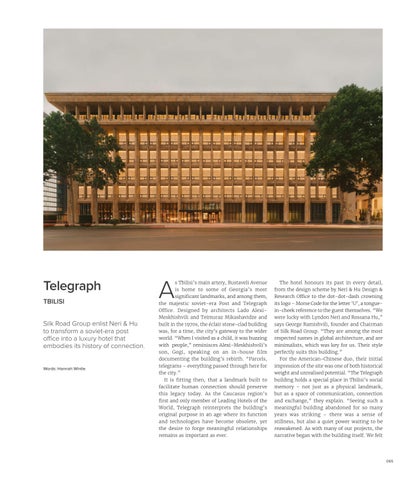
Telegraph TBILISI Silk Road Group enlist Neri & Hu to transform a soviet-era post office into a luxury hotel that embodies its history of connection. Words: Hannah Wintle
A
s Tbilisi’s main artery, Rustaveli Avenue
The hotel honours its past in every detail,
is home to some of Georgia’s most
from the design scheme by Neri & Hu Design &
significant landmarks, and among them,
Research Office to the dot-dot-dash crowning
the majestic soviet-era Post and Telegraph
its logo – Morse Code for the letter ‘U’, a tongue-
Office. Designed by architects Lado Alexi-
in-cheek reference to the guest themselves. “We
Meskhishvili and Teimuraz Mikashavidze and
were lucky with Lyndon Neri and Rossana Hu,”
built in the 1970s, the éclair stone-clad building
says George Ramishvili, founder and Chairman
was, for a time, the city’s gateway to the wider
of Silk Road Group. “They are among the most
world. “When I visited as a child, it was buzzing
respected names in global architecture, and are
with people,” reminisces Alexi-Meskhishvili’s
minimalists, which was key for us. Their style
son, Gogi, speaking on an in-house film
perfectly suits this building.”
documenting the building’s rebirth. “Parcels,
For the American-Chinese duo, their initial
telegrams – everything passed through here for
impression of the site was one of both historical
the city.”
weight and unrealised potential. “The Telegraph
It is fitting then, that a landmark built to
building holds a special place in Tbilisi’s social
facilitate human connection should preserve
memory – not just as a physical landmark,
this legacy today. As the Caucasus region’s
but as a space of communication, connection
first and only member of Leading Hotels of the
and exchange,” they explain. “Seeing such a
World, Telegraph reinterprets the building’s
meaningful building abandoned for so many
original purpose in an age where its function
years was striking – there was a sense of
and technologies have become obsolete, yet
stillness, but also a quiet power waiting to be
the desire to forge meaningful relationships
reawakened. As with many of our projects, the
remains as important as ever.
narrative began with the building itself. We felt
065