MEETING…
“Guests are increasingly aware, often subconsciously, of how a space makes them feel and how it supports their wellbeing, even beyond their stay.”
What makes the project particularly meaningful is the way it engages with craftsmanship. Local artisans were brought directly into the design process, allowing their knowledge of materials, pattern and technique to inform the architecture from the inside out. Rather than dictating form, we listened. The result is a building that feels deeply rooted, rather than styled. It was a project that gave us confidence in slowing down, in trusting culture and in allowing tradition to guide innovation rather than limit it.
ON CHANGES IN HOSPITALITY DESIGN Hospitality design has moved from being transactional to being experiential, and increasingly emotional. Early in my career, success was measured in fairly straightforward terms: a good room, a good view, a good restaurant. Today, guests arrive with very different expectations. They are seeking meaning, connection and a sense that their presence contributes something positive to the place they are visiting. Wellness has become central to this shift, but not in a superficial sense. It is no longer just about spa facilities. It is about human comfort in its fullest expression, including air quality, light, acoustics, movement, sleep and psychological ease. Guests are increasingly aware, often subconsciously, of how a space makes them feel and how it supports their wellbeing, even beyond their stay. Equally important is responsibility. Sustainability has always been an innate part of OBMI’s thinking, particularly in island environments, where resources are finite and systems are fragile. Long before sustainability became a defined discipline, we were designing in ways that worked with climate and geography out of necessity. In island projects, water use has always been a critical consideration. Collecting and reusing rainwater, reducing demand through passive design and working with natural drainage and topography
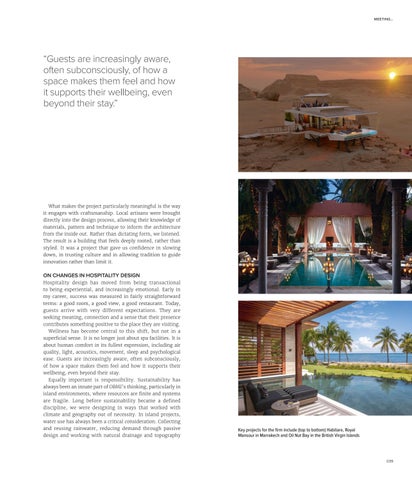
Key projects for the firm include (top to bottom) Habitare, Royal Mansour in Marrakech and Oil Nut Bay in the British Virgin Islands
039