TEDDY STADIUM Jerusalem, Israel
Images: Electro-Voice
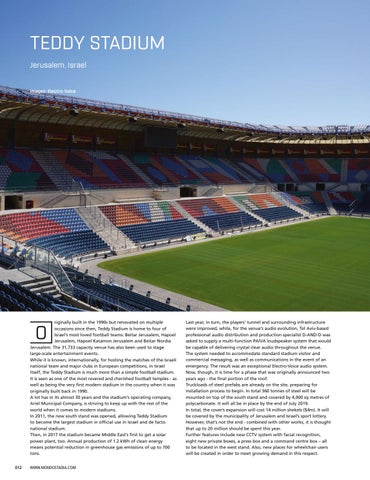
riginally built in the 1990s but renovated on multiple occasions since then, Teddy Stadium is home to four of Israel’s most loved football teams: Beitar Jerusalem, Hapoel Jerusalem, Hapoel Katamon Jerusalem and Beitar Nordia Jerusalem. The 31,733 capacity venue has also been used to stage large-scale entertainment events. While it is known, internationally, for hosting the matches of the Israeli national team and major clubs in European competitions, in Israel itself, the Teddy Stadium is much more than a simple football stadium. It is seen as one of the most revered and cherished football temples - as well as being the very first modern stadium in the country when it was originally built back in 1990. A lot has in its almost 30 years and the stadium’s operating company, Ariel Municipal Company, is striving to keep up with the rest of the world when it comes to modern stadiums. In 2011, the new south stand was opened, allowing Teddy Stadium to become the largest stadium in official use in Israel and de facto national stadium. Then, in 2017 the stadium became Middle East’s first to get a solar power plant, too. Annual production of 1.2 kWh of clean energy means potential reduction in greenhouse gas emissions of up to 700 tons.
O
012
WWW.MONDOSTADIA.COM
Last year, in turn, the players’ tunnel and surrounding infrastructure were improved, while, for the venue’s audio evolution, Tel Aviv-based professional audio distribution and production specialist D-AND-D was asked to supply a multi-function PA/VA loudspeaker system that would be capable of delivering crystal clear audio throughout the venue. The system needed to accommodate standard stadium visitor and commercial messaging, as well as communications in the event of an emergency. The result was an exceptional Electro-Voice audio system. Now, though, it is time for a phase that was originally announced two years ago - the final portion of the roof. Truckloads of steel prefabs are already on the site, preparing for installation process to begin. In total 360 tonnes of steel will be mounted on top of the south stand and covered by 4,000 sq metres of polycarbonate. It will all be in place by the end of July 2019. In total, the cover’s expansion will cost 14 million shekels ($4m). It will be covered by the municipality of Jerusalem and Israel’s sport lottery. However, that’s not the end - combined with other works, it is thought that up to 20 million should be spent this year. Further features include new CCTV system with facial recognition, eight new private boxes, a press box and a command centre box – all to be located in the west stand. Also, new places for wheelchair users will be created in order to meet growing demand in this respect.