
#140
Cover Story: Islamic Arts Biennale, Saudi Arabia Museum & Cultural Lighting
Dorothy Di Stefano
Milan Design Week Review

5Year Warranty
12 Year Life expectancy
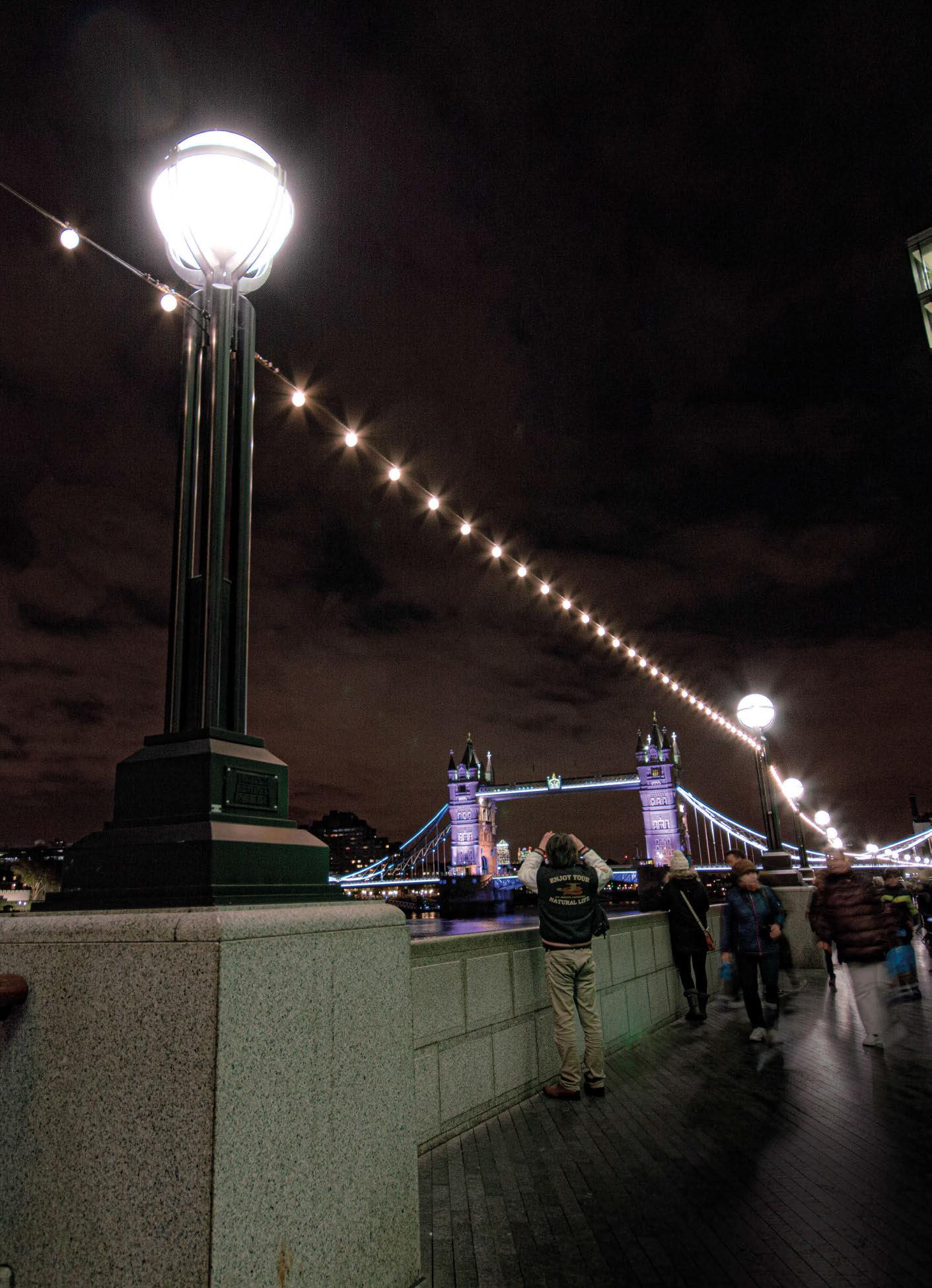
The MaxiLED Lighting Globe Series provides exceptionally long strands of Globe-lensed LEDs that can be used to outline buildings and bridges or connect architectural features with controllable RGBW lighting or static colours. Each strand is built for permanent installations, featuring rugged, injection-molded outer globes, heavy gauge wiring, and dependable high-end LEDs. These features ensure durability and reliability, making them ideal for various architectural lighting applications. Sales@maxiledlighting.com | www.maxiledlighting.com
IP68 IK07
to visit Our website
Scan
Illumination that takes your breath away


The world’s most iconic architecture deserves premier facade lighting solutions to match. Lumascape is proud to o er a full range of best-in-class luminaires and control systems to transform any building into a dazzling display of performance art with the power of light.


Learn more Visit lumascape.com


20 YEARS IN CONTROL

Pharos Architectural Controls - celebrating its 20th anniversary year in 2024 - is an award-winning and independently owned British manufacturer of dynamic lighting control solutions for architecture, themed entertainment, and other specialist industries. Our hardware and software solutions are designed and built in-house, backed by a 5-year warranty, and supported by an experienced technical team. Pharos products are trusted

pharoscontrols.com #20YearsOfPharos @pharoscontrols
to run day and night, illuminating iconic installations around the world.
2008 - Cloud London Heathrow Terminal 5


Artworks in a museum really come into their own in the right light. Pleasant lighting can significantly enhance the experience for visitors. At CLS we consider lighting as an art, and we design our fixtures with this in mind.
CLS fixtures have been applied in numerous museums worldwide. Light designers and architects in the museum industry appreciate the excellent quality and innovative technology of our fixtures. Our fixtures offer numerous configurations with different control options, beam angles and light colours. Exhibitions often change, so fixtures with zoom function and Tunable White LED modules guarantee maximum flexibility.
Some technical features of our fixtures for museums:
> Power consumption from 1-25 Watt
> CRI up to >98 & R9 up to 98
> Zoom range from 6º to 90º (depending on the model)
> Control options via Magno Dim, Local Dim, DALI, DMX512, Wireless DMX or Casambi
 Focus Micro Series
Focus GIII Series
Focus Micro Series
Focus GIII Series
cls-led.com
Lina HP & DF Series Jade Series

Proudly Made in Italy Interior, outdoor, bespoke qu-lighting.com gd D+ studio / ad Aldo Parisotto / ph Pietro Savorelli


lighting products that are unused surplus stock, used but reusable, and used lighting products. For manufacturers, resellers, end users, wholesalers, or refit contractors inc. Cat A/B


Register your interest on the Reuse Hub. You will be notified as soon as stock becomes available from donors. For remanufacturers, charities, NGOs, educational facilities, and more REUSE RECIPIENTS


remanufacturer, to be notified when lighting parts, components, and fixtures have been donated which you can use in your process. LIGHTING REMANUFACTURERS And if you can’t reuse, Recolight recycle RECYCLE
The Recolight Reuse Hub is the first of its kind in the UK for lighting products. There is no other system like it in the UK to facilitate finding a new life for lighting products that have not reached end of life. At Recolight, we recycle, but in a Circular Economy model, recycling is not always the best solution. Recolight is under a legal obligation to prioritise reuse over recycling, so we facilitate and encourage reuse first.


WWW.RECOLIGHT.CO.UK/REUSE-HUB
DONORS
1 2 3 4


Lighting fixtures to enhance experiences. Australian made like nothing ELSe Now available worldwide www.elslighting.global Featured Product _Luxient Track Luminaires Featured Project_ Project 8 Gallery Melbourne, Australia Lighting Partner_ Lighting & Electrical Distributors Efficient Lighting Company Limited Address _40 Serithai 59 Main road Kannayao Bangkok 10230 Thailand sales@elslighting.global

The next session: 24 – 26 September, 2024 Le Meridien Resort Phuket, Thailand
very best
exceptional lighting projects around the world.
Bringing specifiers
of global lighting projects
A series of events connecting the
people creating
For more information contact Jason Pennington: j.pennington@mondiale.co.uk
and suppliers
together

Welcome
I was talking to one of my lighting friends on the phone the other week (Hi Jess! Hope you’re good!), and when she asked me how things were, my response was “oh you know, full on - but that’s just how my life will be from now on.” This was mainly eluding to the impending arrival of my second child this September, but the same could also be said of my working life here at arc HQ. Even as we approach the relative calm of the summer months, the last few months have been a whirlwind of activity, bouncing from [d]arc sessions, to Clerkenwell Design Week, to a print deadline, with barely a gap in between to take a breath. At the time of writing, we’re about to head to London for IALD Enlighten Europe too - our last big event before, hopefully, a restful summer.
Not that we should be complaining about a busy schedule, as it really is a pleasure and a privilege to be able to travel around and meet with so many wonderful people, all in the name of work. Huge thanks to everyone who came to check out our [d]arc thoughts talks programme at Clerkenwell
(if you missed them, all talks were recorded and are now live on the [d]arc media Vimeo page). A big thank you must also go to everyone that came out to the latest [d]arc sessions in Portugal this May too. I love doing these events - it always gives me a warm, fuzzy feeling to see the way that this amazing community of ours comes together for three days of meetings, networking, and a bit of fun (shout out also to the [d]arc sessions Swim Club! Official badges are on the way!). I will be on Paternity Leave during our Asia edition in Phuket this September, but I’m sure this one will be no different. I’ll be leaving it up to the wonderful Sarah Cullen to keep Swim Club going!
Onto this issue then, and this time out I was thrilled to be able to sit down with the legendary Dorothy Di Stefano. If you’ve ever been on LinkedIn, you’ll know Dorothy - she has her finger firmly on the pulse when it comes to mind-blowing, immersive works of art, so it was enthralling to speak to her about the power of light, and the future of immersive art.
Elsewhere, we’ve once again stacked this issue with beautiful lighting design projects, this time looking at some stunning museums and cultural centres. Enjoy the issue!
 Matt Waring Editor
 Front cover: Islamic Arts Biennale, Saudi Arabia (Image: Marilyn Clark)
#140
Inside this issue
Regulars
Event Diary
Drawing Board
In Conversation
Prof. Michael F. Rohde talks about his time at Hochschule Wismar.
Snapshot Light&Studio
Marcus Steffen
The importance of getting the right clients, and how to find them.
Manufacturer Case Studies
A selection of Museum & Cultural Lighting case studies.
Silhouette Awards
Past participants share their thoughts on the importance of mentorship.
GreenLight Alliance
Harmonising the way to Lighting EPDs, in collaboration with LightingEurope.
Product Launches
Bucket List
Christine Sicangco & Jovi Gonzaga
Eye Openers
Dan Flavin. Dedications in Lights
Dan Flavin
Printworks
Cundall
Kalix Bridge Sweco
Terminal for Tirana Karolina Halatek
Through the Looking Prism Ambiguous
Coqodaq Rockwell Group
Features
Milan Design Week
Katia Kolovea shares some of her favourite finds from this year’s Milan Design Week.
Dorothy Di Stefano
The “LinkedIn Celebrity” talks about curating light festivals, immersive art, and the future of the medium.
REBIRTH
Martina Frattura tells arc about a recent collaboration on a one-day fashion exhibition for brand Khris K.
[d]arc sessions
A look back at the highlights from [d]arc sessions Europe, held in Tróia, Portugal, this May.
Timeless Lighting
Afonso Almeida offers a poetic take on the importance of luminaire placement.
Projects
Islamic Arts Biennale
GLARE tell us about the harmony of old and new in this [d]arc awardwinning project.
Leighton House
BDP led the lighting design in this conversion of a traditional 1800s home to a modern museum.
Argo Contemporary Art Museum
After standing abandoned for 40 years, Tehran’s Argo Brewery has been transformed into a contemporary art gallery, lit by The Seed.
Gabrielle Chanel. Fashion Manifesto
The touring exhibition landed at London’s V&A last year. StudioZNA led the lighting design for the show.
The Eames Archives
Grace Mennel tells us how she illuminated this showcase of the iconic duo’s collection of work.


#140
Proudly Supporting
040 052 076 108 018 022 026 028 038 094 114 118 124 130
030 040 092 108 112 020 036 052 090 106 116 054 062 070 076 084

RIPPLING by JAN VAN LIERDE CORSO MONFORTE 7, MILANO / PLATEK.EU OUTDOOR LIGHTING
Events Diary
JUNE
IALD Enlighten Europe 21-22 June London, UK www.iald.org
AUGUST
LEDforum.24
14-16 August São Paolo, Brazil www.ledforum.com.br
SEPTEMBER
Plasa 1-3 September London, UK www.plasashow.com
ArchLIGHT Summit 17-18 September Dallas, USA www.archlightsummit.com
[d]arc sessions Asia 24-26 September Phuket, Thailand www.darcsessions.com
Smart Buildings & Sustainability Leaders 26 September Birmingham, UK www.sbsleadersforum.com
OCTOBER
Circular Lighting Live 9 October London, UK www.circularlighting.live
IALD Enlighten Americas 17-19 October
San Diego, USA www.iald.org
Light Symposium 20-23 October Kongsberg, Norway www.lightsymposium.org
Hong Kong International Lighting Fair 27-30 October
Hong Kong, China www.hktdc.com
NOVEMBER
LiGHT 24
20-21 November London, UK www.lightexpo.london
Festival of Architecture & Interior Designing 22-23 November New Delhi, India www.foaidindia.in
HIX
27-28 November London, UK www.hixevent.com
Light + Intelligent Building Istanbul 27-29 November Istanbul, Turkey www.light-building-istanbul.tr.messefrankfurt.com
EDITORIAL
Managing Editor
Helen Ankers h.ankers@mondiale.co.uk
Editor Matt Waring m.waring@mondiale.co.uk
Contributing Editor Sarah Cullen s.cullen@mondiale.co.uk
Online Content Creator
Ellie Walton e.walton@mondiale.co.uk
COMMERCIAL
Managing Director
Paul James p.james@mondiale.co.uk
Head of Business Development
Jason Pennington j.pennington@mondiale.co.uk
Media Sales Manager
Andrew Bousfield a.bousfield@mondiale.co.uk
International Account Manager Ethan Holt e.holt@mondiale.co.uk
Events & Marketing Manager Moses Naeem m.naeem@mondiale.co.uk
DESIGN
Design Manager
David Bell d.bell@mondiale.co.uk
Design
Jez Reid j.reid@mondiale.co.uk
Production Mel Capper m.capper@mondiale.co.uk
CORPORATE
Chairman
Damian Walsh d.walsh@mondiale.co.uk
Finance Director
Amanda Giles a.giles@mondiale.co.uk
Credit Control
Lynette Levi l.levi@mondiale.co.uk
[d]arc media ltd
Strawberry Studios, Watson Square, Stockport SK1 3AZ, United Kingdom T: +44 (0)161 464 4750 www.arc-magazine.com ISSN 1753-5875
arc (ISSN No: 1753-5875; USPS No: 21580) is published bi-monthly by Mondiale Publishing, UK and is distributed in the USA by RRD/Spatial, 1250 Valley Brook Ave, Lyndhurst NJ 07071. Periodicals postage paid at So Hackensack NJ. POSTMASTER: send address changes to arc, c/o RRD, 1250 Valley Brook Ave, Lyndhurst NJ 07071. Mailed by Spatial Global Printed by Buxton Press · To subscribe, visit www.arc-magazine.com or call +44 (0)161 464 4750.
018 / 019


Smart
Today’s most advanced lighting technology with AI-based microcontroller automatically stages objects. Experience color in a new way. proled.com Learn more
Architectural
Series
Dan Flavin. Dedications in Lights
Basel, Switzerland

Under the title Dan Flavin. Dedications in Lights, the Kunstmuseum Basel has dedicated an extensive exhibition at its Neubau venue to the pioneer of Minimal Art. American artist Dan Flavin rose to fame in the early 1960s with his work with industrially manufactured fluorescent tubes. Showcasing 58 works, some of which that have never been on view in Switzerland, the exhibition presents a thematically and chronologically organised survey of Flavin’s singular oeuvre, with a focus on works he dedicated to individuals or events. The exhibition is the artist’s first major show in Switzerland in 12 years. Taking many different forms, the dedications introduce an emotional dimension and highlight the web of artistic and literary references and personal relationships that informed Flavin’s work. One central objective
of the exhibition at the Kunstmuseum Basel is to throw this dimension of his art into relief.
In addition to Flavin’s installations, some of which take up entire rooms, the presentation includes drawings; portraits and depictions of nature that have received comparatively little public attention, as well as sketches for works and diagrams. The small notebooks he kept were a vital tool for Flavin, and constitute a kind of archive of his oeuvre, which spans over three decades. The exhibition also brings into focus the social and historical context in which Flavin’s seminal earliest works with light came into being.
Dan Flavin. Dedications in Light brings together 35 light installations, 21 works on paper, two early paintings by Flavin that are rarely displayed, and a selection from
the works by Urs Graf that Flavin chose for his presentation at the Kunstmuseum Basel in 1975. It includes works from eminent public and private collections, and institutions such as the Guggenheim Abu Dhabi; the Pinakothek der Moderne, Munich; the Kunstforum Ostdeutsche Galerie, Regensburg; the Museum of Modern Art, New York; and the Panza Collection, Mendrisio. Thanks to the close collaboration with the artist’s estate and his studio, the series untitled (for John Hearfield) is shown in its entirety – the first such presentation in Europe, while several of the works on display have not been in a public exhibition for decades.
The exhibition will run until 18 August, 2024. www.kunstmuseumbasel.ch
eye opener
020 / 021
 Image: Florian Holzherr © Stephen Flavin / 2024, ProLitteris, Zurich, The Dan Flavin Estate, Courtesy David Zwirner

ONE QUEEN, AUCKLAND
Product used: MIMI Poki
Project: One Queen Street – Deloitte Centre & Intercontinental Hotel, Auckland
Lighting Design: Switch Lighting Design + NDY Auckland
Architect: Warren & Mahoney
Photographer: Thomas Seear-Budd
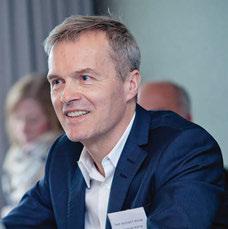
After 18 years at the renowned institute Hochschule Wismar, Michael F. Rohde is retiring from his position as Professor of Architectural Lighting Design. arc spoke with Rohde about how he first arrived in Wismar, and how the Architectural Lighting Design programme has changed during his time at the university.
IN CONVERSATION
How did you first get into lighting?
When I started studying architecture, I stopped buying luminaires and began designing them myself. The first ones were pretty awful from today’s point of view, but shortly before I got my diploma I took part in student competitions and I won some prizes with my solutions. At that time I never thought of being a lighting designer. I got my diploma in 1987, when there were not so many lighting designers around. I worked as an architect in Mannheim for Prof. Carlfried Mutschler. While there, I met Hans T. von Malotki, one of the two founders of Lichtdesign Cologne, who was designing the lighting for the representative parts of the project. He told me he wanted people like me in his office and he recommended I visit David Loe, who was the founder of the first European MSc in “Light & Lighting” at the Bartlett School of Architecture at UCL, London. I did that and started my postgraduate in the winter of 1990.
When and how did you join the Architectural Lighting Design programme at Wismar?
My professorship started in the winter term of 2006. Before, I was an assistant professor in Hildesheim, where we kick-started the architectural lighting design programme together with Prof. Josef Strasser and Prof. Gero Canzler. Apart from Wismar, this was, almost at the same time, the first attempt in Germany for an educational lighting programme at university level.
Why did you want to get into teaching?
I was already a tutor while studying myself, and I liked to share my experience and consult the younger generation. I also found that explaining and sharing ideas helped me in the design process. When I returned to Germany in 1992 my friends, with whom I studied architecture, thought that I should get into teaching architectural lighting design. They told me that they always felt something was missing in studying architecture, where we got just some technical explanations. At that time, I worked for Siemens lighting division. My duties were practical lighting design projects to support the marketing department on a national and international level, and working on internal product design teams. I also had to develop teaching methods for architects/interior designers and electrical engineers. This ranged from technical information, to the importance of “gestalt” and that “There is no architecture without light”. Coming back to the “Why”: I always liked to explain what I was doing, I loved and I appreciate interaction and communication with students and in general people interested in the subject of
lighting. For me, teaching it is so enjoyable and I wouldn’t describe it as “work”! It’s fun and the best is to see how former students are successful in the further development of their careers.
How has the programme changed?
We went through a technical revolution over the last two decades. We had to update everything and make sure that we were not teaching the “history of lighting design”. It was important for me to stay in practise with my own firm L-Plan Lighting Design. Manufacturers have the habit to first share their innovations with lighting practices. I reminded them to send catalogues and product samples to the University of Wismar as well.
In 2008 I was the founder of the Light Symposium Wismar (LSW). Our main concern was the subject of light and health and lighting for wellbeing. KTH Stockholm was our first partner on that scientific conference. Since 2021 we have two more partner universities (AAU Copenhagen, Denmark and NSU Kongsberg, Norway). This allows us to have a conference format on “Light & Health” every year.
Do you have an overarching philosophy or message for your students?
One of the crucial things I like to implement is the importance of daylight – the headline of one of my lectures is: Daylight: the mother of nature, i.e: man and all life on Earth
How varied is the background of students at Hochschule Wismar?
The background of our students is very international, they come from all over the world. Most students are from architecture and interior design, but we also accept students from product or communication design, a few have a background in theatre lighting. The mix is fantastic and a great aid to the programme. Specifically, the mix of nationalities, cultural backgrounds and the differences of professions is a great inspiration.
What do you think the future holds for the lighting design profession?
My hope is that lighting designers and lighting manufactures, including architects, interior designers and their clients, (i.e. project developers) work together for a higher quality of architectural lighting design. Artificial lighting should be as healthy as daylight can be, it includes the necessity of darkness during the night.
Maybe that sounds too easy, but it will remain a challenge to be fully implemented into practical projects. www.hs-wismar.de
026 / 027
MICHAEL F. ROHDE


Snapshot Light&Studio
Boasting more than 200 projects across 35 countries, Madridbased Light&Studio designs both technical and decorative lighting solutions across a broad portfolio of work. Here, we look at some recent highlights from its portfolio.
Pull&Bear
Multiple Locations
Part of the Spanish fashion giant Inditex, Pull&Bear is a brand born for the youth. Always including the latest trends in fashion and music, it champions creativity, diversity, and sustainability. The stores embody a futuristic design brought to life with the help of metals, concrete, digital screens, natural elements, and lighting designed specifically for them. Whenever you visit P&B, you’ll find a mix of technical and decorative lighting that complements the interior design. The lighting layout also distinguishes different areas: sales area, cashier, fitting rooms; even the staff area has fixtures designed specifically for that space. The L&S team joined forces with the client to design and develop products that fulfill the store’s lighting necessities: from colour temperature, CRI, power, and fixture finishes, to solve the store’s lighting needs. It’s important to highlight the ability to recreate this concept wherever the store is located, as this is a brand with global locations. Although the concept is currently being executed, we can’t forget that stores, like fashion, are constantly evolving. Therefore, the L&S retail team is always working to identify trends and new solutions to present to Pull&Bear, and all the other brands it works for, ensuring they are aligned with their vision.
Frankie Burger
Multiple Locations
For L&S, light is the way in which we connect with the essence of a place, convey the brand image, and play with the materiality of the space. It is the link between the substantial (architecture and interiors) and the intangible (brand and essence). A significant challenge arises when the brand style needs to be replicated in different locations and becomes the key to space design. Therefore, from unity to multiplicity, L&S sets its basic parameters where aesthetics and functionality are crucial for these projects. In this traditional burger establishment, the designers aim to convey the brand’s essence through light, emphasising domestic quality products and the craftsmanship
behind them. Hence, the combination of technical and decorative lighting. Apparently simple, the technical lighting is represented with spotlights containing light engines capable of creating different spaces and a sense of comfort. Narrow beams, warm temperatures, specific locations, and product aesthetics are almost drawn within the space. The technical specification was based on products with minimal dimensions, keeping all horizontal surfaces clean. On the other hand, there is the decorative lighting. Following the same design line of drawing the space, L&S took advantage of the dimensions and the architecture to paint with light on the edges. Shapes merge in this light and matter sketch – light lines that accompany and unite the space to become one and create unity. This light scheme allows us to project the space and build a comfortable and sober atmosphere, taking advantage of the restaurant’s height and balancing the lighting to be pleasant throughout the day, while also creating a cohesive effect from inside out so that its light becomes a whole.
Vandido Disco Madrid, Spain
When a low-ceilinged basement transforms into a renowned discotheque, it’s where light truly works its magic. The challenge of harmonising space, light, and sensation is a standout feature of this project.
From the entrance to the central area, where the stairs and reception stand out, the significance of materials begins to emerge as light interacts with surfaces: uplight giving volume to textile walls, lines and points of light highlighting the stairs, and recessed lighting in the expansive alabaster modules of the bathrooms, making them visually lighter elements. The space becomes a dynamic dance of materials reflecting and amplifying the effects of light and depth, creating illusions of impossible heights. Subtle nods to other elements are incorporated, such as the DJ booth, where integrated lighting in luminous reliefs subtly reference the format of vinyl records. The light serves both function and form, with vertical luminaires playing off
mirrored materials to generate visual rhythm, guiding patrons from one area to another.
An additional focus in L&S projects is to add volume and significance to vegetation, thereby expanding visual perception and creating a greater sense of space for viewers.
As a natural element, it also incorporated liquid volumes, enhancing and illuminating bottle racks with linear LEDs. However, functionality is never compromised, as technical lighting is integrated for the bar staff, using LEDs and focal points.
In the end, the space is a canvas where materials and intensities are manipulated, resulting in light effects that guide and enhance the overall experience.
Thompson Madrid by Hyatt Madrid, Spain
Working for a large hotel chain is always a significant challenge. A substantial part of the job is to thoroughly understand the brand image and integrate it until we feel a part of it. That’s when we are ready to translate that brand into light. Every lighting decision we make has to align with the project’s concept. Each aspect of its personality must have a lighting representation in such a way that the proposal not only allows us to discover the space but also infuses soul into the project.
L&S always strives to support hotel chains in their endeavour to surprise, highlight, and connect with their target clientele. That’s why it is highly motivated to design and manufacture bespoke fixtures that are not available in the market and that enhance the project’s concept, whatever it may be. An engineering team helps the team materialise these proposals by combining creativity, design, and technology.
In the case of Thompson by Hyatt, they made it straightforward because they had a well-defined and developed concept. The importance of natural elements, elegance, and the nobility of materials were the foundational pillars of the interior design project. Collaborating with Lopez y Tena Arquitectos, L&S devised a lighting proposal that accentuates the textures and finishes while shaping the architecture and creating pathways within the space.
1 2 3
028 / 029
4

Light&Studio is not just a light consultancy; it seeks to trigger emotions in each of its projects, always working hand in hand with light. It plays with textures, shapes, and colours, and above all, the way each of them harmonises with light.
Based in Madrid and backed by 30 years of expertise, Light&Studio is a multidisciplinary team that collaborates with renowned architects and interior designers to help them bring their lighting visions to life. Whether it’s a technical or decorative solution, L&S provides comprehensive lighting consultancy services: from concepts to all the technical information necessary to bring projects to fruition. It is proud of its diverse portfolio, which includes hospitality, retail, real estate, and artistic projects. Additionally, it has a specialised team responsible for training design industry experts, providing them with the essential knowledge and tools that they can apply to future projects. This School of Light aims to expand the culture of light and provide professionals with the knowledge to understand our working tool, enabling us to share a common language.
The studio’s passion is light and all the experiences that can be created with it.


100 / 100
2 4 1 3

COMMENT
Milan Design Week 2024
Returning this April, Milan Design Week once again saw the Italian city awash with visitors eager to see the latest trends and innovations in design. Katia Kolovea, reports back on her findings in an exclusive from Milan.
My first Milan Design Week (MDW) was in 2022, when I first experienced the emotion of walking through the streets filled with design vibes at every corner. Brands, showrooms, restaurants, and shops go all out, creating captivating installations inside and outside their spaces. They use vibrant colours, reflective materials, and innovative designs to invite visitors in, offering them a unique experience. After that initial visit, I promised myself I would always attend this incredible event. Since then, MDW has become a permanent fixture on my travel calendar. I returned in 2023 for my first Euroluce, and now, in 2024, I was back as a more experienced MDW visitor with a clearer idea of what I was looking for.
For those who haven’t visited yet, Milan Design Week hosts an annual festival that centres around Salone del Mobile, the leading fair focused on furniture and interiors. Alongside this, there are various exhibitions, installations, pop-ups, talks, and workshops. Every two years, Euroluce, the dedicated lighting fair, showcases both decorative and architectural brands attracting thousands of worldwide attendees.
As a lighting designer, when Euroluce isn’t on, I concentrate on the Fuorisalone. This part of the event takes place in various design districts throughout central Milan, including Brera, Isola, Tortona, and Porta Venezia – my personal favourites.
The atmosphere is electric – just like a big celebration. There are hundreds, maybe thousands,
of activities, presentations, parties, talks, and events happening simultaneously, making it impossible to see everything. There’s always a bit of FOMO (“fear of missing out”), but with good planning, you can prioritise your must-see events and still leave room for unexpected discoveries.
My aim this time, was to boost my inspiration and creativity across multiple sectors, including interior design, product design, architecture, fashion, and, of course, lighting, which ties everything together for me. I met new designers and brands, discovered beautiful products, and connected with the right people who can support my projects. Below, I share my personal experience from the four days I spent in Milan. I spotlight what inspired me, highlight some must-visit brands and showrooms, and reflect on a very hectic yet insightful trip. Let’s begin with some selected lighting showrooms, then move on to the most unique installations I encountered across Milan, and end with some unique moments.
Our experience began at the brand-new Contardi Lighting showroom on Corso Monforte. Archifos had the unique opportunity to visit, create content through the lens of a lighting designer, experience the collections, and interview architect Chiara Caberlon, the designer of the portable outdoor lamp Clara. This family-owned business is full of passion, innovation, and fresh ideas – a brand to definitely get to know. Corso Monforte could be named Milan’s lighting showroom street, with many brands choosing it for their premises.
030 / 031
KATIA KOLOVEA


Next, we had an informative tour of Flos Professional Space, where we experienced an interesting setup by Arquitectura-G studio called Out of Office. This installation reimagined a contemporary open-space office as an extension of the Arquitectura-G studio in Barcelona, connected by real footage of a working day. It showcased the Workmates series by Flos Architectural, designed to meet the dynamic lighting needs of the modern workplace.
The Foscarini showroom was another pleasing encounter. Apart from its typical collection, its Habitus collection stood out. It showcased the interplay of light, embroidery, and textiles by Foscarini and Andrea Anastasio in collaboration with Amal.
Leaving Monforte and heading to Montenapoleone, our next stop was the intriguing Tom Dixon pop-up showcase in the Manzoni restaurant. This experimental space, or as they call it, “a theatrical backdrop for the best of Italian food and British design”, was truly inspiring. Being
surrounded by people enjoying their lunch while exploring the new lighting collection and all the reflections, mirrors, and materials used was a unique experience.
Next, we visited the new Davide Groppi showroom. If I had to describe it in one word, it would be “Poetry.” I was particularly impressed by how I felt walking around the various rooms on the basement floor. The combination of the minimal lighting, subtle colours, textures, plants, and the overall architecture was very well done. Before moving to another zone, we accidentally discovered the Gessi showroom – perhaps the most sensory showroom I have ever visited. Gessi designs and manufactures exclusive bathroom and kitchen fittings and furnishings. Its expansive space spans multiple levels. To describe it, imagine an intersection of lights, shadows, contrasts, pink and natural colours, relaxing and real sounds of water, and well-curated scents, allowing you to immerse in nature and forget the day’s tiredness. A mustsee on your future visit.
MILAN DESIGN WEEK
Highlights from Milan Design Week 2024 included Beyond the Horizon, an immersive art experience from Lexus (left), and Crystal Beat II from Preciosa (right) - a dynamic light installation where 400 interactive crystal cubes form a sensorial experience for visitors. (All images courtesy of Archifos)

Just before we move to installations and experiences, I want to spotlight three more showrooms in the Moscova and Brera zones.
Starting with Lodes, which transformed its façade and central installation into a striking red, attracting visitors to explore the Oblò by Paola Navone. Beautiful finishes, with my personal favourites being the Iridescent and Azure Steel versions.
Nearby, another must-see at every MDW, Viabizzuno’s beautiful outdoor showroom space, which always impresses with its narrative and presentation of new and older collections. The interplay of sunlight, shadows, and various materials were a great addition.
Last but not least, as we walked towards Brera, Archifos had the great opportunity to collaborate with iGuzzini and narrate the Light that Moves Time, a design exhibit by Alfonso Femia demonstrating a journey where past and future intertwine. You can find this content on our social media platforms. Now it’s time to leave the centre for a while and move to one of my favourite zones, Tortona – a more “raw” creative area slightly outside the city. We had time to visit four spaces there.
Starting with Preciosa’s Crystal Beat II experience, another must-see. Every year, it creatively utilises its product range, combining light and sound to provide an immersive experience for visitors. This year’s installation included a soundscape inspired by 1980s gaming to reflect the Crystal Pixels’ homage to digital pixels. I loved observing how everyone interacted with the lights, walking around or sitting and enjoying the show.
Next, we visited Agua by Archiproducts, a design exploration curated by Studiopepe highlighting the world of interiors, with many beautiful lights enhancing the space. It was a well-curated display of products, textures, and colours, bringing lots of new ideas for current projects.
Our next stop was the yearly exhibition, Superstudio Piu, which includes multiple exhibitions, artists, and installations. If I have to highlight only three, they would be:
1. Beyond the Horizon by Lexus, an immersive art experience inspired by next-generation mobility. Created by Marjan van Aubel with musician Keiichiro Shibuya and designer Hideki Yoshimoto, it immerses visitors in a light and sound performance. The bamboo fiber backdrop acts as the diffuse lighting source, with the central piece being the LF-ZC car, symbolising innovation and future mobility.
2. Like Trees in the Woods by Michele di Agostino, a strong experience merging nature, materials, and technology. The organisers provided black plastic shoe covers, inviting visitors into a mirrored room with real oak wood typical of the Italian landscape. It was an extraordinary visual experience where I felt very relaxed and connected with nature.
3. Habits, an industrial design studio working with a fascinating blend of new technologies, AI, light, and various materials. A standout series to search for is DDD Digital Domestic Dialogues. The lamp called 1g1lm by Min Dong is particularly fascinating. This lamp was born from a simple but intriguing question, “What would be the effect if light had a tangible weight?” Check it out.
MILAN DESIGN WEEK
032 / 033
Ploom showroom

www.intra-lighting.com/ #Pyrymyd Pyrymyd | All-in-one: acoustic ceiling and a luminare, up to 1600 lm, UGR<19 Pyrymyd E(c)ho friendly RENAMED


Returning to the centre of Milan, a couple more fascinating installations caught our attention, starting with the fashion brand Loewe, which unveiled lamps created by 24 international artists. This special Loewe Lamps edition featured materials ranging from birch twigs and horsehair to leather and Japanese washi paper – a captivating display of materials interacting with light.
Next, we visited Moooi and experienced the A Life Extraordinary exhibition, spotlighting new designs by Cristian Mohaded and BCXSY, alongside lights, carpets, and furniture. It was a beautiful surprise, combining set design, lights, sound, and an overall performance that redefined light as a living, breathing entity – a beautiful storytelling experience.
Another standout exhibition was at Rossana Orlandi’s art gallery, where I discovered many new artists and had the opportunity to meet in person one of the designers behind Mandalaki Studio, whose work I admire. They launched their brand-
new Hypersun floor lamp, another piece worth exploring.
Next, we have a site-specific installation that celebrated colour and daylight, creating another fantastic multisensory experience, with the longest queue I’ve ever seen during MDW. ElicaCooking, in collaboration with Ermanno Casoli, presented Straordinaria, an immersive installation designed by the Japanese design studio we+. Look online for some beautiful pictures.
Lastly, a must-add to everyone’s Fuorisalone list is the Statale University. Every year, they host multiple installations, big and small, with collaborations and support from big brands. One of the standouts this time was the Amazing Walk by Amazon, an installation by MAD Architects that combined a real environment with augmented reality, allowing visitors to walk towards the central mountain and explore a wide selection of home products, furniture, lighting, and smart home gadgets available on Amazon. A very interesting experience
034 / 035


with elements of water, fog, sounds and light. As we move towards the conclusion of this feature, I can’t skip mentioning the beautiful parties happening everywhere during MDW. It was challenging to decide where to go, but if I had to pick a favourite from this visit, it would be the one from Simes. They truly know how to combine Milan’s beautiful vibes with a view directly in front of the Duomo, live-cooked food, live music, and great company. If you receive an invite, don’t miss their party!
I’ll close with two of my most impactful and emotional experiences – I felt super lucky to attend both. I visited Palacio Visconti on a private tour and experienced a dazzling installation by Flos, where the past meets the present in a fascinating context surrounded by Baroque interiors, contemporary glass creations, multiple mirrors, and beautiful new designs by Michael Anastassiades, Barber Osgerby, and Formafantasma. Thank you Michele! Lastly, my most emotional and strong multisensory
experience – The Blind Experience organised by Contardi in collaboration with the Institute of the Blind. Dialogue in the Dark is a life-changing experience where visitors are guided by blind guides in absolute darkness. We experienced daily environments from a completely new perspective, walking in the park, going for grocery shopping, crossing a moving wooden bridge (that was very scary), visiting a café and so on, activating all senses apart from vision and taste. My senses were over activated and experienced very deep emotions. Towards the end, there was a fantastic exercise where we were standing around a table and touched various materials from the Contardi collection guessing which product is behind. When the experience ended, it took me some time to get back to normal. This is a highly recommended experience for everyone, especially fellow lighting designers. www.archifos.com
MILAN DESIGN WEEK
(L-R) Hypersun Floor Lamp, Mandalaki Studio, Rossana Orlandi gallery; Davide Groppi showroom; Straordinaria, by we+ in collaboration with ElicaCooking and Ermanno Casoli; Amazing Walk by Amazon and MAD Architects.

Printworks
Manchester, UK
Cundall has led the lighting scheme for Printworks in Manchester, a £21m redevelopment that boasts Europe’s largest digital ceiling screen. Located in the heart of Manchester’s city centre retail district, the Printworks – a vibrant entertainment and leisure centre – is situated in a 150-year-old listed building. The new aesthetics of the space add to what the venue already has to offer. The digital ceiling screen is 1,000sqm in area – the largest in Europe and first of its kind in the UK, and it completely transforms the space.
Approached by Avid Property Consultants, on behalf of DTZ Investors, Cundall was asked to provide multi-disciplinary design services, including lighting, for the renovation of Printworks.
Cundall’s specialist lighting team looked to provide a considered and dynamic lighting scheme that complemented the architectural enhancement of the building, together with the new immersive digital ceiling screen. The lighting scope included the historic building façade, with a key focus on arrival points and the internal ‘streets’ and ‘pumpyard’ space.
Printworks used to be a newspaper printing house from 1873 to 1985. When designing the external feature wall luminaires, the lighting designers retained this piece of Printworks’ historical significance. To create this effect, they used frosted glass designed to look like printing blocks. The luminaires behind the glass blend into the building façade during the day. At night, it provides an eminent block feature detail. At the pedestrian-level, the team created an intimate lighting effect with a direct contrast to the RGBW grazed light to the upper tiers of the façade frontage.
From the decorative wall lights to the historic façade, to colour-changing uplights and radial luminaires, every detail combines elegance with functionality. The internal lighting scheme guides visitors through an immersive experience, synchronising with the venue’s digital ceiling screen.
RGBW linear wall-grazers and architectural projectors are programmed via a Pharos control system, and the lighting scenes are synchronised to run cohesively alongside the digital content of the venue’s new ceiling screen. Luminaire tracks are positioned along each edge of the screen for a seamless finish, allowing the lighting solution to blend into the background.
Elsewhere, external and internal lightboxes from The Light Lab, as well as an “entrance totem”, act as wayfinding tools both on the building approach and through the centre itself, while also acting as a focal point for signage.
The Light Lab worked in close collaboration with Cundall, and CDA Architects, designing and fabricating bespoke LED signage and Glowpanel lighting for both interior and exterior applications. This included custom brand signage for Printworks and other brands within the developent, as well as large-scale interior and external illuminated glass panel features.
“The historical significance of the Printworks building in Manchester has made it such an enjoyable project to do the lighting design for.
It is great to see it take on a new energy as a prominent entertainment and leisure venue in the heart of the city,” commented Liz Skelton, Principal Lighting Designer and the lead lighting designer on the project.
“Being able to incorporate the history of letterpress printing into the lighting design was an important consideration from the get-go, and it is exciting to see it delivered. There is an important retrofit story to tell here as well. Most buildings in the UK are already built, we know that retrofitting is a lot more sustainable than rebuilding. Most buildings carry a rich history in terms of how they were used. Incorporating this memory for Printworks when designing it was a fantastic experience.”
www.cundall.com
eye opener
036 / 037
 Image: Jason Lock

COMMENT
MARCUS STEFFEN
Clients: can’t live with them, can’t live without them
The dream project is often given to you by the dream client, but how do we find the right clients for us?
Marcus Steffen breaks it down.
Clients are the ones who make our businesses work. It doesn’t matter if you dream of making the most amazing lighting design, if a client is not going to pay you to do it, you cannot realise that dream. But dealing with them can be difficult, and causes huge stress. So how do we find those dream clients?
Not everyone is a client
The first thing to realise, is that not every person is a client. Not every enquiry is the right one for you. As an example, MS Lighting Design specialises in residential and hospitality projects. If I get an enquiry for laying out a 600x600 grid in an office, or producing an external landscape design for a commercial property, I will tell them we are not the right designer for them. These are not right for us, and our service is not tailored to them.
This might sound counterintuitive for a person running a business, but actually it is essential to learn. You need to learn what you do and don’t do for your business, or who you are as a designer. Ask yourself, what do you enjoy doing? What kind of projects are you an expert in, more than anyone else?
It is often much better to be an expert in a small area rather than a jack-of-all-trades. Clients will often want to hire an expert if they value what they are getting. And the clients who do not value lighting design? They are not going to want to pay the fees you are justified earning.
Finding good clients
Finding the right client is not done when an enquiry comes in, but starts in your marketing and online presence. This can act as a filter to push away clients who are not the right fit before they even enquire, and attract ones who are a good fit. While this might reduce the total number of enquiries, it will increase the value and conversion of these clients. To go about this, you can do a number of things:
• Define what it is like working with your company. Show the client how it will be to work with you,
the process you go through, and how you are organised. If they like the way you work, then there will be a lot less friction. If you work a fourday week, tell them, and then they cannot justify getting upset if you are not in the office on Fridays.
• Show your style. If you love colour in your projects, and big, flamboyant designs, then show this, so that you only get clients who want this style of design. Attract the designs you want, and say no to the ones that don’t align with what you love.
• Show off your values. What is it that you care about the most? Talk about that on your social and written media. If your company is focused heavily on sustainability and circular design, it is going to be challenging to work with a quick, cheap shop fitting company, which often has a lot of waste. Put these values front and centre and they will filter your enquiries to ones who want that expertise.
Avoiding bad clients
Finding good clients is often a case of being able to say no to the bad ones. The number one reason we say yes to bad clients is money. If you have no way to pay the bills at the end of the month, you will compromise. To really build those amazing partnerships, you have to wait for the right clients to arrive. To wait for them, you need to have money in the bank.
If you can cover expenses for at least three months (sometimes more depending on sector), you can say no to a project and reliably find something in the future. This is essential to both balance out the ebb and flow of work, and not be forced into accepting a poor project.
If you don’t have this buffer, the client can push down your fee, change the terms, etc, and you will still have a hard time saying no. This is also true if you are an employee looking for a job, where you need to be able to look for the right job, not a job right now.
Unfortunately, the other best way of avoiding a bad client is experience. Once you have had a few you start to recognise them. For example, if someone said to me that money is no object, I am going to
038 / 039
“It is much better to be an expert in a small area rather than a jackof-all-trades. Clients will often want to hire an expert if they value what they are getting.”
run a mile. Money is always a consideration, so I am either talking with someone who has no control over the money, or no appreciation for it, and both of those are bad.
Keeping
good clients
It costs on average approximately four times as much to acquire a new client as it does to keep an existing client. So, maintaining those relationships with good clients is essential. I have found there are three stages to knowing I am going to be able to work with someone long term:
1. First Impression
The first impression is important, so try to make one. All the cliches apply here (don’t be late, be prepared, etc).
2. First Invoice
When you send the first invoice, this is a key moment. We always take a deposit for starting a project, and how the client treats this is a good indicator of whether you will be working with them in the future. If it is argued over, paid late, etc, it is going to be difficult to work with them. There is no point doing the work if you are not getting paid on time. Conversely, those clients who pay the invoice immediately are often some of the best clients to work with. They appreciate your services, value them and want to make sure you are looked after.
3. First Mistake
This is a big one. There will be mistakes. We all work on hugely complicated projects which can take years to complete. If someone says that they never make a mistake, then they’re lying. Mistakes are a part of the work and working together to fix them is essential. How you approach the first mistake with the client will really define your relationship with them and this can come from both sides. If the first reaction is to blame someone and shift responsibility, then it will turn bad quickly. If the client engages with you and wants to work constructively to find a solution, then they have the potential to be a dream client. www.mslightingdesign.co.uk
 Image: Amina Atar, via Unsplash
“I’ve always been drawn to the interplay of light and shadow, and how it can transform spaces and evoke emotions.”

Dorothy Di Stefano
With more than 70,000 followers on LinkedIn, Australian art curator Dorothy Di Stefano has fast become an internet celebrity in the lighting and design sphere. arc sat down with Di Stefano to talk about light, art, design, and what she looks for when curating events.
040 / 041
talking with…
 Dorothy Di Stefano, speaking at Light + Intelligent Building Middle East, Dubai, 2024 (Image: courtesy of Light + Intelligent Building Middle East)
If you are a lighting, or design professional, and have been on LinkedIn at any point in the past few years, chances are high you will have seen a post from Dorothy Di Stefano. With a following of more than 70,000, the Australian art curator is something of a “LinkedIn Celebrity”, regularly sharing some of the most amazing and inspiring works of immersive art from across the globe.
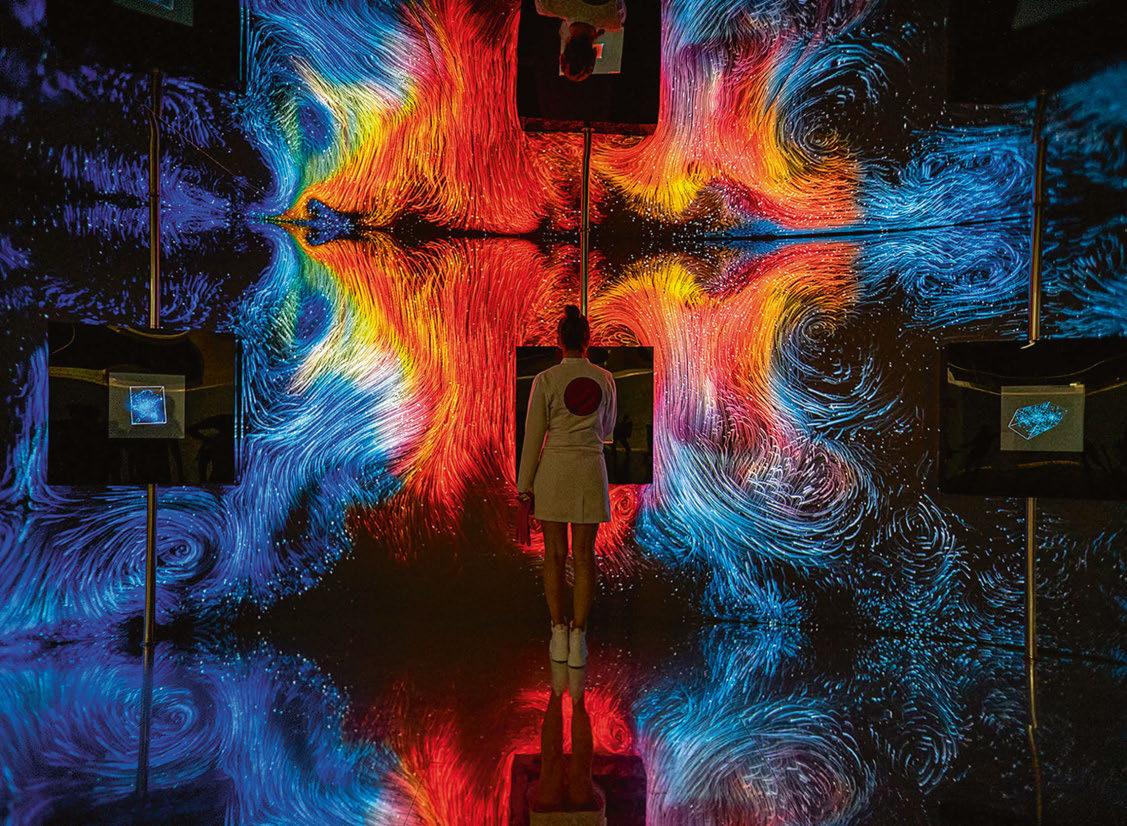
Founder and Director of art collective Molten Immersive Art, Di Stefano has curated art events around the world, including the immense Noor Riyadh in Saudi Arabia, and stands as a leading authority in the captivating realm of narrativebased immersive and interactive art.
Following her star appearance at Light + Intelligent Building Middle East in Dubai at the turn of the year, arc was lucky enough to sit down with Di Stefano to find out more about her backstory, and what she looks for when curating immersive art events.
With a career that has spanned marketing and architectural drafting, to multimedia and audio engineering, Di Stefano describes her path as “more like a spontaneous dance than a meticulously planned journey”, but her fascination with immersive art has been there, in some fashion, since she was a child.
“My journey into the world of art and immersive experiences was fuelled by my love for the beauty around us and my unwavering passion for music,” she says. “My fascination with art, particularly at the intersection of technology, stems from a lifelong love of all things beautiful, and an innate curiosity about the world around me. Ever since I was a kid, I’ve been spellbound by the simple wonders of nature – the fluffy clouds, the crunchy leaves, and those breath-taking sunrises. These simple pleasures make me feel alive, and I found inspiration in the serene beauty of nature, the expressive power of music, and the captivating allure of visual art.
“However, it was the marriage of art and technology, including kinetic sculptures, robotics, and especially light art, that truly captured my imagination. I’ve always been drawn to the interplay of light and shadow, and how it can transform spaces and evoke emotions. Light art, with its ephemeral nature and ability to create an emotional connection, captivated me from the start.”
While Di Stefano’s career began in the graphic design industry, where she worked as a business development manager, she “seized the opportunity to expand the company’s horizons” as offshore design services became more accessible. As such, she transitioned the business into the space of video production and animation, a move she believes “opened up new avenues for growth and innovation”.
“I was on the lookout for our next move when I attended a speaker’s event where the topic of the power of experiences resonated deeply with me. It was a pivotal moment. The very next day, I redirected the studio’s focus, forging partnerships with cultural institutions in Australia to immerse ourselves in the art scene. It felt like the missing

piece of the puzzle had finally fallen into place.”
This is where Molten Immersive Art was born; beginning its journey by focusing on crafting large-scale exhibitions primarily within Australia, Di Stefano soon envisioned a broader scope for the company, delving into curating events, festivals, and immersive art-based experiences, driven by a deep appreciation for the artists themselves.
“At the core of our vision is a belief that art is more than just the finished piece; it’s about the soulful, passionate humans behind the creations,” she continues. “Our aim is to amplify their voices and provide a platform for them to share their work with the world. Central to Molten’s ethos is the idea of integrating art into everyday life, making it an indispensable part of our existence, rather than a luxury.”
As it has evolved, Molten has expanded its horizons to include creative consulting and art direction, and is also set to launch an artist agency, serving as a hub for organisations, clients, and brands to discover the ideal artist for their projects. “Our strength lies in seeing the bigger picture and leading teams to manifest artistic visions, all while
042 / 043

fostering relationships built on mutual respect and trust. Through collaboration and a shared passion for creativity, we aim to nurture an industry that fosters innovation and cultivates moments of pure magic.”
While Di Stefano hopes to bring art to the masses, a central focus for her is on the burgeoning world of immersive art, and the multi-dimensional experience that she believes “transcends the boundaries of traditional artwork” with a fusion of tangible and intangible factors.
She continues: “What truly intrigues me is the idea of making people not just viewers, but active participants in the artwork itself. The ability to blend artistic expression with cutting-edge technology to create immersive experiences that transcend traditional boundaries is what drew me into this field. Whether it’s the mesmerising dance of light and shadow, or the intricate choreography of a robotic installation, I’m endlessly fascinated by the transformative power of these art forms.
“At its core, immersive art is about more than just what you see or touch; it’s about engaging all the senses to create a truly transformative experience;
it’s the interplay of visuals, sound, texture, and even scent, that transports viewers to another world, allowing them to escape the confines of their everyday lives and become fully immersed in the artwork.
“But perhaps the most ephemeral aspect of immersive art is the emotional connection it fosters. It’s about creating an environment where viewers feel not just like spectators, but like active participants in the artistic journey. Whether through interactive elements that invite viewers to become part of the artwork, or through the sheer power of the artist’s vision, immersive art has the ability to evoke a wide range of emotions, from awe and wonder to introspection and contemplation.
“Ultimately it’s about blurring the lines between reality and fiction, creating moments of wonder and connection that linger long after the experience is over, and tapping into the innate human desire for exploration and discovery, creating an environment where anything feels possible.”
As a medium that is built primarily on technology, and the participant’s interaction with it, immersive
TALKING WITH... DOROTHY DI STEFANO
Axion, Christopher Bauder, Noor Riyadh, Saudi Arabia, 2022 (Image: Ralph Larmann)

art has seen what Di Stefano refers to as “a remarkable evolution” over the past decade, which she believes has been “propelled by a convergence of technological innovation and a burgeoning appetite for more interactive and participatory experiences”.
Such innovation has seen the wide-scale adoption of technologies such as projection mapping, augmented reality, and interactive installations, which she adds have “revolutionised the way artists conceptualise and create immersive artworks”.
She continues: “Augmented reality, as an example, has opened up new possibilities for interactive storytelling, allowing viewers to engage with artworks in unprecedented ways and become active participants in the artistic experience.
“Artists are increasingly blurring the lines between physical and digital realms, integrating elements of both to create hybrid artworks that challenge our perceptions and expand our understanding of what constitutes art. From kinetic sculptures that come to life with the touch of a button, to interactive installations that respond to the movements of the audience, the boundaries of immersive art are constantly being pushed and redefined.
“Beyond LEDs, which have democratised access to lighting capabilities, artists have embraced a spectrum of new tools and techniques that have reshaped the landscape of light art. Advancements in sensors and other emerging technologies have expanded the repertoire of tools available to light artists, enabling them to push the boundaries of their craft and experiment with new forms of expression; whether it’s the integration of responsive sensors that interact with viewers, or the incorporation of kinetic elements that imbue artworks with a sense of motion and dynamism, these technologies have broadened the horizons of what is possible in the realm of light art, allowing viewers to actively engage with the artwork, influencing its behaviour and creating personalised experiences in real-time.
“Another significant change in the field has been the growing emphasis on inclusivity and accessibility, with artists striving to create experiences that are not only visually captivating but also emotionally resonant and socially relevant. There is a greater awareness of the power of art to foster connection, empathy, and understanding, and artists are harnessing this potential to create immersive experiences that address pressing social issues and promote positive change.”
One of the most significant developments in the field though, and one that is continuing to change, grow, and progress with each passing day, is the influx of AI. Although still in its infancy, we are already seeing how, working with AI, artists can revolutionise the way that they both conceptualise and execute their artworks.
Keeping a very keen eye on the ever-changing developments surrounding AI, Di Stefano is fascinated by the “plethora of possibilities” for enhancing immersive art installations, particularly in terms of interactivity and personalisation.
“By leveraging AI algorithms, artists can create dynamic and adaptive experiences that respond to the audience’s behaviour and emotions in real-time,” she adds. “For example, AI-driven systems can analyse biometric data such as facial expressions or heart rate to tailor the experience to the viewer’s mood, preferences, and physiological responses.
“It has also opened up new avenues for artistic exploration and experimentation, enabling artists to collaborate with intelligent systems to co-create artworks. Through techniques such as generative adversarial networks (GANs), and machine learning, artists can train AI models to generate novel and unexpected visual or auditory compositions, sparking new ideas and pushing the boundaries of traditional artistic practices.”
In her work as a curator of some of the biggest and best light art festivals around the world, Di Stefano has had a front row seat to witness some of the mind-blowing advancements in the field of immersive light art, and with this, has had the opportunity to work closely with some of the most sought-after names in the field – a privilege that she is acutely aware of.
“As someone deeply immersed in the industry, I find inspiration in the work of numerous artists
TALKING WITH... DOROTHY DI STEFANO
044 / 045
Entre Fer Et Mer, Yann Nguema, Gare de la Rochelle, France, 2022 (Image: Studio Pierre 2 Lune)

“At its core, immersive art is about more than just what you see or touch; it’s about engaging all the senses to create a truly transformative experience; it’s the interplay of visuals, sound, texture, and even scent, that transports viewers to another world.”
and collectives who are pushing the boundaries of creativity and innovation, so to name a favourite artist is like asking me for my favourite sunrise.
“One artist whose work continually captivates me is Christopher Bauder, a master of light and sound whose installations are renowned for their transformative power and mesmerising beauty. His ability to create immersive environments that evoke a sense of wonder and awe is truly extraordinary, and his contributions to the field have been nothing short of groundbreaking.
“James Turrell’s ability to manipulate light and colour with precision and subtlety is truly inspiring, and his work serves as a constant source of fascination and inspiration for me.
“David Spriggs is one contemporary artist whose work continually leaves me in awe. His mastery of depth and transparency creates breathtaking three-dimensional installations that seem to defy gravity and perception.
“Projection and installation artist, Yann Nguema’s ability to seamlessly blend intricate visuals with captivating soundscapes, that transport viewers to otherworldly realms, is something to behold.
“I also love the work of SpY, with his thoughtprovoking urban interventions and playful subversions of public spaces that challenge viewers to reconsider their surroundings and question the status quo. His art installations prompt reflection on societal norms and expectations, sparking conversations and engaging communities in unexpected ways.”
However, while there are many established artists whose work deserves recognition, Di Stefano believes it is also equally important to shine a spotlight on emerging artists and lesser-known practitioners who are “making waves” in the art world.
In this regard, there are a few names for which she reserves special praise: “One such artist who I believe deserves more recognition is Chantal Matar, an architect and generative designer whose work blurs the boundaries between art,
architecture, and technology. Her innovative approach to spatial design and her use of artificial intelligence to craft unique and captivating experiences sets her apart.
“Another emerging artist whose work shows great promise is Joon Moon, whose mastery of light and shadow creates enchanting narratives that linger long after the experience ends. His ability to fuse technology and art to create immersive experiences that resonate deeply with viewers is truly remarkable, and I believe he has the potential to make a significant impact on the future of immersive art.
“Additionally, I’m in love with everything created by Studio McGuire. Their ability to create rich and captivating narratives that transport audiences to new worlds is truly inspiring.
“I am always on the lookout for breakthrough artists who are pushing the boundaries of what is possible in the space. Whether it’s through experimental techniques, innovative use of technology, or thought-provoking storytelling, these artists are shaping the future of art in exciting and unexpected ways.”
One of the defining moments of Di Stefano’s career to date came in 2021, when she was invited to advise the Ministry of Culture in Saudi Arabia –giving her the opportunity to collaborate with other global experts representing a wide array of fields, from literature and performance to museums and music.
“Our mission was to craft concepts for future events and festivals in the region. Being part of such a massive project not only got my creative juices flowing, but also broadened my perspective on the arts.”
This collaboration led her to curating the 2022 edition of Noor Riyadh, the world’s largest light art festival, and working alongside a whole host of leading artists – including Christopher Bauder, Daan Roosegaarde, Yann Kersalé, teamLab, SpY, Arne Quinze, Grimanesa Amorós, and Pauline David. A landmark achievement, however looking back on the event, its scale is not what she is most proud of.
“Witnessing the moments of connection and collaboration that blossomed throughout the festival was immensely rewarding. Observing artists from diverse backgrounds unite, discover mutual admiration for each other’s work, and discuss future collaborations was truly inspiring,” she recalls. “These interactions not only facilitated creative exchange, but also forged enduring connections transcending borders and cultures.
“I am also extremely proud of the impact the artwork had on the local culture and community. Seeing how the beautiful artworks resonated with audiences, bringing profound wonder and joy to people’s lives, was deeply gratifying. It reaffirmed the transformative power of art to inspire, uplift, and unite people across cultural divides.”
Across the events that Di Stefano curates she primarily looks to commission artists to create site-specific, bespoke pieces that are tailored to the narrative and the unique characteristics and ambience of the venue in question. This, she feels,
046 / 047

TALKING WITH... DOROTHY DI STEFANO
Arkhe, Nohlab & Decol, Contemporary Istanbul Art Fair, Istanbul, 2019 (Image: Hakan Gündüz)
Axis of Power, David Spriggs, Sharjah Biennial 9, UAE, 2009

“allows for a deeper integration of the artwork with the environment, creating a more immersive and cohesive experience for the audience”.
Commissioning new works also means that the artists can realise their vision in a way that is “harmonious with the space and the overall theme of the event,” she adds.
“While I do occasionally include existing installations that have appeared elsewhere [such as Daan Roosegaarde’s Waterlicht at Noor Riyadh], the majority of the artworks featured in our events are new commissions. This not only ensures that each event offers fresh and exciting experiences for attendees, but also allows us to support and showcase the creative talents of emerging and established artists alike.
“When commissioning new works, I prioritise open communication and collaboration with the artists to ensure that their vision is preserved, while also adapting the artwork to the specific site and context. This often involves conducting site visits, discussing the unique features and constraints of the venue, and exploring how the artwork can interact with its surroundings in meaningful ways.”
This interaction with its surroundings is an integral part of an installation’s success, Di Stefano feels, adding that the context and setting of a piece “significantly influences the way audiences perceive
and interact with the artwork”, as the environment can profoundly impact the overall experience, shaping the mood, atmosphere, and emotional resonance of the piece.
“One of the key aspects of immersive art is the ability to engage with the surrounding space in a way that blurs the boundaries between the artwork and its environment,” she adds. “By considering the context and setting of the artwork, artists can create experiences that feel integrated and harmonious within the space, enhancing the sense of immersion and presence for the audience.
“Context and setting can also provide layers of meaning and depth to immersive artworks, enriching the narrative and expanding the viewer’s understanding of the piece. Whether situated in a historic building, a natural landscape, or a contemporary gallery space, the context of the artwork can evoke associations, memories, and emotions that add complexity and resonance to the overall experience. Setting can also influence the way audiences perceive time, space, and scale, allowing for a more dynamic and multi-dimensional engagement with the artwork. For example, an outdoor installation may evoke feelings of expansiveness and connection to nature, while an intimate indoor setting may create a sense of closeness and introspection.”
TALKING WITH... DOROTHY DI STEFANO
048 / 049
Loops, SpY, Bern, Switzerland, 2023 (Image: RubenP Bescos)


Powered by Lador 2 RGBW Projector | Sippy Downs, Queensland, Australia www.ligman.com LIGMAN Lighting Co.,Ltd.

With the ever-changing nature of the medium, from the technical advancements, adoptions of new methods and concepts, and even the growing popularity of light art installations and events, immersive art as a whole is in a near-constant state of evolution. As part of this evolution, Di Stefano feels that the medium is moving beyond isolated visitor experiences, becoming more integrated into the wider urban environment – a shift that she believes reflects a growing recognition of the potential for immersive art to enrich public spaces, foster community engagement, and contribute to the cultural identity of cities.
“Traditionally, immersive art has often been associated with dedicated exhibition spaces, galleries, or temporary installations that offer immersive experiences for individual visitors or small groups. However, there is a growing trend towards integrating it into the fabric of urban environments, where it can be experienced by a broader audience in everyday settings,” she adds.
“One manifestation of this trend is the increasing use of public spaces such as parks, plazas, and streetscapes as venues for immersive art installations and events. By activating underutilised or overlooked spaces with artworks, cities can create vibrant cultural hubs that attract residents and visitors alike, fostering a sense of community and civic pride, revitalising
neighbourhoods, and enhancing the urban experience.”
As for the future of the medium, Di Stefano believes that there are several emerging trends that will reshape the landscape of immersive art and “chart a course for future evolution”.
One such trend that she predicts is the growing fusion of virtual and physical realms, “erasing the boundaries between digital and tangible encounters”.
She continues: “This integration offers a fertile ground for crafting immersive narratives that seamlessly blend the real with the virtual, providing audiences with captivating and deeply engaging experiences.
“Another notable trend is the surge in interactive storytelling, where participants actively shape the narrative and outcomes of their experiences. This trend reflects a rising demand for personalised and participatory encounters that foster deeper engagement and connection with audiences.
“Looking forward, advancements in technology such as augmented reality, virtual reality, and mixed reality, are driving innovation in the industry. These technologies are becoming increasingly accessible and affordable, democratising the creation and consumption of immersive experiences, while pushing the boundaries of immersion and realism.
050 / 051 TALKING WITH... DOROTHY DI STEFANO
“The industry is also poised to further embrace multi-sensory experiences that engage all five senses, offering heightened levels of immersion and impact. This shift will likely catalyse the development of novel technologies and techniques to incorporate tactile, olfactory, and gustatory elements into immersive encounters.
“I’m also expecting to see increased collaboration and convergence with adjacent creative sectors such as gaming, film, and live entertainment. This interdisciplinary exchange of ideas and expertise promises to spawn a new wave of ambitious and innovative immersive experiences that push the boundaries of storytelling and immersion, offering audiences unparalleled adventures and discoveries.”
As for any aspiring artists and designers wanting to enter the brave new world of immersive art and use light as a medium for artistic expression, Di Stefano has the following advice:
“Firstly, when delving into this world, it’s crucial to embark on a journey of experimentation and exploration. This involves fearlessly exploring various techniques, materials, and technologies to uncover your distinct artistic voice.
“Collaboration is pivotal, offering opportunities to work with fellow artists, technologists, and experts in related fields. By collaborating, you can expand your creative horizons, gain new insights, and embark on ventures that lead to innovative breakthroughs. Such efforts often yield unexpected discoveries, enriching your artistic practice and fostering community.
“Considering the audience experience is paramount when crafting immersive pieces.
Factors such as space, scale, and interactivity play crucial roles in creating captivating experiences that resonate with viewers. By prioritising the audience’s perspective, artists can cultivate meaningful connections and evoke powerful emotional responses through their artwork.
“Embracing advancements in technology, such as interactive sensors, empowers artists to create
“One of the key aspects of immersive art is the ability to engage with the surrounding space in a way that blurs the boundaries between the artwork and its environment. By considering the context and setting of the artwork, artists can create experiences that feel integrated and harmonious within the space, enhancing the sense of immersion and presence for the audience.”
dynamic installations. Technology serves as a tool for enhancing the impact and versatility of artwork, offering new avenues for creative expression, and pushing boundaries of innovation.
“Infusing immersive pieces with narrative elements adds depth and meaning, inviting viewers to engage emotionally. Whether exploring personal themes or addressing social issues, storytelling enriches the viewer experience and creates compelling narratives that resonate long after the encounter.
“Iterating and refining artwork based on feedback and personal vision is crucial for growth. Remaining open to feedback, embracing experimentation, and continued learning are integral aspects of the artistic journey. Through continuous refinement, artists can hone their craft and create impactful artwork.
“And finally, drawing inspiration from diverse sources fuels creativity and passion. Staying curious and receptive to new ideas cultivates fertile ground for artistic expression.”
Reflecting on her own personal journey, which has seen her become widely regarded as the leading authority on immersive works of art, and an internet celebrity in the design world, Di Stefano remains humble, but is glad that the journey that she has taken has led her to the position that she is in.
“From marketing and architectural drafting to multimedia and audio engineering, I’ve explored a wide array of fields in the constant search for ‘what do I want to be when I grow up’,” she concludes. “Looking back, it’s crazy to think how every little twist and turn led me here. From my studies to picking up skills along the way, each step has played a part in shaping my career in this industry. And while it definitely hasn’t been smooth sailing, I wouldn’t change a thing. I’m pretty confident that I have the best job in the world.”
www.moltenimmersiveart.com
Kalix Bridge
Kalix, Sweden

In one of Sweden’s northernmost towns, near the border with Finland, a new bridge crossing the Kalix River has been completed.
An important link on the E4 highway, the Kalix Bridge has been illuminated by Sweco, with the goal of enhancing its architectural construction with subtle means, while contributing to the atmosphere of the city and acting as an inviting gateway to the central town.
Brought on to the project by Swedish Traffic Authority, Trafikverket, the collaboration of lighting designers, architects, and engineers at Sweco has been a key factor in achieving both the aesthetic and technical requirements of the project.
A series of arches have been illuminated with accents of cool light to create a landmark that draws attention to the magic of the river landscape, and the historical buildings on its banks.
“Because it is located so close to the city, there was great potential in letting the bridge add to the atmosphere,” says Peter Viklund, Senior Project Manager at Trafikverket.
Responsible lighting designer Caroline Zima describes the project as an exciting task, where the challenge was to highlight an infrastructural component without disrupting the sensitive surroundings. “The municipality uses a slogan to describe Kalix as a place ‘where the river meets
052 / 053 eye opener
the sea’, which shows how strongly the city identifies with the river. It gave us an indication of the importance of a lighting scheme that would let the magical qualities of the water landscape emerge at night,” she says. Well-balanced light levels and shielded fixtures that reduce light pollution and stray light have been an important part of the ecological considerations. Socially, illuminating the bridge has led to an increased sense of security and wellbeing. Pedestrian and bicycle paths are connected from the main route to nearby areas for better mobility and integration between neighbourhoods.

Viklund emphasises the high aesthetic ambitions for the Kalix Bridge and how they were met by the dedicated team at Sweco: “I will never forget the freezing night when we fine-tuned the luminaires and adjusted the brightness of the lighting. We had a team on-site and one person in Stockholm. It really made a big difference to the result. You can achieve fantastic effects when working with light in the right way.” www.sweco.se
Image: Måns Berg
Islamic Arts Biennale
Jeddah, Saudi Arabia
Steeped in the cultral tapestry of Saudi Arabia’s heritage, the Islamic Arts Biennale is a harmonious blend of old and new. We speak to GLARE, the lighting designers behind the multiple award-winning project, to learn more about the lighting concept.

054 / 055

MUSEUM & CULTURAL LIGHTING
n airport isn’t typically somewhere you would expect to find an art gallery, but nestled within the illustrious Western Hajj Terminal at King Abdulaziz International Airport – a stunning architectural creation by SOM in 1981 –lies the Islamic Arts Biennale. Steeped in the cultural tapestry of Saudi Arabia’s heritage, the site, opened in 2023, looks to combine history and modernity to tell a captivating tale of past, present, and future.
Designed by Italian studio Gioforma Architects, with lighting design from GLARE, the project has been recognised throughout the design world, picking up a number of awards, including the Structures High category at this year’s [d]arc awards.
With such a significant cultural heritage attached to the site, Camila Blanco, Creative Director at GLARE, explains to arc why this was more than your average gallery lighting project.
“The Hajj Terminal at the King Abdulaziz Airport is not an ordinary airport terminal; it is well known because of its tent structures, designed to house the influx of religious pilgrims that stream into KSA as part of the annual Hajj pilgrimage to Makkah. The terminal was not designed to be a religious space, but is rather a space that evokes the spirit of the Hajj.
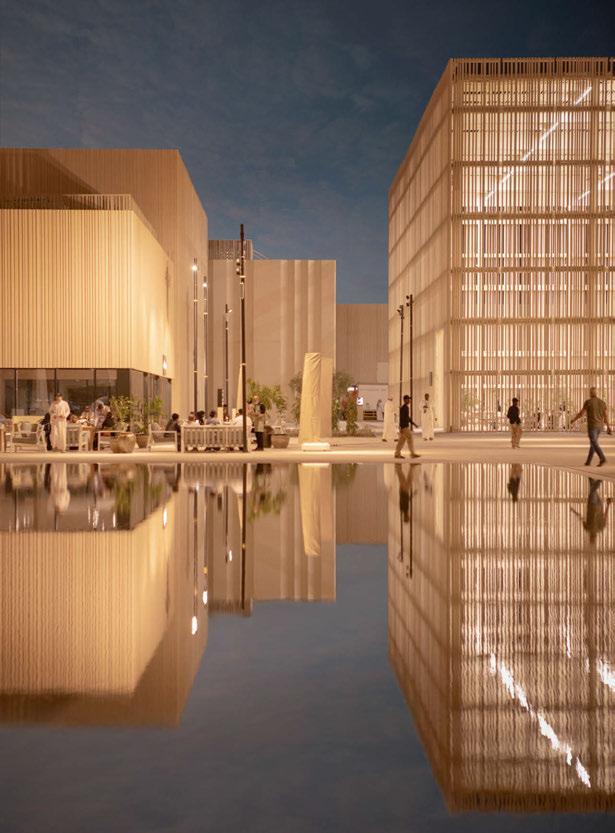
“The Islamic Biennale serves as a centre of excellence for fostering cultural dialogues and for presenting and disseminating ideas and practices in the contemporary arts world. The design itself is dynamically inserted into and beyond the vast tent structures through refined continuity, depth, and visual composition. Interconnected multilevel spaces effortlessly flow into one-another, all of which are conceived as intriguing and integral elements of the biennale experience.
“The internal spaces are immersed in a feeling of grounding serenity; the ideal blank spaces in which art can express itself without the limits of the external world. Material versatility, framed views, apertures and doorways foster moments of discovery and surprise as visitors encounter artworks in a narrative that moves beyond the boundaries of architecture. Our approach was to create a language that could pay respect to history, while welcoming the new architecture, creating a seamless integration in time.”
In order to achieve this goal, the lighting designers were provided with a comprehensive design brief by the architect, complete with renders and visuals, which were “instrumental” in getting the project’s envisioned aesthetic and mood, as well as showing how significant a role that lighting can play.
“The architects emphasised a minimalist and understated approach, with a strong emphasis on seamlessly integrating lighting into the architecture,” GLARE says. “They expressed a desire for concealed light sources to accentuate the building’s textures and facilitate a harmonious transition between indoor and outdoor spaces.
Collaborating closely, we designed custom solutions to discretely incorporate lighting elements, ensuring they organically complemented the overall architectural vision.
“In addition to the aesthetic considerations, the client provided clear directives regarding the lighting requirements for the exhibition spaces, which were the focal point of the project. So, we had to deliver a versatile and efficient lighting solution, both indoors and outdoors, ensuring adaptability and functionality within these spaces.”
Central to the lighting design concept was the “delicate dance” between honouring tradition and embracing innovation. To do this, GLARE’s lighting design unfolds through three defining elements –Ethereal, Breathable, and Reflective.
GLARE explains further: “Ethereal is an intangible, airy, and subtle sense of the light, as the space would be heavenly lit. This was characterised by seamless lighting details spread to highlight the architecture, such as shadow gaps, coves, and trimless fittings that would subtly unveil the buildings, while drawing the eye with a mesmerising allure. Breathable, as spaces effortlessly blended indoors and out, transcending conventional boundaries; Reflective was the word we used to describe how the modern Mashrabiya alight from within, bestowing a floating grace upon the water plaza.”
To realise a lighting concept that would honour both the tradition and modernity of the space, GLARE strategically used three distinct types
MUSEUM & CULTURAL LIGHTING ISLAMIC ARTS BIENNALE
056 / 057
A



Founder and head designer of corporate friends®, Jan Eickhoff, says about the company:
“The year 2010 marked the beginning of our incredible journey. When I was searching for museum showcase lighting for one of my wife‘s projects, we found that nothing available met our expectations. „I just have to do it my way,“ I said to myself, and I got to work. After extensive research and experimentation, I created something new – a small, technically and aesthetically advanced spotlight that is a joy to work with. More projects followed, and soon the idea arose: „Why not turn this into a business?“
In 2011, I founded the company and began fully dedicating myself to developing our own lighting system for museum display cases. Today, with our entire team, we take pride in knowing that our products help preserve cultural heritage in top museums around the world, and we‘re grateful for every moment of this adventurous journey.”


WORK WITH FRIENDS
corporate friends®
1:1 scale C1-micro-LC spotlight attached to a low voltage magnetic track All
12V
three-axis Y-connector
C1-micro-VL
edges closed
magnetic track Cube using
Modular Pole-Spotlight
with independently dimmable heads
of lighting tailored to specific needs; functional lighting serves practical purposes, such as daily activities and exhibition setup, both indoors and outdoors. Architectural lighting was utilised to enhance building features, using techniques like cove lighting and downlighting. “In exhibition spaces, we implemented grazing wall lighting effects and focal point highlighting to accentuate artworks,” GLARE adds.
“Exhibition lighting was meticulously designed to illuminate artworks in galleries with different ceiling configurations, ensuring flexibility to accommodate varying exhibition setups. Indoors, exhibition galleries featured suspended fixtures for high ceilings and recessed tracks for low ceilings. We also enhanced the ambience with decorative chandeliers and other unique pieces, crafting distinctive focal points throughout the space.”
With the venue destined to host both annual and biannual art exhibitions, GLARE conceived of an adaptable indoor lighting system that empowers future exhibition designers with track systems and metal meshes for optimal light placement. Doing so meant that the team had to take a step back and show some humility.
“Lighting serves as a medium of communication between art and observer, providing ideal canvases for artwork to shine without overpowering it. To meet the diverse needs of hosting art exhibitions, we implemented a versatile lighting scheme tailored to adapt to various activities.
“We integrated metal grid ceilings as a prominent feature, serving a dual purpose of concealing structural and mechanical elements while hosting diffused lighting fixtures. This general layer of light ensures optimal illumination for artwork setup, maintenance, and other activities requiring higher lighting levels.
“For exhibition spaces, we used kinetic lighting tracks and bars specifically designed to showcase artworks. Utilising spotlights with exchangeable lenses facilitated effortless adjustment of light distributions to suit different exhibits. Precisely dimmed spotlights met both scenographic and conservation requirements, offering a flexible infrastructure. Additionally, a variety of beam angles provided versatility for accent lighting and floodlighting.
“Wallwashers were then strategically installed in exhibition galleries to achieve a uniform distribution of light across both vertical and horizontal planes. This enhancement significantly enhances the perception of the exhibition space, contributing to its overall ambience and appeal.
“By implementing these layers of light, we ensured the venue not only meets, but exceeds the demands of hosting diverse art exhibitions, transforming it into a dynamic cultural hub capable of showcasing paintings, sculptures, performing arts, and more, with sophistication and flexibility.”
Elsewhere, outdoor lighting was designed to highlight architectural features and create a distinctive night-time ambience. To do this, GLARE employed various layers of light to guide visitors and enhance visibility, while functional lighting was integrated for service areas and parking lots, striking a balance between functionality and aesthetics.
“We incorporated outdoor floor-recessed fixtures, strategically positioned to graze from the bottom to the top of the building, providing a glarefree illumination with a soft, inviting warmth. Furthermore, we utilised poles and bollards to accentuate specific elements of the landscape.”
Concealed façade lighting artfully minimises light pollution, preserving the night sky, while accentuating the architectural grandeur of the building. The adjacent water plaza serves as a “serene companion” to the architecture, creating enchanting reflections across its surface and helping to transform the plaza into a natural gathering haven. GLARE explains how the lighting helps in facilitating this captivating atmosphere:
“The water plaza outside was a key consideration from the outset of our design process. The entire design team shared a vision for the plaza to serve as a reflective surface, enhancing the overall aesthetic by beautifully mirroring the building and its lighting.
“Achieving this effect was a point of pride for us, and we take great joy in witnessing the interplay of light and water. We were aware of the distance between the water and the buildings, which meant we wouldn’t achieve the caustic effect on the façades. Despite this, the reflective qualities of the water still contribute significantly to the visual appeal of the space, adding depth and dimension to the overall experience.”
The lighting designers also opted for warmer colour temperatures of lighting; considering the material finishes and the desired atmosphere, these were preferred outdoors to create inviting spaces while complementing the architecture.
One of the primary objectives for GLARE came in seamlessly integrating various surfaces – concrete, glass, and the intricate Arabic Mashrabiya – into

058 / 059 MUSEUM & CULTURAL LIGHTING ISLAMIC ARTS BIENNALE

MUSEUM & CULTURAL LIGHTING ISLAMIC ARTS BIENNALE


060 / 061
a “unified, visually enchanting tapestry”; each element illuminated, each detail meticulously brought to life.
“Our philosophy centred on the idea of interplay, where lighting and architecture intertwine like a mesh or tapestry,” GLARE says. “From the very beginning, the design team envisioned the lighting as an integral part of the architectural concept. Just as the clusters rise from the sand, our lighting effects were designed to harmonise with the architectural elements, enhancing their beauty and creating a sense of cohesion throughout the space. From subtle uplighting effects on the façades, to carefully designed galleries, ensuring that every aspect of the project worked in concert to create a unified visual experience.”
Within this delicate interplay came the balancing act of merging the new, modern architecture with the historic pilgrim tents. To effectively do this, the designers aimed for the building’s illumination to serve as a “subtle backdrop”, rather than imposing its presence on the surrounding environment: “To achieve this, we opted for minimal and understated lighting, with static fixtures, with warm colour temperature, mostly recessed in the ground or custom-made coves, prioritising clarity and providing ample space for the exhibition, which held primary importance within the space.”
A defining factor in this fusion of new and old came in the modern Marshabiya – itself something of a contradiction, GLARE believes that this feature serves as a “connection element between antiquity and modernity.
“The Mashrabiya is easily recognisable to visitors and aids in the seamless transition between the two. In our approach, we leveraged lighting effects to accentuate the beauty of the Mashrabiya, creating captivating shadows and patterns that are projected onto the floor and contribute to the reflection of clusters on the main water plaza.
“Some elements were illuminated perpendicularly to highlight their intricate patterns, while others were gently washed with light to emphasise their overall presence and significance within the space. By employing these techniques, we ensured that the modern Mashrabiya not only serves as a design feature but also as a symbol of cultural continuity and innovation.”
The project was, of course, not without its challenges – scope, longevity, calculations, etc – but for GLARE, time was the biggest enemy.
“Undoubtedly, working on a Design & Build project presented numerous challenges, with time constraints being one of the most significant hurdles. We had a mere four months to navigate the entire design process, from conceptualisation to detailing.
“However, the strength of our company lies in the cohesion of our design team. Despite geographical barriers, with team members stationed in both Italy and the UAE, our collective dedication and tireless efforts ensured we met the deadline with excellence. We leveraged our international presence to our advantage, enabling close collaboration with stakeholders and facilitating effective communication throughout the project. This collaborative approach and unwavering commitment were instrumental in overcoming the challenges we encountered, ensuring the successful realisation of our vision for the project.”
To that end, the team at GLARE can look back on the project with a great deal of pride, not least because of the accolades that the project has garnered since its opening last year.
Reflecting on the project’s culmination, GLARE says: “Witnessing the completion of the project and seeing our lighting design come to life evokes a truly magical feeling for us. It is incredibly rewarding to see the space teeming with visitors who are enjoying and appreciating what we’ve created.
“In terms of the lighting design itself, we’re delighted with the outcome. The lighting design serves as a component of the space, seamlessly integrated with the architecture to enhance the overall visitor experience. Outdoors, the lighting fulfils a crucial role in connecting the various clusters, guiding visitors along their journey through the space. As visitors move between the pavilions, they embark on an emotional pathway, each step revealing the beauty of a new building, illuminated by distinct lighting layers. This deliberate interplay between architecture and lighting elevates the ambiance, fostering a sense of wonder and discovery that enriches the visitor experience and leaves a lasting impression.”
www.glare.lighting
Client: Diriyah Biennale Foundation / Ministry of Culture
Lighting Design: GLARE, UAE
Architect: Gioforma Architects, Italy
Exhibition & Landscape Design: OMA, Netherlands
Lighting Specified: Erco, Flos, iGuzzini, Ideolux, Linea Light, Radiant Architectural Lighting
Photography: Diriyah Biennale Foundation, Abdullah Alkarimi, Gioforma, Marilyn Clark, Fabrizio Floreani
MUSEUM & CULTURAL LIGHTING ISLAMIC ARTS BIENNALE

MUSEUM & CULTURAL LIGHTING 062 / 063

Leighton House London, UK
The home of eminent Victorian painter Frederic, Lord Leighton has been converted into a museum, combining the traditional, 1800s home with a modern intervention. The design was led by BDP, which worked to balance old and new elements in harmony.
eighton House Museum is a Grade II* listed building with an internationally significant collection, located within London’s Holland Park Circle. Purpose-built in 1865 for eminent Victorian painter, Frederic, Lord Leighton, the property has, over its 150year history, evolved and expanded. While earlier phases were directed by Lord Leighton himself, several less satisfactory interventions were built after his death, and during the period in which the house transitioned from private home to public museum.
The most recent intervention, completed in 2022, looks to celebrate the building’s origins as Lord Leighton’s house, while also creating an inclusive and enjoyable visitor experience, with a new entrance and reception, new staff suite, and restored Winter Studio.
BDP had been working with the museum for a number of years, from an architectural perspective, on heritage approvals when the opportunity to design the lighting for the latest renovations arose. After a competitive tender, BDP’s lighting design team got involved in the project, and developed a concept for both the house and exhibition that would preserve the special atmosphere of Lord Leighton’s Victorian house, while providing state-ofthe-art facilities, scaled to its domestic setting and integrated wherever possible.
Speaking to arc, Colin Ball, Lighting Director at BDP, explained the challenges that came with integrating the exhibition space into the existing house, while preserving the original atmosphere of the space: “This may be a museum, but it is also a preserved residence. The new facilities were to be no different in quality than the Royal Academy or V&A, but were to retain a degree of domestic scale. “Working with a very accomplished exhibition designer, Charles Marsden-Smedley, we could work very closely with an expert that really understood light. Each exhibition piece was negotiated whether the lighting would be integrated within a case or within the room environment. We even agreed finishes of some of the commissioned artworks.” Throughout, the project selectively removes, reinvents and extends the less significant areas in order to celebrate and safeguard the original house. In doing so, BDP has restored the house and garden, and provided the facilities and spaces to create a coherent, inclusive, and enjoyable visitor experience, consolidating the museum as an amenity for the local community and beyond.
In addition to extensive building fabric conservation and restoration works, BDP’s design incorporates new elements that take their cue from the existing, reinterpreting the language of the house through materials, form, and colour. These include a new entrance and reception space in the Perrin Wing, with new visual and physical connections to the original house and garden; a new staff suite has also been created within the volume of the upper gallery space. Leighton’s Winter Studio has been restored, and the space beneath recovered as the De Morgan Café. The existing basement has been extended to provide visitor facilities, display and interpretation space, an archive store, and a gallery to display Leighton’s extensive drawing collection.
“The Winter Studio is restored to how Lord Leighton would have used it,” Ball adds. “Also, the under croft of this studio was to be revealed in the café areas, as previously this was all back of house storage and plant space. During construction, the discovery of original 19th century glass flooring down to the basement also required lighting around it in a sensitive manner.
“The Upper Gallery includes a simulated daylight cove where the new floor was added to the double height space. Where daylight has been lost we have maintained the effect through simulation. Currently for this exhibition area, a dark shadow wall finish was selected to highlight the colour of the gold frames.”
Just as the artist did when he lived in the residence, BDP looked to harness as much of the natural north daylight as possible. The new exhibition facilities are integrated with the house so that the viewer’s eyes can comfortably adjust from one room to the other, resulting in a greater transparency between the old and new spaces. Galleries with a maximum of 50lx did not require darkening of the approaching corridors, as eyes had already adjusted to the lux level.
BDP advised on daylight, addressing any issues of glare, as well as the effects of exposure on

L 064 / 065

MUSEUM & CULTURAL LIGHTING LEIGHTON HOUSE

the artefacts, working closely with the exhibition design team to advise on appropriate locations for sensitive objects. A space saving innovation sets the visitors’ arrival directly into the display area from the front door. Daylight and sunlight were modelled so that artefacts could be positioned at the entrance without high levels of exposure.
Ball further explains how the new lighting marries with the natural daylighting: “We’re used to working with galleries with 50lx maximum objects, one of the first statements on the project is that you do not need to ‘blackbox’ such a space. You can allow daylight to feed into the space, as long as you know how much and precisely where it’s directed.
“The other key factor is that you are able to influence the transition spaces prior to entering the gallery. This is plural with intention. Tunnel effect, or ‘snow blindness’ can result from harsh transitions between spaces; if you can comfortably adjust the occupants’ eyes through a period of at least three minutes, they can enter a low light environment with their eyes pre-adjusted.
“It is not by accident that the statue at the base of the spiral stairs is matte white, nor that the exhibition case is immediately in front of you in a dark wood environment with no accents. You turn to the right and the 50lx environment already appears bright.”
Another new addition to the space, the stair and lift ‘rotunda’ complete the evolution and expansion of the house, connects all levels, and balances the composition of the garden elevation. The lighting to the spiral stair imperceptibly aids the transition from daylight to basement – it is also used for emergency lighting, eliminating the need for any additional fittings on the ceiling. To Ball’s point, the matte white statue at the foot of the stairs was a recommendation from BDP, acting as a diffuse reflector to meet the viewer as they arrive below ground. Mock-ups were posed to ensure correct shadowing to the sculpture, particularly the faces of both athlete and snake.
Ball continues: “The lighting does not work in isolation of the exhibition placement and the room finishes. The integrated handrail keeping the attention downward but with clarity for safety provides the majority of the transition, also influencing the dark floor finish here helps. Once downstairs, the basement gallery includes a backlit ceiling for future options to display bronze sculptures, and integrated spotlights for sharp accenting. This is dimmed down to expose Leighton’s original paper drawings.
“We originally had a real skylight for this area, which was budget restricted,” Ball says. “The room was to have full flexibility, so the idea of a glazed
MUSEUM & CULTURAL LIGHTING LEIGHTON HOUSE
066 / 067


Optec New
For durable, economical and sustainable lighting solutions
Durable
Developed and designed for exceptional durability
Effective Lens system that directs light only where it is needed (lux per watt)
Future-proof
Interchangeable lenses, accessories and standardised interfaces for tracks
www.erco.com/optec-new
dimension of architecture
E
Light is the fourth

ceiling enabling the space to be an ‘external’ winter garden flooded with light for sculptures was to be an option, as well as a dark space with sensitive works and a maximum of 50lx within.
“Surprisingly, the whole ceiling illuminated at 1% only provides 1lx direct to the artworks. We used it on or off depending on the nature of the works –so far, the room has been painted white and black for the De Morgan Gold works. We haven’t used the space in its ‘exterior’ mode yet.”
was kept to an absolute minimum. Each accent was carefully placed for legibility and clarity to the entrance, without any spill light impacting the surroundings.
Despite the project’s atypical location, Ball feels that the local conservation area status “fits in well” with the brief to maintain a domestic scale. He continues: “In this part of London, it is rare for residences to be brightly lit up as they generally fall into historic areas or wider estates with additional restrictions. As such, localised lights around entrances and gateways tend to be the limits.
Low glare integrated landscape lighting however, enabled us to deliver public-grade accessibility without glaring the neighbours.”
Bringing the project to life came through the hard work and close collaboration between BDP and the contractor – the former conscientiously providing samples and prototypes in full operation was an “essential part” to getting the final lamps and optics, precisely as calculated, into the final scheme.
Client: Royal Borough of Kensington & Chelsea
Lighting Design: Colin Ball, Delfina Barbato; BDP, UK
Architect: BDP, UK
Exhibition Design: Charles Marsden-Smedley, UK
Lighting Specified: Aktiva, Artemide, Bega, Deltalight, Eaton, Erco, Flos, iGuzzini, LED Linear, Linea Light, Mackwell, Prolicht, Tryka, Viabizzuno, Zumtobel
Photography: Nick Caville, Dirk Lindner
Given the very nature of the building, the project is a remarkable blend of old and new, with the modern additions to the museum space sitting in harmony alongside the original architecture. Ball explains how the lighting helps to fuse the contrasting elements together into one unified scheme: “Discrete details and a unified bronze finish are the key parts. We also avoided any large ‘systems’ for lighting. Each of the rooms were unique, so we treated them individually. Our luminaire schedule was as long and complex as it would be for any museum, we just used very small quantities of each type – the lighting had to be discrete in all areas.”
Given the museum’s location at the centre of a residential conservation area, all external lighting
Looking back, Ball recalls a personal highlight from the project: “Of particular joy for me personally is the accenting into the concave wall art of the spiral stairs, the stunning calligraphy of Shahrzad Ghaffari. I knew the tiny vertical detail would work from my experience working inside classical architecture, an effect that Dialux models cannot show you. No one quite believed me, so it was a relief to see it work even better than I’d anticipated.”
As for the museum as a whole, he concludes that the lighting plays an integral role in the wider ambience of the space, in that special, intangible way that good lighting design can.
“The museum feels light and airy, for want of a better term,” he says. “Your eyes move from exhibition, daylight gardens, to museum displays, without you noticing how different the lighting is.
“A successful scheme for us is one where the visitors don’t ‘see the light’, they just enjoy what they are looking at.”
www.bdp.com
MUSEUM & CULTURAL LIGHTING LEIGHTON HOUSE 068 / 069

Lights the way, not the sky
The Dark Sky luminaire head for the modular system bollard luminaires protects the night sky and nocturnal wildlife. Optionally available with BEGA BugSaver® technology to switch the colour temperature to an amber tone. Bollard tubes optionally available in sustainable Accoya® wood. bega.com/systembollards
Das gute Licht.
Argo Contemporary Art Museum & Cultural Centre
Tehran, Iran
After standing abandoned for 40 years, Tehran’s infamous Argo Brewery has been transformed into a museum for contemporary art by The Seed

070 / 071

MUSEUM & CULTURAL LIGHTING
In the heart of Iran’s capital, you will find The Argo Factory. It is not hard to miss, at least not in its fully illuminated form, as its concrete roof floats above the neighbourhood buildings. The launch of the new gallery in Tehran is a monumental moment for Iran’s culture and creative community. Its opening in 2020 marked the first art museum in the capital since the revolution in 1979, which saw the destruction of many artistic hubs and spaces.
Located in the city’s downtown district, in a 1700sqm industrial building that was formally a bustling beer factory, producing the beloved Argo beer, now the 100-year-old building has been reborn as a contemporary art museum welcoming a new generation of artists and inspiration.
The Pejman Foundation entrusted the conversion of the factory to Ahmadreza Schricker Architecture North, a New York-based design studio, to house its art collection and attract more cultural activity due to its central location. ASA North’s goal was to breathe new life and identity into the building, opposed to completely preserving it, by creating a blend between old and contemporary elements.

This transformation involved inserting a new foundation and metal structure to support floating concrete floors that were independent of the former structure and extended the ceiling height. In conjunction, five concrete roofs were added to the building, each were illuminated from below to create an illusion of the roof hovering over the old building. Inside, the building comprises of six galleries, an event space, a library, office, gift shop, a studio for the museum’s artist residency programme and a non-alcoholic bar as an homage to its former life as a brewery.
Golsana Heshmati, lighting designer and founder of The Seed Lighting, became involved in the project in a way that almost seems predestined. Having always dreamed of working on a monumental project in her hometown, Heshmati was thrilled when she learned about the construction of the Argo Art Museum. This project was ideal for her to utilise her specialisation in museum and gallery lighting; her skills, combined with her deep understanding of the local demographic, positioned her as a valuable contributor to the whole project.
Heshmati received an initial design brief from the client and architect specifying the project’s design purpose within the city’s context while noting the sociopolitical challenges they were to face, such as increasing costs of construction material and strict sanctions on any European and American items.
In short, the main goal was to create something impactful and sustainable while on a budget. The museum has a dedicated commitment to environmental stewardship, and this was a quintessential factor in the lighting scheme. This was achieved by using high-efficiency LED lighting and a smart controls system - this system ensures that lighting is tailored to the specific needs of the space and automatically adjusts based on the museum’s operations schedule. Consequently, this resulted in impressive energy savings and significant reduction in the building’s carbon footprint. The overall lighting concept was designed to align with the architecture, to seamlessly blend the old and the new elements while injecting an inviting and inclusive atmosphere to this once desolate space. Bringing these concepts to life came through the success of The Seed and ASA North’s close collaboration. The architect had a clear vision of the museum’s look and feel shown through schematic rendering, allowing the lighting team to refine its concept, and ensure it functioned in complete harmony with the architectural design intent. Heshmati says: “We strategically placed lighting to emphasise the building’s unique features, allowing it to “breathe” and glow from within. This not only highlighted the architectural details but also created a warm, welcoming presence that invites the community into the space.”
In keeping with the old, the existing brick walls remained in the original Flemish bond pattern and exposed internally – to accentuate the texture, the walls are illuminated with a soft, warm layer of light. Similarly in the courtyard, illuminated arched brick walls create depth and draw the visitor’s eye from the central courtyard.
MUSEUM & CULTURAL LIGHTING ARGO CONTEMPORARY ART MUSEUM & CULTURAL CENTRE
072 / 073


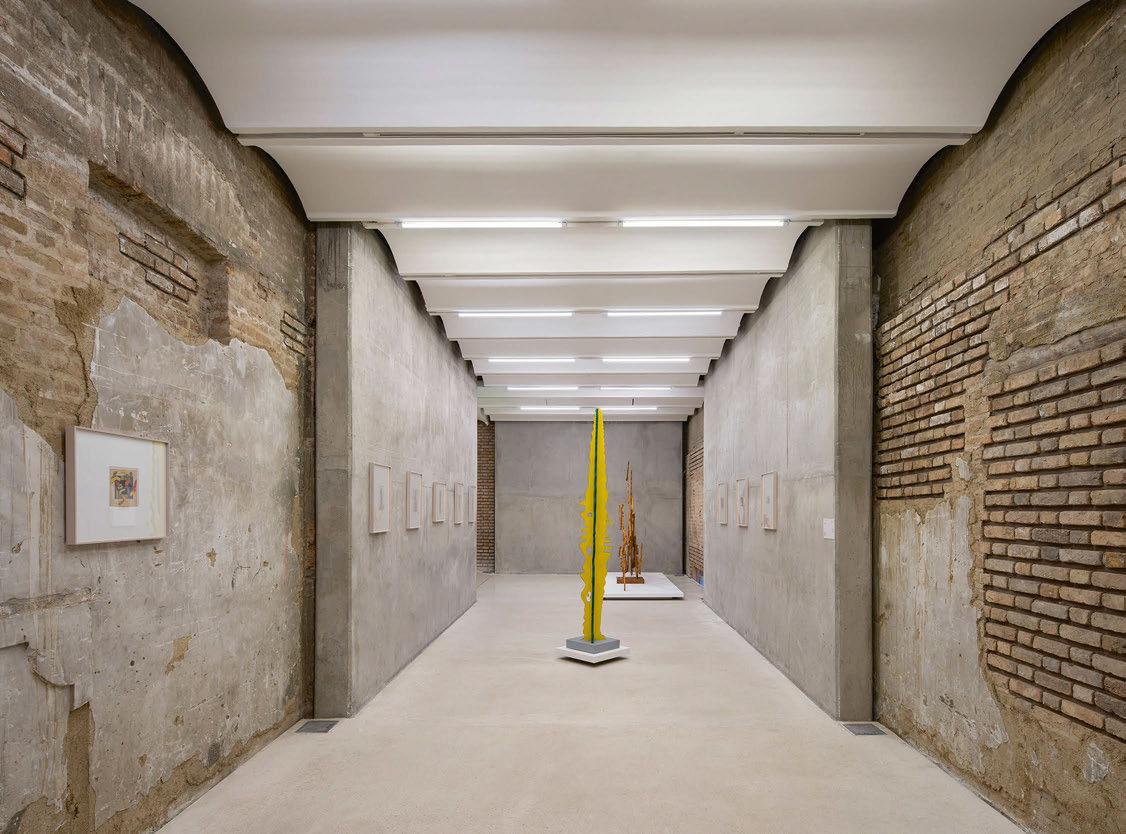
074 / 075 MUSEUM & CULTURAL LIGHTING ARGO CONTEMPORARY ART MUSEUM & CULTURAL CENTRE
“Designing the lighting with respect to the original fabric of the building was a significant challenge,” says Heshmati. “But we managed to minimise disturbances. The design team’s careful attention to detail in both preserving the old and integrating the new allowed us to implement our lighting concepts effectively. Most of the work to accommodate our design was handled skilfully by the builders, which made it possible to place lighting fixtures without compromising the building’s conservation needs.”
A pool of light fills the volume of the double height entry space, illuminating the curved concrete staircase - one of the more modern elements added to contrast the original architecturepositioned to lead visitors from the lobby to the skylit galleries on the second floor. In the galleries, recessed linear tracks are placed between the ceiling’s original arched structure, providing flexibility for the art exhibitions.
Heshmati explains: “Creating a flexible lighting design was crucial for our project. The gallery’s double height makes it one of the few spaces in Tehran capable of displaying large-scale art pieces and sculptures. We focused on ensuring that the lighting could adapt to various exhibitions, enhancing both the artwork and visitor experience.”
A bonus feature to the sustainability initiative in the concept was how the design team utilised daylight to reduce the requirements for electric lighting. However, this utilisation of sunlight also allowed the design to create “luminous voids” to invite an interplay between lighting and shadow into the space.
“The concept of ‘luminous voids’ in the secondfloor galleries plays a crucial role in enhancing the space’s dramatic ambience through the interplay of light and shadow. During the day, the ribbed and pitched roof structures allow sunlight to pour into the building. The asymmetric design of the skylights deepens the dramatic effect by creating varied intensities and patterns of light and shadow, enhancing the visual depth and texture of the space. In the evening, the upper glass of the skylights is illuminated to emulate daylight, preserving the effect of streaming light through the skylight openings.”
The pièce de resistance of the entire project is undoubtedly the floating concrete roofs. The design mirrors the neighbourhood skyline by tapping into traditional local metal roofs. The five new striated, pitched roof structures function as deep, insulating skylights, signalling the building’s revival—a symbolic “tip of the hat”. The architectural gaps within the building, including the space between the roof and the pre-existing walls, also act as symbolic sign of respect to the original structure.
Not only is this project remarkable by its design, but it also holds great cultural implications on the wider community who have been living alongside the derelict building for 40 years. Before the project, the architectural team had discovered the neighbours used the site to throw waste from their windows, or stole parts from its structure for their own buildings. Now in its finished glory, the museum is a cultural gem to Tehran and a profound influence on a new regeneration in the area.
“Tehran is experiencing a cultural renaissance with old buildings being transformed into lively galleries and coffee shops; the museum serves as a focal point for a new generation of artists and art enthusiasts,” explains Heshmati. “Recognising this, we conducted thorough research to ensure our lighting design not only met the technical needs of the space, but also resonated with the local cultural aesthetics, such as appropriate colour temperatures.”
Argo Factory’s transformation has been the comeback story of a lifetime. For decades, this building was a blight on the neighbourhood and was no more than dumpster. Today the museum stands as one of the main cultural hubs of the city and an attractor for international visitors, it has also been cited as a catalyst for the renovation of neighbouring buildings, thus fostering a cultural revitalisation in downtown Tehran. In other words, Argo Factory has become a literal glowing beacon for change and optimism. For Heshmati, this has been a dream realised, her dedication to her work and hometown has been forever immortalised into its walls for the entire world to see.
Reflecting on the project Heshmati stated: “Receiving recognition for our work on this project is both humbling and significant, especially considering the challenges we faced during its completion. The international accolades not only validate our efforts but also highlight the vibrant, open-minded young generation in Iran. This recognition is incredibly rewarding for us.” www.theseed.lighting
Client: The Pejman Foundation
Lighting Design: Golsana Heshmati, The Seed, USA
Architect: Ahamdreza Schricker,
ASA North
Developer: Vandad Development
Electrical Engineer: Aydin Ashfar
Lighting Specified: Fenos Lighting
Photography: DEED Studio
Gabrielle Chanel. Fashion Manifesto
London, UK
After touring around the world, last year, the Gabrielle Chanel. Fashion Manifesto exhibition arrived in the UK, taking residence at London’s V&A Museum. Lighting for the exhibition was designed by

076 / 077
StudioZNA

MUSEUM & CULTURAL LIGHTING

abrielle “Coco” Chanel revolutionised women’s fashion with her pioneering approach to femininity, comfort, and luxury. Guided by her own taste, Chanel’s designs epitomised high-end fashion, creating iconic pieces that remain timeless today. Her signature styles, such as the “Little Black Dress”, tweed suits, pearl costume jewellery, and the legendary Chanel No. 5 perfume, are instantly recognisable to even those not in tune with the fashion world.
In 2023, the famous exhibition in honour of the French couturière, Gabrielle Chanel. Fashion Manifesto, finally arrived in the UK. Originally premiered in Paris 2020, before travelling to Tokyo and Melbourne, its fourth iteration was at the V&A in London. The exhibition ran from September 2023 to March 2024 and charted the establishment of House of Chanel, featuring more than 200 looks by the French couturière to display the evolution of her iconic design style that continues to influence the fashion world today.
The exhibition was housed in the newly bespoke Sainsbury Gallery, one of the UK’s largest gallery halls, spanning 1,100sqm of column-free space designed by architect Amanda Levete of AL_A. The exhibition designers, Storey Studio, split the exhibition into 10 thematic sections, which explored Chanel’s innovative approach to fabric, silhouette, and construction. The individual spaces were set up to transport the visitors to places Chanel frequently visited, from La Pausa Villa on the Côte d’Azur to the iconic staircase at Rue Cambon, the location of Chanel’s boutique and haute couture salons, as well as her own apartment – like chapters from a biography of her life. A tonal palette was utilised to embody Chanel’s love of opulence, using beige, gold, black and shifts in surface texture to reflect her creative approach to materiality.
To ensure the exhibition flowed seamlessly and highlighted its intricate details, a sophisticated lighting design was implemented to transport the visitors through the thematic chapters. Studio ZNA was invited onto the project by both the V&A and Storey Studio.
Zerlina Hughes, Creative Director of Studio ZNA says: “We have worked with the V&A for more than 15 years, while we have collaborated twice already with Storey Studio - on the Kimono: From Kyoto to Catwalk exhibition in 2020 at the V&A, and on a retail project for the Asprey flagship in London.”
Despite being in its fourth iteration, the London exhibition was not to be dictated by any preexisting styles from the previous show.
Instead, the new design was to respectfully reference previous iterations while reimagining every aspect, whether it be the exhibition, graphics, AV or lighting, they were to be redesigned for purpose.
The brief from the curational team at the V&A was provided for both the lighting designers and exhibition designers, asking for a beautiful display that would give narrative support to the thematic drivers of the exhibition and seamlessly transport visitors through Chanel’s life while presenting a cohesive vision.
Studio ZNA was tasked with creating this seamless blend while ensuring accurate lighting for 200 mannequins, 150 objects including photographs, illustrations, jewellery, accessories, and perfume.
“The challenge to all creative parties was how to display the 200 mannequins the exhibition contained at the low light levels required for conservation, while making the most of the beautiful detail and colour of the garments themselves” says Hughes. “Additionally, some of the clothes were relatively understated, even modest in their designs, and they needed to contribute to the overall ‘magical and transporting experience’.”
MUSEUM & CULTURAL LIGHTING GABRIELLE CHANEL. FASHION MANIFESTO
G 078 / 079


A significant task for Hughes’ team involved collaborating with the exhibition designers to ensure the scenography presented a cohesive vision. By following Storey Studio’s approach, Studio ZNA proposed that visitors experience the pieces under subtly shifting lighting qualities, providing the feeling of moving through the section from morning to night in both internal and external contexts, spanning rural and urban locations. Despite the lighting changing in accordance with each section, there is also a unifying thread in terms of tonalities and materials, which is maintained, reflecting the Chanel branding tones of blacks and ivories to natural silvers and golds, all in a brushed, satin-like finish.
Hughes expands: “Our overall concept was to consider the objects as the primary focus and to work carefully with the low light levels permitted, modulating the luminous scenography surrounding the works. The designers wanted to show various thematic chapters in the course of the exhibition by suggesting locations, both internal and external, while also depicting seasons, from Paris in spring to the highlands in autumn and from a busy street to a candlelit interior, culminating in a fashion show presentation, using original footage, sited in Gabrielle Chanel’s boutique and haute couture salons in Rue Cambon.”
To bring these concepts to life, Studio ZNA developed an approach where there is always a luminous background, given the objects could
only have 50lx of direct light for conservation reasons. Objects were mostly illuminated at 3000k temperature, except from embellishments such as pearls, which were highlighted in 4000k.
“We wanted people to read an elevated 3D-ness with each object by creating a luminous environment for it, with backdrops in the form of lit horizons or dynamic window backgrounds. Working closely with the designers on the use of specular materials that would reflect light very softly within the luminous backdrops, we were able to use different tonalities that suggested the location – exterior or interior, for example”, explains Hughes.
Each object typology demanded a bespoke treatment. For jewellery, the lighting design could be rich and dynamic, using up to 200lx, as long as no organic matter was in the display. Illustrations and photographs were kept clean, monochromatic, and elegant – much like Chanel’s own branding. Meanwhile, the double-height vitrine showcase, where Chanel’s classic evolutions are displayed, such as her lightweight tweed suits and tailoring, are lined in white fabric while the lighting adds a dynamic luminosity, highlighting them as individual stars of the show.
The lighting fixtures selected for the display cases had the highest colour rendering at 95+ CRI, employing both very narrow and wider lenses, depending on the condition of the object or complexity of the finish, alongside flicker-free drivers to ensure quality film potential.
080 / 081 MUSEUM & CULTURAL LIGHTING GABRIELLE CHANEL. FASHION MANIFESTO


MANUFACTURERS OF INNOVATIVE SUSTAINABLE LIGHTING EQUIPMENT


MADE IN SCOTLAND FOR UK AND INTERNATIONAL SPECIFICATION



@stoanelighting

A key area in the exhibition was the perfume room. Here, Studio ZNA created rotating beams of glowing light passing through a gold liquid perfume bottle, using a solo installation treatment with scenography and light play refracting through a dynamic light source.
The Perfume Room, which has its own structure within the exhibition, is one of the standout features in the exhibition, along with the bespoke abstracted chandelier in the eveningwear finale section, where the Rue Cambon staircase has also been recreated. Light moves constantly across the stairs at the exact tempo of a film, projected onto the panels alongside and above the stairs, which feature archive footage of Chanel herself.
movement to evoke the feeling of dappled sunlight through branches. In the ‘villa’ backdrop area, the AV treatment created a sunset-scape, ensuring a dynamic space without any extra exposure hitting the objects and works. For the perfume room, we created a dynamic environment using DMX protocols to create changing light scenes. For the finale section, we created a centrepiece chandelier to give a soft, ambient light, while, to further the AV presentation of archive footage, we added a supplementary moving light onto the cascading staircase.”
Client: V&A London
Lighting Design: Zerlina Hughes, Sumya Monga; Studio ZNA, UK
Architect: AL_A, UK
Exhibition Design: Storey Studio, UK
Lighting Specified: Applelec, Atmosphere Zone, Enliten Architecture, iGuzzini, Oshino, Precision Lighting
Photography: Thomas Adank
The lighting designers were brimming with creative ideas and inspiration for what the exhibition could offer in luminosity and elegantly layered lightscapes. However, they were met with the challenge of working within the space’s low conservation lighting requirements. When asked how challenging it was to balance the low conservation levels in the project Hughes replied: “I would say it is challenging, but at the same time we are also very used to it. In our specialised area of work, the norm is creating choreography-led lightscapes with objects as the focus. For example, the ‘window’ backdrop in the second section features a dynamic white lighting loop with soft
Studio ZNA’s design truly elevates the entire exhibition experience, creating mood and atmosphere while enhancing the beauty and detail of the subtler pieces. It effectively highlights the longevity and complexity of Chanel’s creations, adding a three-dimensional dynamic that highlights fine panelling and texture. By preventing flatness through skillful use of luminosity, the lighting design plays a crucial role in the presentation of the 350 objects on display, ensuring each piece is seen in its full splendour. It would be fair to say the team designed a sophisticated and glamorous lighting scheme that captures the very essence of Gabrielle Coco Chanel. www.studiozna.com
MUSEUM & CULTURAL LIGHTING GABRIELLE CHANEL. FASHION MANIFESTO 082 / 083

Our products are designed and tested to withstand the harshest environments.
All our IP68 rated linears, flex and spot product are for permanent underwater installation and suitable for outdoors. A comprehensive solution to mantain the same light consistency for all your outdoor projects.
PRODOTTI DI QUALITÀ ITALIANA
100% for permanent underwater usage www.leditaly.com

MUSEUM & CULTURAL LIGHTING 084 / 085

The Eames Archives Richmond, USA
Situated in the Eames Institute, the Eames Archives is one of the most comprehesive collections of the duo’s iconic work. Lighting designer Grace Mennell was tasked with illuminating the space to effectively showcase the objects on display.
ver the course of their decades-long personal and professional relationship, designers Charles and Ray Eames engaged in a tireless pursuit of problem-solving design that led to some of the most groundbreaking and iconic creations of the 20th century. From massproduced ergonomic furniture utilising stateof-the-art materials and technologies, to films that succinctly and playfully conveyed complex concepts, to exhibitions that structured information like architecture to proposals that brought greater awareness to humankind’s impact on the planet, no subject matter or medium fell outside of the pair’s wide-angled vision.
Situated in Richmond, California, The Eames Institute holds one of the most significant and comprehensive collections of Eames designs and related ephemera in the world.

Titled the Eames Archives, the collection is part of a recent build-out of the Eames Institute’s headquarters, and encompasses early correspondence and artwork that predates their meeting, unique prototypes and process materials, industrial products, printed communications, and even treasured personal effects.
Almost the entirety of the duo’s oeuvre is represented, giving an expansive view of the practice, and inspiring future generations with their humanistic and hands-on approach. The Institute’s internal teams led the exhibition design and curation of the 1,900sqft gallery, alongside gallery designers Standard Issue. Four main elements contribute to the spatial design: Ray’s Table to display 3D objects, Vertical Display Wall with pegboard and vitrines, Archival Photography Wall, and the curtain-defined Chair Tasting Space.
The lighting design for the gallery was led by Grace Mennell, who worked hand in hand with Standard Issue to illuminate the space. Speaking with arc, Mennell explains how her role on the project came to be: “In early 2023, I was approached by a former colleague, now working at Standard Issue, to take a look at their upcoming project, an exhibition space for the Eames Archives, to assess the feasibility of integrating lighting design into their architectural gallery design.
“At the time, Standard Issue had already begun working with the Eames Institute in a pre-design and concepting phase, and the studio was moving into schematic design as these early ideas percolated and took shape. After an initial meeting and project brief, I began working closely with the architects and industrial designers at Standard Issue to develop the lighting design concepts and schemes alongside the exhibition design, including the planned specialty display systems and casework.”
This collaboration, Mennell adds, ensured that, from the early design phases, lighting design could be used a s a tool to better bring the project to life.
“As Standard Issue designed various iterations of object pedestals, casework, and vertical display, I followed shortly behind to consider the role lighting could play and assess the technical feasibility of what we were trying to achieve.”
Guided primarily by the studio’s design vision and concept, Mennell designed a new lighting system for the Eames gallery space. This process began with a study of both the Eames collection, as well as previous retail and gallery displays of Eames furniture. The existing space, which was to be converted to a gallery for the Eames Archives, posed unique challenges though, with its low ceilings, minimal existing track lighting, and adjacent warehouse and office spaces. But, from her initial assessments and design discussions, Mennell’s primary goal for the lighting design became to “elevate, emphasise, and highlight each individual Eames object in the gallery as its own unique moment and work of art”.
She continues: “This lighting design concept worked well with Standard Issue’s exhibition design that aimed to create moments of play and discovery.
MUSEUM & CULTURAL LIGHTING THE EAMES ARCHIVES
086 / 087
O


088 / 089
By integrating the lighting design closely with the overall exhibition design and visitor experience, the lighting became an important tool in guiding visitors, seeing Eames artefacts in a new way, and creating an inviting space where visitors could learn the history of these objects and understand the greater narrative of the Eames Archives.”
Alongside the development of lighting design goals and concepts, Mennell was “keenly aware” that the client wanted the lighting system to be discrete and carefully integrated into the existing space. Luminaires from Luxam Lighting were specified for the project – the microspot and wall wash LED lighting lines providing the flexibility of focus and the brilliance of a high CRI fixture. “The small profile of Luxam fixtures was a huge advantage in designing this space as they allowed for specifically focused spot lighting without compromising sight lines or making the space feel lower and more cramped,” Mennell adds.
“After considering various other track lighting options for the gallery, Luxam became the clear choice for light-quality and careful integration of the lighting system with the architecture of the space.”
With the adjacent warehouse and office spaces, the design team wanted the gallery to feel separate and contrast with the other, more functional spaces operating under the same roof. The warehouse and office spaces employ more ambient light, including daylight, that creates a feeling of vastness and homogeneity as a full archival collection. The goal for the gallery was to instead elevate and draw special attention to each featured object in a more intimate space.
In addition, the gallery, although a small space, has groupings of objects and artefacts that are crucial to the curatorial narrative.
“These groupings and distinctions were aided by the specifically focused lighting and the use of different systems of light for different gallery sections,” Mennell continues. “In some areas, you will see a more general lighting wash approach, and in others, the objects are more spot-lit and the surrounding areas lack ambient light.”
By creating a more dramatic look and feel for specific objects and the gallery overall, Mennell believes that the lighting helps to create a sense of juxtapositions with the rest of the Eames Archives space, as well as contrasts within the collection. She adds: “These differences create the potential for visitors to understand a deeper and more intricate narrative of the objects and design history. The flexibility and ease of the Luxam LED system allowed me to highlight small details, textures, and certain forms of each object to better understand and see the breadth and intricacies of the Eames’ work.”
For the Eames Archives gallery space, it was critical for Standard Issue to create an environment for deep exploration of the objects on display, and Mennell’s lighting design works in conjunction with the wider architectural design to beautifully emphasise line, shape, colour, and texture of the objects in the broader context of the Eames’ collection.
www.standardissuedesign.com
Client: The Eames Institute
Lighting Design: Grace Mennell, USA
Gallery Design: Standard Issue, USA
Lighting Specified: Luxam Lighting Photography: Nicholas Calcott
MUSEUM & CULTURAL LIGHTING THE EAMES ARCHIVES

Terminal for Tirana Tirana, Albania
Contemporary artist Karolina Halatek has unveiled her latest, permanent installation for a public space in Tirana, Albania. Titled Terminal for Tirana, the immersive light sculpture was curated by Adela Demetja and implemented by Tirana Art Lab – Centre for Contemporary Art.
The site-specific installation draws inspiration from the profound recollections of patients experiencing near-death experiences (NDEs), with Halatek looking to create a space where art, spirituality, and science intersect.
Terminal for Tirana therefore offers a contemplative space where visitors can experience a sense of euphoria, peace, and the feeling of transcending physical boundaries.
Halatek’s sculpture is composed primarily of a single polyethylene cylinder of 6x3-metre diameter, illuminated from within by solarpowered LED neons. This tunnel of light invites visitors to step into an otherworldly experience, reminiscent of those reported in NDEs – a journey through a dark tunnel towards an enveloping, radiant light. The artwork finds its roots in echoing common experiences recorded in the databases of the Near-Death Research Foundation (NDRF), adding a profound exploration of human consciousness and mortality to the stunning visual spectacle.
Terminal for Tirana reaches further than an art installation; it is a meditation on life, death, and the persistence of consciousness. Situated at the entrance of Tirana’s University Hospital Center Mother Teresa, the work gains an added layer of significance, resonating with those contemplating life’s fragility and the mysteries beyond. This approach is also reflected in the site’s transformation, which has been designed by Elian Stefa and Dea Buza to create a variety of moments of intimacy and pause.
Accessible from both sides, the installation invites viewers to immerse themselves in the transformative power of light, offering a glimpse into what might lie at the threshold of life. It is a reminder of the eternal continuity in the world of light, urging the audience to reflect on our existence and the universe’s boundless mysteries.
www.karolinahalatek.com
090 / 091 eye opener
 Image: Ilir Tsouko

COMMENT
MARTINA FRATTURA
REBIRTH: The Elegance of Ukrainian Resilience in Couture
Martina Frattura tells arc about a recent collaboration that saw her illuminate a one-day fashion exhibition for luxury clothing brand Khris K.
Client: Khris K
Lighting Design: Martina Frattura, Camila Grimaldi
Curators: Khrystyna Kurliak, Claudia Garcia, Martina Frattura
Gallery Design: Standard Issue, USA
Lighting Specified: Audiomatrix
Photography: Alina Kvitka, Arianne Amores
This is the retrospective of last February’s oneday exhibition of the independent luxury clothing brand Khris K: a testimony to the unlimited potential of light as a means of expression; a bridge between people, disciplines, and emotions. Originally from Ukraine, now based in Portugal, Khris K is a brand that conveys messages of strength and hope and stands for resilience and optimism. More than just illuminating garments, light becomes the vessel for the emotions and convictions of visionary designer Khrystyna Kurliak, embodying the brand’s dedication to natural materials, zero waste, craftsmanship and exclusivity, as well as the message of renewal in the new clothing collection.
Working with lighting designer Camila Grimaldi, when we were asked to join the event team last year, it was immediately clear that it would be more than just choosing and placing the lighting fixtures.
The nature of a one-day event enriched the work with new design details, requiring a more scenic than architectural approach, as well as muchneeded new collaborations.
We were required to transport visitors into an environment that would allow them to resonate with the designer and her artistic message in an ethereal, all-white cultural space, the one chosen as the canvas on which to develop our vision.
Central to our concept was the notion of spiritual upliftment and healing through communion with nature. This is how ‘REBIRTH’ was conceived: an event with an approach as spectacular as it is functional, co-curated with the designer and her team, where light finds its stage. Going out and subverting the schemes of the catwalk, we imagined a metaphorical river, where stories ebb and flow, reflecting the complexity of life itself. Imaginary waters, a non-linear body of water that breaks, meets roots, is sometimes shallow, sometimes deeper, and where light becomes the current that guides visitors along this journey. In the illuminated room, the audience is invited to explore, reflect, and stop as they walk along this imaginary ‘river’.
The audience is called to ‘return to the source’, guided by the verdant charm of a Ukrainian forest that materialises between the bare walls of the room, ceasing to be just a passive receptor, but becoming a co-protagonist, looking at the islands ‘on the banks’ that house the designed clothes. One of the new design challenges was to work in synchrony with an ecological and sustainable floral design company, which was needed to transform the space into a forest of scents and shades, and with a company specialising in lighting supplies for events, which supported our concept and helped us to fit perfectly into the limited time allocated. Even the realisation of the lighting scenarios, with assembly and disassembly in two days, would not have been possible without the guarantee of flexibility and adaptability until the last moments before the event.
These logistical constraints dictated the choice of lighting: battery-operated luminaries with Wi-Fi DMX control, supplemented by wired projectors. While ‘the source’ was represented on a structure belonging to the space itself with a video projector, the river was suggested by a series of linear luminaires placed in sequence, where the same ‘chase effect’ became the guide to the route along the clothes.
The choice of the wireless power and control system, also for the lighting dedicated to the exhibited garments, proved to be a farsighted choice that allowed us to integrate any modifications, as well as considerably shortening the installation time of the luminaires and the fluidity of our and the other installers’ work. Light became the pivot linking fashion, nature and human emotions, casting a luminous spell that transcended the boundaries of physical space and remained in the hearts and minds of all who witnessed its splendour, all in the very short time of a single day’s event.
www.khrisk.com
092 / 093


MUSEUM & CULTURAL LIGHTING

David Geffen Hall
New York, USA
During its most recent renovation, fixtures from GVA Lighting helped to further enhance the elegance of New York’s David Geffen Hall.
David Geffen Hall is the home of the New York Philharmonic, a cultural hub for New York. Designed by architect Max Abramowitz, it opened in 1962. The hall has undergone various beautiful transformations throughout the years. GVA was part of the most recent 2022 renovation, where its luminaries and technologies are utilised to further enhance its elegance.
This latest reimagining of the hall was designed by Diamond Schmitt Architects and Tod Williams Billie Tsien Architects, with a focus on inclusion and community experiences. The architects aimed to create a classy, modern and accessible concert hall while keeping the authenticity intact.
Viewing from the outside, the original columns, façade, and windows remain largely untouched – while the space has been modernised with an improved visitor entrance, a street-facing exterior media wall and new eateries. By rearranging the grand stairs, escalators and ticket desks on the ground floor, an open plan design was achieved. The concert hall itself has been completely transformed. The stage was moved forward 25ft, and the seatings were reduced at the back. Seats were placed surrounding the stage to create a better auditorium experience. Acoustics were improved with innovative modern technologies, using wood panelling coats for the interior.
An improved community space was developed via the creation of a community living room, a screen to live stream performances from inside the Wu Tsai Theatre, and a sidewalk studio for performances and events.
With the use of GVA luminaries, lighting designer Fisher Marantz Stone created a welcoming ambiance matching the interior design, while providing adaptable lighting to accompany performances and events.
STR9 Lite Color Changing was selected to light the cove and ceiling spaces within the main hall, the lobby, and the corridors. The dynamic nature of the colour-changing luminaries makes it possible to generate another dimension of visual experience through light.
STR9 Dynamic White was used to create linear wall washing and grazing – while Highlighter Mono 3000K was utilised to create another cove for the fifth floor.
With the help of GVA’s Color-Amp technology, it is able to deliver the maximum lumen output given the same power available, and create the uniformly lit surface required by the lighting designer. As the curtains rise on the new chapter of David Geffen Hall, it stands as a testament to the harmonious fusion of architecture and lighting design, setting the stage for a future where culture, innovation, and community converge in perfect harmony. www.gvalighting.com www.fmsp.com
case study
MUSEUM & CULTURAL LIGHTING 094 / 095
Image: Michael Moran
Miniature Dark Light sophistication for architectural brilliance

Perfect solution for compact, glare-free architectural lighting. Seamlessly integrates with the existing LEDiL LINDA-10 platform for effortless luminaire customisation, providing a versatile solution for refined lighting in various settings. DALINE-10


Natural History Museum
London, UK
The Wildlife Photographer of the Year exhibition has recently been redesigned, with fixtures from TM Lighting helping to showcase both the works on display, and the building’s Victorian architecture.
The Natural History Museum has redesigned its long-running Wildlife Photographer of the Year exhibition to enhance the presentation of the works and reveal more of the Victorian building’s intricate architecture.
The museum collaborated with architects Witherford Watson Mann, lighting designers Lightheory Studio, and art lighting specialists
TM Lighting to create a modular framework that can be adapted, shuffled, and reused for future exhibitions, while highlighting the impressive stonework of the Victorian exhibition hall.
TM Lighting enhanced the exhibition’s ambience by illuminating the surrounding building architecture and assisted the museum curators in achieving high colour rendition for the backlit framed photographs. The new lighting design brings to life the architectural details of the space, creating an environment that underscores the exhibition’s focus on environmental themes and depictions of natural habitat destruction.
Previously, the space featured graphite-coloured fabric panels to create a black box effect, obscuring the architecture. The goal was to reintroduce natural daylight without allowing too much, using conservation blinds to block excessive sunlight and prevent damage to the artwork. Now, TM Lighting’s Gallery130 (G130) Spotlights highlight the architectural features, providing a dramatic backdrop to the exhibition. These G130 Spotlights deliver a 98+ CRI, providing high colour rendition that effectively displays a full spectrum of colours akin to natural sunlight, but without the harmful effects of UV, infrared, and heat.
The G130 is equipped with linear spreader lenses at a close track offset to graze the grand column stone reliefs, and soft-focus lenses to illuminate the wood panelling that frame the exhibition space. Lightheory’s expertise in blending daylight with artificial light ensures the exhibition space is impeccably lit as daylight levels change throughout the day.
TM Lighting assisted in transforming the space into a flexible and versatile exhibition area. The lighting along with the walls and other elements of the exhibition, can be reconfigured and adapted for each new exhibition. As art lighting specialists, TM Lighting consulted with the museum’s curator on backlighting the exhibited photographs with high colour rendition lighting to ensure the full vibrancy of each photograph was accurately represented. In more intimate spaces, visitors can view behindthe-scenes footage showcasing the photographers’ journeys in capturing wildlife worldwide. Here, TM ZeroThirty Spotlights highlight the furniture surrounding the screens, crafting a seamless and cinematic ambience inviting visitors to take a seat without detracting from the overall exhibition. The Natural History Museum is considered a work of art in its own right. Designed by Alfred Waterhouse in 1873, this building is one of London’s most iconic landmarks. The revitalisation of the Wildlife Photographer of the Year exhibition breathes new life into the museum, honouring its legacy while enriching the overall exhibition experience for visitors. www.tmlighting.com www.lightheorystudio.com
case study
MUSEUM & CULTURAL LIGHTING 096 / 097
Image: Andrew Beasley




by TTC Timmler Technology ® T +49 2255 921 200 E info@ado-lights.com www.ado-lights.com www.led-luc.com www.ttc-technology.eu © Pictures: Hufton + Crow, Peter von Pigage As unique as your project – ADO Lights puts cultural spaces in a good light Individual LED solutions – for interior and exterior matching the architecture LED Luc | LED Lightline

Roman Villa Museum
Somerset, UK
Working alongside abundant natural lighting, fixtures from CLS effectively illuminate this Somerset museum.
The Roman Villa Museum in Somerset, UK, located on ‘The Newt’ estate, is a museum about Roman life in the English countryside in the year 351AD. This project, located on the extensive estate, also includes a hotel, restaurant, garden, multiple museums, and a lifelike version of a Roman villa.
The Roman Villa Museum is the latest addition to the estate. Following Beezantium, and The Story of Gardening, this exhibition was also designed by Kossmandejong, which approached Amsterdambased agency, HeinzLoopstra Lightdesign, to design the lighting.
For the first museum, the designers looked for a suitable lighting solution and decided on the CLS Jade. The Jade has subsequently been used in all three museums. Due to the near-endless possibilities, this fixture fits perfectly into the designers’ lighting plans.
In the design of the Roman Villa Museum, the architect opted for a white back wall and a glass front, allowing plenty of daylight to enter the interactive space. The lighting designers aimed to ensure that the lighting perfectly matches the natural light at all times of the day. HeinzLoopstra explains: “In the daylight, we wanted the light to be cool white. At dusk, the light fades within half an hour, so the change goes unnoticed by the visitor to a warmer evening setting. The owner likes warm light, and by choosing Tunable White LED modules, we could create different scenes based on the incoming daylight.”
To calculate the desired result in advance, the entire museum was put in Dialux to get a precise picture of the daylight in the museum.
By importing the CLS Jade fixtures into the programme, the designers could check the angles of the light and see how they could achieve the desired result. They could also see that the lux values of sunlight corresponded perfectly with the measured values in the museum. Through the renders, they convinced the estate owner of the Tunable White light modules, which are used in all 180 fixtures. The modules and fixtures are programmed with a flexible DMX control system. That was the only logical solution for this project due to the number of fixtures.
Although the lighting designers certainly succeeded in creating a beautiful lighting design in combination with the daylight, this also created a challenge. In addition, the layout of the museum was also a challenge, especially the wooden arches on the ceiling. The arches limited the space for all the installations that had to be placed here, including the light rails.
However, the designers also indicate that these challenges and limitations made the project fun and that they and the customer are satisfied with the result. “It has become a beautiful exhibition. The contact with the glass façade and the ruins of the Roman Villa in the middle of the museum are gorgeous. In addition, we think it has been successful to allow the light to be an addition to the existing daylight and gradually let the fixture’s lighting become warmer as dusk falls. It transforms the entire atmosphere in the museum.”
www.heinzloopstra.com www.kossmanndejong.nl www.cls-led.com
case study
MUSEUM & CULTURAL LIGHTING 098 / 099
Image: Thijs Wolzak


Brand new. The hero for highly robust architectural lighting.
Timelessly elegance, made for eternity. With outstanding characteristics, this series defies the most adverse conditions.


MADE IN GERMANY. SINCE 1919. WIBRE Elektrogeräte Edmund Breuninger GmbH & Co. KG 74211 Leingarten · info@wibre.de · +49(0)7131 9053-0 WWW.WIBRE.DE BUILT TO LAST. MADE FOR CHALLENGES.
More at www.wibre.de TM GROUND SERIES HIRO IK 11 V4A 316Ti LOAD 2t IP 69 IP 68 CAP STOP

Necat Nasiroglu Social Complex Batman,
Turkey
Solutions from Clear Lighting help to illuminate a vast, multipurpose complex in southeast Turkey.
The lighting design for the multi-purpose Necat Nasiroglu Social Complex, covering an area of 164,000sqm, was prepared by NergizArifoglu Lightstyle Studio. The designer envisioned a captivating and mystical atmosphere that would also highlight its architectural forms.
Unique details and products that would create a genuine impact were used in this project, designed for the largest place of worship in the region. The studio chose Clear Lighting’s F22 LED flex linear to emphasise the continuous effects in the lighting design and create a soft depth. Redi Lighting, with years of experience, made a significant contribution by preparing Clear Lighting products that were most suitably implemented for the project. Thus, the design, product, and application seamlessly integrated into each other, enhancing not only the night architecture but also enriching the spiritual experience. The Necat Nasiroglu Social Complex, located in Batman in southeastern Turkey, was planned to be the largest complex in the region. The complex includes a mosque with a digital dome that can accommodate 8,000 people simultaneously, a library for 300 people, a conference hall for 1,000 people, a condolence house for 600 people, and a youth centre.
The complex is situated at a crucial junction of Batman’s worship, education, tourism, and transportation areas. The investor’s special request was for the complex to offer a special lighting design that would create an inviting and impressive atmosphere both during the day and at night.
Nergiz Arifoglu Lightstyle Studio collaborated with a multidisciplinary team for 24 months to design
the lighting of this large complex. Each selected product was tested on-site to ensure it met the specific details and requirements of the project. For the project, reliable, sustainable, durable, flexible, and efficient products were preferred. With years of experience, Redi Lighting supplied the selected products, managed investor relations, and provided installation supervision services, while Clear Lighting’s products stood out in the project.
In the lighting design of the project, to guarantee a three-dimensional perception of the architecture, deepen spiritual feelings at night, and create a seamless atmosphere, Clear Lighting F22 LED flex 2700K products surround the entire complex with soft, warm light. The strategic placement of Clear Lighting’s LED flex linear ensures that no corner of this grandeur remains in the dark. The F22 LED flex linear LEDs, working harmoniously with the lighting automation system, operate with the DALI protocol to smoothly transition into different scenarios designed throughout the day.
The visual harmony created in Necat Nasiroglu Social Complex does much more than just illuminate. It invites contemplation, promotes tranquility, and celebrates the intricate beauty of Islamic art in ways that words can hardly capture with its lighting. This vision not only illuminates a building but also revitalises and creates an inspiring experience, which is a testament to the vision and skills of each stakeholder who has fully performed their job in the project.
www.clearlighting.com
www.na-lightstyle.com
www.redi.com.tr
case study MUSEUM & CULTURAL LIGHTING 100 / 101

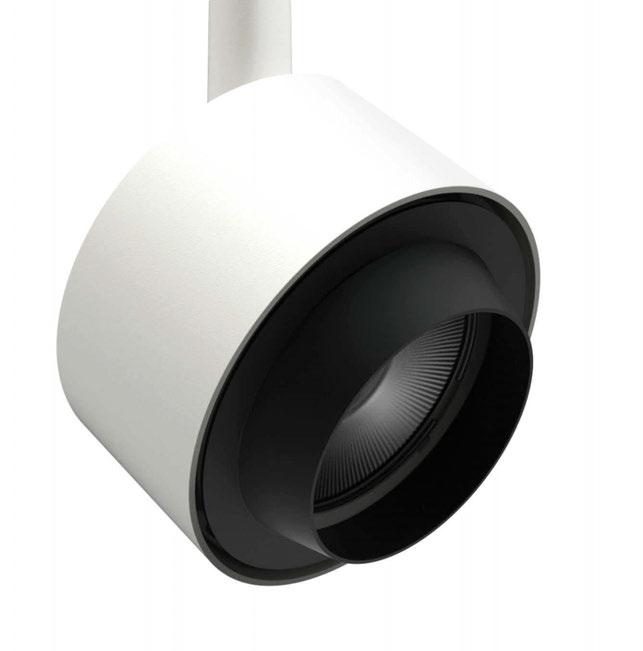

Quick-swap lenses for fast focussing Beam options 9º, 17º, 25º, 36º, 60º
Linear Spread, Colour Shift and Honeycomb Louvre


2174
98
Ø160mm 4200
98
Ø130mm
LUMENS
CRI
LUMENS
CRI
Flood
+44 (0) 207 278 1600 SALES@TMLIGHTING.COM TMLIGHTING.COM
LOCAL | PHASE | DALI
LEADING PERFORMANCE
FRIENDLY LIGHTING
Optic Wall Wash Optic
DIMMING:
INDUSTRY
CONSERVATION

The Samurai Museum Berlin, Germany
At Berlin’s Samurai Museum, lighting from corporate friends plays a dual role in presentation and preservation of the artefacts on display.
The Samurai Museum Berlin, established in 2022, is Europe’s premier museum dedicated to samurai culture. Featuring entrepreneur Peter Janssen’s private collection, it boasts more than a thousand artefacts, spanning the 8th to 19th centuries, showcasing the essence of samurai craftsmanship.
This class, rising from serving the emperor to Japan’s leading hierarchy in the 12th century, held steadfast to a code of honour. The museum delves into their lifestyle, art, and traditions, shedding light on their millennium-long impact on Japan. Interactive exhibits and temporary showcases further explore their cultural influence.
In museum displays, lighting plays a dual role in presentation and preservation. It enhances visibility and aesthetics while protecting artefacts from deterioration. Proper calibration of light intensity and exposure duration is crucial to prevent damage. A high CRI accurately displays artefact colours, crucial for visitor experience.
Lighting fixtures must seamlessly integrate into exhibits, requiring minimal maintenance and durable/stable materials. Flexibility in lighting control allows for highlighting specific features and accommodating diverse artifacts, essential for dynamic museum environments.
Selecting the right lighting system is pivotal for museum exhibits. corporate friends offers toptier solutions integrating innovation with elegant design. Its systems prioritise artefact protection, utilising advanced LED technologies with minimal light damage potential.
These products blend seamlessly into exhibit environments while offering customisation and scalability. Precise control allows curators/ designers to adjust lighting for each exhibit’s unique needs, underscoring the importance of adaptability in dynamic museum settings.
Lighting Designer, Victor Kégli, known for his artistic versatility, contributed to the Samurai Museum’s lighting project. His expertise with corporate friends lighting proved instrumental in customising solutions for each artefact, ensuring optimal illumination without unwanted shadows.
Kégli’s hands-on approach, including modifying fixtures with custom shading, showcased the system’s adaptability. The ease of adjustment and precision offered by corporate friends lighting was crucial for achieving nuanced lighting in the museum’s exhibits.
The lighting at the Samurai Museum Berlin epitomises the synergy between modern technology, good design and creativity, enriching visitors’ experiences. With advanced systems from corporate friends and Victor Kégli’s expertise, the museum’s lighting not only serves functional purposes but also enhances aesthetic appeal.
Interactive installations and innovative lighting techniques create an educational and captivating environment, making a visit to the museum truly memorable.
www.corporatefriends.de
case study
MUSEUM & CULTURAL LIGHTING 102 / 103
Image: David Brandt


UNITY Designed for the Designer THE AWARD-WINNING SINGLE SOURCE LED FLOODLIGHT BOLD BRIGHT COLORS + SEAMLESS COLOR BLENDING (RED, GREEN, BLUE, AMBER & LIME) HIGH CRI WHITES: 2500K-8000K 10,000+ LUMENS OUTPUT SCAN ME 2023 PIA AWARD RECIPIENT AcclaimLighting.com Inspire Illuminate STERLING VINEYARDS, CA Learn how the Unity showcases this magnificent property in wine country.

Palazzo Grassi
Venice, Italy
Part of an update to its lighting system, Erco’s Parscan spotlights bring subtle effective illumination to this Venice gallery’s extensive artwork collection.
Originally designed as a grand family residence in the 18th century, the classical Palazzo Grassi on Venice’s Grand Canal is now a prestigious centre for contemporary art in Venice. Famously renovated in 2005 by Tadao Ando, in 2023 it was brought completely up to date with a lighting system from Erco.
Palazzo Grassi became a venue for art exhibitions when owned by the Fiat Group. It was bought in 2005 by French billionaire François Pinault, owner of a contemporary art collection that includes more than 5,000 works by 20th and 21st-century artists. Ando’s subsequent renovation conserved the grandeur of the original 1772 palace, while equipping the building with modern facilities for displaying art across 5,000sqm of exhibition space.
As part of the François Pinault Collection, Palazzo Grassi features exhibitions from Pinault’s extensive art collection, as well as site-specific installations. It was recognised, 20 years after the restoration, that the lighting system needed a comprehensive upgrade. The key challenge was to achieve a flexible, high-quality solution while preserving the integrity of a historic building. The fittings chosen were Erco’s Parscan 48V LED spotlights, which were integrated with the existing simple suspended beam systems designed by Ando to preserve the integrity of the beautiful, ornate ceilings.
A compact and highly flexible spotlight system specifically designed for use in museums and galleries, the Parscan system offers precise, interchangeable light distributions and dimming capabilities. This enables optimal control and adaptability, crucial for lighting artworks that may
have a range of different lighting requirements.
The Parscan’s cut-back design also reflects Ando’s minimalist aesthetic. Its low profile allows focus on the artworks, not the fittings, and preserves the architectural integrity of the palace, blending seamlessly with the beams in the exhibition areas. The luminaires selected have a wall washing distribution. This produces a uniform illumination across a large surface, avoiding stark contrasts and shadows. Instead, the fittings subtly enhance the art by providing a soft, even light that allows the colours and details of the artwork to be faithfully rendered. Wall washing also contributes to the perception of brightness and therefore increases visual comfort. The fidelity to the appearance of the art is enhanced by neutral white LED sources at 3500K with colour rendering of CRI 92, ensuring that the colours are as true to life as possible.
The Parscan system features interchangeable, toolfree optics, which offer flexibility for both current and future displays. If artworks change or there are new exhibitions, the optics can be easily swapped out for different ones, without requiring a complete overhaul of the lighting system.
The Parscan spotlights are not restricted solely to the display spaces. Its flexible nature means it can also be used to light the magnificent marble staircase. With its precise light distribution and dimming capabilities, it not only creates safe navigation by ensuring clear visibility and no potentially confusing shadows. This creates a visually cohesive and aesthetically pleasing lit environment throughout.
www.erco.com
case study
MUSEUM & CULTURAL LIGHTING 104 / 105
Image: Marcela Schneider Ferreira

Through the Looking Prism
Bangkok, Thailand

Singapore-based lighting design studio, ambiguous, in collaboration with architectural designer Todo Takanao, has unveiled Through the Looking Prism, an immersive installation that examines the interaction of light and space. Launched for Bangkok Design Week, the Thai city serves as a backdrop for the piece, which exclusively harnesses ambient light in an impressive show of colour. Rejecting the conventional use of additional lighting sources, the piece showcases the transformative power of light in shaping the urban landscape, both during the day and at night.
The heart of the installation is a window adorned with a glass prism wall, meticulously designed to capture and refract the myriad hues of Bangkok’s nocturnal charm. Situated along the iconic Chao Phraya River, the structure offers a mesmerising interplay of light and shadow, capturing the essence of the city’s vibrant energy. As visitors approach, their silhouettes dance amidst the kaleidoscopic display, merging and splitting in an enchanting symphony of light and form. Each glass prism, meticulously crafted to pixelate and diffract the surrounding light, serves as a conduit
106 / 107 eye opener
for artistic expression, inviting viewers to contemplate the interplay between light, space, and perception.
Constructed with a sleek stainless steel frame, Through the Looking Prism stands as a beacon of innovation in sustainable design. The absence of additional lighting not only minimises energy consumption but also serves as a poignant critique of light pollution prevalent in modern urban settings.
Originally conceived for Bangkok Design Week, the installation is a testament to the boundless possibilities of light art installations. As it continues to captivate

audiences in Bangkok, the creators envision touring the installation to cities worldwide, sparking conversations and redefining the role of light in shaping our shared environments.
With its adaptable design and focus on sustainability, the installation serves as a model for future urban interventions, challenging conventional notions of lighting and space. www.ambiguous-light.com
Image: Swita Uancharoenkul

[d]arc sessions
The largest edition of [d]arc sessions to date welcomed nearly 200 delegates to the beautiful location of Tróia, Portugal, for three days of meetings, networking, and socialising.
There was a constant hum of positivity and excitement in Tróia, Portugal, this May, as a record number of lighting specifiers and suppliers travelled from across Europe for the sixth edition of [d]arc sessions.
By now an established, and incredibly popular fixture within the [d]arc media portfolio of events, the latest edition was held at the Tróia Design Hotel, on the picturesque Portuguese peninsula. Following a short, scenic catamaran ride, where attendees saw leaping fish and even the occasional dolphin, leading lighting designers and interior designers working within the European lighting specification market came to network and meet with a wide range of high-end lighting suppliers across three days.
The unique format of the event allowed specifiers to make essential connections with lighting suppliers through a series of quickfire, speeddating inspired, 20-minute meetings, where they could learn about the latest lighting products and innovations, discuss upcoming projects, rekindle existing relationships, and meet new brands.
Interspersed with the meeting sessions, delegates attended a small talks programme, in which panelists discussed the industry’s hot topics in a fluid, informal, manner. Topics covered included a
deep dive on maintaining specification integrity, an enthralling conversation on the value of design, and an examination on the ways in which designers can work together - both within their own teams, and across studios, and even international borders. An insightful keynote presentation from Light Collective around the topic of “Inspiration” also got attendees talking, and looking for inspiration for the rest of the event.
As with each edition to date, each day concluded with further networking opportunities in the shape of informal dinner and drinks receptions, where attendees could continue conversations from their earlier meetings long into the night. This event also saw the formation of the inaugural “[d]arc sessions Swim Club”, with several attendees braving the cold of the Atlantic Ocean for an “invigorating” postmeeting swim. Taking place again over UNESCO’s International Day of Light, delegates recreated something first done at [d]arc sessions Rovinj in 2023, spelling out the word ‘LIGHT’ for a special photo opportunity.
The next [d]arc sessions event will take place at Le Meridien Phuket Beach, Thailand, on 24-26 September 2024. www.darcsessions.com
108 / 109
Images: Gavriil Papadiotis


[D]ARC SESSIONS
[d]arc sessions Supplier Highlights
Ariel P IP67 DGA
The patented Plug&Play technology that characterises the products of the Ariel series has been developed for the interchangeability of LED light sources in the luminaires, facilitating and speeding up assembly, replacement, and maintenance operations of light sources within any indoor and outdoor project. The Plug&Play system offers the possibility to repair and replace the LED module at any stage of its lifecycle, minimising the waste of resources and materials. This technology redefines the lighting with an increasingly sustainable and circular perspective. www.dga.it
Expert Pharos Architectural Controls
Expert is a new lighting control range from Pharos Architectural Controls, designed specifically for the architectural lighting market. Expert fulfils the growing need for a practical, straightforward, and cost-effective lighting controller for DMX and DALI fixtures. Expert is an easy to specify, commission and programme lighting control solution centred around a single, reliable, setand-forget controller with simple configuration and guided programming. www.pharoscontrols.com
Shapes
Folio
Folio Shapes are thin, endless, luminous surfaces, totally customisable to designers’ imaginations. Just draw a shape and Folio will transform it in a uniform luminous surface.
Folio is perfect for light diffusion and decoration by cladding with marble or onyx, backlighting an image, a metal mesh or many other materials. UL listing available as standard on all ranges. www.folio.it
MIDI LINE IP68
LEDItaly
The MIDI LINE IP68 is a flexible linear lighting solution designed for harsh and wet environments, perfect for underwater installations. Built to withstand chemicals and salt, it ensures lasting performance in all submersible projects. This product offers unmatched durability and reliability. Use this underwater lighting fixture with confidence, knowing this solution is engineered to excel the toughest conditions, providing strength and solidity for any demanding application. www.leditaly.com
C1-micro-VL
corporate
friends
Elegant and refined, C1-micro-VL is meticulously engineered for museum and luxury retail settings. Crafted with museum-grade materials, its modular design offers unmatched adaptability. Each unit boasts up to four heads with 360° rotation and 90° tilt, custom dimming for each spot ensuring precise illumination. With a slender 8mm stem diameter and 14mm head diameter, it offers discreet yet powerful lighting. Superior light quality with a CRI typically of 97. Choose between single or double heads and explore a range of accessories for added versatility. www.corporatefriends.de
Highlighter Series GVA Lighting
GVA’s Highlighter modular linear lighting system offers direct-view and cove capabilities in colour-changing, dynamic white, and mono configurations. Built on the award-winning Color-Stream platform, it delivers communication speeds 16 times faster than DMX, pixel resolution as low as 100mm, and smooth dimming. Powered by ColorAmp and Infinity technologies, it excels in lumen output and circuit lengths up to 600 metres. www.gvalighting.com
Phantom Mesh
Vivalyte
LTwo can be transformed from a lamp into a luminaire using simple accessories and can be integrated into almost all materials and building structures. With the diameter of a cent piece, LTwo impresses with its discretion and simplicity. 13 optics from one form factor and an innovative, magnetic luminaire holder system make LTwo flexible to use and LED technology interchangeable. The lamp is selfretracting and so easy to install that professional lighting becomes a ready-to-go solution. www.apl.ag
The Phantom Mesh is a transparent, ultrathin, and lightweight LED display. With high contrast and very bright visuals, it creates immersive depth illusions perfect for advertising, exhibitions, or shop fitting. Easy to install and operate, the Phantom Mesh seamlessly blends into its surroundings, providing clear views without light pollution. Easy to install and operate, the Phantom Mesh lets users display immersive content while maintaining clear views of the surroundings. www.vivalyte.com
Kumux Platform
Kumux
Kumux Platform is cutting-edge software that optimises dynamic lighting in architectural spaces by bridging the gap between the control system and the lighting fixtures. The software supports creating and automating illuminance and colour temperature settings throughout the day based on scientific principles to ensure users’ well-being. Kumux applies AI algorithms to customise lighting to the project geolocation, space type, international circadian guidelines, and the project luminaires spectrum. www.kumux.io
Flex Tube Wellness
Proled
From the tropics to the Arctic: the Proled Flex Tube Wellness is your safe companion in areas with large temperature fluctuations. Whether spas or façades: The Flex Tube with IP67 protection class prevents moisture ingress, not least thanks to its molded end caps, and offers consistent light intensity even at high temperatures. Available in 2200K, 2700K, 3000K and RGBW, it is adaptable individually up to a length of 10-metres. www.proled.com
Hero
Glint Lighting
Hero is a linear luminaire adjusted via an integral joystick, changing the direction of its light while the fixture remains in a fixed position and orientation. Following the lines of the space, Hero can provide flexible illumination with up to 40° of beam adjustment. Since Hero does not need extra room to move, it fits into tight spaces where no other adjustable luminaire can go. Since Hero does not tilt or swivel to adjust its beam, it does not cast harsh glare onto neighbouring fixtures, inside recesses and slots, nor up into your eyes. www.glintlighting.com
D 100 WE IP66
Radiant Architectural Lighting
The Radiant D 100 WE IP66 is a DMX controlled, dynamic LED effect lighting projector for use in a wide range of exterior architectural and landscape lighting applications. Customisable decorative lit-effects are created from a light engine incorporating multiple colour temperature and colour LEDs, complex DMX controlled dimming sequences, and textured glass optics. Lumen output is up to 600lm. A variety of mounting accessories including tree-strap, ground spike and custom brackets are available. www.radiantlights.co.uk
LTwo APL
9 4 3 10 2 5 7 11 1 6 8 12
110 / 111

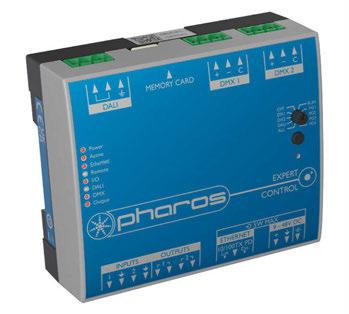


A closer look at some of the products and innovations that were brought to [d]arc sessions by our attending suppliers.


1 2 4 5 6 7 8 9 10 11 12 3 [D]ARC SESSIONS SUPPLIER HIGHLIGHTS

Timeless Lighting
Afonso Almeida, lighting designer at Light Bureau, offers a poetic take on the importance of finding the right placement of luminaires.
It’s fascinating how some luminaires are mounted in the right place. From time to time these luminaires may need an overhaul, upcycling or to be replaced but they remain in their original position. From a sustainable point of view, this is a responsible way to build. If the placement is correct, changes to the infrastructure are avoided. This is an example of good use of natural resources and labour. It is designed to last.
Cave Lighting
This picture presents an evening scene where a primitive human intentionally places a light in the wall, marking a potential first gesture of architectural lighting. The scene helps us pay attention to lighting design when reduced to a set of tools that man had at that time. An exercise of imagination to recreate the plot and try to understand how a placement that has lasted for ages can still work admirably today.
So, imagine a person walking around the cave with the torch in their hands searching for a unique position. This exploration of light and shadows unveils textures, colours, shapes, and keeps going until they find a specific spot in the wall and set the placement.
As in any construction site, the best of luck will offer a drillable surface to drive the nail in deeply. Also, mind a spot not affected by water leaking, with easy access for maintenance and refuelling, which happens often in this case. Modern times challenge us with similar problems despite using another energy source. For example, the location of the luminaire will affect, or be affected by, the layout of the electrical supply route.
Once the torch is lit, the room is transformed into a particular appearance. Regardless of the lighting principle chosen, which can be of any type, those that are installed were the ones that had to deal with all the struggles. They are those that were possible with the available means.
The cave was likely used as a shelter, a military position, a place for holiness, or an archaeological site. Even though the activities inside the cave
have changed over time, this didn’t challenge the placement of the torch. The light did its job regardless of what happened inside the cave or by whom. It is a case of a lifelong lighting scheme where the placement is king.
For sure an ambience with variation and different layers tends to be more attractive. Without any intention of preaching for a lighting scene based on just one position or going to the most effective solution, this imaginative exercise is in search of a lighting element that defines a given space and therefore can last longer.
Outside the Cave
Designing to last is a way of thinking that focuses on things that don’t change. It’s a different approach than a project that seeks innovation or follows a trend. The result is not necessarily boring. It depends on what is being evaluated. If the intention is to minimise environmental impact, then it is great to reduce resources over time.
Perhaps we must re-educate ourselves to evaluate attributes based on other parameters. Then our eyes will perceive these projects as stunning.
PS. To be fair, the torch is the second source of light due to the clarity, warmth, and glow coming from the fireplace, which must be considered the first. A reminder indicating that the need for additional light has come solely after hunger and cold were solved… www.lightbureau.com
COMMENT AFONSO ALMEIDA 112 / 113


The Value of Mentorship
In this issue, we hear from a selection of past mentors in the Silhouette Awards programme, who share their thoughts on the importance and value of such mentor-mentee relationships. SILHOUETTE
The mentors play an integral role in the esteemed Silhouette Awards initiative. Covering all corners of the globe, these hugely experienced and wellrespected designers are not only responsible for selecting the 20 winning mentees for each year’s programme, but they also participate in a sixmonth mentorship programme with their paired mentees.
Mentors team up with a chosen mentee to share their knowledge and experience, helping to support rising talent in the lighting industry and create a supportive platform for inspiration and growth. Over three years of the Silhouette Awards, there have now been 60 mentor-mentee pairings who have worked together to grow their careers. We asked Silhouette mentors from all three years to discuss what mentoring means to them and why they believe that mentorship is so important.
Chip Israel, a year three mentor, said: “It’s because it is the right thing to do. We need to teach the next generation in lighting to “see.” My mentee Anne is great and talented, and it has been wonderful to learn about her and her journey. We meet every two weeks to discuss life, management styles and even her upcoming presentations, all focused on building her confidence to equal her expertise.”
In the dynamic world of lighting design, mentorship is an incredible opportunity to nurture talent and foster innovation. Through the Silhouette Awards, mentors stand as pillars of support, who have the ability to shape the future of the lighting industry through their wealth of experience and expertise.
Beata Denton, a mentor from year one said: “One shouldn’t ever underestimate the importance of sharing or asking for advice. It’s vital for a rewarding and successful career. Learn that early on and you will never feel alone; you will be braver and find more joy in your career. The world gets both bigger and smaller when one is part of this mentorship programme.”
Spanning geographically across continents, the mentors play a pivotal role in a transformative
six-month mentorship journey with their mentees. These partnerships extend far beyond mere guidance; it’s a symbiotic relationship aimed at propelling emerging talent to new heights.
Rachel Fitzgerald, a dedicated mentor from this year’s programme, tells us what it means to her to be involved: “Mentorship for me holds such significance: it fosters a powerful exchange of knowledge, creating a communal space for growth and development that benefits both the mentor and the mentee.
The very essence of mentorship lies in the profound exchange of knowledge and wisdom. Mentors, with their seasoned insight, can collaborate closely with their mentees, imparting invaluable lessons gleaned from years of practice. This is showcased by Arianna Ghezzi, as she reflects on her collaboration last year with her mentee: “We set a goal for the mentorship, which was entering the LIT Lighting Design Awards and it was a great achievement for Jess to win in her category! I could not be more proud of her incredible achievement and this wonderful mentorship journey where we have grown together side by side.”
We also asked mentors to reflect on some standout moments that they have had with their mentee that showcase why mentorship is so crucial.
Neha Sivaprasad, a supportive year three mentor, said: “One standout moment during our interaction was when I shared with my mentee my own apprehensions about starting my own practice, despite several years of industry experience. We delved into how I overcame those fears and how I leveraged my accumulated experience to tackle challenges. It was enlightening to realise that, despite our different career stages, we shared similar feelings. Expressing how I overcame my challenges not only helped me articulate my achievements but also uplifted me and provided hope and reassurance for my mentee.
Siddharth Mathur, a year two mentor, continues: “My mentee had primary experience working as a decorative lighting designer, which was very different to my experience of architectural lighting
AWARDS 114 / 115



design. But it was so interesting to see how worlds overlap, I was able to offer some advice based on my experience of building a brand.”
In addition to mentorship, feedback and open, thought-provoking conversations play a pivotal role in the growth of emerging talent within the Silhouette Awards.
Maida Hot, a mentor from year two, emphasises the importance of giving back to the profession: “We all received training at various points in our careers. Someone generously gave their time to mentor us. Lighting education extends beyond formal channels; it’s about passing on our knowledge generously to the next generation, thus strengthening our profession.”
Kristina Allison, also an enthusiastic mentor from year two, reflects on the reciprocal nature of mentorship: “The mentor/mentee journey is crucial for both parties involved. A career is a journey of continual learning and growth. Meeting my mentee made me realise the depth of this journey and how much I, as a mentor, gained from the process.”
Finally, a comment from a current year three mentor, Maria Dautant who said: “Sharing what we have learned throughout our careers


helps us improve and promote our industry, as we are able to pass on our lessons learned to the future generations and see them improve on them.
“From the point of view of a mentee, mentorship greatly helps in the learning process and it is a useful guide to young designers in setting goals that will take them, just a bit faster, to where they want to go in their careers.”
Through these relationships and pairings, mentorship becomes a catalyst for growth, innovation, and the perpetuation of excellence within the lighting industry.
The Silhouette Awards is a collaboration between Parrot PR & Marketing and Archifos.
Eve Gaut, Silhouette Awards Co-Founder, Parrot PR & Marketing, commented: “We could not be more grateful to our supportive and dedicated mentors. As the awards grow each year, it is a wonderful collective achievement to see another 20 young designers benefit, progressing their careers and developing the future of the industry. We have seen a lasting impact from the past two years at how the mentorship journey has made a huge difference to our mentees.”


Katia Kolovea, Silhouette Awards Co-Founder, Archifos, added: “As the pool of mentors grows larger and reaches further around the world, we are proud to see how everyone is connecting and supporting each other. It is inspiring to see how our passionate mentors want to continue to benefit the industry. This year’s winners equal 60 young talents so far who have been nurtured, making a massive impact on the future of the industry.”
Applications for new-season mentors are now open, and close in August. If you would like to be a valuable part of someone’s design journey, find out more about becoming a Silhouette Awards Mentor on the Silhouette Awards website. www.silhouetteawards.com
SILHOUETTE AWARDS

Coqodaq
New York, USA
Four years in the making, Coqodaq (an onomatopoeia for “cock-a-doodle-doo” in Korean) is a new fried chicken concept from Korean-American restaurateur Simon Kim. Located in New York’s Flatiron district, the restaurant is helmed by executive chef, Seung Kyu Kim.
Inspired by Simon Kim’s desire to create a “modern cathedral for all things fried chicken”, Rockwell Group has infused the dark, luxurious dining room with touches of Art Nouveau, custom furniture, and dynamic, highly strategic lighting throughout. The material palette features hunter green leather, dark walnut wood, architectural lighting, champagne glass, soapstone, bronze, and glowing lacquered panelling. Light is a material here, layered and choreographed to emphasise the textures and colour of the food and the unified organism that is the audience. The palette was driven by a desire to surround guests in an envelope of warmth, creating an inviting environment that changes in tonality and mood from day to night, and is a joyful place to be at any time.
On entering the space, guests are greeted in the restaurant by a handwashing station in green soapstone with a leathered finish and bronze Italian fixtures. An inset concrete “carpet” below further delineates the space. This completely new hospitality element creates a beautiful moment of respite and transition from the busy street; is an offering of convenience for guests who are about to embark on a sensory dining experience; and simultaneously, heightens the sense of ritual and splendour that awaits.
The station is surrounded by 180° of edge-lit, blacktinted mirrors. An inset warm bronze mirror bathes guests in a flattering, luminous glow. Lights inspired by the restaurant’s ovoid logo are mounted to the mirrors for a dramatic infinity effect.
Beyond the handwashing station, an informal and communal dining area features a first-come, firstserved custom communal table made of wood and concrete, plus high tops and mutable, movable furniture pieces for easy transformation. This highenergy space connects to elevated outdoor dining through operable garage-door style windows, and serves as the restaurant’s welcome sign – a vibrant area where guests can visit for any length of time. The intimate dining room has an added layer of luxury and liveliness, and is dominated by a bar and custom Hollywood banquettes. The dining room’s runwaylike circulation is rhythmically marked by a series of “ghost” arches made of lit cast glass and bronze metal connections – a typically architectural intervention rendered here in light, instead, and casting a sparkling glow on diners and food. Theatre lights on the sides of the banquettes that face the walkway create additional drama. A mirrored wall at the end of the room creates an infinity effect, and a horizontal band of black-tinted mirrors and integrated lighting frame the back of both rows of banquettes, creating a datum line and further reflecting the activity of the restaurant. www.rockwellgroup.com
116 / 117 eye opener
 Image: Jason Varney for Rockwell Group

Harmonising the way to Lighting EPDs
In this issue, members of the GreenLight Alliance and LightingEurope discuss the latter’s work with PEP Ecopassport on LCA PSR0014 ed.2, and how it will impact the lighting industry.
Those of you who have been following the GreenLight Alliance’s journey since we set out our objective to “…work together to help everyone in the lighting sector understand their role in adopting and promoting the circular economy, working towards industry standards that are universally recognised, trusted and sought-after”, will be as excited as we are to learn of LightingEurope’s work with PEP Ecopassport on LCA PSR0014 ed.2 and its recent advocation of it as the preferred methodology. Could we finally be looking at the beginning of true harmonisation? In this issue some of the team involved in the process kindly took the time to share their thoughts with us.

Introduction
Dr Irene Mazzei - Stoane Lighting, Sustainability Lead Recently, decarbonisation and sustainability goals have been at the forefront of most companies’ business strategies to meet Net Zero and other sustainability targets. Products belonging to the Mechanical, Electrical and Plumbing (MEP) sector have been found to account for a substantial proportion of the total embodied carbon emissions of buildings, with contributions between 15% and over 70%, depending on the type of building [1], [2]; the proportion of impact associated with lighting within MEP is generally minor, but can also vary greatly across building categories. The significance of the environmental impacts of MEP products is not only evident for embodied carbon, but also considering other environmental impacts. However, the availability of environmental impact data of MEP products is scarce, especially in the form of Environmental Product Declarations (EPDs). Recent statistics from OneClick LCA reported that MEP products only account for 3% of their entire construction product-EPD database [3]. Regarding lighting products, despite progress being made, the results are also often obtained following varying methodologies, assumptions and Life Cycle
Assessment (LCA) approaches, ultimately undermining the possibility to compare results for decision-making.
A recent study carried out applying LCA rules from four different European EPD programmes to the same product (a triple glazed window) returned results which varied by more than 10% from a baseline scenario [4]. This variation was significant and dependent on the modelling differences contained in the Product Category Rules (PCR) provided by each EPD programme. Therefore, the conclusion was that, despite these results all being valid (i.e. they were all obtained applying legitimate rules), the impacts calculated for the same product were ultimately not comparable.
Considering the complexity of MEP products one can speculate that the variations associated with different rules and assumptions will be even more profound: how can the lighting industry model complex electronic systems with compatible and aligned energy-consuming use scenarios and waste treatment of multiple materials contained in the same product? In this context, the definition of a harmonised assessment procedure that can be used for lighting product LCA and EPD publication would provide the necessary conditions to ensure comparability of EPD data.
With this in mind, LightingEurope [5] decided to endorse and support the efforts of French programme operator PEP Ecopassport [6], focused on the update of its Product Specific Rules (PSR) for luminaires [7]. This was achieved through a LightingEurope-led task force, which had the objective of identifying relevant and necessary changes to make to the first version of the PEP Ecopassport luminaire PSR. This article will provide an overview of these changes and illustrate how this initiative contributes to support the advancement of harmonisation of LCA practices in the lighting industry.
ALLIANCE 118 / 119
GREENLIGHT

The success of PSR0014 ed.2
Dee Denteneer - Signify, Chair of LightingEurope Task Force for PSR0014
In a recent public statement [6] LightingEurope endorsed the PSR 0014 Edition 2.0 “Product Specific Rules for luminaires” issued by the PEP Association as a comprehensive and mature set of rules fit to address the diversity of luminaires. The endorsement followed a period of intense collaboration between LCA experts in the PEP Association and lighting experts in LightingEurope, aimed at improving the strong foundation already provided by an earlier version of this PSR. The PSR was subsequently reviewed by independent experts and published by the PEP Association in July 2023.
The key elements considered for the endorsement were: definition of the Functional Unit, product families and the improvement of comparability achieved by the inclusion of default scenarios.
The Functional Unit is defined in the ISO 14040 standards [9], as “the quantified performance of a product system for use as a reference unit”. According to the standard, the Functional Unit provides a reference to which the impacts are related, which is an essential prerequisite for comparability of LCA results.
PSR0014 introduces the Functional Unit for luminaires as “Providing lighting that delivers an outgoing artificial luminous flux of 1,000 lumens during a reference lifetime of 35,000 hours’’. In the EPD, the impacts expressed at the product level (i.e. according to the actual luminous flux and lifetime of the luminaire) can be normalised to the Functional Unit level, therefore supporting the comparison of impacts from luminaires with very different luminous flux and/or lifetimes.
Comparison is further supported by the
introduction of default scenarios. The actual environmental impacts of lighting products depend on the application setting, which is often not known at the product level.
Considerations here are the country of use, but also the ambient lighting conditions, building use and building layout. For EPD practitioners to model such application settings in proprietary ways would increase the modelling workload as well as the verification effort. This would also induce variations in the calculated impacts that are due to modelling assumptions rather than actual product differences. These, potentially arbitrary, variations will invalidate any comparison of product differences.
The PSR therefore standardises default scenarios that can be used instead of the actual application settings, intended as conservative “average case” scenarios, preventing that manufacturers model these settings in mutually inconsistent ways.
The PSR describes many standardised scenarios. A very important one relates to the use stage and specifies region of use and energy mix to be used in the calculations. The PSR also provides scenarios to account for lighting controls. Others relate to (regional) packaging, recycling practices and transportation distances in installation and end of life stage.
Another important topic considered in the PSR is product families. Luminaires are usually offered in product families with, for example, varying luminous flux and colour temperature. Some families comprise a few product types; configurated luminaires typically offer several more products within the family category. The environmental impacts may vary considerably within a given luminaire family; it is scientifically valid to extrapolate impacts from a reference product based on an isolated variation of a specific aspect consistently across the family (e.g. luminaire power). The
PSR0014 therefore defines luminaire product families and ways to extrapolate the impacts within the family. This may serve to avoid the costly overhead to create EPDs for single products in a family.
After the publication of PSR0014 by the PEP Association, LightingEurope temporarily remained silent on the topic, enabling members to evaluate the rules and to create conformant EPDs. The experiences collected during this period allowed an evaluation of the fit of the rules to the wide product portfolio of the members as well as the feasibility of implementation of the rules. This evaluation led to the conclusion and the public statement that the PSR is providing a viable tool to deliver more comparable information on the environmental impact of lighting products in a cost-effective way.

Harmonisation progress: an overview
Elena Scaroni –LightingEurope, Secretary General
The delivery of comparable and verified sustainability information is vital for any industry. Failure to harmonise around product-specific rules will lead industry sectors to produce inconsistent results, as illustrated in the introduction: this equally holds for lighting products.
Achieving harmonisation with a global reach, requires further effort beyond the publication of the PSR0014. LightingEurope has agreed on a programme both to promote the adoption of the rules, to address topics not yet covered by the PSR0014, and to drive international standardisation of the rules. Promotion takes place through the regular channels of webinars and presentations, see e.g. [10], and through collaboration in the Global Lighting Association. These efforts aim to create awareness and foster global

alignment. LightingEurope also supports the programmes of mutual recognition agreements between Program Operators for EPDs aligned with PSR0014. Promotion also involves facilitating the work of EPD practitioners, with LightingEurope leading roadmapping projects to establish guidelines to ease the use of PSR0014 and may also investigate software and databases to facilitate calculations and further improve comparability.
Driving harmonisation also involves extending the rules to other lighting-related products such as control gear and light sources. Customers will also want to compare drivers and light sources for environmental impacts. To enable these comparisons, at least Functional Units must be defined for these products, as well as default scenarios, such as for energy consumption.
Rules for drivers and light sources will facilitate luminaire manufacturers in the development of luminaire EPDs. Indeed, drivers and light sources generate major impacts in a luminaire’s life-cycle, yet, luminaire manufacturers will not generally have access to the information to model these impacts accurately. Publication of component EPDs, driven by the availability of product specific rules, will help luminaire manufacturers with their EPDs. A bonus advantage for the component manufacturers is that product impacts can be published in a standardised way, and overheads due to the requirements of proprietary impact models can be avoided. The luminaire manufacturers can add the impacts of the component EPDs
to the impacts from their own operation. With this in mind, LightingEurope has launched a Task Force to develop Product Specific Rules luminaire components, focusing on drivers and light sources. The Task Force started at the end of 2023 and aims to provide product specific rules for drivers by mid-2024 and for light sources by the end of 2024. These will then be offered for adoption to interested Program Operators.
Some of the topics handled in the PSR0014 are global. However, at least some of the default scenarios are European-centred, such as default scenarios for the use stage (as PSR0014 mandates calculations based on the European energy mix), waste collection and recycling, packaging and distribution. These may vary among the regions and default scenarios should reflect such variations.
To help with the development of scenarios reflecting regional differences, LightingEurope actively interacts with organisations aiming to develop Product Specific Rules for luminaires, for example SmartEPD in North America. The aim is to the keep a common core, while extending the rules with necessary regional variations.
At present, a lot of activities are ongoing in different regions, which is essential to create truly global product specific rules for all lighting products as well as for consensusbuilding purposes. However, LightingEurope firmly believes that it is better to eventually consolidate the rules centrally. LightingEurope has therefore initiated and backs the programme started in IEC TC34 to standardise a PSR for luminaires.
Manufacturers’ feedback
By LightingEurope member manufacturers:
Stoane Lighting, Signify, Erco, Ledvance In this section, manufacturers using PSR0014 will share their experiences, what they have learnt in this process and how they communicate the results to customers.
Stoane Lighting: Stoane Lighting was an active member of the LightingEurope task force TF PEP Ecopassport working on the update to the luminaire PSR (PSR0014), as we recognise the power and importance of strengthening and harmonising LCA practice in lighting. Stoane Lighting has been on a two-year journey to build in-house LCA capability and is working on its first EPDs.
Stoane Lighting recognises the value of producing this information for stakeholders outside the business, but is also using LCA as a means to assess products and processes, with the aim of creating a company impact assessment ecosystem that empowers lower-impact design and decision-making.
Signify: Signify has recently announced the results of a substantial drive to create Environmental Product Declarations (EPDs). As a result of this effort, it has released 2,000 EPDs, covering more than 70,000 product variations around the world, which were created considering the methodology underlying PSR0014. Municipalities, businesses, and individuals are increasingly looking for fast, effective ways to reduce their environmental footprint. EPDs quantify products’ environmental impact over their full life cycle, empowering customers to make informed decisions on lighting investments. In
GREENLIGHT ALLIANCE 120 / 121
 Outline. Redefine the Ordinary.
The modern light column, artfully designed and meticulously crafted.
Designed by Landscape Forms
Landscape Forms | A Modern Craft Manufacturer
Outline. Redefine the Ordinary.
The modern light column, artfully designed and meticulously crafted.
Designed by Landscape Forms
Landscape Forms | A Modern Craft Manufacturer


Graphic representation of the concept of the Functional Unit as a standard performance unit (left), useful to represent and compare the impact based the scope fulfilled by a luminaire, regardless of their specific performance (centre); example of default application scenarios for luminaires, which would impact the use stage of the product (right).

References
1. LETI, “LETI Embodied Carbon Primer,” 2020. [Online]. Available: www.LETI.london
2. Phanos Hadjikyriakou, “MEP Embodied Carbon: The elephant in the room, roof and basement… | 2050 Materials.” Accessed: Mar. 07, 2024. [Online]. Available: https://blog.2050-materials.com/mep-embodiedcarbon-the-elephant-in-the-room-roof-and-basement729257f5cb96
3. “One Click LCA.” [Online]. Available: https://www.oneclicklca.com/
4. F. Konradsen, K. S. H. Hansen, A. Ghose, and M. Pizzol, “Same product, different score: how methodological differences affect EPD results,” International Journal of Life Cycle Assessment, vol. 1, pp. 1–17, Dec. 2023, doi: 10.1007/S11367-023-02246-X/FIGURES/5.
5. “LightingEurope.” [Online]. Available: https://www.lightingeurope.org/
6. “LightingEurope.” [Online]. Public Statement on PSR rules for luminaires. Available: https://www.lightingeurope.org/
7. “PEP Ecopassport.” [Online]. Available: http://www.pep-ecopassport.org/
8. PEP Ecopassport, “PSR-0014-ed2.0-EN-2023 07 13Specific Rules for Luminaires.” 2023.
9. ISO 14040:2006 Environmental management — Life cycle assessment — Principles and framework.
10. LightingEurope: Presentation of the LightingEurope Strategy towards 2030, Light + Building, 2024.
11. https://www.ledvance.de/00_Free_To_Use/ asset13079437_white_paper_globalwarmingimpact_ luminaires.pdf
12. https://register.pep-ecopassport.org/pep/consult
This series is curated by Dave Hollingsbee of Stoane Lighting, dave@mikestoanelighting.com
addition to driving greater transparency for customers, EPDs are advancing evidence-based sustainable innovation within Signify, providing a quantified footprint that acts as a baseline for further improvements in next generation product iterations.
Erco: Erco is renowned for producing highly durable luminaires. The LCA, and in particular PSR0014, provide a robust foundation for globally recognised communication and documentation standards required for sustainable lighting solutions. Its involvement in the revision of PSR0014 has given us a deep insight into the underlying methodologies. Since January 2024, Erco has been offering detailed EPDs to help project developers in various sectors to take advantage of the benefits of long-lasting products. This approach not only promotes transparency, but also enhances sustainability by providing a single view of environmental impact. With this in mind, Erco is streamlining workflows by incorporating the GWP data from the EPD directly into the specification sheets of relevant products.
Ledvance: Ledvance has contributed to and advocated for the innovative PSR0014 standard for luminaire EPDs in collaboration with Lighting Europe and the PEP Association since the beginning. Ledvance is convinced that this methodology is the right approach to enable comparison between products internally and externally with regards to their environmental impact. Ledvance conducted its own internal evaluation, resulting in a white paper that validates the applicability and reliability of this standard [11]. Ledvance has already published numerous externally-verified EPDs according to PEP PSR0014 standard, publicly available in the PEP database [12]. Ledvance is fully convinced that the PSR0014 standard is the right one for the lighting industry and will continue publishing more EPDs according to this standard moving forward. The learnings gained from these EPDs will be leveraged to design even more environmentally-friendly products in the future.

Challenges and next steps
By Dr Irene Mazzei - Stoane Lighting, Sustainability Lead
A background made of robust and consistent LCA rules is the first, necessary step to reach a harmonised LCA practice within the lighting (or any) sector. Being able to capture all aspects of products in LCA, consistently across different manufacturers and different regions, is fundamental to make sure that the results we obtain are valid and comparable.
Despite this, efforts are still at risk if a suitable market infrastructure is not there to welcome them. This means more accessible ways to produce and publish EPDs, but also making sure that the results are used correctly. EPDs contain detailed information about environmental aspects of products; in a previous article curated by the GreenLight Alliance for arc magazine (issue #139), we provided an overview of different impact indicators, commonly found in EPDs, with their respective meanings and how luminaires can contribute to impacts in each of them. It is important that end users of EPDs are familiar with these concepts and know how to read results and apply them in their projects.
It is also critical that, if EPDs are used with the ambition of aiding specification decisions, care is used when comparing environmental impacts. Some of the questions to ask ourselves during this process are: are these results reported for the functional or the declared unit? Which scenarios have been used to model the use-stage? Was the same PCR used – or are the PCRs aligned?
Another aspect to consider when evaluating LCA/ EPD results is that they can carry uncertainty, based on the data used to produce them. Therefore, it is important to acknowledge data gaps and identify ways to fill them by collaborating with the whole supply chain, for example with alignment between initiatives at product level and component level.
GREENLIGHT ALLIANCE
122 / 123


Product Launches

Panoray Free Bend Wall Washer Clear Lighting
Experience the unparalleled flexibility of the Panoray Free Bend Wall Washer. This innovative fixture effortlessly molds to every unique shape and curve, delivering a flawless, even illumination across any surface. Eliminate unwanted shadows and uneven lighting with precision-crafted lenses that offer both narrow and wide beam options. Customise your ambiance with a variety of colours, ensuring perfect lighting for any setting. www.clearlighting.com


TM Gallery130
TM Lighting
The TM Gallery130 (G130) spotlight is a high-performance LED track spotlight for museums and galleries. It provides 98+ CRI high colour rendition and quick-change lenses (9º, 25º, 36º, 60º, linear spreader) to vary the beam width easily. Filters to vary the colour temperature are also available. Adaptable to changing displays, the G130 features local dimming for precise lux control. Additional dimming options including phase and DALI. www.tmlighting.com
The Focus Micro, one of the most compact, fully equipped zoom fixtures available. It is only 48mm to 66mm high, about the size of an AA battery, has a zoom range from 6 to 90º, and is available in a surface-mounted, magnetic, extended, and track version. Apart from that, it also features a CRI of >95, various colour temperatures and a wide range of control methods. Its size makes this fixture virtually invisible and unobtrusive, without compromising on functionality. www.cls-led.com
Northport Collection Landscape Forms
Northport Collection lighting by Landscape Forms and Robert A.M. Stern Architects pays homage to traditional street lighting, offering a warm connection to the past while performing and feeling at home in the now. Including a path light and multiple area light configurations, Northport luminaires offer designers the resources to authentically programme modern traditional outdoor spaces ranging from charming streetscapes, to historic downtowns, to parks and promenades. www.landscapeforms.com
Honeycomb Silicone Flexible LED Wall Grazer
Olympia Lighting
The SFW20 is the world’s first Honeycomb Silicone Flexible LED wall grazer. The unique honeycomb structure provides even light distribution, effectively reducing glare, and offers precise beam control. This product not only boasts an impressive IP68 waterproof rating and 3D bending installation, but also offers a variety of colour and lens options, allowing you to easily create the desired lighting effects, making it an ideal choice for various lighting applications. www.olympialed.com
Globe Series MaxiLED
The MaxiLED Lighting Globe Series provides exceptionally long strands of Globe-lensed LEDs that can be used to outline buildings and bridges or connect architectural features with controllable RGBW lighting or static colours. Each strand is built for permanent installations, featuring rugged, injection-molded outer globes, heavy gauge wiring, and dependable high-end LEDs. These features ensure durability and reliability, making them ideal for various architectural lighting applications. www.maxiledlighting.com
Focus Micro CLS
3 4 1 5 2 6 1 2 4 5 6 3
124 / 125

Contemporary lighting solutions designed to enhance the beauty of outdoor spaces while also meeting the needs of both people and the environment Lighting designed for places and people
dwwindsor.com
Exchange Square, Broadgate Lighting Design: Speirs Major Product: Pharola Max
Please contact Radiant for product information, to see demo samples, or for a presentation.

Oman Across Ages Museum, Manah, Oman. Lighting design by Adam Grater, DHA design. Project Image Credits: Squint/Opera. Radiant’s 3D LED Flex 100 System IP20 is shown installed within an elliptical floor recess, providing an ambient uplight effect onto a replica of an ancient Magan ship.

www.radiantlights.co.uk | +44 ( 0 ) 208 348 9003 | david@radiantlights.co.uk | London, N6 5JW | All products designed by 3D LED Flex 100 System IP20. Modular, 3D Flexible, high-output, interior LED linear lighting system. 28x medium power LEDs per 100 mm module. Up to 12,000 Lumens per mtr. This system and other Radiant systems are installed in several locations throughout the 300,000-square-meter museum.
Advertisers Index
enquiries should be made to Jason Pennington. Tel: +44 (0) 161 464 4750 email: j.pennington@mondiale.co.uk
ad June
2024.indd
06/06/2024 12:36:41 Acclaim Lighting 103 ACEVEL 012 ADO Lights 097 Bega 069 Clear Lighting 123 CLS-LED 008 corporate friends 057 [d]arc sessions 014 dpa lighting consultants 128, 129 DW Windsor 125 ELS 013 Erco 067 Feelux 073 formalighting 027 GVA Lighting 045 IALD 127 Intra Lighting 033 KKDC 025 Landscape Forms 121 LED Linear 132 LEDFlex 004, 005 LEDiL 095 LEDItaly 083 LiGHT 24 131 Ligman 049 LITE 002 Lumascape 003 Luxam 087 MP Illumination 123 Olympia Lighting 010 Pharos Architectural Controls 006, 007 Platek 017 Precision Lighting 079 Proled 019 QU Lighting 009 Radiant Architectural Lighting 126 Recolight 011 Stoane Lighting 081 TM Lighting 101 Vivalyte 105 Wibre 099
arc
- July
1
Advertising

IALD ENLIGHTEN AMERICAS 2024
17 - 19 OCTOBER · SAN DIEGO, CA, USA
EA24 is the crown of the architectural lighting design industry’s leading conference series, offering a comprehensive and enriching experience for hundreds of attending professionals from around the world.
Gain insight into emerging trends, technologies, and methodologies. Enhance skills and spark creativity through dozens of workshops, seminars, and presentations by thought leaders and prominent designers. Join peers in recognizing and celebrating innovation and excellence at the 41st Annual IALD International Lighting Design Awards live presentation.
Held in the warm, inviting Rancho Bernardo region of San Diego, IALD Enlighten Americas 2024 will be another unforgettable and enriching conference experience.
Spend three days with the IALD and the lighting design community’s brightest. Let the IALD Enlighten Americas 2024 experience #SparkInspiration within you.
Registration opens this month at iald.org/ea24


We have the following positions available within our Oxfordshire, London and Dubai studios: Senior Associates - Associates - Senior Lighting Designers www.dpalighting.com
Career Opportunities
Photography: “The Dancing Trees of Sumba” by Vikas Chander dpa lighting consultants

Christine Sicangco & Jovi Gonzaga
Christine Sicangco Lighting Design

What
Firefly watching in the mangrove rivers of the Philippines, via a banca.
Where
Philippine mangrove rivers (Sicaba River, Manapla, Negros Occidental/ Maasin River, Siargao/ Donsol, Sorsogon, Loay River, Bohol, Iwahig, Palawan).
How
Take a “banca” (a small traditional native dug-out canoe) at dusk till dark during the new moon – a banca is the quietest way to glide into the mangrove rivers in the dark so as not to disturb the fireflies in their habitat as any slight change in their environment, like noise or light, affects them.
When
As the fireflies lay eggs at the roots of the mangrove, it is best to watch them from December to January, when the mangrove trees are in full bloom and best during the new moon, when the skies are dark.
Why
Aside from the magical phenomenon of seeing fireflies, there is a pressing need to spread awareness to protect and conserve the fireflies and the mangroves of the Philippines and worldwide.
www.csldi.com
“Fireflies are like small ounces of magic.”
bucket list #40
curated by
Haliegh Kemmerly, Winston Narwhal and the First Wish
130 / 131

Save the Date 20 & 21 November 2024
Join us at LiGHT 24, the UK’s only trade show dedicated to high-end lighting specification.
For those working in design, it’s the best opportunity in the UK to explore new products, access design talks, and network with those across the sector. Now into its third successful year, LiGHT 24 will take place at the Business Design Centre in London. Join thousands of other industry professionals for a fantastic two days of design inspiration.
From the publishers of:
Where lighting and design unite


