#134
Cover Story: Tartan, UK

Frankie Boyle
Museum & Cultural Lighting
Milan Design Week


E www.erco.com/uniscan-site Light is the fourth dimension of architecture
and
Darklight Precise
light
Uniscan Minimalist and multi-talent for galleries
museums ERCO
light beams without spill light 11 distributions incl. zoom and framer optics Dynamic
colour with tunable white and RGBW
Viewing History and Culture In a Whole New Light
Shine a light on history and culture with Lumascape! Our precision-engineered architectural lighting solutions let you preserve the structural heritage of museums and showcase the artistic beauty of cultural centers. Use the power of light to bring people together, and help them discover the extraordinary places that enrich our world.

ARCHITECTURAL & FACADE LIGHTING
Learn more Visit lumascape.com


Lancaster Castle features multiple product families with a consistent 2700k CCT. For your project inspiration or more information about our colour calibration service, contact team Tryka. info@tryka.com +44 (0) 1763 260666 STRIPLINE 45 LUKA 9 INGROUND YEARS OF INSPIRING THE IMAGINATION 20
Did you know?
Our colour calibration service delivers lighting consistency within 50k (2SDCM) across our entire product range.


Lighting Perfection Exemplified.

#20YEARSOFTRYKA @TrykaLED @TrykaLED STRIPLINE AG
Tryka.com URA 7
CONTINUITY T


A series of events connecting the very best people creating exceptional lighting projects around the world. For more information contact Jason Pennington: j.pennington@mondiale.co.uk
The next session: 10 - 12 October, 2023 Art Hotel & Resort, Amwaj Islands, Bahrain www.darcsessions.com

For specifiers and suppliers of global lighting projects

STEP INTO THE…
The UK’s only dedicated lighting specification exhibition
21 & 22 November 2023 Business Design Centre Islington • London www.lightexpo.london Interested in Exhibiting? Contact: John-Paul Etchells on jp.etchells@mondiale.co.uk



www.cls-led.com more info


Welcome
At the risk of sounding a little bit like a broken record, it’s continued to be an incredibly busy time for us over the past few months here at arc HQ. The last month alone has seen yet another successful edition of [d]arc sessions, this time in the beautiful coastal Croatian town of Rovinj (shout out to the #555 Club - if you know, you know); a trip to London a week later for Clerkenwell Design Week (shout out to everyone who came down to our [d]arc thoughts talks); and about a million bank holidays in between. It’s probably just as well that I didn’t join the darc team in Italy for Milan Design Week back in April, as I absolutely wouldn’t have had enough time to put this issue together! Even looking ahead, there’s no sign of slowing down; in the next few weeks I’m going to Glastonbury Festival, IALD Enlighten Europe in Berlin, and somewhere in the middle I’m supposed to be moving house too. Who knows, maybe I’ll get some free time in August...
On to this issue then, and it was my absolute pleasure to sit down with the amazing light artist Frankie Boyle (no relation to the angry Scottish comedian), to talk about her career to date. Diagnosed with Developmental Learning Disorder and dyslexia at an early age, Boyle talked to us about the “superpower” of her neurodiversity and how it has given her a unique perspective across her career, which has taken her through product design and live production before she began creating immersive visual art experiences - all with the guiding power of light leading the way. It’s a really inspirational story, so I hope that you’ll all enjoy reading it as much as I enjoyed writing it. Elsewhere, our main project focus this time around sees us look at some incredibly impressive museum and cultural lighting projects. I always enjoy seeing the huge variety of museums, exhibitions, and galleries - and the incredibly creative lighting schemes - that this focus presents, and this time around is no exception. In this issue you’ll find some beautiful examples from the likes of Arup, Michael Grubb Studio, DALD, and this issue’s cover stars, DHA Designs. Now, I’m off for a lie down, while I have the chance! Enjoy the issue!
 Matt Waring Editor

 Front cover: Tartan - V&A Dundee, UK
(Image: Ruth Clark, V&A)
Front cover: Tartan - V&A Dundee, UK
(Image: Ruth Clark, V&A)
#134
Inside this issue
Regulars
Features
[d]arc sessions
A look back at the fourth [d]arc sessions event, held in Rovinj, Croatia.
Frankie Boyle
The light artist opens up on her DLD, and her unique career.

Casambi Awards
This year’s winners were announced at the Casambi Summit in April.
Changing Light
Pippa Nissen discusses how lighting can create sustainable exhibitions.


Preserve and Protect
Will Salter of dpa examines lighting’s role in preservation in museums.

Milan Design Week


The best installations, events and products from across Milan.
Eye Openers
W Hotel Algarve MBLD talk us through the iridescent lighting of the Albufeira hotel.
The Story of the Moving Image Arup bring an immersive lighting scheme to the Melbourne exhibition.
Tartan
The new V&A Dundee exhibition features a dynamic lighting scheme from DHA Designs.
Formula 1 Exhibition
Sleek lighting from Michael Grubb Studio highlights the new F1 exhibit.
William Kentridge Exhibition
A theatrical lighting scheme from DALD highlights this exhibition.
Citéco Light and scenography creates an enchanting ambience at this Paris museum.

#134 Proudly Supporting
Event Diary Drawing Board In Conversation Light Is More founder Pauline David tells arc about her new book. Snapshot Studio Lumen
Mind Martina Frattura talks about the importance of positive mindsets.
Alliance
members discuss the obstacles of achieving a circular economy. David Morgan Review Simes IP System Product Launches Manufacturer Case Studies Bucket List Kevin J Grant
Designers
GreenLight
GLA
Tensor Christopher Bauder The Embrace Lam Partners Shape of Freedom Light Bureau Inner Peace Foster + Partners Pond Life JPLD Hallgrímskirkja Liska Existence in Perception teamLab 032 058 082 096 018 022 026 028 108 110 118 120 122 130
Projects
030 032 052 056 092 096 020 042 054 082 094 106 116 044 058 064 070 076 084


Events Diary
JUNE
IALD Enlighten Europe
30 June - 1 July Berlin, Germany
www.iald.org
AUGUST
LEDforum.23
16-18 August
Sao Paulo, Brazil
www.ledforum.com.br
Design Helsinki
23-24 August
Helsinki, Finland
www.designhelsinki.com
SEPTEMBER
Plasa
3-5 September
London, UK
www.plasashow.com
Smart Buildings & Sustainability Leaders
7 September Birmingham, UK www.sbsleadersforum.com
ArchLIGHT Summit
19-20 September
Dallas, USA www.archlightsummit.com
Landscape
27-28 September
Birmingham, UK www.landscapeshow.co.uk
OCTOBER
[d]arc sessions MEA
10-12 October Manama, Bahrain www.darcsessions.com
Hong Kong Int’l Lighting Fair
27-30 October
Hong Kong, China www.hktdc.com
NOVEMBER
IALD Enlighten Americas
2-4 November
Banff, Canada www.iald.org
HIX
16-17 November London, UK www.hixevent.com
LiGHT 23
21-22 November London, UK www.lightexpo.london
DECEMBER
Light Symposium Stockholm
4-6 December
Stockholm, Sweden www.lightsymposium.org
EDITORIAL
Managing Editor Helen Ankers h.ankers@mondiale.co.uk
Editor Matt Waring m.waring@mondiale.co.uk
Contributing Editor Sarah Cullen s.cullen@mondiale.co.uk
COMMERCIAL
Managing Director Paul James p.james@mondiale.co.uk
Head of Business Development Jason Pennington j.pennington@mondiale.co.uk
Media Sales Manager Andrew Bousfield a.bousfield@mondiale.co.uk
International Account Manager Ethan Holt e.holt@mondiale.co.uk
Events & Marketing Manager Moses Naeem m.naeem@mondiale.co.uk
DESIGN
Design Manager David Bell d.bell@mondiale.co.uk
Production Mel Robinson m.robinson@mondiale.co.uk
CORPORATE Chairman Damian Walsh d.walsh@mondiale.co.uk
Finance Director Amanda Giles a.giles@mondiale.co.uk
Credit Control Lynette Levi l.levi@mondiale.co.uk
[d]arc media ltd Strawberry Studios, Watson Square, Stockport SK1 3AZ, United Kingdom
T: +44 (0)161 476 8350 www.arc-magazine.com
ISSN 17535875
Printed by Buxton Press
To subscribe visit www.arc-magazine.com or call +44 (0)161 476 5580
*NOTE: All dates correct at time of publication*
018 / 019


020 / 021 eye opener
Tensor Berlin, Germany
Tensor is a new art installation created by German light artist Christopher Bauder and British musician and composer Akiko Haruna. The large-scale outdoor sculpture is being shown at Berlin’s Dark Matter from the end of May to early September, always starting at sunset, as part of Sommerlights 2023.

The piece takes its name from the mathematical term “tensor”, which describes a function that relates to different objects in a multidimensional space, having been inspired by the idea of exploring a new world full of strange phenomena made out of light and sound, where the laws of physics are different.
A living artwork, changing shape, colour and frequency with every moment, Tensor has been designed to be beautiful and mesmerising, but also unpredictable and frightening. “It feels like a dream or a nightmare, depending on the situation,” said Bauder. “Tensor
marks a journey into the unknown, where you can see, hear, and feel the unexpected. It is a technological adventure that challenges the senses and the mind.”
A three-dimensional cloud of 400 suspended lights that float above the audience to create a visual spectacle, Akiko Haruna’s accompanying musical score amplifies the light show, blending cinematic sound design, electronic music, and powerful sonic landscapes. A poetic expression of technology, Tensor is an instrument for transforming data into beauty and emotion. Bauder added: “Utimately, light and darkness are fundamental elements of our existence, affecting our biological rhythms, our sense of time and space, our mood and wellbeing.”
www.christopherbauder.com
www.akikoharuna.com
www.darkmatter.berlin
Drawing Board
Queens Cross Church Glasgow, UK
Home to one of Scotland’s most unique architectural gems, the historic Queens Cross Church in Glasgow is the only church in the world to have been built by legendary Scottish architect, Charles Rennie Mackintosh.
Commissioned by the Free Church of St. Matthew’s in 1896, the project called for simplicity in design to align with its conservative methodology. Externally, the church characterises a style predominantly gothic, however, the internal design reflects an eclectic mix of influences from pre-reformation English to Japanese and Gothic. The unique details throughout the church embody the architect’s distinct style, with original carvings of birds, insects and plant forms influenced by Celtic mysticism and symbolism.
As long-term custodians, today the Charles Rennie Mackintosh Society uses the church as a venue for hosting a variety of community engagements and activities, including weddings and concerts.

In a bid to encourage and preserve awareness of the Mackintosh legacy, and to update the church and its appeal, Office for Visual Interaction (OVI) has created a conceptual lighting redesign of the church. The inspiration behind OVI’s work are the distinctive features that personify the essence of Mackintosh’s architectural style. Each detail in the church tells a story, and the lighting design concept plays a crucial role in conveying these narratives.
To highlight the unique characteristics of the site, the lighting concept calls for delicate layers of light, curated to create a visual hierarchy that engages visitors within the space through carefully placed focal points, which draw attention to specific elements within the church’s design. Miniature LED luminaires are to be intentionally hidden within the architectural details, while specialised optics will obscure direct light from view.
In OVI’s concepts, ambient lighting is concealed behind ceiling beams, providing a soft glow of light for the seating areas and illumination for intuitive wayfinding. The nave areas and deep-set windows are accentuated with brighter illumination, drawing the eye to the unique stained-glass windows and creating focal points and depth of space within the room. Then, small details such as carvings of rosettes on the columns, balcony details, and niches, are delicately articulated with light to provide highlights throughout.
One of the most iconic characteristics of the church is the Blue Heart Window, which throws projections of blue cobalt and purple hues onto the walls throughout the day. The event lighting is inspired by this attribute, transforming the space into a blue, starry night, with the Blue Heart as its central feature.
Moving to an external view, the highest point of the tower is topped with a delicate finial, a faithful reconstruction of the lost original, which is softly illuminated, creating a beacon against the night sky. Lighting draws the eye upwards,
emphasising the height of the building, while also creating a strong focal point that can be seen from a distance. The façades receive ambient light from the surrounding cityscape while splayed window openings and stained-glass windows are emphasised, creating a harmonious vision that highlights Mackintosh’s one-of-a-kind design. Representing Glasgow’s unique Mackintosh heritage, this special place is intended to be enjoyed by all within the community and support the ongoing developments of the Mackintosh Society. While being respectful to Mackintosh’s intentions, OVI’s conceptual design incorporates innovative solutions that push the boundaries of lighting design – showcasing the building as being pioneering in its day, with a lighting strategy that is ambitious, but user friendly.
www.oviinc.com


022 / 023

 Images: courtesy of OVI
Stad Ship Tunnel Stad, Norway
Stad Ship Tunnel is the world’s first full-scale ship tunnel and will ensure safer sailing past Stad, the most weather-exposed and most dangerous stretch of sea along the Norwegian coast.

The tunnel is approximately two kilometres long, 50-metres in height and 36-metres in width. A key design feature is its harmonious integration with the natural landscape, reducing its visual impact. The lighting, designed by Zenisk, follows this principle, being strategically hidden and shielded, revealing itself only where the terrain has been modified due to architectural construction.


In keeping with this unobtrusive approach, the lighting concept creates an impression of an internal glow, of light from within, seeming to emanate and “escape” where the terrain appears disrupted or “cracked”. This results in an intriguing lighting concept that gives the impression of an internal radiance.
The tunnel is located in a region with few buildings, resulting in naturally dark surroundings and providing a clear view of the starry night sky. This “dark canvas” is a rare situation that must be respected, preserved, cherished, and it has also
been a wellspring of inspiration for the lighting design. Importantly, the design respects the necessity of darkness for protecting biodiversity and ensuring navigational safety, as ship captains need to preserve their night vision.
Further elaborating on the lighting concept, the design took into account the distinct experiences of three main user groups: boat passengers, pedestrians, and car passengers. Each group’s specific needs and experiences have been carefully considered and addressed across various timeframes and spaces.
The design features a detailed lighting control system and uses several types of sensors to manage light levels and reduce energy consumption. A colour temperature of 2500K was chosen, and to limit light pollution, all light sources are shielded and directed downwards. This comprehensive design strategy underlines the project’s commitment to enhancing user experience while preserving the natural environment.
www.zenisk.no
024 / 025 DRAWING BOARD
CGI: MIR Illustration: Zenisk


IN CONVERSATION
After unveiling her installation, Moonlight Horizon, at Noor Riyadh 2022, Pauline David, Co-Founder of Light is More, has produced a book offering further insight into the creative process behind the piece. Here, David speaks to arc about the installation, and the new book.

What is the overarching philosophy behind your work?
I am inspired by what surrounds me, from day to night, by the ordinary and the extraordinary, to create an environment in perpetual evolution, unexpected, a surprise, an emotion. My reflection is conscious of the effect that light can have on humans and their environment.
The weather, the time of day, the sun and the moon, the seasons, the physical aspects inside and outside, are all parameters that influence our emotions, our performances, our daily rhythms. I like to create immersive works, to bring us to contemplate the natural beauty of the world sublimated by the light of the sun or the moon.
How did you get involved in Noor Riyadh?
The festival contacted me during the second call for projects in September 2022 to propose I realise the pavilion of the light.
What was the inspiration behind Moonlight Horizon?
The light of day and night, the sun, the moon, and ‘cosmic’ space. I have always been attracted to the moon, the universal nocturnal marker, the embodiment of time passing, the boundary between sun and darkness.
It is a fantasised destination, it evokes dreams, it is part of many poems, it is romantic, a magical vision, a scientific story, mythological, a female deity, a light in the night, a hope, a rebirth.
How was the piece received during the event?
The piece was very well received during the event, the theme, the moon structures the religious calendar of Islam, so the community was really intrigued by this cosmic journey invitation. Also its geographic position was ideal, in the Wadi Namar park, which is a very popular area for families on Fridays, it was one of the must-sees of the festival.
You say Moonlight Horizon is the “confluence of video art, lighting design, architecture and land art”. How does it achieve this?
From the outside, the discovery of the moon and its architecture is a new horizon between the sun and the darkness. Its light is a new energy, its limits an enveloping and mysterious protection.
Inside, the light of the celestial body and a path of stars accompany us in this first encounter, this first journey without limits opened to new horizons.
From dawn to dusk the materials of the sculpture reflect the sun, the colour of the sky and the warmth of the light.
Throughout the night, the moon, a hammered disc eight metres in diameter, is revealed and adorned with a video projection, mirroring the lunar cycle, the rhythm of the tides and the passage of time. Its light is reflected on its environment, notably on the ground, where a bed of solar stars represents the moonlight.
For the video, projected on the moon, we collaborated with Nicolas Weyrich, motion designer. This video is composed of archival photographs from NASA. The parterre of stars is made up of 300 luminous studs, which are charged with solar energy during the day. At night, they recite their programme, mirroring the video projection. The programming and synchronisation of such a large number of solar studs is a world first.
Why did you decide to make an accompanying book for the piece?
I love books so when the editor asked me to do one about the piece I couldn’t refuse. Also, it allows the artwork to last and finally allows me to take the time to describe all its meanings.
How was the experience of creating a largescale light art piece?
It was intense, a real folly to accept the challenge of imagining the pavilion of light in 48 hours and to produce and install it in four weeks. We successfully met this challenge thanks to all our collaborators, and it was a very beautiful energy. The perfect combination of talents and techniques.
If I had to do it again, I would do it with pleasure. And if I had to do it every day, I would too.
What is next for Moonlight Horizon? Will you take it to other events around the world?
We are in discussion with several collectors who are interested in acquiring the work. I am not sure that this original work will travel around the world, if that had been the objective, I would have imagined it lighter.
My dream is that it will be installed permanently in the region of its birth. And I would love to be involved in other artistic project around the world.
How can people get a copy of your book?
For now the only way to get a copy is to contact us at hello@light-is-more.com. We’ll share as soon as possible the list of libraries where the book will be available.
www.light-is-more.com
026 / 027
PAULINE DAVID
Returns darkness to the night
BEGA pole-top luminaires with Dark Sky technology direct the light in a highly efficient manner only where it is required. Light pollution of the night sky is avoided. bega.com/darksky
Das gute Licht.

Snapshot Studio Lumen
Since its formation in 2003, Studio Lumen has sought to use lighting to showcase the uniqueness of individual spaces and structures, complementing architecture and ambience. Here, we take a look at four highlights from the Dubai-based studio’s impressive portfolio.
Indego by Vineet
Dubai, UAE
For Indego by Vineet’s recent renovation, interior designers were commissioned to enhance the visual appeal of the space. As the restaurant has a strong following and identity, chef Vineet Bhatia provided a personal touch to the experience and chose elements that were synonymous with the brand. Lighting by Studio Lumen played a significant role in creating a vibrant and comfortable guest experience. The lighting highlighted different elements and created layers, discreetly accenting the rich art that creates the ambience of the space, wowing diners as they enter the establishment. This lighting effect was achieved with meticulous detailing and sensibility in fixture repurposing. The lenses were optimised and used creatively to accent tables and accessories of various sizes; 80% of the existing luminaires were absorbed into the new scheme, ensuring that the fittings were reused. All details pertaining to lighting were coordinated with the interior designers to ensure discreet installation, and consideration was made to the existing glossy nature of the surfaces, to prevent over-reflection and dazzling guests.
Bushra
Dubai, UAE
Overlooking Dubai’s stunning marina, Bushra by Buddha-Bar offers a unique blend of traditional and contemporary Middle Eastern cuisine by Michelin-awardee Greg Malouf. Bushra in Dubai offers a variety of experiences amidst an ambience of eclectic entertainment, with an internal ‘courtyard’ sandwiched between the vibrant interior and a terrace overlooking the bustling waterfront. Lighting played a significant role in creating the seamless transition between the spaces, with the light gradient traversing its pattern through day and night. Although built indoors, the courtyard was to be an outdoor experience, with lighting pivotal to the design idea and execution. The lighting effect was achieved through a ‘green’ ceiling that created an impression of daylight cutting through the foliage in the courtyards, creating an outdoor light experience indoors. The
lighting plays a significant role in creating a vibrant and comfortable guest experience, discreetly accenting the bold material and architecture that creates the ambience of the space. This was all achieved with meticulous detailing and sensibility in fixture selection and placement. The team drew together their technical and creative skills to ensure the brief was translated seamlessly for this project. The level of detail pertaining to lighting ensured that it neither reflected the lamp image nor was dazzling, so as to not hinder the guest experience. While the lighting addressed the specific requirements for the variety of dining experiences on offer, the gradients seamlessly transitioned across all the spaces to create a coherent experience. The lighting was programmed to realign itself for the day and evening operations, ensuring maximum efficiency and perfect atmospheric conditions.
Chic Nonna Dubai, UAE
Nestled in the upmarket DIFC, Chic Nonna is a traditional Italian restaurant. While the ground floor is reminiscent of grand Italian residential interiors, the first floor hosts an exclusive cigar room and entertaining venue with amazing views of downtown Dubai. The open-plan ground floor is zoned into a traditional residential-style bar counter, restaurant space with an outdoor deck, a bustling show kitchen and an exclusive chef’s table. The lighting design aimed to expand on the interior brief and retain the traditional touch of a grand Italian home, while ensuring that zones within the open plan retained their exclusivity for a seamless experience. The key to the lighting was to identify the elements that transported guests from the bustling DIFC to a village in Italy. While the architectural lighting subtly accented these elements, the hero of the space is a trio of grand Italian chandeliers that fill the space. Cordless table lamps provided the final layer of light on the tables. The first floor has a modern twist with a similar design language as the ground floor. Lighting techniques are subtly tweaked to accommodate the change in atmosphere. A ‘molecular’ glass chandelier spreads its wings over the expansive
bar. Architectural lighting subtly complements the entertainment and decorative lighting, set as the backdrop to all the action. The expansive wine cellar is a feature wall that spans over all the floors, creating a spectacular connecting backdrop between them.
Montecasino Johannesburg, South Africa
Montecasino is a leisure and casino complex covering 26 hectares of land at No.1 Montecasino Boulevard in Fourways, Johannesburg, South Africa. The complex first opened its doors in 2000 and was in need of a refurbishment to uplift its image and the feel of the gaming floor within the casino. The lighting design by Studio Lumen was identified as one of the most important factors of this project, in addition to changing soft features such as carpets and furniture. The original design scheme consisted of PAR56 track-mounted spotlights on the ceiling, creating a general ambient glow throughout the whole space. This fitting had created various maintenance issues throughout the course of its life, and the requirement from the client was to find a more durable and sustainable solution, which is where design and installation became the perfect partnership. Upon reviewing the design brief and the built form at the site, Studio Lumen came up with a concept to use the lighting intervention to enhance the Tuscan Piazza character of the space. It was agreed that the previous lighting arrangement from the ceiling would be completely dismantled, and all of the lighting would then be provided from a lower level. Beautiful architectural details on the façades were cleverly illuminated to create a striking visual definition. Custom-designed lanterns, themed decorative street lighting poles, and suspended lanterns on trees were carefully detailed to enhance the overall vision. By ensuring that the lighting equipment is concealed within the fabric of the space, Studio Lumen created a design scheme that although subtle, had the right amount of visual accent. The optical transition from the semi-lit areas, through to the areas with accent lighting, is perfectly seamless and visually transforms the guest’s experience.
1 2 3 4 028 / 029
Studio Lumen is dedicated to creating memorable and visually stunning experiences through the power of light. Since its formation in 2003, the Dubai-based studio has artistically applied lighting to showcase the uniqueness of individual spaces. With a team made up of passionate and skilled professionals who bring years of experience and expertise in the field of lighting design, the studio is renowned for creating innovative and dynamic solutions for a wide range of industries and clients. As one of the leading light firms in the Middle East, Studio Lumen is proud to be a melting pot of creativity, with a team from diverse backgrounds who bring unique perspectives and diversity to the creative process.


Founded by Siddharth Mathur, with Design Director Vinod Pillai at the helm. Mathur found himself immersed in architecture and light at an early age. He developed a passion for light and how it interacts with space, which led him on his journey to become a lighting designer. Pillai started his career as an architect, and as part of his pursuit to complement the architecture that he loved creating, lighting became his passion. Their passions combined to create the goal for Studio Lumen, which is to showcase the uniqueness of individual spaces and structures. Lighting should complement architecture and perfectly present exquisite design creations, bringing visions to life. www.studiolumen.co

100 / 100
2 3 1 4
[d]arc sessions
This May, [d]arc sessions Europe took place at the beautiful Hotel Lone in Rovinj, Croatia, once again welcoming delegates from around the world for three days of networking.
More than 100 attendees from across Europe travelled to Croatia for the latest edition of [d]arc sessions.
Held at the beautiful Hotel Lone in Rovinj, senior lighting designers and interior designers working within the European lighting specification market met with high-end lighting suppliers for a series of speed-dating inspired 20-minute meetings across three days, where they could discuss projects, explore potential leads, and learn more about the latest innovations and products to market. Interspersed among the meeting sessions, delegates attended a talks programme in which panelists and audience discussed the industry’s hot topics in a fluid, free-flowing format. On the first day, the opening panel examined the future of design; Jörg Frank Seemann of Luce Spazio, Sanjit Bahra of DesignPlusLight, Sacha Abizadeh of WSP, and Beata Denton from Reform Arkitekter, questioned what the design process will look like in the future, pondering on the emerging trend of AI and the potential knockon effect that this will have in lighting design. Picking up on themes from the first day, Raluca
Dascalita of Delta Lighting Design, Graham Rollins from Lighting Design International, Marci Song of SEAM Design, and Marcus Steffen of MS Lighting Design, opened the second day with an in-depth chat about the challenges of design.
A keynote presentation was also delivered by locally based, yet internationally recognised lighting designer, Dean Skira, who offered up some insights into his design process, looking back at career highlights to date.
As with previous editions, each day concluded with further networking opportunities in the shape of informal dinner and drinks receptions, where attendees could continue conversations from their meetings earlier in the day in a relaxed manner.
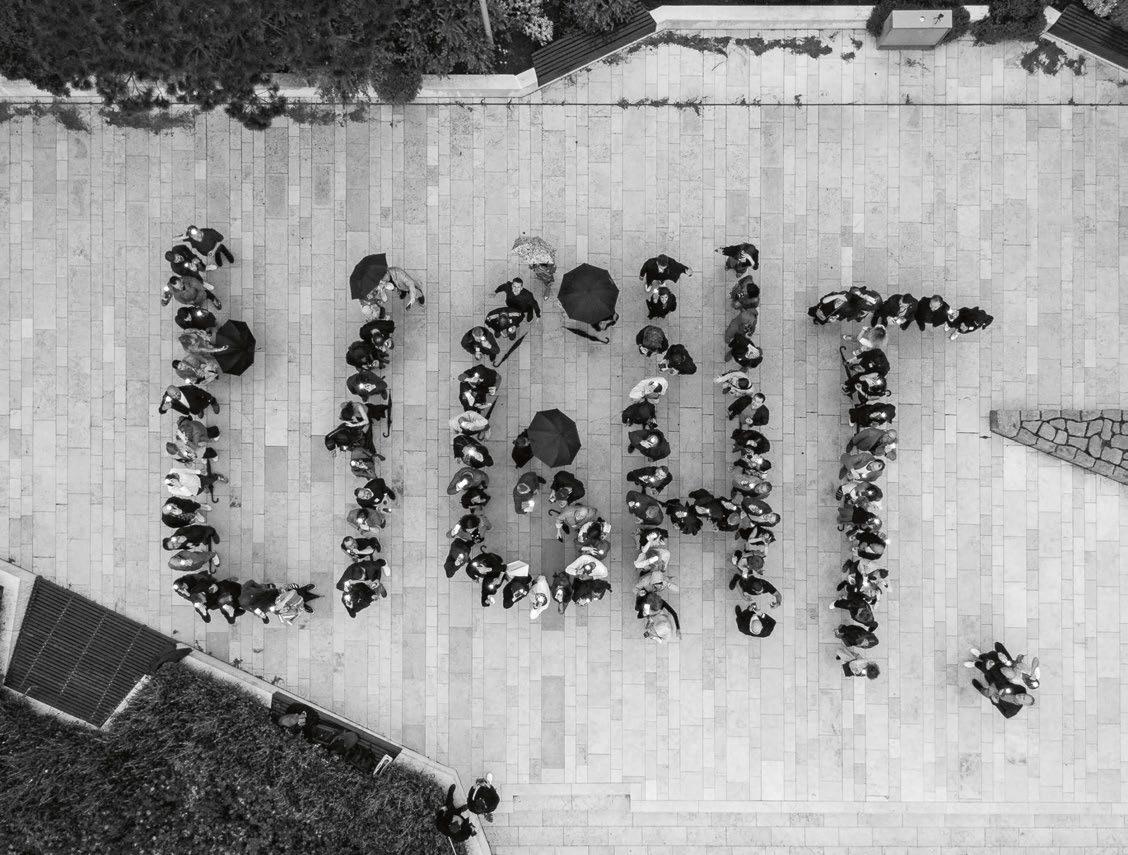
Taking place over UNESCO International Day of Light, on the final night all attendees took part in a unique photo opportunity, spelling out the word ‘LIGHT’ on the Rovinj waterfront.
The next [d]arc sessions event will take place at the Art Hotel & Resort in Bahrain on 10-12 October 2023. www.darcsessions.com
030 / 031
Images: Gavriilux


[D]ARC SESSIONS
Visual artist Frankie Boyle sits down with arc to discuss her unique approach to light, and opens up on how her neurodiversity has shaped her career.

“It doesn’t matter what type of room you have; you could change the emotion of that space instantly just through the lighting. Everything revolves around lighting.”
Frankie Boyle
032 / 033 talking with…
 Image: Jolly Schwartz Photography
In the lighting design world, there is a widespread understanding of the impact of lighting on emotions; how an effective lighting design can evoke particular feelings or communicate a certain message to those who experience it. For British light artist Frankie Boyle though, this understanding came at a much earlier age. Diagnosed with Developmental Learning Disorder (DLD) and dyslexia at the age of seven, Boyle struggled to understand language as a form of communication growing up. However, speaking with arc, she said that she always understood the language of light.
“I’m a big believer that if you take one sense away, your other senses grow stronger,” she said. “I became very heightened to people’s reactions towards me, picking up the finer details of body language, their energy, how they were acting, where we were.

“I became a bit of a science experiment; over a period of two years, I participated in a research project with the medical profession that involved a lot of tests to see what I’d react to and how my brain worked, often in really stark environments. I would often be put into a sensory room, where there were fibre optic lights, and my parents could see that I always wanted to be in the fibre optic room, I always wanted to do things with light.
“I realised that I very much had a heightened sensitivity and receptivity to light and how it was interacting within that space. I subconsciously had this feeling of knowing how lighting could make people feel comforted or seen, or allowed them to move through spaces easier, and I didn’t really know why until I went to university and started to understand more about the psychology and science behind it.”
Boyle studied Three-Dimensional Design at the University of Brighton, and while this was specialising with materials such as wood, metal, plastics, and ceramics, light continued to play a role. “It wasn’t until my art foundation that my tutor turned to me and said, ‘you do realise that in everything that you do, you’re involving light?’ I had even woven fairy lights through my sketchbook, but I was completely oblivious to this,” she said. “But then in my final year, with him telling me this, I suddenly became very aware of it, and wanted to harness it, so for my final year project, I wanted to help people with dyslexia and memory disorders, like me.”
For this project, Boyle created coding for a light source that would “trigger the nervous system into a memory cortex”. “Hearing sounds or alarms suddenly make us go into fight or flight, whereas seeing a colour variation sticks within our primitive scale of understanding, our biological hardwiring of why we have colour in nature,” she continued. “That’s how I started, and how I started learning about DMX and about how to control lighting through computers; and as soon as I started to understand that whole world, it opened my eyes to a lot of exciting things.”
After leaving university, Boyle knew that she wanted to work in lighting, although she wasn’t sure what type of lighting specifically, until one
fortuitous evening. “I was watching Strictly Come Dancing, and I thought the lighting was quite cool,” she recalled. “As the credits rolled, I saw the name Mark Kenyon, Lighting Director; I Googled him, found an email address, told him I thought his work was really cool, and sent him my portfolio, thinking I was never going to hear back from him. Oddly enough, he came back to me half an hour later, asking me to meet him on the set of Strictly… “I apprenticed him for six months, followed him around, and worked on programmes with Ant and Dec, lots of shows on ITV, and I got a real buzz for live entertainment. But unfortunately at that time, I got told by numerous people within that industry that as a woman coming into it, I wouldn’t get anywhere. Their excuse was that I needed to start from the bottom and be hired as a gaffer, but nobody was going to hire a female gaffer because they need to be strong. This was before the #MeToo movement, so I thought ‘I’m not going to fight this one’, and I slid into the art department. There I could make things, and still enjoy the live entertainment.”
034 / 035

TALKING WITH... FRANKIE BOYLE
Field of Hearts, an immersive experience created with Samsung for the launch of its Galaxy S10 phone. (Image: Frankie Boyle)
Alongside her work in television, Boyle was looking to develop a portable light tile that she had been working on since before university. “My parents are chefs, and when I was 18, they would ask me to work on events at front of house, serving food to people,” she said. “We were working a garden party, there was no lighting outside, and I was serving canapés to guests, and not only could I not see where I was going, nobody could see what the food was.
“So, I thought that that I would design a tray with some lights in it. I knew nothing about electricity, but I bought some LEDs, looked up how to solder a circuit, and made this light tile. It worked really nicely, and not only did it help people to see the food, but it allowed the servers to walk through the crowd, and the crowd parted around them, so I knew there was something in it. This was before university though, so it was put on the back burner as I went through university, and even when I was working in television, this tile was sitting in my shadow, haunting me.”
After six years of working in television, Boyle decided to try and do something with the tile; while working on ITV game show Tipping Point, she approached the company doing the lighting to see if they would be interested in producing the product on a larger scale.
“They went one better and said ‘why don’t we go into business together and I’ll bring you on board at my company and we can teach you about electronics, put you in the lab for six months, and once you’ve understood the lab, the electronics, the data, etc, we’ll start making these tiles.
“I thought that sounded amazing, and it was almost a dream job for about three years – I did about six months in the lab, and then I became the main creative for the company, and started creating some amazing bespoke items for Ellie Goulding, and the Brit Awards and Glastonbury Festival.” However, it was during this time that Boyle came to a realisation that, through all the glitz and glamour of working in television, she was missing out on something. “It was amazing, but I realised that it was all done for entertainment purposes through a TV lens, but people couldn’t fully experience it in an immersive space,” she explained.
“I realised that the type of fulfilment I get from life is somebody else looking at something and thinking ‘wow, that’s cool, that’s affected me in a really positive way’. Maybe it comes from both of my parents being chefs: you’re feeding people, you’re wanting them to enjoy the experience, and what the viewer doesn’t get through TV or film is the ability to feel and experience the effect of light.
“I thought that was a bit of a waste, and that there’s this beautiful, amazing lighting that could be harnessed and used in different ways rather than being on a set that people will never really experience. So, I wanted to be able to show people the middle ground of these two lighting aspects and give people the gift of seeing the light for themselves.”
This, Boyle believes, was the launching point for her move into the light art sphere, and her desire to “create things that allow people to have awareness of themselves, and of the space around them”. She continued: “My mission in in life is to allow people to connect with themselves. I think we live in a world that is overstimulated, everything is more and more, and what I want to do is just say ‘hey, why don’t we just have these moments of tuning back into what your thought process is, understanding the environment where you are, and being present within that time’. That’s where my work stems from.

“The more that I do my job, the more I’m trying encourage people to just be curious, and present, and aware of their environment, along with their mindset and mental health.”
However, she also feels that while she has an overriding ethos or philosophy of creating these moments of self-reflection, her work is open to interpretation.
“Everything that I do will have a reason behind it. I don’t really like art for art’s sake, or design for design’s sake, because there’s so much stuff in the world already that we’re just adding to,” she said.
TALKING WITH... FRANKIE BOYLE 036 / 037
The Living Lantern, a public artwork created in collaboration with NEON. (Image: Archicake Design)
Lighting designed for places and people
Contemporary lighting solutions designed to enhance the beauty of outdoor spaces while also meeting the needs of both people and the environment
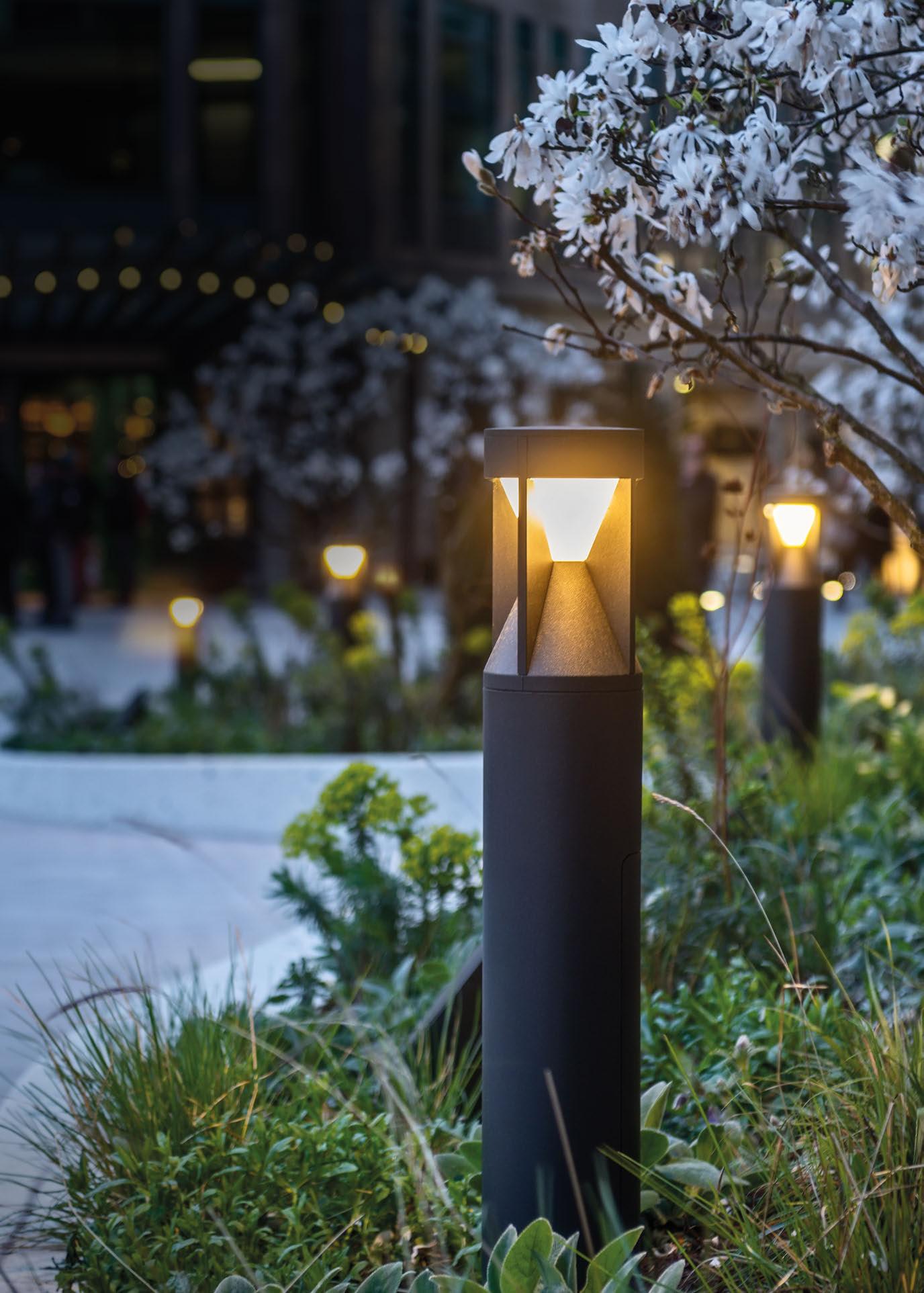
Exchange Square, Broadgate
Lighting Design: Speirs Major
Product: Pharola Max
dwwindsor.com
“Therefore, if we are creating something, it has to have meaning and a thought process behind it. However, I don’t believe that my meaning is the meaning that everybody should take away from it. I often find it frustrating when you go to an art gallery and read a really long blurb explaining what the artist is trying to do. I don’t want to be told why you’ve done it like this, or what I should be feeling, I just want to have the effect that it releases in me. With my work, I’m trying to allow awareness of yourself. I don’t know where that awareness sits within you, so I’m not going to tell you how to feel, but I’m giving you the tools to connect with yourself in different ways.
“Creativity is evolution. It’s exploring, it’s curiosity, it’s awareness, it’s turning over every leaf to see what entices you.”
Within her body of work, that has seen her create beautiful installations for the likes of Tiffany’s, Samsung and Negroni, as well as stunning independent works of art, Boyle believes that her “USP” comes in the fact that she can “speak art and speak tech”, but within this, she has noticed an increasing demand from clients for interactivity.
“I get slightly frustrated when people always want light work to be interactive,” she said. “It’s a bit like saying to Picasso ‘why don’t your sunflowers move?’ He’s created that because that is his emotion. And that’s what I’m also trying to pull people back into. Yes, we can make things responsive, but at the same time we need to create an emotional connection. Interactivity needs to be taken away from pushing buttons to make things happen. For me, in artwork, and especially light artwork, it needs to be about that emotional connection and drawing a curiosity and an awareness and being pulled into a sort of tranquillity stream.
“A project that we’re currently working on, the client wanted me to make some sort of interactive light experience, and the first question when anyone comes to me with any type of brief or idea is ‘what are you trying to create in that user?’ What do you want the person to feel? What is the main point of this? Is it purely for Instagram? Do you want to excite someone or make someone think? What is the feeling that you’re wanting? So, it’s looking at the journey of each person and giving them a connection to the piece. You can have some interaction with it; however the interaction doesn’t need to be the reflection of you, it can just be a trigger point to start the experience.”
These questions form part of a very active creative process, in which Boyle likes to work in person, alongside the client. “I like to be face to face with the client, because I work on energies and picking up on body language and conversations – people can say whatever they want, but it’s not necessarily how they feel or what they actually want,” she said.
“I had a client once who wanted the ‘ultimate disco ball’, we kept meeting on Zoom, but it wasn’t until I met him and really understood his energy that I realised he didn’t want a disco ball, he wanted a light source. When I’m in front of the client, I can really understand what their needs are, what they’re wanting the viewer to feel.”
This approach in part is a way for Boyle to harness
the “superpower” of her DLD, and it extends to the way that she will present concepts and ideas to clients. It is something that she has had to work through, particularly with those with less knowledge of DLD, but she believes there is an increasing understanding now.
“People’s understanding of DLD is still limited; dyslexia is almost known worldwide – it’s the jumbling up of letters, trying to read the words on the page and communicating that – whereas DLD is a jumbling up of language. So, the way that I learned is through sounds – I didn’t learn through spelling because in the English language, it has no rules. That’s what I like about electricity, it’s right or it’s wrong.
“I had to really use that to my potential, because let’s be honest, someone with severe dyslexia and DLD like me is not much good to anyone that needs you to read and write, so I had to make my own path.
“When I first started, everything that I wanted to do was through voice notes, and people wouldn’t listen to voice notes to begin with. So, I was trying to write emails that I thought made sense, but I’d get a response saying it doesn’t make any sense. But the more I got recognised, people were more accepting of voice notes, and I could speed up through my career because people understood that this is how I communicate.
“There is still an expectation though, although we are becoming more accepting, we are still just as judgemental and presumptuous as we have always been. People need to be told that this is the situation, because sometimes they can judge quickly, especially if they don’t have anyone dyslexic in their life.
“When I’m pitching for projects, every pitch that you’ll ever have to make has to be this beautiful language poetry, but I used to get myself so tongue tied in this poetry of what I was trying to say, that all I wanted to do was talk to someone about it, so I turned the whole idea on its head and tried to avoid the written word like the plague within my pitches, come up with sketches, have the images but then have a video of myself explaining each image. And I’d open each pitch by saying ‘due to being successfully dyslexic, I will be talking through this pitch’. So, in straight away saying my disability, being up front with it – a lot of people in my world try to hide it, but not only do I not want to hide it, I want people to understand what I’m talking about and raise awareness of these disabilities.”
Raising awareness has in recent years become a big factor in Boyle’s work, particularly during the Covid lockdown in 2020. “Through lockdown, obviously all my work fell away, and I didn’t know if the world was going to come back at all, never mind work for a light artist of all things. So therefore, I needed to problem solve, and I noticed when on my one walk a day that people were working, living, breathing and relaxing all in one room, but that people didn’t understand how to differentiate that space up. We needed to start switching things up and understanding how to feel within our homes to change that energy, so I thought that I would start up a vlog and talk, tell
The Mothership Connection, a sculpture designed by Zak Ove, illuminated by Frankie Boyle.
038 / 039
(Image: @donrw / limelight tv)
“I don’t really like design for design’s sake, because there’s so much stuff in the world already that we’re just adding to. If we are creating something, it has to have meaning and a thought process behind it.”

TALKING WITH... FRANKIE BOYLE
people how to do the lighting in their homes.
“But if you’re anything like me, you need to understand how something works before you get told what to do, so I decided to start from the very beginning and explain how light works, why the sky is blue, why we get connected to things. And then once we have that information, I can go into what we needed to do in the home. So, I did a few videos, but then life started back up again. But I wanted to keep going with the vlogs – I was getting a lot of interest, and Google asked me to do some talks for them, and teach their employees about the science of light, which was a real highlight.”
From here, Boyle is hoping that she can continue to use her platform to raise awareness and understanding about DLD and neurodiversity, as well as the impact of lighting, particularly on neurodiverse people, channelling her “superpower” for the greater good.
“When you’re neurodiverse, you have different sensitivities to different senses,” Boyle continued. “Having an awareness of people having neurodiversity is something that I’m a real advocate for and pushing for. And I do try and allow people to know that about myself quite early on. I use it as a superpower because I know that I think differently in certain situations, and I can see things in a different way.
“When I’m in a space, I have two ways of looking at life: I have a general chit chat, communication, and then I switch to this other form, this other sense that I have of purely looking at the reflections of the lights in people’s faces, how they’re moving, what the light picks up, and I become super heightened to that. I think that’s what allows me to be good at my job, looking at the general details and also the finer details.
“Lighting in general needs to be understood more and respected more though, even by architects. It doesn’t matter what type of room you have; let’s say you had a blank concrete square, you could change that, and the emotion of that space, instantly just through the lighting. There’s a lot of money in furnishing, but it doesn’t matter what you bring in, if the lighting isn’t good, none of those furnishings, none of those elements, will be enhanced. Everything revolves around lighting.
“Without light, we don’t have vision, and vision is our strongest sense. It’s just tapping into the subconscious language that we all speak, across all nationalities.”
Indeed, from speaking with Boyle and seeing her impressive body of work, it is clear that she is fluent in the vibrant, emotive, and beautiful language of light.
www.frankieboylestudio.com

TALKING WITH...
040 / 041
FRANKIE BOYLE
Working with 18fifty Lighting, Boyle produced an RGB DALI control system that would bring to life the interiors of the Ivy Asia restaurants.
(Image: Gavriil Papadiotis)

www.intra-lighting.com/ #Vyko Vyko | All-in-one: acoustic ceiling and a luminare, up to 1600 lm, UGR<19 Vyko E(c)ho friendly
The Embrace Boston, USA
So many monuments and memorials recall heroes, episodes, battles, or victories. The first sculpture built in the Boston Common in nearly a century, The Embrace, serves as a permanent monument to the legacy of love.
Embrace Boston, a non-profit organisation established by the Boston Foundation in 2017, issued a call for a permanent monument to be located in the Boston Common. This monument was to represent Dr. Martin Luther King Jr and Coretta Scott King’s presence in the city. The bronze sculpture itself is a 20x32ft figural abstraction of a photograph snapped of the couple at the time of the 1964 Nobel Peace Prize announcement. The 6,000sqft Freedom Plaza grounds the sculpture with custom shaped granite pavers, which flow from the sculpture and curve up to form benches, walls, and curbs, while the pattern of the granite evokes an African American quilt. 30 small, groundrecessed narrow beam pin spots located below and around the sculpture uplight it at night. Each one is strategically placed to specifically accent a particular feature of the sculpture (the suit jacket buttons, the bracelet, the fingers), but all combine to bring a wellspring of warm illumination to the form at night.
The narrow optics keep the sources themselves visually quiet when viewed from a distance. As a backdrop, six ground-recessed wall washers are placed to highlight a quote from Coretta Scott King on the plaza wall, where the two flanking benches morph into a wall plane. Soft overspray from these fixtures illuminates park trees enveloping the gathering space. Additional post top luminaires are used along the sidewalks leading to the plaza, but at a considerable distance to ensure a visual transition between light levels and colour temperature. All combine to create the feel of a welcoming, warm hearth for the Boston Common at night. www.lampartners.com

042 / 043
eye opener
 Image: MASS Design Group

044 / 045 PROJECT
W Hotel Algarve
Albufeira, Portugal
 Christian Wendel, Director at MBLD, talks us through the iridescent lighting design for Albufeira’s W Hotel Algarve.
ighting design is an essential element in creating captivating and immersive experiences in luxury hotels. The W Hotel, Algarve, situated in the idyllic southern region of Portugal, is a stunning example of a property that has leveraged innovative lighting design to create a truly extraordinary guest journey. The lighting design was crafted with a lighting narrative that perfectly complements the W Hotel’s cool contemporary brand, while infusing it with a vibrant and energetic party DNA atmosphere. Moreover, the guestrooms are meticulously designed with indirect lighting, creating pools of light that enhance comfort and evoke a sense of tranquillity. Together, these elements contribute to an unforgettable stay for every guest.
One of the most remarkable features of the W Hotel’s lighting design is the mesmerising water ripple projector, brought to life by MBLD and translated into reality by Radiant Architectural Lighting (the product won the KIT - Exterior category at the 2022 [d]arc awards).
This innovative feature adds a touch of enchantment to the exterior façades of the hotel, captivating guests and passersby alike. The projection creates a calming and soothing atmosphere, allowing guests to unwind and be entranced by the rhythmic play of light and water. Its strategic placement ensures that the visual display can be admired from various vantage points throughout the property, making it a memorable element of the guest journey.
The W Hotel, Algarve, is an iconic property known for its luxurious amenities, cutting-edge design, and vibrant atmosphere. Nestled in a picturesque region, the hotel provides a perfect blend of relaxation, style, and entertainment. With its contemporary aesthetic, the W Hotel brand has established itself as a leader in the hospitality industry, and the Algarve location lives up to the high standards set by the brand. From the moment guests step into the hotel, they are transported into a world of modern elegance, where every detail is carefully considered, including the vivid lighting design by MBLD.
The design begins with the striking Block D building, often referred to as the “shark mouth” due to its unusual shape. At night, the lifted ends and tunnels of the building are illuminated with water ripple patterns created by floor-recessed uplights. The external GRC façade of the building receives a more subtle lighting treatment, with back grazing lighting effects that follow the top and bottom edges of the building. The Paper Moon restaurant, located above the façade lattice work, is visually highlighted with a warm wash of light, balancing the illumination on the ground level. As guests enter the resort, they are guided by illuminated olive trees and palms to the porte cocher, which is architecturally designed to resemble a sea creature, such as a manta ray or jellyfish. Integrated downlights within the structure provide a welcoming carpet of light to guests under the porte cocher. The W signage at the centre of the porte cocher is covered in waveshaped tiles, reflecting the local culture and the proximity to the sea.
The lighting design at the W Hotel, Algarve, plays a pivotal role in creating an unforgettable guest journey. By thoughtfully integrating lighting elements that reflect the hotel’s cool contemporary brand, MBLD has successfully crafted an atmosphere that resonates with guests.

The lobby, being the first impression of the hotel, sets the stage for the guest experience. The entrance features a long wall covered in locally crafted multi-coloured plates, illuminated by super narrow beams of light. Infinity mirrors in pebble shapes are strategically placed on the ceiling, creating contrast and adding a dynamic element to the space. During the day, the mirrors emit bright white static light, while at night, they transform into an ever-changing pattern of light and colours, coordinating with the overall lighting scenes throughout the hotel.
The reception pods are covered in a silver hammered finish and float over a stone floor with tile mosaic patterns, reminiscent of the
046 / 047
L

PROJECT W HOTEL ALGARVE
pottery plates on the entrance wall. Spot lighting emphasises the mosaics and creates a contemporary effect at the nearby vertical screen, which emits white light from above and turquoisetinted light from below, adding a subtle and intriguing background element.

The central lounge space features uniquely shaped seating pods covered by metal “bubbles” with various textures, including coloured glass and crochet patterns. Light passing through these bubbles creates patterns of light and shadow on the ceiling, complementing the adjacent infinity mirrors. Warm low-level glow from underneath the soft seating provides a grounding effect during the darker hours, allowing guests to fully experience and enjoy the design of the space.
A covered walkway connects the restaurant to the Block D building, where the gym, spa, and additional restaurant are located. The central staircase within this building dazzles guests with a combination of contemporary decorative lighting, backlit perforated screens, and pin-spotted water feature cascades. The pool area, open to the outside but with a low ceiling, is primarily illuminated by the pool itself, creating a tranquil
atmosphere. Minimal decorative lighting and perimeter lighting define the space, contrasting the warm GRC illumination with the cool glow of the water reflecting on the ceiling.
In the relaxation area, a custom linear projector creates a soothing and relaxing effect. This feature item traces the ceiling along the walls, emitting lines of light with individual white and pastel colour tones that fluidly merge and disappear, providing a unique and calming experience. The lighting effect is achieved without moving parts, using different white and coloured LEDs placed behind a linear layer of refractors, which also was developed in collaboration with Radiant Architectural Lighting. As guests make their way to their rooms, they are greeted by a lighting design that embraces tranquillity and comfort. careful attention to detail is evident in the indirect lighting used in the guestrooms. By incorporating pools of light, MBLD creates an intimate and soothing environment that serves as a welcome retreat from the outside world. The scene set lighting allow guests to customise the ambiance to suit their personal preferences, ensuring a truly personalised experience.
048 / 049 PROJECT W HOTEL ALGARVE


LD155 LD10238 LD82 LD38C LD PICTURE LIGHT LD155 LD10238 LD82 LD38C LD PL
Project: Rochester Cathedral, Kent, U.K
Visit www.lightgraphix.co.uk for more info
Design: CES Lighting & Electrical Specialists
Client: Nozul
Lighting Design: Christian Wendel;
MBLD, UK
Interior Design: AB Concept, UK
Lighting Suppliers: Radiant
Architectural Lighting,
Photography: MBLD
These guestrooms are accessed through open corridors lined with pastel-coloured doors, reflecting the local culture. Within the guestrooms, crochet patterns are a dominant feature, covering the mini-bar, printed on the bathroom glazing, and incorporated into decorative light shade pendants. The patterns are also reflected onto the floor, creating a visually engaging effect at night. Warm linear backlighting traces the extended bedhead, creating a silhouette-like feature.
Within the guestrooms, a dominant feature are the crochet patterns, covering the mini bar, printed on the bathroom glazing, decorative light shade pendants but also reflected in projections onto the floor as a feature coming into full effect at night time. The extended bedhead is traced by warm linear backlighting, creating a feature like a city silhouette.
Each guestroom is visually connected to the terrace through integrated ceiling lighting and vertically contained arches of light. These arches

of light spread over iridescent wall tiles and are controlled centrally for all guestrooms as façade lighting. The combination of central and individual lighting, with warmer and cooler colour temperatures, unifies the appearance of the façade after dark, giving it the quality of a lizard’s skin with its iridescent quality. The lighting changes dynamically based on perspective, time of day and night, as well as room occupancy, adding an element of liveliness to the façade.
The W Hotel brand is renowned for its vibrant and energetic atmosphere, and the lighting design perfectly aligns with the hotel’s party DNA. Nowhere is this more evident than in the lounge bar, where lighting takes centre stage in creating a theatrical and dramatic setting. The lighting fixtures, carefully chosen to enhance the bar’s ambience, set the mood for a lively and unforgettable night out. With the ability to adjust the lighting, the bar staff can tailor the atmosphere to suit the specific needs of the evening, ensuring that guests are immersed in an exceptional sensory experience.
The lighting design created for the W Hotel, Algarve, showcases transformative power of light. By seamlessly integrating lighting elements that align with the hotel’s cool contemporary brand, MBLD has created an atmosphere that enhances every step of the guest journey. From the dramatic lighting in the lounge bar to the tranquil pools of light in the guestrooms, guests are immersed in a world of sophistication and excitement. The water ripple projection further elevates the experience, adding a touch of magic to the exterior façades. The W Hotel, Algarve, stands as a testament to the extraordinary possibilities that can be achieved through exceptional lighting design, creating a truly unforgettable stay for every guest.
www.mbld.co.uk
050 / 051
PROJECT W HOTEL ALGARVE
UNDERWATER LIGHTING
ALWAYS AT THE HIGHEST LEVEL
Certified stainless steel spotlights for safe and attractive experience of well-being in private and hotel pools as well as spas and thermal baths. Performance and sustainability in one.


MADE IN GERMANY. SINCE 1919. WIBRE Elektrogeräte Edmund Breuninger GmbH & Co. KG 74211 Leingarten · info@wibre.de · +49(0)7131 9053-0 Presidential Villa, Jumeirah Bali, Indonesia Partner: PT SINAR TEKNIK, Medan, Indonesia WWW.WIBRE.DE
Casambi Awards
Celebrating the use of Casambi technology in products and projects, the winners of the 2023 Casambi Awards were announced during the Casambi Summit on 27 April.
The Casambi Awards were conceived to celebrate products and projects that successfully utilise Casambi’s Bluetooth low energy-based wireless lighting control technology to create unique lighting experiences. Previous winners include the colossal Panathenaic Stadium in Athens, Greece, Harrods Dining Hall in London, UK, and the CoeLux HT25 Mini, an artificial skylight that introduces chromatic tunability to perfectly mimic the sun.
The shortlisted entries for the 2023 edition of the awards were whittled down to a compact couple by a panel of judges including Chris Lepine, Zaha Hadid Architects; Sebastian Aristotelis, SAGA Space Architects; Francesco Funari, Flos; Light Lab principal, Yah Li Toh; Cameron Girgus, Diode LED; and Aileen Herpell, co-founder of Aimotion.
The jury scouted for creative, characterful, detailed designs that put sustainability front and centre without compromising user experience. In the projects, they considered how well the lighting concept was planned and executed, how well Casambi was used, whether the technology brought something unique to the project and whether the result spurred a personal desire to visit the space. When reviewing the products, the jury set out to find something never-before-seen, with the potential for such a product to be used in projects, and whether Casambi’s technology had been integrated in a novel, innovative way. Chris Lepine said: “All products [that he shortlisted] provide a striking appearance through design, detail, and material to what can otherwise be banal, practical devices. They offer great functionality and look the part.” Of the projects, Lepine’s top picks “used lighting to enhance and define architectural space. From a vast space given scale to a small space made delightful with unexpected experiences.”
Sebastian Aristotelis noted that while the luminaire and control market is very competitive with many products, he zoned in on the particularly daring products that take a chance – celebrating risk and vision
with his final selection. Of the projects, he stated: “I picked the projects that best utilise the transformative quality of light in a space. Changing the character of a room is a powerful feature now very possible with the different luminaires and controls available.” By majority vote, the award for Best Project this year went to the John Hardy Boutique in Mambal, Bali. This project was the result of a close collaboration between CheongYewKuan, Studio Nimmersatt, blancostudio Bali, Kalpataru and Ascendo Lighting who have created a space filled with architectural indulgence.
The design celebrates natural materials by illuminating the architecture through the thoughtful use of bespoke pendant lighting and carefully designed lighting in the jewellery showcases. The Casambi system was deployed to eliminate the lighting control wiring process to protect the existing bamboo structure. To achieve maximum sustainability and energy efficiency for the project, only three Casambi nodes were installed to control the entire lighting design.
Francesco Funari, Head of Product Marketing at Flos and jury member said: “The look and feel of the project are extremely elegant, sophisticated and balanced. The lighting project is extremely simple, but it fully integrates with the structure creating a very smart and unique environment.”
“We use Casambi in a lot of our projects because it’s easy to install and can be seamlessly integrated into any design,” said Rara Rina Pusthika, lighting designer at Studio Nimmersatt, on receiving the award, adding:
“In this instance, the lighting needed to be retrofitted such that it would become a part of the pre-existing bamboo structure. Wiring was not an option. This is an isolated structure in the middle of nowhere, so the lighting needed to be easy to install and maintain. With Casambi, we were able to create a really userfriendly lighting system based on a creative design that was not only aesthetically pleasing but highly efficient and sustainable.”
The Best Product award was given to Ledim
(Arditi) for Lepuk, an extraordinarily tactile remote control that fits snuggly into the palm of your hand. The Lepuk offers four-channel applications inside Casambi networks: touch to dim the ball cap and change the channel by tilting.
Yah Li Toh noted that the Lepuk is particularly interesting as it sets apart the conventional square types of switches and keypads. With this, Funari appreciated the idea of converting a remote control into a decorative element and Lepine added: “This is a quality-looking, tactile product. The beautiful material combination and finish encourage the user to pick up and engage with the object.”
“We have our co-founder’s daughter to thank. After reviewing our early prototypes, she insisted we made a ball,” said LEDIM designer, Ole Noculak, adding: “When we started to develop the internal technology, the whole process was very straightforward. We knew we would like to make something out of wood and as we are using touch technology, the cap of it needed to be made from metal. We needed user interaction, and we needed user signalling and so we came up with the glowing ring, which has a double function; it signals when the touch is activated but it also signals when tilting which channel is selected. Market feedback says this is a must-have item on any desk. We’re delighted with this win.”
Joonas Rinne, Casambi’s VP of Marketing, said: “We really were extremely impressed by the calibre of entries this year. They are all proving the fact that wireless control technology when coupled with creative, smart thinking really can change the game, and create unique lighting experiences that make the world smarter, greener, safer and more beautiful. On top of that thought, we want to underline the importance of our ecosystem and partners: component and luminaire manufacturers, project services partners, architects and lighting designers – we can’t succeed without our amazing partners. These awards were set up to celebrate them.’
www.casambi.com
052 / 053


054 / 055
eye opener
Image: Munch Museum
Shape of Freedom Oslo, Norway
Freedom of expression and the ability to capture action and emotion on a canvas is the topic of Shape of Freedom, an expressionism exhibition at Oslo’s Munch Museum. The exhibition invites visitors into the minds and studio spaces of artists from both sides of the Atlantic, including Jackson Pollock, Mark Rothko, Barnett Newman and Georges Mathieu, with the intent of drawing connecting lines between a Europe in the aftermath of war, and America’s burgeoning, influential art scene in the same period. Throughout, visitors could see some of the best-known artists and works in the field of abstract expressionism and its European counterpart, art informel. Light Bureau worked with Nissen Richards
Studio in giving the exhibition a naturalistic expression and subtle progression through its six sections.
Freestanding, monolithic disruptor walls, finished in concrete, are given a distinctly different light quality to break up the exhibition and create layered views through the space.

In creating the lighting for the exhibition, Light Bureau developed a visualised 3D model to communicate the ambience of the space, and worked on the mounting, focusing and programming onsite.
Shape of Freedom ran at the Munch Museum from 23 February to 21 May 2023. www.lightbureau.com
When we’re designing a new exhibition or gallery, we have to think about how to transform a space as much as possible for maximum impact. We’re constantly under pressure to create something new for repeat visitors, so that each time they come it is a different experience. For temporary shows, the accent is on value for money, while a blockbuster show needs to come complete with ‘selfie moments’ and visually rich displays.

In the past, exhibition design was notoriously wasteful, with every aspect effectively new-build. As we face the future, we are rightly being asked to design more sustainably and also take more responsibility ourselves for thinking laterally and questioning the sustainable credentials of everything we specify. We are thinking increasingly about how to change the appearance of something without adding much in the way of a physical build – and how lighting and graphics can help us achieve this. The aim is for minimal build, but with the ability to change the way it looks and feels throughout a day, or even during a single visit. We can add colour and graphic surfaces, which are easy ways to create dramatic effects, but it’s even better if we can pair this with a clever lighting kit to enable multiple layers of change.
Over the years, I have enjoyed working with lighting design that empowers change and can adapt. I have also been drawn to working with theatre consultants, who have a history of storytelling, which draws from my studies and work in theatre, using light to tell a story and imply all sorts of things – another place, memory, emotion, or idea. I have worked a lot over the last 20 years with Zerlina Hughes, founder of Studio ZNA. We first met on a theatre project all those years ago and I enjoy how she seems to feel the spaces and responds in a very creative way to creating dynamism through light.
A really early project we worked on together perfectly encapsulated lighting’s transformative power. It wasn’t a museum project, but a bar called Liquorish in East Dulwich, where the brief was about adapting through the day from the space
being a cafe for young mothers in the morning, to hosting business lunches later and then transforming in the evening into a nightclub vibe with a DJ and dancing. We developed a shifting series of lights on a scene set, that accomplished just that. During the day, we used linear lights paired with windows, and long new roof lights, with smaller interior windows within the spaces. Later on, these lights became stronger, and started to take over from the natural daylight through the windows. Another set of light bulbs were designed to be closer to the tables to give the flattering feeling of candle light. A larger installation of lights in a double height space then became a feature, and achieved a pin-point effect – almost like a still night sky. At a certain time, deep colours started to emerge as lines of colour throughout, with gelled lights on edges of windows and in niches starting to shine, so that the whole space became filled with coloured light. Lighting alone permitted a seamless transition to totally different atmospheres. Since then, the first bit of kit I now always ensure appears in our cost plan is a lighting control system. It’s fairly pricey, but it means that the space is adaptable to different modes and situations. I am always interested in lighting that considers surfaces, colour, and movement, rather than in the fittings per se. In reality, I rarely use visible fittings, unless bespoke or picking up on shapes or materials we’re using elsewhere in the architecture. I want to think about how a space feels and can adapt. We encourage lights that are small and hidden – and that can change and complement stories. We create troughs and niches to hide lights and conceal fittings.
A more recent project, as a permanent gallery space where the client wanted repeat visitors and the ability to easily adapt, but without large additional costs, was Opplyst at the National Library of Norway. Again, change was achieved to a large degree through lighting, making the space feel magical via a dynamic control system. Coloured, gelled lights shift really slowly across the space, creating a subtle shift between warmer and
Changing light, not build to create more sustainable exhibition spaces
Pippa Nissen, Director at Nissen Richards Studio, discusses the role that lighting can play
in
creating more sustainable exhibition spaces.
COMMENT
056 / 057
PIPPA NISSEN
cooler moods. As you enter, the first experience is a series of light boxes that are pure white, creating a visual ‘reset’ break from outside. Each object is then spot-lit, encouraging visitors to feel as if the only thing they are looking at is each object, with interpretation hidden within the showcases, or subtly placed on light sheets alongside. The beauty of light sheets, when used with a perspex diffuser, is that many different materials can be placed on top with a printed text, and dimmed right down so that, like a kindle, it appears just lit. The text can be reprinted easily but always looks good. For us light is a boost to give more impact, and also an emotional connection to our build – as a way of enhancing and changing people’s experiences and creating a theatrical twist. So, my tip would be, when thinking about a new exhibition project, to consider carefully how much of a theatrical change can be made through pairing lighting with architectural moves, and then allowing different effects to be revealed slowly through time, so that the space isn’t still and one-dimensional, but has a dynamic and changing appearance. This feels like value added to the client, while visitors feel that they are in an ‘experience’ and the client ends up with a more flexible space that can be used in

different ways. They can even add a party mode to the scene setter, so that spaces can be used by corporate or private clients in a different way as a revenue stream. No extra build, but a completely different atmosphere. This feels like the future –and a sustainable one too.
www.nissenrichardsstudio.com
“Light is a boost to give more impact, and also an emotional connection to our build – as a way of enhancing and changing people’s experiences and creating a theatrical twist.”
MUSEUM
Opplyst, The National Library of Norway (Image: Gareth Gardner; Portrait image: Pal Hansen)
& CULTURAL LIGHTING
The Story of the Moving Image
Melbourne, Australia
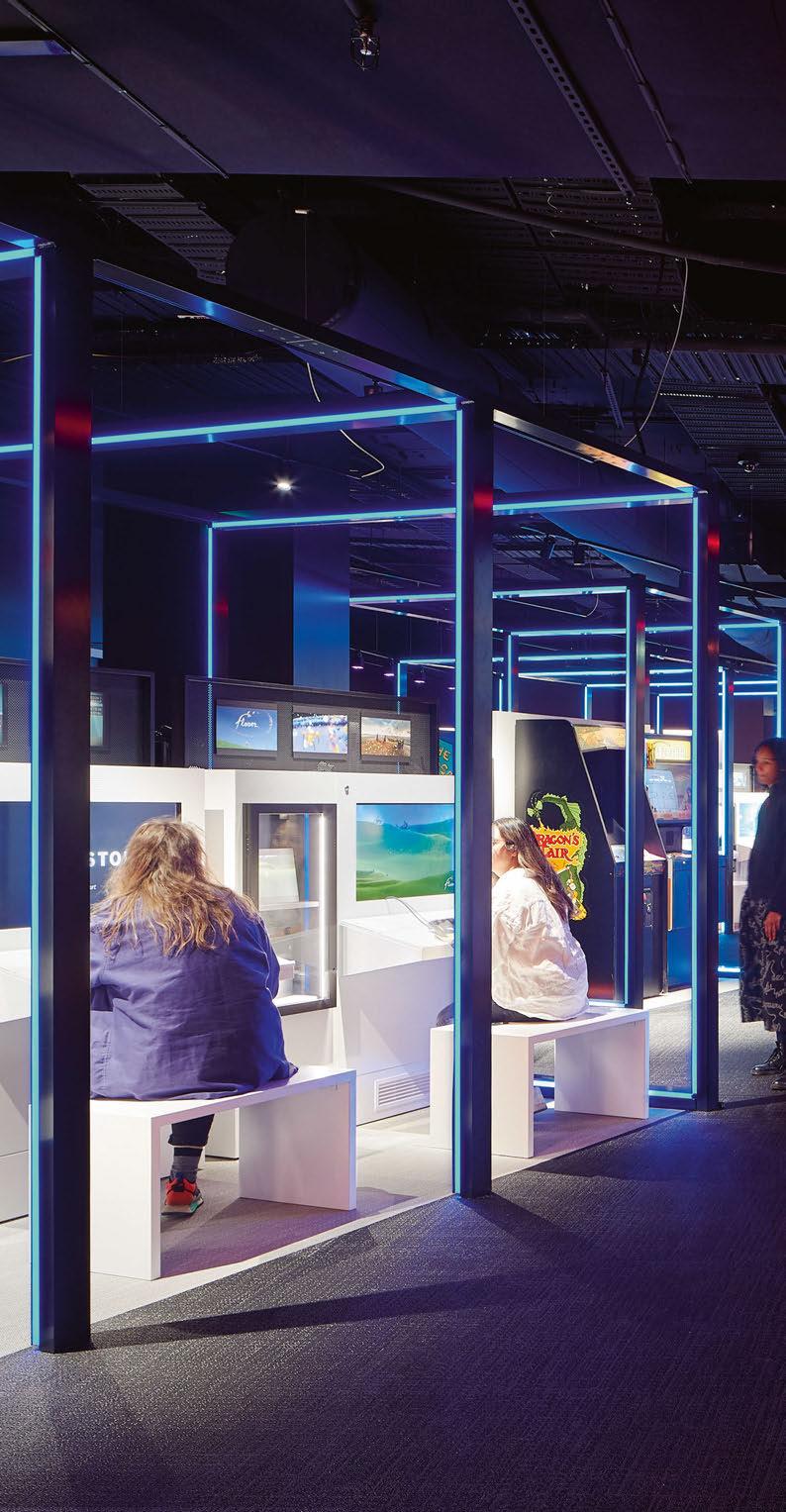
Taking visitors on a journey from the first image projections to the birth of cinema, and into the future, The Story of the Moving Image exhibition saw lighting design from Arup directly contribute to the immersive, experiential atmosphere of the space.
058 / 059

MUSEUM & CULTURAL LIGHTING
t Melbourne’s Australian Centre for the Moving Image (ACMI), a new centrepiece permanent exhibition, The Story of the Moving Image, has opened.

Designed to create an interactive experience, showcase digital innovation and tell captivating stories, the exhibition takes visitors on a journey through the past, present and future of the moving image, from the first projections and optical illusions, to the birth of film and beyond. Spread across five distinct sections that frame the major moments in moving history – including the origins of cinema, production design and the creative process, Australian culture and stories, the rise of videogames, and how screens inform, influence, and empower us – the exhibition features ancient shadow puppets, Victorian-era magic lanterns, original cameras, iconic costumes, movie sets, sketches, clips and contemporary art, all with the goal of “traversing time, countries and cultures in a mesmerising exploration of an art form that changed the world and illuminated our collective humanity”.
Arup was appointed to provide specialist lighting to the exhibition, in collaboration with acoustics and AV design to support the Exhibition and Experience Design team from Second Story in what was a significant overhaul of ACMI.
“Arup was approached by Second Story (2S), to join the team that was preparing the concept for the revised exhibition experience. Based in the USA, 2S was responsible for the creative vision of the user experience for The Story of the Moving Image,” said Tim Hunt, Melbourne Lighting Leader at Arup. “Arup was brought into the design process to take the conceptual ideas from 2S, develop them, and bring them to life through tender drawings and contract documents for construction. The scope fo the lighting team involved lighting control, casework lighting design and integration, production of all installation documents, working as part of a multi-disciplinary team and finishing off with onsite aiming and commissioning. All this was done in collaboration with international creative agencies, as well as our own AV and Acoustics teams.
“Arup’s expertise with light and sound in museums and galleries enabled 2S to have creative and technical support in Melbourne, which became critical in the delivery phase.”
As the exhibition takes audiences on an immersive journey into the past, present, and future of the moving image, through a series of thoughtprovoking displays, interactive experiences, and storied objects, lighting, AV and sound design were key to the visitor experience. Arup led the layering and integration of these services into the exhibition objects to enhance the visitors’ feeling and connection to each element of the space.
“The sound and light concept was led by Ben Kerukniet, a mixed medium artist based in Amsterdam,” Hunt continued. “Ben set the vision and Arup contributed to the creative and technical realisation of this through light and sound. Our interests in the experiential nature of the subject led the development of light graphics that mimic the progress of image technology.”
This concept, Hunt explained, manifests itself as soon as visitors enter the gallery; at the exhibition entrance, where visitors encounter the earliest, most elemental form of moving image – light and shadow. Light was used here to balance the environment as to not overpower the internal lighting from the “magic lens”, and the indigenous artwork suspended above.
From here, a visual connection element, a single red line of light, runs throughout the exhibition, guiding visitors through the “maze of spaces”. This represents one dimensional media – photography and prints – with the red colour inspired by the time spent in darkrooms, exposing photography. This transforms into the white coloured light grid, which starts to tell the story of the growth of still photos into the first cinematic moving pictures, a two-dimension animation. The third dimension of video and new media is then represented deeper into the exhibition in the games lab area, where double-sided lights signify the world of cinema and virtual reality of today.
Forming an integral part of this experiential journey, lighting has been used across the exhibition to create impact for visitors. In the installation of Memory Gardens, for example, the sounds of historical projection equipment were
060 / 061
A

MUSEUM & CULTURAL LIGHTING THE STORY OF THE MOVING IMAGE


062 / 063
overlayed with animated light scenes, programmed into the control system, to help craft this experience deliberately, asking the visitor to reflect on how they may have first viewed video media and photographs.
Within the games lab, the lighting takes inspiration from colour palettes of arcade games, helping to rekindle the feelings visitors have from the past. At the final stop, visitors can explore the Constellation, a human curated map that traces unexpected connections branching off everything the visitor has experienced prior, while also setting up another journey that begins when they leave the building. Shadow and mystery were created via the lighting design and applied soundscape. Hunt explained how the lighting contributed to the visitor experience across the exhibition: “We were involved in just about every aspect of lighting the space and the artworks. Art that was emanating light had to have its area specifically curated so that it would not clash with projector screens or affect the lit outcome.
“The shadow puppets though, were mocked up and specified by us, in accordance with and respected by the cultural requirements. There was a consistent restraint shown by our team to balance the lit effect both from an ambient level, but also a graphical level. The amount of backlit images, projections and media meant that the finetuning of the control system was imperative.”
As visitors explore the exhibition, spaces are kept relatively dark, with black walls and ceilings adding to the ambience. As such, Hunt said that there was a “concerted effort” to use light to create a layered effect in the exhibition.
He continued: “Having such dark backgrounds meant that we could really play up to the contrast and impact; using linear lighting and coloured elements, we have an outcome that is very digital feeling and futuristic. We approached the whole exhibition with layers in our concept. We then selected elements that we needed and withdrew them where we felt there were other light sources or screens that would affect the experience.”
With Arup working on the audio-visual and acoustic elements of the exhibition, as well as the lighting, it allowed for a seamless collaborative process to create “the ultimate sensory experience”.
“Because our teams are in-house, we already have existing relationships and projects that we have worked on. This means that we can have highly technical discussions and cut to the chase very quickly,” Hunt said.
“We all have creative backgrounds, and this was one of the ultimate sensory experiences that we have been able to work on; because there is no daylight in the space, we essentially had free reign to create an aural and visual immersion. It was such a privilege to work on this project.”
However, with various members of the creative team spread out across New York, Amsterdam and Melbourne, one of the biggest challenges was working across continents and time zones. But, Hunt explained, “we developed a strong bond with the design team and overcame these challenges through trust and respect”.
“Due to the nature of New York, Amsterdam and Melbourne, and their time zones, there was a constant cadence of flowing information every day. It meant that we had to be very flexible with tools and communication, but a healthy respect was developed that meant everybody felt equal parts of the team. This became even more important as the delivery phase of the project coincided with Covid, meaning that our Arup team took on a much bigger role of detail and delivery that was first envisaged.”
On a more technical level, Hunt added that one of the biggest challenges came in balancing the lighting with that coming from the screens and animated displays. “The last thing that we wanted to do was become overpowering, and we believe we’ve got the balance right,” he said.
To that end, Hunt believes that the lighting design has contributed to the success of the exhibition. He concluded: “By putting in multiple layers of light and not just track lighting, we were able to use the control system to dim up and down many different layers, giving us such detailed duration of each area within the larger space.
“The lighting design really exceeds the intent of the vision of the project, because it is so inherently part of the project.” www.arup.com
Client: ACMI
Lighting Design: Tim Hunt, Hoa Yang, Ilze Kundzina; Arup, Australia
Architect: BKK, Australia
Exhibition Design: Second Story, USA
AV/Acoustic Design: Arup, Australia
Lighting Suppliers: Bluebottle, EST
Lighting, iGuzzini, Litesource, Lux FX, Space Cannon
Photography: Shannon McGrath
MUSEUM & CULTURAL LIGHTING THE STORY OF THE MOVING IMAGE

064 / 065 MUSEUM & CULTURAL LIGHTING
Tartan Dundee, UK
Celebrating the history of Scotland’s most famous fabric, Tartan, at V&A Dundee, features a dynamic lighting scheme, created by DHA Designs

pened in April this year, the latest exhibition at Dundee’s beautiful V&A Museum is a celebration of one of Scotland’s most iconic fabrics. Tartan, which will run until January 2024, is an in-depth exploration of the textile that aims to celebrate the story of the traditions, fashions, and creativity that it has inspired in communities worldwide.
Showcasing more than 300 objects from over 100 international lenders, the exhibition features a dynamic lighting design, courtesy of lighting consultancy DHA Designs. The studio was brought on to the project by exhibition designers – the aptly named PLAID Studio – to create the lighting scheme for the exhibition, returning to V&A Dundee after having previously collaborated on the VideoGames, Night Fever and Michael Clark exhibitions in the past.
However, despite working on previous exhibitions in the space, David Robertson, Director at DHA Designs, explained how Tartan differentiated from their earlier works. He told arc: “The most unusual element [about Tartan] was that this was the first show that originated at, and was curated by, V&A Dundee; all previous shows there had started elsewhere and therefore already had a lighting design in place.

“The brief for this exhibition was quite open, but there was definitely a desire to make sure it felt like a celebration of tartan in all of its forms. It was also important that the exhibition is by topic (innovation, identity, power, etc), not chronological, so the lighting wanted to change from area to area to suit the subject.”
Working to replicate the symbolism of tartan, and complement the design produced by PLAID Studio, DHA used horizontal and vertical linear light sources to reflect the warp and weft of the material.
Indeed, creating a lighting scheme that would allow the exhibitions to pop was one of the core parameters for the design concept. Robertson continued: “It was important that the space felt light and bright, especially at the start – the external lobby is daylit. Many of the exhibits were 50 lux, and as a material gives very little light back and can look flat, balancing the object against the ambient and architectural lighting would be crucial to the visitor experience.”
An example of this can be seen in the first display, entitled The Grid, which is a large framework of cases and walls in a regular pattern. As well as integrating light into the cases, DHA Designs concealed linear light above and below them to match the location of the voile panels to make the space feel inviting and light, segmenting it to reflect the warp and weft of the tartan. “We considered coloured light for this, but felt that with many dark coloured objects, this might upstage the content, and that warm white light was a more elegant solution,” Robertson added. While the decision to use linear lighting was due to its ability to “both appropriately and softly light the exhibits to light both object and labels”, the move also serves to highlight the unique architecture of the building itself.
Robertson continued: “The structure of the grid encourages the visitor to look up immediately, so the ceiling was going to be seen. The next areas are unusually open plan; we chose to use the existing architectural detail of linear lighting that is really designed for house lighting and hasn’t been used in an exhibition before. We dimmed it right down but were pleased that it highlights the architecture, while the linear source is in keeping with the case and setworks lighting below. We matched the colour temperatures, so it felt like one cohesive solution.
“The gallery is split in two by a low bulkhead, and for a second part where the exhibition gets darker – including a film on slavery and dramatic Alexander McQueen pieces – we chose not to use this architectural lighting, which complemented the exhibition design and paced the exhibition.
“The routing of any exhibition means that you move between the two spaces – choosing exhibits and lighting that go beneath the bulkhead is an opportunity, and we were able to use more uplighting to some dynamic fashion and artworks here to emphasise the change, rather than trying to hide it.
“The gallery is challenging due to the angle of the track that is flush with a pitched ceiling, and
O 066 / 067 MUSEUM & CULTURAL LIGHTING TARTAN
SHABU-SHABU
Dining with Seoul
Yeouido Modern Shabu House


KKDC Products used: FX/LINI Glow
Lighting Design: Bitzro, Ki Young Ko

KKDC proud sponsors of lightasia.org


068 / 069
the roof lights, but we are working with the V&A on a new detail that moves the track out of the ceiling into a more user-friendly horizontal location without spoiling the line of the architecture. This is necessary given the scale and scope of the ambitious exhibitions the V&A now mounts.”
This intimate knowledge of V&A Dundee and its exhibition spaces served DHA Designs well, as the team already knew what would and wouldn’t work within the wider context of the building.
Robertson added: “This is our fourth collaboration since the museum opened five years ago. Knowing the space definitely helped – especially knowing which areas could not be lit from the track.
“The sawtooth ceiling and (closed) roof lights restrict track locations, and we knew where we needed to supplement this with new hanging track to best light the exhibits. Previous exhibitions (VideoGames; Night Fever; Michael Clarke), suited a much darker, more dramatic environment of individuated spaces, and there was more coloured light and AV. This exhibition was a chance to do something different.”
One new element, which brings a sense of dynamism to the exhibition was the introduction of gridded gobos to the floor – a late addition from the design team. “Although the objects were all glowing and the ambience welcoming, I felt it needed a little sparkle,” Robertson said. “Using two overlapping gobos at 45°, I tried to mesh a custom tartan pattern on a large expanse of empty floor in the area that spoke about the warp and weft of the pattern. In an exhibition that showcases many artists’ responses to tartan, I thought ‘why shouldn’t lighting have a go’.”
Across the Tartan exhibition, more than 300 objects are on display, but one of the key messages for the exhibition was to showcase the “democratic nature” or the material. Robertson explained how the lighting helped to democratise the displays. “There were more than 100 international lenders, including some contemporary artists and commissioned pieces, but the exhibition is non-hierarchical. Tartan in all its forms is more important than any one exhibit or person – used by rich and poor, nationalist and unionist. So, the biggest challenge was to make sure every object was well-lit and had a value; whether a faded piece of historic tartan or a sparkling outfit work on RuPaul’s Drag Race; whether a tartan-covered car, or a tartan-covered Xbox controller.”
Since the exhibition opened on 1 April, it has gained widespread plaudits and positive reviews. Looking back on the project, Robertson hopes that the lighting contributes to a positive overall experience for visitors.
“I was most pleased that the initial idea of a bright space has worked, and the visitor feels welcome; and then once their eyes have adjusted and the mood of the exhibition changes, we switch that into a more focused and dramatic lighting scheme. I hope the visitor, thanks to the lighting and more open-plan exhibition design, gets to appreciate the ceiling and architecture, as this would not suit all exhibitions.”
Robertson concluded though that, due to his own personal experience with tartan, he found working on the project as rewarding as a guest visiting the exhibition would. He said: “As someone who comes from the North East of Scotland and was forced to wear kilts as a child, it was a great experience to return to my roots and learn much more about this fascinating and versatile subject.” www.dhadesigns.com
Client: V&A Dundee
Lighting Design: David Robertson, DHA Designs, UK
Exhibition Design: PLAID Studio, UK
Graphic Design: David McKendrick Studio, UK
Lighting Suppliers: Applelec, ETC, iGuzzini, MJ Lighting, Precision
Lighting Photography: Ruth Clark, V&A, David Robertson
MUSEUM & CULTURAL LIGHTING TARTAN
Formula 1 Exhibition Madrid, Spain
An immersive new experience dedicated to the history of Formula 1 has opened in Madrid, with a sleek, complementary lighting design from Michael Grubb Studio

070 / 071
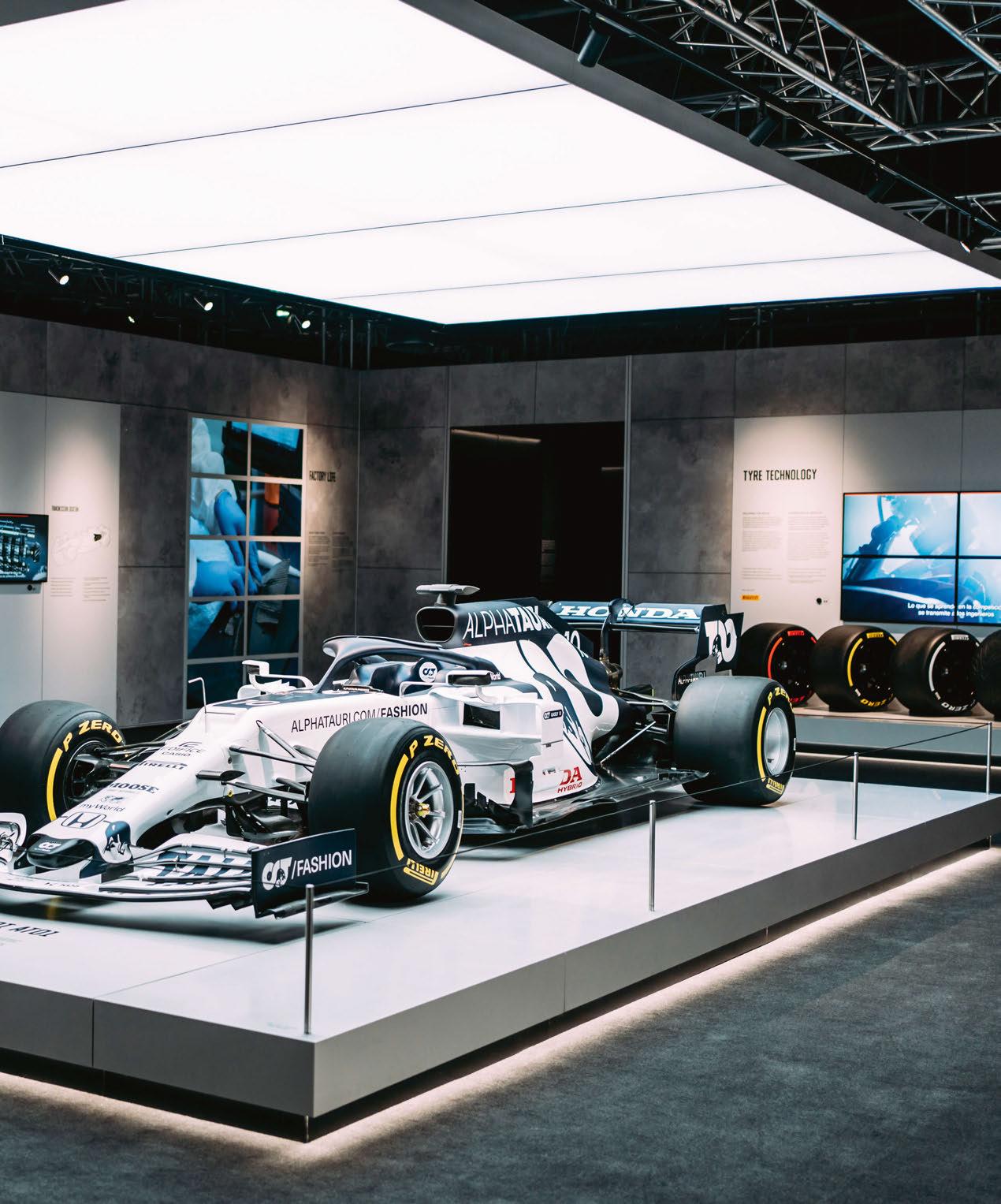
MUSEUM & CULTURAL LIGHTING
ive years in the making, a ground-breaking new Formula 1 Exhibition has opened at the renowned IFEMA Madrid, Spain. Launched at the end of March, the exhibition, produced by Round Room Studios and Pathfinder Studio, allows visitors to experience the past, present and future of the motorsport. From audio-visual spectaculars to elegantly curated displays, the exhibition provides a dazzling journey of interactive and immersive technologies, installations, artefacts and interviews. The show is spread across seven rooms, each individually designed to showcase the world of Formula 1, from its beginnings in Once Upon a Time in Formula 1, to the dramatic climactic experience, The Pit Wall To enhance the visitor experience, Round Room Studios appointed Michael Grubb Studio to provide a creative lighting design for each of the seven purpose-built rooms. The studio worked in collaboration with designer Alastair McCaw, Director at Real Studios, who liaised with curators, artists, and filmmakers to support the narrative of the story of F1.
“We were initially approached by the exhibition design team, who we had worked with years ago,” recalled Michael Grubb, Creative Director at Michael Grubb Studio. “We were then introduced to Round Room Studios, who invited us to a meeting to present our approach and how lighting could enhance both the content and the overall visitor experience. Our initial meeting was extremely positive, with all parties buying into our ideas; we were initially asked to work up a concept for one of the spaces – the Design Lab
“Our first presentation went extremely well. The client was instantly excited by our idea for the space and that bred confidence in us. So much so, we were then asked to look at an overall strategy and invited to work on all the other spaces. It took off from that point.”
After joining the project, Michael Grubb Studios was given the freedom to test ideas, challenge the initial brief of enhancing the visitor experience, and develop a lighting scheme that would be “unique and beneficial for the project”. Through it all though, the team was very clear that each space within the exhibition should feel different to the last. This was in some part aided by the content, and the clear narrative and distinctive look to the stories that were being told.
“We simply took this and developed a lighting language that played to emotions,” Grubb explained. “F1 enthusiasts are passionate about their sport, so we wanted to play on this and create a truly immersive experience. We also knew that we could not ‘fake it’, and we had to be true to many of the issues of F1, so we constantly asked questions to ensure that the experience was authentic.
“The Design Lab concept, for example; we spoke with the client about how they wanted the space to feel. The response was ‘like one of the team’s factory’. We were fortunate to work with McLaren a few years ago, so we were familiar with its facility, having visited behind the scenes a few times. This helped guide our ideas, but we needed to reassure ourselves that the other teams followed the same approach, as we did not want a biased solution.”
The final concept was therefore developed using the studio’s past experience with McLaren, as well as its passion for developing something dramatic. The result was inspired by the Batcave in Christopher Nolan’s Batman trilogy. “The idea was to have a stark, clinical, intense, and (if possible) low ceiling that was wrapped in light,” Grubb continued.
“The challenge was always going to be how we designed this for touring, so we ended up breaking up the ceiling and focusing on the central display, with additional light incorporated around the perimeter walls. By the time the design was finalised, we knew what space you entered and exited from, so we deliberately made them darker to ensure greater impact on arrival.”
Throughout the exhibition, lighting was designed to reflect the setting and atmosphere of each room, from the cinematic atmosphere of the first room, Once Upon a Time in Formula 1, to the aforementioned cool and functional display of the Design Lab. Illumination heightens to represent speed and chaos in the Drivers and Duels race circuit design, before reaching a crescendo with The Pit Wall finale, where fans can relive the greatest moments in F1 history.
“The whole exhibit was very much treated as separate experiences with the history of F1 being the connective thread, so the lighting approach in each was treated as its own project,” Grubb explained.
“The Design Lab is about the process of designing an F1 car, so we wanted the space to feel like a

072 / 073
F
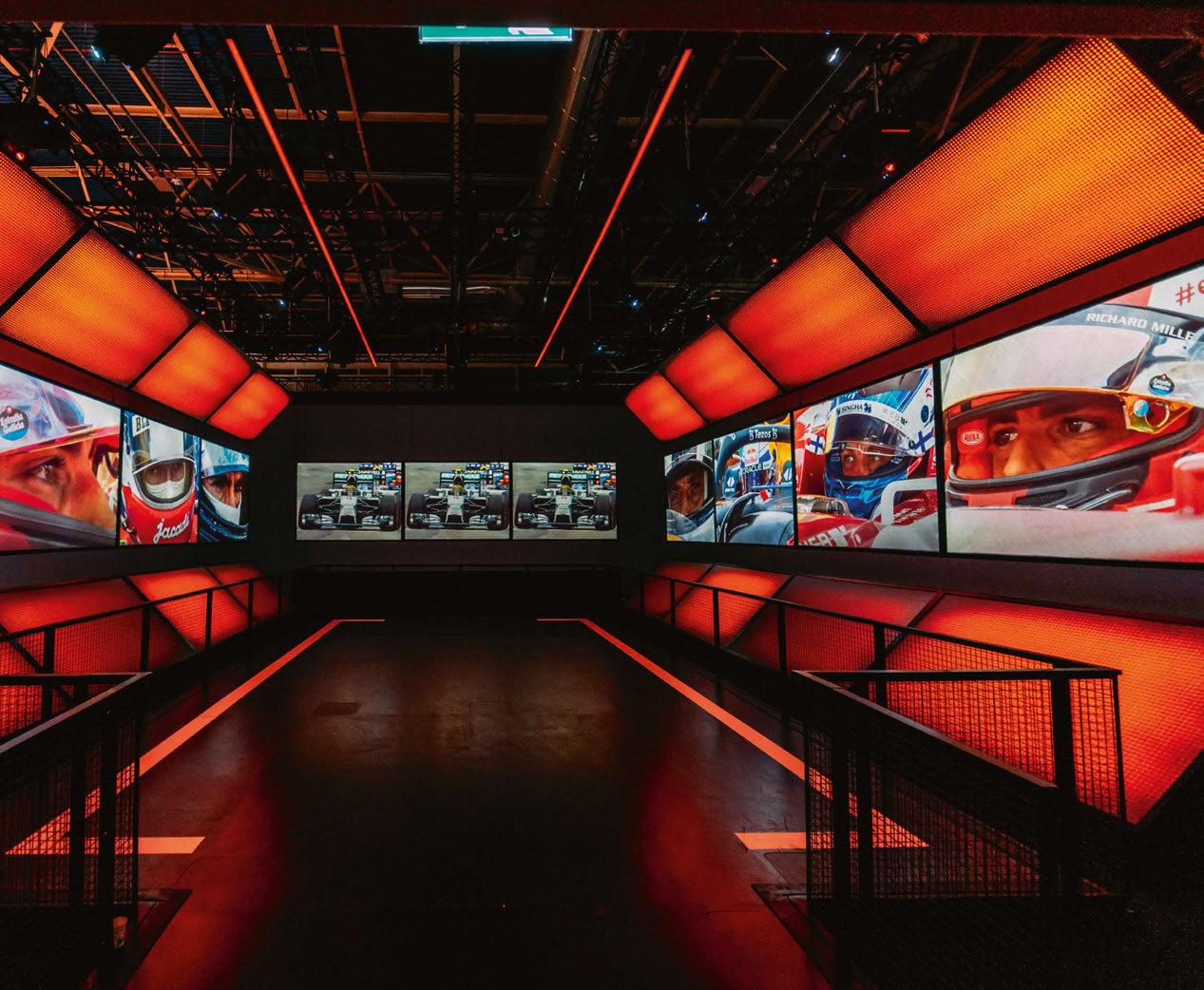
MUSEUM & CULTURAL LIGHTING FORMULA 1 EXHIBITION


074 / 075
futuristic factory line, so we embraced a much cooler and starker aesthetic, while spaces like Grosjean needed to be more sombre and contemplative, so we chose to focus all the lighting on to the case and keep the rest of the space in darkness.”
Across each of these varying spaces, Grubb explained that collaboration was the key in creating successful designs. “We worked closely with the exhibition designers along the process, there were a lot of moving parts and fluidity with the design, so it was important for us to be reactive and quick on our feet to meet the demands of the scheme,” he said.
“For The Pit Wall, we very much stepped back and left the integration with [Production Designer] 59 Productions; they had a clear vision of what they wanted, so we just made sure that the lighting was able to meet their goals and form part of the experience.”
Between the contrasting rooms, the wider exhibition is characterised by a monochromatic aesthetic, typified by darker spaces with black finishes and bright areas with white finishes. This was a deliberate move by the design team to bring more drama and contrast to the visitor experience. “We were also very selective when it came to colour and sequencing of light,” added Grubb. “There were times when we withheld or withdrew ideas as we felt it was too much, or similar to another space. Stripping ideas back created a more dramatic series of spaces – there was a fear that it would become visually busy and chaotic. This is why you need a strategy from the outset.”
However, while each space is identifiably different from each other, Grubb added that one of the biggest challenges was ensuring that each of these spaces transitioned well into one another.
“Grosjean and the Design Lab have a very different look and feel, but sit next to each other on plan with an open portal between them, so how we treated the light in one would have affected the other. Balancing the levels to both space and positions of the lighting helped to maintain both identities without impacting the intent.
“Another big challenge was making sure we had the lighting positions where we needed them; the exhibit itself has no ceiling so a lot of coordination happened between us and the exhibition structural team to ensure that we had hanging points where we needed. While the installing team were fantastic and able to adjust if needed, each time it occurred it would take up valuable time and have a potential knock-on effect to the structure. Luckily, because of the time spent in Stage 4, only minor changes were needed.”
Across the exhibition, Michael Grubb Studio specified fixtures from a range of manufacturers, including Stoane Lighting, LEDFlex, Optelma, Prolicht, Unibox, Optelma and UFO Lighting, all with the intention of crafting a design that would fit within the luxury aesthetic of the F1 brand, while matching sustainability and reuse goals.
“The fittings needed to feel premium and slick, but also with our sustainability goals,” Grubb continued. “There can be a lot of waste associated
with travelling shows, so we were determined to find solutions, via specification or design, when the project could be as sustainable as possible. We embraced the circular economy ethos by selecting products that could be easily upgraded and maintained over the duration of the tour.”
Before the exhibition takes up its travels, it will stay at IFEMA Madrid until the summer. Since its opening in March, the show has been well received, and Grubb is satisfied with how the final lighting scheme enhances the visitor experience of the space.
“I believe that the lighting design approach allowed us to create with the design team seven distinct environments that each have their own story to tell. The travelling lights of Once Upon a Time… mimic the road leading you back in time; the monochromatic Design Lab as the factory line of the future; Grosjean the dark, sombre space of contemplation; Drivers and Duels taking you to the red and white heart of the pit-stop; Revolution by Design as the clean, white space, and The Pit Wall the vibrant, immersive experience.
“We are extremely happy with the final scheme and the drama it creates. More importantly, the client and those visiting have been overwhelmingly appreciative of what we have done. Like all great projects, it really was a collaborative effort, we are so extremely grateful for the support given by the wider design team.”
www.michaelgrubbstudio.com
Client: Round Room Studios
Lighting Design: Michael Grubb, Mike Cascarino, Matt Waugh, Daniela
Rendon; Michael Grubb Studio, UK
Exhibition Design: Real Studios, UK
Production Design: 59 Productions, UK
Lighting Suppliers: Architainment, LEDFlex, Optelma, Prolicht, Stoane
Lighting, UFO Lighting, Unibox
Photography: Courtesy of Formula 1 Exhibition
MUSEUM & CULTURAL LIGHTING FORMULA 1 EXHIBITION
London, UK
 William Kentridge Exhibition
076 / 077
When the William Kentridge Exhibition landed at the Royal Academy of Arts last year, David Atkinson Lighting Design produced a theatrical lighting scheme that would showcase the unique works of art.

MUSEUM & CULTURAL LIGHTING
ate last year, David Atkinson Lighting Design (DALD) completed the lighting design for the William Kentridge exhibition at the Royal Academy of Arts, London, which ran from September to December.
South Africa’s most celebrated living artist, William Kentridge has, with his shows over the last decade, captured the imagination of the public – always large in scale, ambitious in scope, and astonishing in execution.
His globally acclaimed practice spans across etching, drawing, collage, film and sculpture, to tapestry, theatre, opera, dance, and music. Born in Johannesburg, Kentridge developed his early work during the apartheid regime of the 1980s, and his large-scale productions and animations have since been shown across the world.
The latest, the biggest exhibition of his work in the UK, transforms the Royal Academy of Arts’ Main Galleries, with many pieces never seen before, and some made specifically for the show.
Spanning across a 40-year career, the exhibition featured large, four-metre-wide tapestries, his signature charcoal trees and flowers, and the breath-taking three-screen film, Notes Towards a Model Opera from 2015.
DALD was commissioned to illuminate the space by the Royal Academy of Arts, having previously worked with the RA on the Oceania exhibition. “The team felt that my theatrical approach would work well with the William Kentridge exhibition,” David Atkinson, Founder of DALD, explained.

“The brief from the curators and exhibition designer was for the lighting design to have a theatrical, filmic quality, as well as to adhere to strict conservation levels (50lx) for any loaned works. I spent a lot of time researching William Kentridge’s work in film and theatre to bring these influences into the overall lighting design.”
On entering the Vestibule, visitors were presented with Kentridge’s large, immersive sculpture, Action The exhibit was lit by tightly controlled zoom profile fixtures positioned at a steep angle to accentuate its form and texture, with a cool, 4000K LED source chosen to give high contrast between the exhibit and dark background.
Most of the galleries throughout were either lit by medium or broad wall wash optic track fixtures, subject to the scale of the works being exhibited, and in some cases were fitted with warm or cool colour correction filters.
Atkinson explained further how the variety of works, both in style and scale, affected his approach to illuminating the space: “Subject to the scale of the work and the exhibition design, the lighting approach for each space was very different; for example, in the first gallery, which contained single works, they were tightly lit to offset them within the space.
“In contrast, the large scale tapestries in the fourth gallery were lit by broad wall wash optics fixtures, which in turn reflect off the works, giving the space a sense of openness.
“The third gallery space contained large projection screens with suspended sound cones. The space was treated filmatically, with the surrounding cork cladded walls illuminated with a warm CTO correction filter and the suspended sound cones subtly highlighted by tightly controlled sources with daylight correct filters, with the reflected light coming from the projection screens, which helped to animate the space.”
Control of the lighting throughout the exhibition was critical to help offset the exhibits within the galleries, as well as for the audio-visual projections, which play an important part in the immersive experience.
It also proved particularly essential, considering that DALD were utilising the Royal Academy’s stock of iGuzzini Palco fixtures for the exhibition. “By adapting some of the existing stock lighting fixtures and fitting a variety of colour correction filters, it enabled the lighting to have a theatrical, immersive quality. Limiting the number of sources throughout the exhibition and controlling the intensity via Casambi helped to add a sensitive quality.”
While the need to work within the building’s
MUSEUM & CULTURAL LIGHTING WILLIAM KENTRIDGE EXHIBITION 078 / 079
L
Magnet Track LaVilla 48

proled.com
LAVILLA 48
UNI-BRIGHT
VILLA 48 COMBINES A MINIMALIST DESIGN WITH MODERN LIGHTING TECHNOLOGY. A VARIETY OF SPOTS THAT ARE EQUIPPED WITH A 48V ADAPTER CAN BE CLICKED VERY EASILY ANYWHERE ON THE TRACK THANKS TO A BRILLIANT MAGNETIC SYSTEM.
LA
Client: Royal Academy of Arts
Lighting Design: David Atkinson; David Atkinson Lighting Design, UK
Lighting Team: Mark Strange, Michael Lynch, Jason Tuffin, Quentin Jarman, Anita Sidoruk
Exhibition Design: Squatelier, Belgium
Graphic Design: Daly & Lyon, UK
Curators: Adrian Locke with Rose Thompson
Exhibition Manager: Flora Fricker with Belén Lasheras Díaz and Helena Cooper
Lighting Suppliers: Enliten, iGuzzini,
Prolights
Photography: Royal Academy of Arts / David Parry
existing framework, using existing fixtures, may have appeared as a challenge to some, Atkinson explained that, due to the nature of the Royal Academy, this didn’t present much of a problem.
“Although most of the lighting was positioned from the existing, high-level tracks, we had to introduce some additional tracks for some of the exhibits,” he said.
“The gallery lighting is well catered for both large and small-scale exhibitions, with a variety of different optics, which did not hinder the lighting approach.”
Indeed, the collaborative nature of the project, and DALD’s close relationship with the curators and exhibition designers, meant that any potential issues were kept to a minimum.
“A close collaboration with exhibition designer Sabine Theunissen, as well as William Kentridge, during the onsite commissioning stage was key to the success of the lighting. We worked closely with the designer, curators, and exhibition managers throughout the lighting concept and detailed design process too, to accommodate any design changes.
“Through this careful planning with the curators and exhibition managers, it enabled us to avoid any onsite issues. Even with all the best
planning, some of the exhibits did get moved, and by having a well experienced theatrical lighting team, the lighting fixtures were speedily repositioned and focused, keeping the overall lighting design intent intact.”
Alongside the stock of iGuzzini fixtures, further Prolight Gallery Eclipse profiles were rented in from Enliten Architectural, where controlled shuttered light was required.
Following the closure of the exhibition at the end of 2022, Atkinson believes that the lighting design achieved the desired “filmatic” effect sought by the artist. “Looking back at the project, I was very happy with the lighting design, and through working closely with William Kentridge and Sabine Theunissen, we achieved the theatrical quality that is evident in Kentridge’s work,” he said.
“The lighting brings a dynamic depth to the exhibition, with every space feeling very different without uniformity. By varying the lighting approach for each space, it helped to draw the visitors through this large exhibition.
“With the exhibition receiving such acclaim, the lighting was intrinsic to the experience, bringing an invisible support for the amazing works of William Kentridge.”
www.dald.co.uk

080 / 081 MUSEUM & CULTURAL LIGHTING WILLIAM KENTRIDGE EXHIBITION


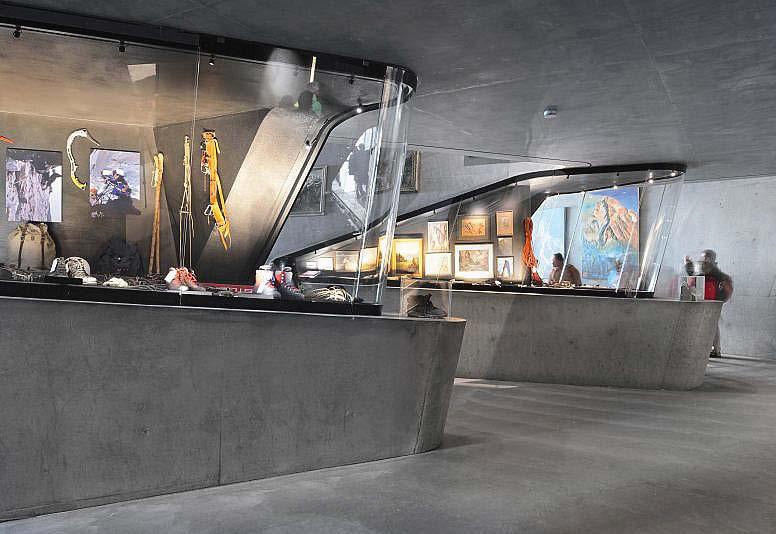


by TTC Timmler Technology ® T +49 2255 921 200 E info@ado-lights.com www.ado-lights.com www.led-luc.com www.ttc-technology.eu Pictures: TTC, Verena Eidel, Peter von Pigage As unique as your project – ADO Lights puts exhibitions in a good light Individual LED solutions – for interior and exterior matching the architecture

082 / 083 eye opener
Inner Peace London, UK
Foster + Partners has collaborated with Amelia Peng, an MA Textiles student at the Royal College of Art, along with musicians and composers from the Royal College of Music, to create an installation for London Design Biennale.
Titled Inner Peace, it combines smart, interactive textiles and musical performance to engage visitors in an immersive display, with their feelings and emotions directing the visual effects.
Irene Gallou, Senior Partner and Head of Specialist Modelling Group at Foster + Partners, said: “This project has been a wonderful opportunity for our team to collaborate with talented students, musicians, and composers in the fields of art and music. We are delighted to see people engaging with and enjoying the installation at this year’s London Design Biennale.”
The installation takes the form of a spectacular waterfall, set against the backdrop of the Nelson Stair at Somerset House. Visitors are invited to wear a headset that records their brain waves and visually expresses them on the back layer of the fabric installation, as they listen to music being played in the space.

The outer layer can respond directly to the music, which is either a pre-recorded piece or a live performance by composers and musicians at the Royal College of Music. During the live performances, which are scheduled throughout the biennale, the musicians will wear the headset to demonstrate the effect of creating music on the brain.
Foster + Partners’ Specialist Modelling Group has developed the data programming that converts the brian waves into movement and colour; the team worked closely with Italian textile weaver Dreamlux, which created the fibre optic fabric for the installation.
Inner Peace will be on display throughout London Design Biennale, running at Somerset House from 1-25 June 2023. www.fosterandpartners.com
Image: Aaron Hargreaves / Foster + Partners
Client: La Banque de France

Lighting Design: Michel Helson;
Realisation Europe, France
Architect: Ateliers Lion, France
Scenography: Explosition France
Audiovisuals: Museomaniac France
Lighting Suppliers: Luxam, Vivalyte
084 / 085
Citéco Paris, France
A combination of scenography and lighting design creates an “enchanting” ambience in Paris’ Citéco museum. Michel Helson, lighting designer for the project, tells us more.
oused in a marvelous historic building in Paris, Citéco is a museum dedicated to the economy. But even if the neo-Renaissance urban château is enchanting in itself, it took more to keep visitors spellbound by the story of the economy and money.
In Citéco, this challenge was met head-on through a brilliant combination of clever scenography and innovative lighting techniques. By carefully crafting two distinct routes, each with its own timetable, the museum successfully engaged visitors while also highlighting the architectural heritage of the building.
The visitor’s journey commences with a grand light and sound show, setting the stage for an extraordinary museum experience. Through large video projections of animated images, contemporary economic and financial issues are seamlessly integrated, respecting the original beauty of the architecture. This immersive introduction piques visitors’ curiosity while creating a bridge between the past and present.
As the show concludes, the tour guides visitors through a meticulously designed mapping of the architecture. Starting with a progressive and dynamic tunable white light description in the reception hall, the lighting design resembles pencil strokes on a sketch, gracefully tracing the intricate details of the building’s structure. Fourdegree ellipsoidal fixtures, meticulously developed to illuminate an area 10-metres high and 60 centimeters wide, provide the perfect medium for capturing the essence of the pencil strokes, breathing life into the architectural elements. Moving through the museum, visitors are met with a modern integrated scenography that seamlessly blends with the historical cultural aesthetic of the site. Using profiles and focusable optical zooms, the lighting design accentuates the architectural elements, furniture, accessories, and punctual points of interest. With varying ceiling heights ranging from four to 10 metres, careful attention is given to creating harmonious atmospheres that define the space’s volume and enhance the overall visual impact.

Dimmed luminous panels emerge as a powerful tool for creating unconventional renditions of graphics. In the museum’s showcases, these lumigraphics serve as backlit displays, bringing dusty portraits to life and creating a captivating
ambiance. Whether as backdrops or supporting “cartel and didascalies” these panels enhance the visibility and aesthetics of the displays, evoking a sense of intrigue and wonder.
The museum’s lighting concept makes generous use of Vivalyte backlight boxes. These provide a uniform light source behind printed PMMA panels, resulting in an extra dimension and visual impact. A particularly striking example is the shimmering display of banknotes from the French Revolution, presented in a 250 x 200cm format, captivating visitors with their historical significance and mesmerising illumination.
Highlighting the classified architectural elements of the museum required meticulous attention to detail. Fine wood and metallic trim, wood paneling, parquet and ceiling designs, opulent sculptures, and intricate stonework carvings were meticulously treated with various types of LEDs, profiles, and focusable optical zooms. This approach ensured the architectural heritage was not only preserved but showcased with stunning precision and elegance. As the tour nears its end, visitors are led to the museum’s unique safe room, an architectural marvel reminiscent of a castle-fortress. The dynamic lighting sequence in the surrounding moat, created by a submarine RGBW projector, entices visitors to explore the treasure cellar within. The vault’s safe cases have been ingeniously transformed into showcases, meticulously illuminated to highlight historical money stones, gold, bronze, silver, the world’s most beautiful banknotes.
All technical aspects were meticulously designed, featuring high-output LEDs with precise specifications for colour temperature, CRI, lumen/ watt output, and more. With more than 1,200 controlled light points, the exhibit really comes to life. For this technological tour de force, Vivalyte’s technical expertise and knowledge were highly valued. For dynamic sequences, the luminaires are DMX-controlled. The signal is conveyed in ArtNet and converted to DMX at the luminaire. The dynamic sequences are either synchronised by the showcontroller with moving images and sounds, or are broadcast in a stand-alone loop. In the ticketing and entrance halls, all luminaires are Casambi controlled.
MUSEUM & CULTURAL LIGHTING
www.realisationseurope.com H
The Danish Jewish Museum Copenhagen, Denmark
The Danish Jewish Museum has expanded with a new entrance design by Polish-American architect Daniel Libeskind, who also designed the museum’s interior with its striking expression. The new entrance rises from the existing space in front of the museum situated in the Royal Library Garden in the heart of Copenhagen, Denmark. It creates a much more visible entrance to the museum. Adding to this it is in many ways the completion of his edifice, which was started with the foundation of the museum in 2004.
Even though Danish museums re-opened in April, The Danish Jewish Museum stayed closed. The museum was in the process of taking down the existing exhibitions, as preparation for the building of the new entrance to the museum. The Museum is situated in The Royal Library’s old buildings with entrances from the Library Garden. The brick vaults forming the celling over Daniels Libeskind’s wooden interior, originate all the way back to the Danish King Christian IV. (1577-1648).
The new entrance secures better access to the museum but will also add to the emotional experience of the museum. The existing architecture, by Libeskind, is based on the story about the flight and rescue of the Danish Jews in October 1943. As such the architecture tells a strong story. It is a visual and physical experience with tilted angels in both the floor and the walls.
The concept of the new entrance is an extension of the museum’s design language of intersecting planes, one of which forms the sloped floor of the existing entrance plaza. The new design adds a vertical dimension with two obliquely inclined walls that intersect to shape the entrance space, preparing the visitor for the experience of the museum itself. The floor and both walls are made of the same light gray granite stone.
In order to maintain the sculptural character of the entrance building, lighting has been recessed into the ground. Eight LED light lines from ADO Lights were flush-mounted to match the architecture, supplemented with recessed LED Ground Level Spots for accentuation.
The new entrance gives more visibility to the museum within the Library Gardens. It will be a new attraction in the heart of Copenhagen in the unique historical frame set by the Royal Library Garden.
www.ado-lights.com

086 / 087 case study
Designed by renowned architect Daniel Libeskind, the new entrance to the Danish Jewish Museum is illuminated by ADO Lights’ recessed exterior luminaires.
MUSEUM & CULTURAL LIGHTING
Image: Hufton + Crow


La Biblioteca Marciana di Venezia Venice, Italy
One of the most culturally significant libraries in the world, La Biblioteca Marciana di Venezia has been given a new lighting scheme, designed by Romano Baratta Lighting Studio, utilising fixtures from formalighting

La Biblioteca Marciana di Venezia is one of the oldest and most important libraries in the world. It is the custodian for Italian masterpieces of art such as works by Tiziano, Tintoretto, Veronese, as well as extraordinary globes and maps like the Mappamondo of Fra Mauro, considered the world’s most precious cartographic document, also called The Gioconda of Maps
The project was set on a “Museum Scale” and an “Emotional Scale”. It allows for visitors to explore what is physically present while also evoking emotion and sensations. The aim is to create a deeply emotional experience for visitors that will long be remembered. The lighting scheme has been created to immerse visitors in the history of the piece and be carried away on a journey into the world of knowledge.
The lighting, designed by Romano Baratta Lighting Studio, physically enhances the architecture of the piece, supporting a holistic experience for visitors. Through the automated system of visual scenarios, and perspective guidance through the light itself, visitors can discover and admire the 16th century architecture through targeted focuses, before diving into the masterpieces.
The new lighting has made it possible to grasp, as never before, how spectacular the blue of the seas are when compared to the stark whiteness of the parchment. The greatest challenge was to avoid shadows and reflections on the art masterpiece. As well as showcasing the beautiful artwork, the uniqueness of this library needed to be conveyed. It was not by chance that Tizano painted on the vaulted ceiling of the Vestibolo La Sapienza.
In the 16th century, being enlightened with knowledge and wisdom had a divine origin. For this reason, the designer planned the light to appear miraculously, illuminating the philosophers, figures and ancient roman monuments – as if ordaining them with wisdom. This particular ceiling painting is in an incredible architectural trompe l’oeil. The new lighting design enhances this architectural perspective and pays tribute to this artwork’s careful restoration completed in 2019.
One of the most exciting elements of this project is how it has reshaped the understanding of museum lighting. In this new way of thinking, a museum is not only lighting the works on display, but also lighting a living place with a history embedded in its architecture. To achieve this, it is necessary to bring out the hidden but intriguing elements of the works and the space itself. A carefully crafted lighting design can create a narrative and profound experience, not just the highlighting of artwork. It brings together the lighting of the exhibition and the enhancement of the pieces, with the overall atmosphere and experience for visitors.
formalighting’s Zero Compasso 40 and Zero Compasso 66 spotlights support the innovative lighting concepts to enhance the cultural heritage and architecture of the space. Each spot is controlled by the Casambi App and can be programmed separately for the right timing and light intensity to enrich the experience.
www.romanobaratta.com
www.formalighting.com
088 / 089 case study
& CULTURAL LIGHTING
MUSEUM
Escher - Other World The Hague, Netherlands
In two unique rooms of a new exhibition at Kunstmuseum Den Haag, Beersnielsen used customised fixtures from CLS to effectively illuminate the installations.

With 160,000 works of art, Kunstmuseum Den Haag is one of Europe’s most prominent art museums. The museum in The Hague has a leading collection of modern and contemporary fine art, fashion, and applied art.
Recently, the Kunstmuseum Den Haag opened a new exhibition, Escher – Other World, created to commemorate 125 years since artist Maurits Cornelis Escher was born. In the exhibition, visitors can experience the work of Escher as never before. His famous prints are combined with spectacular installations by the Belgian architect and artist duo Gijs Van Vaerenbergh.
For this exhibition Gijs Van Vaerenbergh devised space-filling interventions, sculptures based on the notions of light and heavy, temporary, and eternal, impossible architecture and infinity, which are also fundamental elements in the work of Escher.
To best highlight these outstanding works of art, the museum asked Beersnielsen to design the lighting in the new exhibition. Beersnielsen has regularly illuminated exhibitions in the museum, usually by using existing rail spotlighting. However, in this instance, the designers wanted to create a tailor-made solution for specific components. The exhibition spreads through 14 rooms, where in two the regular track fixtures could not be utilised.
“In this specific exhibition, the fact arose that the spatial, architectural installations, designed by Gijs Van Vaerenbergh, made it unattainable to illuminate the works on the walls from the ceiling using rail spotlights,” said Sjoerd van Beers of Beersnielsen.
In one of the two rooms, focused on the theme
of nature, the Belgian duo created a hanging installation, called Inverse Landscape, by installing more than 100 sheets of paper, which have been cut by hand. They all hang parallel to each other, and each sheet has a different shape.
In the other room, focused on patterns, the prints of Escher were arranged in an installation called Tessellation Maze. Made of blue punched steel screens that are open and transparent, the installation creates unique views and vistas. Due to the nature of the installations, the rail spotlights could not illuminate the works of art precisely. That is why Beersnielsen searched for a suitable alternative. For this solution, a compact LED spot was the best option.
Van Beers said: “We were looking for a compact LED spot, with an external driver, preferably a spot that would allow us to adjust the beam after installation. After a test on location with the Focus Micro from CLS, we opted for its bigger brother, the Focus GIII.” With a zoom range from 10° to 70° and an even beam with soft edges, the Focus GIII is perfect for this application where precision lighting with more light output is required.
The 45 Focus GIII fixtures were then customised to best suit the rooms. In the Inverse Landscape room, the fixtures were put on custom-made magnetic pendants, and in the Tessellation Maze room, they were colour matched with the blue maze. The exhibition took nearly two years to create, but the result is eye-catching, with the architectural design of the exhibition giving viewers the feeling of walking around in an Escher print.
www.cls-led.com
case study
Image: Andere Wereld
Xavier Hufkens Gallery Brussels, Belgium
Bridging new and old, luminaires from Erco illuminate the new
Xavier Hufkens has been dealing in contemporary art for more than three decades, and today operates from several locations in Brussels, representing international artists such as Antony Gormley and Tracey Emin.
Ghent-based Robbrecht en Daem Architects has extended the art dealer’s historic town house headquarters by creating a striking extension of concrete and glass. With exhibition spaces on five levels, it creates flowing transitions from old to new building, establishing a wide variety of spatial situations with varying amounts of daylight, providing a versatile background for up to six temporary exhibitions a year.
The interplay between the new building and the existing structure creates a diversity of rooms with very different proportions; ceiling heights vary from three metres on the first floor, to nine metres on the ground floor. The scale corresponds to the diversity of artworks on display, ranging from smallformat prints to monumental paintings, sculptures and expansive installations.

The projecting stack structure of the new building allows the use of natural light through skylights on each floor. The rear façade opens out towards the garden via floor-to-ceiling glass surfaces, and in the basement to a newly created atrium. The challenge, therefore, was to find the right balance between natural and artificial light for the different spaces.
The lighting concept emerged in close collaboration between the Xavier Hufkens team, lighting designer Siegrid Siderius, and electrical contractor Jacques Verliefden. Erco’s Eclipse InTrack wallwashers and track-mounted spotlights combine uniform general lighting in all spaces with focused accent lighting for the works of art. Uniform wallwashing creates a good impression of brightness, with a high level of visual comfort for gallery visitors, while selectively placed light accents on the individual artworks to present them optimally.
All luminaire bodies, as well as the track suspended under the corrugated concrete ceiling of the new foyer, were specified with silver surfaces. Visually, the interior fittings are kept to a minimum, with nothing distracting from the works of art on display; no superfluous detail disturbs the completely homogenous impression of the architecture as a blank canvas that adapts with maximum flexibility to the changing exhibitions. Complementing this, Eclipse spotlights are freely positionable on the track.
The light distributions available consist of the interchangeable optics Flood, Spot, and Narrow Spot, while two sets of luminaires at 3000K and 3500K respectively allow the colour mood of the exhibition to be modified to the wishes of the artist.
www.erco.com
090 / 091 case study
extension of the Xavier Hufkens Gallery.
MUSEUM &
LIGHTING
Image: Thomas Mayer © Erco
CULTURAL
The Holburne Museum Bath, UK
Stoane Lighting used its ReNew service to remanufacture old halogen fixtures at The Holburne Museum into new, more efficient LED equivalents.

The Holburne Museum in Bath houses the collection of Sir Thomas William Holburne. It uses 300 Stoane Lighting MR7, formerly halogen based, track fittings recently remanufactured on site by the Stoane Lighting ReNew service. While the majority of equipment remained in use, there were clear motivations and justifications to support the remanufacturing proposal. The ReNew approach avoided premature disposal of the equipment and resulted in a lower embodied carbon intervention, in comparison to luminaire replacement. 6900KgCo2e was saved and 70% of the luminaires by weight were kept in service. Before the conversion, the maximum power consumption per fitting was 50W. It is now 10W. With 300 track spots, this has the potential for a large energy saving and a route for the museum to reduce costs and their lighting related in-use carbon emissions. While the museum had some stock halogen lamps, restrictions and component obsolescence on the transformers used left threats to the future serviceability of the equipment. Colour point stability through dimming with the new LED light sources allows the same light level to be used without such significant shifts in the colour of the light.
On-site remanufacturing is a very different proposition, so a process had to be agreed and implemented. Light output and beam control options from the original equipment were taken as a baseline specification for the remanufactured luminaire. With commitment and agreed specification from all stakeholders, an assessment had to be made on whether the equipment could
be remanufactured. The robust construction of the equipment along with a product that was originally designed to allow for maintenance allowed a great starting point. Also under consideration were the following: the mechanical condition of the equipment, the design and integration of components required for the conversion and an assessment of the proportion of materials and components that could be preserved. There are compliance obligations to follow with remanufacturing of existing lighting equipment. Equipment must be compliant with the requirements at the time of remanufacturing, and equally as safe. Sample luminaires allowed conversion components and processes to be developed, assessed and tested in off-site factorycontrolled conditions. In this way performance, compliance and design safety was prepared and checked in advance.
Conversion kits were manufactured in preparation for a one week window on-site. The Stoane Lighting ReNew mobile workshop was then parked up on-site with all the tools, test equipment and engineers to carry out 60 conversions each day while the museum remained open.
A circular economy approach based on remanufacturing of lighting equipment presented an opportunity to The Holburne Museum to make energy savings, reduce environmental impact and to do this in a way that minimises the disruption to their opening hours, extends warranty, enhances technical performance, and extends the viability of their existing lighting equipment into the future. www.stoanelighting.com
case study
Preserve and Protect
Will Salter, Senior Designer at dpa lighting consultants discusses the importance of designing lighting for museums that preserves the artefacts on display, as well as enhancing the visitor experience.

The purpose of museums and galleries is to collect, preserve and display objects of cultural, artistic, or scientific significance for the education of the public. However, finding a balance between the two key objectives; display and preservation, is often hard to achieve.
This is because when a decision is made to exhibit an object it may be detrimental to its visual and physical integrity, cause ageing or fading of its materials or impact the significance or value of the piece. Therefore, it is imperative to understand the environment of the space the object will be displayed in, so that it can be exhibited under ‘safe’ gallery conditions while optimising the visitor experience.
Lighting is essential and plays a crucial role. A considered lighting scheme helps to create an atmosphere that complements the artwork, making it more engaging and immersive for visitors. Additionally, lighting can be used to highlight specific aspects of the artwork, such as colour, texture, and detail, making it easier for visitors to appreciate and understand the work. Today, great thought and consideration is given to elements such as humidity, temperature, air quality and lighting to create a suitable environment for displaying objects to the public. Each has its own set of guidelines that museums follow during the installation and then continue to monitor during the entire time objects are on display. The current lighting conservation guidelines for sensitive artifacts groups display objects in to three categories. These are: Sensitive Collections (works on paper, photographs, textiles) 50 lux max; Less Sensitive Collections (oil paintings, wood, leather) 150 lux max; Least Sensitive Collections (metal, ceramics, stone, glass) 300 lux.
Currently, there is an assumption that when the museum opens, the lights turn on and when the museum closes, they turn off. This means, for the most part, that the artwork on display is lit to the same lux level all day, every day – and then sometimes for longer due to out of hours events and viewings.
Display objects are assigned annual light exposure levels. An example of how this is measured is by calculating the usual opening hours of a museum, seven hours a day for six days a week over 52 weeks, therefore resulting that an item can be exposed to light 2,184 hours a year. This figure is then multiplied by the recommended light intensity to give the lux hours. So, a sensitive item with a maximum of 50 lux will have a rough total of 100,000 lux hours.
Some institutions have already started to rethink their approach to object rotation to reduce the total time of exposure to light. These include rotating items from storage or turning pages of books or manuscripts on display.
The most effective strategy in reducing light damage is to reduce illuminance and time of exposure. The longer you leave an item exposed to light, the more damage it will do.
An example of this is at The Edvard Munch Museum in Oslo, where there is an installation displaying three versions of ‘The Scream’: a painting, a print, and a drawing. To protect the works only one is displayed at any one time, whilst the other two are covered. It is programmed to automatically rotate hourly to reduce exposure (lux hours) to each piece whilst creating a sense of mystery and intrigue at the same time.
A similar approach should become more widely adopted in museums because when implemented in this way it does not only benefit the artwork but also the visitor.
Using lighting control systems linked to sensors and timers will reduce total exposure time as the display object will only be illuminated when someone is in the gallery or viewing the display object. Turning off or dimming luminaires that are illuminating artworks will also reduce the energy consumption of galleries throughout the show, therefore not only protecting the works but also resulting in lower energy consumption.
Another benefit from the advances in lighting control technology is the use of digital controls, such as smartphones, tablets, and computers, to
COMMENT WILL SALTER 092 / 093 MUSEUM & CULTURAL LIGHTING
manage lighting systems remotely. This allows lighting designers to adjust lighting levels and colours from anywhere, making it possible to tailor lighting to specific needs and preferences. Also, it allows curators or gallery assistants to recall preprogrammed scenes that could, for example, raise the light level on a particular artwork whilst giving a talk or tour.
Perhaps with the recent technological improvements within the lighting industry, such as the seamless incorporation of digital motion sensors, timers, and in particular smart control systems, a case can be made to encourage museums to begin to adopt such elements. Along with the move away from halogen light sources, is it now time for the lighting conservation guidelines for sensitive artifacts to be re-written?
www.dpalighting.com

“A considered lighting scheme helps to create an atmosphere that complements the artwork, making it more engaging and immersive for visitors.”
Image: courtesy of dpa lighting consultants
Pond Life: Albertopolis and the Lily London, UK
The unique, pioneering programme, Art on the Underground, was created to bring the works of world-renowned artists into the public domain, changing the way travellers and commuters experience the city.
The latest exhibition, Pond Life: Albertopolis and the Lily, by British artist Monster Chetwynd, is an immersive installation incorporating a series of five disc-shaped sculptures, four metres in diameter, along the length of a discussed platform on Gloucester Road tube station.

Each sculpture is populated with creatures – beetles, dragonfly larvae, tadpoles and tortoises – that appear to be constructing sections of the Crystal Palace. They show the underwater life of the submerged lily pads, their spiny network of veins playing host to the industrious wildlife.
Lighting design studio JPLD has dramatically illuminated the discs like performers on a stage, each one carefully lit to bring out the character and immense level of detail on the individual pieces.
JPLD Creative Director James Poore has been working with Art on the Underground and TfL for more than 20 years, and in that time has worked on a whole host of exciting projects – often unusual, regularly challenging, yet always rewarding.
For Pond Life: Albertopolis and the Lily, JPLD looked to dial up the intensity of the white light on the discs, with a slightly different, cooler white colour temperature to emphasise the discs against the backlit arches and the effects at either end of the
094 / 095
Monster Chetwynd, ‘Pond Life: Albertopolis and the Lily’, 2023. Gloucester Road station.
Commissioned by Art on the Underground.
Image: GG Archard
eye opener
platform to really make them stand out. Rather than stepping down into the tunnels of the London Underground it is as if the viewer has stepped beneath the surface of the water, into a subterranean simulation of the Amazon.

JPLD used a different colour temperature of white light projected through a break-up gobo which was then de-focussed to create a mysterious effect on the arches at either end of the platform. The result leaves the viewer discombobulated, wondering if they are indeed under-water, maybe submerged in a secret cave.
The biggest challenge for the lighting designers was working in this fairly hostile and restrictive location, where there are strict parameters on what lighting can be used, where it can be located and where it can light.
Safety is obviously paramount so as well as adhering to the rigid standards of London Underground, the fittings needed to be angled so that they do not cause glare or
distraction to the train drivers. All setting up and programming also needed to be carried out at night during engineering hours when the power is off and the trains are not running, resulting in many late nights for the design team. And of course, the station needed to be operational again by 05:00 in the morning so everything needed to be cleared away by 04:30 with no hint as to the forthcoming exhibition to ensure the mystery was maintained until the all-important “reveal” when the artworks were uncovered and the lights turned on. www.jpld.co.uk
Milan Design Week
Returning this April, the design community once again journeyed to Milan, with product launches, showroom events and beautiful installations held throughout the Italian city. Here, we look back at some of the highlights from across Milan Design Week
Momentum
MAD Architects & L&L Luce&Light
Displayed in the Cortile d’Onore at the University of Milan, Momentum, designed by Ma Yansong and Andrea D’Antrassi of MAD Architects for AXA IM Alts, utilised luminaires from L&L Luce&Light.
The concept behind the installation – a vast, illuminated cube – was a concerted, multidisciplinary reflection on the idea of evolution as a tool for building and redeveloping not only objects and materials, but also known and unknown territories, both physical and digital, contemporary and futuristic. It exploited the knowledge of, and synergies between, people, companies, and institutions to promote a new and positive interaction between human beings and the environment, and the achievement of happiness. Visitors to Momentum found themselves contemplating the pure shape of a cube, tilted
through 45° and anchored in the ground. The iron structure, measuring eight metres along each edge and 12.5-metres high, was covered with strips of ETFE polymer, a metallic, reflective material. During the day, it acted as a mirror, reflecting the light and the surrounding context, and, like a creative mind, capturing anything that might inspire it. In the evening, the cube’s surface became transparent, allowing the artificial light within it to become the installation’s true protagonist as it shone out and illuminated its surroundings.

At a time when anything can be replicated digitally and immediately, Momentum expresses two aspects: on the one hand, the spark, the original idea; on the other, the study, complexity, and care behind creative development.
Fixtures from L&L Luce&Light emphasised the installation’s artistic concept: the cube’s inner sides were lit by a grazing light from Rio 1.3 and 1.4 profiles with 3700K diffuse light. The fixtures were placed end to end to create continuous lines of light that enhance from within the reflective material with which the cube’s structure is clad. Illuminating two of the vertices, they formed two mirrored and opposing Y’s. Meanwhile, nine Trevi 1.2 profiles with 4000K diffuse light were fixed to the triangular base that supported the cube. Programmed to activate at regular intervals, these created a light play that evoked the pulsing rhythm of the heart.
www.i-mad.com
www.lucelight.it
096 / 097
Collected Light Light Collective & formalighting
Following a successful debut in London, the Collected Light exhibition toured to Milan on the 12-14 April, just before Milan Design Week, with the support of formalighting. The exhibition has expanded with the purchase of two new artworks from Liz West (UK) and Kate Hush (USA). The collection now comprises seven artworks created by seven different female artists and features a range of mediums, from neon to projection, created between 2019 and 2023 and curated by Sharon Stammers and Martin Lupton of Light Collective. The Milan venue was the beautiful 17th Century farmhouse, Cascina Cuccagna, a perfect backdrop for guests to also experience work from Kate McMillan (UK/AU), Karolina Halatek (PL), Jacqueline Hen (DE), Tamar Frank (NL) and Chila Kumari Burman Singh (UK).
The new artworks that have been specifically designed for Collected Light are firstly Her Warm Reflection, 2023, by Liz West. Her Warm Reflection creates a conversation between the viewer and the setting using 120 mirrors made of coloured acrylic. The work is comprised of discs with diameters of 30, 40, 50 and 60cm in eight colours, which are set at different heights so that they reflect both the structure of the space and the people who inhabit it, revealing parts of the architecture that would otherwise be invisible, and project warm and rich colours up into the interior. It is playful, elegant, engaging and thoughtful. There is an element of performance to this work; it puts the audience

to the fore, demanding a response; physically, emotionally, psychologically or even spiritually. Viewers each have their own perspectives and their own experiences tempered by movement through the space and through time.
The second piece added to the collection is A Wade in the River Rouge, 2023 by Kate Hush, with a poetic and political concept behind it. Hush explained: “It’s America, June 2022, (and elsewhere, earlier and future) the return of Wade and lost control. But in the inky red brine of the River Rouge, one can float from her natal shore to where the womb is unshackled, free to bear, or to restore. With her head above water and a steely soused gait, she will rid every Wade in the brew or on the banks. For a mother, for a daughter, for a sister; for a pilgrim in the field of a potter. For those who cannot ford the water. She is risen and has rejected the bridle.” The global Women in Lighting project (also supported by formalighting) started in 2019 and inspired Light Collective to look at all aspects of representation in the field of light. They found and researched more than 150 women creating light-based art, which led to the curation of a book: Collected Light Volume 1: Women Light Artists. The book is a small step towards trying to redress the unfair imbalance in visibility for female light artists and is available for purchase online.
www.lightcollective.net
www.formalighting.com
Her Warm Reflection, Image: Gavriil Papadiotis
Light’in Agora’
After years of pandemics and virtual events, this year’s Milan Design Week welcomed huge visitor numbers from across the world – with the returning Euroluce, it also saw an influx of lighting specialists visit the Italian city.
Italy is known for the high number of lighting companies – both architectural and decorative, but apart from a few large design studios, the world of lighting design might seem, on the surface, a little more jagged than in other European countries. This is something that lighting designers Chiara Carucci, Giorgia Brusemini, Martina Frattura, and Giacomo Rossi sought to dispel through the Light’in Agora’ project.
Listed in the official calendar of the UNESCO International Day of Light, conceived and coordinated with the support of the blog Ogni Casa è Illuminata, Luxemozione, Italian Lighting Design promotion group, and The Beauty Movement in the exclusive location of Living Choices – essere e abitare il cambiamento – in partnership with Remigio Architects and Interexpo, Light’in Agora’ was a three-day event comprised of activities, conferences and workshops solely focused on the world of lighting, for everyone from children to professionals.
The curators also looked to enhance the spirit of collaboration with the event’s supporters – Helvar, formalighting, Valmont Structures, and LightLux by Claudio Scaroni – by organising targeted activities with them each afternoon.
One of the primary goals for the event was to strengthen the link between Italian and international designers and industry, creating a “transversal language that can enhance the lighting design profession everywhere, and in general to raise awareness of the importance of good design with light”.
This was done through three discussions, each livestreamed for an online audience as well as those in attendance in person, covering some of the hot topics in the lighting industry. The first of which was a special instalment of Illumina-mente, a conversation format between designers from the Italian Lighting Design promotion group – a nonprofit organisation that has been promoting the culture of light in Italy for the past 10 years.
In this discussion, Italian Lighting Design promotion group co-founders Chiara Carucci and Giacomo Rossi spoke with fellow Light’in Agora’ curators Giorgia Brusemini and Martina Frattura in a discussion entitled ‘Inclusivity in Lighting and

098 / 099
Images: MAF Studio, unless otherwise stated
Design’, to stress the importance of lighting as a comprehensive tool to be applied to various practices and disciplines.
During the talk, what became immediately clear was how, after years of virtual meetings, being together in person made it possible to talk about light in a more engaging and enriching way. The first evening event welcomed local and international designers, who came together to be a part of the discussion – a theme that continued on subsequent evenings.
On day two, the event hosted an IALD/LIRC committee discussion on the importance of creating opportunities for lighting professionals, raising awareness of the profession, and how to increase educational routes into light. Titled ‘Find your light – Building Awareness and Equal Opportunities for Education and Careers in Lighting’, the panel discussion, moderated by Martina Frattura and Chiara Carucci, included IALD members Andrea Hartranft, Dean Skira, Paul Ehlert, and Surbhi Jindal, who all agreed on the need to foster the language of lighting design at early stages, and beyond the walls of those choosing the profession already.

For the final night, Light’in Agora’ collaborated with Women in Lighting for a discussion on how to effectively embrace equity. Opening the session, WIL Italian ambassador Giorgia Brusemini talked about how her approach to the profession has changed since she took on the role. She then introduced a panel, moderated by [d]arc media Managing Editor Helen Ankers, which included WIL ambassadors from around the world – Sabine de Schutter, ambassador for Germany; Francesca Feltrin, ambassador for Switzerland; Claudia Paz, ambassador for Peru; Surbhi Jindal, ambassador in India; and Olga Tuzova, ambassador in Russia.
As well as the evening events, Light’in Agora’ also held activities and discussions during the day to try and reach as large a group as possible. The first of these events, ‘The Power of Light’, was “a call to little superheroes who want to discover the magic of light”. Inviting local schoolchildren aged 9-10, this event included two experiments that involved investigating why the sky is blue, and if all shadows were black.

Afternoon activities also gave partnering sponsors the opportunity to talk about issues close to their hearts. Fabio Marcomin of Helvar examined “the whole truth about control systems” in a session titled ‘The Built Environments of the Future’, offering a moment of insight and exchange on management systems, and some practical examples to evaluate together.
Elsewhere, Sharon Maghnagi of formalighting looked to continue the discussion on inclusivity from a manufacturer’s point of view. Its session, ‘A Vision of Inclusivity’, allowed the company to share its experience as a brand open to challenges. The last afternoon event was dedicated to beauty; after a screening of a short documentary produced by The Beauty Movement, that re-evaluates the importance of beauty and its cross effects, the audience was invited to join in a talk about applied aesthetics and its evolutions in modern design. A formula such as Light’in Agora’, within an event as well-known as Euroluce, is measured by the feedback received from participants who chose not only to attend each day, but to be an active part of the community. The curators of the event believe that this was the key to its success, making them believe that this is only the beginning of a peer group that “evolves and grows together with the aim of raising awareness of the importance of good lighting”.
MILAN DESIGN WEEK
Image: Leonardo Barciulli
Light - Floating Reflection Ingo Maurer
At Porta Nuova, Caselli, a large archway with two adjacent buildings stands at the centre of a traffic island. Here, Ingo Maurer created a beautiful, flowing work of light art, Floating Reflection.

A 30-metre-long “carpet” extended through the arch, with a wooden platform painted in striking fluorescent colours. Above it rose sails made of reflective material, supported by a rope structure that hovered above the ground, stretched at a height of three to five metres. The surface of these sails absorbed the colours and light of the surroundings, reflecting their own interpretation of them. For visitors, this created the impression that not only the floor, but also the ceiling above them had been covered in colour. The crumpling of the material, its own movement and external thermal influences intensified this effect to create a unique atmosphere. While the staging offered a radiant play of colours during the day, targeted illumination of the floor meant that the piece unfolded an intense effect at night also.
www.ingo-maurer.com
Crystal Beat
Preciosa Lighting
Crystal Beat was a dynamic installation created by Preciosa Lighting for Euroluce 2023, inviting visitors to experience a mesmerising journey through a labyrinth of shimmering rhythm and light.
Designed by Preciosa Lighting’s Creative Directors, Michael Vasku and Andreas Klug, Crystal Beat looked to introduce viewers to “another dimension where music and light combine to transport you to a world of pure sensory immersion”. Curious exploration created an experience in which visitors
felt like they were seeing music and hearing light. The piece was inspired by the company’s new Signature Design, Crystal Grid – a concept that combines the patterns of orthogonality with the sparkle of crystal, using hand-blown crystal tubes and a grid structure to create a spatial impression through form and illumination.
www.preciosalighting.com

100 / 101 MILAN DESIGN WEEK
Image: Giuliano Koren
Image: Jan Dolezal
With over 300,000 Products and 3,500 Brands online, Archiproducts offers the perfect tool to bring beauty in every home, every moment, everywhere.

archiproducts.com


102 / 103
The Art of Light Elle Décor Italia & Metis Lighting
How does light affect our perception of space and surroundings? How can natural light dialogue with artificial illumination? How do we perceive and observe objects under focused or diffuse brightness? How differently do we recognise colour depending on the colours of light? We respond to these questions every day without even noticing. When Elle Décor Italia imagined an installation, entitled The Art of Light, for its annual Milan Design Week exhibition revolving around the fundamental role of light, these questions became the inspiration for lighting designers Metis Lighting.
Giuliano Andrea dell’Uva and his team (GDU), entrusted with the interior design, set up the story for Palazzo Bovara in the centre of Milan; the exhibition looked to tell the virtuous relationship between lighting design and interiors with an emotional language and immersive experience. Always inspired by light and by its intrinsic presence in their creative process due to its Southern Italian roots, the GDU team imagined multiple rooms composing the residence of an art collector. Furniture, material and finishings were selected meticulously for the ways in which they already interacted with light – reflecting, refracting, filtering, or obstructing it.
Metis Lighting decided to amplify these effects by inserting one fundamental factor in the installation: variation. Colour temperature, intensity, colour and direction of lighting fixtures varied in each room, creating lighting sequences,

in order to simulate daylight, expressing different principles and changing the overall perception of the space.
A Veranda was illuminated by fake windows that changed colour temperature, a kitchen and living room area simulated 24 hours by warm dimming technology and motorised curtains, and a bedroom was switched and dimmed by the visitors interacting with switch pads.
Art was another important component, either by the presence of art pieces (including work from Liam Gillik and Alfredo Jaar, among several artists) or by using light for exhibiting objects as if the space were an art gallery.
A colour experience room offered the chance to reflect on the colour of light and how it affects the colour of the objects, while a disco space showed how light can be elegantly fun.
The Art of Light was a chance to put light in the centre of the discussion for lighting designers, architects, lighting manufacturers and all visitors to Milan Design Week.
Speaking of the exhibition, Metis Lighting said: “Light is a material to play and enjoy and when used with imagination, technology and inspiration, it is an art piece available to everyone.”
www.metislighting.com
Lighting Design: Marinella Patetta, Claudio Valent, Zoi Katsarou, Luca Carapezzi; Metis Lighting, Italy

Interior Design: Studio Giuliano Andrea dell’Uva, Italy
Landscape Design: Antonio Perazzi, Italy
Lighting Suppliers: Artemide, FLI Formula Luci, Folio Lighting, formalighting, Griven, Louis Poulsen, Lutron Electronics, Platek, Reggiani
Photography: Leo Torri
MILAN DESIGN WEEK
Euroluce 2023
A welcome return to this year’s Milan Design Week, Euroluce saw an influx of lighting companies looking to showcase their latest products. Here, we look at some of the show’s architectural highlights.
Modus Linea Light Group
The Modus modular suspension system is part of the i-Lèd series, designed by architect Jacopo Acciaro. The minimalist profile and versatile aesthetics allow Modus to blend in with the most diverse environments – from office, to retail, to contemporary residential. Modus can illuminate a large surface area from a single light point; its flexibility and ease of installation represents sustainability of the product in the long term from both an economic and environmental point of view.

www.linealight.com
Workmates Flos Architectural
A new family of workspace lamps from Flos Architectural, Workmates offers maximum performance and lighting comfort in a minimal thickness. Equipped with state-of-the-art lighting technology and customised glare-free lenses, the Workmates family is created from an aluminium extrusion that is flattened and rounded at the edges, and houses several light clusters – visually discreet yet extremely efficient and customisable. Alongside the clustered downlights, LED modules also direct light upwards balancing the light contrast and offering increased visual comfort. www.flos.com
Vyko Intra Lighting
With Vyko, Intra Lighting has presented an alternative to unaesthetic acoustic ceilings. An advanced, all-in-one product, Vyko can create various scenarios and personalised micro ambiences, making it ideal for offices and large open spaces. 3D eco-friendly acoustic panels are made from 100% recyclable fibre, guaranteeing an ecofriendly acoustic performance, while providing efficient, homogenous light distribution. www.intra-lighting.com

PROcover Optics Proled
PROcover Optics are now available in five different versions. They are flush-mounted in the plastic cover simply by sliding them into place.
PROcover Optics are an innovative and simple technology for achieving asymmetric or special beam characteristics for your linear lighting application.

The new 2023/2024 general catalogues of the Proled Group brands Proled and UniBright are now available for download.
www.proled.com
Krill Track L&L Luce&Light
A new track version of the brand’s projector, Krill Track, with its clean lines and compact dimensions, is ideal for lighting in display cases and alcoves in the retail and museum sectors. The low voltage track is available for surface mounting, or recessed installation flush with the wall or ceiling, and connection accessories enable continuous ceiling-to-wall and wall-to-wall installation, as well as in straight lines or rightangled lines. At just 19mm wide, with its compact projectors, Krill Track ensures a minimalist look with the least possible visual distraction.


www.lucelight.it
Black Foster Micro Surface Arkoslight
The new Black Foster Micro Surface by Arkoslight, compact and small, becomes an attractive architectural element with a job worthy of a goldsmith and a remote power supply. It is particularly valuable on surfaces where embedding is not possible. Its antiglare effect, common to the whole family, emphasises its discretion and produces great visual comfort. It is also available to incorporate into the Minimal Track system.
www.arkoslight.com
104 / 105
3 4 1 5 2 6 1 2 4 5 6 3
MILAN DESIGN WEEK


Barrisol ® solutions for museums and cultural centres INDOOR AIR EMISSIONS 100% Recyclable Reusable LEDs Barrisol® is the world leader in stretch ceilings for over 55 years. Barrisol invites light into all interior spaces with its Acoustic Light®, Light Lines®, Light Bands, ELT 3D®, Print Your Mind® and Clim® solutions... The Barrisol® stretch ceiling is also 100% recyclable. www.barrisol.com Lighting Solutions Barrisol Light Arch. : SSH International, Architects Barrisol® Lightings - Artolis® Light Arch. : Jesper Kongshaug Lighting Design & Big Bjarke ingels Group Barrisol Acoustic Light® - αw up to 0,80 Arch. : MHCS Barrisol Lumière Color® 3D Arch. : Liminal Architecture with WOHA
Hallgrímskirkja Reykjavik, Iceland
Hallgrímskirkja is a world-famous landmark in Iceland’s capital, Reykjavik. Visible from almost anywhere in the city due to its 73-metre-high tower, the cathedral is instantly recognisable by its striking façade of descending pillars, making it the country’s largest church and most famous landmark. As well as a place of worship, Hallgrímskirkja also hosts cultural events and is a popular tourist destination. A project was recently undertaken to redesign and improve the cathedral’s outdated and inadequate external lighting, which had reached the end of its useful lifetime. Only the front of the building was lit and had limited functionality, meaning a new, state-of-the-art flexible lighting system was required with dynamic controls and smart features.
Local lighting design studio Liska was appointed to deliver the scheme, with a brief to ensure the new LED fixtures were as unobtrusive as possible, and interventions to the building’s structure were minimal. This was delivered through a number of partnerships, including the selection of Pharos Architectural Controls to realise the lighting control requirements.
Pharos provided several solutions from its portfolio; specifically, two Pharos Designer LPC 2s (Lighting Playback Controller 2), and one Pharos Designer TPS (Touch Panel Station).
The Designer LPC is an all-in-one control solution, ideal for architectural LED lighting installations such as Hallgrímskirkja. As a rugged, compact unit it requires minimal power, allowing it to be installed almost anywhere. The LPC is designed for 24/7 operation for complete reliability, and features individually controllable and independently running timelines and scenes that allow users to fully customise and pre-programme lighting effects that can be both sensitive and traditional, tuneable whites, as well as dynamic colours.
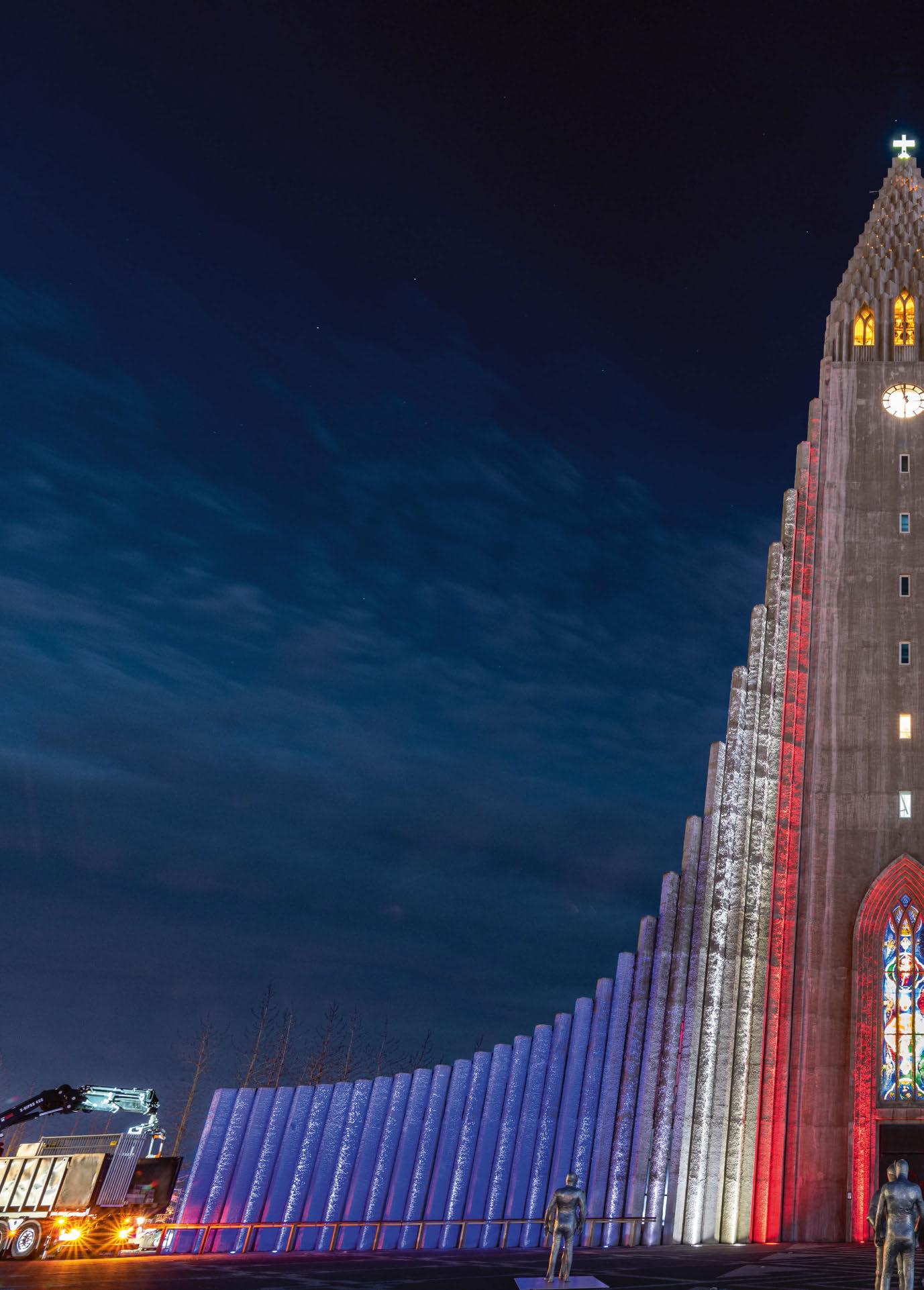
The Designer TPS works with any Pharos Designer Controller. Together, the LPCs and TPS enable automatic scheduled lighting scenes, dimming profiles and on-site manual control of the exterior lighting.
The lighting design comprises exterior lighting that grazes the façade, roof and tower with colour, including options to use colder tones to offset
106 / 107
eye opener
the warm lighting of the interior and clock tower. Carefully planned placement of the light fixtures with considered positioning has enhanced the three-dimensional surface and added contrast to the beautifully flowing texture of the façade. In addition, the luminaires are strategically located so they do not visually disrupt the architecture and surrounding public spaces. The added benefit is that their placement avoids any risk of glare to passers-by. As well as providing light for general purposes, the external lighting is programmed to celebrate religious, national and international calendar events. This is achieved through both static and dynamic lighting scenes. While these special scenes are programmed in advance to align with these calendar dates, the lighting can also be controlled directly using the Pharos Designer TPS. The introduction of RGBW lighting has enhanced this, ensuring more visually pleasing effects that embrace colour, deliver an air of excitement and give a new lease of life to the public space around the structure.

Örn Erlendsson, Lighting Designer from Liksa, said: “Hallgrímskirkja is known across the world for its striking façade and picturesque architecture. To create a lighting scheme for such an iconic place of worship is an honour. As lighting designers, we wanted to enhance its existing beauty while also offering more, such as the ability to illuminate in colour and with a dynamic approach to support key events. Every time we see Hallgrímskirkja we will feel incredibly proud.”
To aid sustainability, an automatic lighting cycle adjusts to the Nordic winter darkness, while saving energy through the brighter periods by applying dimming profiles. All exterior lights are then turned off during the night to reduce light pollution. Overall, the new scheme has delivered huge advantages to Hallgrímskirkja, improving aesthetics, flexibility and control, and sustainability.
www.liska.is
Image: Örn Erlendsson
DESIGNERS MIND
Happy to Perform
Designers Mind contributor Martina Frattura discusses “self-actualisation”, and the importance of postive mindsets on productivity.

When a title can be read in more than one way, it is up to the experience of each reader to assess how to approach it. In this case, for those familiar with the term ‘performance society’, where we use a good deal of self-regulation to stay busy and deeply productive, it may not have a positive meaning.
In fact, it is often implied that productivity, the apparent child of tight schedules, is not entirely related to the happiness of the person who is called upon to perform the task, even though various studies now prove otherwise.
If we consider the balance between reward and emotional values as an inescapable feature of maintaining self-control, every time we tackle a time-consuming task (e.g. a delivery, a presentation, etc.) we take some energy away from it.
Self-control, in fact, serves not only to avoid major temptations, but also to tune our behaviour according to the conditions we face in each specific moment of our daily lives.
And what happens when, in the grip of a pressing need, we become too hard on ourselves?
The social psychologist Baumeister called it EgoDepletion, the state of diminished resources given by a high request of self-control. Considering that we have a certain amount of energy that can be dedicated to deal with these challenges, when our mental resources are engaged, our capacity to regulate our thoughts diminishes, therefore we have less control over our emotions as well.
In other words, it seems that we may suffer emotional instability after being forced too hard on a specific request. Any coincidental moment during working hours, for example, which may not find us particularly prepared in terms of our psychophysical condition at that particular moment to deal with it, and inversely more attracted to a series of distracting temptations, leads to a weakening of the mental capacity to override negative impulses and thoughts, which may also affect the control of our emotions.
The strength of positive emotions
An emotion can be described both as short-term and long-term affective states. These, respectively, refer first to emotions that occupy the foreground of our consciousness, second to moods that appear in the background of it. They are the responses to external stimuli as well as the internal mental representations, and in both cases, they are compared to previous feelings stored in our memories.
Studies, and eventually our own direct experience, have shown that we need positive emotions to overcome any drained state.
The key to understanding why they have such a power over our mental strength is that emotions are able to recollect past feelings and give them the power to trigger them again in the present time.
It is likely that in a moment of tiredness or difficulty, one finds it difficult to consciously open oneself to a positive thought, but when we are no longer able to change a situation, we are challenged to change ourselves: a conscious decision not to let the positivity be switched off.
A brief pleasant memory is enough to trigger a domino effect of positivity. Being happy creates a cue for similar emotions, creating a loop that sticks with good thinking. In simple words, people in a good mood tend to see things in a positive light. However, the main obstacle to this is what, nowadays, we call Tunnel Vision, that is the exclusive focus on a particular emotion. As Fredrickson suggests, sometimes we just miss the big picture by getting stuck on thoughts that bring us acting and feeling in a certain way. We create ourselves an opposite loop that instead of helping us to gain our strength back, forces us towards one direction, given by our temporary inability to go over our own perspective.
The role of rituals in self-actualisation
The perception we have of ourselves, turns out to be key to overcome these obstacles. We are all different and erratic, sensitive to what is outside
108 / 109
MARTINA FRATTURA
and what belongs to our personal history. The discovery of our true self and its expression and development are necessary factors for a healthy performance and respect for our wellbeing. Of course, people will always be permeable to what is outside and the influence of the environment on people’s behaviour may help recovering from mental fatigue, helping us to think positively or negatively, but there might be more.
Letting negativity hold the reins of our moment is, in fact, a possible habit of our mind: a ritual. Often, in fact, it is automatic to put all our attention on what is exhausting our mental energies, without considering what we could do to get out of that, perhaps superficial state of consciousness. Making room, voluntarily, for positivity will be rewarded with renewed energy for the self: vitality. Vitality is defined as physical and mental energy; in fact it is linked to both physical and psychological wellbeing. It can arise from the feeling of freedom, autonomy, support and intrinsic motivation, and is associated with feelings of vigour, positive affect and calm energy.
The term energy is used here as what a person needs to cope with the difficulty of breaking out of a negative loop.

Experiencing vitality is what would manage to restore people from their mental depletion and help them with keeping on with the good mood, without fearing to fall in negativity again. And our work will benefit from it too. Feeling positive also improves executive functioning, synonymous with self-regulation and higher order cognitive processes such as directed attention. The cognitive material we have access to is in fact expanded and reorganised by positive thinking: a person can start looking for possible alternative ways of relating elements, as well as being creative about the way one looks at an element. It takes guts to be positive, but it is our superpower.
www.designers-mind.com
“The discovery of our true self and its expression and development are necessary factors for a healthy performance and respect for our wellbeing.”
Image: Pexels
Regulation and Legislation of the Circular Economy

In this issue, the GreenLight Alliance speaks to several members about the obstacles and opportunities to push towards a circular economy within lighting.

The lighting industry has begun to lean into its environmental responsibilities. It has far to go, but it’s happening. What more can be done? When the topic comes up, very often it is followed by a discussion on the associated legislation. This month we enquired of a few GreenLight Alliance members how they feel on the subject of legislation, asking “where are the obstacles and opportunities in terms of accelerating transition to a circular economy within our industry?”
Nigel Harvey, CEO, Recolight
Many companies within the lighting industry are undoubtedly starting to adopt circular economy principles. That is being driven by a growing awareness of the need for real sustainability which goes beyond energy efficiency, and embraces material efficiency as well. Many manufacturers, specifiers, and end users are now building circularity within their products. But to enable us to go further and faster, we undoubtedly need legislation and enforcement to drive the change.
That legislation should incentivise manufacturers and end users to do the right thing, and should also include mandatory requirements for products that are more “circular”.
Incentivise reuse and remanufacture
The easiest way to apply circularity in almost any situation is to keep existing product in use for longer, but with component upgrades to maximise energy efficiency. And although there is now significant interest in remanufacture within the lighting industry, it still only comprises a few percent, at best, of the total market. Government is already giving consideration to amending the WEEE regulations to recognise and reward remanufacture – possibly via a reduction in the WEEE financing obligations. But that should be extended to include fiscal measures that make reuse and remanufacture even more attractive to end users.
Incentivise ecodesign
Designing new products to embed greater longevity, durability, and upgradeability is also important. The government is currently considering incentives that could “ecomodulate” WEEE costs – with lower WEEE fees for “good” products and higher fees for “bad” products. The system is not without its challenges, but may well have merit.
Changes could also include product standards with a mandatory percentage of reused materials –particularly plastics. The painful reality is that unless recycled plastic is used in the manufacture of new products, the need for recycling at all comes into question.
Standardise the metrics
The industry is awash with a multiplicity of environmental product declarations, life cycle assessments, and similar. Knowing which to adopt is undoubtedly a challenge for all in the sector. Government could provide much needed direction and focus by encouraging or mandating a few methodologies.
Packaging
Defra has already legislated to make producers responsible for the full costs of collection and recycling of consumer packaging waste. For companies selling packaged consumer products, this will mean a significant increase in compliance costs next year. This will act as a strong incentive to reduce the amount of packaging used. Options should also be explored to extend this to commercial packaging.
Enforcement
New legislation is only effective when it is enforced. For far too long, there has been an underbelly of non-compliant product sold within our industry. With the continued growth of online marketplaces, that underbelly has swollen hugely in recent years. It is totally unacceptable for UK based manufacturers and sellers to comply with
110 / 111
GREENLIGHT ALLIANCE
legislation that is flagrantly ignored by those based mainly in the Far East, but whose products are frequently stocked within the UK and sold via online marketplaces. Any new legislation must make online intermediaries responsible for demonstrating the compliance of product sold via their platforms. Such approaches have already been implemented for some legislation in France, Spain and Germany. The UK should do likewise.
Tim Bowes, Head of Lighting Application, Whitecroft

Over the last three years, I have gained new qualifications, learned new skills, educated and learned from peers within the lighting and wider construction sector, forged new relationships, and contributed to presentations and guidance documents within the field of circularity. Many of the conversations have been inspiring, with the enthusiasm and realisation by many of the opportunity that the circular economy can bring to our sector. However, many of these activities and solutions proposed by our industry continue to happen on the fringe of current market activity. If we are to remove the obstacles and create opportunities to realise the potential to move from a linear economy to, as Ellen Macarthur said in 2013, “an industrial economy that is restorative by intention and design” at scale, transformational change is needed.
There are many obstacles to the adoption of the circular economy, such as financial constraints, timeframes, lack of infrastructure, cultural, and current business practices. For some, the only way to make this change is through legislation. Governments are in a position where they are both one of the actors and a key enabler to delivering this change. However, their opportunity to influence others goes far beyond simply legislation. Below are some examples of the ways governments at all levels can support change at scale and address some of the obstacles outlined above.

Provide a test bed
Alongside policy frameworks and legislation, governments can create the market, provide clear leadership, foster partnerships, provide financial support, and support learning. When you consider 14% of all EU spending is from public procurement, and 25% within the UK, they could provide a space for many in the built environment to work and demonstrate how the circular economy can work at scale.
Taxation
Whether the motivation is social, economic, or environmental, one of the highest sources of value creation identified by the Ellen Macarthur Foundation (see Figure 1) is to maintain and prolong what you have. Today most refurbishment work in the UK incurs a VAT rate of 20%, whereas most new build work attracts a 0% rate of VAT. Campaigns, such as ‘RetroFirst’ launched by the Architects Journal back in 2019, are in place to encourage Governments to cut VAT on refurbishment, repair and maintain to 5% or less. A similar taxation is already in place in Sweden. Rather than simply change a single policy, a policy mix can be used to amplify any change. Working in tandem with preferential taxation, could the ‘retro-first policy’ proposed recently by the City of London, support the growth in not just the re-use of structural elements but the services that are already in the building, such as lighting?
Urban Mining
Typical LED production contains up to 96 rare earth elements, five processes, and four different factories. In addition to this, 27% of the emissions for an LED occur at its disposal. With risks around geo-political events, growth of low carbon technologies, cost volatility, demand to reduce embodied carbon and inevitable increase in LED waste, will there be a need, desire and opportunity to move towards urban mining? This change would not be easy, and current infrastructure and financial models do not make this viable. Could
Figure 1: Whitecroft
governments therefore take a lead in identifying LED as a new form of e-waste, and alongside other low carbon technologies. put in place the investment and reverse logistics needed to make the re-use of these materials feasible?
Material Banks
Of the 200 tonnes of waste produced in Great Britain, 60% is produced by the construction industry. In a recent article published by the NLA, it was highlighted that although 90% of materials are recycled from construction sites, only 1% is re-used. While there is some work being done by the likes of Recolight to create material banks for lighting, government intervention and implementation of technological innovation could work alongside a change in the way we design and build in supporting the structural and systemic changes needed to connect those who want with those who have at scale.
While governments will play a key role in the delivery of the circular economy, if we are to make the existing model obsolete, we cannot rely on legislation alone to do this. We all have a part to play in breaking down the barriers and realise the opportunity of the circular economy. Perhaps this will require us all to embrace change, collaborate, listen and inform others and challenge what we know and want to do today to change tomorrow.
Bob Bohannon, Head of Policy & Academy, The LIA

When trying to create change it’s frequent for people to say: “you should change this and here’s why”. I’m guilty of this myself, but on the whole, this approach doesn’t work. In reality, it’s all about motivation and incentives. Introducing circular economy regulations will certainly act as a motivation, but it does bring other important questions into play. Circular Economy is not just about repairability: it’s about maximising the utility of extracted natural resources, keeping them at their highest value for the longest time. So, it’s also about durability.
Lighting is complex, we are not a white goods industry with a limited range of product types, we have hundreds of product types used in hundreds of different applications – how does regulation turn that complexity into simplicity and good law? The Lighting Europe team are trying to do precisely this, and it’s not easy. You then have the level playing field question: lighting is already highly regulated, if additional circular economy regulation is introduced then there must be an effective market surveillance mechanism in place, and I don’t see any evidence that government has that. Any regulation that places a burden on competitiveness, with no mechanism for market surveillance, does not pass
government’s own test for better regulation. Poor regulation disadvantages the law-abiding and does not touch those who flout the law. I might be sounding negative, but that is not the case. As an industry, we must move away from CAT A fit-outs, or products value engineered so far that not only do they not last, but they are irreparable when they fail. This might be economically sustainable for those involved, but it is not environmentally sustainable – so we either need the industry to adopt self-regulation, for example, TM66 (lent further credibility by its third-party LIA/ CIBSE certification under TM66 Assured), or accept the inevitability of government regulation, and hope that it is good regulation without unintended consequences (MEPS is an example of how not to do it).
TM66 is an excellent example of a selfregulating scheme that combines motivation and incentives. The motivation is to improve your product’s circularity by engaging with its assessment. Those using it all report that the moment they start getting their first scores, the first question they ask is ‘how do I get a better score?’ This is exactly what a sustainability metric should be, a transition tool that helps plan and report on the transition and direction of travel. The incentive is that as TM66 is a crossindustry initiative, its adoption by specifiers is also growing the demand for circular products.
Circularity is inevitable, we lived in a circular world for generations, the move to a disposable economy has been far more recent and the negative effects are all too clear. We have a good self-regulation tool in TM66, and I would not stand in the way of regulation but with the two caveats that it must be good and be supported by effective market compliance – the LIA would be happy to work with DEFRA and DESNZ on both.
Dr. Irene Mazzei, KTP Associate, Stoane Lighting

In March 2023, the Intergovernmental Panel on Climate Change (IPCC) finalised the Synthesis Report for its sixth assessment, in which data suggests that humanity is still quite far from limiting global warming to 1.5 °C – or even 2°C by 2030. Figure 2, taken from the report, shows that if no changes are made to currently implemented policies, the Greenhouse Gas emissions will keep increasing, causing global warming to reach 3.2 °C by 2100, with catastrophic effects to Earth’s ecosystems and society.
Industry produces up to a third of the net anthropogenic GHG emissions, with steel, concrete and plastic manufacturing being major contributors. The introduction of more sustainable corporate practices, such as

112 / 113 GREENLIGHT ALLIANCE
Figure 2: Synthesis Report, Intergovnermental Panel on Climate Change (IPCC)
THE KRZYSZTOF PENDERECKI EUROPEAN CENTRE FOR MUSIC
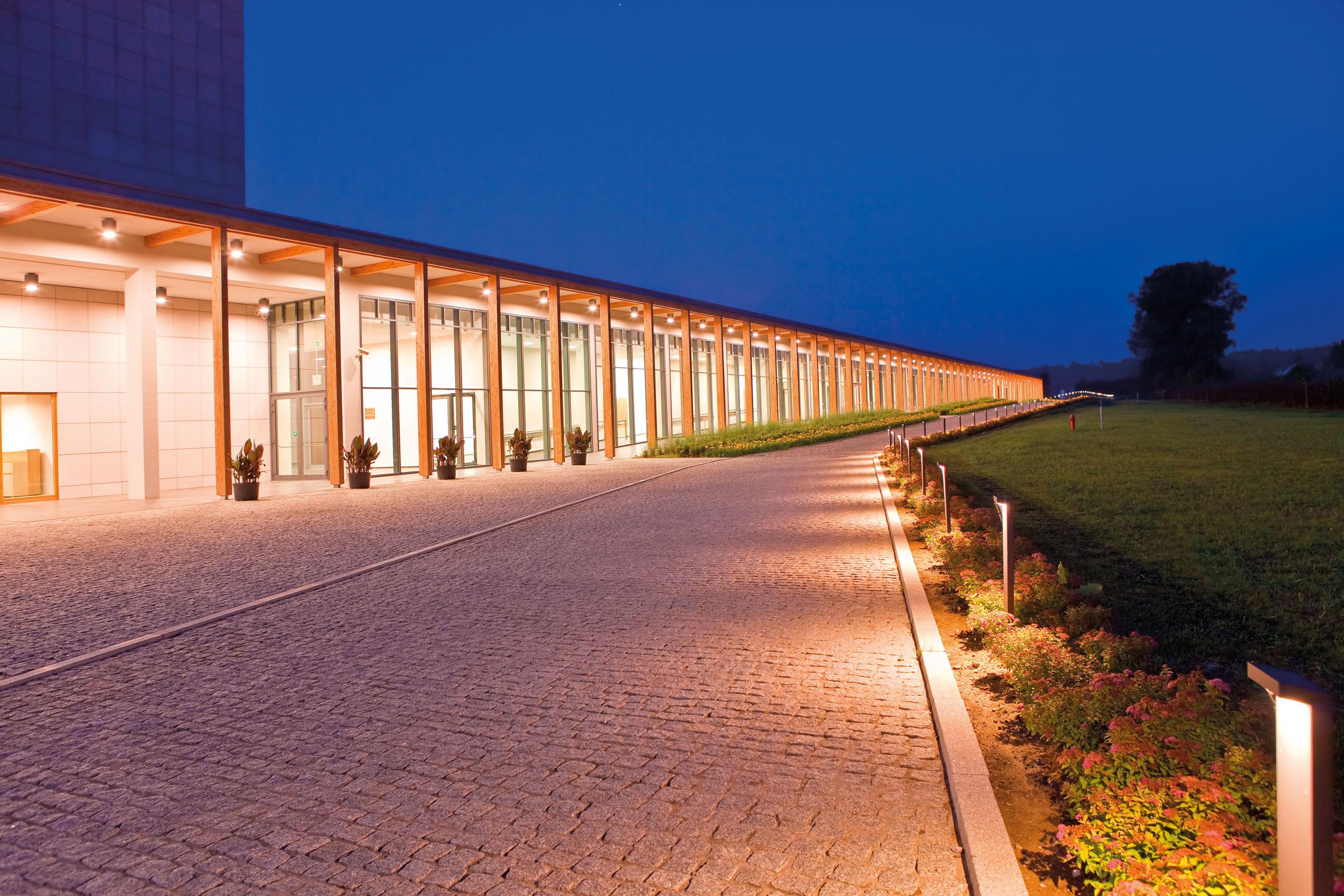 Lusławice, Poland
replacing materials with more environmentallyfriendly alternatives, switching to renewable energy providers and limiting or repurposing manufacturing waste, associated with the application of the principles of the circular economy, can help substantially reduce emissions deriving from industrial activities. The lighting industry is starting to adopt several of these strategies; however, at present, positive actions are mostly driven by internal inputs in companies that want to take steps towards greener business strategies. Looking at these internal inputs, it is also possible to identify opportunities in using and promoting sustainability assessment strategies. Quantifying environmental impacts is the first step for a company to understand where the emissions come from and what to change to reduce them. From simpler assessments, such as quantifying the embodied carbon of products or their circularity (see TM65 and TM66), to more complex Life Cycle Assessments leading to Environmental Product Declarations, being able to communicate clearly and transparently the emissions associated with products is definitely an advantageous skill for a company. However, in addition to internal initiatives, a greater “push” could be provided by external inputs coming from policymakers. In the European landscape, the last piece of the “Circular Economy and Consumers Package” puzzle was added on 22 March with the adoption of the directive on substantiation and communication of explicit environmental claims. The directive – now being discussed by the EU Parliament and Council – has the objectives of: empowering consumers with more trustworthy environmental claims on products; rewarding businesses that take genuine positive actions in improving their company’s sustainability, as opposed to those who use green claims to “greenwash” their unsustainable agendas; and establishing common rules and practices for assessing and reporting environmental information of products. Other key points of the circular economy packages include the European Commission’s ESPR proposal, the Eco-design and energy labelling working plan, and the “right to repair” directive proposal. The latter consists of a proposal recommending repair practices over total replacement of products (when practically and legally possible), especially if the costs for replacement are higher than or equal to the costs of repair.
An important requirement of the publication of environmental information as an EPD, is the application of Product Category Rules (PCRs) and/ or Product Specific Rules (PSRs) to the LCA. A robust and comprehensive set of rules specific for luminaires is provided by the Program Operator PEP Ecopassport. Their lighting PSRs make sure to cover all relevant aspects of these products so that environmental impacts are evaluated in a complete and consistent way.
The progress made by the industry in the field of sustainability is undeniable, no matter if coming from internal initiatives or necessitated by incoming policies. However, some challenges still
stand in the way of sustainability, some of them affecting the entire sustainability and life cycle assessment practice and not only the lighting industry. To mention just a few examples, harmonisation and data sourcing are two factors playing an important role. Using a number of different sustainability assessments – that produce results that are not comparable with each other – does not help the cause. In addition to this, using the same methodology but collecting data from different sources will also produce results that shouldn’t be compared, as stated in article 4(1), paragraph (a) of the Green Claims proposal. The introduction of rules to promote a more systematic and consistent approach within the industry – as done, for example by the PEP Ecopassport PSR initiative – will help reduce the variability of results in the future, leading to more harmonised practices and a “level playing field” for businesses in the industry using sustainability assessments. Finally, a higher level of alignment within the industry would be beneficial to the actors asking questions and those providing the answers on sustainability matters, such as circularity. This is why it’s important to communicate transparently on what the environmental and performance objectives are and ask/provide environmental assessments of products accordingly.
In the responses from the contributors, we see we have a circular economy assessment metric, we have embodied carbon assessment methodologies, product specific rules for LCA of luminaires, business model developments to embrace circular economy opportunities, companies and organisations to assess and validate claims, industry led work on standardisation of remanufacturing processes for luminaires and so much more.
The industry is showing encouraging initiative and striding out ahead. If one looks at assessment of products for circularity as a broad catch-all there is one good methodology, TM66, we now also see narrowed focus on durability, lifetime and repairability separately within circularity. Within impact assessment we see measurement of different impacts, embodied vs whole life carbon as an example. We also see parallel, sometimes overlapping methodologies in impact assessment. With such progress in the lighting industry and built environment the challenge facing us is to hone approaches, select preferred methodologies and through groups such as the GreenLight Alliance and industry associations make proposals to policy makers on regulation that works for the industry and delivers on the objectives to deliver meaningful sustainability improvements in our industry. Encouragingly, this is happening already. www.greenlight-alliance.com
GREENLIGHT ALLIANCE 114 / 115
This series is curated by Dave Hollingsbee of Stoane Lighting, dave@mikestoanelighting.com

Existence in Perception
Himeji City, Japan
Art collective teamLab has opened Existence in Perception, a solo exhibition at the historic Shoshazan Engyoji Temple in Himeji City, Hyogo, based upon the concept of phenomena that do not physically exist, but exist only in our perception. The exhibition, which questions the notion of existence, premieres teamLab’s newest artwork, Massless Sun, Distorted Space, alongside Giant Solidified Spark. These works lead viewers to perceive forms of light and radiance that do not physically exist, produced by phenomena born from the effects of the environments and our perception. Massless Sun, Distorted Space questions the notion of existence and what it means. The sphere of light can be clearly perceived in the space as a mass seemingly made of solidified light, however, there is no material surface boundary. The perception of the boundary between the artwork and the viewer’s body is ambiguous.
“Light does not solidify, and masses made entirely of light do not exist in the universe. In other words, this sphere of light only exists in your perception,” said teamLab. “The artwork cannot exist on its own – its existence is a phenomenon created by its environment.”
In Giant Solidified Spark (pictured), a sphere is created by infinite rays of light that radiate from a central point. The light source remains motionless, yet the countless lines emitting from it wriggle continuously. The sphere has no surface boundary, and the perception of the boundary between the artwork and the body is ambiguous. When viewers try to touch the sphere, it reacts, but since it does not have a physical boundary, their hand goes into the sphere.

The Jiki-do, the exhibition venue, is a nationally designated Important Cultural Property, and one of the three temple buildings (collectively called Mitsunodo), of the prestigious Shoshazan Engyoji Temple, which has more than 1,000 years of history, dating back to the Heian period (794-1185).
The current building is from the Muromachi period (1336-1573), and was a multipurpose space for monks, used for learning, lodging, and dining. The two-storey structure is one of Japan’s largestscale Important Cultural Properties designated by the country, and in this exhibition, teamLab has transformed its first floor, a 38-metre-long hall, into a new artwork space.
The artworks of this exhibition will lead viewers to perceive forms of light and radiance that do not physically exist, produced by phenomena born from the effects of the environment and our perception, showcasing the innovativeness of teamLab’s work. teamLab: Existence in Perception – Engyoji Temple will run until 3 December 2023. www.teamlab.art
116 / 117
eye opener
 Image: © teamLab
Plug and Play
Since its launch at Light + Building last year, the IP System from Simes has been causing a buzz among the lighting design community. Here, David Morgan takes a closer look at the range to see what all the fuss is about.
It is exciting and unusual to review a lighting system that combines a unique combination of features. The IP system from Simes is such a system. It combines an exterior rated silicone encapsulated diffuse linear lighting system with an exterior rated track system for projectors and accent lighting luminaires that can be added or removed along the length of the system.
Simes is based in Franciacorta, in the Brescia region of Italy north of Milan. The current firm was founded in 1973, although the origins of the company date back to 1957, when Edigio Botti started a metals machining company at his home. The company expanded and, in 1972, purchasing the Bruno Magnani company that specialised in exterior lighting. The company name was changed to Simes a year later and the first new product launched was a redesigned die cast bulkhead luminaire that was offered in a range of bright colours.
Under the management of Edigio Botti’s son, Roberto Botti, who has run the firm since 1990, the company has continued to grow and now employs 120 people. With sales distribution in more than 60 countries, around 70% of sales are outside Italy. All of the company’s components are designed in-house, and most are sourced from trusted local suppliers in the region.
The company has worked with a variety of highprofile designers to create new products since 1986. In 2016, I reviewed for arc magazine the innovative Simes Ghost concrete integrated range, designed by Marc Sadler.
The latest development from Simes is the IP System, which was unveiled at Light + Building in 2022 and has received an enthusiastic response from the lighting design community.
The original concept for an exterior IP rated track system was developed by Roberto Botti over many years. The eureka moment was apparently revealed in a dream when he realised the opal silicone used to encapsulate exterior linear lighting systems could also be used as a gasket in a waterproof track system. The Simes in-house design team got

to work and quickly developed a working prototype to prove the design approach.
At the heart of the IP System is a custom flexible LED tape fitted with tight pitch LEDs. This produces the light output for the linear diffuse lighting system branded as the Highlighter by Simes. Running either side of the LED circuit are two additional copper conductor strips, which are used to power the plug-in projectors and other luminaires. The side conductors have a separate power supply from the central LED strip enabling each circuit to be independently controlled. A complex dual material silicone extrusion provides the diffusion for the LEDs and aims to seal the tape from water ingress.
The electrical connections between the plug-in luminaires and the conductive copper strips are made with sharp pins that pierce through the silicone diffuser without leaving space for water ingress. The silicone extrusion is housed in an aluminium extrusion, which gives the system it’s strength and rigidity. The plug-in luminaires snap onto the aluminium extrusion with stainless steel clips. Extruded aluminium side panels are then clipped onto the body extrusion to give a clean, finished appearance.
The Highlighter is available in both surface mount and ceiling recessed versions with lengths up to four metres. The system can be cut to a 50mm module, but this has to be done by Simes during production and cannot be undertaken on site. The Highlighter without any additional snap-in luminaires is rated at IP65. When the snap-in luminaires are first added, the IP rating remains at IP65 but once these luminaires are removed and then moved to a new position the rating for the whole system drops to IP54. I assume that the puncture holes in the silicone extrusion do not completely heal and may provide a water ingress path to the LED tape.
The snap-in luminaire installation is a little more complicated than I expected and requires the use of a patented, moulded jig to ensure that the contact pins pierce the silicone extrusion perfectly
118 / 119
DAVID MORGAN
David Morgan runs David Morgan Associates, a London-based international design consultancy specialising in luminaire design and development and is also MD of Radiant Architectural Lighting. Email: david@dmadesign.co.uk Web: www.dmadesign.co.uk
perpendicular to the surface. To protect the contact pins and ensure they are not distorted, a specially designed moulded cover is provided for each snapin luminaire. Removing the luminaires from the track is also slightly difficult as the stainless-steel clips are an aggressive fit yet seem to allow the projectors in particular, to wobble slightly. It helps to remove the side panels before removing and repositioning the snap-in luminaires. For the ceiling recessed version this would mean removing the system from the ceiling before moving any of the snap in luminaires.
The sample I was given to test worked well with the caveat that there is a knack to getting the snap-in luminaires to make contact through the silicone extrusion. The lit effect from both the linear Highlighter and the snap-in luminaires was good with attractive, clean distributions.
The maximum wattage for all the snap-in luminaires per circuit is 60W, which may be limiting in some situations.
The range of plug-in luminaires includes two sizes of adjustable projectors: 5.4W and 8.6W. The larger size incorporates a zoom lens. Both sizes can be aimed and locked with grub screws. Snoot versions are also available.
In addition to the adjustable projectors, the IP System includes two styles of fixed downlight.
A rectilinear wide flood type design in two sizes rated at 4.2W and 8.4W, and a radius end type with narrower optics rated at 4.2W.

A cylindrical 4.2W pendant available in flood and wide-flood distributions completes the current range of add-on luminaires.

The design of the system is well-detailed from an appearance point of view. However, construction of the luminaires involves the use of hard setting resins, which will make servicing, reuse, or recycling of the die cast and machined aluminium components problematic at the end of life, so the system does not fit into a circular economy model particularly well. It will be interesting to see how the system copes with high levels of heat and moisture in challenging environments over the long term.
The IP System is another example of the innovative and quite daring Simes design approach to luminaire development and the initial positive reaction from specifiers indicates that it will prove to be a commercial success.
www.simes.it

Product Launches
F2222 Bridge Lighting Clear Lighting
The Flexglo F2222 bridge lighting is adaptable,, bendable, and compact, perfect for highlighting intricate details in confined spaces. With a lifespan of 50,000+ hours, 3G vibration rating robustness, and the IP68 liquid silicone injection-molded connector and ClearTech DryWire ensure water tightness and reliability in outdoor environments. It offers an even, soft glow without dangerous glare to enhance safety and aesthetics for drivers and pedestrians.


www.clearlighting.com
Light
SGM
i-1
The SGM Light i-1 Linear series brings a new level of performance and elegance to façade and grazing applications. More than 1,500 lumens/ linear foot, and extremely bright colours are delivered from a completely new dynamic LED drive engine. The tough and beautiful design is IK09 impact and 3G vibration rated. The RGBW or TW i-1 Linear is a powerful new tool for the most demanding lighting designs.
www.sgmlight.com
Ripple
Platek
The Ripple lamp is part of the Nessun Dorma catalogue, born from the collaboration with designer Jan Van Lierde. Platek worked on transparent blown glass, which defines a smooth and regular surface on the outside of the diffuser, generating abstract reflections, infinite concentric circles with a very wide diffusion radius compared to the source, which almost becomes a precious object. Ripple highlights how an outdoor light, which must necessarily be technical, can also have a strong decorative appeal and fit into the landscape, enhancing this aspect.
www.platek.eu
Compact Range LightGraphix
The Compact range has been designed with the knowledge that LightGraphix has collated from the success of its high-power products. This has allowed the company to integrate the same technology, LED engines and features into more compact sized fittings capable of impressive outputs. Delivering between 400lm-600lm, these highly configurable new additions join its existing compact downlights and include its first track mounted fixing option (LD233) and a modularised LD141 inground uplight family.
www.lightgraphix.co.uk
LED-Linargo BL-X ADO Lights
The LED-Linargo Baffle Luminaire BL-X is a compact LED lighting solution for areas where full-surface ceiling installation is not possible. Combining the baffles from Ecophon with the classic linear pendant LED-Linargo, this luminaire integrates smoothly into acoustic ceilings and ensures a homogenous ceiling appearance. Equipped with Zhaga conform LEDs and easy access to the electric components, this luminaire is fully recyclable and repairable.
www.ado-lights.com
FLXible Neon Lens 3D is bendable in two directions (vertical and horizontal) which gives you design creativity with a processional, streamlined finish. This durable, IP67 rated product provides various beam angle ranges with its optics, making it perfect for wall washing and mounting on indoor and outdoor curved surfaces.
It is field-cuttable, diverse accessory options which enriches its original lighting effects are also available; extrusion line, louver for antiglare, and angle bracket for adjustability.


www.feelux.com

120 / 121
FLXible Neon Lens 3D Feelux
3 4 1 5 2 6 1 2 4 5 6 3


The only magazine focused on lighting in architecture For more information, please contact subscriptions@mondiale.co.uk www.arc-magazine.com/subscribe
Federation Square Melbourne, Australia
Melbourne’s revamped Federation Square saw a major lighting upgrade, designed by Arup and powered by Pharos

Architectural Controls
Federation Square in Melbourne, Victoria, is an arts, culture and public events venue located on the edge of the city’s central business district. It houses a number of different event spaces, including the popular Edge Theatre. As part of a A$20m investment into capital works projects by the Victorian Government, the square’s lighting was recently overhauled to enhance the visitor experience in the evenings.
Arup was appointed to lead on the design element of the major lighting upgrade, with bluebottle supplying and commissioning the lighting technology. Pharos Architectural Controls was specified to deliver solutions that addressed a number of key requirements of the scheme, including dynamic lighting capabilities and the power to programme this lighting using its versatile software.
The majority of the LEDs across the scheme are Color Kinetics, a Philips Signify solution. These have been seamlessly integrated with a Designer LPC 1 (Lighting Playback Controller 1) and a 50-universe
Designer LPC X from Pharos, as well as Dynalite solutions for the venue’s functional interior lighting. The luminaires and the control systems work in harmony with bluebottle remote management service (BRMS). Together, they enable dynamic colour changing of the lighting across the main square façade and the atrium, as well as catenary lighting control.
The LPC 50 delivers control across all of the main external areas of Federation Square, while the LPC 1 supports local console bypass in the Edge Theatre.
Designer LPCs from Pharos Architectural Controls are built for 24/7 operation and total reliability, featuring individually controllable and independently running timelines and scenes that allow users to fully customise and pre-programme lighting effects with the freedom of real-time manual overrides, and the versatility of powerful show control and integration features. The comprehensive management system provides the Federation Square events team with the ability to manage their own event scheduling, including ad hoc lighting control as and when required. Together, the integrated package of Pharos technologies, Dynalite solutions, and BRMS has proven to be a robust yet flexible platform. The lighting control is delivered through Federation Square’s ICT network, with a dedicated VLAN. Pharos controllers are simultaneously outputting KiNet and Art-Net control protocols.
After 20 years in operation prior to the upgrade, the new lighting scheme has offered the opportunity to reimagine the lit environment of Federation Square. With a diverse programme of events, the introduction of a responsive and adaptable lighting scheme has allowed the lighting to be used to enhance these activities. It also supports wayfinding, while providing a more welcoming and inviting environment for visitors coming to the square during the darker hours.
www.arup.com
www.pharoscontrols.com
122 / 123 case study
Image: Courtesy of bluebottle
FitnGlam Dubai, UAE
Designers at Nulty used fixtures from from LEDFlex to help enhance the “vibrant and zesty” aesthetic of Dubai’s new FitnGlam gym.

FitnGlam Dubai was founded to transform the landscape of women’s fitness, representing a new concept to build and champion female minds. The interior spaces are vibrant and zesty, with dedicated areas to enjoy all the services from boutique fitness to studio classes, exercise machines and free weights. Guests are also encouraged to take time to rejuvenate in the luxury spa or refuel in the Active Café by Nolus. LEDFlex was specified by lighting designers at Nulty to give an extra dimension to the integral architectural details within FitnGlam. The reception desk is cleverly illuminated by Nano Flex 264, one of LEDFlex’s narrowest range of luminaires, concealed in the soffit, elevating the iridescent glow that welcomes visitors into the space. The overhead dark ceiling void, which combines the reception area and the merchandise section, is broken up with a large modern chandelier, hung in a deconstructed form. These unique details are edge lit using Eco Flex 180, a high efficiency solution that provides a homogenous light output, highlighting the gold mesh inserts that run alongside the luminaire. This technique is repeated in the weights area with Eco Flex 180 fittings radiating from behind the mirrored walls. Suspended cove details in the spa are lit using Ultimo Neon Silicone 16, whereas Ultimo Neon
Silicone 10 is expertly fitted into the vanity mirrors and joinery details, evenly illuminated with a seamless glow. In the Pilates studio, the lighting is relaxing and functional, where Flexi Grazer Asymmetric 110 x 70° is supplied indirectly from discreet cove details.
Pumping iron in the weights room, the black ceiling is given dynamism with three suspended hooped tracks in which Ultra Bright HL 120 RGB has been fitted, emitting a warm white light. Whilst the gym area has its own personality with linear lights complementing the wooden louvered ceiling detail. The infinity mirror corridor incorporates Pixel Flex 60 RGBW, seamlessly integrating into the vertical details and programmed to be illuminated in a full range of Pixel controlled colour combinations, giving the space an extra layer of vivacious energy. The interior design of this women’s fitness super club, combined with thoughtful lighting design helps to foster female empowerment, bringing together a strong community of women motivated by health and wellbeing and the confidence to get fit and glamorous.
www.ledflexgroup.com
www.nultylighting.co.uk
case study
Image: INC Group
The Krzysztof Penderecki European Centre for Music Lusławice, Poland

Fixtures from LUG help to improve energy efficiency at at the Krzysztof Penderecki European Centre for Music.
The Krzysztof Penderecki European Centre for Music is driven by the vision of inspiring and nurturing talented young musicians, guiding them towards artistic excellence and maturity. Through a variety of activities such as master classes, solo, chamber, and orchestra workshops, seminars, and lectures, the centre places great importance on the mentor-student relationship, upholding the cherished European values of musical education. To enhance energy efficiency and reduce CO2 emissions, the project incorporated the latest generations of LED luminaires. These luminaires not only provide optimal lighting performance but also contribute to substantial energy savings. The project presented a significant challenge due to the specific ceiling construction, necessitating the
development of solutions to enable the installation of downlight luminaires between the beams. Overcoming this obstacle was a crucial aspect of the project’s success.
LUG engineers designed a specialised luminaire, specifically tailored for this project. The luminaire’s design aimed at incorporating all functionalities to meet lighting project requirements and fitting in the unique building surroundings.
All the challenges outlined by the architect and project specifiers were fulfilled thanks to LUG’s experience and flexibility in offering custom solutions. By utilising LED technology, the designers prioritised environmental sustainability and significantly reduced energy consumption. www.luglightfactory.com
124 / 125 case study
Bridge the Gap & Glow Far

THE NEW PERFORMANCE STANDARD IN EXTERIOR GRAZING
FEATURES AND SPECIFICATIONS:
• Over 1500 lumens per linear foot

• IK09
• IP66
• C5 corrosion resistance
• 3G vibration rating

• 1, 2, 4 foot lengths (305mm, 610mm, 1220mm)

• RGB4K & 2.7-4K tunable LED engines
• DMX/RDM direct control
• 35W / ft max. power with limiting to any level
• Onboard power supplies for long run lengths
• 100-277VAC
• Precise control with glare accessories
• Custom RAL colors
/ SALES@SGMLIGHT.COM
WWW.SGMLIGHT.COM
Jakob Rope Systems Emmental, Switzerland
Luminaires from L&L Luce&Light bring a dramatic feel to the façade of Jakob Rope Systems’ Swiss headquarters.

Sitting in the midst of the lakes, mountains and quaint villages of Emmental in Switzerland, Jakob Rope Systems is an internationally renowned company with a long history. It was founded in 1904 in Trubschachen and was originally involved in the production of hemp ropes. Today, three generations later, Jakob Rope Systems is a wellestablished manufacturer of metal ropes, mesh and railings for the architecture and construction sectors, with numerous branches worldwide. A recent renovation project was overseen by the rollimarchini architectural practice, based in Bern, which had already been involved in the development of the new headquarters in Vietnam. The project’s scope was to unite and merge a number of different buildings into a single entity, and to reorganise the development and production areas. In addition, the extension of the office space made it possible not only to set up new internal processes but also to create an appropriate, well-defined and meaningful external image that immediately shows off the company’s core business. A uniform look was created for the entire structure using the firm’s own products: the wire ropes wrapped around the body of the building, giving the impression of a lightly woven fabric. Light plays an indispensable supporting role in the project: when the sun goes down, the façade can only be made out through the reflections of the illuminated steel cables. “Without lighting, the building would look inelegant,” said rollimarchini.
“During the day, the sun makes it look different in every moment; at night, this effect is achieved by the lighting on the wirework.”
In collaboration with lighting designers Sommerlatte & Sommerlatte, L&L Luce&Light’s Lyss 1.0 7W 3000K projectors were identified as having the most suitable technical characteristics for the project’s success. By carefully positioning the products between the rope layers and using 10°x180° optics, it was possible to create a bladeof-light effect directed straight onto the steel rods – from top to bottom, in order to avoid disturbing the night sky and respect the surrounding rural environment. Furthermore, the product’s light distribution curve made it possible to maximise the distances between the fixtures.
To achieve the desired result, the projectors had to be positioned directly on the horizontal poles of the metal structure supporting the cables. “The Lyss projectors fully met our requirements and, placed between the cables, give the cable structure a sensual lightness,” said rollimarchini.
The studio’s engineers worked with L&L’s technical department to design and produce a custom bracket with a curved surface to attach the fixtures to the metal frame. The result is a façade that’s one of a kind, an original combination of metal weaves, light and creativity.
www.lucelight.it
126 / 127 case study
Image: Severin Jakob


FIND OUT MORE!


ACEVEL 013 ADO Lights 081 Alto 019 Archiproducts 101 Barrisol 105 Bega 027 Clear Lighting 125 CLS-LED 012 [d]arc sessions 008, 009 Darkon 017 DW Windsor 037 ELR 025 Erco 002 Feelux 087 formalighting 006, 007 IALD 014 Intra Lighting 041 KKDC 067 Landscape 127 LED Linear 132 LiGHT 23 010, 011 LightGraphix 049 Lighting Design International 129 LUG Lighting 113 Lumascape 003 Platek 115 Proled 079 Radiant Architectural Lighting 128 Recolight 131 SGM Light 125 Tryka L.E.D 004, 005 Wibre 051 Advertisers Index Advertising enquiries should be made to Jason Pennington. Tel: +44 (0) 161 476 8350 email: j.pennington@mondiale.co.uk Please contact Radiant for product information, to see demo samples, or for a presentation www.radiantlights.co.uk | +44 ( 0 ) 208 348 9003 | david@radiantlights.co.uk | London, N6 5JW | All products designed by
D 100 WE
Exterior, DMX controlled, dynamic LED effect lighting system. Up to 800 Lumens. Working life of up to 100,000 hours. arc ad June - July 2023.indd 2 02/06/2023 10:11:29
Each
fixture incorporates an 8x LED light engine, one or two LV multi-channel DMX drivers and a textured glass panel optic. These can all be customised to create decorative, dynamic lit-effects tailored to suit project requirements.
SYSTEM IP66
CREATING ADVENTURES IN LIGHT FOR 30 YEARS
Passionate about light, creative at heart, a stickler for detail, thrives in a dynamic team environment –does this sound like you?
We are looking for two ambitious lighting designers to join our growing team. If you’re looking for a new challenge with the opportunity of working on a range of prestigious projects around the world, we would love to hear from you. Excellent written and spoken English is essential and if you have another language to add to our multi-national studio, then all the better.
SENIOR LIGHTING DESIGNER
Ideal candidates will have at least 5 years’ relevant experience with an independent lighting design consultancy. You will be self-motivated and able to demonstrate a flair for design and a high level of project management and communication skills. Experience in high-end residential and five star hotels would be an advantage.

LIGHTING DESIGNER
Ideal candidates must have at least 2 years’ experience in the lighting design industry. Although not essential, a lighting qualification would be preferred, along with a passion for design. You will be proficient in AutoCAD, Photoshop, InDesign and MS O ce. Knowledge of Revit would be an advantage. You will be motivated, enthusiastic and able to thrive under pressure.
To apply, please send your CV and portfolio to recruitment@ldi-uk.com. Please state which position you are applying for in the subject line.
Kevin J Grant LIGHTALLIANCE
What
Experience the visual phenomenon known as the ‘Firefall’.
Where
The Horsetail Fall at Yosemite National Park in California, USA.
How
Most extreme rock climbers will be aware of El Capitan - it’s the centre of the rockclimbing universe. The Horsetail Fall flows over the eastern edge of El Capitan, in Yosemite Valley. When the setting sun illuminates the Fall, it can glow with vibrant and radiant amber hues, for maybe 10 minutes or so, invoking images of fire, or molten lava.

Although it’s entirely natural, this rare phenomenon is perhaps reminiscent of the man-made Firefall shows, which historically occurred from Glacier Point in Yosemite National Park. A huge bonfire was pushed over a waterfall as part of the annual 4 July celebrations in the late 1800s and revived again for a short period until the last event in 1968.
When
This unique, natural, and magical illusion only happens when the conditions are just right, during mid to late February with a clear sky, when the ice has melted, and the waterfall is flowing.
Why
As designers we are often inspired by nature – embracing powerful images and contrasts, dynamic variations, and rich multi-sensory experiences which can enliven the senses.
www.lightalliance.com
130 / 131 bucket list #34
curated by
“To love beauty is to see light.”
Victor Hugo
Image:
© Sangeeta Dey - @Sangetadeyphotography


M *Subject to minimum quantities and fair use policy.