HOSPITALITY LIGHTING
Circa Resort & Casino Las Vegas, USA
The Circa Resort & Casino is a throwback to the classic Las Vegas skyline of years gone by, while also offering something new and exciting to visitors. Shop 12 Design worked with illumination Physics for its striking façade.
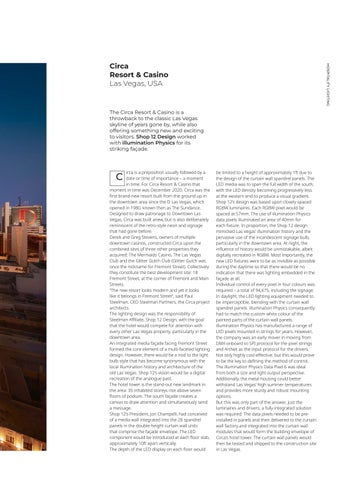
irca is a preposition usually followed by a date or time of importance – a moment in time. For Circa Resort & Casino that moment in time was December 2020. Circa was the first brand-new resort built from the ground up in the downtown area since the D Las Vegas, which opened in 1980, known then as The Sundance. Designed to draw patronage to Downtown Las Vegas, Circa was built anew, but is also deliberately reminiscent of the retro-style neon and signage that had gone before. Derek and Greg Stevens, owners of multiple downtown casinos, constructed Circa upon the combined sites of three other properties they acquired: The Mermaids Casino, The Las Vegas Club and the Glitter Gulch Club (Glitter Gulch was once the nickname for Fremont Street). Collectively they constitute the best development site: 18 Fremont Street, at the corner of Fremont and Main Streets. “The new resort looks modern and yet it looks like it belongs in Fremont Street”, said Paul Steelman, CEO Steelman Partners, the Circa project architects. The lighting design was the responsibility of Steelman Affiliate, Shop 12 Design, with the goal that the hotel would compete for attention with every other Las Vegas property, particularly in the downtown area. An integrated media façade facing Fremont Street formed the core element of a multi-faceted lighting design. However, there would be a nod to the light bulb style that has become synonymous with the local illumination history and architecture of the old Las Vegas. Shop 12’s vision would be a digital recreation of the analogue past. The hotel tower is the stand-out new landmark in the area: 35 inhabited storeys rise above seven floors of podium. The south façade creates a canvas to draw attention and simultaneously send a message. Shop 12’s President, Jon Champelli, had conceived of a media wall integrated into the 28 spandrel panels in the double-height curtain wall units that comprise the façade envelope. The LED component would be introduced at each floor slab, approximately 10ft apart vertically. The depth of the LED display on each floor would
C
be limited to a height of approximately 1ft due to the design of the curtain wall spandrel panels. The LED media was to span the full width of the south, with the LED density becoming progressively less at the western end to produce a visual gradient. Shop 12’s design was based upon closely spaced RGBW luminaires. Each RGBW pixel would be spaced at 57mm. The use of illumination Physics data pixels illuminated an area of 40mm for each fixture. In proportion, the Shop 12 design mimicked Las Vegas’ illumination history and the pervasive use of the incandescent signage bulb, particularly in the downtown area. At night, the influence of history would be unmistakable, albeit digitally recreated in RGBW. Most importantly, the new LED fixtures were to be as invisible as possible during the daytime so that there would be no indication that there was lighting embedded in the façade at all. Individual control of every pixel in four colours was required – a total of 94,675, including the signage. In daylight, the LED lighting equipment needed to be imperceptible, blending with the curtain wall spandrel panels. illumination Physics consequently had to match the custom white colour of the painted parts of the curtain wall panels. illumination Physics has manufactured a range of LED pixels mounted in strings for years. However, the company was an early mover in moving from DMX onboard to SPI protocol for the pixel strings and ArtNet as the input protocol for the drivers. Not only highly cost-effective, but this would prove to be the key to defining the method of control. The illumination Physics Data Pixel 6 was ideal from both a size and light output perspective. Additionally, the metal housing could better withstand Las Vegas’ high summer temperatures and provides more sturdy and robust mounting options. But this was only part of the answer, just the luminaires and drivers; a fully integrated solution was required: The data pixels needed to be preinstalled in panels and then delivered to the curtain wall factory and integrated into the curtain wall modules that would form the building envelope of Circa’s hotel tower. The curtain wall panels would then be tested and shipped to the construction site in Las Vegas.