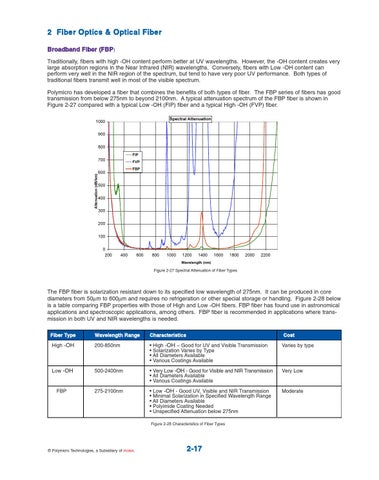
2 Fiber Optics & Optical Fiber Broadband Fiber (FBP) Traditionally, fibers with high -OH content perform better at UV wavelengths. However, the -OH content creates very large absorption regions in the Near Infrared (NIR) wavelengths. Conversely, fibers with Low -OH content can perform very well in the NIR region of the spectrum, but tend to have very poor UV performance. Both types of traditional fibers transmit well in most of the visible spectrum. Polymicro has developed a fiber that combines the benefits of both types of fiber. The FBP series of fibers has good transmission from below 275nm to beyond 2100nm. A typical attenuation spectrum of the FBP fiber is shown in Figure 2-27 compared with a typical Low -OH (FIP) fiber and a typical High -OH (FVP) fiber. Spectral Attenuation
1000 900 800 FIP
Attenuation (dB/km)
700
FVP FBP
600 500 400 300 200 100 0 200
400
600
800
1000
1200
1400
1600
1800
2000
2200
Wavelength (nm)
Figure 2-27 Spectral Attenuation of Fiber Types
The FBP fiber is solarization resistant down to its specified low wavelength of 275nm. It can be produced in core diameters from 50µm to 600µm and requires no refrigeration or other special storage or handling. Figure 2-28 below is a table comparing FBP properties with those of High and Low -OH fibers. FBP fiber has found use in astronomical applications and spectroscopic applications, among others. FBP fiber is recommended in applications where transmission in both UV and NIR wavelengths is needed. Fiber Type
Wavelength Range
Characteristics
Cost
High -OH
200-850nm
• High -OH – Good for UV and Visible Transmission • Solarization Varies by Type • All Diameters Available • Various Coatings Available
Varies by type
Low -OH
500-2400nm
• Very Low -OH - Good for Visible and NIR Transmission • All Diameters Available • Various Coatings Available
Very Low
FBP
275-2100nm
• Low -OH - Good UV, Visible and NIR Transmission • Minimal Solarization in Specified Wavelength Range • All Diameters Available • Polyimide Coating Needed • Unspecified Attenuation below 275nm
Moderate
Figure 2-28 Characteristics of Fiber Types
© Polymicro Technologies, a Subsidiary of molex.
2-17