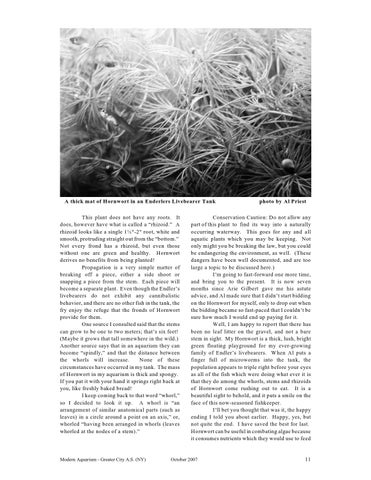
A thick mat of Hornwort in an Enderlers Livebearer Tank This plant does not have any roots. It does, however have what is called a “rhizoid.” A rhizoid looks like a single 1½"-2" root, white and smooth, protruding straight out from the “bottom.” Not every frond has a rhizoid, but even those without one are green and healthy. Hornwort derives no benefits from being planted! Propagation is a very simple matter of breaking off a piece, either a side shoot or snapping a piece from the stem. Each piece will become a separate plant. Even though the Endler’s livebearers do not exhibit any cannibalistic behavior, and there are no other fish in the tank, the fry enjoy the refuge that the fronds of Hornwort provide for them. One source I consulted said that the stems can grow to be one to two meters; that’s six feet! (Maybe it grows that tall somewhere in the wild.) Another source says that in an aquarium they can become “spindly,” and that the distance between the whorls will increase. None of these circumstances have occurred in my tank. The mass of Hornwort in my aquarium is thick and spongy. If you pat it with your hand it springs right back at you, like freshly baked bread! I keep coming back to that word “whorl,” so I decided to look it up. A whorl is “an arrangement of similar anatomical parts (such as leaves) in a circle around a point on an axis,” or, whorled “having been arranged in whorls (leaves whorled at the nodes of a stem).”
Modern Aquarium - Greater City A.S. (NY)
photo by Al Priest
Conservation Caution: Do not allow any part of this plant to find its way into a naturally occurring waterway. This goes for any and all aquatic plants which you may be keeping. Not only might you be breaking the law, but you could be endangering the environment, as well. (These dangers have been well documented, and are too large a topic to be discussed here.) I’m going to fast-forward one more time, and bring you to the present. It is now seven months since Arie Gilbert gave me his astute advice, and Al made sure that I didn’t start bidding on the Hornwort for myself, only to drop out when the bidding became so fast-paced that I couldn’t be sure how much I would end up paying for it. W ell, I am happy to report that there has been no leaf litter on the gravel, and not a bare stem in sight. My Hornwort is a thick, lush, bright green floating playground for my ever-growing family of Endler’s livebearers. W hen Al puts a finger full of microworms into the tank, the population appears to triple right before your eyes as all of the fish which were doing what ever it is that they do among the whorls, stems and rhizoids of Hornwort come rushing out to eat. It is a beautiful sight to behold, and it puts a smile on the face of this now-seasoned fishkeeper. I’ll bet you thought that was it, the happy ending I told you about earlier. Happy, yes, but not quite the end. I have saved the best for last. Hornwort can be useful in combating algae because it consumes nutrients which they would use to feed
October 2007
11