Livebearers Lacking a Thingy Story and Photos by Allen Wood
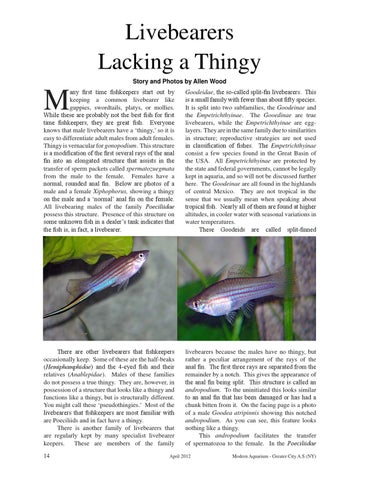
any first time fishkeepers start out by keeping a common livebearer like guppies, swordtails, platys, or mollies. While these are probably not the best fish for first time fishkeepers, they are great fish. Everyone knows that male livebearers have a ‘thingy,’ so it is easy to differentiate adult males from adult females. Thingy is vernacular for gonopodium. This structure is a modification of the first several rays of the anal fin into an elongated structure that assists in the transfer of sperm packets called spermatozuegmata from the male to the female. Females have a normal, rounded anal fin. Below are photos of a male and a female Xiphophorus, showing a thingy on the male and a ‘normal’ anal fin on the female. All livebearing males of the family Poeciliidae possess this structure. Presence of this structure on some unknown fish in a dealer’s tank indicates that the fish is, in fact, a livebearer.
M
Goodeidae, the so-called split-fin livebearers. This is a small family with fewer than about fifty species. It is split into two subfamilies, the Goodeinae and the Empetrichthyinae. The Gooedinae are true livebearers, while the Empetrichthyinae are egglayers. They are in the same family due to similarities in structure; reproductive strategies are not used in classification of fishes. The Empetrichthyinae consist a few species found in the Great Basin of the USA. All Empetrichthyinae are protected by the state and federal governments, cannot be legally kept in aquaria, and so will not be discussed further here. The Goodeinae are all found in the highlands of central Mexico. They are not tropical in the sense that we usually mean when speaking about tropical fish. Nearly all of them are found at higher altitudes, in cooler water with seasonal variations in water temperatures. These Goodeids are called split-finned
There are other livebearers that fishkeepers occasionally keep. Some of these are the half-beaks (Hemiphamphidae) and the 4-eyed fish and their relatives (Anablepidae). Males of these families do not possess a true thingy. They are, however, in possession of a structure that looks like a thingy and functions like a thingy, but is structurally different. You might call these ‘pseudothingies.’ Most of the livebearers that fishkeepers are most familiar with are Poeciliids and in fact have a thingy. There is another family of livebearers that are regularly kept by many specialist livebearer keepers. These are members of the family
livebearers because the males have no thingy, but rather a peculiar arrangement of the rays of the anal fin. The first three rays are separated from the remainder by a notch. This gives the appearance of the anal fin being split. This structure is called an andropodium. To the uninitiated this looks similar to an anal fin that has been damaged or has had a chunk bitten from it. On the facing page is a photo of a male Goodea atripinnis showing this notched andropodium. As you can see, this feature looks nothing like a thingy. This andropodium facilitates the transfer of spermatozoa to the female. In the Poeciliidae
14
April 2012
Modern Aquarium - Greater City A.S (NY)