8
Thursday, March 22, 2018
West Bank residents want diverse cops Cedar-Riverside residents are asking MPD to appoint diverse officers. BY ISABELLA MURRAY imurray@mndaily.com
Cedar-Riverside residents and city officials are calling for greater diversity in the Minneapolis Police Department. Neighborhood residents argue that having more East African officers on the force will build trust between police and the community. Requests for more East African officers came after two Somali officers patrolling Cedar-Riverside were promoted to sergeants. “Constituents have come and asked for officers that speak their languages and understand them better,” said Ward 6 Minneapolis City Council member Abdi Warsame. “[Having East African officers] breaks down barriers of understanding between law enforcement and residents that can occur from language and cultural differences.” Just 8 percent of sworn MPD officers are of African American descent, according to MPD human resources consultant Dan Villarreal. MPD doesn’t segment minority groups further than African American, Hispanic, Native American, Hawaiian and Asian. While MPD numbers aren’t specified further than general minority groups, Sergeant Dave Burbank said the department does have community engagement teams to conduct outreach with certain minority groups. There is an engagement team specifically for the East African community.
“We are working to diversify our police force, so there is a need to get more East African officers on the department,” Burbank said. Community service officers are part of this diversification process. CSOs assist the police department and community by mediating between department personnel and local communities. CSOs can eventually become full-time police officers, according to Burbank. “We have three CSOs that are of Somali descent. We had four, but one was just promoted to the cadet academy to become a fulltime officer,” he said. Two Somali police officers, Abdiwahab Ali and Mohammed Abdullahi, previously served the community. But the two left their roles as patrolling officers after being promoted to sergeants. Though this was a success for the officers, Warsame said their departure has resulted in a loss of trust between the community and MPD. “ T h e n e i g h b o rh o o d knew Officers Mo and Ali by name and asked for them by name during emergencies,” Warsame said. “That extreme sense of trust and comfortability was built over time and is hard to replicate with officers not as familiar with the community.” Mohamed Ali, director of the Cedar Riverside Opportunity Center, said there’s been a notable shift in the officers community members confide in. “With Mo and Ali, we’d be praying with them at the mosque, sitting with them at the restaurants. On Friday, you’d see them in uniforms, and on Saturday you’d play soccer with them,” he said. Abdirizak Bihi, director
ANANYA MISHRA, DAILY
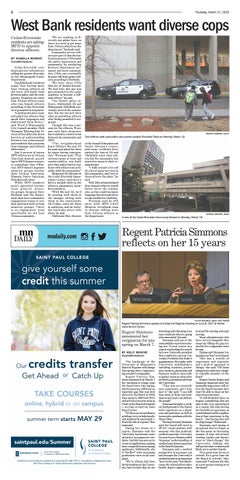
Two children walk past police cars parked outside Riverside Plaza on Monday, March 19.
of the Somali Education and Social Advocacy Center, said some residents have noticed the loss of Ali and Abdullahi more than others, but the community has started to warm to their replacements. “I walk around a lot and do a lot of social services in the community, and I see officers all over the place,” he said. Still, Bihi acknowledged that Somali officers would better serve the community, as they could navigate language barriers and serve as role models for residents. Warsame said he will meet with MPD Chief Medaria Arradondo soon to discuss adding more East African officers to the department.
A view of the Cedar-Riverside Community School on Monday, March 19.
ANANYA MISHRA, DAILY
Regent Patricia Simmons reflects on her 15 years
ELLEN SCHMIDT, DAILY FILE PHOTO
Regent Patricia Simmons speaks at a Board of Regents meeting on June 8, 2017 at McNamara Alumni Center.
Regent Simmons announced her resignation for late spring on March 7. BY KELLY BUSCHE kbusche@mndaily.com
The landscape of the University of Minnesota’s Board of Regents will change this spring after a long-serving member’s resignation. Regent Patricia Simmons announced on March 7 her intention to resign from the board later this spring, which many say will leave an expertise gap. She was first elected to the board in 2003, then again in 2009 and 2015, and served a two-year term as Chair of the Board of Regents — serving in total for more than 15 years. “It’s been an extraordinary privilege to try to help faculty and students be successful — that’s the role of regents,” Simmons said. During her tenure as a regent, Simmons said the University has become more attractive to prospective students. And she has seen an increase in applications, causing more competitiveness among applicants. Additionally, she is “thrilled” with increasing graduation rates on all campuses. “We’ve always had wonderful students at the University, but it’s clear that we are
attracting and educating even more students who are going to be successful,” she said. Simmons said one of the most notable experiences during her 15-year tenure as a regent was leading the search for a new University president that resulted in current University President Eric Kaler’s appointment. She spoke with University stakeholders, including students, professors, farmers, physicians and business leaders statewide to gather input on what they needed in a president and from the University. “That was an extraordinary experience, and I treasure it,” she said. “I can still hear some of those conversations in my head. I can still see the people.” Simmons brought a medical background to the Board, with experience as a physician and professor, as well as in executive positions with the Mayo Clinic. Moving forward, Simmons said the board will need to fill her vacant position with someone who has academic medical expertise. University Provost Karen Hanson called Simmons’ understanding of medical operations important to the Board’s function. Simmons said a medical perspective is necessary not only because the University’s medical school is an important “force in the state,” but also because the school offers other health degree opportunities
in areas like nursing and engineering. Many administrators who have served alongside Simmons say filling the gap created by her resignation won’t be easy. Hanson said Simmons’ resignation is a “loss” to the board. “She has a wealth of experience and expertise and a kind of approach to things,” she said. “All those things have made her a hugely valuable member of the board.” Regent Darrin Rosha said Simmons’ departure after her unusually long tenure will affect the board because they won’t be able to draw on her experiences anymore. “It will definitely have an impact, considering that not only is she very experienced as a regent, but also having her breadth of experience as a professional and her application of that experience to the board. … Not having that will be a big change,” Rosha said. Simmons said spring is an optimal time to resign, as she has spent an increasing amount of time out-of-state visiting family and doesn’t want to “short-change” the University. Adding, she will pursue other ventures and likely serve on other boards. “It’s a great time for me to refresh. It’s a great time for the Board to refresh,” Simmons said. “I welcome the idea of a new person coming on to the board.”