they were married in 1865 and continued to reside in the northern building until their deaths in the 1920s. Both were buried in the Bowie family cemetery to the east of the main house. Lizzie worked in the Fairview mansion, while Basil served as a farm laborer. One of the buildings burned and a new cinder block tenant house was built on the same spot. Children’s toys (e.g., marbles, dolls) found in the vicinity of the structure imply the presence of families. Most tenants raised their own gardens to feed their families; garden staples included white potatoes, sweet potatoes, turnips and greens. Much of the extra food was canned and remnants of canning jars were recovered in the excavations.
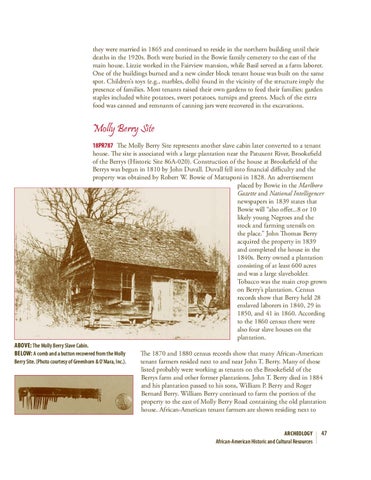
Molly Berry Site 18PR787 The Molly Berry Site represents another slave cabin later converted to a tenant house. The site is associated with a large plantation near the Patuxent River, Brookefield of the Berrys (Historic Site 86A-020). Construction of the house at Brookefield of the Berrys was begun in 1810 by John Duvall. Duvall fell into financial difficulty and the property was obtained by Robert W. Bowie of Mattaponi in 1828. An advertisement placed by Bowie in the Marlboro Gazette and National Intelligencer newspapers in 1839 states that Bowie will “also offer...8 or 10 likely young Negroes and the stock and farming utensils on the place.” John Thomas Berry acquired the property in 1839 and completed the house in the 1840s. Berry owned a plantation consisting of at least 600 acres and was a large slaveholder. Tobacco was the main crop grown on Berry’s plantation. Census records show that Berry held 28 enslaved laborers in 1840, 29 in 1850, and 41 in 1860. According to the 1860 census there were also four slave houses on the plantation. ABOVE: The Molly Berry Slave Cabin. BELOW: A comb and a button recovered from the Molly Berry Site. (Photo courtesy of Greenhorn & O’Mara, Inc.).
The 1870 and 1880 census records show that many African-American tenant farmers resided next to and near John T. Berry. Many of those listed probably were working as tenants on the Brookefield of the Berrys farm and other former plantations. John T. Berry died in 1884 and his plantation passed to his sons, William P. Berry and Roger Bernard Berry. William Berry continued to farm the portion of the property to the east of Molly Berry Road containing the old plantation house. African-American tenant farmers are shown residing next to
ARCHEOLOGY African-American Historic and Cultural Resources
47