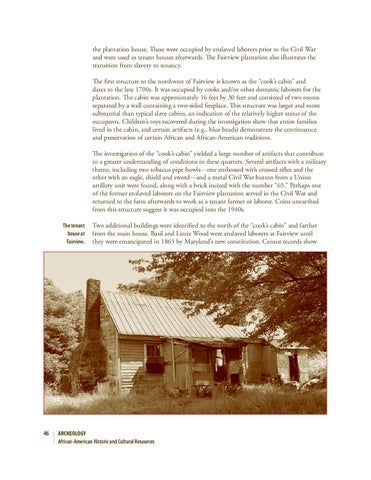
the plantation house. These were occupied by enslaved laborers prior to the Civil War and were used as tenant houses afterwards. The Fairview plantation also illustrates the transition from slavery to tenancy. The first structure to the northwest of Fairview is known as the “cook’s cabin” and dates to the late 1700s. It was occupied by cooks and/or other domestic laborers for the plantation. The cabin was approximately 16 feet by 30 feet and consisted of two rooms separated by a wall containing a two-sided fireplace. This structure was larger and more substantial than typical slave cabins, an indication of the relatively higher status of the occupants. Children’s toys recovered during the investigation show that entire families lived in the cabin, and certain artifacts (e.g., blue beads) demonstrate the continuance and preservation of certain African and African-American traditions. The investigation of the “cook’s cabin” yielded a large number of artifacts that contribute to a greater understanding of conditions in these quarters. Several artifacts with a military theme, including two tobacco pipe bowls—one embossed with crossed rifles and the other with an eagle, shield and sword—and a metal Civil War button from a Union artillery unit were found, along with a brick incised with the number “65.” Perhaps one of the former enslaved laborers on the Fairview plantation served in the Civil War and returned to the farm afterwards to work as a tenant farmer or laborer. Coins unearthed from this structure suggest it was occupied into the 1940s. The tenant house at Fairview.
46
Two additional buildings were identified to the north of the “cook’s cabin” and farther from the main house. Basil and Lizzie Wood were enslaved laborers at Fairview until they were emancipated in 1865 by Maryland’s new constitution. Census records show
ARCHEOLOGY African-American Historic and Cultural Resources