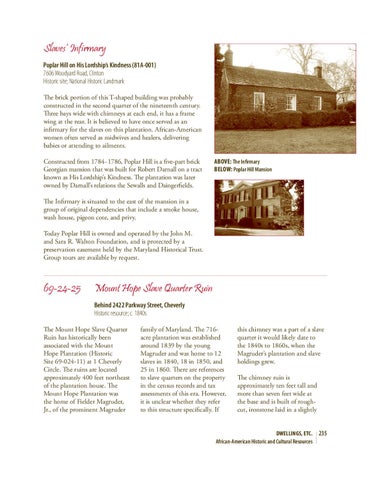
Slaves’ Infirmary Poplar Hill on His Lordship’s Kindness (81A-001) 7606 Woodyard Road, Clinton Historic site; National Historic Landmark The brick portion of this T-shaped building was probably constructed in the second quarter of the nineteenth century. Three bays wide with chimneys at each end, it has a frame wing at the rear. It is believed to have once served as an infirmary for the slaves on this plantation. African-American women often served as midwives and healers, delivering babies or attending to ailments. Constructed from 1784–1786, Poplar Hill is a five-part brick Georgian mansion that was built for Robert Darnall on a tract known as His Lordship’s Kindness. The plantation was later owned by Darnall’s relations the Sewalls and Daingerfields.
ABOVE: The Infirmary BELOW: Poplar Hill Mansion
The Infirmary is situated to the east of the mansion in a group of original dependencies that include a smoke house, wash house, pigeon cote, and privy. Today Poplar Hill is owned and operated by the John M. and Sara R. Walton Foundation, and is protected by a preservation easement held by the Maryland Historical Trust. Group tours are available by request.
69-24-25
Mount Hope Slave Quarter Ruin Behind 2422 Parkway Street, Cheverly Historic resource; c. 1840s
The Mount Hope Slave Quarter Ruin has historically been associated with the Mount Hope Plantation (Historic Site 69-024-11) at 1 Cheverly Circle. The ruins are located approximately 400 feet northeast of the plantation house. The Mount Hope Plantation was the home of Fielder Magruder, Jr., of the prominent Magruder
family of Maryland. The 716acre plantation was established around 1839 by the young Magruder and was home to 12 slaves in 1840, 18 in 1850, and 25 in 1860. There are references to slave quarters on the property in the census records and tax assessments of this era. However, it is unclear whether they refer to this structure specifically. If
this chimney was a part of a slave quarter it would likely date to the 1840s to 1860s, when the Magruder’s plantation and slave holdings grew. The chimney ruin is approximately ten feet tall and more than seven feet wide at the base and is built of roughcut, ironstone laid in a slightly
DWELLINGS, ETC. African-American Historic and Cultural Resources
235