70-87
Good Luck School 7600 Northern Avenue Historic resource; built 1899
T
he Good Luck School is one of the oldest extant schoolhouses in Prince George’s County. The school was originally designated as Colored School 2 in District 14; it was also known as the Glenn Dale Colored School. This oneroom schoolhouse is an example of vernacular educational architecture dating from the turn of the twentieth century.
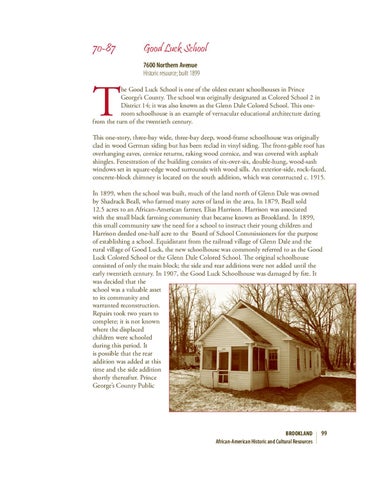
This one-story, three-bay wide, three-bay deep, wood-frame schoolhouse was originally clad in wood German siding but has been reclad in vinyl siding. The front-gable roof has overhanging eaves, cornice returns, raking wood cornice, and was covered with asphalt shingles. Fenestration of the building consists of six-over-six, double-hung, wood-sash windows set in square-edge wood surrounds with wood sills. An exterior-side, rock-faced, concrete-block chimney is located on the south addition, which was constructed c. 1915. In 1899, when the school was built, much of the land north of Glenn Dale was owned by Shadrack Beall, who farmed many acres of land in the area. In 1879, Beall sold 12.5 acres to an African-American farmer, Elias Harrison. Harrison was associated with the small black farming community that became known as Brookland. In 1899, this small community saw the need for a school to instruct their young children and Harrison deeded one-half acre to the Board of School Commissioners for the purpose of establishing a school. Equidistant from the railroad village of Glenn Dale and the rural village of Good Luck, the new schoolhouse was commonly referred to as the Good Luck Colored School or the Glenn Dale Colored School. The original schoolhouse consisted of only the main block; the side and rear additions were not added until the early twentieth century. In 1907, the Good Luck Schoolhouse was damaged by fire. It was decided that the school was a valuable asset to its community and warranted reconstruction. Repairs took two years to complete; it is not known where the displaced children were schooled during this period. It is possible that the rear addition was added at this time and the side addition shortly thereafter. Prince George’s County Public
BROOKLAND African-American Historic and Cultural Resources
99