ECCENTRIC WORKSPACE: A WORKSHOP OF THE GLOBAL ART PROGRAM (GAP) LED BY ASSISTANT PROFESSOR TAMAO HASHIMOTO (TOKYO UNIVERSITY OF THE ARTS)
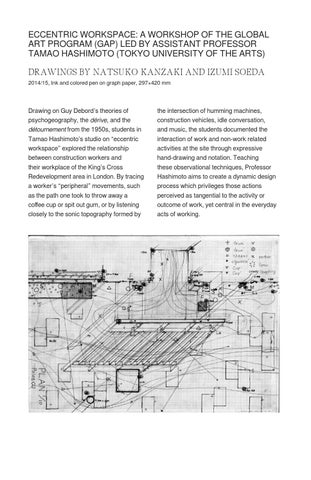
DRAWINGS BY NATSUKO KANZAKI AND IZUMI SOEDA 2014/15, Ink and colored pen on graph paper, 297×420 mm
Drawing on Guy Debord’s theories of psychogeography, the dérive, and the détournement from the 1950s, students in Tamao Hashimoto’s studio on “eccentric workspace” explored the relationship between construction workers and their workplace of the King’s Cross Redevelopment area in London. By tracing a worker’s “peripheral” movements, such as the path one took to throw away a coffee cup or spit out gum, or by listening closely to the sonic topography formed by
the intersection of humming machines, construction vehicles, idle conversation, and music, the students documented the interaction of work and non-work related activities at the site through expressive hand-drawing and notation. Teaching these observational techniques, Professor Hashimoto aims to create a dynamic design process which privileges those actions perceived as tangential to the activity or outcome of work, yet central in the everyday acts of working.