Acid Ecologies
This thesis seeks to unpack the nature of ecology within architecture, not as a neutral science, but a legitimizing construct, building a future and transforming the ethics of the present towards very deliberate ideological ends, and contingent on certain practices of alienation which themselves have historically laid the groundwork for later environmental and social crisis. The project takes place in Almeria Spain, which in the last forty-five years has gone from the poorest region in Spain to one of the richest, through the wide scale application of greenhouse urbanism. Almeria is currently the largest intensive agriculture site in the world (80,000acres) and supplies the majority of winter produce to Europe. However, Almeria is also, in many ways, an accelerated microcosm of larger contemporary ecological paradigms, what Keller Easterling called an autonomous world, Almeria is a place in which the apparent neutrality of ecological ideologies are consistently leveraged towards technological transformations of the landscape precipitating widespread environmental and social fallout conditions. In Almeria, Ecological ideologies consistently serve as the legitimizing platforms by which transformation after transformation (each promising an ideal future) compound the effects of peripheral disaster all under the guise of a seemingly neutral science. The thesis argues that within a condition in which neutral ecology is leveraged to legitimize specific ideological and economic positions, it may actually be the task of an ecological architecture to irrigate radical alternatives, not as ideal futures, but as provisional presents, alternate ecological life rafts within contested environmental conditions.
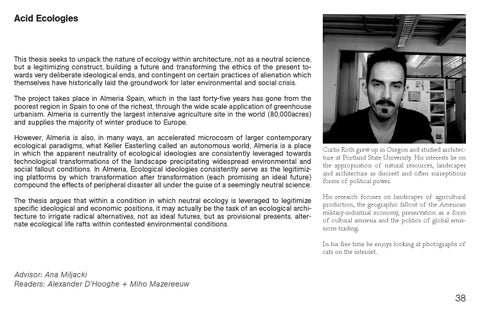
Curtis Roth grew up in Oregon and studied architecture at Portland State University. His interests lie on the appropriation of natural resources, landscapes and architecture as discreet and often surreptitious forms of political power. His research focuses on landscapes of agricultural production, the geographic fallout of the American military-industrial economy, preservation as a form of cultural amnesia and the politics of global emissions trading. In his free time he enjoys looking at photographs of cats on the internet.
Advisor: Ana Miljacki Readers: Alexander D’Hooghe + Miho Mazereeuw
38