The Ghost City in China: A Revitalization Strategy for Ordos Difei Xu Advisor: Brent Ryan, Readers: Michael Dennis, Tunney Lee
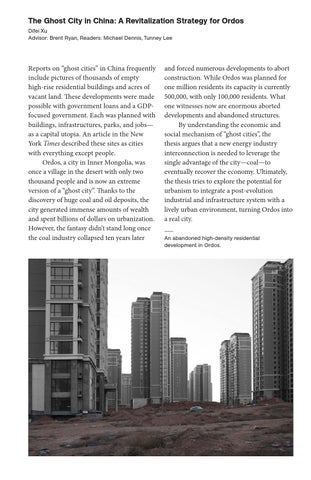
Reports on “ghost cities” in China frequently include pictures of thousands of empty high-rise residential buildings and acres of vacant land. These developments were made possible with government loans and a GDPfocused government. Each was planned with buildings, infrastructures, parks, and jobs— as a capital utopia. An article in the New York Times described these sites as cities with everything except people. Ordos, a city in Inner Mongolia, was once a village in the desert with only two thousand people and is now an extreme version of a “ghost city”. Thanks to the discovery of huge coal and oil deposits, the city generated immense amounts of wealth and spent billions of dollars on urbanization. However, the fantasy didn’t stand long once the coal industry collapsed ten years later
and forced numerous developments to abort construction. While Ordos was planned for one million residents its capacity is currently 500,000, with only 100,000 residents. What one witnesses now are enormous aborted developments and abandoned structures. By understanding the economic and social mechanism of “ghost cities”, the thesis argues that a new energy industry interconnection is needed to leverage the single advantage of the city—coal—to eventually recover the economy. Ultimately, the thesis tries to explore the potential for urbanism to integrate a post-evolution industrial and infrastructure system with a lively urban environment, turning Ordos into a real city. An abandoned high-density residential development in Ordos.