Interstitial DenCity: A Strategy for the Hyper-Densification of Chinese Urban Villages Jinhui Huang Advisor: J. Meejin Yoon; Readers: Arindam Dutta, Brent D. Ryan
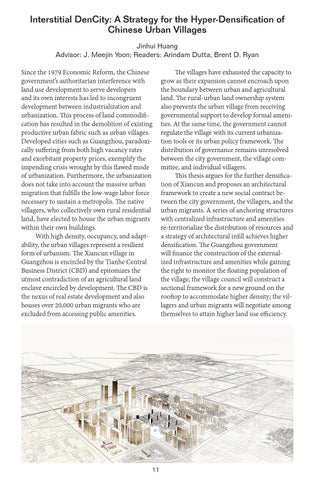
Since the 1979 Economic Reform, the Chinese government’s authoritarian interference with land use development to serve developers and its own interests has led to incongruent development between industrialization and urbanization. This process of land commodification has resulted in the demolition of existing productive urban fabric such as urban villages. Developed cities such as Guangzhou, paradoxically suffering from both high vacancy rates and exorbitant property prices, exemplify the impending crisis wrought by this flawed mode of urbanization. Furthermore, the urbanization does not take into account the massive urban migration that fulfills the low-wage labor force necessary to sustain a metropolis. The native villagers, who collectively own rural residential land, have elected to house the urban migrants within their own buildings. With high density, occupancy, and adaptability, the urban villages represent a resilient form of urbanism. The Xiancun village in Guangzhou is encircled by the Tianhe Central Business District (CBD) and epitomizes the utmost contradiction of an agricultural land enclave encircled by development. The CBD is the nexus of real estate development and also houses over 20,000 urban migrants who are excluded from accessing public amenities.
11
The villages have exhausted the capacity to grow as their expansion cannot encroach upon the boundary between urban and agricultural land. The rural-urban land ownership system also prevents the urban village from receiving governmental support to develop formal amenities. At the same time, the government cannot regulate the village with its current urbanization tools or its urban policy framework. The distribution of governance remains unresolved between the city government, the village committee, and individual villagers. This thesis argues for the further densification of Xiancun and proposes an architectural framework to create a new social contract between the city government, the villagers, and the urban migrants. A series of anchoring structures with centralized infrastructure and amenities re-territorialize the distribution of resources and a strategy of architectural infill achieves higher densification. The Guangzhou government will finance the construction of the externalized infrastructure and amenities while gaining the right to monitor the floating population of the village; the village council will construct a sectional framework for a new ground on the rooftop to accommodate higher density; the villagers and urban migrants will negotiate among themselves to attain higher land use efficiency.