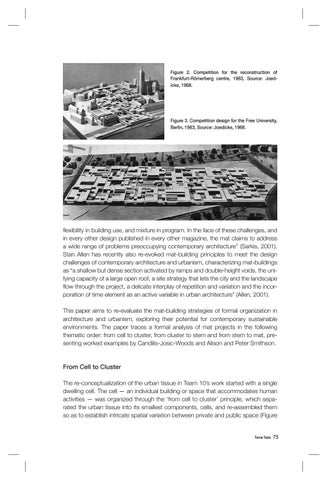
Figure 2. Competition for the reconstruction of Frankfurt-Römerberg centre, 1963, Source: Joedicke, 1968.
Figure 3. Competition design for the Free University, Berlin, 1963, Source: Joedicke, 1968.
flexibility in building use, and mixture in program. In the face of these challenges, and in every other design published in every other magazine, the mat claims to address a wide range of problems preoccupying contemporary architecture” (Sarkis, 2001). Stan Allen has recently also re-evoked mat-building principles to meet the design challenges of contemporary architecture and urbanism, characterizing mat-buildings as “a shallow but dense section activated by ramps and double-height voids, the unifying capacity of a large open roof, a site strategy that lets the city and the landscape flow through the project, a delicate interplay of repetition and variation and the incorporation of time element as an active variable in urban architecture” (Allen, 2001). This paper aims to re-evaluate the mat-building strategies of formal organization in architecture and urbanism, exploring their potential for contemporary sustainable environments. The paper traces a formal analysis of mat projects in the following thematic order: from cell to cluster, from cluster to stem and from stem to mat, presenting worked examples by Candilis-Josic-Woods and Alison and Peter Smithson.
From Cell to Cluster The re-conceptualization of the urban tissue in Team 10’s work started with a single dwelling cell. The cell — an individual building or space that accommodates human activities — was organized through the ‘from cell to cluster’ principle, which separated the urban tissue into its smallest components, cells, and re-assembled them so as to establish intricate spatial variation between private and public space (Figure
Ferrer Forés 75