�� Narkiss Block
Language Culture Type
Misha Beletsky • Ẓvi Narkiss
the page. It had ample counters, large openings, balanced square proportions, and a clear distinction between similar characters (הח, דר, גנ, )בכ. The designer preserved a human touch, the feeling of the natural movement of a hand holding a pen. If Narkiss Linotype was an elegant book type, a later design in a similar style, Narkissim, seemed have less personality, and therefore to be more universal (figure 19, top). It was better suited for magazine and newspaper composition. It is more monotone then Narkiss Linotype and more uniform in construction. The Sephardic sharp corner on the bottom of ט, ס, and שwas replaced by an Ashkenasic round bowl. These foreign forms in an otherwise Sephardic letter achieved greater distinction between the characters and help the readability of Narkissim. The high readability, economy in setting, and simple elegance of this face explain the wide popularity it enjoys today. Later ‘sans-serif ’ designs such as Narkiss Tam (figure 19, middle) and New Narkiss reflect some of the same modifications in their shape and would serve as excellent companions to this ‘serif ’ face. Other types designed by Narkiss were the sans faces Shulamit; Ruti; Shimshon; a display Narkiss Gazit, based on Ashkenazic manuscript letter, but with little contrast; Tammi, a lively calligraphic face based on handwritten script; and revivals of historical Vilna and Rashi types, based on the types used in the Vilna Talmud.
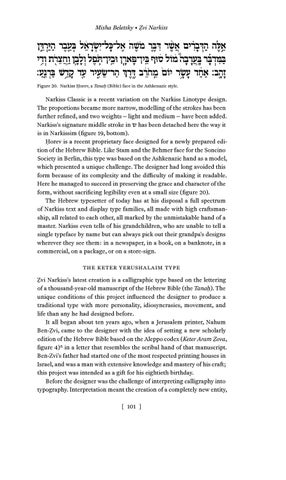
�� Narkiss Linotype �� Narkiss Linotype Figure 20. Narkiss Ḥorev, a Tanaḥ (Bible) face in the Ashkenazic style.
�� Narkiss Block
�� Narkiss Tamm �� Narkiss Tamm
�� Narkiss Linotype
Narkissim Narkissim
�� Narkiss Tamm
Narkiss Classic Narkiss Classic
Narkissim � Figure 21. Three proportionally related types. From top to bottom: Narkissim, Narkiss Tam and Narkiss Classic. �
[ 100 ]
Narkiss Classic is a recent variation on the Narkiss Linotype design. The proportions became more narrow, modelling of the strokes has been further refined, and two weights — light and medium — have been added. Narkiss’s signature middle stroke in שhas been detached here the way it is in Narkissim (figure 19, bottom). Ḥorev is a recent proprietary face designed for a newly prepared edition of the Hebrew Bible. Like Stam and the Behmer face for the Soncino Society in Berlin, this type was based on the Ashkenazic hand as a model, which presented a unique challenge. The designer had long avoided this form because of its complexity and the difficulty of making it readable. Here he managed to succeed in preserving the grace and character of the form, without sacrificing legibility even at a small size (figure 20). The Hebrew typesetter of today has at his disposal a full spectrum of Narkiss text and display type families, all made with high craftsmanship, all related to each other, all marked by the unmistakable hand of a master. Narkiss even tells of his grandchildren, who are unable to tell a single typeface by name but can always pick out their grandpa’s designs wherever they see them: in a newspaper, in a book, on a banknote, in a commercial, on a package, or on a store-sign. Ẓvi Narkiss’s latest creation is a calligraphic type based on the lettering of a thousand-year-old manuscript of the Hebrew Bible (the Tanaḥ). The unique conditions of this project influenced the designer to produce a traditional type with more personality, idiosyncrasies, movement, and life than any he had designed before. It all began about ten years ago, when a Jerusalem printer, Nahum Ben-Ẓvi, came to the designer with the idea of setting a new scholarly edition of the Hebrew Bible based on the Aleppo codex (Keter Aram Ẓova, figure 4)⁶ in a letter that resembles the scribal hand of that manuscript. Ben-Zvi’s father had started one of the most respected printing houses in Israel, and was a man with extensive knowledge and mastery of his craft; this project was intended as a gift for his eightieth birthday. Before the designer was the challenge of interpreting calligraphy into typography. Interpretation meant the creation of a completely new entity, [ 101 ]
Narkiss Classic