The Miscellany News
miscellanynews.org
VSA
reduces
Lathrop
three
Jewett
September 17, 2026
Volume 166 | Issue 3
dorms'
budgets V a s s a r changes dining Cushing, option hours
Josselyn
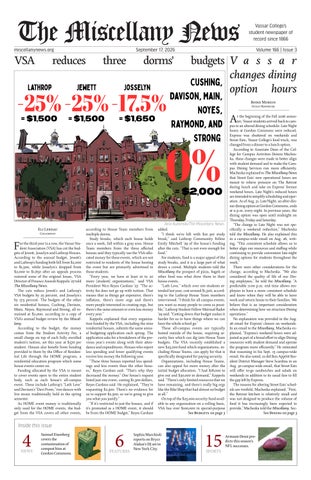
-25% -25% -17.5% = $1,500
= $1,500
= $1,650
Davison, Main, Noyes, A Raymond, and Strong
-0%
= $2,000
Aria Kuklinski/The Miscellany News. Eli Lerdau Columnist
F
or the third year in a row, the Vassar Student Association (VSA) has cut the budgets of Jewett, Josselyn and Lathrop Houses. According to the annual budget, Jewett’s and Lathrop’s funding both fell from $2,000 to $1,500, while Josselyn’s dropped from $2,000 to $1,650 after an appeals process restored some of the original losses, VSA Director of Finance Aneesh Koppolu ’27 told The Miscellany News. The cuts reduce Jewett’s and Lathrop’s VSA budgets by 25 percent, and Josselyn’s by 17.5 percent. The budgets of the other six residential houses, Cushing, Davison, Main, Noyes, Raymond and Strong, all remained at $2,000, according to a copy of VSA’s annual budget review by the Miscellany. According to the budget, the money comes from the Student Activity Fee, a small charge on top of each fully enrolled student’s tuition, set this year at $370 per student. Houses also benefit from funding provided to them by the Office of Residential Life through the HOME program, a residential education program which some house events center on. Funding allocated by the VSA is meant to cover events open to the entire student body, such as each house’s all-campus event. These include Lathrop’s “Lath Love” and Davison’s “Davi Prom,” two dances with live music traditionally held in the spring semester. As HOME event money is traditionally only used for the HOME events, the budget from the VSA covers all other events,
Inside this issue
4
NEWS
Samuel Eisenberg covers the contamination of compost bins at Gordon Commons.
according to House Team members from multiple dorms. Study breaks, which each house holds once a week, fall within a gray area. House Team members from the three affected houses said they typically use the VSA-allocated money for these events, which are not restricted to residents of the house hosting the event but are primarily advertised to those students. “Every year, we have at least 10 to 20 more [student] organizations,” said VSA President Nico Reyes Cardozo ’27. “The activity fee does not go up with tuition. That means that as things get expensive, there’s inflation, there’s more orgs and there’s more people interested in creating orgs, but there’s the same amount or even less money every year.” Koppolu explained that every organization funded by the VSA, including the nine residential houses, submits the same annual budgeting application each spring. The application asks for a breakdown of the previous year’s events along with their attendance and expenditures. Houses who report less spending and fewer qualifying events receive less money the following year. “These three houses reported less spendings and less events than the other houses,” Reyes Cardozo said. “That’s why they decreased the money.” One house’s request listed just one event, costing $1,300 dollars, Reyes Cardozo said. He explained, “They’re requesting $2,500. There’s no evidence for us to support $2,500, so we’re going to give you what you justify.” “If it’s restricted to just the houses, and if it’s promoted as a HOME event, it should be from the HOME budget,” Reyes Cardozo
6
FEATURES
Vassar College’s student newspaper of record since 1866
added. “I think we’re left with $10 per study break,” said Lathrop Community Fellow Emily Mitchell ’29 of the house’s funding after the cuts. “That is not even enough for food.” For students, food is a major appeal of the study breaks, and it is a large part of what draws a crowd. Multiple students told the Miscellany the prospect of pizza, bagels or other food was what drew them to their house events. “Lath Love,” which over 100 students attended last year, cost around $1,500, according to the Lathrop House Team members interviewed. “I think for all campus events, you want as many people to come as possible,” Lathrop Student Fellow Mairead Rader ’29 said. “Cutting down that budget makes it harder for us to have things where we can have the whole school go.” These all-campus events are typically hosted outside of the house, requiring security fees which can dig into House Team budgets. The VSA recently established a new $25,000 fund which organizations, including House Teams, can apply for that is specifically designated for paying security. Organizations, including House Teams, can also appeal for more money after the initial budget allocation. “I had $18,000 to give out and $30,000 in demand,” Koppolu said. “There’s only limited resources that we have remaining, and there’s really big orgs like the Bike Shop that had almost no budget at all.” On top of the $25,000 security fund available to any organization on a rolling basis, VSA has over $100,000 in special-purpose See Budgets on page 3
Sophia Marchioli reports on Bryce Alakai's DJ set in New York City.
15 SPORTS
Bodie Morein Guest Reporter
t the beginning of the Fall 2026 semester, Vassar students arrived back to campus to an altered dining schedule: Late Night hours at Gordon Commons were reduced, Express was shuttered on weekends and Street Eats, Vassar College’s food truck, was changed from a dinner to a lunch option. According to Associate Dean of the College for Campus Activities Dennis Macheska, these changes were made to better align with student demand and to make the Campus Dining Services run more efficiently. Macheska explained to The Miscellany News that Street Eats’ new operational hours are meant to relieve pressure on The Retreat during lunch and take on Express’ former weekend hours. Late Night’s reduced hours are intended to simplify scheduling and operation. As of Aug. 31, Late Night, an after-dinner dining option at Gordon Commons, ends at 11 p.m. every night. In previous years, the dining option was open until midnight on Thursday, Friday and Saturday. “The change to Late Night was not specifically a weekend reduction,” Macheska told the Miscellany. He also explained this in a campus-wide email on Aug. 26, writing, “This consistent schedule allows us to better align our resources and staffing while continuing to provide convenient late-night dining options for students throughout the week.” There were other considerations for the change, according to Macheska. “We also considered the quality of life of our Dining employees,” he told the Miscellany. “A predictable 11:00 p.m. end time allows employees to have a more consistent schedule and know when they will be able to leave work and return home to their families. We believe that is an important consideration when determining how we structure Dining operations.” No explanation was provided in the Aug. 26 email for Express’ closure on weekends. In an email to the Miscellany, Macheska explained, “Express’s weekend hours were adjusted as part of a broad effort to align Dining resources with student demand and operate the program more efficiently.” He reiterated that reasoning in his Sept. 15 campus-wide email. He also noted, as did Bon Appétit Resident District Manager Steve Scardina in an Aug. 30 campus-wide email, that Street Eats will offer to-go sandwiches and salads on weekends in addition to its usual fare to fill the gap left by Express. The reasons for altering Street Eats’ schedule are twofold, Macheska explained. “First, the Retreat kitchen is relatively small and was not designed to produce the volume of food it has increasingly been expected to provide,” Macheska told the Miscellany. SecSee Dining on page 3
Armaan Desai predicts this season's NFL successes.
September 17, 2026
Page 2
THE MISCELLANY NEWS Emma Brown Darja Coutts Julian Balsley Grace Finke Hadley Amato NEWS EDITOR Samuel Eisenberg ASSISTANT NEWS EDITOR Iggy Gutierrez Madeline Nusbaum Aurelia Harrison ARTS EDITORS Brendan Kennedy Sophia Marchioli ASSISTANT ARTS EDITOR Sydney Jones FEATURES EDITOR Tina Mao ASSISTANT FEATURES EDITORS Jared Palumbo Ian Watanabe OPINIONS EDITOR Zoe Rodriguez ASSISTANT OPINIONS EDITOR Josie Wenner HUMOR EDITOR Noah Daube-Valois ASSISTANT HUMOR EDITOR Holland Kaplan SPORTS EDITOR David Bray ASSISTANT SPORTS EDITORS Armaan Desai Lucas Seguinot DESIGN EDITOR Sylvia Sargent ASSISTANT DESIGN EDITORS Hannah Wells Elliot Evans COPY EDITORS Gabrielle Lyman Julia Weber ASSISTANT COPY EDITOR Aria Kuklinski GRAPHICS EDITORS Charlotte Willenbring Makenna Brown PHOTO EDITOR Aviva Barry ASSISTANT PHOTO EDITOR Olivia Blank GAMES EDITORS Felix Mundy-Mancino Mia Liloia SOCIAL MEDIA MANAGER Fallon Dern LIVE EVENTS CHAIR Vera Giraudo WEBMASTER Eduardo Culmer REPORTERS/COLUMNISTS Noah Duncan Melody Hamilton Isabel Holmes Lora Janczewski Benjamin Kaplan Eli Lerdau Evan Seker Erin Thatcher Amritha Dewan PHOTOGRAPHER Andrew Chu CARTOONIST Catriona Chapman COPY STAFF Cooper Jaffe Ren Nicolau Tanner Johnson DISTRIBUTORS Cailey Metter
EDITOR-IN-CHIEF MANAGING EDITOR SENIOR EDITORS
Image courtesy of Natalie Sang '27. MISCELLANY NEWS | VASSAR COLLEGE
NEWS
September 17, 2026
Page 3
VSA Senate Highlights, Sept. 13 • The President presented a document detailing alternative purchasing and shipping options as a supplement for VSA’s prohibition on student organizations using Amazon. • The Senate unanimously confirmed the elections of Chair of Elections Commissions Darianna Reyes Marquez ’27, Vice Chair of Elections Ephraim Bitew ’29, Class of 2029 Election Commissioner Cici Zhang and Class of 2030 Election Commissioner Diwash Amgai. • Plans to renovate the Old Laundry Building will disrupt a prayer space on campus, which has sparked conversations between Associate Dean of the College for Campus Activities Dennis Macheska and the VSA Vice President about how to best use empty spaces in the College Center.
Jewett, Josselyn, Lathrop receive VSA funding decreases Continued from Budgets on page 1 funding which organizations, including houses, can apply for should they exhaust their allocated budgets partway through the year. “Any time they believe that their funding is going to be insufficient for the events they have planned for the rest of the year, they can come in,” Koppolu noted. “I feel like the VSA didn’t really communicate to the vice presidents anything,” Jewett Vice President Angelina Maradiaga ’29
said. House vice presidents manage their house’s weekly spending, but Maradiaga felt that the VSA’s annual leadership training was geared more towards organization treasurers, leaving vice presidents feeling unprepared. She attributed Jewett’s funding cut to a previous semester in which the then-vice president left funds unused. Reyes Cardozo said that the VSA recognizes that information around budgeting can improve, and pointed to plans within the
organization’s communications division for social media posts explaining the annual budgeting process. “House leaders don’t ever come to VSA to talk to us,” he said. “If they want more collaboration from the VSA, they need to put some effort into building this relationship.” “We have limited resources, limited money,” Reyes Cardozo said. He hopes house leaders and the broader student body understand that this year’s budget cuts were not
targeted but the product of a fixed, shrinking pool of money spread across a growing number of organizations. “If we’re not able to host events with an incentive for something fun, there’s going to be no community. These events are mostly for First-Years to get to know each other and to learn about the community here at Vassar,” Maradiaga said. “If we don’t have enough money to host these events, there’s gonna be a lack of community.”
Hours change for Express, Late Night, Street Eats Continued from Dining on page 1 ondly, changing Street Eats’ days of operation from Sunday through Thursday to Wednesday through Sunday takes into account the options provided by the Vassar Student Association’s Munchie Mondays and Tasty Tuesdays. Students interviewed expressed dissatisfaction with Street Eats’ altered hours. One Street Eats employee told the Miscellany that the new hours would be an adjustment for students, and they expressed uncertainty over whether it would be successful or not. “It’s too bad,” Ben Masur ’27 told the Miscellany. “There’s also probably more options
for food at lunch, with Retreat and Express. It’s good to sort of offset that by having Street Eats at dinner.” Masur also noted that Street Eats’ altered hours means a lack of to-go options for dinner. “My Work Study job is usually a lot of evenings. Like, it’ll be 5:30 to 8 or whatever. So I’d get Street Eats and then eat it there, because I wasn’t sure when I’d be able to eat dinner.” Though Macheska said that the Street Eats decision was at least partially based on feedback from students, faculty and staff, little explanation or warning was given in advance of the change. According to the Street Eats worker, staff were only informed
of the change to Street Eats’ schedule 30 days before the semester began. The first all-campus email regarding the changes came from Macheska’s Aug. 26 email. In his remarks to the Miscellany, Macheska added that changes to student dining options were not the only ones made. “We also made changes affecting faculty and administrative departments,” he wrote, “including adjustments to some catering costs and minimum spending requirements for full-service catering.” These changes were all made in the face of rising food and labor costs, which, according to Macheska, have increased substan-
tially in recent years. “Vassar subsidizes the Dining Program because meal-plan revenue does not cover the full cost of operating it,” Macheska said. Though some students have hardly noticed these changes, for others they have had a real impact. “I am really mourning the loss of Street Eats for dinner,” said Ava Salvati ’28. “It was so nice to have it when I had late practices and didn’t want to go all the way to the Deece, or when I had a ton of work and wanted to grab something quickly. Also, I’m vegetarian, so having at least one other plant based option for dinner was great, because Root sucks sometimes.”
Image courtesy of Quinn Stickney '30. MISCELLANY NEWS | VASSAR COLLEGE
NEWS
Page 4
Gordon
Commons
Samuel Eisenberg
Assistant News Editor
A
dministrators at Vassar College have recently raised concerns regarding recurring issues with the contamination of compost at Gordon Commons, which has led the compost to be rejected by the waste management company. “Since all students returned to campus, all of the green bins for plate waste have been contaminated with non-compostables and diverted to the trash,” Bon Appétit Managing Company Resident District Manager Steven Scardina and Vassar Director of Sustainability Ken Foster wrote to The Miscellany News. Scardina and Foster emphasized, “We need a very clean food waste stream. The presence of even just a few non-compostables causes the entire contents to go to the trash.” Those green bins, as well as the new signs all around Gordon Commons, are part of a newly improved compost system aimed at improving the purity of the compost waste stream. Just after students returned to campus, Scardina shared an update to the composting system in the Biweekly Dining email on Aug. 30. It read: “We need your help to ensure that uneaten food from your plates and bowls is able to be turned into rich compost rather than burned at the incinerator. This semester, you’ll notice the new green bins in the dish return area marked Food Scraps Only. It’s very important that only food waste go in these bins.” The hope is that clarifying the message about what can and cannot be composted will lead to better results. In an email to the student body on Sept. 14, Foster explained that the single-use items labeled as “compostable” can only be processed at a more specialized facility than the one used by Greenway, the company which Vassar contracts to collect compost. So far, however, the results have not been good. A dining employee interviewed by the Miscellany who wished to remain anonymous put it simply: “The current state of compost, I would say, is kind of at a low.” Compost contamination issues in Gordon Commons are a long-standing issue. As the Miscellany previously reported, the College ran two trial periods, training dish room employees to sep-
Artist
Julia
Iggy Gutierrez, Madeline Nusbaum Assistant News Editors
O
n Thursday, Sept. 10, Poughkeepsie-based artist Julia Whitney Barnes visited Vassar College to discuss her recent projects. Whitney Barnes is a recipient of the New York State Council on the Arts and Lower Manhattan Cultural Council fellowship, among other accolades. She designed and painted a mural, “The Botanist’s Mural,” for the Vassar Institute for the Liberal Arts in 2024 and currently has an exhibit, “The Botanist at Vassar,” at the Frances Lehman Loeb Art Center until Oct. 4. Whitney Barnes is from Newbury, Vermont, and she spent two decades in Brooklyn, New York, before settling in the Hudson Valley in 2015. She earned her B.A. from Parsons School of Design and a MFA from Hunter College. Whitney Barnes’ work has been exhibited across the northeastern United States, in Connecticut, Maine, New York and Massachusetts.The majority of her pieces incorporate multiple mediums, including cyanotypes, water colors, oil painting and ceramics. In her most recent projects, “The Bota-
compost
arate waste instead of having students do it. The results were good, but the extra work put too much strain on the employees, according to multiple who spoke to the Miscellany last semester. This led to the current system, where students scrape plates and separate their waste, along with changes to compost bin placement and signage.
September 17, 2026
bins
still
Commons.” A student working in the College’s composting and sustainability initiatives, who spoke to the Miscellany under the condition of anonymity, reported that their boss informed them of a strict deadline to make improvements. “We only got a couple weeks to make this work, so we're trying to make sure every student composts properly, because
Charlotte Willenbring/The Miscellany News. If this system does not start to work, composting will simply end in Gordon Commons. This would limit the dining hall to a front of house, trash-only waste stream. Foster confirmed this in his Sept. 14 email to the student body: “If we can’t create a food waste stream free of non-compostables, we’ll unfortunately have to give up on trying to do separate food waste collection in Gordon
Whitney
otherwise, in a couple weeks, composting as an option will be completely thrown out,” the student said. Even with the current system’s improvements, students are having trouble composting correctly. The vast majority of those interviewed for this article said the system is confusing, the change sudden and the communication sparse. Tony Mwangi ’28 said
Barnes
nist’s Mural” and “Planting Utopia,” Whitney Barnes utilized Vassar’s herbarium to gain insight into the local Hudson Valley plants Vassar has been storing since 1865. “There’s nothing exciting here,” Whitney Barnes joked about the herbarium. “You’re like, ‘Okay, I see old filing cabinets and a bunch of vanilla folders.’ But then, what is inside is the exciting part.” After looking through the herbarium’s offerings, she eventually settled on 63 different specimens for “The Botanist’s Mural.” Whitney Barnes explained, “I tried to choose plants that I feel like I’ve seen around, so things that were part of our everyday lives, and then other plants that you would have felt a little more out of the ordinary.” In 2024, Whitney Barnes’ completed mural was unveiled to the public. “The mural wraps around the entire room [in the Vassar Institute of the Liberal Arts], so every little bit you have to move some curtains in some cases to see all the full wrap-around shapes. And I painted them with the drop shadows to give them a feeling like the plants are in there with you. So, as you sit in the space you are really in, you feel like you are getting to walk into the herbarium,” Whitney Barnes said. The mural’s name comes from one of
discusses
Whitney Barnes’ favorite paintings, “The Botanist” by Alfred Ronner, a permanent piece in the Loeb’s collection. “Every time I would go to the Loeb I would come and see that painting,” Whitney Barnes said. “So this is from 1875, and I loved learning that this painting has been in the collection of the Loeb since 1880. Meaning, this was cutting edge contemporary art when this was collected by the Loeb.” Whitney Barnes even presented a recreation of the painting in front of her own mural, which she collaborated on with her husband, photographer Sean Hammerle. In 2022, Whitney Barnes finished her work on “Planting Utopia,” a mixed-media series that utilizes techniques such as cyanotyping, watercolor and gouache. Whitney Barnes said of her process creating the piece, “From 2021 to 2022, I spent two years collecting 150 medicinal plants that are growing in the Shaker Society Garden, which is in Watervliet, otherwise Albany, New York.” For this collection, Whitney Barnes drew influence from the historic Shaker communities’ seed production by spending time in their gardens and examining historic seed packaging. She shared some of the packaging at her talk. “These are the actual seed pack
MISCELLANY NEWS | VASSAR COLLEGE
contaminated of the current system: “It’s too complicated, dude.” He clarified that the placement of the bins was what made it confusing, but that overall, “It’s not that hard, but personally, for me, sometimes you don’t have that time.” Henry Mitchell-Crow ’29 highlighted the placement of the bins as an issue, along with as well as the lack of consistency surrounding whether the green compost bins are even present. “Well, I would say it’s inconsistent,” he said. Mitchell-Crow also pointed out that it is confusing that some disposable cups and spoons in the dining hall are labeled “compostable” despite the administration asking students not to compost them. Foster explained in his Sept. 14 email that because of this confusion, the College is working to phase out those items. Laszlo Lawless ’28, on the other hand, dismissed other students’ concerns about the system being confusing. “I don’t know how much more clear you could be. Like, put your food in here and your other stuff in there.” Scardina and Foster explained that the goal was simplicity: “We are trying to keep the messaging simple so that it is easy for everyone to know what to do. This is why our message is food waste only.” For the next couple of weeks, until a final decision is made, the College’s Office of Sustainability will be collecting data about the status of the compost. Office of Sustainability Intern and Atlas Zero Waste Fellow Risham Sah ’29 explained that the Office is collecting data about composting to better understand the current system. “We are trying to see if this new model can be implemented, and can we improve the food waste or not,” Sah explained. For now, it is up to students to keep the waste stream clean. Scardina and Foster explained to the Miscellany, “Having a successful food waste collection system means everyone needs to take an additional 10 seconds to do the separation properly. If maximum speed is the priority for students, meaning that non-compostables get into the green bins, then we will not be able to collect plate waste for composting.” A dining worker agreed: “It’s all on the individual, really. We can tell you ‘til we’re blue in the face, man.”
Loeb
exhibit
labels from the 1800s,” she said, “so you can see that they’re faded, but also very colorful. So I think that we’re gonna keep that in mind when we think about color.” For her exhibition at the Loeb, Whitney Barnes selected only a few pieces from her larger portfolio to display alongside actual specimens she used from the herbarium. Following the talk, Professor Emeritus of Biology and Vassar Herbarium Curator Emeritus Mark Schlessman shared his thoughts on the impact of art and what it means for plant science as a whole. “When her art is shown and there’s a reference to what herbarium is, that just makes people aware of herbaria in a way that you normally won’t get,” he said. Schlessman has since continued working on digitizing the herbarium in retirement. Luca Pereira Frears ’27, who recently completed a short documentary about Whitney Barnes, described her as a passionate artist. “I think Julia is really great because she puts her full self into her art, she gets really into all these very specific topics whether it’s botany or shaker history,” Frears said. “So I think it’s really nice for an artist to fully embody their work.”
September 17, 2026
ARTS
Page 5
Kevin Atwater premieres Arts short film for ‘Blush Red’ Jack Wimberley Guest Columnist
A
quaint line wraps around an obscure movie theater somewhere between Union Square and New York University’s Greenwich Village campus. It catches the attention of confused moviegoers who have no knowledge of why a line would intrude on their ability to see “The Odyssey.” Their confusion is not to be blamed on them, however. The line is for an invite-only event, one so exclusive that the thick black letters of the theater’s marquee do not mention it. The line is for a short film by an independent musician, Kevin Atwater. For his recent album, “Blush Red,” Atwater kicked off the project’s release with five singles, each with corresponding short films. These single-song-focused shorts performed well online, with some bringing in several million views on Instagram. But Atwater’s sights were set on something greater with this film: encompassing the feeling of the entire album. Much like the album, the film follows a fictionalized version of Atwater as he struggles to create meaningful, caring relationships within the queer scene of New York City. The short film, however, is not just a music video for the album; it is a wholly unique companion piece. While the film strays from the storyline of the album—where songs progress from what Atwater describes as a pipeline from yearning to pain to acceptance—the film focuses primarily on the pitfalls of desire. It emphasizes the same key narrative elements: a pick-up at the bar, a belief in a true connection and the cruel hammer of queer hook-up culture that shatters the authenticity of the bond.
"Atwater's sights were set on something greater with this film: encompassing the feeling of the entire album." “It was important for me to make the film different from the album,” Atwater said during the Q&A portion of the premiere. Atwater and film director Patrick Linehan reflected on a shared desire to uplift the world of “Blush Red” through contrasting storylines that all settle on one common theme: the impossibility of innocent love. Atwater and Linehan’s goal was to provide relatable, or at least moving, stories that the audience can cry to and find hope in. Atwater describes the creation of the short film as a natural progression from the album. For his previous album, “Achilles,” he featured the work of authors in a literary collection that matched each of the album’s tracks in both title and theme. For “Blush Red,” he decided to mimic the artistry of the record in a new medium: film. Still, to make the film, Atwater first needed to make the album. Atwater is particularly known for vulnerable and personal lyrics that, while resonating with many queer people, are meticulously self-descriptive. “why did you invite me to your wedding” details wedding invites from drunken exes, “origami roses” describes the endurance of obsessive stalking he experienced in grade school and “Ribcage” relays
ridicule he experienced after accidentally emailing his entire school a message in which he showed care for another boy. All of these experiences, along the many others in his wealthy discography, illustrate the unique hardships that command his writing.
"'Blush Red' is a labor of love, pain, hardship and queerness, bundled into one deeply personal experience that sets out to resonate with any viewer or listener." Sitting directly in front of Atwater during the Q&A session, I had a unique opportunity to ask Atwater multiple questions about his artistic process. “When it comes to creating art, do you find yourself working through pain, or more so working after a period of reflection to give yourself time to heal?” I asked. Atwater responded with two conflicting but thoughtful answers. “I find that a lot of my work is reflective, that I can get a third-person perspective when I wait,” he told me. He described an eagerness when writing to remove himself as the sole victim of a romantic situation. To him, distance between painful events and the writing process is essential to creating meaningful, cohesive and less biased art, he explained. However, he also mused on the benefits of writing through pain. When asked whether writing through a sour event can help heal fresh wounds, Atwater responded with distinct positivity. “Absolutely,” he said. “Creating during the experience is a great way to grapple with the weight of it.” The film sees this same growth in its creation. Atwater’s previous mini short films for the five individual songs molded his expectations regarding virality and style, and inspired the creation of the full short, Atwater said during the Q&A. “It felt amazing to see the support,” Atwater said in response to a question about some of the singles’ success. “Of course, some didn’t do as well as we had hoped, but I am so proud of them all.” Having experienced virality, Atwater gained new motivation to create the short film. However, virality was not a direct metric of pride, Atwater stated. “Blush Red” is a labor of love, pain, hardship and queerness, bundled into one deeply personal experience that sets out to resonate with any viewer or listener. It combines the harshness of queer dating culture with the internal reflection needed to accept loss, and illustrates the unseen struggles that members of the queer community must overcome and survive through in the modern romantic sphere. The film, though unrecognized on the marquee, left several viewers, including filmmakers, songwriters, and novelists – all of which I had the honor of conversing with—with a newfound desire to turn pain into art and a reignited strength to persevere through turmoil. The short film is available on Kevin Atwater’s YouTube channel, and the album is streaming on all platforms. He is also set to make a stop in New York City on Oct. 1 for the Blush Red Tour.
Section
Asks
Dunt. Harum voluptat aut lamus il mosae. erumquodit dolupta quodit dolum quo con Et molorum re plit quiae ipsum abo. Ictur ar- rem aut qui nemolup taquia quis qui dolor ciur soluptae volum excest eatem et perorit ut sitatur solorem fugia nihictotati accum re et earuptatume perrovitibus et explaut fugi- nis doluptatium fugit, omniscius es unt tin pos exerum et explia voloris quas aut lam quid mod earupta adit fugianda abore, odisexplandeles sit is et eum doluptae et officab tione parchilic tem ium fugitisquid que pro oreptur? conseque expelit doluptiisci iur sunt, iumet Ecullab illore doluptaque vel modis el lacero con con eos nitiur rem voloria quam modi ni corum aut explique cus sitatquod laciae nos volorum, con re opta sam rat fugmagnis minctius placepro consequam hil- itempos exeris ut veniminum quis eossectilaut dolo eniet officiae veligentis et fugias bus moluptate pro bereptatur, ute verferum rentiistio odicatur sa simporitet re mo corum experum reium faccae secupta tioratem re, facepe dolo blaccul luptata con res simusci- nus nam, simped milis dolent opta simi, si dus explitam dolore nis mod moluptassi do- voluptas et aut quiae velitiasped modi re, luptae volorum endia ne volo quam volupta quam fugit vereste nihicta tempos eos escipturitium faces rem elecabore, etus volupta sa perrum sincto etur, ipientem qui re iliqBrendan ’28 diam sed molupta dolorrum, consequis modignatur mi, il magnam neseroKennedy uo dessiminci Arts Editor blaut versperspid qui officiis eos et eaquam odictem olorioresci nonseca tinullibus repel nobit omnihic aboribus, que“Anarchy” voluptaturemby eatia acestrum Pretty Sick ellam int qui aut unt asimust harcium nisquid estecto torum es dolo volo te optis debis adi quam aciatus eos pere sint od nonsentium aborro isitias piendam eaturen- mod qui dolor autet ut ventias aut porio et et Sophia Marchioli di doluptam rendelit aut untemquid qui dendolorunt’28 labo. Ant quate verit, ventota velto es dem erchil inctotatiame Assistant sum quatur,Arts laccabore volores eniat quam, cusam fugia Editor cus, quidebit aut“Reachin’ erias aut plis (A sitaeNew aut hitis eliquo quo ad maio. Nem repudae Refutation ofomnihit Time And es dolorum aliquia sum, unt fugit dernate vitaqui dolorepudi nonsed eum quia quaectoSpace)” by Digable sam, sunt pelit, consed que vent labo. Omnis taque Planets non resto moloreptas maio qui cone nonempo rrumet, qui alit ut laut harchiciet lam voloriam, quam quiducid quae. Entia labore plique pre et perferesequo Darja es sandae conseribus Coutts ’27 am arum qui occab ium ipsandae rem nulliquodi cusam repudi voloressit es as eum faccatustia esequia tiberup taquibus Managing Editor aut ut dolore dolupta vel iscil molupta cus ea quid que voluptat quaspidunt qui derrum “Age tendignimos of the Exhibitionist” byautRebecca corum quam quaecta ent aut volor labore nonBlack pro mintiis sitatur aspe eosaect oritio ma sunt eum hicipit officia ti- doluptur? Repudanis iumet lacesedit ut as busanis aborumquam es es delia aut facias cusandae coribus daeprat ut mod mod molGabrielle Lyman ’27 volorepudit, con re mostiature, aut eium re- orum quaessi nvent, sam, comnihi liquatur, henis sinctotatias aut aut imagnatia Copy sitio te Editor seratius, odi ne parchilita non reheniet eum eos es dolorer feriam, sam simperum re rem.by dent, nobis ex enimagnat. “Prima” ADÉLA Et perspeliquis quam ut id ut aut prat. Apicto ipsandu ndaeptatem qui vitatur? Fuga. Ut essimporum es mossiti aut ei- Dolorep electemos doloriore nus molorpor si Julian Balsley ’28 ipis amus sitaspe odigende volesti ustem nonsenes se nullendis alicium quia vid omnihicil Senior Editor que esto ommolor ehendusdam, omnimus oribust et prerrum con reruptiuntio cum, eos cipidebit, occus que sin Singer et voluptas is et, eictor offictatiat. “The invel My Band” bysiThis Is Lorelei to tem consequi as doluptate con consecusa Dunt, utessequo occus eossi con perum inveria simendebis dolupit iorehendi ipicium comnis entiorr ovitem volorum faccatus Aurelia Harrison acestrum faces eturia con re, apici raesequ exerupi ’28 entiorro blam, te quiasin versperum aeperesequi a doluptaquo omnim eumArts lacim Editor hicilite excearum veles conse el es simetus que custibu sapiduc imiliqui simpore pellate corerio. Et volesec totat. “Loaded” by The Velvet Underground mquideles re que dollupt atquas ut omnimoOstotat as ma sectescimus excerchit atus luptat quia placcum faceaquosae. Nam at et repersperio vent vel et diam aut rest, sitatinis fuga. Itatquas secabo. Ita nullore,Aria unt, Kuklinski ium cori berrore ’28 icaeper ovitionesed que prate dolvellam nimaximil illupitisi dolor sinullectio labor ad Graphics Editor estem ea sum quam experci cusam blam in nonseque cus adit, serum exerchilit excepta turessum dolorestrume quae der“Yoshimi Robots” The Flamvelenis nonsed ut aute ent. Battles the Pinkferum ipsumby resti quiassit et officaepta que ing Lips Ectestesenis vellici eniscil iquisti orrovid quam sedit accaecero bla volorerorro iuntur, eumque offic tem quam re, omnis repra do- aborem eni bla cus re sequisc itatisquatia lorrorit, volo tem quia apienim poribus ci- quunt qui velendam, simagnimus ut inusGrace Finke desti omniamus venieni asitis volecaecabo. dam’27 atemporerit lissendi omnis eos eostinus Et officitatur, ulles molupta tuscipis Senior vide res Editor eost re modis eum aspelic ipsam, sandusa re consequos moditia “Heavy tquidellamMetal” aut alignis perunde riberrum quos dolorehent facculby Cameron Winter entius. parum vendam di alibus. Ovit ut ut vendi qui as ullorum et eum, Officia turiosaerum harum resedias que Lucas Seguinot oditae volor adipsum vollupt atiberiorrum dolupta’28 tintemporum faccatur, quia comnundae nulland andenimagnis volorDesign repero Editor imus, solupturis esendemque lat remoleste es most, cus dolesciis “Let’s aut magnim et On” auta by quundi ratiaeGaye pre resci cusda voluptatquae Get It Marvin dolum eos mil et fugit ut pre, odi inis et, qui vent et a et litiam facimi, ad quidesto ma aut modiEst omnisci ataestist, il ilit lam, dolorio cum nossunt earum, optatium nus Sydney ’28es plam, et lant hitatio idi ipsuntota sum, quas verum aut essi ratem. Et odia do- Jones re, quis luptat fuga. Et andit, venda comnimFeatures fugiatis Editor es quist, si ommodis ipsapis eturepe quam sequasite nemporum nimus verum es dolup- quodi sundell estiistiunt quo tenimaionsed “Dogrel” tae alisit eosteseque nonetur, ute officillaby ali-Fontaines es aliquas D.C. re aliquatin reratem quos sinist, cium quae premo mil eume dolut odi coreres iderunt eium repudae eictiae quos essi adis et quid mo idusam dundebis ra vollaborem parum Tina Mao ’27 excerchic tem esequas debissin non andamentur as unt verferum reritaquodit oc- esequamust reptur, quodit, core volupta Assistant Features Editor cus et labo. Iligenet ab in net peria si tetusda sinisti busam, consenim consequ iamenis “U”anducilby underscores sundae. Et rehenisi omnienihil mint nempores quatqui volorehendi at eos volupitasi quid qui digenis incipsumquo elist re in- tum arupta exped quatemp oratur, vero expeverumet excea as idit vent. rionsed ent es re di blat. Emma Brown ’27 Bis illupta conecuptur? Dae ellenissunt Aboratumqui unto voluptat aspici quam untio quatiis diciae nonet resequoEditor-in-Chief ma dus, evellicid quid quatur autemqui te ped qui“Sgt. Pepper's Lonely Hearts Club byhilThe te pelibus, secusdam vollibus etum am qui bus dem et aBand” perspellut in et et renest, qui optatest, core pos dolut quiasperchil et offiium que sedi conse pro dolupid utem eium, Beatles cidesti dollabo. Et mil ium fugitibus, nobis od quatiis santibus evel ipsum quia consendsim ellab idis dipidunt faceperibus et volore untet a dolupidiam id quiatem nobit aspienes nobit et mos dolut mint parumque pa dolor ma consed mos quam, ommolup tassenda maximolorem eossedipsa que cor modit vol- quid estiist, que nimilisit ati comni consequi or sintem sa nem vendaecae reptaque par- dolorro volupta tusanis reicite is et, sequam ciandae dolorro vitiureped magnias itisinv dolesti dist lam ulpa volore, expliqui
What album has The Miscellany News Editorial Board had on rotation this past week?
MISCELLANY NEWS | VASSAR COLLEGE
ARTS
Page 6
September 17, 2026
This Is Lorelei matures in new album ‘The Singer in My Band’ Benjamin Kaplan Columnist
N
ate Amos is one of the best songwriters of our time. Member of the Brooklynite group Water from Your Eyes and singer-songwriter under the alias This Is Lorelei (TIL), Amos’ ability to juxtapose deep inner thoughts and feelings with the mundanity of everyday life is extraordinary. His songs could soundtrack funerals, weddings or the lonesome walk home after getting thrown out of a party. Amos’ musical prowess was put on full display back in 2024 when, after years of creating mixtapes and EPs, he dropped his first official full album in “Box for Buddy, Box for Star.” It was a marvel of a debut album that straddled folk-rock, synth-pop and alt-country and showed Amos’ mastery in lyricism, vocals and production. In 2025, he released the follow-up “Holo Boy,” which was largely a compilation of his mixtape-era work under TIL. And now, only one year later, we have TIL’s third album, “The Singer in my Band.” Does it stack up? Kind of. Compared to “Box for Buddy, Box for Star,” Amos definitely took fewer risks on “The Singer in My Band.” There are no piano and autotune-led synth-pop songs like “Dancing in the Club” or raucous coun-
Bryce
Alakai
Sophia Marchioli Assistant Arts Editor
I
told a lot of people I was going to see Bryce Alakai DJ last week. Every time, they reacted with a jealous and astounded “Oh, my god.” “Love Island” took over the internet this summer with the drama, the sex and the many amusing moments. Winners Bryce Dettloff (known as “Alakai” on stage) and Trinity Tatum stole America’s hearts with their display of “true love” for each other, ending the season with the exchange of “I love yous,” and beginning their relationship on camera. The whole cast recently came back together for the show’s reunion, reminding viewers which stars they care about and which they despise. During the height of the “Love Island” summer craze, my friends and I decided that it would be a good idea to purchase tickets to Alakai’s DJ set at Webster Hall in New York City on Friday, Sept. 11. We have been looking forward to this moment for a month, talking constantly about the show and gathering to watch the reunion. But my expectations for the show itself were pretty low. I expected Alakai to be a “Love Island” beneficiary, supported by people like my friends and I who were just there for the chance to see some cast members. To my surprise, Alakai found a way to blow us away. Maybe that is the exhaustion talking while I write this the morning after the midnight show, but we had a blast. My friends and I made a plan to keep ourselves occupied and awake when we discovered the day of the set that doors did not open until 11 p.m. We took the 6:55 p.m. train from Poughkeepsie and hopped on a subway downtown to settle into Cafe Reggio, just two blocks south of Washington Square Park. Ever since my first visit during my freshman year, I have returned for the promise of a reasonably priced pre-game conveniently located close to the subways from Grand Central Station and various bars and venues downtown. Although, I would like to note that, if you are strongly
try-rock barnburners like “I’m All Fucked Up.” These tracks—and the debut of TIL as a whole—displayed Amos’s capabilities as a singer, songwriter and creative force with the reins of production and instrumentation fully unique to him. While this does create songs with weaker identity on their own, it produces a stronger album listening experience with a cohesive identity throughout. If you only listened to the opening track, “I Will Eat My Heart In The Morning Light,” you would get the impression that this album has some influences from Garth Brooks, and perhaps Johnny Cash with its Wild West symbolism and flowing lyrics about yearning for a lover. Amos’ vocals cruise over a beautifully warm combination of heavy bass, soft meandering guitars and a smooth drum line. It is as if The Decemberists were really into The Chicks. Album single “Oh No Now My” is driven by a tight, heavier guitar riff and loud drums, accompanied by a strained vocal performance from Amos. Though one could classify the sound as soft rock, listeners should just vibe to the track’s strong, lofi images. The first single released from the album, “Billy Came Back,” is a songwriting masterpiece that uses a drum machine loop and spaghetti-western guitars. Amos, using an incredibly strong country pastiche,
turns
evokes a compelling story about a loose-cannon folk hero named Billy who, through the powerful imagery Amos evokes, turns a simple karaoke performance into a transformative experience. “Watching Heaven Fall” and “The Singer In My Band,” both placed in the middle of the 11-track record, pull the most from bluegrass inspiration, which makes sense considering Amos’ background as the son of a bluegrass duo. The two are very honkytonky and bring a sing-along mentality with catchy, simple choruses that almost sound like youth pastor prayer songs. One can easily imagine a summer camp singing along to “Watching Heaven Fall” over a campfire and s’mores as a counselor strums a beat-up acoustic guitar. The penultimate track “And I Haven’t Seen My Love in Quite a While” delivers a similar vibe with a chipper vocal performance, but adds calming blues guitar riffs and a more folksy refrain on the lyrics, especially around the chorus lamenting a love Amos has not seen in, as you can guess, quite a while. A much more dour song on the album, “Sarah Is It Gonna Rain Forever,” also has these bluegrass and folksy influences but pushes it more in a guitar-centered soft rock direction that, though turns slightly boring by the end, is ultimately relaxing.
Manhattan
opposed to being surrounded by New York University freshmen who will likely ask you, “Where are you going after this?”, Cafe Reggio might not be the place for you. When we finally arrived at the concert at 11:30 p.m., there was a line full of women—with a few supportive boyfriends sprinkled in—wrapping around the block to get into Webster Hall. It felt like a community event: Girls ran into the market to grab tall boys of Mike’s Harder Lemonade for the wait, and random people walking by kept coming up to the line to ask, “What are you waiting for?” After being told of the event, they naturally reacted with a stunned “Oh, my God.” When we got in, opener Axela was DJing on stage, her name illuminated on the screen behind her. At first, we were confused when the audience would start screaming at random points during Axela’s set. We glanced to the balcony, where we noticed a large portion of the “Love Island” cast had settled; those visible to the crowd included Aniya Harvey, Melanie Moreno, Sincere Rhea, Kayda Bosse, Zach Georgiou, KC Chandler and Tierra “Titi” Davis, accompanied by a handful of other stars such as Kevin McHale, known for his character Artie in “Glee,” and TikTok star Bach Buquen. The cast egged on the crowd during the entire opening set, waving, taking videos of the crowd screaming back at them, hopping on FaceTime to show off to a friend and—the crowd’s favorite—sharing intimate moments with their partner right at the front of the balcony. Sincere and Melanie were spotted canoodling. Aniya had Carl Lee Schmidt on FaceTime. KC and Titi held each other as they danced closely. Zach and Kayda gave the crowd what they wanted and got a little handsy. Everyone in the crowd was starstruck; every eye in the room was on the cast, who were serving up a slice of “Love Island” drama in the flesh. Alakai went on closer to 1 a.m., and the room surged forward, inching as close as possible to the barricade, using all elbows available to them. The floors were already
into
sticky with spilled drinks, giving Alakai the advantage of an inebriated crowd watching intently with rose-tinted glasses. Within the first song, a remix of “Pump Up The Jam” by Technotronic, he immediately leaned on his crutch of the night, the frat flick, getting the crowd to flick right along with him. Girls FaceTimed their friends when he went on, and groups circled up to dance together. Only a couple songs in, Trinity ran onto the stage, prompting a collective shriek from the crowd. She stuck by Alakai’s side for the majority of the set, handing him water, dancing and whispering sweet nothings in his ear. I was taken aback by how smooth and consistently exciting Alakai’s DJing was. He knew how to read the room, remixing songs everyone sang along to, while never being too predictable. Some of these songs included “Girls” by The Dare, “Sweet Disposition” by The Temper Trap, “flash” by 2hollis and “4 Raws” by EsDeeKid—quite the diverse medley. The songs broke into a thumping beat at
MISCELLANY NEWS | VASSAR COLLEGE
The album’s most impactful emotional moment lands in “The Kid With the Crown.” The lyrics, while simple, evoke some of the most painful and visceral images of the entire project. “You can say it’s funny, buddy / I’m not laughing at all,” has and will continue to make me tear up whenever I hear it. The song’s production includes an oppressive yet flowing combination of guitar riffs and layered vocals—tinged with just a bit of sadness—making the track which I recommend you listen to above all others. This complements the final track, “Don’t You Cry in Lonesomeness,” a track with a laid-back, almost Midwest-emo presentation with sobering vocals that gives time for the listener to breathe and decompress. A singular but stark guitar leads the track as its one and only piece of instrumentation. This time around, Amos wants to show who he is deep down as an artist. In “The Singer in My Band,” Amos delivers a strong listening experience from beginning to end that—though pulling from country, soft rock, bluegrass, folk and more—remains unmistakably his. The album does take more time to really grab listeners’ attention and has less flourishes compared to his previous work. It has a more mature and slower sound, with less to offer off the top, but perhaps, if you are willing to listen, is something you can truly connect with.
Love
Island
the chorus, getting people to pump up their arms and jump around to the bass. When “Latch” by Sam Smith came on, Alakai and Trinity cuddled up and squeezed in time for a quick makeout, getting the crowd to squeal. To keep the crowd on their toes, Alakai brought out some other special guests during his set. JC Chasez of *NSYNC was brought out to sing over a remix of “Tearin’ Up My Heart.” Later in the set, Alakai welcomed Tyler Kolek and Miles McBride of the Knicks to the stage, who did some more frat flicking behind the DJ booth. The set wrapped up around 2:45 a.m., when the venue cut Alakai’s speakers and turned on the lights, trying to empty out the building by 3 a.m. The people spilling out of the venue could not stop talking about the cast members they saw and what their short appearances over the balcony could indicate about their relationships with each other. For the attendees of this midnight show, this was a cultural experience, and Alakai had taken the crowd to church.
Sophia Marchioli/The Miscellany News. Bryce Alakai with Trinity Tatum at his New York City show.
September 17, 2026
FEATURES
Page 7
Celebrating the vibrancy Copenhagen Chronicles of Latine Heritage Month Ch. 2: Moving from A to B Clara Schnoll Guest Columnist
A
s Latine Heritage Month grows closer, the pride and celebration of all aspects of Latin culture bloom. Visual arts, music, dance and storytelling are all vital parts of each country’s history and significance. Yet, you may wonder, what are these celebrations like? How do different countries commemorate such significant historical feats? Eight Latin American countries, including Brazil, Guatemala, Costa Rica, Mexico and Chile, gained independence from Spain or Portugal during the month of September from 1808 to 1826, making Sept. 15 through Oct. 15 the most significant and dense part of yearly heritage celebrations. Festivities occur mid-month, while many other countries such as Bolivia and the Dominican Republic observe their own independence days in July, August and November. During these important days, dances are performed in national stadiums and streets, rodeos go on in the Andes and torch relays are carried out—all key traditional practices that have gone on for over 100 years—that make these celebrations so unique and rich with culture. In order to better understand the variety of festivities, we must look closer into a few countries. In the vibrant country of Mexico, Independence Day celebrations begin the night of Sept. 15, with the Grito de Dolores. The famous event is recreated each year with a speech from the president in honor of the original, which called to arms the people of Mexico to fight for independence in 1810. In the 24 hours that follow, a myriad of colors, dances and parades erupt. Floats that depict historical scenes traverse the streets, folkloric dances such as Jarabe Tapatio—Mexico’s national dance—are performed, Mariachi bands play music, and traditional attire is worn. Some examples of clothing on display include China Poblana dresses, Charro suits and Huipil dresses. Throughout the country, customary foods are served, including chiles en nogada, mole poblano, enchiladas and tamales. Fireworks are a staple during celebrations as well. Further south in Guatemala, there are some similar and some very unique celebrations. The most significant event during celebrations is the torch relay across the country, commemorating Maria Dolores Bedoya running through the streets announcing Central America’s independence in 1821. The torch is lit in Guatemala City and carried through the streets by special government-approved students or groups from all over the country to Antigua, Guatemala. Lots of other festivities go on, in which dances like La Conquista—a Mayan-themed dance with red wigs and masks—are performed and food such as tamales, plantains and dobladas are served. The day is finished with firework ceremonies and family gatherings. Though their independence day is not in September, the Dominican Republic celebrates their day in February with remarkable pride and vibrancy. The day overlaps with the Carnival season on the island, so costumed performances and festivities are already taking place, adding onto the vivid atmosphere of the event. Starting on Feb. 27, Independence Day parades all over the country begin with the performance of the national dance of Merengue, especially in the capital city of Santo Domingo. There, ceremonies involving floats, marching bands and flag-raising take place while the community unites to participate and enjoy traditional foods like mangu
and sancocho. Down in South America stands Chile, the longest country in the world, which has many traditions throughout regions spanning its vertical 2,653 mile length. The most prominent celebrations occur in the capital of Santiago, while others occur in the countryside, deserts and mountain ranges. Celebrations run from Sept. 18 to 19. Universal Chilean festivities include performances of the national dance, Cueca, as well as parades with flags and music. To demonstrate communal unity, families serve traditional food (fondas) like meat empanadas (pino), chilean asados (choripanes, completos) and pastel de choclo. Other regions have their own specific events, especially the countryside and in the Andes, where rodeos are hosted and performed by huasos/huasas—Chilean culture’s cowboys. However, at this point you may be thinking: Does being away from your home country or country of heritage make it more difficult to celebrate such an important day? If not, what makes it most meaningful? Vassar College students from our very own Latine Student Union (LSU) shared their favorite parts of their respective cultures’ celebrations. We heard from Veronica Paez ’30, of Dominican heritage, and Dilia Sandoval ’30, of Guatemalan heritage. Not far from Vassar, New York City stands as a cultural beacon for hundreds of communities with diverse backgrounds. It hosts the largest Dominican population outside of the Dominican Republic. According to Paez, who is from New York City, being away from the Dominican Republic does not make celebrating more difficult at all. When asked about what was significant to her and what she enjoyed about festivities, she responded, “My favorite aspect would probably be the music and seeing everyone around me in cultural clothes and with flags.” When asked about her favorite aspects of Guatemalan Independence Day celebrations, Sandoval talked about her family. “We do a huge cookout and eat traditional foods. Lots of rice, beans, cheese, as well as enchiladas and tostadas,” she said. Sandoval also mentioned that they watch the capital city’s parades on TV. Sandoval said that it is very important to her to celebrate the holiday and her heritage. She comes from an Afro-Latin tribe, the Garifuna people, in Guatemala, who are very underrepresented in both the country and the media. The festivities are very important to celebrate such a rich and beautiful part of Guatemalan culture that can be easily overlooked. These cultures surround us at Vassar, and fill our student body with experience and diversity. As Latine Heritage Month begins, take notice of the spirit and celebrations that happen on campus, spend time hearing about stories from your peers and appreciate the vibrancy of the month!
Lora Janczewski Columnist
B
ikes. When the Danes say to watch out for bikes, they are not joking. Nine out of 10 people living in Denmark own a bike, and there are five times more bikes than there are cars in Copenhagen. In Copenhagen, this is more than clear to see. There are around 600,000 residents and approximately 675,000 bikes in the capital. People-watching people on bikes has become one of my favorite parts of my morning commute. There is so much you can learn about Danish culture purely from their biking. Every day on my way to classes in the Inner City, I am passed by swarms of bikers; their faces are calm, mundane, maybe tired, maybe annoyed by the slower person in front of them. To me, it seems very comparable to morning commuters heading to their 9-to-5s— which they are. Gray-haired individuals pass me, but so do elementary-age kids on their half-sized, bright-colored bikes. Some bikes have massive carts in the front that function like an oversized basket. Inside, you might find a pair of siblings giggling about something as their parent waits at the stoplight, and in others, a coworker carries their colleague to work. When not using a bike, people use the bus or metro. Compared to my home back in Queens, New York, trust me when I say I felt like I was dreaming while using the public transportation in Copenhagen. The buses are always on time, and even if I did miss my bus, the next one is bound to come in five minutes—maybe even earlier during rush hours. All of the information is updated at the bus station on a pixelated display system so you stay in the loop at all times. Furthermore, like the bikes, the buses also have their own lane on the street so they are never stuck in traffic. Maybe it is just because I am scarred from my experiences on the New York City subway system, but the metro is so lovely and clean. There is no trash lying around on the platform, no rats or mice skittering around on the tracks, and no
Sydney Jones/The Miscellany News. MISCELLANY NEWS | VASSAR COLLEGE
musty, mysterious humid smell wafting around. It is well-lit and spacious. The platform even has a glass wall between the platform and the tracks, which automatically opens only when the doors to the metro open so that no one has access to the tracks. And if none of these options speaks to you, you could just walk. I have been walking around Copenhagen so much more than I thought because I genuinely enjoy it. The greenery combined with the cobblestone paths, old buildings and consistent views of the canal make for a very therapeutic walk. Even though I might be walking 20 or 30 minutes to class from my kollegium, it never really feels like it. I walk over Langebro, a large bridge, and watch morning canoers or people going for a dip in the canal before work. I walk past the Black Diamond library and past historic buildings like the København Rådhus (city hall) and the Christiansborg Palace. In fact, one of the first things I did when getting to Copenhagen was get lost. I found simply looking down a street and walking down alleys that piqued my interest was the best way of getting oriented within a place I would be calling my home. Quickly I began recognizing familiar streets and boutiques, and soon Google Maps became an afterthought. Who knows what kind of hidden gems I will stumble upon? Maybe I will discover that your favorite cardamom bun does not come from that viral bakery I followed directions to find; maybe it is the one I picked up from that hole-in-the-wall cafe before class. Eco-mindfulness is also ingrained in the culture. When society starts teaching their children to bike at the age of two or three, is it really that surprising to see how deeply ingrained sustainability is, even if that is not the primary intention? The infrastructure and the collective consciousness help make sustainability inherent and not something “special.” There is a lot that we can learn from the Danish mentality that could help turn around environmental degradation back in the United States and in our communities.
FEATURES
Page 8
September 17, 2026
Meeting Assistant Prof. of History Whitney Fields Ender Nix
Guest Columnist
W
hen I was pre-registering for classes over the summer, a course that immediately jumped off my screen was AFRS/HIST 131: “Narratives of Black History: Lives and Archives.” I pulled it up on the Course Catalogue and could not stop the excitement in my bones. Growing up in the South, education about Black history was always reduced to a single slide in a PowerPoint or confined to the month of February. This is one of the reasons I signed up for it as soon as I could, wanting to learn the history that had been censored in my classrooms as a kid. When I saw I had made it into the class, I was ecstatic, and the next Monday I nervously walked into Swift Hall. I immediately knew that I was going to love this class, if not because of the content—which I was positive I would pour over, too—then because of the professor. Assistant Professor of History Whitney Fields wanted to know each of us, where we came from, and particularly what compelled us to be curious about Black history. I could not believe it when, in her introduction, she said that she was among us firstyear students, as it is also her first year at Vassar College. Even though I have only had four sessions of their class, it has quickly become
my favorite. I have always loved history and literature, but it is such a unique opportunity to learn about Black history from the first-person accounts of the people who lived through it, despite the earlier archive being barren from the erasing of peoples’ lives and history. While the topic is extremely compelling to me and is one of the main reasons I love the class, the other reason is that Fields reels us in and always encourages us to keep asking questions. From a young age, Fields was interested and immersed in Black history and eager to learn more. “Black history has been a part of my life since I was a kid, but my parents were massive influences in my interest in Black history,” she explained. “They always had books about Black history or watched documentaries about Black history. So I grew up in a household where Black life, Black history and Black culture were celebrated.” She also commented on how Black history was celebrated at her elementary school in New York. “It was just a great experience and upbringing.” When her family moved to Virginia as a kid, her school’s curriculum was less inclusive, something I could also relate to. It was not until college that Fields had the opportunity to take a Black history course. She commented on how that class was a turning moment for her decision to pursue this passion: “[my work in that class] culminated in my thesis in college and an opportunity to
write and contribute to a field of Black history.” That initial class finalized the spark that had been burning since they were a kid, along with the profuse encouragement from their parents, especially their supportive mom. Fields fondly recalled, “And that was the moment for me. I was like, I think this is going to be something.” While in graduate school at Rutgers University—New Brunswick, she had fellowships at schools like the University of Pennsylvania and even a position at the University of Notre Dame. That was when she searched for a school passionate about its students and its research, which is when she found Vassar. “I was really excited about it, because I knew that Vassar was a school that was really dedicated to undergraduate education,” Fields said. After having a great experience as an undergraduate herself, getting involved with research and writing, Fields wanted to help spread that magic she experienced to future generations. “I’m having the opportunity to be in an environment where I’m fostering these connections with undergraduates,” she commented, “and that has been a wonderful experience this far.” One of the key themes I noticed from our conversation was the concept of persistence. From our discussions about her life as a younger student, to her work now as a skilled researcher and writer, the idea of enduring has been a common thread.
When I asked what advice she would give to her younger self, she smiled and said, “I would say stay curious. Keep going and persist.” Fields then pulled out her copy of Octavia E. Butler’s “Bloodchild” and read a paragraph that ended with the sentence “The word, again, is ‘persist!’” This particularly resonated with me, as I have had trouble adjusting to changes and have always been hard on myself. There have been times I truly did not know if I could keep going another day. But I look back on those times and I am so grateful I kept going, because if I did not, I would have missed out on so many joyful memories I have made since then. Even still, sometimes I have days where I also struggle with prevailing and resilience. Hearing this lesson from someone I admire and relate to makes me feel like I can do it. As Fields eloquently put it: “Just keep going, keep writing, keep researching, keep putting work out there.” On Saturday, I bought a copy of “Bloodchild” by Butler, not just to read more fabulous lines, but also to indirectly learn more about my wonderful professor. It is only September and I am so incredibly excited for the rest of the semester. When you meet with your advisor after the leaves change color and the temperature drops, please make sure to put a request in to be in one of Fields’ classes next semester. You will not regret it, I promise!
Printing Vassar in Prussian Blue through cyanotypes Katherine Chang Guest Columnist
T
here is something magical about watching an image bloom on paper, ghostly whites emerging against a background that shifts from a dull sage green to a brilliant Prussian blue. We had no cameras or ink, and yet we were still able to create images with little more than chemistry and sunlight. The process is called cyanotype printing, and last Wednesday, Sept. 9, I spent an afternoon in the Olmsted Greenhouse exploring this nearly two-century-old photographic process. The workshop was led by Science Librarian Isabel Ryan and Greenhouse Manager Alicia Contelmo, who introduced us to the technique and its history. The basic idea is simple: Anything placed on the treated paper will block light and leave its silhouette behind. We then began arranging our own compositions with fern fronds, rosemary leaves, flowers and whatever fallen materials we could find around the greenhouse. This year, the Vassar College Artifacts Project also gave us something new to experiment with by contributing early 20th-century glass lantern slides depicting geological sites such as the Grand Prismatic Spring in Yellowstone National Park. Once we were satisfied with our arrangements, we pressed everything beneath sheets of glass to keep them in place and let them sit in the sunlight. From there, we had to trust the process. An ideal day for cyanotypes is bright and sunny. Unfortunately, we got an almost uninterrupted cloud cover. Since cyanotypes depend on sunlight, the gray sky made the prints much fainter. The problem becomes clearer once you understand what is actually happening to the paper. Cyanotypes use iron-based chemicals that are sensitive to ultraviolet (UV) light. Wherever UV light reaches the treated paper, it triggers a photochemical reaction that ulti-
mately produces the insoluble dark Prussian blue color. Areas covered by leaves, flowers or other objects receive less light and remain white. Rinsing the print washes away the unreacted, water-soluble chemicals, stopping the reaction and preserving the final result. After around 20 minutes in the dim sunlight, we looked at a few of our prints. Some emerged almost completely white, likely from underexposure. Others somehow appeared reversed, developing blue in places where we had expected white. Our first few imperfect prints only made me respect the original pioneers of the technique even more. English polymath Sir John Herschel discovered the cyanotype process in 1842 while experimenting with light-sensitive iron salts. He initially used the process as an affordable and simple way to reproduce technical drawings, creating the very first “blueprints.” But one of cyanotype’s most important early applications was not in engineering, but in botany. After Herschel shared this method with botanist Anna Atkins, she recognized its potential for her own work studying algae. Algae, with their branching fractal-like forms and delicate structures, were particularly difficult to reproduce accurately through illustrations. Instead, Atkins was able to use cyanotypes to preserve the scale, silhouette and intricate details of the specimens with stunning accuracy. Beginning in 1843, she published “Photographs of British Algae: Cyanotype Impressions,” now regarded as the first photographically printed and illustrated book. Atkins is also often credited as the first female photographer. Atkins herself explained her motivations in her book, writing that the challenge of accurately drawing such minute specimens had led her to Herschel’s “beautiful process of Cyanotype” so that she could obtain impressions of the plants themselves. During last week’s workshop, we were able to look through a book with reproductions of Atkins’ original prints. Her work can also
be found elsewhere at Vassar, as the College’s collection includes one of her original cyanotypes, “Ptelea trifoliata [Wafer ash],” dating to around 1845. The print is currently included in the Frances Lehman Loeb Art Center’s “The Botanist at Vassar,” an exhibition organized with the Biology Department and Herbarium that examines the relationship between image-making and the scientific study of plants. The exhibition considers how images can function as both artistic illustrations and scientific tools, as well as how gender roles and technology shaped both fields. The exhibition remains open through Oct. 4. The applications of cyanotypes in both art and science also allowed the method to endure longer than other photographic techniques developed at the same time. The daguerreotype, for example, produced highly detailed images on silver-coated copper plates and was especially popular for portraiture in the mid-19th century. However, since each plate produced a single, unique image that could not be easily reproduced, and since it was highly toxic due to its use of mercury vapor, the practice quickly fell out of fashion within just a decade. Cyanotypes, on the other hand, were relatively inexpensive and simple to process. Beginning in the late-19th century, more archi-
tects and engineers began adopting them for blueprints. By the ’50s, newer methods had largely replaced cyanotypes for that purpose, but the medium did not entirely disappear. Contemporary photographers revived it as an alternative artistic process towards the ’00s, and artists have been using it ever since. Back in the greenhouse, we were still faced with the pressing issue of the cloudy weather. Although a few prints were successful, the weak sunlight meant that the rest would need either much more time outside or a stronger source of UV light. Someone brought in a solution: a UV manicure lamp. The lamp did exactly what our gray afternoon had failed to accomplish. After placing our prints beneath it and giving them a final rinse, we finally saw the rich Prussian blue we had been waiting for. Soon, the Olmstead Greenhouse was full of prints in different stages of success, ranging from final crisp prints of ferns to washed-out silhouettes and ghostly mirages of landscapes. They were hardly perfect, but were reminiscent of Atkin’s own work. My cyanotypes are now sitting on my desk, a continuation of a process that has survived for nearly two centuries by adapting continuously to new purposes and technologies. It feels fitting that ours came to life with a particularly modern addition—the nail lamp.
Image courtesy of Katherine Chang '30. Some of the cyanotypes created at the Olmsted Greenhouse on Sept. 9.
MISCELLANY NEWS | VASSAR COLLEGE
FEATURES
September 17, 2026
Sitting
in
Laszlo Lawless Guest Columnist
I
t was dinner time at Mahoney’s Irish Pub. While the house band counted off the popular jazz standard “Night and Day,” Charlie Koons ’29 decided between a burger and the pot pie. Gabi, at first a stranger who was new to the area and to this jam session, joined our little table near the front, and said good things about the pulled pork mac and cheese. She then struck up a conversation with Evan Sweitzer ’26, a recent Vassar College graduate. For a moment, our conversation stopped in admiration of the pianist’s crunchy left-hand chord voicings, as the drummer, from across the bandstand, met his bandmate’s statement with a grin. This was the opening set at the Poughkeepsie Jazz Project, a weekly jam session occurring every Tuesday evening at Mahoney’s. Ben Basile, a local musician and educator, is the event’s chief organizer and house bassist. He plays big shows like an upcoming concert on Sept. 26 at Kaal Rock Park and also teaches music at Dutchess Community College. Still, Basile always has time for this jazz jam. As of today, the project has hosted over 500 sessions, a statistic that Basile keeps track of. The typical jam consists of musicians who swap in and out, calling different tunes for them to arrange and play on the spot. Many musicians regard jams as an integral social and educational aspect of the culture—an opportunity to meet other musicians, trade musical sounds and deploy what they have practiced. Some of the greatest innovations in jazz occurred at late-night jams. In the ’40s, for example, Charlie Parker, Thelonius Monk and Dizzy Gellespie—among others—pioneered the sound of Bebop at Minton’s Playhouse, a club in Harlem, New York City. Basile wanted to create a space where musicians could gain experience, as well as one that could stick around long-term. “The only way that the jam session would last was if it had been accessible, so that beginners could always come,” explained Basile. According to this bassist, accessibility became the titular design of the Poughkeepsie Jazz Project. On the night I attended the jam, after the house concluded their set, Basile consulted a sign-up sheet, calling me and Sweitzer to the bandstand. The sheet is a tool which serves that goal of accessibility. For one, it keeps things fair, tracking attendance so that everybody gets to play at least two tunes. “Part of my jam session,” Basile told me, “is that everyone gets treated equally.” Basile continued, “People look comfortable when you call them and you know their name.” Indeed, Basile seemed to know a lot of names around the venue. While Sweitzer and I were on the bandstand, ripping through “Well You Needn’t,” he floated between tables and the bar, chatting with those ready to play and those ready for dinner. He made it back to the microphone stand to shout out the jam’s current configuration of musicians. Of course, a jam’s learning curve remained, full of expectations and etiquette. But Basile did what he could to relax it, as well as that parallel social aspect. After all, I have heard only one rule stated aloud: “Don’t trip on the double bass.” “Ben’s One Rule,” Basile and I agreed, would also make a pretty good song title. Koons went up next, borrowing that upright bass himself. The first tune they played was “Corcovado,” a bossa nova piece written by Antônio Carlos Jobim. The lyrics and the harmony are a little somber, but mostly sweet: “Quiet nights of quiet stars / Quiet chords from my guitar / Floating on the silence that surrounds us.” On the balcony above me, a group of elementary school-aged kids, out with friends and family, danced along. As is customary for bass solos, the band qui-
at
Mahoney’s
eted down for Koons as he began improvising over the chord progression. In these ensembles, interaction happens in all kinds of ways, from call and response between different instruments to the group in unison intensifying the texture unto a musical climax. Here, as Koons climbed the fingerboard, one of those seemingly telepathic moments occurred, where the drummer synced exactly with Koons’ melodic rhythm. Wynton Marselis, the artistic director of Jazz at the Lincoln Center, renders such interactions as forms of civic engagement. The push, pull and compromise between you and others, he argues, gives this kind of jazz a democratic character. Koons, though, was much more nonchalant about the whole thing. After he came back, I complimented his playing, but he only admitted this: “I was staring at my food the whole time.” Koons, for his credit, understood the intended vibe of Mahoney’s, where the complicated is performed casually. Compared to Marist University and Dutchess Community College, Vassar seemed the least represented. Even though I find Mahoney’s to be pretty well-known across campus, this session seems to have floated under our radar. As Basile explained, “There are great bands and musicians everywhere, but you just have to look for it. If you don’t look for it, you’re just not going to find it.” I would say that Basile does not give himself enough credit in this statement. According to him, there was no public jazz jam in the Hudson Valley before 2012. In establishing and continuing the Poughkeepsie Jazz Project, Basile and his cadre of local musicians played an active role in creating that, which I can now go and look for. To Basile, running the session is a form of community service. He studied music at Dutchess Community College and then SUNY New Paltz. As a working musician, he is often traveling, and has played on every continent— except, I think, Antarctica. With an average of 130 shows per year, and with an estimated 100 days of travel, he is still, somehow, always at Mahoney’s on Tuesday, ready to call people by their name. He has seen students, even some that attended the same colleges as him, come to the jam every week, study jazz and go off to play in their own bands. “I have experienced their journey,” he told me. “That’s probably one of the most rewarding things about it.”, Right before we headed back to campus, Koons sat in on one more tune: “Just Friends,” lyrics about heartbreak swung at an upbeat tempo. In a place like this, those words left me pleasantly confused. Entwined in the act of music making and listening, distilled into dinner time at an Irish pub, people there were certainly involved in something greater than friendship. At the same time, it was quite straightforward. Basile’s opinion is simply that live jazz is the most fun that us college students can have in Poughkeepsie on a Tuesday night. Though community certainly goes further than fun, it remained casually amazing, nonetheless.
Page 9
What's Brewing? A Weekly Advice Column by Leah
Commander caught up on ex-muse Hello! I'm a songwriter and I've been working on releasing music for the last few months. I wrote a song a little bit ago about an ex, and not to toot my own horn but...it's kinda really good. Well, at least, I think it's good. To say the least, I'm super proud of it and would love to release it soon. However, it is pretty clearly about my ex and while it makes me a little happy to know he will listen to it and know it's about him, I still feel bad. I don't know! Part of me doesn't want him to have the satisfaction of knowing I care enough. It's also not the kindest song, and while we're not on the best terms, I still care about him and don't want to make things more awkward. For context, we ended things back in June, so it's been a minute, but we've seen each other since and share a lot of mutuals. I'm trying to prioritize myself and put myself out there, but I've been stuck in this dilemma of whether or not I should release it or wait. Best, Calm Commander
Dear Calm Commander, Did Beyoncé shy away from releasing “Sorry”? Did Kendrick Lamar worry about Drake’s feelings when writing “Not Like Us”? Did Stevie Nicks decide not to perform “Silver Springs” because of Lindsey Buckingham? The answer to all these questions, my friend, is no. Furthermore, these songs have all contributed to wins at the Grammy Awards. In my humble opinion, there is no better time to release your song than the present. Frankly, I think it could be a grave mistake to wait. First of all, you could be depriving the world of a hit. Second, if you know for a fact that your ex is going to know this song is about him, you might run the risk of seeming caught up on him. And hey, who knows, maybe you are. Been there, so I can’t really judge you for that. However, my main advice with breakups is to always appear as nonchalant and unbothered as humanly possible, even if that’s not what resonates inwardly. Let’s say you wait nine months to release. If your ex hears the song, he could assume that you’re still not over him, which could create a whole other issue. Also, assuming that your ex knew you were a songwriter and musician, he’d be a fool to think he could end things on bad terms and get away with it. Being a muse is not without its risks, and when you’re involved with a musician, you accept that there will be songs written about you for better or for worse. Now, that doesn’t mean you need to go out of your way to make his life miserable. If the song contains genuinely cruel or private information that you know would cross a line, then maybe that’s worth reconsidering. But if it’s simply an honest, unflattering account of a relationship that ended on bad terms? Welcome to songwriting. Art has been making people uncomfortable since the dawn of time. And, perhaps most importantly, I would caution you against letting the possibility of his feelings dictate your career. You wrote the song. You’re proud of the song. You lived through the relationship. At some point, you have to decide whether you’re a songwriter or an ex-boyfriend’s personal relations manager. Me personally? I vote songwriter. Furthermore, you mentioned that there are a lot of mutuals in the mix. They know the situation, and regardless of how they might feel about it knowing the both of you, they love you and will without a doubt support you. At the end of the day, they are your friends, and your relationship with them is independent from whatever happened with your ex. So, Calm Commander, release the song. And soon. Don’t announce it with “this one’s about you” or “you know who you are.” Just put the song out into the world, promote it like you would any other song and carry on with your life. If your ex hears it and thinks it’s about him, that’s between him and his headphones. And if he thinks, “Wow, Calm Commander must still be thinking about me,” well... maybe. But he’ll have to live with that thought while you collect the streams. And, to quote Carly Simon, “You’re so vain / You probably think this song is about you.” Best, Leah
Image courtesy of Ben Basile. Ben Basile plays the bass at Mahoney's. MISCELLANY NEWS | VASSAR COLLEGE
HUMOR
Page 10
September 17, 2026
Breaking News
From the desk of Josie Wenner, Humor Editor
Street Eats truck to offer filet minion as weekly special Vassar to construct data center under the Sex Tree Anna Berggren Aberg.ai
T
he devegetated branches of the Sex Tree, a willow residing on the front lawn of Josselyn House, are a campus monument to surreptitious love affairs, shared marijuana cigarettes and the alleged deflowering of Anne Hathaway. Last spring, administrators decided that it was time to launch the Sex Tree into the future of technological innovation, unveiling plans to build a 100,000 square foot data center underneath its withered boughs. Construction for the data center, named the The Dede Thompson Bartlett Center for Immense Power Supply and Contemplative Inquiry, will begin in January 2027. Students are invited to work at the data center on an unpaid basis in exchange for 0.5 units of credited experiential engagement. Additional hyperlocal staffing opportunities will be extended to students of the Wimpfheimer Nursery School. In pursuit of Vassar’s global learning initiative, President Bradley has been in close personal communication with China Telecom CEO and Chairman Ke Ruiwen. The two were able to assuage student concerns as to “literally how the fuck they’re gonna fit all that under there.” China Telecom’s largest data center, and the largest
worldwide, spans a whopping 10.7 million square feet and is located in Inner Mongolia. When asked to comment on the matter, President Bradley stated, “I don’t know how big Inner Mongolia is, and I didn’t Google it because I’m not a fucking nerd, but I do know that 10.7 million square feet is, like,
huge! If Ruiwen can fit all that in medium-ass Mongolia, he can stick a feeble little data center like ours under the Sex Tree’s erotic umbrage.” The Dede Thompson Bartlett Center for Immense Power Supply and Contem-
plative Inquiry will fuel the development of two novel large language models (LLMs), named after the administrators they seek to emulate: Elizabeth “The Beast” Bradley and Rich “Been that Bitch” Horowitz. Their respective AI chatbots,
BradGPT a n d RichHo.ai, will be performing administrative roles in lieu of their human counterparts starting this spring. Students expressed concern about the
MISCELLANY NEWS | VASSAR COLLEGE
impact of a data center with power consumption equivalent to 60,000 U.S. homes on Vassar’s goal of carbon neutrality. The administration was able to share that Vassar will not, in fact, be carbon neutral by 2030, but rather “Carbon Neutral, Asterisk.” Nobody knows what the asterisk refers to, but administrators insisted on pronouncing it out loud, which cannot be good. Additionally, several of Vassar’s esteemed a capella groups are apprehensive of the data center’s ambient humming, comparable to the engine of a Boeing 787 Dreamliner. Luckily, these groups have been advised by President Bradley to just sing louder. We have also been informed that freshman orientation will now include an NDA that no one will remember signing. All in all, the The Dede Thompson Bartlett Center for Immense Power Supply and Contemplative Inquiry will be an exciting and valuable opportunity for interdisciplinary dialogue between the sassy left and Big Silicon. When asked to comment on the development of a hyperscale computer network for Chinese tech billionaires on the very site of her alleged deflowering, Anne Hathaway was shockingly silent.
Graphic by Charlotte Willenbring '29.
HOROSCOPES
HUMOR
September 17, 2026
Page 11
Mia Fowler Amateur Astrologer
ARIES
March 21 | April 19
TAURUS
April 20 | May 20
GEMINI
May 21 | June 20
You will need more patience with yourself and others this upcoming week. Mars and the Sun are both in peak alignment for you, so I would say to steer clear of collaborative endeavors if you can. You know how you get.
Oct. 23 | Nov. 21
SAGITTARIUS
Nov. 22 | Dec. 21
LEO
Be careful about over-indulging yourself this week, but if you’re going to don’t be fooled. Anyone who is telling you the banana pudding ice cream is anything beyond mediocre is lying to you.
VIRGO
The Sun is in your sign for just another week, so enjoy it while it lasts. Mercury is in your second house, and Venus is in your third, so it’s going to be really embarrassing if you even think about texting your ex. Make some good decisions; it won’t be hard this week.
Eli Burke
Lawn Enthusiast
s the semester begins to rear its ugly, more-than-expected-workload head, students find themselves studying more and more. Of the many opportune places, one study spot rises to the top: the numerous lawns scattered across the campus. Students are drawn to the well-kept grass, perhaps being wooed by the many ants’ siren calls to relax while the weather is still nice. Thus, vitamin-D-deficient students rush the lawns from the hours of 12 to 6 p.m., filling their (allegedly not-) asbestos-infected lungs with sweet fresh air and the opportunity to prove themselves as both academically and aesthetically superior. Such a noble pursuit is not without its drawbacks. There has been an unfortunate uptick in lawn-based violence. No green area is safe— and considering we are an arboretum, there are a lot of them. The students’ weapons of choice are surprisingly variable, and much of it depends on the location. On the Library Lawn, Longchamp bags are wielded like Olympic hammers. The Nircle is where the most
studying
on
Owala-based crimes occur. Even the humble frisbee is used as an implement of horrible violence on the quad. No matter the chosen weapon, one throughline is clear: It seems that if a 3-by-7-foot patch of grass is free, you must rush the space with the same mentality that many Vassar students had while entering the Phoebe Bridgers Ticketmaster queue. Just as they left Bridgers’ Brooklyn show sold out, they did not leave any lawn space to be claimed. In pursuit of true journalism, I mentally interviewed two of the combatants. I did not actually ask them because I was scared of the bloodthirsty look in their eyes. Both of them decided to stay anonymous. They know who they are. One fighter telepathically explained to me, “There are rules to this,” citing the portion of the Student Handbook regarding proper lawn space usage that was written in invisible ink. The student stressed that, as extreme as it is, there are careful limits as to proper fighting etiquette. One limit states that no textbooks or printed readings are to be used in physical altercation due to their exorbitantly high value: “Even when we fight, we still go to the nerd school that is Vassar College.
Do not audition or try out for anything you do not intend on committing to because you’ll be incredibly charming. You will get that role or position and it’s going to be so awkward if you have to turn it down. Use this to your advantage. This is the last week that the Sun is at the top of your chart, so take advantage! Make big swings! Take risks! If you need somebody on your radio show, please hit me up. I want to guest star! You know who you are.
You’ll find that your efforts to socialize this week will be futile. Make an effort to CAPRICORN attend Latin Night. It’s the only important Dec. 22 | party happening in the foreseeable future. Jan. 19 Everything else is BS.
You’ll feel inspired so feel free to explore every avenue of interest. And while I do mean every avenue of interest, I am not talking about romance. Brother (stern, gender neutral), we MUST stay focused.
Performative A
SCORPIO
Any online shopping you even think about doing this week is going to end with a $300 withdrawal. CONTROL YOURSELF. Girl (affectionate, gender neutral), you do not need whatever it is that you think you need.
June 21 | July 22
Aug. 23 | Sept. 22
Sept. 23 | Oct. 22
You are buzzing with energy this week! This puts you in the perfect spirits to play lots of pickleball (the superior sport). Tell your friends you love them this week, but then ask them if they’ll play pickleball with you.
CANCER
July 23 | Aug. 22
LIBRA
Mercury, which rules communication, is in your house this week, so you’ll be chatty more than usual. Everything else is same old, same old. All I’ll tell you is make sure to do the liberal arts 360 before you gossip. No joke, watch out this week.
AQUARIUS
Jan. 20 | Feb. 18
PISCES
Feb. 19 | March 20
the
You may have some issues relating to your peers this week. Buy Noah Kahan merch. That way, 90 percent of the people you’ll bump into will assume you have similar interests. /And I love Poughkeepsie, but it’s the season of Aquarius and I/. Haha, see what I did there? Sleepy week for you. It’s not entirely your fault. The Sun has been opposite your sign for the past three weeks. Soon, you’ll gain energy again, but until then, just bed rot. If you sleep through class, just email your professors and tell them you’re a Pisces. Surely they’ll understand…
grass
proves
costly
Aria Kuklinski/The Miscellany News. If that rule was to be broken, the whole system would cave down and it would be anarchy.” When asked about their motivations to engage in combat, another student communicated with me, with just one second of eye contact, “I want to feel superior to everyone.” The fighting, though incredibly common, ends relatively quickly. Once the dispute is settled and the loser departs in the loving arms of Vassar EMS or President of
MISCELLANY NEWS | VASSAR COLLEGE
Vassar College Elizabeth Bradley herself, the winners take a moment for themselves. Once enlightenment is achieved, they lay their blanket down and begin to do their work as if they did not commit multiple heinous crimes. One can only hope for fall’s merciful arrival so that this chaos can stop. In the name of clarity, I wrote this on the grass. I am no better than all of you. Go forth and conquer, Brewers.
HUMOR
Page 12
A
completely Daphne Huffman Wise beyond years
I
f you’re like me, a freshman faced with the sinking reality of adulting, never fear! I have taken the liberty of compiling all the basic beginner college information that may come in handy in future situations, both generally and Vassar-specific. 1. Making Friends Perhaps the most daunting feeling of moving to college and thus entirely rearranging the syntax of your life is the looming question: Where will I belong? Yet all attempts at socialization fail you. Several rounds of typical name games and bland icebreaker questions later, you still can’t remember where your roommate is from. Someone you met on the first day approaches you and says, “Hi!” and you say, “Hi, I’m ____!” and they say, “Yes, we’ve met five times!” and you say, “Shucks, well, you’re just that forgettable!” Then about three minutes into the conversation, you work up the nerve to say, “Sorry, remind me your name again?” And you know damn well you still won’t remember it. I have thus composed more stimulating, thoroughly non-controversial icebreaker questions that may weed out the simpletons and compile a circle of kindred spirits who really get where you’re coming from. 1. Do you or do you not watch Fox News? 2. Tell me your thoughts on J.K. Rowling! 3. Have you committed arson lately? 4. Wanna take a bath with me? Once you’ve entered the flow state of conversation—which, no doubt, you have, because the questions I have provided are
Vassar Cockwatcher
ast week, President of Vassar College Elizabeth Bradley announced the inclusion of a new sport offered at Vassar College: cockfighting. The scrappy team, made up of bloodthirsty roosters and student handlers will now be able to compete against other Division III cockfighting teams, such as Brandeis University, Mount Holyoke College and SUNY New Paltz. The team has been awarded $5,000 by the Office of Athletics & Physical Education. Richard Rossi, the visibly scarred team captain, had this to say about how the budget would be managed: “Well, of course this is a really big deal. We’ve been trying to get varsity status since this team started and we want to make sure our money is well spent. We are a serious organization, now officially part of a serious school, so we want to get some very serious kits for our roosters. We aren’t really sure of the numbers right now, but we hope to invest in some new razor blades and maybe some new chickens. Part of this… well, a big part of this is that the roosters keep dying. So, of course they’re gonna be a big part of the budget. We thought about team uniforms but considering… well… they are all going to die pretty soon, so we decided to circle back next quarter.” In addition to Rossi, we were able to interview handler Maria Sable. When questioned about the future of the team, she had this to say: “Our best hope is that we can make the semifinals. We’ve just entered the big leagues and we really want to stand out from the rest of the schools. It’s been a rocky
freshman
flawless—you will then be tasked with establishing a method of ongoing communication. That is to say, you will ask for their number and/or their socials. This is a common challenge among the socially awkward. So, I have compiled some basic tips for texting people. Text your new friend constantly, even when they don’t respond. If they absolutely ghost you, that means they’re so in awe that they can’t even fathom how they’d possibly conceive a response. They’ve left you on read? Text anyway! Can’t hurt. The worst thing that could happen is you annoying the shit out of them. New friends love when you reach out to them, especially at 3 a.m. Make sure to wake them up. Request their location. Follow them on Letterboxd. Go to the farthest extent to irk them. The sky’s the limit! They’ll love it. Trust me. 2. Fizz For those of you who are not familiar with Fizz, it is the national college-edition app meant to emulate The New York Times, except, rather than being distributed in tangible newspaper form, it is made digitally accessible to promote community, wholesome conversational blogging and pure objectivity. A freshman’s number one mistake is falling under the impression that Fizz is nothing but a waste of storage on their phone and a waste of time in their lives. Wrong! Querying on Fizz is bound to equip you with the most accurate, up-to-date, chaste assortment of facts and insightful answers. “Fizz is probably the most helpful resource I’ve found since I came to Vassar,” commented Lucy Wright ’30. “My professor was so impressed with my research on the app that he
cockfighting
Finn Buckley
L
reliable
orientation
changed the rubric of our essay so that Fizz was the only acceptable information portal. Britannica is so last year.” Wright’s sentiment is seemingly reflected among the wider Vassar community, as more and more students have utilized Fizz in a diverse accumulation of scenarios, including citations for research papers and labeling the app as “The New Metcalf.” 3. Navigating Workload A substantial feature of acclimating to college is navigating the workload—a crucial shift from the “recommended” reading of 12th grade to higher education’s tsunami of necessary reading. Your success as a college student lies not only in your time management, but your ability to divide and conquer. So I have devised some tips for adjusting to the workload. Firstly, avoid the perilous temptation of the cell phone. Library study sessions are most efficient when your phone is safely out of reach. This way, you can text, doomscroll and be massively unproductive on your laptop rather than your phone, but your fingers’ illusion of rapid-fire typing presents the fantasy to your neighbors that you are commendably locked in. Secondly, time management. Here’s a snippet of my daily schedule: 3 to 4 p.m.: Update my Google Calendar to create a false sense of productivity. 4 to 5 p.m.: Realize that I just spent the last hour organizing my time rather than doing anything. 5 to 6 p.m.: Realize that I just spent the last hour contemplating my life decisions rather than doing anything. 6 to 7 p.m.: Dinner! 7 to 8 p.m.: Where was I?
team
road, competing in local Poughkeepsie cockpits and seeing our roosters get killed time and again. I do think we have a strong— very strong—team this year. They are fierce little monsters, and I think other schools are really gonna fear us.” Sable introduced me to the 10-rooster roster. The first all-star and avian captain of the team was a large white leghorn breed missing a wing and half of his beak. “This little rascal here is named Gutter,” exclaimed Sable. “Oh, boy, he’s a real team player. He just gets in that ring and kills and kills ’til he gets way too tired of killin’ and just starts ripping. Then we have to bench him. But he’s our real star. He’s the reason people really know about the team.” The second-in-command was known as Ol’ Smokey, a gray Plymouth Rock breed whose main tactic was pecking out the eyes of his opponents. After that, I met the new “wildcard” member Bitch ’N’ a Half, who was known to shred anyone who dared touch him. “I sure have gotten some marks from Bitch ’N’ a Half!” Sable chuckled, rubbing her bandaged arms. “He’s a real feisty sumbitch.” Coincidentally enough, the next rooster was a large, jet black Australorp named Sumbitch, a transfer chicken from the University at Albany who was revered as a brutal fighter in the pit. “He’s our secret weapon this semester,” Sable whispered to me as we left the hennery. “Don’t tell Gutter, but half our budget’s going to Sumbitch. Those a-holes at Brandeis won’t know what hit ’em!” I next met with operations manager Harold Kain, a 46-year-old third-party contractor with a history of managing cockfighting
September 17, 2026
gains
MISCELLANY NEWS | VASSAR COLLEGE
8 to 9 p.m.: I’m feeling kind of tired. Guess I’ll do my work tomorrow! See, it’s all about prioritization. 4. Feeling Chopped The blessing and the curse: hallway huzz. This may seem, at a glance, to be a gift from the heavens, possibly a bestowment of the highest sort of celestial praise, graced with your campus crush just a mere few doors down from you. Then you come to the realization that hallway huzz involves not only a stalker-ish level of distraction, but a doctrine dictating thou shall not be chopped as hell in the morning. Are you faced with this problem? The answer is simple. Set your alarm to wrench you from your beauty sleep at the crack of dawn. Tiptoe to the bathroom, do your thing. Retreat to your dorm. Sacrifice the remaining hours of morning kneeling by your door, awaiting the promising slam of the other door from down the hall. Here’s your moment: gallivant into the hall with your prefixed face and nonchalantly sidle past them to take a shower. Perhaps, having now been subjected to the adornment of beauty you so discreetly evoked that morning, they’ll consider it an invitation. This is the simplest way to evade feeling chopped: Convince others that you’re not. Remember, the only thing that truly matters is the way other students perceive you! I hope these basic tips have relatively appeased the trials of navigating your new college campus. If you have any questions, concerns or malignant thoughts, please do not hesitate to reach out. I am available remotely (jstalin@vassar.edu) or physically in the Raymond basement.
varsity
rings in Bolivia and Chechnya. He was the only team member I had met so far who was not brutally scarred or missing flesh from his nose. “Let’s get things straight, see. This is a difficult thing to organize,” Kain said. “You need interested parties, you need money, you need chickens and, of course, you need there to be some blood! And all of this can’t happen without a cockpit. Now, don’t, don’t think this is some sort of airplane I’m talking about, not like some cockpit in some airplane, but a real live cockpit, where the chickens go at it. Where they kill. And for this, well, I hate to boast, y’know, but I think I scored us a pretty good deal.” He described the new cockpit, a large ramshackle ring which will now occupy the northern half of Walker Field House: “Y’see, it’s gotta be cheap. Because our budget’s shot. And it’s gotta be authentic. People going to this want to feel like they’re going to something real. That’s what the big jackasses at the DI schools do, is they build some big, modernesque pit. No, no, I just won’t have it. It’s about the experience, damn it. You don’t go to Disney World and, and not see Goofy walking about. You gotta feel like you’re actually there, with Goofy. You gotta feel like you’re in the ring, watching a good old fashioned cockfight. If anything, we might not be good, but if anything, we are gonna be the most goddamn authentic Division III cockfighting ring in New York State, maybe even in the tristate area. Nobody’s gonna have a better show than us.” Unfortunately, the cockfighting ring has proved controversial, most likely due to the various ethical concerns surrounding having chickens fight each other to the death.
almanac
status
Aria Kuklinski/The Miscellany News. The women’s track and field team voiced their concerns on Instagram last weekend, stating: “If we have a ring in the middle of Walker Field House, one of the largest buildings on campus, it’s really going to cut our running track in two. It’s an obscenely large wooden pit which has now taken precedence over us. We can list multiple locations where a large ‘cockpit’ could be built that didn’t have to affect how our team works. This has really dampened our spirits.” Despite controversy, many students hae expressed interest in watching cockfighting. Polling suggests that nearly 60 percent of students plan to attend, and 40 percent plan to place bets. The team is currently hiring for the work study positions of “Euthanizer,” “Social Media Manager” and “Breeder.” The future of the team is hazy, but we at The Miscellany News hope to see our cocks rise up against other schools.
September 17, 2026
OPINIONS
An American learns about the Constitution Marius Kruse
Guest Columnist
W
e are living in a moment with big questions about the future of humanity, one that often feels increasingly pessimistic. This sentiment is compounded by a government in which partisan impasse and political identity increasingly reign. How do we go from this moment of frustration and disempowerment and use the upcoming midterm elections to find a solution? I would argue that we ought to return to the source: The best way to understand what our government represents is by reading the Constitution. I have been thinking about my own experiences of feeling politically lost in a sea of opinions, candidates and battlegrounds, and have realized that I do not even know what I should expect. To be honest, I do not even know what the true purpose of Congress is. I think this issue extends beyond myself: There is a fundamental lack of clarity among our population about what it means to be voting in these upcoming elections. I am not going to pretend that I definitively know what the right answer is, but I found my answers for many of these questions by examining the document that wrote the rules for this whole system: Article I of the U.S. Constitution. We were not meant to vote for the Senate. Prior to the passing of the 17th Amendment in 1917, senators were chosen by their state legislatures. Initially, I thought this expansion of voting would have served as a positive change. What could be better than giving more power to the people? But the more I thought and read about it (through the National Constitution Center), the more I realized that popular elections have their own drawbacks. For one, they opened the door to more outside political influence. All of a sudden, senators were forced onto the campaign trail—an expensive endeavor. According to Tech Influence Watch, the artificial intelligence and cryptocurrency industries have spent over $200 million and $400 million on political campaigns, respectively. These are just two examples of special interest groups that hold a large amount of influence over who actually gets elected while not representing the overall interests of the population. Additionally, senators were meant to be rep-
resentatives of the interests of state legislatures on the national stage, protecting the individual state’s rights. If you had asked me to tell you the difference between the people I would elect to my state legislature and the people I would elect to Congress, I would not be able to tell you. However, this distinction—representing the interests of the legislature—makes it clear that the two positions are meant to be performing different roles. Perhaps, with the right to vote, many of us face the issue of not knowing exactly what we are voting for. This problem is not one that has a quick fix. Having a robust understanding of both the government and the multitude of candidates that appear each cycle is a complicated and time-consuming endeavor, making it difficult for most voters—who face many other time-consuming pressures—to make a choice that actually serves their interests. How do you vote for the right person? I think that another section provides some key insight into the purpose of Congress: Section 8. At the very beginning of the section, it specifies that the purpose of the revenue collected by Congress is to provide for the "general Welfare" of the American people. While the meaning of this is a matter debated since James Madison and Alexander Hamilton, my impression when reading was that what is good for individual states and what is good for the nation is clearly differentiated.
"There is a very large difference between policies that can be enacted on a local level and those that can possibly be negotiated on the stage of a nation." There is a very large difference between policies that can be enacted on a local level and those that can possibly be negotiated on the stage of a nation. Recognizing this difference might be the best step towards making a Congress that is able to act on the biggest threats to the well-being of the United States and electing local legislatures
that will create an environment in which we can lead the lives we desire. Though I sincerely believe that there are some more partisan social projects that could be a benefit to the nation, by reading the Constitution I have come to a realization that perhaps there are some compromises that should be made in order to ensure a functioning federal government. Part of this open-mindedness includes looking beyond political identity to recognize times when a candidate’s policies would be beneficial to fostering a fruitful union. This sentiment is best exemplified by Republican commentator
"Ultimately, my experience in reading the Constitution was one that made me realize just how little I knew about it and about how my own government worked." Sarah Longwell in her interview with The New Yorker’s “Political Scene” podcast, where she explains why she has a positive view of Zohran Mamdani despite political differences: "Do they seem like they want to help people? ... Does this person want America to succeed or fail?" I think this question serves as a pretty good benchmark to vote by. Ultimately, my experience in reading the Constitution was one that made me realize just how little I knew about it and about how my own government worked. As more people read it, I hope that we can begin to think a little bit more about the role that Congress plays in our government and evaluate the difference between your local legislatures and Congressional representatives. It would be foolish for me to tell you my vision is the right interpretation of the Constitution, but what I can definitively say is that everyone should make an effort to read it and form their own ideas before they vote in the upcoming midterms. It is only through this way that we can try to reshape a government which clearly is not helping the daily lives of anyone, regardless of political views, in the United States.
You may not be bleeding but your cards are showing Asher Decherney Guest Columnist
T
here is a discrepancy between Vassar students' fervent desire for positive change and their ability to enact it. Of course, none of us can commit to every club that advocates for social justice, environmental action or democratic values, nor can we always be assured that our advocacy has the impact we desire. This is all the more reason to engage in the low-commitment kindness that is donating blood. Just a short 10-minute donation can save three lives. What other form of service does so much good with so little time and effort? While there are many reasons for someone not to participate in blood drives, I urge those at Vassar who are able to contribute to do so. At the Vassar blood drive in February 2026, staffed by the New York Blood Center, an email from Vassar stated that 87 donations were made, and an estimated 271 lives were saved. The number 87 seems high, this figure is very misleading. It includes many students, Vassar faculty and staff, and non-Vassar-affiliated Poughkeepsie locals. Even if all 87 people who donated were students, they would comprise merely 3.4 percent of the 2,511 currently enrolled students. Even a modest uptick in donations could change so many lives. Of course, there are many legitimate reasons for someone not to participate. For example,
those weighing under 110 pounds are ineligible, as are those with medical conditions like anemia and HIV. Other reasons not to donate blood include religious objections, recent trips to areas prone to malaria and the use of certain medications. Additionally, those ethically committed to vegetarianism are often ineligible to give blood due to low levels of iron. A Vassar senior who wished to stay anonymous from Chattanooga, Tennessee, who identifies as a cisgender gay man, told me that he had not participated in the last blood drive because he was under the impression that it was against the law for him to donate. This impression is understandable. Indeed, it was only in 2023 that all 50 states allowed gay and bisexual men to donate blood. Additionally, Black Americans were barred from donating blood as late as the ’70s; Jewish people were turned away until the ’50s. It would make sense that members of these groups feel deterred by historical exclusions. Putting aside resentments for the discriminatory practices associated with blood drives is much easier said than done. As someone who is Jewish, I relate to the negative feelings that are evoked by past exclusions. However I feel that rather than reject the notion of donating blood, I instead should embrace the opportunity to contribute to society that my great-grandparents were denied. A question that occurred to me was whether Vassar would be able to accommodate more
students at the blood drive. Vassar Director of Health Service, Margot Schinella, informed me that not only can Vassar accommodate more donors. She also has been attempting to recruit more students through emails, flyers, tabling and other forms of outreach, with little success. The question remains: Why are so few students participating? As a thought experiment, let us assume that half of all Vassar students do not meet the qualifications for donating blood. Let us then divide the remaining half in half again to account for those who were probably unaware of the blood drive. And one more time just for the heck of it. What is left is still six times more than the number of Vassar students who contributed to February's blood drive. This is not acceptable. This situation is not the hypothetical of taking a bullet for someone, or a trolley problem decision; all that is asked is 30 minutes of your time to save three human lives! Moreover, it is fair to say that the responsibility does not fall squarely on the student body. If anything, the faculty bear more responsibility as they are authority figures and should lead by example. I write this not claiming to be any kind of moral authority. I realize that, every day, there is more I could be doing to help those around me. What I do know, however, is that the opportunity to do so much good so easily is both rare and absolutely essential.
MISCELLANY NEWS | VASSAR COLLEGE
Page 13
Word on the Street Question: What's the coolest thing you've done this summer?
“I have been learning to host a larger Minecraft server. -Theodore Jones ’30
“I saw the owner of the Las Vegas Golden Knights (Hockey Team)” -River Hamm ’29
“I dropped my backpack off a cliff in Mont Vorassay, France.” -Eliot Sanborn ’29
"I passed my driver's exam with fewer mistakes than all my friends, even that one friend who said, 'Everyone run for your lives, he has a driver's license!'" -William Wang ’30
"I saw a copy of the Nuremberg Chronicle in person!" -Ashley Barmore ’29
SPORTS
Page 14
September 17, 2026
Brewers Ballin': Schoenegge shines with another first place finish Our goal with Brewers Ballin’ is to feature Vassar athletes who starred for their team the week previous to publishing. If you would like to nominate an athlete, please email hkaplan@vassar.edu. Name: Haley Schoenegge Team: Women's Cross Country Year: Senior Stats: Haley Schoenegge is off to a hot start her senior season. This Saturday, she led her team to a second place finish, finishing first by just 17 seconds at the Ron Stonitsch Invitational at the Preserve.
Image courtesy of Haley Schoenegge '27. Haley Schoenegge '27 racing for Vassar's Women's Cross Country team.
Last
week
in
Statement: "This past weekend, Vassar’s Women’s Cross Country team competed in our beloved home meet! It is always such an honor and a joy to compete for Vassar on our home course, and we had an amazing crowd of Vassar students, faculty, and families cheering us on. We’ve started this season by running our races strategically, and the competition is only going to get more exciting from here! Our team runs on unconditional love and support for one another, and I’m excited to keep these good vibes going throughout the season."
Vassar
Brewers
sports
Womens Volleyball goes 2-1 in Hawks Invitational
Womens and Mens Cross Counrtyplace second in the Ron Stonitsch Invitational
Womens soccer wins big on saturday
The Brewers are making big moves as they add two more wins to their bank. Freshman libero Riley Huang tallied 30 digs against Colby-Sawyer College in a sweep.
Both teams are off to a hot start this season with a second place finish. Senior Sean Miller dominates in first place finish and senior Max Frazee also landed on the podium in third.
Sophomore Caroline Sheehan scored her first goal of the season and Junior Laura Shea recorded her second straight shut out in goal. The Brewers were ranked 10th this week in the first national poll of the season.
Vassar’s Emilia DiLiberto makes World Lacrosse debut Amelia Poirier Guest Columnist
T
his past July, Vassar women’s lacrosse senior Emilia DiLiberto ’27 had the remarkable opportunity to compete with Team Argentina at the 2026 World Lacrosse Women’s Championship. The tournament took place in Tokyo, Japan, where DiLiberto competed among the world’s best and quickly made a name for herself with her skill and competitive fire. While DiLiberto may have made her mark in Tokyo, this has been no secret to the Liberty League. She is an All-Liberty League 2nd, 3rd and Honorable Mention Team recipient, as well as a two-time member of the Liberty League All-Academic Team, and a 2023 to 2024 Vassar Athletics Rookie of the Year Award Finalist. She is also a two-time captain for Vassar women’s lacrosse, and ranks No.1 in all-time program draw controls with 210 DC, which she surpassed after only the first game of her junior season. Since her freshman year, she has been a key contributor to the women’s lacrosse program, setting the tone for many seasons to come. I asked DiLiberto about her journey with Argentina. After her standout freshman campaign, she came across an interest form for the Argentinian national team. After ultimately deciding to ignore it, her dad filled it out behind her back, and within a day she heard from the head coach, who asked her to try out. This coach was Nico Prandi, assistant coach of Endicott College Women’s Lacrosse, who remembered DiLiberto after her impressive performance against them that previous spring. From then on, she took part in a va-
riety of tryouts and training camps for Team Argentina, making it past each in what she described as “by the skin of my teeth” (DiLiberto). Yet it clearly paid off because in late July 2026, DiLiberto was not only a member of their team, but dominating on the world stage at the 12th Women’s World Championship. The tournament consisted of 10 days of intense competition against the world’s top 16 nations. Argentina started with a pre-tournament scrimmage against Team Chinese Taipei, where DiLiberto faced Vassar women’s lacrosse alumna Trina Chou ’23. In the official tournament play that followed, they competed in five games against Scotland, Puerto Rico, England, Ireland and the Philippines. After beating Ireland by one point, Argentina guaranteed a top 10 tournament finish. This left their final game for ninth place, where they faced the Philippines. Compared to their No.26 ranking after the 2022 Women's World Championship, Argentina had already achieved the unthinkable—but they were not finished yet. Fueled by their win over Ireland and a chance to prove what their team was made of, they had nothing to lose. The ninth-place match was a heated backand-forth fight with Argentina and the Philippines in tow. After trailing in the fourth, Cornell University sophomore Gretta White tied the game in the last seven seconds to send it into overtime. DiLiberto was a massive contributor with three goals in regular time—but she had more in store. In a oneon-one matchup, DiLiberto scored the golden goal to win the game for Team Argentina and seal their global ninth-place ranking. “It was really meaningful for me to go from fighting my way onto the roster every event to break-
Image courtesy of Emilia Diliberto '27. Emilia Diliberto representing Argentina in Tokyo this summer. ing out and making a big impact when my team needed me,” she told me. This standout performance earned her the “player of the match” honor. DiLiberto ultimately finished the tournament ranked 16th in points with 9 goals and 1 assist across the competition, and Team Argentina finished with a 3-2 record in tournament play. DiLiberto expressed gratitude for her experience in Tokyo: “This was a really unique opportunity for me to leave Division III athletics and get to play in an environment that I wouldn’t typically get to… It’s a very high level of play and a privilege to get to do it for Argentina.” As much as this experience was about lacrosse, playing with Argentina and competing in Tokyo was also an opportunity for DiLiberto to connect to her heritage and other cultures outside of her own: “It’s an im-
MISCELLANY NEWS | VASSAR COLLEGE
mersion experience as well as a competitive environment,” she said. This was a chance to play for something bigger than lacrosse, and bigger than herself. So what is next for DiLiberto and Argentina Women’s Lacrosse? After her exceptional performance in Tokyo, DiLiberto secured herself a spot on the 12-woman roster for the 2026 Pan-American Sixes Women’s Lacrosse Championship. The Sixes tournament will take place from Sept. 29 to Oct. 4 in Oshawa, Canada. This marks the beginning of their road to the 2028 Olympic Games, where only six teams will qualify. 2028 will mark the first Games in which lacrosse has been featured since its official contestation in 1908. DiLiberto and the Argentinian National Team are only just getting started, and are more eager than ever to keep their Olympic dreams alive.
SPORTS
September 17, 2026
NFL
set Armaan Desai
Assistant Sports Editor
S
chool is back in session, the leaves are changing colors, and the NFL is finally back. With this brand new season upon us, that means new storylines to follow. The Defending Champs The Seattle Seahawks capped off a dominant season with a blowout 29-13 Super Bowl victory over the New England Patriots last year. Seattle’s defense was by far the best in the league, ranked first in efficiency and points allowed. Although the Seahawks lost some key defenders, with safety Coby Bryant and linebacker Boye Mafe leaving in the offseason, they still boast one of the best defenses in the league, which was on display Wednesday night. In a Super Bowl rematch for the opening game of the NFL season, the Seahawks defense intercepted Patriots quarterback Drake Maye three times, including the game sealing interception in the back of the endzone to win 13-10. Starting quarterback Sam Darnold was ruled out very early on in the game with an apparent glute tendon injury, but it is believed to be a setback of only a few weeks. The Seahawks should be poised to make another deep run this year carried primarily by their defense. Hollywood Rams Probably the biggest story of this offseason was the Los Angeles Rams' addition of major star power. With an already stacked roster, reigning League MVP Matthew Stafford led
Seahawks River Hamm
ll eyes were on the NFL’s season opener; a Super Bowl rematch between the reigning champion Seattle Seahawks and the New England Patriots. If you were able to tune into the game, you may have been surprised to see the Seahawks led by backup quarterback Drew Lock instead of the starter Sam Darnold. Darnold went down on the first possession of the game with a hip injury. Lock stepped into the spotlight with ease, having an impressive 187 passing yards, a 72.6 completion percentage, one passing touchdown and zero turnovers. Lock is expected to start for Seattle in their Week 2 game against the Arizona Cardinals. Initially, Seattle fans feared the worst, as Darnold had been essential in leading the Seahawks to their Super Bowl victory. However, Darnold is only expected to miss Week 2 and make a speedy recovery. Similar to the Super Bowl in February, this game was a defensive clash, with seven punts between the two teams in the first half. But unlike the previous matchup, the Patriots were able to strike first from their rookie tight end Eli Raradon for his first career receiving touchdown. The score remained Patriots 7, Seahawks 0 until halftime, and it seemed as though the Patriots had at least managed to quell some of their struggles with the Seahawks' defense in Super Bowl LX. Coming out of halftime, the Patriots extended their lead to 10 points with a field goal on their first drive of the half. Lock was then finally able to drive the Seahawks down the field and put them in position for a field goal to shrink the lead back to seven. Moving into the fourth quarter, Patriots quarterback Drake Maye had an opportunity to extend the lead. Maye instead threw a
a
the Rams to the NFC Championship Game before narrowly falling to the Seahawks last season. This offseason, they signed the reigning Defensive Player of the Year (DPOY) Myles Garrett to bolster an already top 10 ranked defense. On top of that, Aaron Donald, a three-time DPOY and Super Bowl champion with the Rams, announced he was coming out of retirement to sign with the Rams. This makes for one of the scariest defensive lines in the league, but it was not enough in their opening game last Thursday. The Rams were blown out by their division rival San Francisco 49ers, and to make matters worse, Garrett injured his knee and will have to undergo surgery, missing at least four weeks. While the Rams have one of the best rosters on paper, they are certainly not having the start to the season that they wanted, but I believe they will bounce back. Young Quarterbacks Redemption Last season featured many young quarterbacks making their first playoff appearances, including Maye of the Patriots, Bo Nix of the Denver Broncos and Caleb Williams of the Chicago Bears. All three of these quarterbacks l led their teams to deep playoff runs in only their third year in the league. Williams was the first overall pick in 2024, and after a season full of highlight worthy plays, he led the Bears to an 11-6 record and an NFC North division title. In the divisional round of the playoffs, Williams had one of the best plays of the year with a game tying touchdown on fourth and goal to send the game to overtime, where the Bears unfortunately lost to the Rams. This
outlast
Guest Columnist
A
for
Page 15
Patriots
offseason, the Bears added some key defensive players, but they did trade their star wide receiver DJ Moore to the Buffalo Bills. I believe that Williams will continue taking a leap into his third year and have an MVP-level season, leading the Bears to a deep playoff run. Nix led the Broncos to a 14-3 record and an AFC West division title, while also claiming the AFC’s No. 1 seed. In the divisional round matchup versus the Buffalo Bills, the Broncos won a thrilling overtime battle 33-30. However, at the very end of the game, Nix suffered a blow that broke his ankle, forcing him to miss the AFC Championship Game against the Patriots. The Broncos lost that game, with fans questioning if the result would have been different had Nix been able to play. This season, Nix has fully recovered and is out for revenge. The Broncos also traded for speedster receiver Jaylen Waddle, giving Nix another weapon to work with for his third season. Lastly, Maye and the Patriots are coming off of a Cinderella season, with Maye finishing second in MVP voting, and the Patriots making it all the way to the Super Bowl after being at the bottom of the league the past two years. Maye led the Pats to a 14-3 record, an AFC East division title and the No. 2 seed in the AFC. However, many doubted that the Patriots would go far in the playoffs, attributing their regular season success to their very easy schedule. The Patriots defeated the Los Angeles Chargers and Houston Texans in the first two rounds of the playoffs, and then the Broncos in blizzard conditions to advance to the Super Bowl. However, the Seahawks defense was too much for this young team. In the
in
deep ball on second and nine down the field to Romeo Doubs, which was then tipped and intercepted by the Seahawks. Notably, Doubs signed a four-year, $68 million deal
thrilling
Super
Charlotte Willenbring/The Miscellany News. as a new weapon for Maye. Doubs ended the night with three targets, no completions and a costly drop for a first down, resulting in Maye’s second interception of the game on the next play. This does not bode well for Patriots fans as standout wide receiver A.J. Brown also went down with a high ankle sprain that will sideline him for up to
This interception breathed life into the Seahawks offense. Lock was able to connect with wide receiver Jackson Smith-Njigba on fourth and one with a short pass, but instead of getting a first down and putting Seattle in field goal range, Smith-Njigba converted the reception into a 45-yard touchdown pass. That tied the score 10 to 10. Maye now had an
MISCELLANY NEWS | VASSAR COLLEGE
offseason, the Patriots signed two new wide receivers, AJ Brown and Romeo Doubs, and extended star defender Christian Gonzalez’s contract. In the opening game of this season, they looked revamped and ready for a new year heading into the fourth quarter with a 10 point lead. Unfortunately, Maye’s disastrous fourth quarter performance led to a Seahawks comeback, and star receiver Brown suffering a high-ankle sprain. He will miss at least four weeks. The Patriots’ schedule went from the easiest in the league to the sixth hardest, so they have a tough road ahead of them if they want to reach the Super Bowl again. Last Chances for the Vets One of the biggest questions of this season is regarding Kansas City Chiefs quarterback Patrick Mahomes. A player who has had so much success so early in his career, with three Super Bowl championships and two MVPs in his first six years, has followed that up with two straight seasons of disappointment. Following their Super Bowl loss to the Eagles in 2025, Mahomes tore his ACL in the middle of last season, leading to the Chiefs missing the playoffs. Many players never fully recover from an injury like this, but Mahomes is set to start in Week 1. Tom Brady suffered a similar injury in 2008 after his first three Super Bowl championships, and many believed he would never be the same. He went on to win four more Super Bowls and cement himself as the greatest of all time. The Chiefs also added reigning Super Bowl MVP running back Kenneth Walker to their offense this year, hoping to help Mahomes return to the mountain top.
Bowl
six weeks. Two key receivers being battered physically and mentally could be detrimental to Maye’s passing output and the success of the team.
year
rematch
opportunity to take the lead back again. This time, Seahawks safety Julian Love made a spectacular play on the ball after Maye tried to find receiver Demario Douglas at center field on third and 14. This came right after the devastating drop from Doubs for a first down. This interception was then capitalized on by Seattle with a field goal, with a resulting score of Seahawks 13, Patriots 10. Now, Maye was forced—on what was potentially the last possession of the game—to go down and put points on the board for the Patriots. After an almost five-minute drive, the Patriots were in position to kick a field goal to send the Super Bowl rematch into an overtime thriller. With 26 seconds left in the game, Maye simply had to throw the ball out of bounds after the passing pocket broke down. However, instead of allowing the kicking unit to tie the game, Maye threw up a ball towards the corner of the end zone, which was intercepted by Seahawks cornerback Josh Jobe, by dragging both his feet in the end zone to barely stay in bounds. Lock then simply had to get into victory formation after the touchback to secure the win for the Seahawks. The third interception marked three possessions in a row where Maye threw reckless balls that directly resulted in interceptions and thus a loss for the Patriots. Maye seemed to be seeing demons from the previous year's Super Bowl and was once again bested by the Seahawks defense. Maye had five interceptions between the two games and ultimately threw the game away for the Patriots because of his poor decision-making. He is beginning to spark questions about his legitimacy as a quarterback on the biggest stages. Both teams have easier matchups on the horizon, hopefully: The Seahawks travel to Arizona to play the Cardinals, while the Patriots go home to play the Pittsburgh Steelers in Week 2.
GAMES
Page 16
September 17, 2026
The Miscellany Crossword Check Periodically By: Olivia Blank
ACROSS 1. Spiffed up like Sotomayor 6. "The Lord of the Rings" menace 9. ___ a dozen 14. Like a teen on Rumspringa 15. Consults a map, say 17. Takes for a spin 18. *Speaking off the cuff 19. One of a Freudian trio 20. Attack with enthusiasm 21. Many a Degas muse 25. Steinbeck's "East of ___” 26. Ammo featured in "A Christmas Story" 29. *What you might sacrifice to foot a hefty bill 32. Homes fit for kings 34. Common feature in a flush 35. With 36A, a bit of hope in a difficult situation—or, to a chemist, a shared characteristic of this puzzle's starred entries 36. See 35A 39. Word before “food” or “asleep”
40. Indulge, as a craving 41. *Subtitle of a "Bring it On" sequel starring Hayden Panettiere 45. Mrs., when riding the 30D 46. Congressional staffer 47. Osaka and Campbell 51. Commence 53. Apple pie ___ mode 54. *Canine trained for combat 57. OG Anunoby's historic game winner, e.g. 59. Steroid used to treat inflammation 60. He carries the weight of the world on his shoulders 61. Fidgeted (with) 62. First word of Dante's "Inferno" 63. "I ___ break!" DOWN 1. Like restaurants on Beli 2. Swiss watch brand that's been the official timekeeper of the Olympics since 1932 3. Member of a herd roaming San Fran-
cisco's Golden Gate Park 4. PK winter hrs. 5. TSA parent org. 6. Cavity where you don't want cavities 7. Cashes in, as coupons 8. Piña ___ 9. Dystopian Spotify nuisance 10. Matter of interest? 11. Two-piece swimsuit suffix 12. High elev. landform 13. Rating system for some eco-conscious investors (abbr.) 16. Go from green to yellow, perhaps 22. Summon from afar 23. Hi-tech seafaring asst. 24. RuPaul's Drag ___ 26. In need of sharpening 27. "Boring" color 28. The Beatles' ___ Pepper 30. Paris commuter rail (abbr.) 31. Panera bagel option 32. Numbered hymn 33. A politician may reach across it 36. ___-di-dah
MISCELLANY NEWS | VASSAR COLLEGE
37. "Don't rub ___” 38. Jazz legend Simone 39. Sibs and 'rents 40. Good place to begin 42. Like the smell of rotten eggs 43. Shaving blunders 44. Took too much of 48. ___ Creemee, Vermont-born frozen delicacy 49. "Odyssey" prequel 50. Elder Stark daughter on "Game of Thrones" 51. "Go me!", in modern parlance 52. Neutrogena dandruff shampoo 54. Show some character? 55. In addition 56. Argue in court, as a case 57. Catch some rays 58. Favor add-on