The Miscellany News
miscellanynews.org
November 19, 2026
Vassar College’s student newspaper of record since 1866 Volume 166 | Issue 10
Administrative workers’ union reaches agreement with Vassar Julian Balsley Senior Editor
O
n Oct. 30, Communications Workers of America Local 1120 (CWA), the union representing Vassar College’s administrative workers, voted to ratify a new contract. The union had been bargaining with the College for nearly eight months—perhaps the longest process the union has ever seen, members said. The previous contract had ended in July but had been extended multiple times as negotiations continued. In August, union members had overwhelmingly voted to authorize a strike in the event that bargaining stalled. On Sept. 25, the union had allowed its latest contract extension—and the contract’s no-strike clause—to lapse, meaning the union could strike at any moment. For a month, CWA members waited to hear from the union if they would walk off the job. Now, for the first time, they would see the deal CWA’s bargaining team had fought for. “Having this [contract] in front of us, and it being as good as it was, was a big sense of relief,” recalled Rosemary Fritz Grabowska, a CWA member and the Drama Department’s Administrative Assistant. “I am really surprised in a good way at what the bargaining team achieved with this contract.” A strike had been averted. Some of the highlights of the new collective bargaining agreement (CBA), according to CWA President Jim Gescheidle and three CWA members, are wage increases,
job security from AI and the preservation of all the previous contract’s gains, especially concerning healthcare. It was a long road to this CBA, union members said. Multiple members alleged that Vassar’s bargaining team presented contracts with numerous
Resources, Chief People Officer and a member of Vassar’s bargaining team, wrote by email, “We are proud of the work that both negotiating teams did together to reach this agreement that supports both the goals of CWA membership and the College. It was
Julian Balsley/The Miscellany News. “givebacks”—removing protections from the previous CBA. “But we fought hard for what we got,” said one member who requested anonymity for fear of retribution. “And we have zero givebacks and some improvements. And that’s big,” added a second member, who also requested anonymity. Ginger Jurecka Blake, Vassar Associate Vice President of Human
also positive to see the broader CWA membership vote promptly to ratify the contract.” “We are overall quite happy with the new contract,” said one member, “and I’m really grateful to our membership and the larger Vassar community for coming together to support us.” CWA members and Gescheidle described
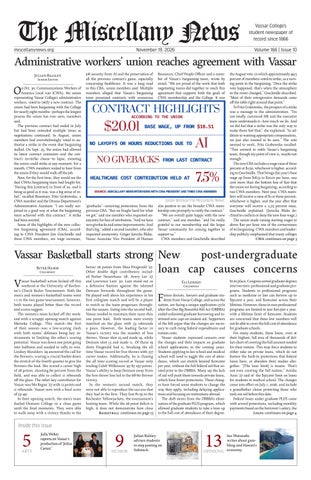
the August vote, in which approximately 99.5 percent of members voted to strike, as a turning point in the bargaining. “Once the strike vote happened, that’s when the atmosphere in the room changed,” Gescheidle described. “Most of their retrogressive demands came off the table right around that point.” To Fritz Grabowska, the prospect of a strike was a message to the administration. “I’m not totally convinced HR and the executive team understands it—how much we do. And we did feel that a strike was the only way to make them feel that,” she explained. “In addition to wanting appropriate compensation, we just also wanted to be seen.” The vote seemed to work, Fritz Grabowska recalled: “That seemed to rattle Vassar’s bargaining team, though my point of view is, maybe not enough.” The new CBA includes a wage raise of three percent or $1.50, whichever is higher, according to Gescheidle. That brings this year’s base wage up from $18.51 to $20.01 per hour, one cent more than the bottom line of $20 that the union set during bargaining, according to two CWA members. Next year, CWA members will receive a raise of $1 or three percent, whichever is higher, and the year after that everyone will receive a 2.75 percent raise, Gescheidle explained. (Jurecka Blake declined to confirm or deny the new base wage.) The union made raising starting wages to above $20 per hour one of the cornerstones of its bargaining. CWA members and leadership publicly emphasized that many colleges CWA continues on page 3
Vassar Basketball starts strong New post-undergraduate loan cap causes concerns River Hamm Columnist
V
assar basketball action kicked off this weekend at the University of Rochester’s Chuck Resler Tournament. Both the men’s and women’s basketball teams went 1-1 in the two game tournament; however, both teams played better than the record and scores suggest. The women’s team kicked off the weekend with a scrappy opening match against Marietta College. This match—the first of their season—was a low-scoring clash with both teams’ defenses being key instruments in limiting the other’s scoring potential. Vassar was down one point going into halftime and needed to rally to win. Lindsey Shoulders ’29 answered the call for the Brewers, scoring a crucial basket down the stretch of the fourth quarter to give the Brewers the lead. She scored a career high of 28 points, shooting 60 percent from the field, and was able to collect 11 rebounds off the glass. The other key contributor for Vassar was Mo Regan ’27 with 12 points and 11 rebounds. Vassar won with a final score of 53-49. In their opening match, the men’s team dueled Denison College in a close game until the final moments. They were able to walk away with a victory thanks to the
Inside this issue
5
ARTS
Julia Weber reports on Vassar's production of ‘Julius Caesar.’
heroic 26 points from Shea Fitzgerald ’27. Other double digit contributors included Parker Neuenhaus ’28, Avery Lee ’27 and Lawrence Lam ’30. Lam stood out as a defensive bastion against the talented Denison forwards throughout the game. He played well above his experience in his first collegiate match and will be a player to watch as the team progresses throughout the season. Going into the second half, Vassar needed to maintain their razor thin one point lead. Both teams were evenly matched on the glass with 33 rebounds a piece. However, the leading factor in Vassar’s victory was the number of free throws. Vassar shot 23 and made 19, while Denison shot 13 and made 11. Of those 19 shots Fitzgerald had 11, breaking the all time Vassar record for free throws with 317 career makes. Additionally, he is chasing the all time scoring record at Vassar only trailing Caleb Wilkinson ’97 by 197 points. Vassar’s ability to keep Denison away from the free throw line led to the 68-60 Brewer victory. In the women’s second match, they were not able to reproduce the success that they had in the first. They lost 81-55 to the Rochester Yellowjackets, the tournament’s hosting team. While the 26 point deficit is high, it does not demonstrate how close Basketball continues on page 15
9
HUMOR
Eli Lerdau Columnist
F
uture doctors, lawyers and graduate students from Vassar College, and across the nation, are facing a unique application cycle after the One Big Beautiful Bill Act (OBBBA) ended unlimited graduate borrowing and instituted new caps on student aid. Supporters of the bill argue that the changes are necessary to curb rising federal expenditures and tuition costs. Vassar students expressed concern over the changes and their impacts on graduate school applications in the coming years. Students applying to law school and medical school will need to juggle the cost of attendance, which can stretch beyond $100,000 per year, without the full federal aid that existed prior to the OBBBA. Many say the lack of aid will push them towards private loans, which have fewer protections. These changes have forced some students to change the way they apply, including delaying applications and focusing on institutions abroad. The shift stems from the OBBBA’s elimination of the graduate PLUS program, which allowed graduate students to take a loan up to the full cost of attendance of their degree.
Julian Balsley advises students to stop posting on Substack.
13
In its place, Congress sorted graduate degrees into two tiers: professional and graduate programs. Students in professional programs such as medicine or law can borrow up to $50,000 a year, and $200,000 across their lifetime. However, those in non-professional programs are limited to just $20,500 a year, with a lifetime limit of $100,000. Students are concerned that these low numbers will not be able to cover the full cost of attendance for graduate schools. For many students, these loans, even at their highest, fall tens of thousands of dollars short of covering the full amount needed for their tuition. This may force students to either take on private loans, which do not feature the built-in protections that federal loans have, or abandon their studies altogether. “[The loan limit] is insane. That’s not even covering the full tuition,” Anisha Azizi ’27 said of the $50,000 limit on loans for students in medical school. The changes came into effect on July 1, 2026, and include a grandfather clause protecting those who took out aid before this date. Federal loans under graduate PLUS came with several protections, including monthly payments based on the borrower’s salary, the Loans continues on page 4
Ian Watanabe writes about gambling and Hawaii's OPINIONS economy.
November 19, 2026
Page 2
THE MISCELLANY NEWS Emma Brown Darja Coutts Julian Balsley Grace Finke Hadley Amato NEWS EDITOR Samuel Eisenberg ASSISTANT NEWS EDITORS Iggy Gutierrez Madeline Nusbaum Aurelia Harrison ARTS EDITORS Brendan Kennedy Sophia Marchioli ASSISTANT ARTS EDITOR Sydney Jones FEATURES EDITOR Tina Mao ASSISTANT FEATURES EDITORS Jared Palumbo Ian Watanabe OPINIONS EDITOR Zoe Rodriguez ASSISTANT OPINIONS EDITOR Josie Wenner HUMOR EDITOR Noah Daube-Valois ASSISTANT HUMOR EDITOR Holland Kaplan SPORTS EDITOR David Bray ASSISTANT SPORTS EDITORS Armaan Desai Lucas Seguinot DESIGN EDITOR Sylvia Sargent ASSISTANT DESIGN EDITORS Ellen Tan Elliot Evans COPY EDITORS Gabrielle Lyman Julia Weber ASSISTANT COPY EDITOR Aria Kuklinski GRAPHICS EDITORS Charlotte Willenbring Aviva Barry PHOTO EDITORS Jay Fu Olivia Blank GAMES EDITORS Felix Mundy-Mancino Mia Liloia SOCIAL MEDIA MANAGER Fallon Dern LIVE EVENTS CHAIR Vera Giraudo WEBMASTER Anna Berggren REPORTERS/COLUMNISTS Finn Buckley Eduardo Culmer Noah Duncan Melody Hamilton River Hamm Isabel Holmes Daphne Huffman Lora Janczewski Benjamin Kaplan Eli Lerdau Bodie Morein Ender Nix Evan Seker Erin Thatcher Liza Williams Amritha Dewan PHOTOGRAPHER Andrew Chu CARTOONIST Catriona Chapman FACT CHECKER Emma Fuchs COPY STAFF DanaMarie Galindo Cooper Jaffe Naomi Kaplan Ren Nicolau Ida Polys Leah Weinraub Will Hamilton DISTRIBUTORS Cailey Metter
EDITOR-IN-CHIEF MANAGING EDITOR SENIOR EDITORS
Aria Kuklinski/The Miscellany News. MISCELLANY NEWS | VASSAR COLLEGE
NEWS
November 19, 2026
Page 3
VSA Senate Highlights, Nov. 15 • The Senate passed two bills: The first allows the VSA to vote on whether to sponsor certain student-led protests. The second creates an internal VSA policy on cancelling committee meetings, office hours or for alerting members about an absence. • Two Class of 2028 senators discussed ongoing work with the administration and various academic departments to create public guides for students on each major, correlate and any respective pathway. • The President tabled a bill that would require all student organizations to add a disclosure clause for AI image generation use to their constitutions. Senators discussed wording changes and potential consequences for failing to disclose AI use appropriately, among other items.
CWA
ratifies
CWA continued from page 1 similar to Vassar provide employees a substantially higher base rate than Vassar does. One flyer from the union alleged that each of the other Seven Sisters colleges provided a base rate of over $25 or over $30 per hour. “The fact of the matter still is that Vassar does deeply underpay workers on campus,” said one CWA member. “We are behind in pay. And at some point, they’re going to have to deal with that.” A second member added, “We are always fighting last year’s war.” Union members described that in one of the later bargaining sessions, Vassar’s team presented a deal with a base wage below that target. CWA’s team responded that $20 was their bottom line. According to one CWA member, the College’s negotiators returned with a base wage proposal of $20.01. “I thought they were joking,” the member recalled. “I actually thought that that was just them having a little tantrum, and then they would give us a little more.” In response to a question clarifying this version of events, Jurecka Blake wrote, “It was an iterative negotiation process that started with the college and
new
CWA each presenting starting points for negotiation. While we were very far apart early on, both parties committed to the process, and continuous progress was made throughout.” “I still feel angry at the College,” a CWA member described. “But when we were ready to ratify, I was actually feeling really good about what we have done. Even though it could have—should have—been better.” Fritz Grabowska said, “I know that the bargaining team had to fight for that three percent. And it’s frustrating that it has to be a fight for three percent, when you think about some of the increases that other positions are receiving.” (In recent years, the salaries of Vassar’s top administrators have had an average compound growth rate of 4.6 percent.) “We’re still not at the wages that provide for a living wage for everybody,” Gescheidle said. “We still have a ways to go. It’s a constant fight.” The Massachusetts Institute of Technology’s Living Wage Calculator puts the living wage for one individual without children in Dutchess County at $26.24 an hour, still more than $6 above the starting rate under
contract,
averting
the new CBA. Another major part of the union’s public campaign was its fight for job protections in the face of AI. “They fought hard against that,” one CWA member described. Another quoted a colleague during bargaining as saying, of the College, “Okay, so you want to replace us with AI. Just say it.” The new contract guarantees that the College will not institute layoffs or hour reductions due to AI, according to Gescheidle. He said it was one of the last issues resolved before a deal was struck. “It is not unusual for new items to take longer to discuss and finalize during negotiations, particularly issues that are still developing, as is the case with technology like AI,” wrote Jurecka Blake. CWA members also highlighted that the new CBA contains no givebacks, especially for healthcare. Members said one such proposal from Vassar was extending employees’ probationary period from six to 12 months, and prohibiting employees on probation from taking sick days. The CWA members noted that this proposal would have violated New York State law, which states that em-
strike
ployees are immediately eligible to accrue and use sick leave, including on probation. Jurecka Blake disputed this version of events: “The College is committed to following all state and federal employment laws. We would not make proposals that run counter to our compliance responsibilities.” One CWA member also alleged that Vassar tried to eliminate the retiree health savings plan from the previous contract. The union secured the continuation of that plan, union members said, as well as the 7.5 percent of health insurance costs that current employees contribute. The difficulty of the negotiations brought union membership closer, multiple members described. “It was just shockingly brutal the first couple of months,” said one member. Another added, “We were horrified at the callousness for such a long time.” They continued, “It got us angry and it made us tighter and stronger.” Gescheidle, who oversees 16 contracts in the area as president of CWA Local 1120, said, “I would say the membership at Vassar out of all of our units is probably the most militant and strongest right now.”
Bodie Morein/The Miscellany News. MISCELLANY NEWS | VASSAR COLLEGE
NEWS
Page 4
Students
react
Loans continued from page 1
ability to defer payments when experiencing financial difficulties and the potential of loan forgiveness. The ability to pay the loans at a rate equivalent to the borrower’s income is especially important for medical school students, who typically work three to seven years of residency after medical school. These residency programs rarely cover the full cost of loans, with starting salaries averaging around $68,000.The average debt taken on by a student in medical school is over $225,000, with some reports saying over 32 percent of practicing physicians owe more than $250,000. Azizi said, “At this point, there’s no choice but to buy private loans.” The difference between private loan repayment plans and graduate PLUS repayment plans is significant. Private loans typically carry higher interest rates, stricter monthly payment plans and offer little chance at loan forgiveness. “I looked [private loans] up and it was a nine percent interest rate… I would never pay it off,” said Emma Brown ’27 [Disclaimer: Brown is Editor-in-Chief of The Miscellany News], who is planning to apply to law school. Students are not the only ones worried about these private loans. Michael Rosenblum, Vice-Chair for Education of the Department of Medicine and Director of the International Medicine Residency Program at Albany Medical System, wrote by email, “For those currently in medical school or about to enter, we will continue to see a decrease in those choosing primary care fields as they
to
graduate
are the lowest paying and often offer the least support for the physicians in our contemporary models of care.” Vassar seniors have already begun to factor this into their future planning. Speaking about her reaction to finding out about the policy change, “I just remember feeling like, ‘Oh my god, I’m going to throw up,’” Brown said. “This really changes things for me.” She is delaying her application to law school, and she plans to take at least one gap year to make up for the lack of aid. Top law schools, such as Yale or Columbia Universities, often charge nearly $100,000 for tuition alone. This does not account for living expenses, a significant factor given that many of these schools are located in expensive areas, with the total cost of attendance often adding up to nearly $130,000 per year. With loans limited to $50,000 a year, many students worry they will not be able to pay the total cost of attendance. “I’m not in the financial position to pay [the other] $70,000 over the course of three years, or $210,000 out of pocket right now,” Brown said. Graduate PLUS loans helped to pay for this cost of living, if said expenses fell within the school’s published cost of attendance. Cutting off this aid has forced students to change the kinds of programs they apply to. “Living expenses add up. If you have a car and a car loan…groceries and rent, especially in this political climate we’re in, they’re only skyrocketing and they’re only going to increase,” said Gabrielle Lyman ’27 [Disclaimer: Lyman
November 19, 2026
school
is a Copy Editor for The Miscellany News], who plans to pursue graduate study in English. “I will not accept any master’s [programs] within the United States,” she said, explaining that she applied to programs in Europe, in part due to the rising costs of education in the United States. While Ph.D. programs will pay students a small salary for attendance in exchange for students taking on a teaching or research load, master’s programs typically cost just over $60,000 dollars. Azizi said, due to the changing costs of medical school, she is considering jobs in research fields: “That’s something I didn’t really want to consider before.” Advocates of the changes argue that the new provisions will pressure institutions to lower tuition. “Schools have no reason to lower costs or ensure degrees align with employer needs, all while students and taxpayers pay the price,” Rep. Tim Walberg, R-Mich., said during a debate on the changes to graduate PLUS. Cost of attendance at higher education institutions have risen dramatically in recent years, with some reports estimating increases of up to 102 percent over the past 20 years. None of the students spoken to agreed with Walberg. “I think there’s almost no way that law schools would lower their tuition,” Brown said. Supporters of the bill have further argued that the aid programs are a drain on the federal budget, especially in the face of rising national debt. The changes are estimated to reduce federal loan volume by $8 to $10 billion
loan
caps
annually, and $44 billion over the next decade. Opponents of the bill argue that these billions of dollars are worth the sacrifice. “We need education for society to progress,” Azizi said. “If we’re not spending money on education, then what are we spending it on?” White House officials have also argued that graduate PLUS loans allowed students to take on hundreds of thousands in debt for degrees with little ability to repay it. “The federal government will no longer sponsor $150,000 master’s degrees that saddle graduates with debt that they are not well equipped to repay” Secretary of Education Linda McMahon said in a November statement. Many Vassar students disagreed with this framing. “We don’t think about librarians, people who are cataloging data [or] working in archives,” Lyman said of people pursuing English degrees. “Our elementary schools are in a literary crisis, so I hope [the lawmakers who wrote the bill] enjoy all the new coming illiterate Americans,” she added of a prospective lack of strong educators. Medical schools have concerns for the future of their own. “I have great concern that we will see a marked acceleration of medical students and medical residents away from primary care specialties,” Rosenblum wrote. “A greater proportion of our populations (especially in underserved areas) will lose their already limited access to care, and that the demographics of medical students will become more homogenous than they currently are with a loss of students from underrepresented communities.”
Comp Sci Dept. to create lab with AI capabilities Iggy Gutierrez, Madeline Nusbaum Assistant News Editors
T
he Computer Science Department recently approved a retrofit to create a general purpose, computer science classroom with the capacity to run small scale AI models. The new classroom would allow computer science students to study and create localized AI programs while also being a space open to other departments. The new project’s location is still being decided, though preliminary discussions have centered on a space in the Sanders Laboratory of Physics building, also known as Sanders Physics. Many physics students expressed concerns that the proposed classroom would potentially take space away from the Physics and Astronomy Department, and they worried about the environmental and ethical implications behind the project. Dean of Strategic Planning and Academic Resources and Professor of Biology Kelli Duncan wrote in an email that she and her office have gone through an extensive process to identify spaces that would best serve the needs of everyone involved. She added that many of the renovation’s details are still under discussion with both chairs of the Physics and Astronomy and Computer Science Departments. Construction for the renovations is set to start in Summer 2027, according to Duncan, with the room ready for students in the fall. The project will be donor funded, covering both the construction and the equipment costs for the space. The administration did not disclose the identity of the donor or the amount donated. Equipped with two dozen new energy-efficient desktop computers, outlets and ethernet connections at the desks, the new space will be similar to the Computer Science Department’s current computer classrooms,
but with additional AI-related capabilities, Duncan explained. Associate Professor and Chair of Computer Science Jason Waterman wrote, “In this room, the computing will happen on compact desktop machines, where students can run AI models themselves and see firsthand how they work, where they fail, and what they cost.” However, Waterman clarified, “It is a shared teaching space, not a facility dedicated to AI.” The classroom will hold a range of courses from introductory programming to creating computer systems. Other departments can also schedule the room when the Computer Science Department is not using it. Many students in the Physics and Astronomy Department shared worries about the classroom beyond its potential placement within Sanders Physics. Physics and Astronomy Majors’ Committee Co-chair Aidan Dombrosky ’27 stated that although he knows the classroom will not be as energy consumptive as large scale AI data centers, his main issue with the project lay in the general normalization of AI within academia. Similarly, physics major Wyatt Nault ’28 expressed, “We, as a community, endorse a well rounded curriculum and deeper thinking across various disciplines. Adding an AI classroom is a step backwards for a richer experience in learning how to be a human.” Waterman stated in an email that the chatbots and image generators most commonly associated with critiques of AI will not be the focus of the space, but rather an engagement with methodologies that drive scientific research, simulation, data analysis and engineering. “Studying something isn’t the same as endorsing it,” Waterman argued. He expressed that the project will act as a space for computer science students to engage with and study how these AI systems work. “Art stu-
dents need studios and music students need practice rooms; for computer science, this room is the studio,” he wrote. Director of Sustainability Ken Foster addressed the environmental implications that come with an AI-oriented space, noting that, as with any new technology, the tradeoffs between innovation and environmental damage need to be weighed. He added, “If the benefit of the technology is deemed to outweigh the environmental costs of it, then the question involves how we can minimize the environmental costs of its use.” Waterman explained that the room will only be running small, local AI models using the resources provided in the classroom, rather than relying on energy-intensive remote data centers. As a result of the computing happening in one space, students and professors can measure exactly how much energy is being used, and will be able to share and teach the results. He also assured that the room will not require any additional load to the existing power distribution in the building as the desktop computers are air-cooled and turn off automatically when not in use, requiring no specialized cooling or heavy electrical infrastructure. He added, “Even with every computer in the room running at full capacity at once, the entire classroom will draw less power than a single commercial AI server.” Waterman also noted that the current computer classrooms, located in Sanders Classroom and Sanders Physics, limit both course possibilities and scheduling opportunities for the Computer Science Department. Waterman explained, “The times [the two current classrooms] are available limit when we can schedule our courses, and a third classroom gives us the flexibility to offer them at times that work well for students.” In addition to discussions around ethics
MISCELLANY NEWS | VASSAR COLLEGE
and environmental impacts, some students worried about the potential addition of the new classroom to Sanders Physics. One of the dedicated computer rooms is currently in Sanders Physics, a building that previously only housed the Physics and Astronomy Departments but has grown to accommodate the Computer Science Department and other various sciences as part of Vassar’s four Integrated Science Commons. Dombrosky shared his thoughts on the building’s integration with computer science, stating, “I think since 2012, the idea of it being a shared space has been one of contention rather than interdisciplinary department togetherness.” He added, “The Physics Department has always been a gracious host of the Computer Science Department, but time and time again, they act almost parasitically to the space in the building.” Physics major Simon Goldweber ’27 expressed his annoyance with physics classes having to be scheduled in various other buildings around campus due to a lack of classroom space in Sanders Physics. He explained that one of his professors has to walk from Blodgett Hall to Sanders Physics in a 15-minute period, limiting his availability to talk with students after class. “It’s frustrating to have a dedicated Physics building and have Physics classes still end up in Blodgett,” he said. Dombrosky commented, “Last time I checked the front of the building, it was just Sanders Physics and not Sanders Computer Science.” Waterman affirmed that the new space will be available for other departments, citing that the room will still remain open to all professors and that the desktops will be able to fold into the desks, encouraging other departments to use the space. Dombrosky remarked, “I think it will not be a shared space, because I know most of the physics and astronomy students are opposed to the proliferation and integration of AI curricula.”
ARTS
November 19, 2026
Page 5
‘Julius Caesar’ director reflects on the noblest play of them all Julia Weber
Assistant Copy Editor
F
riends, Romans, countrymen, lend me your ears as I tell you all about Vassar College’s brilliant production of “Julius Caesar” by William Shakespeare. Performed in the Susan Stein Shiva Theater from Nov. 5 to 7, the student-run classical theater organization Merely Players gave life to Shakespeare’s tragedy of conspiracy, tyranny and miscommunication. As a Shakespeare enthusiast, I absolutely had to see it, even though I knew little to nothing about the play. This presented no issue, however, as sophomore director Hazel Waldron’s incredible talent and knowledge of “Julius Caesar” made the play easy to understand, even for those who are new to Shakespeare. The best Shakespeare production is one that makes its audience truly feel something, despite its unfamiliar, antiquated style of language; Waldron’s production was no exception. “Julius Caesar” tells the story of its eponymous Roman dictator, famous for his assassination at the hands of his own senators. Shakespeare’s play follows a cast of Roman senators who, feeling that Caesar (Sophia Miller ’29) has become tyrannical, gradually hatch a plan to assassinate him. Casca, Cinna, Brutus, Caius Cassius, Metellus Cimber, Trebonius and Decius Brutus take turns stabbing Caesar, a foul deed that leads to tragic consequences. Caesar’s loyal companion, Mark Antony (Ayalah Spratt ’30), uses his anger and grief to turn the people of Rome against Cassius (Yeshe Rai ’30) and Brutus (Benji Boyd ’29), resulting in a civil war. Several ghosts, suicides and miscommunications later, the play ends with power in the hands of Antony and Caesar’s nephew Octavius (Ava Leslie ’29), who later became Augustus, the first emperor of Rome. I found myself intrigued by the play’s message about what happens when someone takes their power too far. Waldron did a beautiful job of turning what was once his middle school obsession into a reality. When I asked him why “Julius Caesar” has so strongly resonated with him, Waldron said, “Depending on your perspective, you can make a case for any of the characters
Are
we
losing
Jo Pearlstein
Guest Columnist
T
being the villain, the tragic hero, whereas I think in a lot of other works, that feels a little bit more straightforward.” This ambiguity struck me as well; the play is indeed more about the tragic consequences of political ambition, rather than who is to blame for it. Watching this play about tyranny, it was hard to ignore that the world of Caesar’s Rome bears some resemblance to our current political landscape. “I think that the way the positions that people are put into, and the way that interpersonal loyalties end up mixing with political loyalties continues to be relevant,” Waldron noted. Although the conspirators-turned-assassins could not have foreseen that their murder would result in the creation of the very empire they were trying to prevent, what matters is the fact that they attempted to overthrow tyranny at all. Despite their ultimate failure, Waldron said, “That doesn’t necessarily mean it wasn’t worth trying.” Waldron added personal touches to his production with striking directorial choices, one of which was the play’s costuming. Beyond the incredible decision to have most characters wearing Doc Martens, Waldron demonstrated his knack for giving meaning to the characters’ emotional state through costume changes. For example, Mark Antony begins the play as an energetic companion to Caesar, donning blue, gold and yellow. However, Antony flips the switch after walking into the horrific scene of Brutus, Cassius and the other conspirators stained in the blood of his friend, who lies dead right in front of him. Regarding Antony’s post-assassination costume, Waldron explained, “He has this black military jacket, because it really is the way that he utilizes his mourning as a military strategy.” As for Brutus, who wears brown tones before the assassination and dark blue tones afterward, Waldron said, “I think that blue has this connotation of nobility, loyalty.” Thus, Brutus’ post-assassination costume suggests that he, albeit hesitantly, embraces the concept of honor, prompting this famous line spoken by Antony as he stands over Brutus’ dead body: “This was the noblest Roman of them all.” Another one of Waldron’s fascinating di-
heater etiquette has always been an evolving part of entertainment culture. The individual’s experience of attending a theatrical performance is hugely affected by it: The Ancient Greeks would stomp their feet if they disliked the performances they saw on stage, and in Shakespeare’s day, audience members would boo the actors and sometimes throw dried figs and oyster shells at them. While theatergoers today do not act quite this impolitely toward the performers they see onstage, there has been a great departure from traditional standards of going to the theater in the last century. Last week, on Nov. 6, I went to see the Vassar Drama Department’s production of “Cabaret” in the Martel Theater. As other attendees and I filed into the theater and took our seats, I noticed that we were all dressed casually. Personally, I was wearing a sweatshirt, jeans and sneakers. This informality is quite different from how theatergoers dressed in the early 20th century and before—when suits and evening dresses were standard attire—whether attending an op-
the
Image courtesy of Daphne Huffman '30.
Image courtesy of Miranda Shandell ’29. The cast of Julius Caesar performed on Nov. 5, 6 and 7. rectorial choices was to make explicit what seems implicit in the script: the romance between Brutus and Cassius. In the production, Brutus and Cassius share several kisses, moments of flirtation and overall romantic chemistry. This, according to Waldron, was notably done without changing a single line from the script. Feeling it absolutely necessary to explicitly showcase their romance, Waldron stated, “[The romance] doesn’t change anything about the nature of these characters… In a more broad assessment of Shakespeare’s works, I think that there’s a lot of queer coding, whether that’s sexuality or gender. And so to me, it feels true to the script to have it like that.” Waldron also spoke about how, despite the audience’s positive response to Brutus and Cassius’ romance, his choice was not for shock value, but simply to showcase a queerness he feels is implied in the script. One of Waldron’s favorite parts of directing “Julius Caesar” was working with the talented actors and witnessing how they
plot?
era, a vaudeville revue or a musical. While I am not saying we need to revive wearing floor-length dresses or tailcoats, I believe that we can find other ways to preserve the privilege of theatergoing. Putting on a nice pair of slacks as opposed to sweatpants signifies a respect for the playwrights creating the work, the tech crew backstage making sure everything runs smoothly, and the actors performing, which distinguishes this form of entertainment from sitting on your couch watching a movie in the privacy of your own home. This shift in dress code from the early 20th century may be due in part to the easy accessibility of media and the ease of finding entertainment online. The rise of technology has greatly impacted how we engage with theater as audience members. A prime example of this, as any theater nerd would know, is Patti LuPone’s meltdown—well, there have actually been a few—when an audience member took flash photographs of her mid-performance in “Gypsy,” prompting her to stop singing the dramatic, belty number “Rose’s Turn” and have them kicked out of the theater. Personally, I have sat next to many people
Theater
etiquette
throughout the years who had their phones on full brightness as they texted or scrolled through their email during the show, and have heard someone’s phone ring echo through the theater during a vulnerable moment between two characters. Not only were these experiences distracting for me as an audience member who paid quite a chunk of change to see a show I was really looking forward to, but they have become commonplace. Before technology, theater served as an escape from the mundanities of life. There were no disruptions during these breaks taken at the theater because we lived in a less connected world. Are these breaks valued just as much now as they were before the digital age? As a self-proclaimed theater nerd, another pattern I have noticed from the numerous Broadway shows I have seen is the concession of food and drinks before the show starts and during intermission. I am definitely as hungry as the next person—especially after an early dinner to make it to the theater on time—but between the crinkling of plastic chip bags, boxes of Junior Mints and tumblers filled with alcohol, it feels more like going to the movies than prepar-
MISCELLANY NEWS | VASSAR COLLEGE
came to understand their characters deeply over time. The cast was just as enthusiastic about the character development process as Waldron was. Waldron described how eager the actors were to talk about their characters, often setting aside time to speak with Waldron one-on-one about their characters, conversations which would go on for over an hour. Waldron said, “I think it was just so amazing to have those conversations, to have both my input and their views of the characters merge, and then to see that come out in their performance was so gratifying.” The programs handed out at this performance featured the great words of Cassius: “How many ages hence / Shall our lofty scene be acted over / In states unborn and accents yet unknown!” After seeing such a spectacular performance, I hope that Waldron continues to direct such lofty scenes, allowing fans and people unfamiliar with Shakespeare alike to feel truly impacted by its gravity and meaning.
today
ing to see a live performance. I have also sat next to someone twice now who has spilled their drink on me before the start of the show. Selling food and drinks supplements theaters’ revenue; however, this decision can impact audience satisfaction, as it can be difficult to listen to and concentrate on dialogue and songs with someone crunching on chips next to you, or the strong smell of alcohol invading your olfactory senses. While we live in a fast-paced world, going to the theater is one break that we know we can count on. It gives us stories that make us feel, sometimes in ways we did not know we could, and provides room for us to think about what it means to be human in the world we currently live in. While live performance is not unique to the theatergoing experience, it is important that we establish a distinguishable etiquette code that separates what is appropriate when attending a variety of live experiences. For example, a Broadway show with clapping at the end of a number, versus a live concert where rowdiness is encouraged to cheer on the artist and part of the culture. It is up to us to protect these experiences so that they remain enjoyable and meaningful for all.
ARTS
Page 6
‘Antigone Melody Hamilton Columnist
I
n the weeks following election day, the crashing of the “blue wave” has inspired a range of emotions across campus. For some, it has come to represent hope, however tentative, that the country will reorient itself toward the salvaging of human rights. However, others have been left asking, with thick layers of cynicism, will this slight shift in power really be enough to enact justice effectively? And if it is not, what can we do? These thoughts were on my mind last Saturday, Nov. 7, as I made my way to The Mug to see the classical theatre group Merely Players’ production of “Antigone Now.” The one-act play, penned by playwright Melissa Cooper, is a modern retelling of Sophocles’ classic tragedy “Antigone.” Under the creative vision of director Kate Lynch ’28, the play was staged in-theround, with chairs surrounding the entire performance space. Within this space was set designer Maya Egrie’s ’28 abstract yet
Now’
gives
striking set: The human consequences of a war-torn era were represented by heaps of clothing strewn across the floor, alongside other various debris. As my friends and I took our seats, we had to navigate around the rubble, and when we finally sat down, we were left to observe not only the stage but also our fellow audience members from across the room. When it was finally time for the show to begin, the organic chatter of the audience was interrupted by a gentle shushing from a player, as if we were mouthy children awaiting an important lesson from our elders. The four members of the cast gradually entered from all directions, delivering an essential preface: “Whoever survives gets to tell the story. But the ghosts have a say in it, too. / Listen.” Indeed, much of the conflict was in the tension between survivorhood and martyrdom. The play follows Antigone’s (played by Adeline Oh ’30) determination to bury her brother against the will of her uncle and her nation, knowing this action will condemn her to death. Meanwhile, her sister Ismene’s (played by Rachel Carrillo
November 19, 2026
ghosts
a
’30) allegiance lies ultimately with her determination to stay alive—any possibility of a desire to bury her deceased brother is overshadowed by her need for personal safety and her ineffable attraction towards life. After Antigone is executed for the crime of burial, Ismene mourns the loss of her final family member, but her resolve to live remains. In the play’s closing, she says: “They’ve started to rebuild. I want to see it. I want to watch them clear the rubble, stone by stone, and see the buildings rise. How can I resist life? I can’t. I can’t resist life.” Following the performance, a friend of mine told me how they were reminded of Achille Mbembe’s 2003 article “Necropolitics.” In the article, the author coined the eponymous concept: “The use of social and political power to dictate how some people may live and others must die.” Indeed, the existence of the government in “Antigone Now” required the undignified death of those who displeased it. This idea was brought into the modern age when the character of Creon (played by Arthur Beauregard ’28), the head of the state who
say
condemned Antigone to death, was outfitted as the spitting image of an American politician. In the program’s Director’s Note, Lynch notes that the play asks us: “Is Antigone’s story a feminist one? Is Antigone even the subject, the actor, of her own story?” Mbembe’s answer: “Under the conditions of necropower, the lines between resistance and suicide, sacrifice and redemption, martyrdom and freedom are blurred.” Regardless of your own personal answer to the question, whether you feel that Antigone is a fool or a hero for following her morality to its mortal conclusion, she is dead. She can no longer tell her story, and thus the telling of it by those still living is a powerful act. Among the questions posed by the caring cast and crew of “Antigone Now,” I found that one of them especially stood out: When faced with a government that denies the voiceless their dignity, what would you do? Or rather, what will you do? And will it be enough? And when the rubble is cleared and the buildings rise again, will you be proud of it?
Don’t be sad, be blue: It’s time to (re)watch ‘Arrested Development’ Charlotte Willenbring Graphics Editor
I
t was a Thursday night. To celebrate the end of another work week, I was engaged in my familiar routine of scrolling through Netflix, on the hunt for something new and interesting to watch. The search felt futile, given that I cannot remember the last time a TV series managed to keep my attention past the first few episodes. Historical drama? Too bland. Reality TV? Too catty. Teen fantasy? Too cringey. Sci-fi dystopian? Just depressing. I was just about to give up and resort to my safe option, “The Great British Bake Off,” when neon orange letters caught my eye: “Arrested Development.” Created by Mitchell Hurwitz and premiering in 2003, it was one of those shows that I had occasionally heard about in passing over the years, but which I never got around to watching. On a whim, I clicked, unaware that not only had I just stumbled upon my newest obsession, but my favorite kind of TV: the rare gem that makes you die laughing in the moment and at night, keeps you ruminating in deep, philosophical thought. Though I originally expected the age of the early 2000s sitcom to deliver some respite from the latest headlines, it would turn out to achieve this while bearing relevance to the current political landscape. The show opens with the main character, Michael Bluth, played by Jason Bateman, attending his father’s retirement party on a boat. A cheeky narrator, voiced by Ron Howard, introduces us to Michael’s family, who we quickly learn are a highly dysfunctional lot: Michael’s twin sister who throws extravagant wine and cheese fundraisers—a notable one being HOOP (Hands Off Our Penises)—an older brother who performs magic tricks (“illusions”) for a living, an unemployed brother-in-law who lost his medical license administering CPR to a sleeping tourist… You get the idea. As we get to know the Bluth family a bit more through their ridiculous endeavors, all funded by the family’s real estate company, we naturally feel Michael’s frustration at their wasteful habits and ignorance. Everything is going to be OK, though, be-
cause after working tirelessly for 10 years, Michael is going to be made partner in his father’s company. Or so we think. Nine minutes into the show, all hell breaks loose. Suffice it to say, Michael is not made partner in a twist of events that involves the police, a disappearing act and a gay protest. The remainder of the pilot episode, and every subsequent episode in the series, revolves around an exasperated Michael cleaning up after his family’s messes. The show’s structure is not unique. In typical sitcom fashion, each 20-minute episode starts off by showcasing the Bluth family’s quotidian activities and quickly devolves as characters make bad, albeit humorous, decisions before a resolution brings dynamics back to the status quo. However, despite its formulaic quality, I found myself coming back to the show over the next few days and weeks. But why? What makes “Arrested Development” so compelling and watchable? Part of the reason, of course, lies in the show’s extreme absurdity. Between the family’s main means of transportation being an airport stair car, a deteriorating Bluth Company model home serving as the family’s primary residence and the family’s frozen banana stand that repeatedly gets destroyed and rebuilt, each episode invites an endless number of bizarre possibilities. The clever interweaving of these possibilities is what makes the show so addictive. What makes it compelling, however, and relevant today, is something else. Underneath the absurdity lies the most vital feature of the show: It allows us to laugh at the incompetence of the Bluth family without becoming disenchanted. In theory, we should despise the Bluths: The entire series consists of them recklessly dipping into the never-ending coffers of the Bluth Company to pursue their trivial, petty schemes. They occupy positions of extreme privilege and make the worst decisions possible, wreaking havoc on everything in their path. As hinted at in the series’ title—“Arrested Development”—not only are the characters essentially toddlers stuck in adult bodies, incapable of functioning in the real world, but at their core, they never change. They
never learn from their mistakes. They never become “better people.” And yet, hidden in the seemingly bottomless pit of arrogance, greed, selfishness and stupidity are moments of connection. When the Bluths are not occupied with trying to throw one another under the bus, they do band together for the sake of something greater: family. In a day and age where incompetence at the helm of a polarized society plays out in extremely nefarious ways, as made apparent by our political climate, “Arrested Development” offers a bit of optimism. A lot of the time, we see ourselves in Michael, the only sane person in a world of nonsense. But despite Michael’s family members never failing to let him down, and despite his temptation to forget them and stake out on his own, he ultimately pulls through for them—and occasionally, they do the same for him, too. And when he comes to the rescue, time
MISCELLANY NEWS | VASSAR COLLEGE
and time again, we the audience cheer him on, because in Michael, we see more than just our own frustrations and gripes—we see our better conscience. Even if we aren’t Michael (because let’s face it, none of us have that much patience), we all want to believe we can be. It is by this mechanism that the humor of “Arrested Development” sobers us up to what we derisively refer to as “the current state of the world” without eradicating all hope for something better. Unlike a lot of Gen Z humor—exemplified on platforms like TikTok—it does not leave the bitter aftertaste of cynicism. Making sense of our nonsensical reality is a Sisyphean task, but, as Michael teaches us, not a worthless one. And if this seems like too lofty of a message, then find comfort in the fact that even if you are having a bad day, you can curl up in bed and put on any episode of “Arrested Development.” Chances are, Michael Bluth is having a worse one.
Charlotte Willenbring/The Miscellany News.
FEATURES
November 19, 2026
Vassar
warms
Anna Hagen Columnist
O
ne of my favorite parts of fall is its aroma. From the sweet scent of crunching leaves to cinnamon sprinkled on apple cider donuts, many smells comprise Vassar College’s autumn atmosphere. However, there has been a recent kick to campus life with the return of Spice Week, a programming event that was started last year by Research Librarian for Sciences Isabel Ryan, in collaboration with Greenhouse Manager Alicia Contelmo and Assistant Professor of Chemistry Rebecca Pollett alongside biochemistry and chemistry majors. I learned from Isabel Ryan that she was inspired to create Vassar’s own version of Spice Week by the American Chemical Society’s theme for last year’s National Chemistry Week, “The Hidden Life of Spices.” Writing to The Miscellany News, Ryan recounted, “I took inspiration from their education materials and wanted to do something locally as a way to connect college students and the larger campus community with the science behind spices.” Programming began with a Spicy Plant Print Workshop at the Olmsted Greenhouse, during which students produced anthotypes that rely on natural photosensitizer chemicals—in this case, turmeric mixed with alcohol—to decorate prints and fabrics. Isabela Belani ’30 participated in this event and found it fascinating to create patterned bandanas through the anthotype process. In a conversation with Belani, she noted that “I normally see turmeric and alcohol as separate things, so it was cool to see them mixed together to create a cyanotype-like print,” Belani expressed. Both printmaking processes were popularized in the 19th century, but while anthotypes used natural plant extracts, cyanotypes used iron-derived chemicals. “When I think of art, I think mainly artificial [pigments], not natural dyes,” Belani explained. “It was interesting to see the mix of nature and humanity in the process.” The Greenhouse also hosted a tea-making workshop. As someone who never leaves their dorm without their travel mug, I loved the opportunity to design my own blend instead of going for a prepackaged teabag. I made blends of lavender black tea with chamomile and sencha with hibiscus leaves, and was intrigued by the variety of medicinal properties that each tea and herb had. Soon, the space was filled with a perfect blend of scents as everyone crafted their own cup tea with gingerbread cookies against the backdrop of a chilly November morning. “My favorite part of spice week is the sense of community it brings. I love hearing everyone's relationship to spices and how important certain spices are to different cultures. During our tea event, we saw people of all ages appreciating their teas, while trying new things and learning about the chemical makeup of spices,” Contelmo shared in a message to The Miscellany News. Later in the week, Vassar chemistry students hosted a perfume-making workshop. Not only did I finally venture to the second floor of the Winton Evans Bridge for Laboratory Sciences, but I left with an orange vial of vanilla, chamomile and sandalwood perfume. We were led through the makeup of the perfect perfume, which combines top, heart and base notes blended with a carrier—we used fractionated coconut oil. Although I built my fragrance pyramid with the “Warm Vanilla Spice” blend provided as an example, students were free to combine whichever essential oils caught their eye—
up
the
or nose. I enjoyed seeing the variety in the fragrances that everyone created, from jasmine to bergamot to rosemary. Personally, I find scents to be such an underrated component of curating memorable experiences. Every culture has its own scent profile that emerges from the particular plants, spices and places of its environment. “I enjoy how Spice Week could connect with students’ pre-existing and future interests. And if that brings them closer to the library, even better,” Ryan added. Since arriving on campus, I have loved exploring the world’s range of scents that are often incorporated into cuisine, at events such as Night Market, Kaleidoscope and Spice Week. Culture, cuisine and memory are inextricably linked as vital parts of the human experience, and are all connected through our sense of smell. According to an article from Harvard medicine, “If the hippocampus [which stores and organizes memories in the brain] deems [a] smell important — if it were connected with a particularly emotional moment, for example — it can file the information and store it indefinitely. Even decades later, the same scent can bring the memory and emotional salience of the moment flooding back.” Rachel Herz, a neuroscientist at Brown University who studies the psychological science of smell, asserted in the same article: “Smell can instantly trigger an emotional response along with a memory, and our emotional states have a very strong effect on our physical well-being.” Moreover, Herz acknowledged, “Research showing that smells evoking personal memories promote slower, deeper breathing than pleasant but more generic smells and linking odor-evoked memories to significant reductions in markers of inflammation.” The activities that Spice Week hosted serve as a much-needed creative repose and outlet during the second half of the semester. Moreover, Vassar’s Libraries, Greenhouse and Chemistry Department developed a unique set of experiences that you do not often get the chance to participate in while on a college campus. I loved the week’s interdisciplinary focus—mixed with perfect cozy vibes—on highlighting the chemistry behind common “luxuries” that we do not often associate with pipettes or molecular models, like perfume and tea. Ryan wrote, “My goal with Spice Week is to create experiences where people can feel a sense of awe or connection to learning. As a librarian, I love when knowledge is shared by collective meaning-making […] My hope is to support the discovery process by designing a space where people can share a nice time while in the presence or spirit of books about spices.” “My hope for Spice Week is that it becomes a Vassar tradition!” Contelmo expressed. “I think these events themed around spices can be very therapeutic and can provide a feeling of home, especially for students who might not get to go home for holidays.” For me, Spice Week served as a helpful reminder of the Greenhouse’s coziness, especially in the colder months. Personally, I am looking forward to next year’s events as a chance to revive my senses from the numbing cold of the encroaching winter. Until then, I will spritz my new perfume before going on my morning walk, letting vanilla and sandalwood mix in the air with the other scents of a Vassar fall. In case you would also like to stop by and enjoy its wide array of plants—including the tree that produces cinnamon from its bark and a vanilla orchid, the Greenhouse’s hours are 10 a.m. to 5 p.m., Monday through Friday.
season
Page 7
with
Spice
Week
Images courtesy of Alicia Contelmo. Students make anthotypes and tea during Spice Week at Olmstead Greenhouse.
MISCELLANY NEWS | VASSAR COLLEGE
FEATURES
Page 8
Brewer Featuring
of
Afia
Week Copenhagen Chronicles Nasim ’27 Chapter 6: Playing cards and making friends
the
Lora Janczewski Columnist
Image courtesy of Chip Downes-Le Guin '29. Afia Nasim talks for Brewer of the Week. Welcome back to Brewer of the Week, a series where, in each issue, Chip Downes-Le Guin interviews a random student around campus. Students are selected for interview through randomly generated letters, a random number and Vassar College’s student directory. This week’s feature: Afia Nasim ’27. Afia Nasim ’27 arrived for our interview bundled for the cold and sporting a Waseda University sweatshirt. She gave me advice on how to pitch a change in major to your parents and the best way to really “live” at Vassar College. Our conversation has been edited for length and clarity. Q: You’re a senior… So you know what you want to study? I’m a history and Japanese double major. I actually started off doing compsci [computer science] because it’s what my parents wanted, but I kind of finessed getting into history. I was like, “Okay, I’m majoring in compsci and I’m minoring in history,” and then I was like, “You know maybe I’m minoring in compsci and majoring in history,” and they were like, “Okay…” I declared history [as my major] in fall of my sophomore year because I wanted to study abroad…and I thought, if I’m really choosing, I’m not gonna choose compsci. I have to do what I really want to do. And then I went to declare a Japanese correlate and my professor said, “Just do a major, you’re already there,” which was how I ended up with that. Q: And why Japanese? I’m into a lot of anime and both of my parents have ties to Japan. Both my parents are from Bangladesh, and my dad went to Japan first and lived there for a bit before he went to the United States. And then my mom, she went directly to the United States, but her eldest sister lived in Japan for 30-something years. So that was also a thought in my head; I can finesse and be like, “Your favorite sibling knows Japanese and I can talk to her in Japanese now. Isn’t that so cool?” So everything I’ve chosen, I was like, “I can finesse this with my parents.” Q: Outside of academics, how do you enjoy spending your time? The org I go to the most is the Aikido Club. I actually was forced to become its president in sophomore year, because the only senior was graduating, and she was like, “I'm bestowing this upon you, and if you don’t take it, well, the club’s over,” and I was like, “Oh God… okay, guys.” So I’ve been doing that for four years, and doing Aikido at Vassar is kind of what helped me choose which school to study abroad at, be-
November 19, 2026
cause their style of Aikido is the same that they teach at Vassar. Q: And how did you start getting involved with Aikido? I just started, freshman year. I went to the org fair, I got sniped by the president, she was just like, “Come here,” and I was like, “Okay,” she gave me a piece of mochi, and she was like, “Come to practice,” and I was like, “Alright.” I’d always wanted to do martial arts, but I never did. I’m from Long Island, and there’s this huge karate dojo called Tiger Schulmann’s and they used to run commercials all the time on TV, and I was super into those commercials. I was like, “I wanna do karate.” But what’s really funny is that I thought, “I’m too old, I can’t get into it”—I was nine years old. But that’s the exact age where you’re like, “Oh, if a seven-year old beat me up, that would be really embarrassing,” so I thought I couldn’t get into it. I passed my prime. Q: What do you admire most about your friends? They’re so good at living. They’ll go to all of their classes, and then especially my housemates this year, they’ll go to a concert in the city and come back—they just went to a screening of the Stephen Colbert show— and then will just come back on a Sunday evening. But they always make it to their classes and I’m like, “How are you doing all of this?” A lot of my housemates have accommodations so they’re not on the Vassar meal plan, so they’ll also cook at home, and I’m here still living like a stereotypical college student. If I don’t make it to the Deece, I’m eating ramen at home or I’m starving. ‘You guys are cooking, you’re doing extracurriculars, you’re going out and doing fun things, and you’re doing your classes and you still have good grades…’ so I’m always impressed with their time management. Even though they tell me that they’re running out of time, I’m just like, “I don’t know. It seems like you’re doing it all.”
C
ard games were integral to my childhood. Whether it was the tried-andtrue Go Fish or I Declare War, a deck of cards was never far away to start up a little game during recess or when bored at home with family. However, I stopped playing cards as I grew older. Maybe it was because I became busier with other tasks or schoolwork, or maybe I simply found other more efficient means of entertainment—like using my phone or watching shows. I had essentially forgotten all about card games. It was not until I went to Greenland with DIS over the summer that I rediscovered the joy of playing cards. In Greenland, one of the quickest ways I made friends experience was learning the different games people grew up playing. Some became classic go-tos (I love playing Caboo), others I never quite understood (what was going on in Euchre…) and others frustrated me to great extent until I actually started to win (looking at you, Mau). We spent many hours on ferries or in hotel lobbies playing our beloved card games and, more importantly, laughing and growing close. So it was obvious to me that I needed to pack my own deck for my semester abroad. I glanced at the unopened deck of cheap cards that was collecting dust on my bookshelf. I tossed them into my suitcase, and when I finally started to unpack my things in Copenhagen, I put them straight into my school bag. After one of our first days of classes, my friends and I headed to a cafe. While waiting for our coffee and pastries, we talked about class and all the little things that do not really matter—you know, those typical “new friend” conversations. I briefly peered into my bag and saw the deck of cards that I had been lugging around for a few days and took it out. My friends’ attention was immediately piqued. I taught them how to play Caboo, with fewer rules at first so that it was simpler. We started every game with four cards, only looking at the bottom two. With
Q: If you were talking to your younger self, what would you tell her? Maybe it sounds a little cliché, but it’s okay to not be in a set friend group. I always tell this to people: I’m just friends with individuals.
MISCELLANY NEWS | VASSAR COLLEGE
many rounds of switching our highpoint cards for the lowest card values possible, we had a few different winners who held a total of three or even just two points. After a few rounds with increasing competitiveness, we added the rest of the moves. Over time, our coffees became lukewarm. We were laughing, stifling frustrations, agonizing over our mistakes and having a wonderful time overall. It seemed that just a few moments had passed, but in reality, it had been hours, and we needed to start getting ready to walk over to our next classes for the day. This became our tradition. After class, we would head over to a new cafe or sit in the student hub and play cards. New ones or old ones—it did not matter. As long as we played something and chatted in between, it was guaranteed to be a good time. During our study tour to Sweden, we brought our cards. I grew closer to the people in my core course by learning their version of Caboo—Cambio—and by playing games in the hotel lobby until it was past midnight on a Wednesday, only stopping when it dawned on us that we had to wake up early the next morning. Even just learning how to shuffle cards the proper—and cooler, satisfying-fall-into-your-hands—way became a means of becoming closer friends. Not only are cards great for getting closer with others, but they also serve as an open invite. I have made friends with locals studying at Copenhagen University just by playing cards in a public space with a friend. We were probably setting up to start our hundredth round of Caboo that day when a group of friends came up and asked what we were playing. Soon enough, the five of us were all sitting around a small table pointing fingers, almost crying from laughter and learning about each other, all because of some cards. I carry my once shiny and stiff cards with me everywhere I go—except now, you can tell that they have been wellloved. The box, too, is worn and cannot stay closed. Nonetheless, they continue to teach me that people can bond over even the simplest things. Sometimes, all you need is an avenue to connect.
HUMOR
November 19, 2026
Please
stop
writing
Page 9
Substacks
Julian Balsley
Also Writes Essays
I
’m all for democratizing information and the ways the internet has loosened the stranglehold middle- and upper-class white men held over media production for most of this country’s history. Nowadays, anyone can write an essay about anything and put it on the internet forever, for anyone to see. That does not mean you should. If you are considering starting a Substack, here is my advice to you: Do not. You are not that interesting. Your ideas are not that good. And you are not a good writer. Save yourself and the rest of us the trouble. I love a good essay, and I read a lot of them. A good essay can crack open the world and draw out a pearl of human experience that reorients the reader’s experience of what it means to live. Your Substack essay will not do that. You may think that you are the next Joan Didion, standing on the cusp of a brilliant career of biting cultural criticism, and the only thing holding you back is that you haven’t linked your Vassar Gmail account to Substack. You are dead wrong, pal. It is pure hubristic narcissism to waterboard your friends and family with your verbose nonsense like this. I promise you that nobody cares what you have to say. Please stop forcing us to read your bullshit takes that were too halfbaked for your 100-level philosophy class. You do not have anything new to say about the mind-body problem. You do not have an interesting take on AI. Nobody wants
Image courtesy of Arin Miller '30. to read about “Why your alternative dairy latte is oppressive.” You are doing nothing but contributing to the ever-expanding Great Pacific Garbage Patch that is the internet. Nobody wants to read your Substack. Please just shut up. Honestly, you’re doing yourself a favor more than anyone else by leaving your screed in your Google Docs and not forcing the rest of us to slog through it. Here’s why: You’re way worse at writing than you think. Your sentences stumble and bump into each other like punch- drunk preschoolers. Your metaphors sound like an AI-generated pop-country ballad. Your Substack is
one long self-report that your high school English teacher failed you. Remember this: Everything you write on Substack will be attached to your name forever. Do you really want your future spouse, or the boss at your dream job, to know that your “best writing” sounds like a fourth grader’s book report on a picture book they didn’t read? You may be thinking, “Oh, he’s not talking about me. I actually have a good Substack.” Wrong. I am talking specifically to you. You do not have a good Substack. I hate your Substack. I hate you. Hey, I get it. I love writing. I understand the dizzying dopamine rush of seeing your
name in print. But, please, I’m begging you. Do not start a Substack. We—and I speak for everyone here—truly, honestly, deeply don’t want to hear what you have to say. Just start a journal. A personal journal. A personal, private journal none of us will ever have to see. [Disclaimer: I, Julian Balsley, would read Editor-in-Chief Emma Brown’s Substack, no matter the topic, should she choose to make one. This is because she has very good Substack ideas. However, she does not currently have a Substack, because, in her words, “We don’t need another white girl with a Substack.” This proves my point.]
What is Crafted Kup’s RPG, really? A very serious investigation Sydney Jones
Caffeinated Code-Breaker
A
t Crafted Kup, there is a latte that is not like the others, an outlier among the mochas, macchiatos, breves, cold brews, cortados and cappuccinos: The RPG. I started ordering the RPG as an experiment. I wanted to taste-test the modernist poem, the ambiguous list of ingredients that is its sparse menu description: “Espresso, Caramel, Vanilla, Brown Sugar.” Can you blame me? Blinded by its brevity, I lived for months ordering the RPG in syruped ignorance. Then one fateful Thursday—my cup perspiring, my face sweating—the weight of investigative responsibility fell upon me. I had an epiphany—no, the opposite of one, I’ll call it a depiphany™: None of those words begin with R, P or G. I trust my baristas’ better judgement almost as much as I distrust acronyms, so my first assumption was that “RPG” must have a deeper meaning. Follow my premises: if liberal arts degree = barista job, liberal arts degree = intellectual and latte = made by barista; then latte = made by intellectual. Socrates = proud. My philosophy professor = confused, disappointed, ashamed. With this conclusion, I could no longer tolerate living in caffeinated naivete, no matter how niche or scrumptious. Truth transcends tastiness. So, with the “PSL” for my blueprint, I hit the drawing board (for your own sanity, I would advise you avoid Study Room 178) and devised a list of possibilities: Really Potentially Great. This would be strengthened by the addition of “latte,” to reflect their espresso’s… inconsistency. But you didn’t hear that from me. #supportlocalbusinesses. #ILoveTheCraftedKup #dontbanmeCrafted.
Radically Progressive Grandmas. The alumni donors strike again. Ridiculously Purposeful Gnats. Self-explanatory. Bzzzzzzzzz. Really Pragmatic Guide. To what? Radiating Photons, Generally. Can acronyms have commas? My next investigation. Also, time to renew my irradiation therapy subscription. Rambunctiously Playful Giraffes. Self-explanatory. Tall. Reflexively Placed Gerunds. Do any real English majors out there want to explain this one to me? Relaxing Pear Gel. Self-explanatory. Nonsensical. Ruth Bader Ginsburg. RIP. Fine, you caught me, you close reader you. But I was sick of writing acronyms and decided a ⅔ match was “good enough,” in technical terms. Unconvinced by any of these options, I took another pilgrimage back to the Kup. I brought my red tacks and string collection, bought myself an RPG and took over the bulletin board near the back indoor picnic table. No patrons seemed to notice the significance of my work—presumably distracted by the blasting of Imagine Dragons—as I pondered in the noir, cloaked in smoke from my Sherlockian pipe. But maybe it isn’t an acronym at all, I whispered into my tape-recorder. If so, the Crafted overlords must surely have a perfectly good reason for deviating from the sensible. My newest cup of the sweet sweet enigmatic liquid, and the memory of the many hundreds of its predecessors I’d consumed, mocked me from the table. Maybe, it is a front for some… nefarious substance. I need more evidence. Stat. Then, the next day, a certain story broke
out. I decided there would’ve been too much competition for my latest theory to stand. With the power of journalism on my side, I realized I had no choice. I’d exhausted all available options. I needed to be brave and go where no journalist had gone before. I needed to talk to the baristas. After months of rehearsal (shoutout Nate Fielder), I approached the register with $1.93 in Arlington Bucks and an unquantifiable need for answers. Here is my dramatic retelling of the very real events which followed: The Crafted Caper. TW/CW: unused Arlington Bucks, unanswerable questions. INT. CRAFTED KUP — NIGHT (before 5 p.m.) Baristas engage in their usual conversation. I stand awkwardly. Students mill about discussing superfluous matters. Me: Hello. Barista: Hello. Me: Can I get a 16 oz. iced RPG with whole milk, please? (That’s right, I'm lactose-tolerant AND I order with all the necessary information. Hold your applause.) Barista: Sure. Your name? Sydney: Sydney. (Still me.) Barista: Ok. Me: I have a question. What does RPG mean? Note: I immediately regretted asking about my order after ordering it. Now it was obvious I was a person willing to live in ignorance. An intellectual would not appreciate this. Barista: It’s a latte made with espresso, caramel, vanilla and brown sugar. Me: … oh. ok.
MISCELLANY NEWS | VASSAR COLLEGE
Barista: It’s gonna ask you a quick question on the screen. You’re all set. Fin. I was, in fact, not all set. In protest, I exited out of the front entrance. Now that’s punk rock. But I understood the message: My search was, from the start, a selfish one. It dawned on me that I'd been missing the true meaning of RPG all along. Crafted is not a coffee shop, it is a creator of concepts almost as strong as The Global Kitchen’s recipes; it is a beacon for togetherness, a discussion starter, a bridge builder. Naming a latte the “RPG” and not including an explanatory subtitle on the menu is insane and misguided, sure, but it is also bold. Beautiful. Decisive. It begs us to share the experience of squinting and muttering “huh…?” at the register, together. As Nicole Kidman once said, “Somehow, heartbreak feels good in a place like this.” Though I leave the case cold like my iced RPG in January, with an unusable amount of fake currency and a punch-card from which I will never reap the $4 benefits, I’ve learned a valuable lesson in this investigation: You don’t have to know what is going on to enjoy the RPG. Maybe, we can love things that we don’t understand, just as we can be collectively frustrated and charmed by the establishment’s resistance to alliteration, just as I felt offended and impressed— so seen and yet so fundamentally misunderstood—when one barista spelled my name “Sidnie.” Maybe, I’m just coping with my inability to ask follow-up questions. If my case has convinced you to join the RPG following, welcome. All I ask is that you consider one final question: What does RPG mean to you? You may report your findings back to my address: Indoor picnic table, The Crafted Kup. Poughkeepsie, NY 12603.
HUMOR
Page 10
November 19, 2026
Breaking News
From the desk of Josie Wenner, Humor Editor
President Bradley exposed for affair with Chinese spy Congress bans executive branch's social media access Daphne Huffman Actively Tweeting
W
ASHINGTON, D.C. — Last Tuesday, in a decision that sent shockwaves throughout the GOP, Congress voted on a legislature henceforth prohibiting all members of the U.S. Executive Branch from accessing social media, effectively grounding President Donald Trump and Vice President J.D. Vance for the foreseeable future. Upon hearing this news, Trump reportedly dove for his phone, prompting Congress to amend their initial ruling with an additional provision banning the President’s personal use of any smart device, including his Meta Glasses and all eight of his iPads. Within hours of the announcement, the legislation came into effect. Voters noticed the disappearance of several Instagram profiles, including @potus, an account traditionally maintained by the sitting president. The measure marks another setback for Republicans, who are still reeling from Democratic victories in the 2026 midterm elections. Fox News reportedly sat shiva in the Rockefeller Center for Americans who had lost their primary source of information, providing activities ranging from support groups to Truth or Dare: Felony Edition. Mourners traveled from across the country to pay their respects, many still struggling to comprehend how they would receive updates on the President's latest grievances. The public’s distress was compounded by the disappearance of Trump’s Aug. 27, 2026, presidential tier list, in which he had ranked himself as “The Greatest” among a handful of American presidents. Voters expressed their anguish: “How will we know who the greatest president is now?” The general public is not alone in their sentiments. Verified celebrities have reacted across their respective social media platforms. “This is a disgrace against the American people,” wrote Facebook CEO and Founder Mark Zuckerberg. “At Meta, we believe everyone deserves a voice, regardless of being coherent, grammatically correct or currently under federal investigation. That’s why we’re rolling out the new Meta silverware set next month, so you can livestream your political rants while chewing your food! Sponsored by our friends at Chick-fil-A.” Actress Sydney Sweeney also expressed her condolences in a post that has since circulated widely. “rip donnie’s insta :(( my cleavage is heaving in sadness #cryemoji,” she wrote.
Congress shared the main impetus for why Trump was being banned from all social media platforms, citing a growing body of complaints from foreign leaders who had become unwilling recipients of the president’s digital correspondence. In a speech earlier this year, Iranian President Masoud Pezeshkian described Trump spamming him with brainrot reels up to 20 times a day. He claimed it had “nothing to do” with the ongoing international conflict, consisting primarily of parodies set to A Flock of Seagulls’s “I Ran.” Russian President Vladimir Putin, in a leaked series of interviews last month, complained that he, too, was on the receiving end of reels in bulk. Translated from the original Russian, he complained, “All President Trump does is send me edits of ‘Stranger Things’ Season 4. And Chernobyl. I don’t think he even realizes…” CEO of Tesla Elon Musk commented on Trump’s activity across social media websites. “He has so many accounts, I can’t even keep track,” he mumbled. He recalled the strangest of Trump’s profiles under the username @ masmrga, explained by its bio, Make ASMR Great Again. One viral video follows Trump’s morning routine: “GRWM to serve president in the Oval Office,” the president heaved into his microphone. “Skincare time. The leftists don’t know what’s coming. First, moisturizer. Tremendous moisturizer. Nobody moisturizes like me.” Congress declared Trump’s excessive social media usage detrimental to the cabinet’s functioning and mandated he be removed from internet access at once. Upon Trump’s return from his midday heckling session, Director of the Office of Management and Budget Russell Vought was tasked with relaying this information. He sat Trump down in the Oval Office, where a transcript of this was made available: VOUGHT: Sir, they’re giving you a timeout. TRUMP: A timeout? Nobody knows timeouts better than me. I invented the timeout. Biggest timeout. Beautiful timeout. Tremendous timeout. They’re giving everyone a timeout, folks, it’s the immigrants, radical scumbags, vegans. They’re going for my job. VOUGHT: Sir, Congress has disabled all of your accounts. TRUMP: Biden’s disabled. Sleepy Joe, you know, give the people what they want— VOUGHT: Mr. President, they’ve deleted
Aria Kuklinski/The Miscellany News. your accounts on X, Truth Social, Instagram, Facebook, TikTok, everything. TRUMP: Pinterest? VOUGHT: Deleted. TRUMP: OnlyFans? VOUGHT: Gone. TRUMP: Grindr? VOUGHT: It’s all gone, Mr. President. TRUMP: Who deleted them? He’s fired. You’re fired. You’re all fired. VOUGHT: Um, Congress. TRUMP: They’re fired. However, the Senate acknowledged that social media now constitutes a substantial avenue through which Americans receive news and political information and declared this ruling as finite and an impermanent solution. This morning, Congress reissued a
MISCELLANY NEWS | VASSAR COLLEGE
statement documenting the new screen-time regulations they’re considering passing prior to the 2028 presidential election: 1. The Executive Branch shall endeavor to employ proper grammar to the best of its ability. 2. The Executive Branch shall not equate itself with biblical figures. 3. The Executive Branch shall not repurpose last year’s classified files on Vinted. 4. The Executive Branch shall not post thirst traps. 5. The Executive Branch shall operate under Parental Controls on all platforms. At this time, Trump is currently out of commission as he experiences withdrawal.
November 19, 2026
HUMOR
HOOTERSCOPES
Page 11
Liza Williams Proud Jewett House Member, Night Owls Superfan
ARIES
March 21 | April 19
TAURUS
April 20 | May 20
GEMINI
May 21 | June 20
CANCER
June 21 | July 22
LEO
July 23 | Aug. 22
VIRGO
Aug. 23 | Sept. 22
Did you know that owls can rotate their heads 270 degrees? Well, this week, you should be careful about who you gossip to. You never know who will be around to hear that everyone on campus knows they have a secret taxidermy collection. Remember to do the liberal arts 360 before you spill! You’re going to eat a piece of chicken at the Deece that still has bones. Yikes! Not to worry, if barn owls can swallow their prey bones and all, so can you. Just try not to blame this section of the paper if you wind up in the hospital, or if you awkwardly have to give yourself the Heimlich by belly flopping on the side of one of the diamond-star-trapezoid-shaped tables.
Boreal owls are likely to find more mates in years where there are more prey, since it is easier for them to feed their kids. Time to go after that campus crush you’ve been pining after all semester on weeks when they serve more dining options! It doesn’t matter that you’ve never spoken to them; your raw sex appeal will attract them to you, and you can spend the rest of your beautiful relationship regurgitating Retreat chicken nuggets to feed your nonexistent children.
All owls are zygodactyl, which means they have two flexible talons on each foot that help them catch prey. Off topic, but you should definitely get your nails done soon. They’re almost as long as a Pemba scops owl! Wasn’t that joke a HOOT? When you get approached by any street toughs trying to steal your VBucks late one night, use this tip! Owls don’t always hoot, they also hiss in self-defense. Hissing at any adversary will not only protect you from danger, but it will also make you seem really cool, mostly to those who had a “Warrior Cats” phase as a child, as all street toughs did.
With the weather starting to turn cold, try not to take a page out of the burrowing owl’s book. They are the only kind of owl that doesn’t fly, and instead, they live in burrows made by other animals! Instead of spending every hour of the day sitting in your dorm like a chud, try going out and experiencing the winter snow. It’s what every other species of owl would want.
MISCELLANY NEWS | VASSAR COLLEGE
LIBRA
Sept. 23 | Oct. 22
SCORPIO
Oct. 23 | Nov. 21
SAGITTARIUS
Nov. 22 | Dec. 21
CAPRICORN
Dec. 22 | Jan. 19
AQUARIUS
Jan. 20 | Feb. 18
PISCES
Feb. 19 | March 20
Owls have tube-shaped eyes, which give them binocular vision! By the way, when was the last time you used binoculars? Maybe this is a sign you should get a pair and do who knows what. I would say go owl-watching, but that would make me look like a complete owl-amateur because you obviously can’t see them at night.
There’s absolutely NO excuse for not doing your 5 a.m. single-seat canoe practice. I mean, if the northern sawwhet owl can fly up to 70 miles over long bodies of water, you too can glide across the lake like a fabulous, feathered fiend. Leave the laziness to the great horned owl instead.
Just like the great horned owl, you’re going to have a lot of audacity this week. Who gave you the audacity to steal that table next to the window in the library? Who gave great horned owls the audacity to steal other owl’s nests instead of sucking it up and building their own? Who gave me the audacity to compare anything to something as abysmal as the great horned owl?!
Did you know a group of owls is called a parliament? That’s it. I just really like that fact and wanted to share it with you.
Congratulations! All Aquariuses are hereby elected into Vassar’s top secret and highly elite Owl Appreciation Society! We meet every Saturday from 8 p.m. to 2 a.m. in the storm shelter of President Bradley’s house. Every meeting begins with a sacrifice to Athena, and then we spend the rest of the night searching for owls across campus to add to our extremely top-secret c-owl-lection.
Congratulations! All Pisces are hereby blacklisted from Vassar’s top-secret and highly elite Owl Appreciation Society! It’s nothing personal, but we did hear some rumors that you said elf owls were “tiny freaks.” I mean, I’m not the biggest elf owl fan, but you DO NOT get to disgrace the good name of any Strigiformes (except the great horned owl). Don’t even think about coming to President Bradley’s storm shelter any time soon.
OPINIONS
Page 12
How
we
can
Theodore Jones Guest Columnist
A
few weeks ago, The Miscellany News published the opinion article, "We are enforcing the digital surveillance state" by Grace Finke. The article focused on concerns like sharing location on Find My, showing how peer pressure can lead to a system of digital surveillance. None of these points are wrong. In fact, they do not go far enough. The same peer pressure that pushes us to share our location is what keeps us trapped on platforms that surveil us, limit our speech and keep us addicted to our devices. When we post to Instagram or Fizz or TikTok or X, we uphold the national—and even global— digital surveillance state, the one promoted by the likes of Palantir and Peter Thiel. We pressure each other to join these platforms to view each other’s posts and then we pressure each other to stay by keeping information locked behind these platforms. We should not have to sacrifice connection with our communities when we opt out of these platforms. Within our close community of Vassar, we can make changes to reduce the control social media has on our lives, reduce the digital surveillance everyone faces and help make information more accessible to everyone. For the most part, digital surveillance is powered by the social media apps you use every day. Almost all apps create unique identifiers for your device. On their public App Store listing pages, apps like TikTok state all the information they track, including who
resist
the
you communicate with via your Contacts and even your location. If you used any Meta app between September 2024 and May 2025, even in Private Browsing with a VPN, Facebook and Instagram trackers abused a loophole to send data from your browser to their apps, following you across the web. These companies frequently have their data requested by the government, such as when U. S. Immigration and Customs Enforcement attempted to subpoena Meta multiple times for user data in 2025.
"Platforms maintain their dominance through people’s inability to live without being in the know." These platforms are also simply hostile to their users. It is in the platforms’ best interests to serve you as many ads and keep you online as long as possible. It is not in their best interests to quickly bring you to the person or content you want to see. In many cases, social media platforms require you to sign up to even view posts on their platform. If you are a person or organization posting content, you are beholden to an algorithm that only promotes content it likes and could ban you if it does not. It is far too easy to get distracted on Reels when you are checking up on a message or a post from a club, and this is by design. As students at Vassar, we should already have
digital
November 19, 2026
surveillance
plenty of reasons to not use social media as a main method of communication. Yet somehow, we remain stuck on these platforms. Cory Doctorow, a technology journalist and author, defines the way that platforms like Instagram, TikTok and others like it can keep their users: switching costs and the collective action problem. Switching costs refers to what you lose if you leave a platform. Most Vassar clubs have an Instagram and post to social media platforms frequently. Every post enforces the digital surveillance state, ensuring that someone looking for information on your club or event must log in and check these social media platforms. When you put information only on Instagram, TikTok or Fizz, you force someone to create an account and be surveilled and advertised to. Platforms maintain their dominance through people’s inability to live without being in the know. We should not have to choose to lose community when quitting social media. Instead, people should choose to provide alternatives. Vassar is arguably the best and only place where we can fully choose to opt out of digital surveillance and tech oligarchy. Our community allows us to collectively take efforts to remove these platforms from our lives. We can coordinate in real life, instead of relying on algorithms to promote our clubs and organizations. At Vassar, we have the rare opportunity to promote things through offline means with flyers. We can email anyone by just knowing their first and last name. We have our own Google Sites and Wordpress setup (at pages.vassar.edu), allowing any student or organization to create their own web-
state
site for free, with minimal coding knowledge required. All that needs to happen is change. Clubs should have websites as primary modes of communication, not profiles. Organizations and clubs should follow POSSE: Publish (on your) Own Site, Syndicate Elsewhere. Create a website, and use that as your primary method of communication. Attach your personal or club website at the bottom of your email, maybe with your social media handles, or maybe instead of your social media handles. Having information available outside of social media helps loosen the grip social media has on our lives. Whether you like social media, or whether you have never used it, the best way to fight back against this new digital surveillance state is to not force people into the platforms that cause it. We should opt out of these platforms not only because they surveil us and are hostile to us as users, but also because, as a community, we should make information accessible to those around us. At any given time, there are plenty of people who want to opt out of social media, even for a short digital detox or while they are focusing for a final. By making information available on public websites, we create more accessible access to that information. We resist the digital surveillance state by showing that we no longer rely on it to spread our message or communicate, and by allowing people to opt out. Resisting the digital surveillance state means reducing the pressure for people to share their activity online, whether that is with their friends or with a company.
Hanging ten as a Southerner surfing the blue wave Ender Nix Columnist
I
cannot recall a time in my life when I was not frightened to live in America. I think it was sometime before third grade, but it is debatable if that counts because I was barely self-aware then anyway. My feet had not hit the bottom of my bunk bed yet, and I could still play in the McDonald’s playground without it being considered weird. Though I do vividly remember the night of the 2016 election when he won, and I felt something shift in my gut. I was only eight; I did not truly understand the gravity of what I just watched live from my living room. Even still, I cannot forget that utter devastation, even if I was only mourning the idea of the country’s first female president. I laugh now at how unprepared I was for what would come. I come from a town in the Lowcountry, South Carolina. My high school was the kind of school where goats roamed the halls—and I am not exaggerating; you could hear “baa”s from your algebra class. The increase in comfortability of expressing hatred towards minorities in my semirural home in the South was one of the reasons I was desperate to move up north as soon as I grabbed that diploma. I lived my life terrified in the South, especially as the only openly queer and socialist person in a very conservative family—at least on my dad’s side. My paternal grandpa is a pastor, for goodness’ sake. Needless to say, I did not feel safe expressing my thoughts and being myself in my town. I know many other people who also felt the same fear but unfortunately did not have the same opportunities to get into a better situation. I strive to help the disenfranchised people I know back home who did not have that privilege. I was never truly proud to be from South
Carolina. Embarrassed is a better word, because it has been a blood-red state for as long as I have been alive. No matter how much I wished on the stars, I thought my home state would always stay red. It was just a fact of life: The sky is blue, the grass is green and South Carolina is red. The last time we were blue was in 1976 when Jimmy Carter was running, and that was when my parents were still babies. But now, as best said in “Yorktown” from “Hamilton,” “The world turned upside down.” On election night, the unthinkable happened in my state: South Carolina turned blue. And not just my home, but so many of my neigh-
bors. Mississippi. Georgia. By God, even Texas. Growing up, I felt like the rest of the country continued to move forward—albeit slowly—while my state dug its heels into the marsh and rooted itself in the past while so many suffered as a result. I did not feel I belonged as an antithesis to the god-fearing girl I was supposed to become. Yet, this is the first time in my life I have felt proud to be from my home state. Dare I say even patriotic? Patriotic feels a little too far, because my “joy” is hesitant. I know we won the battle, but I know he is still in office. I know U.S. Immigration and Customs Enforcement
Ender Nix/The Miscellany News. MISCELLANY NEWS | VASSAR COLLEGE
is still shredding families up back home. I know trans kids like me in South Carolina still cannot get gender-affirming care or use their preferred bathroom at school. I am well aware this blue wave does not fix anything. This is not a magic wand; there is no fairy godmother. We still have so much to do to undo all the damage that has been done, and was done even before he was voted in. But I cannot help but feel some bubbling relief, despite my hesitation and grasping at straws for any hope. This victory for us as a nation symbolizes a step forward, as opposed to the hundreds of steps backwards we have taken over the past decade. It might be a baby step, but it is a step nonetheless. For so many years, I have felt hopeless and like nothing will ever change. I have fantasized with my friends about a day when we can leave and go somewhere better. Somewhere marginalized kids could openly be proud of themselves. But now, I actually have a feeling there is something we can do. The urge to run has been replaced with the urge to mend. As President Snow from “The Hunger Games" said, “Hope, it is the only thing stronger than fear.” Fear of corruption in our government and gun violence has controlled my life—and so many others’ lives— these past years. But while fear is strong, we can leverage the hope that we have conjured from the dust in this moment to fix things. It is not close to over, but we deserve to take a second to smile and be hopeful for the future. This blue wave symbolizes that the power has not been completely stripped from our hands. If we continue to rally these next couple years, we can take back the reins. I have newfound faith that I will eventually see the day a kid like me can grow up Southern with pride and without any fear.
OPINIONS
November 19, 2026
Vassar’s
shuttle
Jose Lopez
Guest Columnist
T
he Poughkeepsie Galleria: Despite its subpar store selection in a dying mall culture, it remains an important destination for Vassar students looking to buy some dorm essentials at Target or for a fun movie theater outing. If you are interested in journeying to the mall, CVS, Stop and Shop or a plethora of other Poughkeepsie destinations, Vassar has a solution: the Vassar Student Association’s bi-weekly shuttle bus service! My experience? The shuttle bus services are poorly managed, lack communication and leave a lot of room for improvement. At first, the shuttle buses seemed like the perfect answer to me and my roommates’ needs, as we were in the pursuit of some important items we needed at Target. For first-year and sophomore students who cannot have a car on campus, this sounded like the most convenient option for a quick and easy ride, right? When determining the schedule for the shuttle buses, the first problem became apparent. If you want to know when and where the shuttle buses even operate, you have to scour the annals of the Vassar webpage. If you do eventually find it buried at the bottom of the Vassar app, you find that the page claims that the shuttles are biweekly, stating, “The Shuttle begins on Sept. 13 and will run every other week thereafter.” But which week are those biweeks? Hope you have your calendar app and a calculator handy, as you need to figure that out yourself based on the cryptic clues on the page. As the weeks go by, it becomes harder to track the schedule of the buses. Why even make them bi-weekly? Having the buses run weekly or even more frequently than that would alleviate this confusion and allow students more flexibility to travel. It was already not
Gambling Ian Watanabe Opinions Editor
W
hen Americans think of vacations, they often think of Hawaii. But when Hawaii residents think of vacation, they think of Las Vegas. Las Vegas receives over 300,000 visitors from the state of Hawaii a year; many visit multiple times a year. What the so-called “Ninth Island” lacks in tropical weather and sparkling beaches, it makes up for with the one thing you cannot get there: gambling. Since before its statehood, Hawaii has outlawed nearly all forms of gambling, from casinos to lottery, with very few exceptions; even the casinos on cruise ships must close their doors when entering Hawaii’s shores. However, Hawaii’s tourist economy has slowed, and citizens are dealing with a high cost of living. As Hawaii stares down these challenges, the legalization of gambling looks like an obvious way to fill gaps in the budget. Nonetheless, this decision should not be taken lightly. Lawmakers must factor in potential risks, or their solution will create more problems than it solves. The debate over legal gambling in Hawaii is part of a larger effort to adapt to Hawaii’s current economic reality. Hawaii’s dominant industry is tourism, largely from the United States and Japan. However, the high prices have led to continental American tourists reducing their days spent in Hawaii, while Japanese tourism has fallen by 60 percent from 2019. Since numbers are declining, the logical
buses
are
looking good for our Saturday plans. Once we established that this Saturday was a shuttle bus day, we sat and waited. A handful of other eager shoppers approached the stop. The anticipation was killing me, but to our detriment, the bus never came. We waited for nearly two hours, expecting that any passing minute a big beautiful yellow school bus would turn the corner of Collegeview Avenue into the North Lot. This exposed me to the bus’ next problem: They are not exactly the most reliable forms of transportation. I understand being late; schedules are difficult to keep up with. But not showing up at all? The ambiguity of the system leaves too much room for chance to play a role in whether you make it to the mall or not. Additionally, with hour-long gaps between every
Page 13
not
here
supposed pick-up cycle, you are left to wait for an unreasonable amount of time between rides. Students have to decide if it is worth it to wait another half hour for the possibility of a bus, or just to give up and find an alternative. In the lucky chance you do make it to your destination, good luck getting back to campus. On another Saturday— one when we successfully arrived at the mall—a group and I sat by the curb and awaited the bus to make its hourly loop back to pick us up. We previously saw students getting back on to the bus at the drop-off location, so it seemed logical to assume the same pick-up spot applied to us. However, once again the bus betrayed our trust and left us stranded outside of a Macy’s. How are students expected to traverse locations across Poughkeepsie when
Charlotte Willenbring/The Miscellany News.
will
not
move is to make as much money per person as possible. In pitching casino projects and gambling legislation, many proponents emphasize all the money that will be taken from tourists and fed into the state. Greater care needs to be taken, however, with the effects on Hawaii’s population. According to the American Psychological Association, gambling addictions most often affect young people—mostly men—as well as people with low incomes. As of May, Raymond Cho of Rutgers University asserted that although there is insufficient information about the potential effect on the Hawaii population, current factors such as low job access and a high cost of living would create the risk of widespread gambling addiction. Even if a better tourist economy puts more money in people’s pockets, gambling addictions will offset the prosperity felt by citizens. Addiction treatment programs would need to be funded to counteract this potential problem. Hawaii currently does not possess a state program to assist with gambling addiction since the practice is illegal. If a casino is opened, it should be mandated by state law to fund addiction treatment services in the communities most affected and vulnerable. This has been done before in other states and can be as simple as disallowing problem gamblers from entering the premises of the casino. Before legalizing gambling, Hawaii lawmakers should also consider banning prediction market apps to mitigate harm and competition. Apps like Kalshi and Polymarket
fix
MISCELLANY NEWS | VASSAR COLLEGE
you
a pick-up location is not even specified? What are your options when the bus is not by your side? Remember, only juniors and seniors are currently allowed personal vehicles on campus, leaving about half of the student body with few options. Uber and Lyft are always available but can be a horrendous financial burden. For a regular-sized Uber ride to the mall and back, prices can go up to a crisp $40—not a small sum by any means for broke college kids. How about the Dutchess County buses? On top of also being infamously unreliable, a city bus ride requires a onehour wait and at least one transfer on the way to the mall. More than anything, this reflects the overall trend of poor transportation services in the Poughkeepsie area. Philip Kong ’27 is a transit activist and former member of Transportation Alternatives, an advocacy group working on improving public transportation across the country. When asked about the problems with the bus system, Kong stated, “A major priority is to prove that Vassar-provided transportation is fundamental for the wellbeing of Vassar students, through rider-counting, frequent surveys of trips not taken or quality of current transit, and the out-ofpocket costs of getting around a city that was once designed for walking and public transit.” His perspective demonstrates that the shuttle bus system is part of a wider issue in public transportation. In light of recent cuts across several divisions of the College’s budget, the problem of the Vassar shuttle buses will likely continue to be ignored and lay dormant due to its inconsistency and confusion. But if I could speak for the countless Vassar students who have been left at a bench across from the Deece, or for shoppers who have to bite the bullet and buy themselves an Uber home, we ask for these shuttle bus issues to be recognized.
Hawaii’s
have escaped Hawaii’s ban by technically classifying as equivalent to trading stocks. Prediction markets hold inherent dangers beyond the usual addiction risk. Because they allow the user to bet on politics and events, they hold the potential for corruption and insider trading. For example, experts have warned that the ability to bet on wildfires creates a financial incentive to commit arson. Additionally, prediction markets like Kalshi are federally regulated, while traditional gambling is left up to the states. When it comes to taxation, states have explicit gambling taxes which they can draw revenue from. Prediction markets have no explicit tax. For example, North Carolina makes traditional sports betting providers pay an 18 percent tax. Prediction markets, on the other hand, pay 2.5 percent as outlined by North Carolina’s corporate income tax. In states without a corporate income tax, prediction markets pay nothing. If allowed to continue alongside legal casinos, prediction markets would compete with said casinos, but their revenue could not go to any social services. Hawaii, should it pursue legal casinos, would have good economic and ethical reasons to ban prediction markets. I want to emphasize that the state has many needs, and not a lot of money to fulfill them. Budget cuts from President Trump’s One Big Beautiful Bill Act, combined with the increasing frequency of storms and hurricanes, are not insignificant. However, the sources of income are often just as important as the income itself in the long run. Hawaii,
for
economy
being a former colony, has often seen single industries dominate to meet the needs of American businesses. First it was sugar, then the military and now tourism. Residents of Hawaii experience a much riskier economy when one industry dominates. For example, Hawaii’s main industry today is tourism. In 2022, Alaska Airlines acquired and merged with Hawaiian Airlines, decreasing flight options and increasing prices. Because Hawaii is an island, there are no other convenient ways to enter or exit the state. This hurt tourism, which in turn hurt everybody’s pockets. Even if legalized gambling fixes tourism and does not cause harm, that does not change the fact that Hawaii relies on factors outside its control. Fixing the economy means diversifying our industry, not just propping up the ones that already exist. Determining what those industries are would take another article, but my point is that gambling will not guarantee long-term stability. Gambling is not a magic spell that creates free money. It carries with it the potential to drain already struggling residents of their money and opens the door to endless crises. Legislators who want to legalize gambling should be serious about treating addiction, ban prediction markets that could interfere and take other measures to ensure Hawaii can benefit properly. Moreover, they should not treat it as a long-term solution to the state’s economic woes. Ultimately, the important question is not “gambling or no gambling,” but rather how it is implemented.
SPORTS
Page 14
November 19, 2026
Brewers Ballin’: Lindsey Shoulders earns career high Our goal with Brewers Ballin’ is to feature Vassar athletes who starred for their team the week previous to publishing. If you would like to nominate an athlete, please email hkaplan@vassar.edu.
Name: Lindsey Shoulders Team: Women's Basketball Year: 2029 Hometown: Glen Allen, VA Statement: "I’m super excited for this season. This group has a lot of talent and grit. Our program is built on love for one another and the game and it’s special to be a part of. We’re ready to go.”
Image courtesy of Lindsey Shoulders ’29. Lindsey Shoulders ’29 dribbles with ease against University of Rochester.
Last
week
in
Vassar
Brewers
sports
Womens soccer wins two first rounds of NCAA tournament
Womens rugby advances in NCR Fall National championship
Cross Country places high in regionals
The Brewers soared to the sweet sixteen match this weekend with 1-0 victories. Gigi Panarelli '27 scored both winning goals.
In the round of 16 the Brewers won 38-7 and followed it up with a 34-7 win in the quarterfinal.
Sean Miller '27 and Max Frazee '27 earn All-Region Honors as the Brewers placed 6 out of 27.
The
Playoff
Match
to
See
Saturday 11/21: • NCAA Third Round- 1:30PM: WSOC vs Colby College
MISCELLANY NEWS | VASSAR COLLEGE
November 19, 2026
SPORTS
Page 15
Vassar Basketball shows potential after opening weekend Basketball continued from page 1 the game actually was. Out of the gate, Rochester scored 30 points in the first quarter, putting Vassar in a hole it struggled to climb out of for the rest of the game. Vassar’s 22 turnovers did not help in giving the team a lifeline to a potential victory, especially with Rochester capitalizing with 26 points off turnovers. Rochester protected the ball and kept their turnovers to only 10. Taking care of the ball allowed Rochester to shut the door in Vassar’s face whenever they made an attempt to come back. Vassar struggled to get a basket to roll, only shooting 35.2 percent from the field, going 19 for 54. The women’s team is also young, struggling with injuries and three players out. Of the eight Brewers who played, four are first-years and will need some time to adjust to the pressure of collegiate basketball. Vassar’s team was ranked third in preseason rankings—only a couple of ranking points from number four and five, Ithaca College and St. Lawrence University, respectively. If the Vassar women’s team is able to channel their young talent into a winning formula, they will be potentially contending as the top team come the conference tournament. The men’s second game was similar
to the women’s, also battling against the Yellowjackets and losing 68-80. Fitzgerald, the team’s key scorer, did not see the court in this game due to illness, and Vassar suffered. Lee had a bounce-back game, scoring 22 points and leading the Brewers in scoring after a knee injury cut his last season short. The Brewers had a tough shooting day, going 23 for 66 from the field at a measly 34.8 percent. When compared to Rochester’s 54.7 percent, the diagnosis for Vassar’s loss is easy: They could not make a basket. Rebounding was another category Vassar struggled in, with 10 fewer rebounds than Rochester by the end of the game. The Vassar men’s basketball team was ranked number one in the preseason Liberty League poll and is hoping to defend last year’s Liberty League title. If the men are able to win the conference again, the thought of the program’s first ever NCAA tournament victory may become a legitimate possibility. The women’s team are set to play SUNY New Paltz on Friday, Nov. 20 at 5:30 p.m. at home. The men’s team will face off against Williams College on Wednesday, Nov 18 at 7:00 p.m. The remainder of the season looks to be packed with action.
Image courtesy of Lindsey Shoulders ’29. Lindsey Shoulders ’29 during her Liberty League Rookie of the Year season.
Blue Jays outfielder faces backlash after Islamophobic content Caroline Brabeck Guest Columnist
A
bdul El-Sayed made history on Nov. 3, 2026, winning Michigan's U.S. Senate race to become the first Muslim elected to the chamber. For many Americans, the victory stood as a milestone for representation in the federal government. However, not everyone shared the same excitement surrounding the results. Toronto Blue Jays outfielder Anthony Santander was among the many who took to social media to post disparaging and Islamaphobic comments about the Senator-elect. Santander is a 32-year-old Venezuelan switch-hitting outfielder for the Toronto Blue Jays. After being traded to the Blue Jays in 2025, Santander appeared in 54 regular-season games, but missed the 2026 season following labrum surgery for shoulder and back injuries. On Nov. 4, Santander posted two reels on his Instagram story following the midterm elections. The first reel featured a post by The American Truth Project, a highly conservative, right-wing platform, targeting El-Sayed and making false claims that he, alongside other Muslim officials, wanted to impose Sharia law in the U.S. Congress. The video
was captioned, “America voted for Sharia law last night.” The second reel shared by Santander featured a Christian preacher, claiming that Islam is “not peaceful,” is “driven by war” and that there is “no such thing as kind Muslims.” Santander deleted both posts two days later. Public backlash forced both the Blue Jays managers and CEOs to respond. In the days following these posts, the Blue Jays released an official statement distancing the team from Santander’s remarks: "Baseball is for everyone, and the Blue Jays have created an inclusive experience where all fans feel welcome at our ballpark. Individual comments do not represent our organization's values and beliefs." Following suit, at the Major Baseball League General Manager Meetings on Nov. 10 in Las Vegas, General Manager Ross Atkins expressed deep disappointment in Santander, stating, "There aren't words to express my level of disappointment with him making those comments." Atkins confirmed to reporters that he told Santander that he needed to publicly address the situation. Subsequently, following Atkins' Tuesday remarks, Blue Jays President and CEO Mark Shapiro met with Toronto Muslim commu-
nity leaders on Thursday, Nov. 12, where he condemned all forms of hate, committed Santander to educational training and formally apologized to their fans, stating, “The Blue Jays are deeply sorry to the Muslim community and our fans for the pain and harm these Islamophobic posts have caused.” Despite being directly asked by the MLB franchise to publicly address the remarks, Santander remained silent. This public attack on El-Sayed and anti-Muslim propaganda gave rise to a familiar yet unresolved question for sports fans everywhere: Where is the line between judging athletes for how they play their sport and holding them accountable for their personal beliefs? For many supporters, that boundary lies between holding a political opinion and promoting rhetoric that demeans an entire community. Sports are often viewed as a place where fans can find common ground and rally around a shared team—a sentiment the Blue Jays’ front office echoed in its initial statement. Yet, when a player uses a public social media platform to share videos claiming there is “no such thing as kind Muslims,” fans, including Muslim supporters and employees in a diverse city like Toronto, are left
MISCELLANY NEWS | VASSAR COLLEGE
to wrestle with whether cheering for an athlete's performance means overlooking hostility toward their own identity. That tension grows sharper when on-field value enters the conversation. In professional sports, public and team patience often depend on a player's contract and athletic production. In 2023, the Blue Jays swiftly cut ties with reliever Anthony Bass after he shared an anti-LGBTQ+ post, and decided to stand by his remarks afterwards. Santander, by contrast, is two years into a five-year, $92.5 million deal, though injuries limited him to 54 games and a 0.175 batting average in 2025, before sidelining him for the entire 2026 season. Without recent on-field success to fall back on, his silence has left little goodwill for fans to separate the player from the controversy. Ultimately, modern athletes carry influence that reaches far beyond the box score. While teams cannot police what players privately think, broadcasting divisive claims to a massive audience turns personal beliefs into public actions. Until Santander chooses to speak for himself, the conversation surrounding him will remain less about his return to the lineup and more about what fans are willing to accept from the athletes they support.
Image courtesy of Luke Jenkins '26.
MISCELLANY NEWS | VASSAR COLLEGE Definition: For everyone Indicators:
At last: referring to the last letter of neighboring fodder 60% off: 60% (i.e. 3 out of 5) of the letters in neighboring fodder are being deleted
Fodder: Pub, ICEEs
Pub at last call: 60% off ICEEs for everyone (6) Definition: Home heating device Indicators:
Accommodate: neighboring fodder accommodates (i.e. contains) our definition
Fodder: Wifi replacement
Wifi replacement accommodates home heating device (9) Definition: Scramble Indicators:
Center: referring to the center letter of neighboring fodder Substituted for: a part of neighboring fodder is being substituted for something else Head: referring to the head (i.e. first letter) of some neighboring fodder
Fodder: Souffle, gooey, haddock
Souffle’s gooey center substituted for haddock head scramble (7) Definition: Sweet Indicators:
Zany: neighboring fodder is arranged unconventionally (i.e. anagrammed) Gets lost in: some fodder gets lost in (i.e. inserted into) other fodder Fringe: referring to the outer edged (i.e. first and last letters) of neighboring fodder
Fodder: Dan, city
Sweet, zany Dan gets lost in city fringe (5) Flip the page upside down for hints. The cryptic component of these clues lies in their wordplay. Wordplay can be broken down into two smaller categories: indicators and fodder. Think of indicator words as your instructions—they tell you how to manipulate surrounding words, or fodder, to get to your answer. The definition is typically found at the very beginning or very end of a clue. A clue’s definition is a synonym for its answer, just like you would expect to see in a standard crossword puzzle. Every cryptic clue has two main parts: 1. Definition 2. Wordplay
HOW TO PLAY By: Olivia Blank
Miscellaneous Cryptics! GAMES
Page 16
November 19, 2026