The Miscellany News
miscellanynews.org
Vassar College’s student newspaper of record since 1866
November 12, 2026
Volume 166 | Issue 9
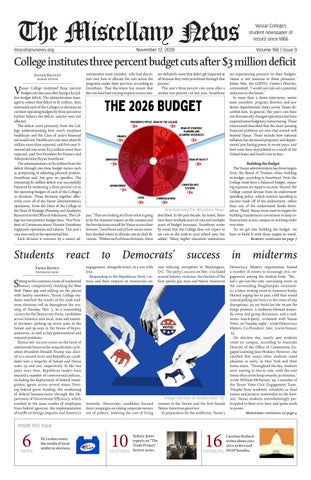
College institutes three percent budget cuts after $3 million deficit Julian Balsley Senior Editor
V
assar College instituted three percent budget cuts this year after facing a $3 million budget deficit. The administration managed to reduce that deficit to $1 million, then instructed each of the College’s 10 divisions to cut their operating budgets by three percent to further balance the deficit; salaries were not affected. The deficit came primarily from the College underestimating how much employee healthcare and the Class of 2030’s financial aid would cost: Healthcare costs were about $1 million more than expected, and first-year financial aid was some $2.5 million more than expected, said Vice President for Finance and Administration Bryan Swarthout. The administration cut $2 million from the deficit through one-time budget moves such as postponing or adjusting planned projects, Swarthout said, but gave no specifics. The remaining $1 million deficit was successfully balanced by instituting a three percent cut to the operating budgets of each of the College’s 10 divisions. Those divisions together effectively cover all of the Vassar administration’s operations, from the Dean of the College to the Dean of Strategic Planning and Academic Resources to the Office of Admission. The College has two primary budget lines, Vice President of Communications Victoria Grantham explained: operations and salaries. This year’s cuts were only to the operational line. Each division is overseen by a senior ad-
Students Editor-in-Chief
S
itting in the common room of residential houses, compulsively checking the New York Times app and talking on the phone with family members, Vassar College students watched the results of the 2026 midterm elections roll in throughout the evening of Tuesday, Nov. 3. In a resounding victory for the Democratic Party, candidates across America won local, state and national elections, picking up seven seats in the Senate and 39 seats in the House of Representatives, as well as key gubernatorial and mayoral positions. Democrats’ success comes on the heels of nationwide losses in the 2024 election cycle, when President Donald Trump was elected to a second term and Republican candidates won a majority of Senate and House seats—53 and 220, respectively. In the two years since then, Republican leaders have enacted a number of controversial policies, including the deployment of federal immigration agents across several states; freezing federal grant funding; the weakening of federal bureaucracies through the Department of Government Efficiency, which resulted in the mass exodus of employees from federal agencies; the implementation of tariffs on foreign imports; and America’s
Inside this issue
NEWS
Eli Lerdau covers the results of local midterm elections.
are definitely areas that didn’t get impacted at all because they were prioritized through that process.” This year’s three percent cuts come after a similar two percent cut last year, Swarthout
Aria Kuklinski/The Miscellany News. pus. “They are looking at it from what is going to be the minimal impact on the campus and the best decision overall for Vassar across their division,” Swarthout said of how senior members decided where to allocate cuts in their divisions. “Within each of those divisions, there
react
Emma Brown
6
ministrative team member, who had discretion over how to allocate the cuts across the programs under their purview, according to Grantham. That discretion has meant that the cuts have had varying impacts across cam-
to
described. In the past decade, he noted, there have been multiple years of cuts and multiple years of budget increases. Swarthout wrote by email that the College does not expect to see cuts in the 2026 to 2027 school year, but added, “Many higher education institutions
Democrats’
engagement, alongside Israel, in a war with Iran. Responding to the Republican Party’s actions and their impacts on Americans na-
success
and reducing corruption in Washington, D.C. The party’s success on Nov. 3 included several historic victories: the election of the first openly gay man and Native American
Image courtesy of Violetta Rohr '30. tionwide, Democratic candidates focused their campaigns on taking corporate money out of politics, lowering the cost of living
10
Sydney Jones reports on "The Truth Project" FEATURES lecture series.
woman to the Senate and the first female Native American governor. In preparation for the midterms, Vassar’s
16
are experiencing pressure on their budgets. Vassar is not immune to these pressures.” Julian Vela, the LGBTQ+ Center’s Director, commented, “I would not rule out a potential reduction in the future.” In more than a dozen interviews, senior team members, program directors and academic departmental chairs across Vassar described how, in general, this year’s cuts have not dramatically changed operations but have required some budgetary restructuring. Those interviewed described that the most pressing financial problems are ones that extend well beyond Vassar. Those include how national inflation has decreased programs’ and departments’ purchasing power in recent years, and how costs have skyrocketed as a result of the United States and Israel’s war in Iran. Building the Budget The Vassar administration has three targets from the Board of Trustees when building its budget, according to Swarthout. First, the College must have a balanced budget, meaning expenses are equal to income. Second, the College cannot deviate from its endowment spending policy, which restricts spending to income made off of the endowment, rather than any of the endowment funds themselves. Third, Vassar must meet its targets for building maintenance investment to keep infrastructure across campus in working order over time. “As we get into building the budget, we have to build it with those targets in mind, Budget continues on page 7
in
midterms
Democracy Matters organization hosted a number of events to encourage civic engagement among the student body. “We… led a get-out-the-vote canvassing event in the surrounding Poughkeepsie community; a letter writing event to Governor Kathy Hochul urging her to pass a bill that would extend polling site hours in the event of any disruptions; an art build for the recent No Kings protests; a midterm-themed jeopardy event and group discussion; and a midterms watch-party, co-hosted with Vassar Votes, on Tuesday night,” wrote Democracy Matters Co-President Alex Lewin-Knauer ’27. On election day, nearly 400 students voted on campus, according to Associate Director of the Office of Community Engaged Learning Jean Hinkley. However, she clarified that many other students voted absentee or early, in New York and their home states. “Throughout the day, students were waiting in line to vote, with the wait times often stretching towards 30 minutes,” wrote William McNarney ’29, a member of the Vassar Votes Civic Engagement Team. “Despite busy academic schedules as final exams and projects materialize on the horizon, Vassar students overwhelmingly participated in their civic duty and spoke truth to power.” Midterms continues on page 4
Caroline Brabeck writes about executive orders and OPINIONS SNAP benefits.
November 12, 2026
Page 2
THE MISCELLANY NEWS Emma Brown Darja Coutts Julian Balsley Grace Finke Hadley Amato NEWS EDITOR Samuel Eisenberg ASSISTANT NEWS EDITORS Iggy Gutierrez Madeline Nusbaum Aurelia Harrison ARTS EDITORS Brendan Kennedy Sophia Marchioli ASSISTANT ARTS EDITOR Sydney Jones FEATURES EDITOR Tina Mao ASSISTANT FEATURES EDITORS Jared Palumbo Ian Watanabe OPINIONS EDITOR Zoe Rodriguez ASSISTANT OPINIONS EDITOR Josie Wenner HUMOR EDITOR Noah Daube-Valois ASSISTANT HUMOR EDITOR Holland Kaplan SPORTS EDITOR David Bray ASSISTANT SPORTS EDITORS Armaan Desai Lucas Seguinot DESIGN EDITOR Sylvia Sargent ASSISTANT DESIGN EDITORS Ellen Tan Elliot Evans COPY EDITORS Gabrielle Lyman Julia Weber ASSISTANT COPY EDITOR Aria Kuklinski GRAPHICS EDITORS Charlotte Willenbring Aviva Barry PHOTO EDITORS Jay Fu Olivia Blank GAMES EDITORS Felix Mundy-Mancino Mia Liloia SOCIAL MEDIA MANAGER Fallon Dern LIVE EVENTS CHAIR Vera Giraudo WEBMASTER Anna Berggren REPORTERS/COLUMNISTS Finn Buckley Eduardo Culmer Noah Duncan Melody Hamilton River Hamm Isabel Holmes Daphne Huffman Lora Janczewski Benjamin Kaplan Eli Lerdau Bodie Morein Ender Nix Evan Seker Erin Thatcher Amritha Dewan PHOTOGRAPHER Andrew Chu CARTOONIST Catriona Chapman FACT CHECKER Emma Fuchs COPY STAFF DanaMarie Galindo Cooper Jaffe Naomi Kaplan Ren Nicolau Ida Polys Leah Weinraub Will Hamilton DISTRIBUTORS Cailey Metter
EDITOR-IN-CHIEF MANAGING EDITOR SENIOR EDITORS
Charlotte Willenbring/The Miscellany News. MISCELLANY NEWS | VASSAR COLLEGE
NEWS
November 12, 2026
Page 3
VSA Senate Highlights, Nov. 8 • The Chief Justice of the Judicial Board presented the Board’s review of the Internal Affairs Committee, finding it productive and well-run. The Board recommended that the Committee continue its current goals of better union relationships and revising old statements and policies to make VSA operations more representative of student and staff interests. • The Senate approved Historic Vassar and the Vassar Heart Club as pre-organizations. Historic Vassar will advocate for education about the College’s architectural history; the Heart Club will work to educate students about heart disease.
Dish washing machine fixed after nearly a month Samuel Eisenberg
Assistant News Editor
T
he dish washing machine in Gordon Commons was fixed on Wednesday, Nov. 4, after being out of service since at least Oct. 11, when disposable dishware began appearing in the dining hall. During the outage, students expressed concerns about the excess waste and environmental impact of using disposable cutlery as well as the lack of communication or clear timeline for repairs from the Vassar College administration. During the outage, two of the dish machine’s three motors were broken and the other was approaching the end of its “operating life,” according to Associate Dean of the College for Campus Activities Dennis Macheska. Macheska announced the outage in an all-campus email on Oct. 13; he sent another email to the student body on Nov. 4 announcing that it was operational again. Multiple students said they were concerned about how long the dish machine remained out of service, as well as the apparent lack of a clear timeline for fixing it. “Why isn’t there a timeline? Is this, like, some organizational thing?” asked Tobias
Fantl ’28. He noted that he had received the initial email about the machine being broken on Oct. 13, but said he saw no updates in Resident District Manager Stephen Scardina’s biweekly dining emails. Steve Zhang ’30 commented, “I think it [would] be a rather simple thing to fix. It shouldn’t be taking up so much time to fix a dishwasher machine.” On Oct. 29, Macheska wrote to The Miscellany News by email, “We are awaiting the necessary replacement parts and cannot yet provide a confirmed timeline for returning the machine to service.” In a second email on Nov. 2, he clarified, “The machine has required repairs in the past, but this is one of the more significant repairs needed. The time required to source the replacement motors and other necessary parts has extended the outage.” Macheska noted that the machine is seven years old and constant operations put strain on its components. He did not specify the machine’s anticipated lifespan in his Nov. 2 email, two days before announcing it had been fixed. In total, the machine was out of service for around 25 days, including for the entirety of October Break. During the outage, a dish room employee told the Miscellany that because the
machine was broken, everything had to be washed by hand: “We’ve got to work twice as hard because we’ve got to wash the pans and stuff, and they’re big, so it’s easier to throw them in the machine and have them cleaned.” They emphasized that these issues are not new, estimating that the machine may break as often as every two weeks. While larger repairs are being conducted, Gordon Commons resorts to using disposable dishes and cutlery. Multiple students raised concerns about the sustainability impact of the dining hall using disposable dishware for nearly a month. Fantl told the Miscellany that he felt it was “incredibly wasteful” to throw all of the paper plates and plastic utensils into the trash. He added, “It just feels like we went from maybe being a little more environmentally conscious to now doing absolutely nothing about it.” Zhang felt similarly, saying, “It feels bad to throw away so many plates.” Director of Sustainability Ken Foster wrote to the Miscellany, “We have not tried to calculate the environmental impact of having to use disposable items.” He did not comment on the excess cost that these disposable items carry. Foster explained that any environmental impacts caused by the dish machine outage were already being
MISCELLANY NEWS | VASSAR COLLEGE
mitigated: “We are already using single-use items made from plants, and these have a lower environmental impact than plastic items made from petroleum.” He also wrote that the Office does not know how much excess waste has been generated. In his Oct. 13 email announcing that the dish machine was out of service, Macheska explained that compost contamination at the dining hall had continued. He wrote, “As a result, we will be discontinuing this effort for now.” The dining hall’s use of disposable dishware for nearly a month did not affect employees’ regular schedules, Macheska wrote. Some employees were reassigned but not hours were cut. “Safety is always a priority in our dining operations,” Macheska added. “When a piece of equipment is out of service, employees must adjust established workflows and routines to accommodate the change.” The dish room employee noted, “The College don’t want to spend the money, so they put Band-Aids on it. But it keeps breaking down. So you got to actually fix the machine.” They added, “That way we can come to work and work properly and don’t got to deal with the mental stress and things like that.”
Page 4
NEWS
November 12, 2026
Students discuss Senate, gubernatorial wins following midterms Midterms continued from page 1
Reflecting on the Democratic Party’s nationwide success, students from states with contentious elections expressed joy, relief and tentative optimism about the future of American politics. Georgia Incumbent Jon Ossoff won his bid for Senate reelection in Georgia, beating his opponent, Mike Collins, by 18 points. Ossoff, an Atlanta native, was first elected to the Senate in the state’s historic 2020 election, in which both of Georgia’s Senate seats went to Democratic candidates. “I was given the chance to meet [Ossoff] at my high school where he came to speak with my class, inspiring us to vote,” wrote Ellie Tinley ’27, a student from Georgia who voted for Ossoff. “In his past term he has worked hard to fight corruption, something that has become all too familiar in the U.S. political system.” Democrats’ success in Georgia did not end with Ossoff. Democrat Keisha Lance Bottoms, a former mayor of Atlanta, won the gubernatorial election. She will become the first Black woman to serve as governor in U.S. history. Bottoms ran on a platform of expanding Medicare access, raising the state’s minimum wage to $15 per hour and repealing Georgia’s six-week abortion ban. “I voted for Keisha Lance Bottoms because, growing up in Georgia, I never saw myself represented in government,” wrote Carmen Haley ’27. “I moved around a lot, and although there were minorities everywhere I went, there was always a clear precedent that certain areas in Georgia that served the most black communities were being underserved… I have hope that Georgia’s economy will go towards rebuilding that infrastructure under her care as someone who grew up in those communities.” Students expressed tentative excitement about America’s future following the elections. “I feel a sense of hope for a more progressive future in American politics
while also realizing there are lots of strides still left to make,” wrote Tinley. “I am grateful that Democrats have regained control of the Senate and House and hope they can do some real good.” Haley added, “I’m really hoping that this resurgence of liberalism will actually result in genuine change and not just political posturing. It’s hard for me to be fully hopeful; I think it’s important that people don’t get idle now that we've seen this happen and get into the mentality of ‘okay, I did it; we’re done.’” Maine Democrat Troy Jackson emerged as Maine’s next senator after defeating incumbent Susan Collins, a longtime fixture in the Republican Party after serving five terms in the U.S. Senate. Jackson’s path to victory was far from straightforward; he originally ran for governor but lost in the state’s primary.
In Maine’s primary election in June, Graham Platner originally won the Democratic nomination to challenge Collins’ seat. However, Platner’s campaign was mired in controversy from the start over the candidate’s history of misogynistic comments in online forums, a tattoo which some claimed resembled a Nazi symbol and allegations of sexual misconduct and rape. Only after several news outlets conducted interviews with Platner’s accusers did the candidate officially withdraw his bid for office on July 8, 2026. “[Platner] was able to connect with Mainers all across t h e board, both Re -
publ i cans and Democrats, and he felt like our shot to win against Collins,” wrote Adeline Mangalam ’30. “When everything came out about him, so many people felt betrayed and debated even showing up to the polls.” After Platner’s short-lived candidacy, it was unclear whether Democrats could unite Maine residents behind another candidate. Yet Jackson, a logger from Maine’s northernmost county, drew support from a broad coalition of voters, especially college students. “I think that the writing had been on the wall with Platner from early on, but I myself, like a lot of other Mainers I know, chose to swallow any doubts because we were so excited to have a candidate who touted such progressive policy up for election in our state,” wrote Lucas Richards ’27. “When he ultimately stepped down I was immediately ready to vote for whoever ran in his place and I’m glad it was [Troy] Jackson.” Other students from Maine expressed excitement about Jackson’s progressive positions. “I remember being 8/9 years old and door to door canvassing with my mom,” recalled Jo Ellis ’29. “Every year, I was more and more shocked to hear the testimonies from teachers, union members, business owners, construction workers, etc. etc. about how and why their Congress members had failed [them]. I was lucky enough to do some work on Jackson’s campaign this summer, and it was completely inspiring to see how hopeful and impassioned Maine voters were this year. He’s a candidate that can really connect with, understand, and fight for real people.” Describing the issues that were important to her in this election, Chloe Bibula ’28 wrote, “I was looking for someone who understands the economy’s effect on working-class people, lowers the cost of living and sees them all as human and deserving of rights regardless of their race, gender, and sexual orientation. Jackson says he will fight to fix economic policy, such as Trump’s tax cuts for billionaires, and issues on the civil rights (including immigration) agenda.”
Multiple students highlighted the significance of Jackson removing Collins from power. Collins, who has long described herself as a moderate, has frequently voted in lockstep with the MAGA base of the Republican Party. “I’ve spent my whole life with Susan Collins as my senator, and every year she’s made choices that I could not stand by,” wrote Mangalam. “She votes with Trump 96% of the time, but markets herself as a more moderate politician, so she can continue to attract voters. We need someone who can stand up to Trump and make decisions for Mainers, not for MAGA.” “I voted for Troy Jackson, but what it really felt like was voting against Susan Collins. Collins has been in office eight years longer than I’ve been alive, and I have not once seen evidence that she has the interests of young Mainers at heart,” wrote Jonathan Eccher-Mullally ’27. Students expressed excitement about a progressive candidate winning in what has historically been a swing state. Recalling his reaction to the election results, Eccher-Mullally wrote, “I’m agnostic, but I think I uttered the words ‘thank God.’” Michigan In a highly contested election, Democratic candidates won both the Senate and gubernatorial races in Michigan. Senator-elect Abdul El-Sayed’s victory—the first Muslim candidate ever elected to the Senate—followed a hard-fought campaign against Republican state Senator Mike Rogers. El-Sayed, an epidemiologist and the former Executive Director of Detroit’s Health Department, focused his campaign on expanding Medicare and reducing corporations’ involvement in the electoral process. Students noted that El-Sayed’s medical background and progressive policy positions motivated them to vote for him. “With the environment at a tipping point, and the rights of so many people on the line, voting for a candidate that reflects my views was deeply important to me,” wrote Michigan resident Caroline Robinson ’27. “He stands for many issues that are crucial to me, including affordable healthcare access, LGBTQ+ and reproductive rights, a n d fighting for the environment.” Multiple students said they felt that Rogers’ campaign played into Islamaphobic tropes when depicting ElSayed. Referencing attack ads produced by the campaign, Claire Hurley ’30 said, “A lot of them were just untrue. Like, I saw one—and this is a real ad, by the way—that was saying that Abdul El-Sayed would institute Sharia law, which is not true, and that was an actual ad that I saw. So, I feel like I saw a lot more along the lines of attack ads, and stuff that is racist against Abdul El-Sayed, attacking him especially because he’s Muslim.” Two days before the general election, Haley Stevens—the Democratic congresswoman who El-Sayed defeated in the primary—
MISCELLANY NEWS | VASSAR COLLEGE
endorsed Rogers in a surprise move, saying in a video posted on X: “I don’t belong in Abdul’s campaign… What our students see, what our children see and who we are as Michiganders is not hate and it is not what we are getting out from our Democratic nominee right now.” Michigan’s Senate election was projected to end with a close victory, with some commentators expressing concern that ElSayed was too progressive to win in a state that voted for Trump in the 2024 presidential election. “I also think a lot of so-called moderate Democrats were really hoping for Haley Stevens and trusted her more, and thought Abdul [El-Sayed] maybe didn’t have enough experience or that his qualifications weren’t what you need for being a senator, that he couldn’t reach across the aisle as much, something like that,” said Hurley. Robinson added, “Even though the senator that [El-Sayed] is replacing is a Democrat, Michigan is a swing state that went red in the 2016 and 2024 presidential elections, so I didn’t feel completely confident in how the senate race would turn out.” Nevertheless, El-Sayed defeated Rogers by seven points. “When the results were announced around 2 am, I felt a sense of security, relief, and gratitude, and was proud that Michigan was able to pull through!” Robinson stated. “I think it’s pushing us in the right direction, and I think it’s going to be really helpful generally for the people in Michigan,” said Hurley of El-Sayed’s victory. Like students from other states, Michigan natives expressed both excitement and hesitancy about the future of state and national politics. “This election gave me hope for the future of our country—that in 2028, it could be possible for a more progressive candidate to win the presidential election,” Robinson wrote. “However, I think it is still so important to hold our elected officials accountable to make sure they follow through with the platforms they were elected on.” North Carolina Democrat Roy Cooper beat Republican Michael Whatley by approximately 19 percentage points in North Carolina’s Senate election. Cooper has a long history of public service in North Carolina: Before serving as governor from 2017 to 2025, he served in the General Assembly and was elected as the state’s attorney general—a role he held for nearly 16 years. “When I saw that the NC election had been called, I went to Cooper’s Instagram and saw a video he posted featuring clips of the natural beauty of North Carolina, and I felt incredibly emotional watching it,” wrote Mia Zottoli ’27. “I always feel proud to be from North Carolina, but I am especially proud now to see someone who seems to be an authentically kind human representing our state.” Cooper centered his campaign around his plan to “Make Stuff Cost Less,” tapping into Americans’ growing anxieties about the cost of living. Since December 2024—one month before the start of Trump’s second term—inflation has risen by 5.2 percent, according to data from the Bureau of Labor Statistics. The cost of gas, electricity and groceries have all risen under Trump’s leadership. Students from North Carolina emphasized that Cooper’s support for gender-affirming care and the LGBTQ+ community, along with the politician’s stance on immigration, were particularly important in their decision to vote for the former governor. Midterms continues on page 5
NEWS
November 12, 2026
Campus
reacts
Midterms continued from page 4
“I grew up with him [Cooper] as the governor of North Carolina, and he was always such a beacon of intelligence and humanity,” wrote Zottoli. “I remembered him helping repeal HB2 [House Bill 2 required individuals to use the bathroom that corresponded with their sex assigned at birth and prevented local governments from passing legislative protections for members of the LGBTQ+ community], and in general being a defender of LGBTQ+ political rights,
which is an issue that has long been important to me, especially growing up in a less queer-friendly state.” Ruby Gentithes ’29 added, “The most important issues to me in this election were immigration and healthcare, specifically reproductive care and gender-affirming care. Donald Trump has attacked these issues, and I wanted to vote with candidates in mind who would ensure the rights of all people in the United States and keep them safe.” North Carolina, traditionally a swing state, also saw five state legislative seats flip to Democrats. After seeing the state vote go red in every presidential election since 2016, students felt excited by the prospect of having Democratic representatives in office. “I was overjoyed at the results of last night’s election in North Carolina!” wrote Gentithes. “Not only did we flip a Senate seat by electing Roy Cooper, but we also flipped multiple seats in the House in traditionally red districts and took control of the North Carolina House of Representatives. This felt like a big step for North Carolina and demonstrated how we want to fight for change.” Zottoli noted, “There should always be room for criticism and growth in politics, and Cooper seems like someone who will listen to his constituents in ways I have not felt many past senators have.” Ohio Last week, Ohio voters elected two Democrats in a consequential state election: Sherrod Brown won his bid for Senate, and Amy Acton became the state’s first female governor. Brown, a longtime U.S. Senator, was first elected in 2006. After losing his bid for reelection in 2024 to Republican Bernie Moreno, Brown ran for Senate once again in Ohio’s special election in 2026. The election sought to fill the vacancy left by Vice President JD Vance’s departure from the Senate following the 2024 presidential election. “I voted for [Brown] because he has a long track record of positive public service,” wrote Ohio native Arya Cox ’27. “Jon Husted’s priorities are not aligned to benefit the majority of Ohioans and he works for the wealthy rather than the middle class and majority of people.” Unlike Senate candidates in other states, students from Ohio were less enthusiastic about Brown’s campaign, with some saying they no longer feel connected to the Democratic Party’s platform. “Obviously, I’ll continue to vote, but I just feel like the Democrats aren’t who I resonate with anymore, but I don’t want to go to a third party because I’m afraid of my vote not counting or whatever,” said Mae Nettle ’27. “I’m just tired of ‘well-intentioned peo-
to
blue
ple’ not doing anything.” Nettle continued: “I voted for everyone [on the Democratic ticket] and I felt good about it, and then I came home and there’s a bunch of mail on the table from some third-party candidate I’ve never heard of about how—Sherrod Brown especially, and I think also the governor—they were, anti-Black people and for mass imprisonment, and they’re the issue with our system and blah, blah, blah. And they spoke to a lot of issues that I care about, but I didn’t really think about while voting, because again, even if I knew that beforehand, I was still going to go for the majority.” Brown’s opponent, Husted, was first appointed to the Senate in 2025 to fill Vance’s vacancy. Throughout Husted’s campaign, the senator struggled to overcome a past bribery scandal and backlash from voters over his support for Trump’s policies. As in other states, students felt that Trump’s support for Husted only hurt his chances of winning. “Jon Husted is Trump’s lapdog,” wrote Cox. In the weeks leading up to the midterms, Ohio’s gubernatorial race gained national attention when Republican candidate Vivek Ramaswamy funded an attack ad in which Acton’s estranged mother told Ohioans not to vote for her daughter. After the ad aired, Acton explained that she had not seen her biological mother since she was 12, as she was removed from her mother’s custody after her stepfather sexually abused both Acton and her brother. In response, politicians from both sides of the aisle widely condemned Ramaswamy’s ad, which Ramaswamy, as well as Trump and Vance, continued to defend. “When I first saw it, obviously, I was shocked,” noted Nettle. “I was like, ‘How did they get her mom to do this?’ I didn’t have any of the context. And then I thought about it, and I was like, well, I don’t know, this could work on me. I feel like if someone’s mom’s like, ‘Oh, they’re not trustworthy, they’re blah, blah, blah.’ I thought it was convincing, honestly. I didn’t believe it, but, I thought, as a strategy, it was
convincing.” W h e n asked how they felt in the aftermath of Ohio’s election, some students said that they did not believe the results of the midterm could resolve the issues of American politics. “I wasn’t excited with the results,” said Nettle. “I was happy that they were blue, but I just feel like the U.S. is too far gone.” Texas In a state that has gone red in every presidential election since 1980, Democrats saw success in both Texas’ Senate and governor’s races. Texas state representative and Presbyterian preacher James Talarico was elected to the Senate, defeating Republican nominee and Texas Attorney General Ken Paxton. Paxton’s campaign was embattled by allegations of infidelity, his indictment
Page 5
wave
in
on federal securities fraud charges and the Texas House’s 2013 decision to bring 20 articles of impeachment against him. Talarico, a former public school language arts teacher, ran on a platform of improving public education, reducing the cost of living and reforming immigration. According to students from across Texas, issues such as the deployment of U.S. Immigration and Customs Enforcement (ICE) throughout the state, gun control and abortion access polarized voters. Speaking about ICE, James O’Malley ’30 said, “Now they conduct traffic stops on I-35 [a major interstate that runs through Texas]. They’ll pretend to be a cop and try and pull you over. And then if you pull over for them, they’ll grab you out of your car. But if you don’t pull over and it turns out to be a cop, there’s not really any way of telling. There’s no winning.” There is some evidence that ICE officers have pulled drivers over. According to reporting by the San Antonio Current, ICE agents followed a vehicle of roofers in two unmarked SUVs, conducted a traffic stop and pulled their guns on the passengers. While no major outlets have reported on ICE agents impersonating police officers, there is extensive evidence that Texas police frequently call immigration officials to the scene during traffic stops. This practice has resulted in the deportation of several people. “The stakes of this election could not have been higher,” wrote Sadie Helgeson ’27. “Having grown up in and graduated from an underfunded Title 1 school district in Central Texas, I know what it feels like to attend a school full of teachers and staff who love their students, but lack the resources to support them.” When asked how he felt about voting for Talarico, O’Malley said, “I mean, he seems [like] a good guy. He’s also running against evil incarnate, you know?” In the months leading up to Texas’s Senate election, Tesla and SpaceX founder Elon Musk donated approximately $158 million dollars to Paxton’s campaign, although estimates regarding Musk’s donation vary. Musk, who recently relocated his companies to Starbase, Texas—a town Musk himself created along the U.S.-Mexico border—spent $446 million supporting conservative candidates in 2026 alone. The billionaire’s campaign contributions allowed Paxton to distribute canvassing materials and mailers to prospective voters, all while remaining financially competitive with Talarico’s campaign, which had raised $134.3 million as of mid-October. However, some students said they felt that Musk’s support of Paxton only hurt the attorney general’s campaign. “Paxton is a vile human being, and if elected, he would have only worked to enrich himself, Donald Trump, and Elon Musk,” wrote Helgeson. In the gubernatorial race, Texas state representative Gina Hinojosa defeated longtime fixture in Texas politics Governor Greg Abbott. Abbott, first elected to the governor’s mansion in 2014, has seen his support drop by about 11 percentage points since the 2024 election, particularly on issues surrounding the criminalization of marijuana, the construction of data centers and the disbursement of private school
MISCELLANY NEWS | VASSAR COLLEGE
midterms
vouchers to Texas families. Hinojosa’s victory will make her Texas’s first Latina governor. Hinojosa, who is a former civil rights attorney, school board member and representative in the Texas House, focused her campaign on improving public education and lowering the cost of living. “I was excited to vote for a woman of color to lead the state. She is a highly qualified, hard-working, and smart person who cares about all Texans,” wrote Helgeson. “Her opponent, Greg Abbott, is a vicious, selfish, racist, misogynistic, transphobic loser who has hurt so many people during his time as governor. Hinojosa fearlessly took on a staunchly entrenched white male incumbent, and I admire her bravery and the example she is setting for young women all over the state and country.” In a state that voted for Trump in the last three presidential elections, many were surprised by Texans’ support for the Democrats. Most students explained that, in the lead-up to the election, they felt more confident that Talarico would win than Hin o - josa. “In the days leading up to the election, I was pretty confident that Talarico would win,” wrote Helgeson. “He is a white Christian man who ran against a historically poor Trump-picked opponent. I was much less confident that Texans would choose Hinojosa to be governor. Running as a Latina in a state where many people openly express violently racist and misogynistic views, I had a hard time seeing her path to victory. When both of their wins were confirmed, I freaked out.” “Even though the polls showed promise, I was in absolute shock when the race was called so early and by the margins that Talarico and Hinojosa won by,” wrote Zach Flisakowski ’27. With two Democratic victories in Texas, students expressed excitement about the state’s future. “When the results came in I immediately called my family and friends,” wrote Flisakowski. “There was a general feeling of disbelief and a lot of happy tears from everyone.” “While there is so much work to be done, I believe in the people’s ability to come together and trust that we will work to hold our newly elected officials accountable,” wrote Helgeson. “I also spent a lot of this fall phone banking and door knocking and it has made these wins feel even better. It feels good to know you were even a small part of making change. I would encourage other students to find candidates whose ideas they resonate with and find ways to get involved. The work is how we sustain this hope.” Looking Forward Following the midterms, students discussed the need for their peers to stay engaged in politics and continue to fight for causes that matter to them. “Just because the election has run its course does not mean the fight is over,” wrote McNarney. “Stay involved, hold politicians accountable to their promise and continue to advocate for issues that better the lives of everyday Americans.”
Graphics by Violetta Rohr '30.
NEWS
Page 6
Democrats Eli Lerdau Columnist
D
emocrats saw large victories across Dutchess County in the Nov. 3 elections. Incumbent Democratic Representative Pat Ryan defeated Republican opponent Jackie Mary Auringer by almost 25 percentage points. In what was supposed to be a competitive state Senate race for New York’s District 39, County Legislator Lisa Kaul defeated Republican incumbent Rob Rolison by over 10 percentage points. The sweeping victories in a region that polls suggested could be competitive helped bring the Democrats decisive majorities in both Albany and Washington, D.C. The 39th State Senate District, long a Democratic target, was integral to the eventual success of this effort. “This is a critical seat because right now I’m a little short of a supermajority. So send me Lisa,” State Senate Majority Leader Andrea Stewart-Cousins said at a Poughkeepsie rally on Nov. 1. The effort succeeded, as Democrats secured a supermajority in the state Senate. While the 18th congressional district was already thought to likely go Democratic, Ryan’s overwhelming victory solidifies it as a firmly blue district and a piece of the Democratic U.S. House majority. Vassar College’s electoral precinct, located in the Aula and serving the College and surrounding community, saw 782 total votes, of which 87 percent in the Congressional race went to Ryan and 83 percent in the State Senate went to Kaul. Kaul, a progressive who ran on freezing rent and supported the creation of a state single-payer healthcare system, outraised and handily defeated Rolison, an experienced incumbent who appealed to Democrats in past elections. Rolison previously served as a police officer and the Mayor of the City of Poughkeepsie, and ran a campaign that championed his local experience and bipartisanship. Kaul was helped in her victory this year by the general Democratic-leaning demographics of the district. Rolison narrowly won reelection in 2024, by just over 2,000 votes. The same area went for former Vice President Kamala Harris by just three percent in 2024. The Democrat Ryan won reelection to the House by just under one percent in 2022. This year, he outper-
formed the national environment by almost 16 percent. Both candidates made use of New York State Public Campaign Finance Program, a 2022 program which allows candidates to apply for the state government to match small donations. Kaul received over $600,000 from this program, while Rolison received just under $300,000. Kaul maintained a strong financial ad-
win
big
vantage throughout the race, outraising Rolison by nearly double. Her financial upper hand came largely from the state Democratic Party and the New York State Public Campaign Finance Program. This is a 2022 program which allows candidates to apply for the state government to match small donations. Kaul received over $600,000 from this program, while Rolison received just under $300,000. The state Democratic Party gave almost $300,000 to her campaign, in contrast to Rolison who did not receive donations from the Republican Party. This is a change from 2024, where the party was Rolison’s largest donor; this time around, his largest non-state donor was a single individual who gave $10,000. Kaul’s spending showed, as her signs and pamphlets could be seen around the district. “The Republicans didn’t even try to put up a viable opponent,” Professor of Political Science Richard Born said of the 2026 race. Ryan’s Republican opponent, Auringer, was just 29 years old, held no prior political experience and stormed out of her one debate with Ryan. “While the results weren’t what we had hoped for, I am incredibly proud of what we accomplished in just a few short months,” Auringer said in an email to The Miscellany News. She added that she is laying the foundations for a local nonprofit, planning to help rebuild the local Republican Party and is not ruling out a 2028 election bid. Kaul has strong ties to Vassar College. She was the Director of the Office of Community-Engaged Learning from 2017 to 2021 and her husband, Jeffrey Seidman, is an Associate Professor of Philosophy at the College. Vassar For the Many, a left-wing student
organization focused on enacting left-wing policy, turned out around 30 students who knocked on roughly 300 doors. Organizer Mia Walker ’28 told the Miscellany, “Having [Kaul] as a supporter, especially replacing Rolison who is super oppositional, is strategically helpful for the rest of our campaigns.” (Rolison did not respond to
across
November 12, 2026
Dutchess
County
multiple requests for comment.) Democracy Matters held a town hall for Kaul in Rockefeller Hall in late September, and while Rolison was offered a similar town hall, he declined, according to an email from Co-President of Democracy Matters Alex Lewin-Knauer. “[The campus] is definitely very active and Dem-
vacant warehouse in Chester, New York, without alerting local authorities. “There should be more legislation that goes into carefully thinking about how ICE is dealt with and what they can and can’t do,” Jules Cressy ’29 commented. Cressy said that ICE operations were a large part of what drove him out to vote for the Democrats this November. “Before the end of last semester, [For the Many] w e n t down to [Roli-
ocratic,” Aidan Sinha ’29, who voted for Democrats down the ballot, told the Miscellany. The campaigns were largely dominated by discussion of two main themes: affordability and immigration. “We have people across the socioeconomic spectrum who talk about affordability,” Kaul told the Miscellany. “Everyone refers to groceries and gas prices—literally, regardless of whether you’re earning $120,000 a year or $50,000 or $30,000. Groceries are crazy, gas prices are crazy, everybody’s utility bills [are crazy].” “With people whose door we knocked, the number one [issue] was Central Hudson,” Walker told the Miscellany. Central Hudson is a utilities provider for the central Hudson Valley which has been accused of price gouging. “Central Hudson [is] a corporate monopoly [that] essentially does whatever it wants to do with the blessing of the Public Service Commission,” Kaul, who hopes to turn the company into a publicly run system, said. “It’s really fleecing us, and they have no incentive to lower our rates at all.” “The Democrats never really do much about affordability, but the Republicans seem hell-bent on making it worse and worse,” said Julian Sherman ’29. U.S. Immigration and Customs Enforcement (ICE) was also a major topic of the campaign, among both politicians and voters. “ICE did, I believe, the most un-American thing I have seen in my 44 years on this earth,” Ryan said, at a Nov. 1 rally held in Poughkeepsie, regarding its aborted attempt to establish a detention center in a
son’s] offices to talk to him [about two anti-ICE bills],” Cressy said of his activism last year. “He was giving the generic non-answers…kind of just dodging our questions.” Rolison voted no on this year’s Public Protection and General Government bill, a section of the state budget which incorporated elements of both anti-ICE bills. However, he did oppose immigration authorities’s usage of a warehouse in Newburgh, New York. “I worked in a restaurant in D.C. that had been raided by ICE…and a lot of people that I worked with… they had a very deep-seated dislike for that sort of intervention that has driven multiple aspects of the Republican Party,” Henry Brylawski ’29 told the Miscellany. “That really filled me with a sort of dread.” “I’m hearing in the district about people who are not sending their kids to school,” Kaul, herself an immigrant, reported. “So ensuring, at a very micro level, safety for folks to feel like they can go to school, they can go to work, they can access healthcare when they need to.” All of the students spoken to believed the election results were likely more a rejection of President Donald Trump than an endorsement of the Democrats. “This mostly comes as people being fed up with… the conduct of President Trump and his administration,” Brylawski said. Looking ahead, people hope for changes in New York. “I would like to see some concrete policies. I think often people talk about the things they want to do without actually [doing them],” Walker said. “Judge me on what resources I have brought back [to the district], judge me on whether I have created an office which is communicating clearly with you…, judge me on whether I have moved the bills that I have said that I am standing by…judge me by my responsiveness to your issues,” Kaul said.
MISCELLANY NEWS | VASSAR COLLEGE
Graphics by Violetta Rohr '30.
NEWS
November 12, 2026
Campus
discusses
Budget continued from page 1 and then we make a lot of assumptions about what we’re expecting as it relates to revenue and our costs,” Swarthout explained. “And because we’re trying to predict the future, there’s always some variation.” Most years, he said, the administration underestimates some costs and overestimates others, resulting in a reasonably accurate estimate overall. Some contingency funds are always built in to account for underestimations. This year, the administration underestimated much more than it overestimated costs. According to Swarthout, “What we saw this year is all of those things worked negatively towards the budget, and it was more than the contingency we keep in the budget.” For example, Swarthout said, looking at previous years’ costs and current trends, the administration usually makes an estimate of how much financial aid will cost that is under $1 million off from the real number. This year, Vassar underestimated those costs by $2.5 million.
Programs The primary effect of budget cuts so far appears to be postponements to planned campus improvements. Swarthout noted that $2 million of the original $3 million deficit was removed by delaying and adjusting projects the administration has planned. He did not respond to a question asking for specific projects that were affected by the cuts. Last year’s budget deficit was at least in part covered by forgoing some equipment purchases and planned investments to the Campus Safety Office’s vehicles, according to Associate Dean of the College for Student Growth and Engagement Wendy Maragh Taylor. In the Office of Communications, which Grantham oversees, this year’s cuts mean fewer guest speakers, less catering, less conference travel and fewer copies of the alumnae/i magazine mailed internationally. Grantham emphasized, “Our operations have not been substantially affected.” However, the exact effects within the other divisions is unknown. Swarthout wrote by email that the administration did not track the specific cuts that each senior administrator made to offices under their division. Multiple directors of student-oriented programs under Maragh Taylor’s Office of Student Growth and Engagement (SGE)—including the Jeh Vincent Johnson ALANA Cultural Center; First-generation, Low Income (FLI) Program; LGBTQ+ Center; and Office of International Services (OIS)—said that their operating budgets had not seen specific cuts. Vela, the LGBTQ+ Center Director, recalled that at the beginning of the year, Maragh Taylor requested that any cuts to SGE be taken from her budget rather than specific programs. Maragh Taylor explained by email: “The ‘removal’ of funds from my overall area should not be understood as a cut to student support. Instead, it was a minor reallocation of funds to help create an operating budget for another student support resource.” Every SGE program director interviewed for this article emphasized that they do not anticipate the cuts impacting the student resources they provide. Director of International Services Yousra Khan wrote by email, “We have been fortunate to maintain our programming and student support services without any reductions, and we appreciate the continued collaboration of our campus partners in making that possible.” Nonetheless, Vela noted, “We are encouraged to think about ways in which we can reduce spending and return any unspent money to the College at the end of the fiscal year. This isn’t necessarily anything new.” For example, Vela wrote by email, he always looks to reuse
three
supplies purchased for certain events—he has used the tablecloths he bought for 2024 Vassar Pride for numerous other events since then. FLI Director Michelle Quock also said that she is always trying to be conscientious in how to conserve funds when planning programs and buying supplies, such as informing caterers of the number of RSVPs to a given event to manage costs and help reduce food waste. “We strive to be thoughtful and strategic with our budget without comprising the work we do,” she wrote in an email. Some parts of the College’s operations appear to have been almost entirely unaffected. For instance, the Office of Religious and Spiritual Life and Contemplative Practices, another part of the Dean of the College’s office, saw no budget reduction, according to Reverend Callista Isabelle, the Associate Dean of the College for Religious and Spiritual Life and Contemplative Practices. Furthermore, Dean of the College Carlos Alamo-Pastrana decided to largely preserve Gordon Commons’ budget, which Associate Dean of the College for Campus Activities Dennis Macheska previously told The Miscellany News increased by a similar percentage as previous years. However, Maragh Taylor mentioned, “Dean Alamo addressed this year’s deficit with changes to the dining program.” Those changes may include recent adjustments to Dining Service hours, such as shuttering Express on weekends and closing Gordon Commons at 11 p.m. every night. As Macheska told the Miscellany earlier this semester, “Express’s weekend hours were adjusted as part of a broad effort to align Dining resources with student demand and operate the program more efficiently.” Academic Departments All academic departments received an equal three percent budget cut, multiple professors said. This was reportedly announced at a faculty meeting early in the year. (Dean of the Faculty Demetrius Eudell did not respond to a question confirming this). Since different departments have dramatically different needs—from putting on theater productions to running laboratories—the equal cuts have had disparate impacts. Those differences seem to have made some academic chairs hesitant to speak about the cuts. In all, the Miscellany reached out to 16 departmental chairs for this article—at least three from each of Vassar’s four curricular divisions. Only two agreed to speak on the record. Ten did not respond. Four declined, some because they felt their department was less affected than others and did not want to “rub it into departments” that were struggling, as one chair wrote. Another wrote simply, “I am not interested in speaking on this topic.” Some departments, such as those in the performing arts and natural sciences, face a two-pronged budgetary problem. As Associate Professor and Chair of Drama Peter Gil-Sheridan said, “We’re all running an academic department, but we’re also running what is akin to a professional performing arts center… So, not only are we struggling with material costs, but we’re also struggling with outdated technology, outdated spaces, and we feel strongly that our students are not learning on the technology they need to be learning on to be competitive in the industry.” Drama Administrative Assistant Rosemary Fritz Grabowska estimated that the department’s budget was cut by about $2,000 this year, from around $86,000 to around $84,000, which is broadly consistent with a three percent budget decrease. To compare, the chair of a relatively small department who asked not to be identified said their budget is about $7,500.
percent About three-fifths of the Drama budget— some $50,000—go to the department’s five yearly productions, Gil-Sheridan and Fritz Grabowska explained. Putting on these productions entails building elaborate sets, sewing costumes and purchasing shoes. “I mean the costumes alone, oh my God, are so expensive,” Gil-Sheridan said. On top of the costs associated with putting on the production, the department also has to pay for inspections of rigging, industrial equipment like lifts and fire safety. “Doing five to seven shows on $50,000 is incredibly difficult,” Gil-Sheridan explained. (The remaining $34,000 or so goes to the department’s general operations—the events and class supplies every department has.) Similarly, according to Professor and Chair of Biology Jodi Schwarz, on top of the typical costs of running an academic department, Biology must run a scientific laboratory, which includes purchasing equipment, contracts and supplies; maintaining the building and equipment; and funding intensives, such as research projects with professors. Unlike student organizations, who submit budget requests to the Vassar Student Association, academic departments’ budgets are fixed and assigned by the College. They generally change little year over year, Schwarz described. “This is the first year in many years that we have been informed that the operating budget will be smaller next year,” she noted. But even in years without budget cuts, the purchasing power of the U.S. dollar continues to change. The cuts themselves are not disastrous—as almost every person interviewed for this article said—but they are exacerbated by wider economic difficulties. According to Gil-Sheridan and Fritz Grabowska, the Drama Department’s budget has hovered around $85,000 since at least 2019. Inflation has soared in that time: According to the Bureau of Labor Statistics’ inflation calculator, $85,000 in September 2019 equals over $111,000 in September 2026. That means the department’s purchasing power— and, therefore, its ability to put on high-quality theater productions—has decreased in the past seven years. One example of that: The department now produces five shows each year, but a few years ago, it could afford seven. Skyrocketing costs due to the war in Iran have also forced departments to tighten their belts. Since the beginning of the war on Feb. 28, diesel prices have increased by 68 percent, according to Brown University. Diesel is the primary fuel for most forms of long-distance freight transportation, from trucks to trains to ships. Jet fuel costs a full 96 percent more than before the war, according to Forbes. That has put a strain on departments’ ability to get crucial supplies. “As a science department we order many types of scientific research kits and materials that have to be shipped frozen or on ice, and the costs of shipping have skyrocketed,” Schwarz explained. Those price hikes are hitting Drama too, which needs lumber and textiles for sets and costumes. As of September, lumber prices have increased by 5.5 percent compared to the previous year—construction inputs at large are up more than 11 percent. Textile costs have increased, too. “We’re just having to take that same amount of money and create the same result,” said Gil-Sheridan. Endowed Funds In 2022, Vassar launched its “Fearlessly Consequential” campaign, with the goal of raising $500 million. With nearly a year left in the campaign, Swarthout told the Miscellany that the goal has been reached. To some, the upper administration’s announcement that it has raised $500 million while instituting three percent budget cuts has raised ques-
MISCELLANY NEWS | VASSAR COLLEGE
Page 7
budget
cuts
tions. “A lot of the things I am hearing from students is the seemingly incongruent statements about a budget deficit and the need for a scaling back on operating budgets while also celebrating a wildly successful capital campaign that raised a ton of money,” Vela wrote. It is not that simple, Swarthout explained: “We have raised $500 million in commitments where a donor is willing to give us money, but generally it’s in the future. So we haven’t actually gotten $500 million in cash from donors… What this does is it really sets up Vassar well for the long term, but it doesn’t mean we have the money today.” Some of those donations are bequests, meaning Vassar has been listed in the donor’s will and the money will only be released when they pass away, which could be decades from now. Furthermore, donors often restrict their donations to specific purposes—such as Pamela Mars Wright ’82’s $5 million donation to build a new lacrosse center or Dede Thompson Bartlett ’65’s $10 million donation to build a new admissions building. The administration cannot use those funds to fill budget holes. Similarly, donations to Vassar’s endowment increase its total value—which was about $1.39 billion in fiscal year 2025—but the College can only spend the income the endowment produces, not any of the money in the endowment itself, Swarthout noted. The capital campaign does have one program that can directly reduce budget deficits. The Vassar Fund is an unrestricted pool of money that pours into the operating budget. The Office of Advancement looks to raise about $9 to $10 million for the Fund each year, Swarthout explained. In an update on the capital campaign at the beginning of the semester, Vice President for Advancement Tim Kane wrote that his office had raised over $10 million for the fund in the past fiscal year. The first two areas he listed as places Fund money could go were financial aid and health and wellness. “That is an area where donors are less and less likely to give over time,” Swarthout said of the Vassar Fund. “Donors want to give to specific things and restrict their gifts to those specific things.” Like the College’s overall budget, many academic departments are supplemented by restricted endowed funds. Such funds allow departments to run programs they could never otherwise afford, such as the Drama Department’s Vassar Ticket Fund, which helps students see off-campus theater productions, or the History Department’s Evalyn Clark Memorial Travel Fellowship, which funds students’ historical research trips. As Schwarz wrote of Biology, “Our department does have endowed funds that are essential to keeping our department a rich and vibrant place to learn and conduct research.” She added, “Each endowed fund has very restricted spending criteria.” But because those funds are defined by their donors, they can lead to disparities among departments’ operating funds. To mitigate that, Eudell wrote by email, “We have central Dean of Faculty sources of funding as well so that departments without endowments still have a source of funds.” The nature of endowed funds also means that departments often do not have control over which parts of their operations to prioritize. “This is oligarchy, isn’t it? This is when we have rich people deciding what their priorities are, as opposed to letting the administration and people who understand education decide what that is,” Gil-Sheridan commented. He continued, “Obviously, we’re very grateful for the generosity of donors. But I would imagine it leads to a lot of inconsistencies around budget.”
ARTS
Page 8
‘Cabaret’
balances
Grace Finke Senior Editor
F
rom Nov. 5 to 7, the Vassar College community was swept into a display of allure, sensuality and unrest. The Drama Department’s production of “Cabaret”—a musical with music by John Kander, lyrics by Fred Ebb and book by Joe Masteroff—masterfully struck the delicate balance of musical spectacle and impactful social commentary. Set in Berlin, Germany between 1929 and 1930, “Cabaret” uses the city’s overindulgent nightlife as a setting to slowly unveil the impact of the rise of the Nazi Party. With the opening number, “Willkommen,” the audience is immediately welcomed into the Kit Kat Klub by the cabaret’s Master of Ceremonies (Emcee), portrayed by Oliver Hollmann ’27. The Emcee also serves as the show’s de facto narrator, supported by an ensemble of dancers for the Kit Kat Klub, all accompanying the show’s grand display as we watch the story unfold. The show focuses on the relationship between American novelist Clifford Bradshaw (Jove Leonard ’27) and English cabaret performer Sally Bowles (Nora Guzikowski ’27), and the conflict between the two characters in how they choose to navigate the political tumult in Germany. We also see the romance between landlady Fräulein Schneider (Ada Lovelace ’27) and Jewish fruit vendor Herr Schultz (Nick Monsion ’27), and meet the promiscuous Fräulein Kost (Skylar Spiro ’28) and smuggler Ernst Ludwig (John Miley ’28), who is revealed to be a supporter of the Nazi Party. “In any way possible, the citizens of Germany, as represented in the characters of Cabaret, sought to experience a renewed sense of joy in life free from military, economic, and political struggles,” Fure wrote in the show’s dramaturgy note. “But, the effort to ‘leave your troubles outside’ risks ignoring what’s right in front of you.” One of the draws of “Cabaret” for the De-
‘In
the Columnist
A
few months ago, I had a realization: “In the Heights” was coming to New York City Center, and I would be close enough to go. There have been so many shows that I would have loved to see, but were too far away. This time, I would have a chance. I immediately texted my friend from back home in South Carolina and asked her if she would be able to come up here in November to see it. As theater kids, Lin-Manuel Miranda’s “In the Heights” has been one of the things we have bonded over. The opportunity to see this show with one of my favorite people was a dream just within my reach. After months of anticipation, the day finally came and she flew into Stewart International Airport. We caught the train early in the morning on Saturday, Nov. 7. And even though I, a non-native to New York State, was in charge of navigation, we miraculously made it to the city, exhausted but thrilled. After I accidentally took too many Playbills—do not tell anyone—we took our seats. The second the first note played, we both turned to each other with tears brimming our eyes. We were really here. Matte Martinez—who played the main character Usnavi—understood the humor and the passion of the character so deeply. The first moments of choreography were stunning and so intricate, even before a single lyric was sung. The
commentary
partment was its usage of explicit political commentary and lasting contextual relevance. “[‘Cabaret’ is] so polished in some way as a piece of theater, as a script for it to then be able to work across time,” said Director and Adjunct Assistant Professor of Drama Anna Brenner. “And it’s also extremely disturbing that it could work so well right now and that it can have such resonance still.” The show served as the Senior Project in
with
visual allure and pulling in the audience to this world of escapism, and then all of a sudden throwing them back into the real life and political upheaval and social problems.” The performers in “Cabaret” exemplified this contrast between escapism and political unrest. Part of what makes “Cabaret” so impactful of a show is its usage of the Kit Kat Klub as both a setting and a narrative device. “The Kit Kat Klub is a place where
Grace Finke/The Miscellany News. The Drama Department produces 'Cabaret.' Drama for actors Hollmann, Guzikowski, Leonard, Monsion, actor and choreographer Lovelace, actor and dramaturg Grace Fure ’27 and lighting designer Ren Nicolau ’28. “Cabaret” also featured a student orchestra, directed by Ian Ho ’28. One of the defining characteristics of “Cabaret” was its glamor: I was hypnotized by the show’s jazz-influenced score, sparkling costumes and sophisticated choreography. While choreographing the show, Lovelace not only considered the aesthetic interest of her work, but also how she could curate the production’s visual storytelling through embedded messages in movement. She explained, “A huge device that ‘Cabaret’ uses is distracting the audience with this
Heights’
Ender Nix
November 12, 2026
tells
lighting perfectly captured the emotions and feelings of the scenes, especially during a song like “Blackout,” which takes place at the very end of Act 1 when the club lights suddenly go out and the characters are plunged into darkness. The creativity of the lighting in a moment that is specifically lacking light was so impressive. The characters’ fear during the song was palpable. I cannot think of a time during the show that my eyes were dry. This is not surprising, as I am generally a very sensitive person and I dissolve at any musical, but even during the happiest songs like “The Club” and “96,000,” I was weepy. I felt like every second was being etched into my memory. “In the Heights” is told from the perspective of Usnavi de la Vega, a bodega owner who lives in Washington Heights. The musical explores the identities of Latine and immigrant people in the neighborhood and their day-to-day lives. I might not have any cultural connection to “In the Heights,” but my friend from home does, as her family is from Mexico. Seeing her watch people tell stories like hers on stage, especially during songs like “Paciencia Y Fe” and “Breathe,” was breathtaking. It made my heart so full to assist her in realizing this dream of seeing this show she has loved since she was a little girl. As she flew her Mexican flag during “Carnaval Del Barrio,” watching others fly theirs from around the world, she told me, “It was great to see the pride people have for their
people come to escape,” Lovelace said. “They come to escape because it’s the one place they can feel joy and comfortability in their own skin.” Through Lovelace’s choreography, the student dancers presented the Kit Kat Klub as a diversion from real life, encouraging characters to rid themselves of their worries. However, the Kit Kat Klub slowly loses its spark—its songs imbued with disturbing political undertones, its performers losing synchronicity, its entire illusion of escape fading—as Nazi rhetoric becomes more prominent, showing just how quickly blissful ignorance can crumble. Brenner compared this sudden shift in sentiment to existing in an environment
hundreds countries.” The theater had a whiteboard in the opening stairwell where audience members could write where they were from. It was so heartwarming to witness how far hundreds of people traveled just to see this show and to see people who looked like them on stage. I get goosebumps thinking about it. “In the Heights” punched me in the gut. It is crucial to celebrate immigrant stories, especially during such a tumultuous time in our world and country, where people are being ripped from their homes and identity is being scrutinized by ICE in partnership with the current administration. People deserve to feel represented and seen, and know that they belong. We are all human and deserve to be treated as such. There were many aspects of the show I could still relate to. One character from the show—Nina Rosario (Jaci Calderson)—is a college student who has just returned to her hometown with a secret: She dropped out because of financial burden without even telling her parents. Her whole life, she has had pressure put on her by herself and her family to succeed. I can relate to the yearning to succeed and make my hometown and family proud. Needless to say, the song “Breathe” had me in pieces, because it is Nina’s lament about her anxiety surrounding her fear of failing her family and disappointing them. That is just the beginning of Act 1. Additionally, the actor who played Sonny
MISCELLANY NEWS | VASSAR COLLEGE
artistry
like Vassar: “I talked with our cast and students about this particular time of your life when you’re a student…where you leave the life that you knew, and you’re suddenly in this kind of bubble or utopia that can be so beautiful and exciting and personally expansive…then old wounds or shadows also can emerge in that. And I felt like that’s a really powerful personal aspect of this story.” Brenner, Fure and Lovelace emphasized the importance of “Cabaret” in today’s political context. “That is the point of the piece, you know, is to represent that kind of possible violence and that potential for fascism to come in if you really are trying to put blinders on,” Brenner said. “And so much of the story for me was: how can we delight the audience and lure them in and enjoy this fun cabaret, and then turn the tables and look to them, and shine the light on them to say, ‘well, what would you do?’” “Cabaret” is a chilling reminder of this message, directly portraying the consequences of ignoring the stakes of the situation at hand through the dissolution of Bradshaw and Bowles’ relationship. In the final scene of Vassar’s production, the dancers and Emcee have lost their elaborate costumes, the Emcee speaks without his German accent and the curtain hanging behind the Kit Kat Klub has fallen. Bowles, Bradshaw, Schneider, Kost, Schultz and Ludwig surround the Emcee, with Ludwig wearing a Nazi uniform and Schultz in the striped uniform of a Nazi concentration camp—a shocking image that grounds the audience in the gravity of the show’s political context. “I think ‘Cabaret’ is such an important show to watch and think about,” Fure wrote in an email to The Miscellany News. “It reminds us that we have to relentlessly fight fascism, even in seemingly good times. It's one of those shows you see and can't forget. I hope the audiences this past weekend thought deeply about its meaning, and how this story applies to us 100 years later.”
of
stories
de la Vega (Ishamel Gonzalez) was nonbinary, and it was the first time I saw someone trans play a role that was not specifically made for a trans person. I felt so seen by a character who was played by a trans person, yet that was not all their story was about. I am trans, but my identity is much more than just that label. On a different note, the song “When the Sun Goes Down,” where Nina and Benny (Aaron James Mackenzie) mournfully discuss her going back to college and what it means for them, was personal for me too. It made me think of all the people I left behind to pursue my dreams, and how I would not be here without all of them. I am disappointed that “In the Heights” will not be in town for much longer, only until Nov. 15. I believe it is truly the best thing Miranda has ever written, and that is coming from someone who got into musical theater, and theater in general, because of “Hamilton.” I even got to meet the actors at the stage door for the first time. And best of all, I got Usnavi (Matte Martinez) to sign my Usnavi hat. I will be hanging it up in my dorm, and later putting it in a glass box. It is my new prized possession. I hope “In the Heights” will come back to Off-Broadway one day, maybe in another 10 years—hopefully sooner. But I hope this well-timed run helps to remind people of our humanity and to love each other like family, regardless of blood. We all deserve to have a home and to feel welcome.
ARTS
Page 9
November 12, 2026
An English major reviews the new ‘Sense and Sensibility’ movie Darja Coutts
Managing Editor
[Disclaimer: This review contains spoilers.]
H
owever fun and charming it may be, “Sense and Sensibility” is far from my favorite Jane Austen novel. As an only child, I did not connect to the story’s central sister dynamic, the love interests struck me as poor matches for the heroines and the character development felt rushed. However, with the recent—highly anticipated among English majors—release of director Georgia Oakley’s “Sense and Sensibility” on Oct. 16, I was ecstatic to see if the film could change my mind. “Sense and Sensibility” follows the women of the Dashwood family in the aftermath of their father’s death. Their half-brother takes over their childhood home and, having been persuaded by his wife, forces them to find elsewhere to live. The novel focuses on two sisters, Elinor (Daisy Edgar-Jones) and Marianne (Esmé Creed-Miles)—the former representing the rationality and practicality of “sense” and the latter standing in for the dramatic emotions of “sensibility”—as they grapple with adolescence, love and family. One thing every viewer of this film would agree on is that it is absolutely stunning, evident from the opening scene and the plethora of shots of nature throughout. The movie quietly begins with an intense close-up of Marianne lying in a field, letting a caterpillar crawl on her finger as she absentmindedly runs her hand through the tall grass. A bird flies overhead, and a group of deer stand nearby until they are spooked by a nearby carriage. Marianne pops up to run after it, eventually catching up to it in order to receive the mail. This
was an effective beginning to the film, serving as a “calm before the storm” moment before the drama of the story I knew was about to begin. Marianne runs home to Norland Park to deliver her news, luring in readers and non-readers alike as she reveals to her family that it is her father’s will. As the Dashwoods discuss and grapple with the effects of the will, the characters and their big personalities take center stage. Elinor takes charge; the youngest Margaret—more of a real, present character here than in the novel—clings to their mother while Marianne sobs dramatically in the background. Despite the dialogue’s faithfulness to the Regency period of the early 19th century, it never felt overly formal, awkward or hard to understand. Rather, the writing and delivery was natural and actually made me laugh a lot. Every time the actresses spoke, I could not help but notice how they felt like real sisters, calling one another out and poking fun at each other. This feeling permeates the film as a whole. The actresses wear minimal makeup and their outfits are simple—bringing “Pride and Prejudice” (2005) to mind. The settings were vibrant, clutter decorated every surface and dogs roamed around what felt like every shot; the girls took up space with their hobbies and games. They were no longer characters from a novel—they were human and alive. The only Dashwood character who fell flat was Mrs. Dashwood (Caitríona Balfe), who is not the same dramatic and silly mother from the novel. I do not mind this change, however, as other characters adopt her more theatrical aspects instead, such as the later-introduced Mrs. Jennings (Fiona Shaw), who is more reminiscent of Lady Bertram from “Mansfield Park” with her pug present in every shot. While I enjoyed the movie up until this
point, I could not be sold unless the male protagonists were perfect. I fell in love with Edward Ferrars (George MacKay) as his chemistry with Elinor was potent and very apparent from the first time they met. This Edward is a yearner: Their relationship through the film is full of almost-touches and longing glances. However, without Elinor as the narrator, the viewer does not fully understand her internal struggle between giving in to her feelings for Edward and repressing them. As for Marianne’s love interests, Willoughby (Frank Dillane) did not have as much screen time as I would have expected, and because of that, I was not entirely sold on the infatuation that develops between him and Marianne. That being said, Creed-Miles’ portrayal of Marianne’s breakdowns is impeccable: Her reactions are raw, gutterally sobbing and often clutching her stomach as if her intense feelings physically hurt her. At first, I was thrown off by Colonel Brandon’s (Herbert Nordrum) introduction when he comes riding in on horseback, nearly running into Marianne in the woods—reminding me more of Willoughby’s dramatic introduction in the novel, or even Mr. Rochester in “Jane Eyre.” Despite this rough start, I did grow to appreciate this representation of Brandon, who seems better matched to Marianne than in the novel itself. With some of the changes made to Willoughby and Brandon come interesting consequences in turn. One shocking departure from the novel came in the form of a dramatic on-screen duel between these two men—one that is technically mentioned in the novel, albeit subtly. The duel was an interesting way to demonstrate how Brandon is in fact suited for Marianne because of his “passion,” while Willoughby runs off like a coward.
The end of the film also came as a surprise. The novel itself ends abruptly and, as most Austen novels do, with a marriage or two. In a beautiful, climatic moment, Edward professes his love for Elinor and proposes to her, and the two walk back to Elinor’s family handin-hand. The family rejoices, exits the frame and the movie ends with a dreamy shot of a tree swing. A previous scene in the woods between Marianne and Brandon insinuates that she might one day develop feelings for him, but that is it in terms of their relationship. As I despise the way the novel ended for Marianne, I do appreciate that the film did not end with her swiftly married off. One scene I am disappointed did not make it into the film was a conversation between Elinor and Marianne after Marianne recovers from her illness: Marianne apologizes for her behavior through the novel, declaring that she will now devote more time to her mother and sisters. Although I never loved how Marianne’s illness is figured as the reason for her coming to her senses, this moment offers closure for the sisters that the film needed instead of jumping into their romantic attachments. I watched this film with the perfect group of people: a fellow 19th century literature enthusiast, a friend with whom I recently took Professor of Music Kathryn Libin’s MUSI/GNCS 209: “Jane Austen and Music in the Domestic Sphere” and a friend who has never engaged with Austen before. With sundaes in hand and a great group of friends, the viewing experience was fantastic. Even though Oakley’s film might not be the most book accurate, it was still thoroughly enjoyable. With its big theatrical release and dramatic scenes, this “Sense and Sensibility” was made for a new, modern generation to get them interested in Austen—not just the English majors.
Witnessing a night of mystery at ‘A Fright at the Museum’ Jo Pearlstein
Guest Columnist
“F
ormal wear encouraged” was the only instruction given on the flyer advertising the on-campus comedy theater group The Harlequin Travelers’ student-written production of the interactive whodunit, “A Fright at the Museum.” Shrouded in mystery, one thing I knew for certain as I put on the fanciest dress in my closet and headed for Rockefeller Hall was that I was in for a night of shocking reveals and lots of laughter. Upon entering the space, I realized I was actually at the reception of a masquerade ball hosted by the Blackwell Entomological Museum of Natural History. This was made clear by the sign written on the blackboard, other guests in cocktail attire and exhibits spaced around the transformed lecture hall, each holding a different species of fake bug with its scientific name written underneath. I sat closest to the Tetramorium caespitum exhibit, otherwise known as the pavement ant. The immersive atmosphere was further established as the double doors opened on both sides of the hall and members of the ensemble entered the space, mingling with each other and other theatergoers. Each troupe member was a partygoer dressed as a different bug, concealing their everyday identities under species such as Yellowjacket (Jack Moskowitz ’27), Bumblebee (Chris Zhu ’30), Cricket (Ellie Kawaja ’28), Katydid (Destiny King ’28), Weevil (Emily Bearse ’27), Silverfish (Serena Shanbhag ’29), Snail (Jason Wong ’27), Ladybug (Graciela Leahy ’29) and Monarch (Avery Sklar ’30). As they walked around the space conversing, I learned more about each char-
acter and their relationships to one another. For example, I overheard a conversation in which Katydid criticized Silverfish’s attire; I ascertained that she was the archetypal mean girl, while the doormat, Cricket, stood next to her, unable to get a word in. Partygoers also approached me. Bumblebee
that Monarch had been murdered by an unknown guest. This event kicked off what turned out to be a hilarious rest of the evening, as underappreciated—well, in his own head—Environmental Protection Agency officer Yellowjacket conducted an investigation with the help of weirdo wax artist
Image courtesy of Jo Pearlstein ’29. Troupe members of The Harlequin Travelers performing “A Fright at the Museum.” gave me a business card with the job title “Wax Creator/Daddy” on it. I had a rather interesting debate with Ladybug about how many spiders we eat per year in our sleep. My conversation was interrupted by the clinking of a champagne flute as Monarch thanked all of her guests for attending and formally introduced the cast of partygoers. Just as I was settling in, the lights turned off, and a scream echoed through the space. When the lights turned on, it was revealed
Bumblebee. After a cursory examination of the body, the audience was invited to leave the main reception hall and choose another room in Rockefeller Hall to view either the panic and the paranoia of the other characters, interrogations run by Yellowjacket and Bumblebee or the setting straight of alibis. In the first room I walked into, Katydid and Cricket were questioning Silverfish on why she was invited to the ball. Silverfish claimed she was a real estate agent and wanted to
MISCELLANY NEWS | VASSAR COLLEGE
find new clients among the donors attending. In another room, Bumblebee interrogated Snail about his whereabouts during the murder. The last room provided a shift from the light-hearted comedic nature of the show as Ladybug expressed to Snail that she did not want to hide their relationship in the shadows anymore. The comedy was the cherry on top of the whole evening. Between Silverfish’s revealed thievery of the zoo sea turtle named Goop and Katydid’s self-soothing mantra, “I am chosen, I am loved and I am that bitch,” I was in stitches. As I watched these vignettes, I began to think about their function beyond storytelling and plot advancement, which they definitely did achieve. There was a level of intimacy in the smaller rooms, where not only could I watch the scene more closely, but I could more palpably feel the actors’ emotions. I could easily buy into the world they were living in, and their fears, such as being accused of a crime they did not commit. Usually, when sitting in a theater, there is a proverbial fourth wall between the audience and the performers. However, the interactive nature of the show and the invitation to watch these vignettes made the performance feel less presentational, which acknowledged the presence of the audience but emphasized character over plot, and was more representational of the internal life happening within each character. This made the show even more entertaining and cozy as a viewer. I look forward to seeing what other wonderfully suspenseful and sharp-witted comedic shows The Harlequin Travelers will put on in the future.
FEATURES
Page 10
November 12, 2026
CNN’s Natasha Bertrand ’14 speaks at “The Truth Project” Sydney Jones
Features Editor
J
ournalism is under attack. The Trump administration recently banned reporters from CNN, MS NOW and Politico from entering the White House. In June, Secretary of War Pete Hegseth declared the usual Pentagon press office “classified” and “off-limits” for all journalists, prompting a lawsuit—one of two since last year—from The New York Times. As the executive branch seeks to sever ties with the so-called “Fake News media,” there are increasing concerns about where not only the public, but journalists, should turn to find the “truth.” One of these affected reporters, CNN national security correspondent Natasha Bertrand ’14, returned to campus last week for the first iteration of “The Truth Project”: “A new public lecture series dedicated to the role truth and objectivity play in promoting an informed citizenry,” as described on the Vassar website. Hosted at The Vassar Institute for the Liberal Arts, the lecture took the form of a conversation mediated by Professor of History on the Shirley Ecker Boskey Chair Robert Brigham—one of Bertrand’s former professors. “You were a quick mind, a keen writer and very thoughtful,” said Brigham to his former student. “So I’m not surprised at all about your trajectory.” “The Truth Project” was developed last spring by Brigham and donor Susan Perry Ferguson ’65—who provided the title—along with Deputy to the President and Secretary of the Board of Trustees Wesley Dixon and Associate Program Director at the Institute for the Liberal Arts Michelle Ransom. “Our hope is that Natasha’s story and perspectives will imbue students and others with a sense of hope as it relates to opportunities to make a difference in spite of a professional, social and political landscape that seems to be going through unprecedented change,” Dixon wrote to the Miscellany. “The Truth Project hopes to shed light on how practitioners in a variety of fields grapple with this question.” Why start the program with a journalist? As Brigham mentioned in the lecture, “In this age of distrust of journalism, one of
the key themes that we’re trying to explore here is how does a journalist do their job as a cornerstone of American democracy where free speech, freedom of the press, is so essential to participatory democracy?” For Bertrand, fulfilling this responsibility as a journalist requires a driving curiosity, like the kind she exercised while studying political science and philosophy at Vassar. Her dedication to accurate and fair reporting is not a new tenet of the field or a reaction unique to the current administration, but rather an integral part of producing coverage in “good faith.” “And it comes with layers and layers of independent verification and triangulating sourcing constantly in collaboration with colleagues who have sources here, there and places that you don’t,” Bertrand said. “And it’s just constant questioning of, Okay, we’re being told this. But is that actually true? Is that actually getting to the core of what’s happening?… This [is] obviously a very pertinent question right now, but in every government, really.” She recalled CNN anchor Christiane Amanpour’s words as a guiding light for her work at CNN: “Our job is to be truthful, not neutral.” Bertrand always knew she wanted to pursue journalism, in some form. At Vassar, she contributed to the Miscellany's Opinions section. After graduation, she developed her craft on the job rather than attending journalism school, working for outlets such as Business Insider, The Atlantic, NBC News and Politico. Even then, journalism faced existential threats. “It was just a really tough field to enter at that point,” described Bertrand. “And everyone was saying, ‘Don’t go into journalism. It’s a dying field’… And I ignored them, and I applied to a bunch of places.” While working for NBC, Bertrand began to appear over broadcast to speak on her written coverage. In 2021, she started at CNN’s Washington, D.C., bureau and has since appeared regularly on the channel to deliver live coverage on stories such as the United States’ strikes on Iran and the CIA’s “secret war” on drug cartels in Mexico. She has also won two Emmys, for her coverage on a missing U.S. intelligence binder during the Russian invasion of Ukraine in 2023, and
Israel’s attacks and use of “dumb bombs” in Gaza. Over the course of Bertrand’s career, her gradual shift from writing to reporting live and on-the-air changed her approach to individual stories, but not to journalism. “Being a TV correspondent [is] really a lesson in getting to the damn point and doing it really, really concisely. Because you really only have 90 seconds or two minutes to break down a very complicated subject. Whereas in print, obviously, you have the luxury of writing long articles and really getting in-depth,” said Bertrand. “But at the core of both of those things is just being a good reporter.” For Bertrand, good reporting means corroborating sources, pooling resources and expertise as well as implementing thorough and transparent corrections when necessary. “You can never have one person as a source. I mean, that’s just a policy for us and it’s a policy for most news outlets. When I get a tip about something or when I get information, we immediately begin a process of collaboration across the newsroom,” she explained. “Yes, we have really good sources who know things, but even they are often only getting a piece of the picture, no matter how high level they are.” Bertrand is no stranger to interacting with sources at the highest level; she remains a consistent target of the Trump administration for her coverage at CNN. Trump called for her firing, and the White House website has a page which describes her as a “Media Offender” and a “Fake news journalist.” At a June press briefing, former White House Press Secretary Karoline Leavitt called Bertrand out personally, saying, “This is a reporter who has been used by people who dislike Donald Trump in this government to push fake and false narratives.” Bertrand and other Washington journalists are not alone in facing personal attacks from the government in their efforts to inform the public. High ranking military personnel, like recently fired three-star General Brett Sylvia, have been put under criminal investigation by the Department of Justice for sharing information in press briefings which previous administrations considered standard procedure. “Having covered the
Pentagon for several years now, I can tell you that is a completely normal thing for people in the military to do,” said Bertrand. “And it’s really unfortunate because, again, it really does make the public more informed and make our reporting better and stronger when we have the people in these positions talk to us and communicate with us.” This has made Bertrand, and her colleagues at CNN, “scrappier,” as she described, as they work to continue reporting fairly and accurately despite limited sources and potential disparagement from government leaders. “It’s still a really tough environment and the Justice Department is still very much coming after not only sources for leaking information, but also journalists,” said Bertrand. “I mean, journalists in D.C. have had their homes raided. I was the subject of a leak investigation last year where I had to give up all my devices and have them wiped.” Following the lecture, the Institute held a student workshop with Bertrand. To demonstrate the importance, and challenges, of comparing information from various and often conflicting sources, she presented a simulated newsroom scenario, asking students how they might write a headline and coverage based on limited and rapidly developing information. Ethan Levitt ’30 attended both the lecture and workshop, and found both to be a rewarding experience. “When I found out that Natasha Bertrand was coming to Vassar, I registered immediately,” Levitt wrote to the Miscellany. “I’ve long admired her work, as well as the work of many anchors and correspondents on CNN. I was excited to hear her speak in person.” As for the future of the series, Dixon reported that the Institute plans to bring another, yet to be decided, speaker to campus next semester. “As the series continues,” continued Levitt, “I’d definitely like to hear from more journalists across the field and hear about their experiences. I also have a big interest in mathematics and economics, so I’d be interested in hearing from people in those fields as well. They’re very different from journalism, but they all have something in common: They’re focused on evidence, facts and figuring out what’s true.”
Amritha Dewan/The Miscellany News. MISCELLANY NEWS | VASSAR COLLEGE
November 12, 2026
FEATURES
Office hours audios, memes and more centered around Guest Columnist partisan politics. So much of social media— with and without a focus on politics—is built n my first interview for Office Hours, the on branding and alliance with companies, new column for The Miscellany News that celebrities and ideas. Patch’s point reminded spotlights professors across Vassar depart- me of a class I took last year, RELI 102: “Reliments, I was fortunate enough to sit down gion, Media and American Popular Culture” with Associate Professor and Chair of Mu- with Professor of Religion on the Andrew sic Justin Patch. Patch is an ethnomusicol- W. Mellon Chair Christopher White. White ogist who has studied topics such as music talked about the decline of organized religion in American politics, East Asian art music beginning in the ’60s that continues to this and the African diaspora, and sound stud- day, in conjunction with the idea that withies. Additionally, before completing his out the community provided by self-chosen Ph.D in ethnomusicology, Patch was a pro- religions, people look for alternative forms of fessional classical guitarist and has played at community. This need often results in secua variety of venues and festivals, including lar “worship,” a phenomenon that can arguSouth By Southwest. Sitting in his office in ably be seen in the fanbases of major music Skinner Hall with his adorable dog, Darby, artists today. last Wednesday, Nov. 4, we had a fascinating Patch expounded on this point, recalling, conversation about music in ads, the effects “I remember someone saying—in reference to of social media on politics and the commod- the Belgium-based metal band Amenra—that ification of identity through branding. seeing them live was like being at a church The interview started with, as can be ex- service.” Historically, music has always been pected, the results deeply connected from the recent to spirituality— Nov. 3 elections. from Gregorian While discussing chants in medithe blue shift in eval Europe, to Texas—where Patch Middle Eastern completed his Ph.D. maqams and the at The University jazz and blues of Texas at Ausforms from tin—Patch brought Black American up how the digital musicians, muera and commodisic has been a fication of lifestyle prominent force has changed both in nearly every advertising and known culture. politics, comparing “You can’t politics to beer or blame people perfume ads. “The for looking for average consuma sense of beer cannot tell the longing,” Patch difference between remarked. “It’s these products beunfortunate that cause they are so MAGA has beminute,” Patch excome that thing plained. “Instead, for so many peobrands sell their ple though.” Yet, Image courtesy of John Abbott. with the Demoproducts by selling Professor Justin Patch speaks for Office Hours. cratic shift seen a lifestyle, and you can see a similar trend in political ads.” across the country last Tuesday, MAGA’s staWhen I thought back to my own consump- bility appears to be crumbling. So what will tion of political advertising, this rang true: the next big “organization” be, if there will There was practically no mention of concrete even be one? Can we, in this era of isolation, policy in any political ad I saw leading up to ever return to social movements that defined the election. Instead, as Patch noted, ads tend the ’60s? In response to my questions, Patch to focus on “slogans and party,” a far easier bid pointed to Edgard Varèse, often called the to make when a candidate is fighting against “father of electronic music,” as a compariat most 30 seconds on screen and the short son to the future of the social movements of attention spans of the modern consumer. It the ’60s. “There were things he wanted to do is hard to dive into any comprehensible ex- with music that the tech of his time simply planation of a single policy—let alone every- couldn’t do yet,” Patch said. “But if he was thing a candidate is running on—with those alive today, man, the things he could do with constraints. our technology now would be remarkable. This notion brought us back to music, and We have been given a baseline by these moveits entrance into the world of political ads. ments.” Patch adds, noting a renewed interest Patch points to Frank Sinatra’s reworking of in federal wage and ensuring baseline living his hit song “High Hopes” for John F. Kenne- conditions, “While it might be disguised by dy’s presidential campaign in 1960 as the be- politicians as welfare, we are talking about ginning of celebrity-musician-endorsement poverty in America for the first time in dein political advertising. “They would hand cades. They are talking about our obligations out sheet music at rallies,” Patch remarked, (to other people)”. “and now, with digital media, there can be Patch notes a similar shift in advertising music made about candidates, along with with the rise of A.I. “A.I. has its flaws, but memes, shorts and other forms of content. it’s helping wake people up to how much of Political ads have become so much bigger, like these digital lives and ‘adtopia’ branding are the goals of beer ads. Politics have become a false, and raising the question again of what lifestyle.” it means to be human,” Patch said. “People Simply going through my own social me- talk about rights, and they should talk about dia page, looking at friends’ stories or scroll- rights, they should have rights, but rights and ing through Reels, I see parodies, TikTok responsibilities go together.”
What's Brewing? A Weekly Advice Column by Leah
Kerala Kim
I
Page 11
Geeker weans off the suckle stick Dear Leah, The invocation of the demon spirit lies within my soul; that is to say I have a nicotine addiction. I can’t put down the Geek Bar. I crave the bathroom stall because with it comes the promise of Miami Mint. I will curate my outfit, ensuring it has enough pockets to store Sour Ice. I seek out peers that will let me hit my Geek Bar and possibly share their Raz. How do I stop? How do I quit? Not entirely, but I have started to hit my vape at work. It is in a very polluted part of campus. I’m sure someone has walked by and seen me in action; one day it may be my boss. So, I guess, my question isn’t “how do I quit,” but rather, “how do I conceal my actions?” My tweakerhood precedes my reputation, I am known as the Geek Bar enthusiast at this point. Help me quit/seem like less of a tweaker. SOS, Geeker
Dear Geeker, Nicotine addiction is a cruel mistress—I really do feel your pain. The hard part is, I can’t tell you how to quit. First, the pot isn’t in a position to tell the kettle to quit, if you know what I mean. Second, I don’t think there is a right or wrong way to do it; it’s a difficult process that looks different for everyone, and you know your own mind and body better than anyone. I can, however, strongly encourage you to quit. And, if you’re reading this and do not indulge in nicotine beyond the occasional drunk cigarette, I strongly advise you to quit while you’re ahead. When it comes to quitting, cold turkey, nicotine patches and gum and sour candy are all typically suggested, but you have to find what is right for you. More importantly, though, it is a mental game. You need to decide that this is something you want for yourself to improve your quality (and longevity) of life. If it’s any consolation, I strongly believe that you can have the same level of “coolness” walking down the street eating an apple as you would smoking a cigarette. One is just a little more European. So, if you don’t yet feel ready to quit, I can help you become less dependent. If you want to dip your toes into the Sour Ice-free life, I would suggest leaving the device in your room. One of the ways big vape pulls you in is the ability to hit it anywhere and everywhere, and while that is convenient for quick dopamine rushes, it makes it that much harder to kick the habit. By eliminating the ability to hit it at any time, you are weaning yourself off the Miami Mint teat. If you’re at the point where you’re hitting it in bathrooms or at work, you’ll probably be tweaking for a day or two when it's not in your pocket-optimized outfits. But that’s just what happens. Maybe now you’ll be able to dress in the morning without worrying about whether you’ll have enough pockets for the device. You could also go about it with the “I only do it socially” tactic. You mentioned that you have found yourself seeking out like-minded individuals, so become a moocher. I think that this is a solid tactic because it is a little more embarrassing to be at the mercy of another. Maybe you and whoever you’re mooching off of can make it more humiliating by using alternative terminology like “Can I suck on that thing?” or “Pass the suckle stick.” Shame might be the best medicine here. My best advice, though, is to rely on the people around you to quit (or at least wean off) vaping. Be open about your concerns with nicotine addiction, because the only thing harder than quitting is quitting entirely alone. Even if some of your friends encourage the habit, I’m sure that they would still support you in any way they can. Free yourself from the clutches of Miami Mint. Quick dopamine rushes feel awesome, don’t get me wrong, but life went on before the suckle stick, and it will go on after. There is so much to love about life beyond inhaling flavored vapor with a stupid name. I hope one day I will see you walking down the street eating an apple and think to myself, “Damn, that guy is cool.” Best of luck, Leah
MISCELLANY NEWS | VASSAR COLLEGE
FEATURES
Page 12
'Lofi
Girl’ Anna Hagen
Guest Columnist
A
s I have adjusted to the college workload, one thing has remained constant: music. I have enjoyed studying while listening to many genres, but the one that I always return to is lo-fi. The genre is known by many for its “chill beats to relax and study to,” but I am especially intrigued by its personification “Lofi Girl.” While reflecting upon my experience studying, I also became interested in learning more about her world of jazzy instrumentals that’s been with me throughout the endless grind of academia. Even though I associate lo-fi music with evoking calmness, it actually has its origins in rock. According to Britannica, “lo-fi” is derived from “low fidelity,” where music is intentionally produced with “imperfections” such as static, background noise or harmonic distortion. As more artists in the late 20th century began recording in home studios rather than those of major record labels, lo-fi sounds became more prominent and were soon incorporated as key elements of the final, usually “polished” product. In the 2010s, a new generation of artists more frequently used computer software to create music and added lo-fi’s “imperfections” to their songs. Around the same time, Dimitri Somoguy, a French music producer, started a livestream of lo-fi music under the name “ChilledCow.” The first “Lofi Girl” was a looping GIF of the character Shizuku Tsukishima from Studio Ghibli’s 1995 film “Whisper of the Heart.” As noted in an article by French news platform actu.fr, Somoguy commissioned Colombian artist Juan Pablo Machado in 2017 to animate a
asks
us
to
unique character for his channel. Machado’s final design, “Jade,” can be seen in “Lofi Girl” livestreams studying with the French slopes of La Croix Rousse, in the city of Lyon, outside her window. Even with the French twist, many elements of Shizuku’s original studying environment were kept for Jade—both girls share the same headphones, desk and bookshelf setup and determined expression. Lo-Fi music’s prominence in the 2010s soared to widespread popularity in the 2020s. For many of us, there was an obvious catalyst—the COVID-19 pandemic. With people confined to their homes, Somoguy’s “Lofi Girl” and her accompanying soundtrack became an accessible and familiar face for many while working and studying in isolation. According to Britannica contributor Nicholas Gisonna, “Between January and September 2020, searches for the term lo-fi on Google increased by some 85 percent.” I likely contributed to many of these searches—as an awkward middle schooler without any siblings, it was helpful to have an aspirational figure to do my homework alongside. “By early 2024 the channel had nearly 14 million subscribers and more than 1.8 billion views in its lifetime,” Gisonna notes. Through these numbers, it is clear Lofi Girl serves as a symbol of the resilience of humans to find connection against all odds in the midst of the never-ending workload of modern society. On the surface, lo-fi music’s appeal is its warm ambience that is conducive for work. For me, its combination of melodies with background noise creates enough sound for my mind to be occupied, but its lack of lyrics prevents me from getting too distracted. I turned to Associate Profes-
examine
November 12, 2026
music
sor and Chair of Music Justin Patch to ask about lo-fi’s impacts on concentration and overall well-being. “At face value, that kind of long and deep concentration (sometimes over an hour) is thought to [contribute] to things like lowering stress—reducing cortisol levels and quieting negative self talk— and blood pressure, and improving cognitive function,” Patch wrote. “The science is not settled, but the idea is that practicing prolonged concentration helps you to concentrate on other tasks with similar focus.” As a result, lo-fi music can help reduce academic stress, especially during exam season. When I listen to music or romanticize my studying, I am able to turn the anxiety of facing my to-do list into the peace of knowing that I am getting something done. A study published by the National Institutes of Health (NIH) suggests that music may trigger the release of dopamine, a neurotransmitter linked to motivation and reward. When working, this can help you get into a “flow state” more quickly. Another NIH study concluded that background music can help improve cognition function, such as problem solving and memory recall—vital skills in the classroom. A major appeal of Somoguy’s channel is the ability to have someone to work with regardless of your location, even if “Jade” is only a looped animation. According to the Cleveland Clinic, “body doubling” is a form of external executive functioning which describes how working with other people can keep you accountable and focused, like parallel play in young children. Even though Lofi Girl is not a real person, the comment sections of her study livestreams and playlists are filled with motivating comments and a chill community—living up to the channel’s initial name—which
online
show her real importance to real people. To me, Lofi Girl represents the opportunities for connection facilitated by the digital world. She has helped make studying and the “academic” aesthetic become more accessible. “In this way, music can help to humanize others and to bring us into another orbit. But we have to remember that this is simply a surface, and that ultimately those bridges depend on how we actually interact with each other,” Patch highlighted. As
"In this way, music can help to humanize others and to bring us into another orbit. But we have to remember that this is simply a surface, and that ultimately those bridges depend on how we actually interact with each other." much as Lofi Girl and other online spaces can serve as helpful companions when you need a study buddy, it is just as important to find off-screen communities. Since arriving on campus, it has been rewarding to study with friends in the library or The Crafted Kup; in these spaces, the ambience that lo-fi artists inject into their music is naturally created by human interaction. In those moments, I am grateful to not just be sitting alongside a GIF on loop, but a real person.
Music and arts flourish amidst stress of student life Clara Schnoll Guest Columnist
W
henever life feels suffocating, like I cannot do anything to escape stress, I write. Whenever the words are not enough, and I cannot put them together into something cohesive, I listen to music. Whenever the world around me is too loud, I switch back and forth until I soothe myself. When I started college, I often found that I used up all my words in essays, annotations, and notes—I did not have any left for leisure or release after a long week. In place of writing, I turned to music. I became stuck listening to all the same songs, looking for comfort in lyrics I knew and loved. Nevertheless, the non-academic parts of my life seeped into my headspace and threw off my emotions, worsening my mental health. Life is unpredictable, and for that reason, I realized I could not let it get in the way of my self-expression and favorite emotional outlets. Everyone has their own ways of supporting themselves, whether it be through humor, art, learning or something else. Throughout my life, I have found that one of the best ways to connect with others is to listen to and appreciate their outlooks on life and their forms of self-expression they use to push through difficult moments. I have made many friends in this way, both back home and here at school. As one of the many current and prospective English majors at Vassar College,
I often write stories and poetry for my classes, and I am reminded how important writing is to me. It has helped me get through the darkest periods of my life. Creating a world separate from my own through short stories or novellas allows me to escape responsibilities that are weighing on me, and poetry has helped me process my thoughts in a style that makes the most sense to me. Similarly, Annabel Wang ’29 uses writing as a way to express what is beautiful and intimate about people. She told me that her favorite writing styles are poetry, memoir and creative fiction writing, considering their capacities for deep emotional articulation. “Writing and language occupy a large part of my art practice,” said Wang. “Written language attempts to both immortalize oral communication and transcribe the internal. For me, written language works in tandem with visual language to [attempt to] express the inexpressible.” The beauty and feeling intertwined in prose are incredibly valuable for many writers, including Wang, as she describes how she expresses herself. When asked about the importance of continuing to write even when life becomes overwhelming, she stated, “It’s important for me to keep writing because it’s the closest I have to mediate the gap between the emptiness of self and my constructed reality. I think that there are many benefits of writing. I am myself all the time, how could I keep it all in?” This is a meaningful perspective because it encourages continuing to make art through
times when your inner self feels disconnected from your surroundings, classes or relationships. Hearing these responses made me feel seen and understood in my own relationship with my art. Daphne Huffman ’30 [Disclaimer: Huffman is a Columnist for The Miscellany News] offered another outlook on writing. Her philosophy is that you live with yourself always, and fulfillment cannot always come from the people you surround yourself with. For her, writing is one of the most vulnerable activities as it forces you to look inward. Huffman said, “By being a writer, I have more of a sense of how to be fulfilled and how to get through situations I don’t have control over. I find that I am a better person because of it.” Huffman also shared that scriptwriting is her favorite genre, and throughout high school, she wrote and directed many plays. “Writing is the basis of storytelling in any sort of script, but you can make it come to life in multimedia. You can put it on a stage through an immersive experience.” She loves scriptwriting the most, describing it as something that can reflect human connection most accurately. Writing is not the only place to find common ground: Listening to and composing music connects people worldwide, across generations and with a wide range of tastes. Sometimes, lyrics are not even necessary: Tchaikovsky’s “Pas de Deux” from “The Nutcracker,” for example, is a composition filled with so much emotion that it almost drowns the listener, creat-
MISCELLANY NEWS | VASSAR COLLEGE
ing an experience that can bring people together through their shared reactions. Musical genres are vast, unique and complex. They appeal differently to specific audiences and situations, making it easy to switch between genres to match a given emotional or mental state. In turn, music can become therapy to soothe, a connection through memory or offer an opportunity to dance and spend time with others. Marni Kramer ’30 is a composer and music listener. Her love for music started at a young age thanks to her father, and ever since, she has immersed herself in vocal performance. She is a member of the Vassar College Choir, Vassar College Chamber Singers and the Vassar Night Owls—dedicating much of her days to her art and talent. I asked Kramer about her personal listening habits, and she remarked, “When I’m not singing, I’m usually listening to music. Sometimes it’s an emotional outlet, and sometimes it’s something to keep me grounded or occupied. I’ve been able to meet some of the people closest to me by bonding over music in some capacity!” She also mentioned being a fan of jazz, metal (nu metal) and grunge, drawn to the depth of lyrics and music’s capacity for emotional resonance. Writing and music affect people in similar ways. Both music and writing seem to be valuable to the community here at Vassar, and both consuming and creating media allow me and my interviewed peers to explore our own complexities, connect and cope with the stresses of student life.
HUMOR
November 12, 2026
Page 13
Breaking News
From the desk of Josie Wenner, Humor Editor
Lisa "I'm
Kaul sweeps District so glad I remembered
39 my
election: broom!"
Vassar founds bear hunting squad to counter bear sightings Leina Darling Beary Invested
I
n response to recent bear sightings, Vassar’s administration is piloting a new bear minimizing initiative. This will take the form of a bear hunting squad— “VBears”—which will “fuck them bears up,” according to Chuckley von Huckley, the founder of VBears. Von Huckley had this to say about the initiative: “There’s nothing more terrifying than a bear encounter, especially for our students. Imagine getting out of class—and BOOM!—a big brown bear. Now imagine that again, but you’re a low-testosterone Vassar student. Vassar is facing a crisis, and we’re the only ones bearing our fangs at it.” “We’ll have our men, in the gender-inclusive sense, patrolling the edges of the campus,” said von Huckley when questioned on their methods. “Each squad will have three roles. First, one soldier will approach with arms raised, shouting. This will paralyze the bear with fear. Beary scary stuff… “Then, we have our second soldier shoot them with a laced dart that’ll knock ’em straight out,” von Huckley continued, a little too excited. “Once they’re asleep, we finish them off.” He quickly clarified, “Ethically. We’re bloodthirsty bear hunters,
not monsters.” A Miscellany reporter asked von Huckley about the source of his bear extermination passion. “Y’know, I lost one of my good buddies, Burt, to a bear. Old military guy, got into beekeeping after his stint. Loved his honey. He went out for a walk one time with one of his famous jars. A big ol’ mama bear, Big Beartha, caught his scent though...” von Huckley, staring wistfully into the distance, said. “Not one of us ever seen him
since.” Ana Dalida, a subordinate of von Huckley, had this to say about VBears: “It’s a well meaning initiative, I guess,” Dalida said. “Honestly though, I can’t think of a single time I’ve ever seen a bear on campus, even when I get the notifications. I assume it must have been Chuckley doing his work, though.” She added, “I… the job actually kinda
bothers me. Chuckley put me on executioner duty, for when he can’t be there himself to do it. It’s.. it’s…” Dalida trailed off and politely requested the interview be paused. When ready, she continued, “I can see why Chuckley is the way he is. This job takes a lot of you. A lot from you. It can be overbearing. That, and his lingering feelings from the Big Beartha incident, explains a lot.” “I’m gon’ fuck them bears up big time,” said von Huck- ley when questioned further about the Big
Beartha incident. “What Big Beartha did to me was personal. Burt was the Bert to my Ernie. If I have to drag every single one of these damn bears outta their caves, I will.” “Can I be honest?” von Huckley continued. “I do this to lure out Big Beartha.” Our reporters asked Dalida the reason for von Huckley’s vendetta against Big
MISCELLANY NEWS | VASSAR COLLEGE
Beartha. “They—Chuckley and Burt—were lovers, y’know. They wouldn’t ever call each other that, wayyy too much militaristic pride, but that’s what they were to each other. We could all see that. They were honeybears,” Dalida said. “Chuckley was actually talking to me about setting up a duel with Big Beartha,” Dalida added. “Just a one-on-one, man versus bear kinda thing. I think Chuckley just wants a place to bear his emotions out. I’m actually kind of concerned for him. He’s dedicated his life ever since Burt’s passing to killing this bear. Once Big Beartha is gone, what next?” Our reporters contacted von Huckley for another interview after learning of the upcoming duel. He commented, “I was taking a stroll one morning, one of Burt’s jars of honey in my hand, when I came across Big Beartha. We looked each other in the eye, and we understood. The Nircle, Friday night, would be the place of one of our last breaths.” He continued, “We understood each other with just that one look. Are we… the same as each other? Beasts, killing to justify more killing?” “Nah,” said von Huckley. “She’s a fuckin’ bear and I’m gonna be the one to put her down.”
Graphic by Arin Miller '30.
HUMOR
Page 14
HOROSCOPES
November 12, 2026
Josie Wenner No Nonsense November
ARIES
March 21 | April 19
TAURUS
April 20 | May 20
Fall is the season of change, and it’s a good time to make some adjustments to your lifestyle. Try No Nut November and cut out peanuts and tree nuts from your diet in order to raise awareness for one of the world’s most common and debilitating allergies. What did you think I was talking about? Get your mind out of the gutter.
Have yourself a No Goon November. It’s time for you to stop hiring muscled thugs to intimidate your foes and carry out your evil schemes. We get it, you can afford henchmen to do your bidding. Stop rubbing it in.
Sept. 23 | Oct. 22
You can take a break from flicking the bean this month. Leave Chicago’s iconic monument alone. You can take as many trips to the Windy City as you want once finals are over, but for the month of November, you should let both your flicking fingers and the big silver bean rest and heal.
SCORPIO
Stop beating your meat. Your chicken cutlet addiction is getting out of hand. I know you want to get paper-thin chicken breasts for the crispiest cutlets possible, but you need to stop pounding your meat with a hammer so vigorously.
LIBRA
Oct. 23 | Nov. 21
Stop rubbing one out. Save your wishes for another day. The genie only GEMINI grants three, and you’ve used up two alMay 21 | ready wishing for a comically large coat June 20 and a comically small hat. Quit rubbing that magic lamp and go outside.
You need to pause your downstairs DJing. Your upstairs neighbors are sick of it. There’s only so many times you can SAGITTARIUS crossfade “Anaconda” with Beethoven’s Nov. 22 | Symphony No. 5 before people get sick of it. Dec. 21 Leave the downstairs (and upstairs, inside and outside) DJing to the professionals.
Take a break from choking the chicken. Animal cruelty is no joke. In fact, if you choke that poor chicken one more time, I’ll call PETA and they’ll converge on your location faster than you can say “faux fur coat.”
Try to stop burping the worm so much. I know you’re so passionate about your worm nursery, but the worm nurses have got it covered. CAPRICORN They’ve trained to burp little worm Dec. 22 | infants, and they can handle it. Take a Jan. 19 step back and focus on the big-picture logistics of running a small business.
CANCER
June 21 | July 22
LEO
July 23 | Aug. 22
VIRGO
Aug. 23 | Sept. 22
It’s time to put your master baiting on hold. We know that you’re a pro at putting worms on hooks, but give the amateur baiters a chance to try it out. Who knows? Maybe the newbies will be even better at catching fish than you are.
You’ve had jacking off on the brain, and it’s getting to be too much. You’ve talked way too much about Jack Nicholson, Jack the Ripper, Jack Black and Jack McBrayer recently. Nobody cares about the clothes any Jack takes on and off. Move on.
MISCELLANY NEWS | VASSAR COLLEGE
AQUARIUS
Jan. 20 | Feb. 18
PISCES
Feb. 19 | March 20
Quat wankang. Thit’s raght, we lave an the world where “i” ind “a” hive swatched plices. Everyone’s sack of you closang one eye it people an i flartitaous ind seductave minner. Knock at off!
Do not touch yourself even once this month. Don’t fucking do it. No Nut November, baby.
HUMOR
November 12, 2026
Page 15
My Czech friend Jan Beran has a funny story for us Finn Buckley Pisatel Dopisů
I
’m not sure if you’re aware, but I’ve been making myself pretty present within The Miscellany News the past few weeks, and people have been noticing. I sent my clippings to Spain, where I was awarded a knighthood and my own personal bodyguard, Felipe, who protects me from assassins. I sent some clippings to NASA, and they’re gonna bury them on the moon as soon as the next Artemis Mission goes up. I’m raking in the full eight-figure salary, so I think I’m gonna retire at 19 and hire people to sail me around the world. Of course, all of that is ridiculous, and I can’t believe you fell for it. I’m raking in a nice two-figure salary, and it's the low two figures. I sent my clippings to Spain and I’m no longer welcome within the country. I sent them to NASA and the Secret Service paid me a visit to check if I was okay. In fact, the only kind response I received was from my friend Jan Beran from the Czech Republic. Jan lives in Přibram, a small mining town in central Bohemia. Přibram is known for the Přibram Mining Museum, as well as the Přibram air strip. It’s a real exciting place. As such, the town found my stories to be so amusing that the entire town got together
A
Ahoj! Dobré ráno všem na Vassar College. Musíte žít na úžasném místě. Poughkeepsie, páni! Já—tedy ten, kdo tohle
píše—se jmenuji Jan Beran a moc se mi líbí vaše noviny, kterým říkáte Miscellany News. Teď vám budu vyprávět příběh o své cestě do práce z mého rodného města Příbra-
traumatized Liza Williams
Eager Entomologist
T
to help Jan write us a story for The Miscellany News. I’m so excited for you to read it.
his past week, I had the privilege of interviewing one of Vassar’s most vulnerable: the spotted lanternfly. The bugs first arrived in the United States around 2014 and have kept their status as an invasive species since due to their, as one Facebook group puts it, “sex-crazed” ability to repopulate. However, since their arrival to campus in 2021, students have put it upon themselves to single-handedly exterminate them from Arlington. Possible reasons why lanternfly annihilation has become Vassar student’s latest pastime range from attempts at being environmentally conscious to taking their rage out in the bugs after failing their Intro to Clowning midterm. I’ve decided to take it upon myself to hear another side of the story. How bad could lanternflies truly be? While they do suck sap from crops and trees, making them more vulnerable to disease, I think we as a student body have done a great disservice to their population on Vassar. I mean, we’ve been stepping on them without a second thought for years, and we could be ripping apart families! They probably live in fear of coming outside because they know they’ll be faced with 20 pairs of Sambas trying to flatten them. In order to properly understand lanternflies, I decided to get in touch with one who was placed in the Witness Bug-tection Program (WBP) to protect it from being found by students. The lanternfly, who goes by Dottie Dotterson (it/its), faced a tremendous loss at the hands of Vassar’s student body. My goal with this interview is to aid others in comprehending the emotional turmoil they are causing these bugs, no matter how evil they think lanternflies are. I met with Dotterson on a clear Saturday afternoon, where we sat on a bench and enjoyed custom sap-puccinos from The Brew. I knew this would be a difficult interview. I thought the language barrier would be an issue, but I was able to get in
mi, kde najdete hornické muzeum i letiště. Ráno jsem vylezl z postele a oblékl se. Tohle ještě není ta vtipná část příběhu, takže ji tu zatím nehledejte. Ta přijde až za chvíli. Poznáte ji snadno – budete se smát a říkat: „Ha! Ha!“ No každopádně, šel jsem n a
snídani; maminka připravila párek, což je u nás taková týdenní tradice. Mám párky rád, ale to už do příběhu nepatří. Pak jsem si obul boty, vyšel z domu a zamířil na náměstí, kde
lanternfly
a few Buganese lessons from the cockroaches in the Josselyn House basement. My main concern was to not upset Dotterson, due to the excessive amounts of trauma it has faced in the past few months. I knew I needed to be careful with my questions. After exchanging a few pleasantries, I began the interview. Liza: So, how did you first come to Vassar? Dottie: bzzt bzzt bzzt (Well, my family is originally from Pennsylvania, but I felt like I needed a change of scenery. Don’t get me wrong, I love it there. It’s just… a little lanternfly like me wants to see the world. So, I hitchhiked onto someone’s car last summer and eventually made my way to Vassar!) Liza: And how has your past year been on campus? Dottie: bzzt! bzzt (It was great! Well… at first. The summer was quiet, and it allowed me to really connect with the other lanternflies. Vassar is where I’ve made some of my closest friends.) Liza: You also met your partner here, correct? Dottie: bzzt bzzt bzzt bzzzt (I did… I met Spot in the Shakespeare Garden. It was trying to suck some sap from a tree, and I noticed right away how its spots glistened in the sunlight. We have been together ever since. That is, until orientation week…) Liza: What exactly happened during this year’s orientation week? Dottie: bzzt bzzt bzzt… (As soon as the first-years stepped on campus, it was a massacre. Everywhere I flew, I saw countless lanternflies being crushed. I was horrified. I watched so many friends, all the memories we made growing sooty mold from leaves and hanging out on the steps of the Deece, everything vanished with a single squish. And it continued even after the upperclassmen came to campus. I’m shocked.) Liza: I’m so sorry. How were you able to evade the first-years? Dottie: bzzt bzzzzt (One of Spot’s friends
speaks
told us about a hiding place underneath a sedan in the Jewett parking lot, where some other lanternflies were taking shelter. So, we hid there during the day, and we would sneak out at night to get food. I remember how scared I was the first night under that sedan. But Spot was always right next to me. It said once we had time to gather supplies, we would go somewhere nice, somewhere where we could finally relax. Our dream was to go to Palm Springs… but I guess that’ll never happen now…) Liza: …That sounds wonderful. If you feel comfortable, do you mind telling me what happened to Spot? Dottie: …bzzt… (…Alright. Just give me a few minutes.) Liza: It’s okay, take your time. I think your story has the possibility of reaching millions. You’re very brave for doing this. Dottie: bzzt. bzzt bzzt bzzt bzzzt… (Thank you, I truly hope so. Okay… One night, Spot told me that it knew of a way to get more food for everyone under the sedan. It said there was a vending machine in the Jewett basement, and it would try to find a safe way for all of us to get snacks. So, Spot and Tittle, another lanternfly it recruited, said they would be back in a second, and left…) Liza: What happened next? Dottie: bzzzt bzzt…! (After they didn’t come back for a few minutes, I started to get worried. Then hours passed, and one of the lanternflies said it would go look for Spot and Tittle. When it came back, it only brought Tittle, who looked horrified. The news it brought back would change my life forever… Someone had stepped on Spot. Apparently, it had stopped on the floor near the kitchen and didn’t realize a person had just come out. I still can’t believe it. I should’ve told it not to go… It would still be here with me if I said something. We could’ve gone to Palm Springs…!) Liza: God, that’s terrible. Again, I’m so sorry. I paused for a moment. A lanternfly
MISCELLANY NEWS | VASSAR COLLEGE
pracuji jako zástupce mobilního operátora. Cestou na náměstí jsem uviděl psa, který mi připadal nějak povědomý. Byl to můj dobrý kamarád Antonín! Antonín je pes. A choval se docela legračně–v tlamě totiž nesl celého sledě. Sledě! No vážně. I já jsem se rozesmál. Už jen to, že má pes sledě, je nesmírně vtipné; zajímalo by mě, jak k němu přišel– musela to být určitě zábavná podívaná. Ale dál jsem pokračoval v cestě a dorazil na náměstí. Chvíli jsem tam počkal a zavázal si botu. A zrovna když jsem si ji zavazoval, přelétl kolem velmi zajímavý pták. Příroda je prostě úžasná. No a pak jsem dorazil do práce a dostal chuť na kávu. A to je, pokud vás to zajímá, konec příběhu. Antonín je domácí pes, žádný toulavý, takže vidět ho, jak si vykračuje se sleděm, bylo prostě úžasné. Opravdu mi to zpříjemnilo ráno. Později jsem Antonína viděl, ale sledě už u sebe neměl. Představa, jak jeho majitelka Ališka toho sledě najde a spustí kvůli tomu takový povyk – to by byla paráda. Klidně bych zaplatil pár korun, jen abych tu scénu mohl sledovat. What a riot! I hope you all enjoyed this wonderful story. I hope he is able to become a natural here at The Miscellany News, despite the fact that he is 45 years old and does not go to Vassar.
Graphic by Quinn Stickney '30.
her
truth
crushed in the Jewett basement? Why did that sound familiar? Liza: Would you mind telling me what day this occurred? Dottie: bzzzt (I think it was… Yes, it was the second of October) Wait. What was I doing the night of October second? Liza: What the person who killed Spot was doing? Dottie: bzzt bzzt bzzt bzzt (Tittle said the human was filling up their water bottle. It was a Stanley.) Oh no. Could it really be? Liza: …What color was the Stanley? Dottie: bzzt bzzt? (...Blue. Why?) Oh god. I couldn’t let her know it was me. This would ruin the whole interview, not to mention ruin my solidarity with the lanternflies. I needed to end this interview now. Liza: I… I just want to get all the details. Okay, I think that’s all. Thank you so much for your time. Dottie: bzzt… (Thank you for telling my story. I’m glad there are still humans out there who care for bugs like us. I hope you will capture Spot’s memory through this.) Liza: I will, Dottie. I will. …Okay, so maybe I should’ve done a more thorough background check, but my argument still stands! Look at all the harm we humans have done to the lanternfly population! Look at how traumatized they all are! It’s not my fault! I’m actually doing a good deed by telling this story! Maybe I killed Spot on purpose to really show how tragic this whole situation is! Don’t you guys get it?! I! Did! Nothing! Wrong! Sorry. I guess I’m pretty passionate about this interview. Anyways, I hope this interview makes you understand all the harm Vassar students have done onto the (mostly) innocent lanternfly population. To Dottie, I’m truly sorry about Spot, and I hope you enjoy your all-expenses-paid vacation to Palm Springs. And to the readers, please, I beg you, think before you step.
OPINIONS
Page 16
November 12, 2026
How executive power affects children living in poverty Caroline Brabeck Guest Columnist
R
oughly 42 million Americans—about 13 percent of the country’s population—rely on food stamps, or the Supplemental Nutrition Assistance Program (SNAP), in the United States. At a register on a Tuesday morning, a mother will swipe her Electronic Benefit Transfer card to pay for her weekly groceries, but instead of an approval beep, the screen will flash back an error: Insufficient Funds. As the register line grows, she will silently hand back the apples and the milk, moving them to the cashier's put-back basket while her six-year-old daughter watches. This quiet exchange at the register is a clear picture of what policy scholars call the downstream effect. Political decisions made in the White House affect citizens across the country; the policy created in Washington, D.C., changes the lives of thousands of Americans everyday. The downstream effect characterizes how abstract political or administrative decisions at the top of the chain in D.C. filter down as severe, tangible hardships for people trying to access basic needs. This affects the most vulnerable populations, such as women, immigrants and children. For children living in poverty, decisions made hundreds of miles away determine whether their families can afford food, receive healthcare or remain housed. President Donald Trump and his administration have signed an unprecedented 292 executive orders since Jan. 20, 2025. This rapid expansion of presidential authority directly impacts social safety nets, as executive directives tighten SNAP work requirements, verification rules and eligibility criteria. For low-income families reliant on food stamps, these orders in Washington translate into immediate bureaucratic hurdles and reduced food budgets at the checkout register.
What
can
a
Marius Kruse
Guest Columnist
M
asquerading as a soccer club, Manchester United is really an entity designed to suck the soul out of all who support it. What was once England’s top team has now descended into a mess of incompetence across all levels. Every new dawn is soon pulled back into an enduring nightmare. Why am I writing this? No, it is not a method of processing the agony I have from watching them every week. I think that United offers a very clear lesson for our current political-economic moment: The world we lived in yesterday is not the same as the one we are living now. To plan as if what we have is “given” or “correct” prevents us from adequately addressing new challenges that come up with development. First, a little bit of history for those who do not follow English soccer. Manchester United was once considered one of the best teams in the world. Following the retirement of legendary manager Sir Alex Ferguson in 2013, however, the club experienced a downturn in form and is now characterized by its outdated facilities, a stadium with a leaking roof and a fanbase which has turned against the owners. Here is where we turn to France. If you have been following the news recently, you should be aware that students have taken to the streets, protesting, in part, against deteriorating infrastructure. Interested in getting a better view about the government policies, I looked at the data and saw that French
When federal policies impose stricter work requirements and limit the expenses parents can deduct when calculating SNAP eligibility, the consequences extend beyond the individual recipient. Because SNAP benefits are determined at the household level, changes to a parent’s eligibility or benefit amount can directly diminish the resources available to feed their children. When parents lose eligibility due to administrative compliance hurdles, the entire household feels the effects. Downstream, these reductions can translate into smaller meal portions, lower nutritional quality and heightened daily stress for children dependent on that shared table. At heart is a fundamental constitutional question: Can a president unilaterally reshape the scope and accessibility of congressional safety net programs without explicit legislative action? When executive orders bypass Capitol Hill to restrict public assistance, federal courts must determine whether presidential power preserves administrative efficiency or breaches the separation of powers, all while low-income children bear the immediate, real-world consequences. The United States sits at a legal crossroad and will set a precedent for future political landscapes in D.C. Beyond courtrooms in Washington, these executive orders will remap childhood opportunities across the country. By tightening eligibility rules, reallocating discretionary funds and imposing administrative barriers overnight, executive actions alter the baseline of daily survival for low-income youth. In doing so, presidential authority transforms essential social programs—like school lunches or pediatric Medicaid—from reliable statutory guarantees into volatile policy instruments, reshaping the physical realities of growing up poor in America. By wielding such power, presidents are able to directly influence anchange policy overnight, bypassing constitutionally created checks and balances. Executive orders are fast acting as they are
soccer
club
government expenditure on education per student has remained relatively constant between 2004 and 2024 for both secondary and higher education. Contrary to my expectations, there has not been a lack of investment in education, but rather, it has remained steady. Why all the drama then? Here is where we can turn back to United to get a better idea. The club once had one of the best scouting networks in England, relying on Ferguson’s expert networking skills to find all the best talent. United managed to maintain a very large—and expensive—network of scouts throughout the following years, so what happened? Other clubs had shifted gears and invested heavily in data analytics to drive recruitment. Despite not spending any less than before, United had fallen far behind its competitors in the race to find the best players. Turning back to France, there are issues that cannot simply be addressed by spending the same amount of money. The structural flaws of old buildings compound over time and it becomes increasingly costly to maintain them. Classes are canceled because they lack air conditioning to deal with a warming world. Even internet access has not been properly installed or updated across many of these facilities. While integrating new technology sounds like a simple idea, it is not without its challenges. The current classrooms lack the capacity for many of these necessary installments; changes to the entire building would
Charlotte Willenbring/The Miscellany News. not ratified by Congress and can be influential. However, they are easily undone by the next administration. The problem then becomes: How much destruction and harm will be inflicted by the time these executive orders will be reversed? How long do families have to suffer before change will come? How many lives will be lost before these orders can be flipped? An analysis by the Center for American Progress projected that under the current administration’s social program cuts, there will be nearly 70,000 avoidable deaths due to worsened chronic disease, reduced nutrition and increased hospitalizations due to these cutbacks in SNAP programs and decreased healthcare. As we look forward into the rest of Trump’s presidency, we must recognize that the consequences of these policies extend far beyond the duration of a presidency. We
teach
us
need to be made in order for these smaller additions to be possible. This forms the base of the idea of leapfrogging: That between two countries, the one which develops last benefits from being able to integrate modern technologies directly into the infrastructure, rather than trying to incorporate it into systems that were not intended for it. To move forward, the French education system will need to make wholesale changes in order to bring it up to a “modern” standard, a demanding task which will be costly and require an effective plan, but a necessary one to address the country’s future. If you tune in to a United match, there is a large chance that you will see some form of protest: banners calling for the owners to sell the club, boos directed towards members of the hierarchy and distinctive green scarves from the founding of the club—when it was fan-owned. Despite the record revenues, ticket receipts and shirt prices increase every year while the owners keep taking dividends to pay themselves out. Fans support the club due to an emotional connection but are instead treated as potential revenue to extract. Once again, we see students voicing similar ideas at these protests. One of the chief demands of the group representing the students is the removal of a program called “Parcoursup,” the French equivalent of the Common App. The inequalities which it helps perpetuate represent a system which serves the interests of the “heirs” of the bourgeoisie. Thus, despite living in a moment with unparalleled prosperity, the French youth do not feel like
MISCELLANY NEWS | VASSAR COLLEGE
must consider not only the political implications of these executive orders, but also the irreversible human cost of allowing them to remain in place. While a future administration may have the power to reverse these decisions, it cannot undo the suffering, restore the opportunities lost or bring back the lives affected in the meantime. A president may only hold office for four or eight years, and an executive order may only remain in effect for a fraction of that time. But for a child who misses meals, a family that loses healthcare, or a parent who cannot afford basic necessities, the consequences of those decisions can last a lifetime. The question is not simply whether these policies can be reversed, but how much damage we are willing to accept before we decide that they must be.
about
policy?
they are sharing in these systems. Growth metrics that defined success in a prior era simply do not feel as relevant in our modern lives. The government needs to adopt a new role and realize that its purpose is not to try to foster an ever-increasing number but to help the real people which make up its constituency. The metrics which we try to target today feel like they are further from what matters in our day-to-day lives. Growing wages do not capture how valued someone feels at work, and GDP does not calculate the effect we have on the environment. To try to build forward, we need to find new ways to engage in the real experiences of people, rather than fall into the capitalist trap. I have spent most of this article talking about a football club and France, so I would like to turn to the United States for a moment. Though we are not witnessing the same level of unsettlement as either of other entities, the United States is not free from these issues. The last “report card” by the American Society for Civil Engineers returned nine Ds out of 18 metrics. We are already seeing the effects with outdated water management systems facing pressure from cyberattacks which could cut off a community's access to potable water. The backlash from people who felt left behind is a large part of why Donald Trump is our current president. As we strategize how to progress policy following the midterms—and as we interact with the world more generally—let us keep these two case studies in mind and build for a new future rather than an old one.
OPINIONS
November 12, 2026
Music
performance
Winter Qiu
Guest Columnist
C
onsider the tomato. Despite its common treatment as a vegetable due to its savory application in culinary contexts, it is botanically a fruit. Its conventional purpose does not determine its taxonomy. I apply the same principle to music performance, which I argue should be classified as a sport rather than an art, regardless of its conventional purpose. This excludes impromptu composition, such as improvisational jazz. A sport, as understood here, is an executory activity with an emphasis on rules and a limited set of accepted executable moves. For example, swinging a tennis racket randomly by itself is not tennis; to play what is identifiable as tennis, you must conform to performing game-specific actions such as serving and forehand. On the contrary, I define art as a generative activity that produces an innovative—as in, this composition has never existed before—creative product. For example, Vincent van Gogh’s “The Starry Night” and Johannes Vermeer’s “Girl with a Pearl Earring” are both oil paintings that prominently feature ultramarine blue but are recognizable as unique art pieces regardless of their similarities. Wolfgang Amadeus Mozart and Antonín Dvořák both composed piano quintets, but they are distinct due to the variation in the composition of the notes. Of course, those whom I have presented this argument to have raised objections, which I will proceed to acknowledge and address to further my argument. Objection A: Music's purpose of eliciting emotion distinguishes it from a sport, whose purpose is winning.
Moving Guest Columnist
S
I argue that the purpose of something does not determine its classification. Music performance’s association with eliciting emotion does not necessarily make it artistic. Even disregarding Tomato Theory™’s debunking of this idea, spectators of sports competitions can also experience profound emotions watching their favorite team win or witnessing an aesthetically pleasing serve. Furthermore, music can also be competitive, as seen in piano competitions, while sports are not always necessarily: Someone shooting basketballs alone is still engaging in the sport. Objection B: Is the performance itself not an original creative product? A terrible pianist and a great pianist can both play Chopin’s Nocturne Op. 9 No. 2. It is not more or less Nocturne, similarly to how tennis remains tennis regardless of the skill level of the player. Similarly, a printed reproduction of any original art piece displays the work without itself constituting a new creative product. The composition of music and the design of tennis are distinct creative products, while music and sports performances adhere to these preexisting creations. The quality of their execution does not determine whether a new product has been created. Objection C: Can artistic products not be evaluated and ranked by objective standards just like musical performances? Musicians and athletes are primarily evaluated through technical accuracy. A violinist is praised for precisely executing difficult passages as a tennis player is praised for accurately executing serves. A pianist who consistently misses notes is usually considered
beyond
Prathom Mitra itting on a bench in Central Park, I start thinking about what brought me here: not my physical self, not the causal chain of events—getting accepted to a university, acquiring a visa and getting on an unimaginably long jet lag-inducing flight—but something inexplicable that only comes to me in flashes, like broken bits of a dream I cannot remember. This feeling of estrangement can arise from a loss of the familiar voices, faces and physical world in which one had figured out a stable sense of existence. For most of us, moving away from home and adjusting to new social and linguistic environments, balancing our academic needs and responsibilities while trying to create and maintain new interpersonal relationships, can often lead to a sense of helplessness and disorientation. We are wired to try to make sense of our place in this world, to give our choices meaning and to fit them into their place in the bigger picture. Many of us are here because we were sold the product of a wonderful liberal arts education, because we want to specialize in our interests and passions and a wide range of other reasons. But according to absurdist philosophy, the world is unsympathetic to the reasons we give our actions. It claims there is not something fatefully beautiful in the ether that imbues our choices, interactions and experiences with a universal significance. The French-Algerian absurdist philosopher Albert Camus characterizes this contradiction as the central question of life facing most human beings. In the limitless vastness of the universe, we are physically small and insignificant, and on the seeming-
is
a
sport,
not
a bad pianist, regardless of how emotionally expressive they are. On the contrary, one cannot definitively establish that Mark Rothko is a worse artist than Leonardo da Vinci because their paintings display different levels of precision. You may ask: What alternative criteria determines artistic excellence? If artistic excellence is determined by complexity, the composition with the most brushstrokes and colors is the best, and thus Jackson Pollock defeats all in artistic excellence even though he is often dismissed by critics as a mediocre artist. If the quality of a music composition is determined by the number of notes, the consequences of this position would be that I could write a composition with one billion 256th notes across the entire range of a piano and have supposedly created the best piano composition ever. If artistic excellence is determined by conceptual depth, I could depict figures experiencing every conceivable social issue in one huge mural, making it the most complex art piece ever created and then excellence in art would be a competition of who can visually represent more of these concepts in their work. If artistic excellence is determined by originality, it is epistemologically impossible to determine that something was never done before. A composition we consider highly original could have been influenced by lesser known composers who died before publishing their music. For originality to determine who is a better artist, it would have to be meaningfully quantifiable, which it is not in the way that technical accuracy in sports is. Most people would consider Picasso more innovative than Mark Rothko because Picasso “invented” Cubism, whereas Rothko is perceived as “just painting color blocks on
meaninglessness
ly infinite timeline of the cosmos, we are at most a fleeting thought. In Camus’ seminal novel, “The Stranger,” the protagonist Meursault falls into a sense of profound numbness following the death of his mother, and in the epilogue, he is sentenced for murder with the jury using his apparent lack of grief to paint him as cold and heartless. His encounter with the existential, in many ways, ends up causing his eventual demise. And yet, in “The Myth of Sisyphus,” Camus explains that it is essential that we ask ourselves if life is worth living, and his answer is nothing if not inspiring. But before Camus, there was Søren Kierkegaard, a Danish existentialist philosopher who asked himself the question, “If an unfathomable, insatiable emptiness lay beneath everything, what then would life be but despair?” As a follower of Christ, his solution was devoting himself to religious practice. But he did so because he recognized that “objective” human reasoning can often fall short of soothing the vicissitudes of a brain that never stops questioning. One can take the same leap of faith in their own religion, political belief system or even a set of moral values devised through careful introspection. Kierkegaard wants us to believe in a cause, or a way of life, and to stick to it. At its core, he is preaching a kind of self-effacement that seeks to decentralize the self from the maelstrom of existential dread by elevating concerns about religion, community and morality. Similarly, Slovenian philosopher Slavoj Žižek emphasizes the need to have a “mask”—to embody our values through our actions, and to have a story about who we are. Both thinkers strongly imply the importance of creating an identity for ourselves that we
Page 17
MISCELLANY NEWS | VASSAR COLLEGE
art
a canvas.” Not even getting into how heavily Cubism drew inspiration from African masks, Picasso is not necessarily more innovative because his contributions are more widely recognized in the cultural consciousness. Thus, the goodness of art cannot be determined by the same objective standards that music performance and sports are evaluated by. Objection D: Is a composition not more “actualized” when played by a better musician? Does it not reach a level of artistry that constitutes it as a new creative product? This claim actually reinforces the sportshood of music. One can soundly argue that X player is better than Y player at tennis because X is better at Z techniques and has won more matches. If X pianist is better than Y pianist because of superior piano technique, that is structurally the same way sports skills are compared. Or is the pianist better because they are more emotional? If someone screams and cries onstage while smashing the piano keys, they are certainly conveying more outright emotion. But one would not argue that this makes them a better pianist, right? One of my close friends plays five instruments and has endured many painstaking debates with me on whether playing them constitutes a sport. I have spent four years in a flute studio myself, and I do not intend for this argument to belittle or diminish the talent of musicians; I do not find sports to be inherently inferior to arts or vice versa. I am more interested in the philosophical complications of distinguishing between the disciplines.
and
believe in by prioritizing outcomes that serve a higher purpose beyond individual gain. In the context of our student lives, this can look like making intentional choices that fit into our lives’ stories. It can be joining a student organization that we identify with, refusing to compromise on what we believe is the right thing to do in a given situation or any other decision where we have to accept the consequences of being principled in our beliefs. Camus believes we must face the absurd head-on, accepting its unfeeling cruelty. But that is not where he stops. His famous quote, “The way to deal with an unfree world is to become so absolutely free, that your mere existence becomes an act of rebellion,” beckons the indomitable human spirit. According to Camus, to rage against the meaninglessness of the universe and the uncertainty of our life’s outcomes is to embody the Greek mythological figure of Sisyphus. In “The Myth of Sisyphus,” Camus looks at the journey of Sisyphus as a reflection of the human encounter with the existential. The gods punish Sisyphus for his hedonistic mortal life by cursing him to roll an impossibly heavy boulder up a hill for time immemorial. During his descent, Sisyphus asks himself if it is worth it to keep going; unsurprisingly, his answer is yes. Sisyphus defies Olympus by refusing to stop, by accepting his fate and ceaselessly repeating his punishment. Similarly, Camus identifies the human condition in what can sometimes feel like a senseless repetition of the daily motions of our lives—waking up for the same classes, rushing to meet deadlines, and trying to rest and recover to do it all over again. But like Sisyphus, Camus wants us to return to the bottom of the hill knowing what awaits us, fully conscious of the apathy of the
an
despair
universe, and to wake up every day ready to live in rebellion. By accepting that we are responsible for creating our own meaning we can find the will to keep going in a truly absurd world. We possess the ability to translate our political beliefs and personal philosophies into action and to actively contemplate the why and how of our lives. We can do so while confronting the fear of tomorrow’s unknown and of an unpredictable post-Vassar future. Most of us already do. If we are responsible for our actions and their consequences, then, in many ways, we are also radically free to define who we are. For Camus, Žižek and Kierkegaard, there is nothing stopping us from accepting the indifference of the universe and choosing to move beyond it.
Graphic by Charlotte Willenbring '29.
SPORTS
Page 18
November 12, 2026
Brewers Ballin': Jacob Raphan wins Liberty League Championship Our goal with Brewers Ballin’ is to feature Vassar athletes who starred for their team the week previous to publishing. If you would like to nominate an athlete, please email hkaplan@vassar.edu.
Name: Jacob Raphan Team: Men's Soccer Year: Senior Hometown: Oceanside, New York
Image courtesy of Jacob Raphan ’27. Jacob Raphan '27 wins Most Outstandng Performer.
Last
week
in
Statement: “I’m super proud of this team after we battled to a 1-0 win over St. Lawrence to bring the Liberty League Championship back to Poughkeepsie. In a season of many ups and downs we have always had belief that we deserved to be in the championship game and to make it over the finish line was a great feeling. Big thank you to Coach Hood, Coach Brian, Chuck, Kiernan and all the support staff for an amazing year!”
Vassar
Brewers
sports
Women's volleyball celebrates Senior night with a reverse sweep
Women's soccer wins liberty league championship
Women's rugby wins Tri-state conference title
The Brewers celebrated their three seniors as the team reverse swept United States Merchant Marine Academy for their last regular season game.
The Brewers beat William Smith College 2-1 this past Sunday winning the Liberty League Championship for the second year in a row. Cece Wager '27 won Most Outstanding Performer of the tournament.
This win marks the end of the regular season as the Brewers travel next week Indianapolis for the round of 16.
Women's Soccer hosts NCAA tournament • Saturday 11/14 First Round- 1:30 PM: WSOC vs #RV University of Hartford
• Sunday 11/15 Second Round- 1:00 PM: NCAA First Round Winners
MISCELLANY NEWS | VASSAR COLLEGE
November 12, 2026
SPORTS
Page 19
Vassar students react to UPenn swimmers Title IX court case Caroline Brabeck Guest Columnist
A
Title IX lawsuit involving former University of Pennsylvania swimmer Lia Thomas has sparked national debate over transgender participation in women's collegiate athletics. But among the Vassar student-athletes interviewed, awareness of the case was limited, with many expressing uncertainty about how to balance the rights and experiences of transgender and female athletes. Lia Thomas is the first openly transgender athlete to win an NCAA Division I National Championship. Thomas swam for UPenn, where she originally began competing on the men’s team from 2017 to 2020. After beginning her hormone replacement therapy (HRT) in 2019, Thomas was allowed to compete on the women’s team in March 2022. Three years after beginning HRT, Thomas won the women’s 500-yard freestyle, the first ever openly trans athlete to do so. Instead of being celebrated, her participation sparked debates about fairness and regulations in women’s sports. Thomas’ own teammates sued the school and the NCAA over Title IX compliance regarding Thomas’ participation on the women’s team. Currently, Thomas’ case is paused indefinitely while waiting for a ruling on the massive Riley Gaines v. NCAA
lawsuit. Riley Gaines is a former University of Kentucky swimmer and conservative political activist who leads a group of 19 college athletes suing the NCAA over its policies on transgender athletes. Filed in March 2024, the lawsuit seeks financial damages and the removal of records and awards earned by transgender women. Gaines’ case was important not just for Thomas, but also for setting a precedent surrounding trans athletes in athletics. There are three main categories that people see fit for trans athletes, demonstrated across 15 Vassar student-athletes’ responses: allow them to compete, do not allow them to compete or, finally, make a separate category for them. None of these are perfect solutions. Since the trans athletic community in collegiate sports is small—only 10 individuals across more than 500,000 college athletes are openly transgender—making a new category would not allow for sufficient and fair competition, meaning transgender student-athletes would lack sufficient numbers of competition that reflects their talent. This case begs the question of how up-todate students are on court cases that make history, such as this one. One male student-athlete who requested to remain anonymous shared that he had never heard of this case before and felt conflicting feelings between safeguarding trans athletes and their rights,
as well as female athletes and their countless hours of dedication. After explaining the case for a few minutes to him, the student expressed that, “I feel, like, really bad for everyone in this situation. Women athletes deserve to be respected in their sports, but like, so do trans athletes. I have no idea what should happen in this situation, but all around it sucks. Everyone should just, like, get along.” Ellen Zwerling ’29, a student-athlete on the women’s volleyball team, similarly said, “I haven’t heard about that specific case. What is it about?” Again, I explained the case to her and I could see the impact it had. It became obvious that she felt for these student-athletes all around by her body language and remarks. We had a long conversation about transgender athletes in college sports and the hardships they face. “I mean it’s a delicate balance right,” said Zwerling. “Trans athletes already endure so much struggle before they even come out, and then once they do, I can't imagine how it feels to be contested against when playing, like, the sport that you love.” Later, she remarked, “Overall, it’s like this really hard decision that's a moral dilemma.” Another student who wished to remain anonymous reflected, “When I was younger I was a swimmer. I still keep up to date with the news on SwimSwam Magazine, so I have read about this case.” He remarked, Overall, this case begs the question of how
“I understand both sides of the debate. I mean, I get why people, especially girls would be mad, but I also, like, get why people want to protect trans athletes. They deserve to be respected too, but like so do girls.” intrusive testing and regulations can get, specifically for athletics. If the distinction for trans athletes becomes how much testosterone or estrogen they have, how do governing bodies decide who gets tested and who does not? Would this subject all female athletes, trans or not, to adhere to such tests? Where is the line? We must protect trans athletes. Allowing these athletes to be truly themselves is a necessity that transcends the athletic sphere. Adhering to higher conversations about these cases can help facilitate understanding, support and resolutions to a system that honors everyone.
Women’s cross country crushes Liberty League competition
Image courtsey of Stockton Photo, Inc. Women's Cross Country wins the Liberty League Championship for the fourth straight year. Ellen Zwerling Guest Columnist
O
n Oct. 31, the women’s cross country team delivered a dominant performance on the Montgomery Place trail at Bard College, securing their fourth straight Liberty League championship title. The Brewers’ victory was bolstered by incredible performances from the entire team. Senior Haley Schoenegge earned her second straight conference title with a first place finish of 21:19.3. Following closely behind, senior Adeline Nyhan obtained a third place finish along with junior Chloe Bibula and senior
Cayley Swaim finishing in seventh and eighth place. Juniors Hadley Snell and Lizzie Lowe both earned their first Liberty League Second Team honors after their 12th and 14th place finishes. First-year Eden Panchison continued her successes throughout this season, as she earned a 19th place finish and an All-Liberty League Honorable Mention. Sophomore Emerson Wyatt completed the race with a 26th place finish, crossing the finish line in 24:04.9. Senior Norah Reade, sophomore Malaika Dechet-Wetzel and senior Acadia Helfand all secured top-50 finishes as well. The Brewers’ first-years concluded the
championship race with both Grace Alpin and Avery Palmore earning top-50 times, and Delaney Aronson’s final time of 25:32.7 winning her a top-60 finish. Safe to say, the Brewers are in good hands after this dominant senior class graduates. In the 770 meter race, Bibula, Nyhan, Lowe and Wyatt earned sixth, seventh, eighth and ninth place finishes, respectively. Schoenegge took first place in the 770-meter, 2380-meter, two-mile, 4060-meter and three-mile races. To no one's surprise, Schoenegge received All-Liberty League First Team honors for the fourth year in a row, along with Nyhan who received her third First Team honors. Bibula
MISCELLANY NEWS | VASSAR COLLEGE
won her first All-Liberty League First Team award. Swaim added to her list of Liberty League honors, winning her third All-Liberty League Second Team title. All-Liberty League Second Team titles were also awarded to Snell and Lowe. Panchison’s incredible rookie season was recognized with an All-Liberty League Honorable Mention. The leadership, work ethic and talent brought by this season’s senior class has set the standard for years to come. The Brewers’ season wraps up this November with the NCAA Mideast Regional Championship meet on Nov. 14 and the NCAA Division III Championships on Nov. 21.
GAMES
Page 20
November 12, 2026
The Miscellany Crossword Spelling Bee
By: Felix Mundy-Mancino
ACROSS 1 Member of a strict Jewish sect 6 Universal building block 10 Lied, slangily 14 Clarinetist Shaw 15 Book series by Frank Herbert 16 Jazz singer James 17 Current Pope's ancestor, nine iterations ago 18 "Two fives for ___" 19 Consume, as a novel 20 Burying someone alive 23 Memphis to Nashville, dir. 24 FDR's successor 25 Possessing a natural power of magnetism and hypnotism 28 Headwear 29 Burkina counterpart 31 Rain-___ gum 32 Free-range bee product 36 Snack wafers 38 "The hour ___ at hand"
39 Ancient prefix 41 Tallow bird feed 42 Castel a Napoli 44 American vehicles? 46 Repetitive neuro. condition 47 Tailless cat 49 LP filler? 50 Hitting the slopes 52 ’80s gaming console 53 Common batteries 56 Renaissance master of light and shadow 60 Popular sandwich cookie 62 Bourdain movie 63 Slowly, in music 64 Harvest 65 Church song 66 Company formerly in Poughkeepsie 67 Puts on 68 "Gimme ___," plea for time 69 Black, in Paris
DOWN 1 Cut in two 2 "The results ___." (Eelection declaration) 3 Cooking surface 4 20 minute mark, on a fancy clock 5 2023 Scripps Spelling Bee winner 6 Change with the times 7 South African nobelist 8 What "marvellous" has in America 9 Chewy mints 10 Fruit genre 11 Color of tempered metal 12 Arrival fig. 13 Papa 21 Legally prohibit 22 Thick noodle 26 More sick 27 Jackets 28 Flat-screen, say 29 Sprinter Allyson
30 Yesterday, in Guadalajara 32 Grape nuts? 33 Self-deprecating remark 34 Indifferent to religion and politics 35 Indian flatbread 37 "Do or do not. There ___ try." 40 Ancient Mexican 43 Prefix meaning "all" 45 Diabetic's concern 48 Mystery's Christie 51 Popular breakfast establishments 52 Lance Bass' band 53 "___ a woman?" speech by Sojourner Truth 54 Fall flower 55 Graduation drapery 57 Rogers and Clark 58 "My treat!" 59 Nevada metropole 60 Chi. airport 61 Rock's speedwagon
Answers to last week's crossword By: Olivia Blank MISCELLANY NEWS | VASSAR COLLEGE