The Miscellany News
miscellanynews.org
Vassar College’s student newspaper of record since 1866
October 29, 2026
Volume 166 | Issue 7
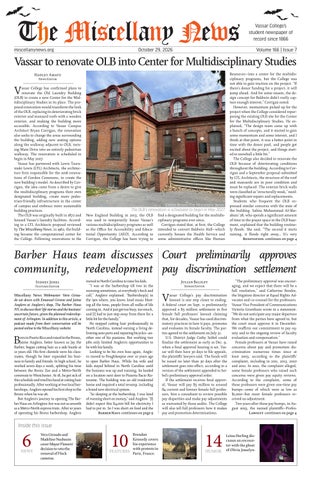
Vassar to renovate OLB into Center for Multidisciplinary Studies Resources—into a center for the multidisciplinary programs, but the College was not able to gain traction on the project. “If there’s donor funding for a project, it will jump ahead. And for some reason, the design concept for Baldwin didn’t really capture enough interest,” Corrigan noted. However, momentum picked up for the project when the College considered repurposing the existing OLB site for the Center for the Multidisciplinary Studies. He explained, “The design team came up with a bunch of concepts, and it started to gain some momentum and some interest, and I think at that point, it was a better point in time with the donor pool, and people got excited about the project, and things started to snowball a little bit.” The College also decided to renovate the OLB because of deteriorating conditions throughout the building. According to Corrigan and a September proposal submitted by LTL Architects, the structure of the roof and mansards are in poor condition and must be replaced. The exterior brick walls were classified as “structurally weak,” needing significant repairs and replacements. Students who frequent the OLB expressed similar concerns with the state of the building. Salma Muhammad Al-Sheabani ’28, who spends a significant amount of time in the prayer space in the OLB basement, explained that the building routinely floods. She said, “The second it starts raining, it floods right away… It’s very Renovation continues on page 4
Hadley Amato News Editor
V
assar College has confirmed plans to renovate the Old Laundry Building (OLB) to create a new Center for the Multidisciplinary Studies in its place. The proposed renovation would transform the look of the OLB, replacing its deteriorating brick exterior and mansard roofs with a wooden exterior, and making the building more accessible. According to Vassar Campus Architect Bryan Corrigan, the renovation also seeks to change the areas surrounding the building, adding new seating options along the walkway adjacent to OLB, turning Main Drive into an entirely pedestrian walkway. The renovation is scheduled to begin in May 2027. Vassar has partnered with Lewis Tsurumaki Lewis (LTL) Architects, the architecture firm responsible for the 2016 renovations of Gordon Commons, to create the new building’s model. As described by Corrigan, the idea came from a desire to give the multidisciplinary programs their own designated building, create more pedestrian-friendly infrastructure in the center of campus and embrace more sustainable building practices. The OLB was originally built in 1872 and housed Vassar’s laundry facilities. According to a LTL Architects proposal reviewed by The Miscellany News, in 1962, the building became the computational center for the College. Following renovations to the
Emma Brown/The Miscellany News. The OLB's renovation is scheduled to begin in May 2027. New England Building in 2013, the OLB was used to temporarily house Vassar’s various multidisciplinary programs as well as the Office for Accessibility and Educational Opportunity (AEO). According to Corrigan, the College has been trying to
find a designated building for the multidisciplinary programs ever since. Corrigan stated that, at first, the College intended to convert Baldwin Hall—which currently houses the Health Service and some administrative offices like Human
Barber Haus team discusses Court preliminarily approves community, redevelopment pay discrimination settlement Sydney Jones
Features Editor
Miscellany News Webmaster Vera Giraudo sat down with Emanuel Greene and Jaime Anglero at Anglero’s shop, The Barber Haus NY, to discuss their life stories and the business’ uncertain future, given the planned redevelopment of Arlington. In addition to this article, a podcast made from their conversation will be posted online to the Miscellany website.
B
orn in Puerto Rico and raised in the Bronx, Jaime Anglero, better known as Jay the Barber, began cutting hair as a side hustle at 12 years old. His first clientele were his classmates, though he later expanded his business to family and friends. In high school, he worked seven days a week, splitting his time between the Bronx Zoo and a Metro-North commute to Westchester. At 18, he got sick of this schedule and tried his hand at cutting hair professionally. After working at two local barbershops, Anglero opened his first shop in the Bronx when he was 26. But Anglero’s journey to opening The Barber Haus on Arlington Ave was not as smooth as a Metro-North express train. After 10 years of operating his Bronx barbershop, Anglero
Inside this issue
6
NEWS
Vera Giraudo and Madeline Nusbaum cover Mayor Flowers' decision to veto the removal of Flock cameras.
moved to North Carolina to raise his kids. “I was at the barbershop till two in the morning sometimes, at everybody’s beck and call,” Anglero explained. “Barbershop[s] in the ’90s where, you know, loud music blasting all the time, people from all walks of life coming in. And it just got too busy, too much, and [I] had to just step away from there for a little bit for the family.” He stopped cutting hair professionally in North Carolina, instead earning a living delivering auto parts and repairing bicycles—another one of his passions. But working two jobs only limited Anglero’s opportunities to be with his family. Looking to be his own boss again, Anglero moved to Poughkeepsie over 10 years ago to open Barber Haus. While his wife and kids stayed behind in North Carolina until the business was up and running, he landed on a location next door to Pizzeria Bacio Ristorante. The building was an old residential home and required a total revamp, including a brand new electrical system. “So sleeping at the barbershop, I was kind of running short on money,” said Anglero. “[I] didn’t expect this $4,000 bill for electricity I had to put in. So I was short on food and the Barber Haus continues on page 9
10
Brendan Kennedy covers his experience with protests in FEATURES Paris, France.
Julian Balsley Senior Editor
V
assar College’s pay discrimination lawsuit is one step closer to ending. A federal court on Sept. 11 preliminarily approved a $5 million settlement in five female full professors’ lawsuit claiming that, for decades, Vassar has used discriminatory practices in how it pays, promotes and evaluates its female faculty. The parties agreed to the settlement on July 31. U.S. District Judge Cathy Seibel could finalize the settlement as early as Dec. 9, when a final approval hearing is set. Vassar will then have 30 days to file appeals, the plaintiffs’ lawyers said. The funds will be issued no later than 30 days after the settlement goes into effect, according to a version of the settlement appended to Seibel’s preliminary approval order. If the settlement receives final approval, Vassar will pay $5 million to around 84 current and former female full professors, hire a consultant to review possible pay disparities and make pay adjustments as warranted by those audits. The College will also tell full professors how it makes pay and promotion determinations.
14 HUMOR
“The preliminary approval was encouraging, and we expect that there will be a full resolution,” said Catherine Bendor, the litigation director at Equal Rights Advocates and co-counsel for the professors. Vassar Vice President of Communications Victoria Grantham wrote in a statement: “We do not anticipate any major departure from what the parties have agreed to, but the court must approve it in December. We reaffirm our commitment to pay equity and to the ongoing review of faculty evaluation and compensation.” Female professors at Vassar have raised concerns about pay and promotion discrimination numerous times since at least 2003, according to the plaintiffs’ complaint, including in 2011, 2013, 2020 and 2021. In 2021, the complaint alleged, some female professors who raised such concerns were given pay equity reviews. According to the complaint, some of those professors were given one-time pay bumps—some of which were as low as $1,000—but most female professors received no adjustment. Two years after those pay bumps, in August 2023, the named plaintiffs—ProfesLawsuit continues on page 4
Leina Darling discusses an encounter with the ghost of Olivia Josselyn.
October 29, 2026
Page 2
THE MISCELLANY NEWS Emma Brown Darja Coutts Julian Balsley Grace Finke Hadley Amato NEWS EDITOR Samuel Eisenberg ASSISTANT NEWS EDITORS Iggy Gutierrez Madeline Nusbaum Aurelia Harrison ARTS EDITORS Brendan Kennedy Sophia Marchioli ASSISTANT ARTS EDITOR Sydney Jones FEATURES EDITOR Tina Mao ASSISTANT FEATURES EDITORS Jared Palumbo Ian Watanabe OPINIONS EDITOR Zoe Rodriguez ASSISTANT OPINIONS EDITOR Josie Wenner HUMOR EDITOR Noah Daube-Valois ASSISTANT HUMOR EDITOR Holland Kaplan SPORTS EDITOR David Bray ASSISTANT SPORTS EDITORS Armaan Desai Lucas Seguinot DESIGN EDITOR Sylvia Sargent ASSISTANT DESIGN EDITORS Ellen Tan Elliot Evans COPY EDITORS Gabrielle Lyman Julia Weber ASSISTANT COPY EDITOR Aria Kuklinski GRAPHICS EDITORS Charlotte Willenbring Makenna Brown PHOTO EDITOR Aviva Barry ASSISTANT PHOTO EDITOR Olivia Blank GAMES EDITORS Felix Mundy-Mancino Mia Liloia SOCIAL MEDIA MANAGER Fallon Dern LIVE EVENTS CHAIR Vera Giraudo WEBMASTER Anna Berggren REPORTERS/COLUMNISTS Eduardo Culmer Noah Duncan Melody Hamilton River Hamm Isabel Holmes Lora Janczewski Benjamin Kaplan Eli Lerdau Ender Nix Evan Seker Erin Thatcher Amritha Dewan PHOTOGRAPHER Andrew Chu CARTOONIST Emma Fuchs COPY STAFF Naomi Kaplan Ida Polys Eliza Spyropoulos Leah Weinraub Catriona Chapman FACT CHECKER Tanner Johnson DISTRIBUTORS Cailey Metter
EDITOR-IN-CHIEF MANAGING EDITOR SENIOR EDITORS
Charlotte Willenbring/The Miscellany News. MISCELLANY NEWS | VASSAR COLLEGE
NEWS
October 29, 2026
Page 3
VSA Senate Highlights, Oct. 11 • The President tabled a bill that would change the way the VSA votes to sponsor student-led demonstrations, due to under two-thirds of the Senate being present. • The Senate unanimously passed a resolution to eliminate the requirement for the Judicial Council to meet after the Senate on Sundays at 4 p.m. • The Senate considered and debated a bill that would ban student organizations from using AI image generation for promotional purposes. A possible amendment was proposed, where organizations would be banned from any AI image generation use, including internally. The bill will be debated in committee and reconsidered at a future Senate meeting.
Vassar students hold vigil, walkout on Oct. 7 week Eli Lerdau Columnist
[Disclaimer: For privacy purposes, members of Vassar Students for Justice in Palestine quoted in this article will be referred to anonymously.]
O
n the evening of Oct. 7, 2026, roughly 40 students, faculty and community members gathered for a vigil on Library Lawn to light candles, sit in silence, read poetry and honor those killed in the Gaza Strip since 2023. The following morning, a group of students held a walkout to protest Israel’s ongoing genocide in Gaza. The vigil, organized by Vassar Students for Justice in Palestine (VSJP), ran for three hours and marked the third anniversary of the Oct. 7, 2023, attacks on Israel and the escalation of Israeli military operations in Gaza that followed. One thousand two hundred Israelis were killed in the attacks by Hamas and other Palestinian militant groups. In response, Israel has killed over 74,000 Palestinians in Gaza—about one in 30 people in Gaza—at least 21,000 of whom were children. There are thousands of unconfirmed deaths, as people are buried under rubble or missing. Israel has also forcibly displaced millions of Gazans and created widespread famine throughout the Strip. Multiple United Nations inquiries and numerous human rights organizations have declared the Israeli campaign a genocide. “Tonight’s vigil is about just coming together in remembrance and in mourning,” one of the event’s organizers told The Miscellany News. “As an organization, it’s important we don’t only do [General Board] meetings, but also create spaces like this, uplift Palestinian voices and remind ourselves of their humanity.” Another organizer criticized the way the conflict has been addressed by the Vassar administration. “There hasn’t been much discussion or acknowledgement since my freshman year on this campus of Palestinian suffering,” the organizer, who is of Palestinian heritage, told the Miscellany. “Why can’t Vassar say genocide? The UN is calling it a genocide. All of these scholars are calling it a genocide. We act like we have this neutrality on the subject,” another organizer asked. “We’re constantly having to protect others that aren’t present, on a semantic front, when the reality is people are dying.” The mood at the vigil was varied. “I was really struck by how many of the poems were about joy,” said Quinn Lynn ’29, an
attendee of the vigil and the following day’s walkout. Ernesto Neyeli, a Poughkeepsie resident who attended the vigil, commented, “I think it was very intimate. There was a sense that it’s okay to feel what you feel when you talk and reflect on Gaza.” “It was a lot of grief, and a lot of mourning and sadness. But it was also reminding ourselves of the strength and hope of the Palestinian people, and trying to embody that. It wasn’t a hopeless event,” one of the organizers said of the vigil's general feeling.
campus really breaks that feeling.” “I think Vassar is enclosed,” Neyeli, who attended the University of Buffalo and was involved with organizing there, said. He noted that he was disappointed in the lack of organizing for Palestine in the wider Poughkeepsie community: “If there was an off-campus organization, I would organize with them, but VSJP was the best thing I could find for what I was looking for.” The following morning, roughly 50 students gathered on the Library Lawn for a
Emma Brown/The Miscellany News. VSJP held a vigil on Library Lawn on Oct. 7. The event was largely silent, broken by small readings and the occasional speech, something Neyeli said he did not expect: “The silence was a complete change of pace from the vigils I’ve gone to previously.” He added that during his time in Buffalo, New York, he attended vigils for Palestine and for Nurul Amin Shah Alam, a 56-year-old near-blind man from Buffalo whose death as part of immigration enforcement operations was ruled a homicide by the Erie County Medical Examiner’s Office. Additionally, Lynn noted the presence of non-students at the vigil, a fact they welcomed. “One of the biggest issues facing college organizations, especially in a college like this, is how isolated it feels,” they said. “The presence of people outside of the
walkout announced the prior night. The walkout was not officially organized by VSJP. The walkout moved past Rockefeller Hall, Main Building and Ferry House before arriving at the lawn in front of President Elizabeth Bradley’s house. Bradley’s windows were dark. Students gathered around a large Palestinian flag held by two marchers. Four students took turns reading a statement from a shared script. The statement cited Gaza’s Health Ministry, which has reported more than 1,400 Palestinian deaths since a ceasefire declared in October 2025; ongoing demolitions across the occupied West Bank; the nearly 10,000 Palestinians held in Israeli prisons amid documented human rights
MISCELLANY NEWS | VASSAR COLLEGE
abuses; and continued violence in Lebanon and Iran. “In the financialized education system, Vassar lets itself be just another cog in the war machine,” a speaker read, “allowing its endowment to fund genocide and terror around the world.” The marchers put forward three demands: that Vassar’s administration formally acknowledge the ongoing genocide in Palestine and call for its end; that the College disclose its investments and divest from the surveillance and weapons industries; and for the College to boycott Israeli academic institutions, specifically the two study abroad programs it currently approves. One program is located at the Hebrew University in Jerusalem, which has faced criticism for illegal construction on Palestinian land. The other is located on a kibbutz in Southern Israel. Speakers at the walkout noted that other institutions have successfully divested or disclosed their investments. The University of San Francisco divested from Palantir, L3Harris, GE Aerospace and RTX, who all maintain contracts with the Israeli military, in May 2025. And in May 2024, the University of Minnesota disclosed around $5 million in investments in Israeli companies and U.S. defense contractors following student pressure. “Both disclosure and divestment are attainable, tangible goals that can really happen,” a walkout organizer told the Miscellany. “We don’t think we’re going to do one walkout and have it be successful, but there’s a lot you can do along the way. Putting pressure on the College, disrupting business as usual while genocide is happening, raising money for people affected in Gaza and Lebanon.” Long-term, they made their goal clear: “Divest from genocide.” Passersby largely kept walking or made small gestures of support. “I was really trying to make as much eye contact as I could with everyone around me, and everyone was really intent on not following through with that,” Lynn said. “A lot of people are like, ‘Why is this still happening? What is this for at this point?’ and that’s exactly why we still do it.” “I try to think as minimally as possible about administrative response, because it’s our duty as students to do this regardless. We benefit from this institution that is invested in the military, so it’s our duty to organize,” a senior VSJP organizer said. “The vigil is honoring the damage and the hurt of the Palestinian people,” Lynn said. “The walkout is honoring the hope.”
NEWS
Page 4
College
to
Renovation continued from page 1
much an old building and it needs to go, because they keep doing repairs and it’s not working. So, I understand needing to start fresh.” The renovation would also address the current issues with the OLB’s lack of accessibility. Corrigan explained, “The AEO office on the lower level is accessible down here at the back. But that basement level is not connected to the floors above. You gotta walk outside the building and come back in one of these other doors to get up.” The renovation aims to fix these accessibility issues by creating new entries to the building along the north and south sides, each with entry ramps. According to a copy reviewed by The Miscellany News, LTL Architects submitted a layout design for the project on Sept.
Pay
renovate 18. The layout details new classrooms and offices, a new elevator and larger multipurpose rooms within the building. It also includes spaces for new benches, bike racks and terraced seating around the building. Additionally, the renovation aims to improve the walkability and pedestrian experience of the central campus. Corrigan detailed a plan to transform the road between Main Building and OLB into an entirely pedestrian walkway, except for emergency vehicles, with the existing parking spaces removed. “It’s kind of an interesting move, and an interesting change to get that much closer to making central campus more pedestrian [friendly],” Corrigan said. Sustainable design is also central to the renovation. According to Corrigan, by choosing to renovate the OLB instead of tearing it down, and by investing in biogen-
discrimination
Lawsuit continued from page 1 sor of English Wendy Graham, Professor Emerita of History Maria Höhn, Professor of Film on the Mary Riepma Ross ’32 Chair Mia Mask, Professor of Physics Cindy Schwarz and Professor of Psychological Science Debra Zeifman—filed suit against Vassar in federal district court. “I think the terms of this settlement are very positive for the class members and of course our named plaintiffs, the five professors who were involved in the case from its inception,” Bendor said. The College did not admit any liability in the settlement. “By entering into this Agreement, Vassar does not admit or concede, expressly or impliedly, but instead denies, that it has in any way violated the law,” the settlement included in Seibel’s order stated. The settlement contains three major elements. First, Vassar will pay the plaintiffs $5 million, which will be allocated based both on how long each professor has worked at Vassar relative to other members of the settlement class, and how long they have been a full professor. The settlement asks that each of the five named plaintiffs receive a $75,000 service award in addition to their portion of the settlement as compensation for the risks they took by being the faces of the lawsuit and time they devoted to the litigation.
"The monetary relief is very significant and what are called injunctive provisions— the non-monetary provisions—we hope will make a significant impact going forward in preventing gender-based pay discrimination at Vassar College." The plaintiffs are requesting $1.7 million of the settlement go to attorney’s fees and $168,994 to litigation costs; approximately another $6,750 is expected to go to the third-party settlement administrator, Bendor explained. If the attorney’s fees, service awards and administrator costs are granted, that would leave just under $2.8 million to be disbursed to the approximately 84 settlement class members. Second, the College will hire a third-par-
Old
October 29, 2026
Laundry
ic and reusable materials, the renovation will avoid wasting 161 metric tons of carbon dioxide in the building process. Corrigan expressed that this is largely thanks to LTL Architects commitment to using biogenic and reusable materials in their architectural designs. He explained, “They’ve embraced our Climate Action Plan. They’ve embraced the concept of reusing as much of the existing building materials as humanly possible.” Multiple students voiced that multidisciplinary students and professors were not adequately consulted about the renovation. Muhammad Al-Sheabani recalled that Vassar employees came to the building to scope out plans for the renovation, but did not ask students for their feelings on the renovation: “You didn’t even want to ask, and you were all here. You work all the way by
settlement
Building
Central and you walk all the way here and you had students and you didn’t ask.” Shanti García ’28, an Africana Studies major who attends numerous classes in OLB, shared a similar sentiment about the College’s lack of communication with the students about the renovations. “I do think that it’s so ridiculous that their culture is to construct these ideas without ever interrogating who the space is for. They do it for the campus; they do it for Vassar. They’re not consulting with you. They’re not consulting with the students.” None of the three students or any of the OLB staff in OLB interviewed for this article were aware of the specific design plans for the renovation. The proposal for the renovation passed unanimously in the Town of Poughkeepsie Planning Board on Wednesday, Sept. 17.
moves
forward
Image courtesy of Wikimedia Commons. A federal judge preliminarily approved Vassar College’s pay discrimination settlement with five professors on Sept. 11. ty consultant, most likely Charles River Associates, to conduct annual pay audits for three years, and will make pay adjustments based on the consultant’s findings as necessary. Vassar will also give the consultants’ methods, a summary of each audit and the status of any pay adjustments to the College’s Faculty Compensation Committee and the plaintiffs’ lawyers. The settlement prohibits Vassar from reducing any full professor’s salary to equalize pay in response to audit results. Third, Vassar will increase its transparency about how pay determinations and policies are made. The settlement stipulates that, for three years, the College must tell all full professors how it determines full professor base salaries, salary increases and promotions to full professor, as well as any new policies or procedures implemented in that time. The settlement’s language specifically highlights that the College must share how its performance evaluation process affects full professors’ compensation—the professors argued in their lawsuit that this system is stacked against women, which has made it more difficult for female professors to reach full professorship. The presumptive settlement class includes every woman who served as a full
professor between May 14, 2015, and Sept. 11, 2026: That is about 84 in total, with 54 of them being current full professors and around 30 of them professors emeritae. The suit is an “opt out” class action suit, meaning everyone who qualifies is automatically included in the settlement class unless they submit a written notice opting themselves out. Presumptive class members have until Nov. 12 to opt out, Bendor said.
"We want to ensure that pay equity is not simply a stated institutional value, but a commitment that is measured, monitored, and acted upon." If more than five percent of the presumptive class—or five women—decides to opt out, Vassar can withdraw from the settlement, making it null and void. Defendants in similar cases often request such a provision, Bendor said. As of her conversation with The Miscellany News about a month
MISCELLANY NEWS | VASSAR COLLEGE
before the opt-out deadline, Bendor did not know if anyone had yet asked to be excluded from the settlement. “The monetary relief is very significant and what are called injunctive provisions—the non-monetary provisions—we hope will make a significant impact going forward in preventing gender-based pay discrimination at Vassar College,” Bendor explained. “The combination of compensation and structural reform is significant,” Michelle Lamy, a partner at Lieff Cabraser Heimann & Bernstein and one of the plaintiffs’ lawyers, wrote by email. “We want to ensure that pay equity is not simply a stated institutional value, but a commitment that is measured, monitored, and acted upon.” Lamy explained that the settlement’s system of combining monetary compensation with independent audits, a commitment to adjust compensation based on those audits and increased transparency with faculty could serve as a model for other higher education pay equity cases. The professors’ lawyers hope this agreement will reach beyond this campus. “I do think this settlement is a message to universities everywhere,” Bendor commented. “You cannot let pay inequity stand.”
NEWS
October 29, 2026
Retreat
hosts
Samuel Eisenberg
Assistant News Editor
O
n Wednesday, Oct. 7, The Retreat hosted its first ever Oktoberfest event. An assortment of traditional Oktoberfest food, including sauerkraut and bratwurst, was laid out on tables on The Retreat’s patio. The event was focused on the folk festival of Oktoberfest in Munich, Germany, which has been held nearly 200 times since 1810, and which is attended annually by more than six million people. This year, the event hosted 7.4 million people, the most in its history. Oktoberfest was first held in Munich following the wedding of Prince Ludwig and Princess Therese von Sachsen-Hildburghausen. After a week of festivities
Page 5
Oktoberfest
event
around the city, the couple decided to continue the tradition every year. At Vassar College’s Oktoberfest celebration, students talked and laughed with friends as they waited in line for a spread of fresh food. According to Assistant Director of Dining David Linnell, Oktoberfest was selected as the theme partly because of the approaching fall. He wrote by email, “We thought our team would have fun highlighting these menu items for the Vassar community.” Head Chef of The Retreat Dawn Ilardi, who has “extensive experience” with German cuisine, came up with the idea for the event, Linnell wrote. However, Linnell emphasized, “The entire Retreat team worked together to execute it.”
Emma Brown/The Miscellany News. An example of the traditional Oktoberfest food served at The Retreat.
Emma Brown/The Miscellany News. Students line up for the Oktoberfest event on The Retreat’s patio.
Trump’s
new
Georgia Browning Guest Reporter
O
n Sept. 29, President Donald Trump issued an executive order authorizing the development of America.gov, an AI chatbot intended to improve communication between U.S. citizens and federal government services. As Vassar students continue to encounter AI as it proliferates within the technology industry, this new government software has caused students and staff to remark on its impact on academia. The government chatbot interacts with about 29,000 government websites to answer questions with up-to-date information, aiming to modernize government data over time. The new AI chatbot is powered by both Google Gemini and Elon Musk’s Grok. On Sept. 29, Google posted on a company blog, “By supporting the administration’s vision for digital modernization, we are committed to making these everyday public services seamless, accessible, and responsive for all Americans.” Additionally, when announcing this new government tool, Trump said in a speech, “It’s not just simply a website. It’s a restoration of America’s founding promise, and it’s a reinvention of your government for the 21st century and beyond.” Although Vassar College has no formal partnerships or licensing deals with AI
AI
chatbot
corporations, the College recommends that, if students are to utilize AI, they use Google Gemini. Students’ exchanges with Gemini are not shared outside of the College’s Google Suite. Additionally, students are directed to check their account settings if they would like to opt out of having their data be used to further train the company’s large language model (LLM). In a statement written by Vassar President Elizabeth Bradley on the College’s approach to AI, she spoke to the technology’s future advancement, explaining, “AI presents a whole new set of ethical, social, economic, political, and cultural dilemmas and challenges—issues that cannot be avoided and will impact our collective futures.” One student, Marius Kruse ’29, expressed a similar view about the progression of the integration of AI in society. Kruse said, “You can’t escape AI. It will be a part of your life. I mean, you can go up into the mountains and be secluded, but if you want to join the workforce and modern society, you cannot escape it. You have to learn how to act with it in a responsible manner.” However, students raised concerns about the ethical implications of AI, particularly in the context of America.gov. Students noted that Musk’s involvement in the development of the new LLM made them apprehensive about the reliability of the project. Musk’s company, Space
For Vassar’s Oktoberfest event, tables were set up on the patio, and students lined up to use their lunch swipe for food. After being handed a container, students could take as much food as they wanted from options including bratwurst, potato salad, pretzel bites, cheese sauce and cucumber salad. The varied menu took days of planning and preparation to come together, according to Linnell. As with the barbecue event hosted on Sept. 17 by The Retreat team, students and employees widely approved of the Oktoberfest event. An Express employee commented, “I think the managers do an absolutely wonderful job. They work very hard to present and bring to the students something different and unique.” Samip Paudel ’28 agreed, adding that he enjoyed the variety of food and that the event was fun to attend. He shared, “I re-
raises
privacy
XSI, created an AI chatbot, Grok, that is capable of facilitating conversations and creating images. Since Grok’s launch, Musk has come under fire for a number of scandals related to the technology, including when the LLM posted a number of antisemitic statements on X, as well as Grok’s production of child pornography. Discussing Musk’s involvement in America.gov, Kruse said, “We’ve seen Musk meddle in a lot of things. We saw it happening in Ukraine with Starlink, and we’ve seen these tech companies have a much larger political influence now.” Rosie Madden ’30 expressed similar concerns: “I would be skeptical of the AI chatbot because I would say there is a considerable risk of data breaches, specifically because of Elon Musk’s involvement.” Students also noted their concerns about the use of AI as a form of surveillance. Kruse said, “We live in a society where a lot of things are monitored by things like Instagram, McDonald’s orders. If you are signed up for a rewards program, you’re being monitored. So much of your data is being harvested to the point where I’m so pessimistic about it that I’m like, ‘what’s one more?’” The government chatbot’s privacy policy explicitly states that it will not retain an individual’s personal information, including search history, messages or GPS location. Professor of Political Science on the Margaret Stiles Halleck Chair Sidney
MISCELLANY NEWS | VASSAR COLLEGE
ally like when [there are] themed events and stuff like that. It’s always uplifting.” Another student, Juniper Schlesman ’29, also praised the food options and the choice of theme for the event: “I thought it has a wonderful variety of cabbage and that deeply pleases me.” Schlesman added, “I’m German and I’m happy... I had a great time.” “We are happy to hear that this was well received by the Vassar community,” Linnell wrote. He added that more events like this will be held in the future. “The BBQ in September was well received by the staff along with the community that we shared it with,” Linnell explained. “We wanted to keep the same good vibes going with an additional event. We like to take these opportunities of sharing great food and have fun with the Vassar community.”
concerns
Plotkin expressed similar privacy concerns. Plotkin said, “Under the circumstances of the current regime in Washington, I would not trust any bot, policy program, instrumentality of artificial intelligence, or anything else that it provides. Because it is being shot through that regime in Washington, I wouldn’t trust anything from them.” Despite concerns about the objectivity of the chatbot, America.gov has been reported to provide non-partisan answers that go against the Trump administration’s narratives. For instance, when a user asked America.gov whether the worst inflation in the history of the United States took place under President Joe Biden’s administration, the chatbot replied, “No. Bureau of Labor Statistics (BLS) Consumer Price Index data do not show that January 20, 2021–January 20, 2025 was the worst inflation ever in US history.” AI continues to be a prevalent force, fueling fears among the Vassar student body and faculty about how it will affect the progression of education. The development of America.gov aims to bridge the gap between American citizens and the federal government. However, as Vassar students highlight, this chatbot can instead create further divides due to hesitations about the influences on the technology and skepticism about how it monitors society.
Page 6
NEWS
October 29, 2026
Mayor to veto council’s resolution removing Flock cameras Vera Giraudo, Madeline Nusbaum Webmaster, Assistant News Editor
O
n Oct. 20, the Poughkeepsie Common Council voted 8-1 to end the use of the city’s 13 Flock Safety cameras. Poughkeepsie Mayor Yvonne Flowers, however, said at the meeting that she will veto the resolution. The council’s resolution would deactivate and cancel the city’s contract with Flock Safety—a popular automated license plate reader (LPR) brand that collects data including the color, make, model and license plate number of passing cars. The resolution would bar all agencies with access from using the Flock network and remove the 13 city-owned LPRs over the course of a month. The City of Poughkeepsie first installed Flock cameras in 2022. Shortly after the council voted, Flowers addressed them, saying, “I have no choice but to turn around and veto this. And y’all can override it if you want, but you’re going to have to explain to the residents of this city why you didn’t get more time than we can come up with another plan so that way we can keep this city safe.” The council can override Mayor Flowers’ veto as soon as its next meeting on Nov. 2. The council’s vote is the latest in a series of anti-Flock actions by jurisdictions across Dutchess County. Municipalities including Milan, Pleasant Valley, Pine Plains and Hyde Park have all canceled their town’s contracts with Flock in the past year due to controversies surrounding public surveillance and constituent disapproval. On Sept. 25, Dutchess County Sheriff Kirk Imperati and District Attorney Anthony Parisi announced the deactivation of county-owned LPRs after residents raised concerns about Fourth Amendment violations, lack of guardrails and data security at a public forum. The county first entered the contract with Flock in 2023. On Oct. 13, the Dutchess County Legislature unanimously voted to physically cover the county’s 65 Flock cameras. At the Poughkeepsie Common Council meeting, attendees applauded the county’s decision to deactivate its 63 cameras and asked Poughkeepsie to follow suit. “I was extremely pleased when I learned that the Dutchess County Legislature took a strong stance and voted to discontinue the use of the
Vera Giraudo/The Miscellany News. Residents line up to speak to Dutchess County lawmakers. Flock cameras the county had contracted for, and I’m hoping they will be removed promptly,” Poughkeepsie resident Sarah Kennedy told the Common Council. “I’m asking each one of you to please follow our legislature’s lead,” she said. However, when Flowers addressed the council after its vote, she argued that Poughkeepsie’s crime rate makes canceling contracts with Flock more complicated than other jurisdictions. She cited Flock’s LPRs as a reason for the recent reduction in drive-by shootings in Poughkeepsie. “The DA and the Sheriff can pull the Flock cameras from areas because it doesn’t really affect them like it affects the City of Poughkeepsie,” she told the council. “You mention here the town of Milan, Pleasant Valley, Hyde Park. Are they having drive-by shootings and the problems we are having in this urban city? No.” In an Oct. 22 statement, Flowers added that the Flock gunshot detection devices the city uses would also be removed under the council’s resolution.
“I recognize and respect the concerns surrounding privacy and the responsible use of this technology,” said Flowers in the statement. “These concerns warrant serious consideration, but they must be weighed alongside the potential consequences of eliminating existing public safety capabilities.” In response to community members’ concerns about how LPRs are used, Flock released a transparency portal detailing the system’s safeguards earlier in the year. According to the portal, “Data is used for law enforcement purposes only.” However, Poughkeepsie residents have raised worries about law enforcement officials abusing LPR systems, including by stalking ex-partners. “Unfortunately, we see painfully common evidence of authorities abusing this network,” said a Poughkeepsie resident who identified himself as Aaron at the Oct. 20 Poughkeepsie Common Council meeting. “There have been numerous and repeated instances of users misusing this network to track and stalk political opponents
and vulnerable individuals like women, children and immigrants.” According to Weronika Jeziorski, a Town of Poughkeepsie police officer, every officer in the department has a Flock login and every search in the system requires a case number. “I’m going to preface this by saying there absolutely should be audits,” said Jeziorski of the Flock systems. “But this is a huge resource.” She defended the surveillance system to the Miscellany, adding, “Technically, on a public road, [we] are not entitled to not be recorded, right? Even if it makes us uncomfortable.” Prior to Flowers’ address to the Common Council, Councilmember Daniel Atonna, who represents Poughkeepsie’s eighth ward, voiced his strong disapproval of Flock cameras. “It’s not constitutionally sound to have mass surveillance of an entire city, county, and country without a warrant,” he said. “Stop spending taxpayer dollars on mass surveillance that the vast majority of people do not want.”
Image courtesy of Luke Jenkins '26. MISCELLANY NEWS | VASSAR COLLEGE
ARTS
October 29, 2026
Are Jay Fu
Guest Columnist
A
llow me to say that I was here first. No, I do not have the prescience of the fans who witnessed her name appear among the kaleidoscopic rotation of radio darlings due to her hit single “2 On” from her 2014 debut album “Aquarius” landing on the Billboard 200. Nor can I claim the persistence of later stans who followed her through a series of commercially scattered releases studded by the occasional but inescapable banger: A feature on Nick Jonas’ “Jealous,” “Nasty,” “No Broke Boys.”. What I can say is that after my first listen of Tinashe’s recent album, I was won over, already certain of its future success. I am not alone in my latent familiarity with Tinashe’s name up until her recent breakthrough, and perhaps it was the force of that decade’s worth of stored potential that propelled the long-awaited victory of her career peak—by critic and popular vote—“Popstar.” This is not an album review. Much has already been said about “Popstar” and its formal excellence: the Arca and Machinedrum-produced “Sunglasses,” with Tinashe’s vocals threading rapid, percussive synths like water between marbles; melancholic temperament and cheeky lyrics of fan-favorite “Flashbacks”; electro-ballad breakup bop “I’d Rather Be Alone” cohering generic achy sentimentality with wise words from a weathered self; no clearly defined breakout track—how to avoid being a one-hit wonder. To that end, much has been said of Tinashe herself. After earning both Pitchfork’s Best New Music award and a profile in The New York Times, the paradox of the celebrity famous for being not-quite-famous finally resolves, and with no shortage of psychological interest in its subject. An artist as prolific and influential as Tinashe would be unfairly characterized as
Probing Julia Weber
S
you
uplifting
unimpressive, but until “Popstar,” “Aquarius” (2014) had been Tinashe’s highest charting release. This narrative forms a striking arc, begging a satisfactory conclusion for the hopes and messages essentially imbued within the 2026 album. The listeners’ understanding of “Popstar”’s thematic basis would be fundamentally altered on the basis of its reception. Track four, “Empty Stadium,” opens with a simple, haunting line—“Last night I had a dream so vivid that I woke up sick”—and proceeds to describe Tinashe’s fears of “d[ying] underrated.” In the wake of the album’s success, the emotional resonance of the track, bound by rousing strings, reads as triumphant rather than tragic. Beyond “Popstar,” the relationship between fame and the famous is a persistent theme: disillusionment with stardom, typical Hollywood alienation, passionate desperation. The periphery of stardom may be the most near, and thus the most relatable, of its woes to a mass audience. Take, for example, ADÉLA’s 2026 debut album “PRIMA.” Working off a similar theme of previous failures grounded in stan culture narratives of fraught success—take the pseudo-anti-American dream anthem “Ain’t in LA”—nonetheless embraces the aesthetics and nostalgia of 2010’s FM. On the other hand, the recent rise of artists like Zara Larsson and Slayyyter, hitting their stride years into their career, seem to attract a fanbase more strongly from localized virality breaking containment—such as with “Midnight Sun” and “CRANK,” respectively—compared to explicit dealings with their status as stars. It is simple enough to conclude that Tinashe had been hovering closer, and longer, to the mainstream than most other artists recently breaking through from absolute obscurity, to which “Popstar” owes its explosive success. However, this could indicate a case of survivorship bias. Working to repair longer
stretches of near-misses or missteps within past albums is a tricky feat. If there is any worse fate than the one-hit wonder, it may be that of the washed-out artist. Pitchfork, writing on Justin Timberlake’s 2024 dud “Everything I Thought It Was,” states that “The pop star’s latest is less of a faceplant than a comfortable rehash of past glories” and offers a middling 4.9 score. With the decline of radio and rise of the algorithm, the line between celebrity and obscurity has become more diffuse. Localized virality, as mentioned above, occurs on the micro-scale daily and, oftentimes, fails to break through to the mainstream. On one hand, fame appears more obscure than ever, and on the other hand, more accessible and even democratized. The context of fame does not inherently generate goodwill—if anything, a bend towards cynicism. Along another axis, fame becomes idealized as accidental and involuntary, at odds with the traditional interpretation of fame as sought after and earned. Does it make a difference when industry giants like Taylor Swift release multiple versions of an album to drive up sales and when Tinashe does the same? The hypocrisy of celebrity—of its being a collaborative project for the sake of one person—is at the fore, emphasized by the democratization of fame that incorporates stan culture as participation. What of “Popstar”? “Melatonin” charms and affiliates the listener—are you, like the targeted audience, “sleeping on” Tinashe? Similarly, title track “Popstar,” aimed towards Tinashe’s younger, dream-seeking self, promises a vulnerability that encourages our identification with a different dream. This new dream of Tinashe’s—separate from the American dream labeled as “outdated” in “Crash Out”—desires authenticity as central to the “Popstar” she imagines. Authenticity is both a topical and ambi-
Phoebe
Assistant Copy Editor
tanding at the entrance to Barclays Center in Brooklyn, New York, drenched by the rain, I said a hesitant goodbye to my phone for the next few hours. Having encountered so much discourse on the internet regarding phone-free concerts, I was excited to see if there was any merit in the experience. Would it help me enjoy the concert more? Would I anxiously yearn to check my notifications? Or would this phone-free concert from one of my favorite artists turn out to be a positive experience? On Sept. 26, a couple of friends and I ventured out of Poughkeepsie to see the final night of Phoebe Bridgers’ sold-out threenight concert stretch in New York City. Following Bridgers’ international tour with her band boygenius in 2023, Bridgers took a hiatus from the music scene that ended in May 2026 with several secret shows around the country. In June, she announced a new album titled “Lost Weekend,” released on Aug. 14, and an accompanying slot of tour dates. The caveat of this coveted return was that every concert would be phone-free. At the concert on Sept. 26, Bridgers spoke about the challenges she has faced over the past few years due to her father’s death, and upon her return to performing music, she wanted to cultivate the most vulnerable and intimate experience possible for her fans. This is where the phone-free policy comes in, made possible by a company called Yondr. They specialize in creating magnetic
Page 7
Bridgers’
pouches for phone-free spaces, especially schools. Throughout the ticket-selling process, Bridgers made her phone-free policy clear: Concertgoers had to agree to a message explaining the policy on Ticketmaster prior to purchasing their tickets. At the actual concert, the process was simple. We presented our tickets on our phones upon entering the venue and proceeded to stations equipped with Yondr employees, who then placed our phones into magnetic locked pouches, which they swiftly unlocked at the end of the concert. “I really felt like I could be in the moment and just have fun and enjoy the music,” said concertgoer Dasha Coutts ’27 [Disclaimer: Coutts is Managing Editor of The Miscellany News], despite feeling strange at first about not having her phone. People on the internet debated the phonefree policy with varying degrees of apprehension. Some people, such as TikTok user @song.of.myself, argue that the phone-free policy is a form of gatekeeping. Internet naysayers also raise the question of how this rule impacts someone with a disability that requires their phone as a medical device. Finding myself curious about this issue, I asked Jacqueline Rosenblum ’28 about how Bridgers’ phone-free policy accommodated her Type 1 Diabetes. Rosenblum recalled, “after telling [Yondr employees] that you have an ADA certified disability that requires your phone as a medical device, they wrap your camera in special tape…that prevents you from actually capturing any of the footage from inside.” Thus, individuals with
tious theme to contend with, so the album must hold up under the weight of its demand: for the audience to embrace the possibility of authenticity as autonomy from industry. The #UpliftTinashe trend can be seen as proof of a favorable result. As covered by Harper’s Bazaar, “Tinashe’s mainstream success can be attributed, in part, to the poptimists of social media who started a movement jokingly asking people what they are doing to “uplift Tinashe” in their daily lives.” The trend reached Tinashe herself and was included in Charli xcx’s introduction of Tinashe as her surprise guest during her headlining set at Austin City Limits. Did it work? Upon its release, “Popstar” charted at #6 on the Billboard 200, Tinashe’s first ever top 10 appearance. The great achievement of “Popstar”’s composition, then, is its creation of the convincing, collective frame of success necessary for its thematic coherence. It is a musical feat, absolutely irresistible, and my favorite album of the year.
Grace Finke/The Miscellany News.
phone-free
disabilities were accommodated by this policy, which allowed them to have a great time while still having access to their phones as a medical device. In the end, the concert would not have been remotely as beautiful and cathartic had it not been for the phone-free policy. I was finally able to understand the phrase “living in the moment,” which is something I am not used to at concerts, as I am usually preoccupied with deciding which songs to record on my phone. “At Phoebe’s show I was able to enjoy the music and atmosphere without thinking too much about how it would look on social media,”said my fellow concertgoer Eliza Spyropoulos ’29 [Disclaimer: Spyropoulos is a Copy Staffer for The Miscellany News]. The phone-free policy also allowed me to appreciate the vividness of what was happening around me. When Bridgers brought out her boygenius bandmates to perform a few of their songs, it felt extra special and beautiful to witness without worrying about taking pictures and videos of the reunion. I also observed things I might not have noticed had I been focused on filming with my phone. For example, I witnessed two best friends embracing one another in the row in front of me as Bridgers sang the lyric, “I have a friend I call / When I’ve bored myself to tears” from her song “Funeral,” which made me think of my best friend from back home. Meaningful moments like these were pricelessly augmented by the beautiful visuals Bridgers chose to suit the various moods of her songs. When Bridgers performed
MISCELLANY NEWS | VASSAR COLLEGE
Tinashe?
policy
her song “Scott Street” as the finale—a melancholic tune about running into someone from your past—all of the lights were turned on in the arena. Fans were swaying with each other, singing along without a care in the world or a phone in their hand. As Emma West ’29 noted, “It was so special hearing my favorite songs live with thousands of people who feel the same way!” This feeling would not have been possible if most of the audience was busy recording pieces of the concert on their phones. Among the many positive outcomes of Bridgers’ phone-free policy, is the multitude of beautiful fan-sketches of what the concert looked like. Leah Weinraub ’29 [Disclaimer: Weinraub is a Copy Staffer for The Miscellany News] said, “I like how on Instagram everyone started posting sketches instead of clips because they require a lot more effort and are more individualized.” I think that a phone-free concert may not work for all concerts, as some artists make certain choices in their performances that cater toward the camera. However, the phone-free policy sure worked for Phoebe Bridgers. Her decision made the concert altogether more satisfying and even personal than any typical concert where phones present a barrier between the artist and the audience. Instead of one artist performing for thousands of phones, it was one artist performing for thousands of human beings. There was more joy in the audience than I expected for a concert full of depressing tunes, and I think we owe it all to Bridgers’ phone-free policy.
ARTS
Page 8
‘Teenage
Sex
Tina Mao
Assistant Features Editor
J
ane Schoenbrun’s films have a particular way of eluding neat description. At the tail end of last semester, I watched the director’s 2024 feature film “I Saw the TV Glow” with a group of friends. Having heard so much about the film’s groundbreaking trans representation from TikTok users since the film’s release, I was eager but skeptical to discover what sets Schoenbrun’s feature apart from the existing queer movie canon. When the credits rolled, I found myself transfixed, speechless and with an intense urge to burst into tears. To me, the film captured the strange, ineffable alienation that underlies the existence of many genderqueer people—a constant TV static buzzing in the background that only amplifies the more you try to ignore it. Sure, “I Saw the TV Glow” is an allegory for the trans experience with self-repression, but it ultimately speaks to the everyday horror of feeling like something is fundamentally wrong with oneself and the familiar homesickness for an alternate life. Much like “TV Glow,” watching Schoenbrun’s newest feature “Teenage Sex and Death at Camp Miasma,” released on Aug. 7, was a cathartic experience that left me feeling deeply seen. But it also left me utterly clueless about what I had just watched. “Teenage Sex and Death” is marketed as a slasher film, but it is really a film about slasher films that offers a meta-exploration of the experience of consuming horror media as a queer viewer. The premise is that a well-known director named Kris Williams (Hannah Einbinder) is
and
Death’
given the opportunity to revive the fictional “Camp Miasma” horror franchise. In “Teenage Sex and Death at Camp Miasma,” the original “Camp Miasma” movies take place at sleepaway camp where a slasher known as “Little Death” (Jack Haven, who also played Maddy Wilson in “TV Glow”) lives at the bottom of a lake. Little Death, the ghost of a gender non-conforming camper who was heavily bullied and eventually drowned in the lake by their fellow campers, has an air-vent shaped head and holds a comically large spear. The symbolic ending of the original “Camp Miasma” feels like an indulgent choice on behalf of Schoenbrun: Squeak (Gillian Anderson) arrives at her first ever petite mort—a French term literally meaning “little death” that colloquially refers to an orgasm—as she witnesses the gory disfigurement of her sexual partner at the hands of Little Death. In the film, Kris’ obsession with the “Camp Miasma” franchise constitutes a core part of her childhood. She credits Billy Presley—who played Squeak, the final surviving character in the slasher film (a.k.a. final girl)—as the source of her “queer awakening.” Now an established filmmaker, Kris is troubled by the franchise’s use of the outdated, transphobic trope that connects genderqueer characters with monstrosity. Kris neurotically hunts down Billy Presley (Gillian Anderson), the reclusive star of the franchise, and shows up to her home—which happens to be the set for the original “Camp Miasma” movies—to discuss the reboot. Yet, when Kris mentions her aim to challenge the transphobic norms of the genre, Billy does not show interest in the
explores
“woke” ideology, instead criticizing her for being too much of an “academic.” But from there, the film spirals into surrealist territory when it becomes increasingly impossible to tell if the interactions between Kris and Billy are dream or reality. At times, Kris finds that she has somehow fallen into the cinematic world of the “Camp Miasma” set she is working at. The horrors lurking in the sleepaway camp are now Kris’ reality; but for her, this is a thrilling dream come true. The messy metanarrative that is “Teenage Sex and Death at Camp Miasma” feels like an intimate love letter to the queer coming-ofage experience of anchoring one’s identity in digital media and figuring out who one is through the representation they see on TV. In particular, the horror genre has amassed a cult of ardent queer audiences who see horror media as an important emotional outlet. For many queer viewers, experiencing controlled physical terror through a screen is a comforting alternative to the amorphic and persistent unease of existing in a trans body. Through blurring the real and the fantasy, Schoenbrun resists the common impulse to criticize and shame people who participate in fan culture. To many queer and trans people, for whom the real world feels like a dystopia, the world inside the TV often becomes more palpable than reality. To me, the most moving part of the film was the scene where Kris shares an intimate moment with Billy but abruptly withdraws from it as they are about to have sex. Before she can contain it, Kris begins a frantic outpouring of her struggles with experiencing sexual intimacy and pleasure. The film
October 29, 2026
queer
horror
concludes in what can only be described as Kris’ blood-drenched wet dream. Now transported into the “Camp Miasma” world, Kris and Billy engage in an erotic roleplay, where Kris comes face-to-face with Little Death. Watching the campy gore that unfolded in the aftermath was nothing short of exhilarating: as Little Death’s spear sinks into her flesh, Kris arrives at a soul-shattering climax as she overcomes her sexual inhibitions and is reborn through a bloodbath. Schoenbrun’s unapologetically over-the-top explorations of queer desire so aptly represent the ubiquitous queer and trans experience with body horror and the somatic dissociation that comes with it. When society is prone to categorizing the trans body as a site for perversity, sexual liberation can feel unattainable without a violent sort of self-surrender. In an age where much film and literature have become infested with a sort of literalism that attempts to elucidate its own symbolic value from the get-go, Schoenbrun’s films are a breath of fresh air. Like “I Saw the TV Glow,” “Teenage Sex and Death at Camp Miasma” does not hold the viewer’s hand through its cinematic world. Rather, it drops you head first into a sweeping parallel universe and leaves it up to the viewer to make meaning out of the surreal realm on the screen. My gripe with many works of explicitly queer media is that they possess a voyeuristic gaze that reduces the queer experience to all romance or all suffering. The je ne sais quoi of Schoenbrun’s projects insist on the importance of queer media that is uniquely made for the queer audiences that get it.
We need ‘The Devils’ in all its unabridged glory Ashton Samson Guest Columnist
[This article mentions sexual assault, violence and contains spoilers.]
W
ho is the devil and how can we spot him? Consider this while watching Ken Russell’s “The Devils” (1971), a filmic fever-dream evasion of genre classification. “The Devils” is a true story, adapted from John Whiting’s 1960 play of the same name and Aldous Huxley’s 1952 book “The Devils of Loudun.” It is an exercise in ’70s psychedelic cinema—commingling horror with religious criticism, uproariously comedic and intrepid onslaught of nuanced provocation. I attended a 35mm screening of “The Devils” at the Lincoln Center for the Performing Arts in New York City, the first release in the United States with previously unseen sequences restored. “The Devils” is an account of Catholic priest Urbain Grandier’s fall from grace and execution in 1634 for possessing Loudun’s Ursuline nuns. Abbess Sister Jeanne des Anges, Grandier’s accuser, claimed that the priest—whom she had never met—caused her intense sexual desire, possession in dreams and performance of unnatural acts. This accusation spreads throughout the convent. Released in 1971, the film was denounced by the Vatican, banned in Ireland and Spain and censored in the United States and the United Kingdom due to its graphic violence and sexual content, despite winning Best Foreign Film at the Venice Film Festival. It is hardly shocking that scenes were cut; the shock is that the cuts were not minimal. The cuts include scenes of a nun pleasuring herself on a charred femur bone and the “Rape of Christ,” a sequence in which
nuns partake in the orgiastic defilement of a life-sized effigy of Christ. The scenes were eliminated due to the studio’s “moral” panic about how audiences would react. Ironically, the scapegoating, enacted through the unholy marriage between church and state in the film, occurred in reality through the unholy marriage of the British Board of Film Censors (BBFC) and Warner Bros. The result was an imposition of moral stringency upon a film that critiqued moral stringency in the first place. Rather than signaling an understanding of the film’s themes by releasing it unedited, the BBFC and Warner Bros. used an age-old playbook: identify a scapegoat and condemn that person’s “guide.” Ken Russell and his “guide,” “The Devils,” are such scapegoats. Rather than consider Russell’s statement, they condemned it for its nudity. The studio and censor’s condemnation applied the very moral code the film sought to critique. “There is far too much of the orgy, too much nudity, too much masturbation, scenes of nuns making love to the effigy of Christ on the Cross…which seem to me to be prohibitive, objectionable,” a BBFC examiner stated in Linda Ruth Williams’s article in the November 2026 issue of the British Film Institute’s Sight and Sound magazine. The examiners sought to blame, but blamed the wrong source: Russell. Russell presented the script to the studios, to their subsequent approval. When confronted with the visuals, Warner Bros. became fearful of such blatant sex and nudity. However, Russell merely filmed his historically accurate script. The studios accused the easiest source that disrupted, agitated and offended their moral system. That there is nudity and
sex in the film is not morally objectionable. What is portrayed as morally objectionable—and what Warner Bros. and the BBFC and everyone who used Russell as a scapegoat should have perceived—is that the “devils” are not Grandier and his sexual behavior or the nuns’ “Rape of Christ.” The “devil” is the Church’s repression of a woman’s desire to love, which unleashes an extreme embodiment of sexuality, a desperation that finally looks like liberation but is just another churchand state-sanctioned action. The Church identified Grandier as an obstacle to the removal of Loudun’s self-contained fortifications. His removal allows for Church expansion and state control. Learning of Sister Jeanne’s accusations, the Church performs torturous gynecological examinations and encourages her to perform sexual acts, including the ravage of Jesus. At the height of hypocrisy, the priests participate in myriad orgiastic acts, more so than Grandier. These are the devils. If there is an age-old playbook for scapegoating, a playbook for reversing the effects of scapegoating must be drafted. In the context of “The Devils,” the first step is film critic Mark Kermode’s tireless efforts to find the decomposing footage in the Warner Bros. archives and reintegrate it into the film, as covered in Sight and Sound's November 2026 issue. The next step is for the widest audience to see it as intended. That multitudes have flocked to see Russell’s masterpiece is a testament to Kermode’s restoration. The final step is to engage with the terms of the film and understand that the “Rape of Christ” and Sister Jeanne pleasuring herself were missing pieces necessary to complete the puzzle—revealing that the real “devils” are Church and state working beneath the
MISCELLANY NEWS | VASSAR COLLEGE
surface of ecstatic sexual behavior. The opening scene—King Louis XIII’s performance in a drag-esque costume for Cardinal Richelieu—initiates the film’s deception in unveiling the true devils. This king, skimpily dressed, hardly looks tyrannical. The scene concludes with Cardinal Richelieu’s sinister remark: “I may assist you in the birth of a new France where church and state are one.” King Louis responds by kissing Richelieu’s ring and saying “amen.” This scene is set to nerve-jangling music with the crimson title card “The Devils” framing their faces. There is no doubt who the devils are. In the final moments of the film, Grandier’s wife’s walk along the rubble of Loudun amidst the open expanse in this long take feels liberating. However, Grandier’s execution effectuates a loss of freedom to church and state. Devils reside under the guise of liberation. The two reintegrated scenes repeat this notion, essential because they involve the commingling of Jesus and love. The “Rape of Christ” and Jeanne with Grandier’s femur bone convey the price of repression, that the “real devils” are church and state, and that the “scapegoat devils” are the sexual beings. The real tragedy is that the nuns’ repression led to deception, defilement and Father Grandier’s execution in direct opposition to Jesus’ love. These blisteringly tragic, visually kinetic sequences reveal the film’s true glory. To respect this film is to engage with its previously suppressed scenes: to bring Russell’s vision to fruition, to condemn hypocrisy, corruption and the “unholy” devilish marriage of church and state instead of sexuality and love. Watch this illuminating film. Find the scapegoat, the devil and the unrequited love.
FEATURES
October 29, 2026
Mindfulness
blooms
up what I would otherwise call silence: birds calling outside the windows, the train horn as it chugs along past campus, the other people spending time in Pratt. Milly Shi ’30, a frequent Sangha member, shared her experience in Sangha this semester with me. “Throughout these practices, I realized [that meditation is] a process, a skill that you could develop to focus yourself,” Shi remarked. “So, I actually use this through my usual work, too.” Shi recalled the foundation of Zen meditation that she learned during her first sit. “The instructor talked in a very calm tone, and said that you can concentrate only on your breath. How to do that was to count from one to ten, and then back, again and again and again,” Shi remembered. I have found that Sangha’s most prominent impact on my life has taken place outside of the meditation room. Besides leaving the space feeling rejuvenated, I take time to appreciate the morning dew on my walk to class, or the rising moon while heading back to my dorm. Shi explained to me, “After Sangha, I started to use my breath to adjust myself into that study mode.” When feeling distracted, Shi closes her eyes and counts to six. “During these six seconds, I will experience all of the distractions I have, like thinking, ‘I wanna go outside, I wanna look at my phone.’ And after I count to six, I will totally calm down. And then, through my breath, I will get into my study mood,” Shi described. In September, I had the opportunity to join a trip to Zen Mountain Monastery (ZMM) to attend a Sunday service in the Catskill Mountains, organized by Buddhist Sangha leadership. As rain fell on our way to the monastery, it served as the perfect ambience for our day of
Anna Hagen
Guest Columnist
T
he first six weeks of college can be hectic for anyone. When starting at Vassar College, I knew that I wanted to find a way to keep myself grounded amidst a whirlwind of new people, activities and possibilities. Luckily, I found Buddhist Sangha, one of Vassar’s many on-campus spiritual groups, as a way to recenter myself. I did not have much experience with meditation or Buddhism before, but I nevertheless sought to give the practice a “college try.” Sangha, a Pali/Sanskrit word roughly translating to “community,” is one of the three pillars of Buddhism alongside the Buddha himself and the Dharma, his teachings. Sangha meetings at Pratt House give students the opportunity to engage in a period of meditation—primarily taken from Zen Buddhist tradition. Incorporated into evening sessions are chanting and conversation about our meditation experience. I know, sitting in silence for 20 minutes may not seem like a “fun” way to spend your evening or start your morning. However, I always look forward to the scent of incense rushing into my lungs at the start of a meditation session. When the “time keeper” rings the inkin—a handheld bell that marks the start and end of each sit—I savor how the sound waves reverberate into space, slowly fading into silence until I am left with the sounds of nature. As summer faded and the semester began, the chirping crickets and cicadas outside Pratt House guided my breath during Sangha sessions. Now, I notice the sounds that make
Barber
Haus
Barber Haus continued from page 1 pizzeria guy was like, ‘Hey, you know, why don't you come over and have dinner with us on Sunday?’” The pizzeria guy was Franco “Frank” Carina, the brother of Pizzeria Bacio’s owner Gerardo “Gerry” Carina. Coincidentally, Anglero learned that the Carinas also used to live in the Bronx, and had owned and operated the pizza shop, Pizza Time, next to Anglero’s wife’s childhood home in the borough. “So right away we hit it off,” said Anglero. “Man, we’re like family at this point.” Franco Carina was handy with construction and helped Anglero renovate the house. Anglero also hired an old regular from his barbershop in the Bronx who worked as a carpenter to install new countertops in exchange for free haircuts for his two sons. A local electrician overhauled the old electrical system, which Anglero explained was a mess of crumbling wires insulated with paper rather than rubber. Anglero did much of the manual work to install mirrors and lights before Barber Haus officially opened in 2016. Barber Emanuel “Mano” Greene, originally from Detroit, has lived in Poughkeepsie for 19 years and set up shop in one of the Barber Haus chairs eight years ago. He is a graduate of Arlington Middle and High School, where he took cosmetology. After graduating from the American Barber Institute in New York City, Greene moved his focus back into men’s hair and, looking to escape the noise, returned to Poughkeepsie to join Anglero. Both Greene and Anglero believe that haircuts should be affordable and accessible, operating the Barber Haus against the trend of exclusive, expensive and impersonal businesses popping up across social media. They pride themselves on welcoming people from all walks of life and require no reservations.
through
reflects
Despite minimal interactions with the Vassar community in the past, just before the pandemic, Barber Haus developed an especially close relationship with the Vassar baseball team through former Head Coach Matthew Righter and then captain of the team, Bobby Kinne ’18. Barber Haus employees and barbers Pino Pace and the late Jose Vasquez were integral to this connection. Pace cut Kinne’s hair regularly, during and after graduation. A life-long baseball player himself, Vasquez played softball games with Vassar baseball and ran in one of their events for Suicide Awareness. Vasquez worked at Barber Haus for three and a half years, and developed a close relationship with Anglero, before his sudden heart-related death in 2020. Vasquez’s passing motivated Anglero—who also has a history of heart problems—to be more careful about his health and encourage his friends and family to do the same. Greene remembers Vasquez’s presence at Barber Haus fondly: “[He was] somebody who, no matter who you are or what you look like or where you come from, he would make conversation with you, make you feel like you’ve been to this barbershop 80,000 times.” In Vasquez’s memory, Anglero and his family hosted annual community softball games for a few years after his death. However, when Coach Righter left his position at Vassar in 2023, Barber Haus lost their close relationship with the baseball team and the tradition ended. Anglero and Greene expressed interest in reviving their memorial softball games and collaborative events. But Barber Haus’ own future, and its relationship with the College, remains uncertain after its property was purchased by the Arlington Capital Investors LLC (ACI) in October 2023. As covered previously by the Miscellany, an application submitted to the
Page 9
Buddhist
meditation. My mind hung between serenity I had not experienced in years and insatiable curiosity towards the practices surrounding us. In this balance, I reset my nervous system and found the perfect source of inspiration to explore Sangha through the rest of the semester. It was rewarding to get to speak with the other meditation practitioners, both non-monastic students and monks who live at the monastery. Everyone I encountered on the trip was very welcoming and open to questions. In all my time with Sangha—whether in Pratt house or ZMM—I did not feel any barriers to my participation, despite my lack of prior meditation experience. The Dharma talk was a notable highlight of the retreat for both me and Shi. Each talk begins with a koan, a paradoxical short story used in Zen Buddhism intended to bypass logical reasoning to achieve intuitive thought. The koan that our Dharma talk was based on goes as follows: “Xixian Faan of Lushan was asked by a government officer, ‘When I took the city of Jinling with an army troop, I killed countless people. Am I at fault?’ Xixian said, ‘I am watching closely.’”Instead of walking away from something I would normally get frustrated over, Roshi Geoffrey Shugen Arnold, the Head of the Mountains and Rivers Order and Abbot of ZMM guided us in unpacking the koan to find the true causes of suffering, followed by clarity and self-understanding. Buddhism as a greater practice has a similar effect in my daily life. For Shi, the most impressive change in her meditation practice was after our trip to the Monastery. “I remember that then I actually really struggled because I had a lot of reading
on
time
MISCELLANY NEWS | VASSAR COLLEGE
to do, but I still went on the trip,” said Shi. “Afterwards, I thought it would be hard to focus on my reading work right after the monastery. But actually, the whole meditation was really helpful. So when I got back to work, I was totally concentrated on the work. And that’s the first time I felt like I could control my mind.” Has going to Sangha for six weeks made me any better at meditating? I am not sure. I know I am more comfortable with my feet falling asleep. However, I have definitely become more aware of my surroundings, and less inclined to or rush through a conversation. The component of Buddhist Sangha that I have enjoyed the most has been becoming part of a welcoming—and very chill—community. There are people like Shi that I see regularly at morning and evening meditation sessions, whom I have established unofficial routines with, but I also enjoy the chance to meet new people. At times, it can feel vulnerable to sit in a silent room with others, but it is eye-opening to learn how people can have drastically different experiences or take different meanings from the same meditation session. Sangha ends by reciting a part of the metta (loving-kindness) meditation, used to cultivate goodwill. Whether or not you decide to try out meditation, I hope that as we enter next part of this semester, you are able to take a moment to pause, breathe and appreciate the people around you: May be we safe May we be kind May we be joyful May we be awake
in
New York Department of Environment in October 2025 outlines the potential redevelopment plan to involve the demolition of all buildings—except for the fronting of the Juliet Building—on the 2.24 acres of acquired land in downtown Arlington. This plan would include the Barber Haus’ current building. In a Letter to the Editor to the Miscellany last December, responding to the paper’s reporting on the redevelopment plans, ACI Asset Manager David Kaminski wrote: “Since acquiring these buildings, which had long suffered from deferred maintenance, we have invested in numerous improvements, with a particular focus on life-safety upgrades and repairs that directly affect tenants’ well-being.” In the three years since the purchase, Anglero claimed the ACI has fulfilled their promise not to raise the rent for Barber Haus—which Anglero continues to operate on a month-tomonth lease. But Anglero also expressed that the LLC has not assisted him with any renovations on the building, despite his concerns about chipping lead paint and falling shingles on the exterior. Anglero said, addressing ACI: “You don’t wanna make any renovations, anything in the meantime to at least make your area that you purchased three years ago look a little nicer...until you get the construction done. So what does that really say? Like, you wanna make it a nicer neighborhood, but you’re not willing to invest in what you already have.” Furthermore, Anglero shared that ACI has failed to communicate or provide him with adequate support or alternatives in the case that Barber Haus’ location is affected by the future redevelopment plans. This is despite promises also made in Kaminski’s letter for more individual and collective meetings with every tenant affected by potential updates. Kaminski wrote in an email to the Miscel-
Sangha
Arlington
lany: “Barber Haus is a valued part of Arlington, and we want it to remain part of Arlington’s future… We accept the criticism that we have not reached out to Jaime directly. That was our mistake. We have no definitive plans to share at this time, but we will seek to sit down with him as soon as possible. When we do have plans, we will share them with all of our tenants.” Responding to Anglero’s allegations that ACI has declined to renovate the building, Kaminski wrote, “ACI has never received a request from Barber Haus for renovations to the building or its space. On the one occasion that there was an issue within the premises, our staff responded immediately, had a plumber make the repairs and addressed and repaired the damage.” Despite Kaminski’s comments, Anglero and Greene remain worried about the future of Barber Haus and their Arlington neighbors, uncertain how potential plans and the opening of new and potentially competing businesses will impact existing storefronts. “We’re not completely against the change, right?” Greene explained. “We’re all about renovations and innovation and growth and everybody to have a healthy environment, right? ’Cause all the buildings are old and they can use a little facelift. The whole neighborhood could. But let’s keep the little guys in mind, you know what I mean?” Anglero has eight barbers and a recently-hired braider who continue to run their businesses using the chairs at Barber Haus. With his future uncertain, Anglero cannot ensure that these barbers will continue to have a space to work, or hire new employees. “You’re not obligated to give me a spot anywhere,” said Anglero of ACI’s redevelopment plans. “All I ask for is just communication and make it short and sweet.”
FEATURES
Page 10
October 29, 2026
Julie Hardwick discusses Adelaide Zaire’s Catholic journey Janice Sor
Guest Columnist
I
n 1781, Adelaide Zaire wrote a multitude of documents, describing herself as a “negresse libre,” or a “free Black woman.” But was she ever really a free woman? According to official documents and legal terms, perhaps not. Yet, her mindset of standing firm in her self-identity cultivated her sense of freedom. Her act of claiming her identity as a free African woman not only transcended legal terms, but defied the label of “enslaved” that was put up against her. On Oct. 8, The University of Texas at Austin’s John E. Green Regents Professor of History Julie Hardwick delivered a lecture entitled “Adelaide Zaire’s Catholic Journey: Slavery, Sexual Violence, and Salvation in a French Eighteenth-Century Port City,” which highlighted the journey and testaments of multiple French-African women who fought through pain, erasure and displacement in order to obtain freedom. The lecture was a part of the C. Mildred Thompson Lecture Series and hosted by Vassar College’s History Department. Hardwick introduced three women: Adelaide, Catherine Sophie and Cattin, all African women who were repeatedly displaced by enslavers between their hometowns and Nantes, France, and whose stories and feel-
ings were concealed in documents, and whose pain does not go unrecognized from historians of today. Hardwick defined their stories as small histories: not necessarily small in terms of the importance of their individual lives, but defined in the sense that they were just the surface of the many unrecorded notable parts of French history. Hardwick’s choice in centering her lecture on these three women posed an alternative way of thinking about slavery. Hardwick explained: “Centering these three young women’s accounts tells us a very different way of thinking about slavery as an experience and institution in France and the long roots of current French patterns around race, about Catholicism and slavery, and an understanding their experiences as being shaped by fugitivity running towards freedom, identifying as from West Africa, seeking security, safe spaces, Black allyship, control over bodies, etc.” During this time, French Catholicism was very hypocritical towards the realities of many enslaved African women. Their babies were godparented, baptized and taken care of by the same individuals who, despite their trauma from sexual, emotional and physical abuse from their enslavers, were denied their own freedom. Documents of the time seldom recognized the harsh realities of their lives, as well as their personal truths. Priests self-censored records as they wrote them in order to
protect the enslaved women’s abusers, an action that produced a cyclical loop of abuse—a loop many enslaved people never had any power over. Adelaide was impregnated by her enslaver, and was forced to make a pregnancy declaration—to note her pregnancy on record. Yet, when it was time to document the baptism of her child, the father of her child was marked as unknown. A similar situation occurred with Catherine Sophie. She was considered a free woman when she was pregnant with her child, but when she gave birth and passed shortly after, there was no reference to her legal status during the christening of her baby. It is as if French Catholicism was a paradox for the enslaved: It was a practice many cooperated with while simultaneously fighting it. Hardwick defined Catholicism as a lived experience and a core part of an empire built on slavery. The practice of Catholicism was embedded in their culture, names and rituals that the enslaved may have begrudgingly participated in, as well as infrastructure they participated in like the Hôtel-Dieu. The Hôtel-Dieu was an institution of charity, medical treatment and holy practices. Yet, as much as the poor were treated healthwise and provided resources, it was a dwelling place of the many truths (the violence that the enslaved experienced) that were taken away from the enslaved. Since Hardwick’s lecture, I have continued
to consider the question: Was Adelaide a free woman? Sure, she addressed herself as a free woman, but her request for freedom was never granted by the local officials. I see the act of freedom as an internal agency where we choose to respond to what happens to us; it is the attitude that you carry across the things around you and how you choose to interact with them. Greek philosopher Epictetus famously wrote, “Freedom is the right to live as we wish.” It is obvious that these women did not have the opportunity to live as they wished. But does that deny the freedom Adelaide Zaire granted herself? In 1803, a group of Igbo people on a slave ship off the coast of Georgia overpowered their captors and waded into Dunbar Creek, choosing death over a life of chattel slavery in the ultimate act of resistance. The Igbo Landing, as it has come to be called, was one of the largest mass suicides in the history of the transatlantic slave trade. Both Zaire and the Igbo people were captured in a physical and legal sense, but, like the Igbo people’s act of choosing death, Zaire’s act of choosing to write about herself as a free woman granted freedom within the mind. It detaches the physical being from the mental and asserts autonomy over one’s identity. Adelaide’s act of resistance allowed her to hold on to both her independence and humanity to some degree.
Experiencing the French protests as an American Brendan Kennedy Arts Editor
I
t was 4:27 p.m. on Saturday, Oct. 17, and I had asked for the check three times. My friends and I were sitting outside a quaint restaurant in Paris’ seventh arrondissement, overlooking a cream-colored stone building lined with tall windows and ornate, black balustrade de fenêtre. We were the only group sitting outside. The small tables in front of us were covered with empty bread baskets and decaying cappuccino dregs, and we were ready to leave. Then suddenly, our waiter came running from the restaurant in a panic, screaming at us to get inside. “The protests are coming!” he yelled. When you are planning a trip to Paris months in advance, you probably do not consider the presence of protests as a deciding factor on where to stay, or even on what dates to choose. Indeed, the recent French protests—a show of public anger over rising living costs, growing economic inequality and cuts to school and education funding— had been growing for the past month, but had not appeared to be heavily disrupting day-to-day Parisian life, particularly not for tourists. The movement began in mid-September with localized, student-led blockades in Créteil—a working class suburb of France—arguing against concrete issues with the public high schools, including dilapidated buildings, lack of heating, crowded classrooms and the shortage of teachers. Within days, the small demonstrations spread to hundreds of neighboring schools in poor Paris suburbs. By early October, the protests had spread across the country, roping in university students, teachers, labor unions and citizens, transforming it into a massive nationwide dissent. It was not until Oct. 16, my first night in Paris, that I had fully understood the severity of the unrest in the city. Seated outside a glowing bar at midnight, a red flicker appeared in the corner of my view: a handheld
flame. Confused, I asked the friend I was visiting what I was looking at. “Oh, those are just the protests passing by,” she explained. But she also noted that the protests she witnessed up until this day were relatively minor—typically small gatherings of students blockading universities and high schools. The shining flare was followed by a group of about 100 people, chanting and waving their cardboard signs in the air. As it became clear to everyone else seated outside the bar what the crowd was, we quieted and watched them go by down the street. Once they passed, a group of French students turned to our table: “Are you guys going tomorrow?” I had already heard whispers from other Vassar students studying abroad that Oct. 17 would be “the big day.” But as an outsider in the country, I did not know what to expect. After explaining to the French students that my friends and I were just visiting the city for the next few days and did not plan to attend the protests, they tried to convince us: “But everybody is going! You guys must attend, even if you just watch from a distance. It’s the revolution.” The next day, we decided to go ahead with our planned trip to the Musée d’Orsay rather than attend the protests. After a chocolate croissant and shot of espresso, we walked into the metro station, hoping to get on the train that would carry us over to the museum. But as we stepped inside, a man stopped us immediately. His face was bright red and streaming with tears. “Don’t go in there!” he screamed at us. He explained that the police were throwing tear gas at the previous station, Place de la République, and the smoke had entered the metro cars and been brought to our station. Unnerved, we exited the metro station and stood on a nearby street. There, we watched thousands of people rush towards the République, holding signs and dressed in all black. We decided our best course of action was to leave the area—where we had rented an apartment—via Uber and head
towards a more touristy center before the protests could become more disorderly as the day progressed. That is how we landed locked inside a restaurant in the seventh arrondissement at 4:27 p.m., far away from our safe apartment, watching the staff frantically push furniture in front of the door and yelling at us to hide in the corner. France has a long history of political protest getting destructive. Take the “Yellow Vests” Movement of 2018, where protests against fuel tax hikes and living costs resulted in rioters burning cars, looting shops and vandalizing landmarks like the Arc de Triomphe. Would things in Paris escalate to that level on Oct. 17? The restaurant staff certainly thought so. Hiding inside the restaurant, I witnessed a peaceful march of a few thousand people through the glass windows. After they passed, however, a band of police officers followed, screaming at the peaceful demonstration and wailing their loud, harrowing sirens. The crowd quickly dispersed. This encounter was just a fraction of the action that was happening around the city that day. At Place de la République, what started as a peaceful gathering quickly escalated into intense clashes. Masked groups and violent fringe elements smashed storefronts, vandalized buildings and set fires throughout the area. The police deployed tear gas, water cannons and riot units throughout the day. More than 1,200 civilians were arrested and 150 police officers were injured. In a televised address the next day, French President Emmanuel Macron said, “Those who looted will have to pay back for the damage, and those who sought to bring down the Republic will be held accountable.” As an American, hearing about protests in other countries (typically via a prompt social media post) is something one can easily turn a blind eye to. It is simpler, or perhaps lighter, to disregard the societal issues that exist in other countries; besides, America has hundreds of problems on their
MISCELLANY NEWS | VASSAR COLLEGE
own. But as a tourist, dropped directly in the initiatives of the city, it is impossible to ignore my own proximity to issues I had previously recognized as someone else's. Why be upset that The Louvre is forced to close from the unrest when hundreds of thousands of French citizens are unhappy with their own day-to-day lives? After an hour, the restaurant eventually let us go, but only after reminding us that anything that happened to us once we left was not their responsibility. Since the metro was down and cars would get trapped by crowds, the only option was to walk two hours to the apartment through areas of yelling crowds, cars set on fire and broken glass. Yet despite the disorder, I still witnessed other businesses carrying on as if it was an ordinary day. Most strikingly, I watched residents enjoying meals and drinks outside as disarray occurred just down the block. Oct. 17 showed me a part of French culture I had not bargained for when I planned my trip. In France, protesting is a mainstream, institutionalized form of public discourse—something you can only truly comprehend when you witness it in person. Had the restaurant overreacted to the actual situation that occurred at the moment? Probably. But the events I experienced that day, particularly as someone who has barely traveled in my life, was a deeply intense culture shock, one that enlightened me to how disruptive public dissent can actually operate as a civic duty, and the power of citizens’ ability to attempt to hold the state accountable. As my apartment host told me, “It is impressive the first time you witness it.” While the uncanny sound of the police sirens may plague my head for months, my greatest takeaway is the disillusionment of my own assumptions of what a protest can look like. What may seem like chaos to an outsider, is instead an essential part of the workings of democracy. Perhaps our own American society could implement a few notes from our friends across the pond.
October 29, 2026
FEATURES
Copenhagen Chronicles Chapter 5: Still studying, but not in Copenhagen
Page 11
What's Brewing? A Weekly Advice Column by Leah
Townhouse or Dollhouse? Dear Leah,
Lora Janczewski Columnist
A
part of the DIS Study Abroad in Scandinavia program that really drew me into studying abroad was the opportunity to take study tours, academic trips that students take as a class in their core courses. My core course, “Medical Biotechnology and Drug Development,” scheduled a short study tour across Sweden and a long study tour in Paris, France, which I have just come back from. I must admit that the core course I am in is unlike any biology class I have taken at Vassar College. Before taking this class, I had not considered how influential finances and economics are in the field of drug development, nor had I learned about the microbiological aspects of therapeutics science. Such interdisciplinary studies have opened the floor for a wide variety of speakers to come talk with our class, as well as provided us with incredible opportunities to explore different labs, startup companies and even “science villages.” For our short study tour, our class visited Malmö and Lund in Sweden. At Lund University, we learned about induced pluripotent stem cells. In therapeutics, cells from already-specialized cells can be reprogrammed to induced pluripotent stem cells—which can grow into cells of different parts of the body and are used to create organoids—or mini replicas of organs—in which scientists can observe complex structures and diseases, especially those that pertain to the brain or the heart. It was fascinating to hear about this new field of study and actually step into the lab where the scientists do their research. In addition, we heard from people like Entrepreneur in Residence Jalal Vakili from evAde, who is creating opportunities for biotechnology companies to break into the therapeutics market and receive necessary funds for their ideas. In addition to other academic talks and visits, we took the time to explore the cities we visited. One of the best parts of studying abroad is traveling and exploring—just getting lost. My friends and I ambled around cobblestone streets admiring the colorful houses in Lund, ate Swedish meatballs at a restaurant we happened to stumble upon and walked through open botanical gardens. We got to speak with locals who were curious as to why a large group of American stu-
dents was wandering around their small city; yet, instead of being bothered by us, they were happy to see us enjoying their homes and recommended their favorite spots. We left Sweden feeling welcomed and well-educated on not only the science, but also on the daily culture and history of the place. In Paris, we spoke with researchers from IVeTH, a national biotherapy-bioproduction integrator dedicated to extracellular vesicles. After they summarized their research and how they got involved in the sciences, they invited us into their labs for practice in what they do. Remember the organoids I mentioned? My group and I were actually able to transfer the organoids into new petri dishes and suspend them in a new medium. It was one of the coolest experiences ever, especially considering how novel this research is and that those cells were once a part of a person. In Paris, we hit up all the top spots: the Eiffel Tower, the Arc de Triomphe, Notre-Dame and the Basilique du SacréCœur de Montmartre. But I do not think anything can beat walking through the Louvre Museum for the first time; you never truly realize the gravity of the hundreds of momentous art pieces that line its hallways and exhibitions, each meticulously curated and placed in their respective spots. You can feel the history seeping through them: the progression of art styles, the messages behind the paintings, the significance they have on French society and collective culture. We also wandered through parks, enjoying the still-summery weather and veering away from Google Maps’ suggestions to walk down narrow streets decorated with vintage bookstores and eat at boulangeries that smelled warm and rich with fresh baked goods. We watched as people filed into the metro after work or school and learned that eating dinner at 7 p.m. in France was nearly a crime. We spent our late nights reflecting on the past few days with a better sense of why it helps to study medicine in Paris, but also why Paris is so culturally significant. It has been eye-opening to experience both culture and science so deeply and simultaneously. Through these integrated opportunities, I am encouraged to make connections between subjects but also between lifestyle and work—constantly being inspired by new ideas and exposed to the winding paths that I could pursue after my education.
I am living in a Town House (TH) this year. Three people in the TH have been my close friends since freshman year, but my downstairs roommate is a friend of a friend we didn't really know beforehand. We asked her to live with us because we needed a fifth roommate, and we met a few times last year and got along well. However, multiple times this year, I’ve found little dolls that look a lot like my roommates and I, and I don't know what to think. I am really not sure what to do, as this is such an odd situation. Should I approach her about this or pretend that I know nothing? Should I try to move? Best, Josephine
Dear Josephine, Alright, you win. This is probably the strangest thing that has ever been submitted to “What’s Brewing?” I don’t think your situation is strange enough to get Rich Horowitz involved, but I think there is a reasonable explanation for the dolls of it all. I’m a TH resident myself. In fact, I’m a bottom-floor resident. Although I really love my sweet E room, I’ll admit that it can get kind of lonely. Hearing the pitter-patter of my roommates upstairs and their chatter while getting ready to go out on the town always leads me to make the treacherous journey up the stairs to stand in their doorways. Everyone always says the second floor is where the party is, right? All of this is to say that this could be your roommate’s way of trying to break the ice, especially if you guys weren’t that close prior to living together. I don’t think that doll-making specifically is a love language, but if I had to categorize it, I feel that it would fall under gift-giving. Maybe even acts of service if they’re flattering images of you. My housemates and I have a framed group photo of us on our TV stand, so perhaps this could be akin to that. Everyone shows their love in different ways, so there is a chance that this is your roommate’s way of asking to be involved. Is it the way I would have gone about it? Probably not. But you can’t blame a girl for trying. Living with people is such an intimate thing, and it can be hard to navigate when taking it on with cohabitants you might not know as well. Was there anything strange about the dolls? Perhaps—and I’m just spitballing here—pins sticking out of the doll roommate who forgot to do their dishes? If these dolls start looking messed up in a crazy way, then I would be alarmed. But if your roommate is just getting crafty, there’s nothing to worry about. If these figures were simply out and about, in the kitchen or the living room, it could be worth a shot to inquire. More likely than not, there’s a simple explanation. If you were snooping, which is obviously ill-advised and something I would discourage you from doing in the future, pretend that you know nothing. I assume that you chose to live with this person for reasons beyond just needing a fifth roommate. You said that you got along well with this person, and that there are mutual friends involved. If your fifth roommate was a danger in any way, I don’t see why a friend of a friend would let you take them on as a housemate. Based on that, my verdict is that she’s probably just a little quirky, and aren’t we all, in our own ways? I can understand the discomfort of the situation, though. If you’re the only roommate who has noticed this, I would bring it up in a cool and casual way. Again, the explanation is probably a lot simpler than you might expect. Don’t come at it with hostility or suspicion—ask out of genuine curiosity. And, if the explanation turns out to be something of the “pins in the doll roommate who didn’t do their dishes” variety, you can voice your concern. As I already mentioned, you chose to take this person on as a fifth roommate for a reason, and sharing a space can be a hard thing to navigate, even with your closest friends, so give your roommate a little grace. Best of luck! Best, Leah
MISCELLANY NEWS | VASSAR COLLEGE
HUMOR
Page 12
October 29, 2026
PB spotted at Bohemian Grove; possible links to owls Arthur Beaugeard Hoot Hoot
P
resident Bradley was seen last Wednesday at Bohemian Grove, raising suspicions over Bradley’s role in a potential owl-related conspiracy. The Bohemian Club is a secretive group of the world’s elite, including many of America’s top politicians and businesspeople. They meet annually in Bohemian Grove, a compound buried deep in the woods of Northern California, away from the prying eyes of the proletariat. It is rumored that these fat cat capitalists enjoy numerous twisted pleasu-
res, including sketch comedy, the hunting of human children through the woods and the ritual burning of a massive effigy of an owl. This past Sunday, grainy photos surfaced of Bradley at the annual gathering, raising a flaming torch to the owl sculpture and laughing with perverse delight. The owl has been the harbinger of doom and gloom in all cultures, all around the world, since the dawn of time. The Aztec and Mesopotamian gods of death have been linked to owls. From the Inca to the Zulu, from the Qin to the Han, the owl has been universally recognized as the omen of de-
Reclaiming Marius Kruse CIA Student
A
s a Deece Defender, I often find myself misunderstood. I hear people bemoan how they could not find anything they liked last night, how dry the chicken is or how the fruit is not up to par. There is a false understanding that Deece Defenders, like me, believe that the Deece is home to the greatest delicacies known to man. Their claims are not only inaccurate, but an insult to my sensibility and taste. As reported by the Misc just a couple of weeks ago, there are genuine concerns about the quality of the Deece. It would be completely irrational of me to attempt to refute these points, so I will not. Instead, I will build my fortress on a far different ground than journalism: psychology. The concept of learned helplessness was first conceived of by psychologist Martin Seligman in 1967 through the classic method of morally dubious experiments. If you find yourself suffering from a short attention span and are willing to take my word for it, here is the long story short: They had a dog and gave it unavoidable shocks. They then placed the dog in an environment where it could escape by jumping over a barrier. When shocked again, the dog simply accepted the shocks with no effort to escape. The study showed that you could “learn” to be helpless, and it would affect you even in situations where you could do something about it. In my fellow students, I see the
Seven
independence legacies of these dogs: Rather than seek to escape, they merely bear the electrocution. “But Marius,” you may ask, “there IS no escape from the Deece.” Here is where I introduce you to the other side of the fence: “Your Kitchen.” But then, I ran into a problem. What could I possibly cook that could convince people of the potential that I saw in the Your Kitchen station at the Deece? Yes, most people (I would hope) have cooked themselves an omelet, made a panini or taken rice from Your Kitchen, but this was not ambitious enough. Was there something that would lift the clouds over people’s eyes and show them what I saw? I searched far and wide for sources that could satisfy my requirements—and the admittedly limited ingredients available. After a few moments of digging through the archives, I had found my inspiration: Tom Kerridge. As the owner of the first pub to be awarded two Michelin Stars, I realized that he would be the man accustomed to cooking in tough environments. Low and behold, his website yielded the perfect recipe: Cheesy Bean Burritos. Armed with the dual powers of knowledge
costume
ideas
Materials: cat eye glasses, defined cheekbones, white sheet with holes cut in it.
s Elizabeth Bradley once said, “In girl world, Halloween is the one night a year when a girl can dress like a total slut and no other girls can say anything about it.” With Halloween fast approaching, there’s one question on everyone’s minds: Why would President Bradley say something so reductive about women? I can’t answer that, but I can provide Halloween costume ideas! We at The Miscellany News have put together a list of costumes that are sure to stun in the Big Tent this October.
John Bradley during his brief stint as a contestant on MasterChef Junior Not many people know this, but our illustrious first gentleman once landed a spot cooking for Gordon Ramsay alongside our nation’s finest eight- to thirteen- year-old home chefs. Bradley’s MasterChef Junior career, which lasted from January to March 2021, ended when he served Chef Ramsay what he called a “beef wellington concept.” Materials: white apron in size youth XL.
A
The ghost of Meryl Streep A campus legend in life as in death, a Meryl Streep costume is sure to win hearts at Vassar College. You might get some pushback on this one, such as, “Sshe’s literally still alive,” from diminutive and small people. This Halloween, you have the chance to answer the question on all our minds: Ddoes death really become her?
at
Gender-expansive burlap Halloween costumes can’t be sexy-sexy all the time; someone has to hold it down in Wokeville, USA. Untreated burlap is 100% biodegradable, a good insulator and antistatic. Nothing says neutral like fermented and stripped jute fiber woven into breathable cloth! Materials: burlap, faux burlap, hemp weave or linen canvas.
for
Graphic by Charlotte Willenbring '29.
the
and a pan, I set to work. After about an hour of labor, reducing tomatoes into a paste, frying onions, mixing in spices and seasoning, adding the rice and beans and wrapping it all up in tortillas, I was left with three perfectly acceptable burritos. Now, at this moment I must disclose that The Miscellany News receives funding from Vassar Col- lege, and it is against the policy of the College and Gordon Commons to take food in and out of the Deece. Therefore, as an extension of the College, the Miscellany does not condone any violation of campus policies and rules. So, after having consumed three burritos, returned to my dorm, independently purchased the ingredients and remade three burritos with the precise shape and character of the original three (but nevertheless not having passed through the Deece doors). I was left with the final step of the whole process: the burritos needed to be reheated in the oven so that the cheese fully melted. Yes, I realize that this step cannot be completed within the Deece. HOWEVER, all dorms
perfect
Anna Berggren Style Advisor
ath. Vassar requires Duo Mobile for two-factor authentication. Duo. Duo. Duolingo. Duolingo’s mascot is an owl. Vassar is all about learning and knowledge. The Greeks associated owls with wisdom. Owls. I was smoking something crazy last night and I thought I heard…Hoo-Hoo. Hoo-Hoo. Did you hear that too? Or was that just me? A fearless truth-teller at the Misc is in contact with the authorities, encouraging them to issue a warrant for Bradley’s arrest. In the meantime, students are advised to keep their tinfoil hats on and their ears plugged to avoid mind control from Bradley’s flock.
Deece
have access to ovens in the community kitchen, so such a step should not be too great an ask. With joy, I made my way towards the community kitchen of Main, excited by a job well-done and the tantalizing prospect of not having to endure “Shrimp Creole” for dinner. Walking down the hall, something was wrong: There was a congregation of Vassar staff around the entrance to the kitchen. It’s just some event, I told myself. It was a crime scene. Someone had broken the top of the stove and, like the shattered glass on the floor, my dreams of a hot burrito laid on the floor. It was surely a targeted assassination designed entirely to prevent my mission from going through. But would I let such an incident stop me? No. I instead went back to my dorm and…placed it in the microwave. Taking a bite from this burrito, I felt as though all my expectations were satisfied, I felt a true sense of accomplishment, and I felt an alignment with the power of the Deece. It was a true awakening of my sense of self-efficacy and independence. It was proof that the Deece could produce some genuinely good food, on demand. Having published this, I now expect all objections to my Deece defense to crumble: One may argue many things, but it is certainly impossible to try to complain that the Deece was “bad” one day. You should have just planned ahead, set aside an hour of your day and made Deece burritos.
Graphic by Grace Finke '27.
Vassar
Halloween
Sexy Dede Thompson Bartlett Never judge a book by its Center for Admissions and Career Education—DTB would serve in patent leather and some knee-high boots. Materials: fierce red lip, professional demeanor.
ly worse alto. This resulted in the first mass subtweeting event in recorded human history and the subsequent disbanding of the Vassar Devils’ long-time rivals, the Vassar Convicts. Materials: devil horns, pitchfork, little red cape, tasteful latex.
M&Ms This is perfect for a group costume. The idea is simple: everyone wears a different-colored shirt with a white letter “m” on it and a tutu that matches the color of the shirt. That way, whoever wears green is the green M&M, whoever wears red is the red M&M and so forth. Materials: multicolored shirts decorated with a white “m,” high-top Converse sneakers, corresponding tutus.
Pick an ex Hoping for an awkward text exchange? Reminiscing? Longing to recreate one unfortunate fashion choice? This is a perfect costume for anyone with an ex, ex-situationship, or regrettable one-sided crush. If they call you out on this, refer to Psychology Today’s useful article on how to gaslight someone. Materials will vary.
The Vassar Devils during their brief insider trading scandal The Vassar Devils faced a horrific controversy in 2007. Their leader, Mr. Devil, traded one of their altos to a rival group for a slight-
MISCELLANY NEWS | VASSAR COLLEGE
The night is almost upon us when Big Tent will extend its polypropylene arms to the homosocial savants of Vassar College. As always, stay super chic and super niche as you hop on Vassar’s fashion train, and have a great Halloween.
HUMOR
October 29, 2026
HORRORSCOPES
Page 13
Liza Williams had an astrology phase in middle school
ARIES
March 21 | April 19
TAURUS
April 20 | May 20
If you turn off all the lights in any bathroom on campus, spin around and say “Bloody Bradley” three times, President Bradley will appear behind you and punch you in the face. Trust me, one of my friends did it, and she had to get her jaw wired shut.
A flock of trick-or-treaters will appear at your dorm this weekend, so make sure to stock up on everything that encompasses a Vassar student. Examples include Vitamin C (Nutrient-deficient), Zoloft (Mentally ill), copies of Virginia Woolf’s “Mrs. Dalloway” (Gay) and, of course, don’t forget the Magnolia Bakery Banana Pudding THC Bar (Self-explanatory).
Do you have a campus crush? Try flirting with them through fun, spooky-themed activities! You could carve pumpkins, GEMINI watch a scary movie or, my personal faMay 21 | vorite, sneak into their dorm and stare at June 20 them at the foot of their bed while they sleep, just like Edward Cullen! Don’t forget to run around the quad shirtless and covered in glitter to really sell it.
CANCER
June 21 | July 22
Take some time for yourself and watch a cozy fall flick, like the hit 2004 Canadian film “Spookley the Square Pumpkin.” Start telling all your friends about how you should do a movie night and watch “Spookley the Square Pumpkin.” Make a shrine of a hundred carved pumpkins in your dorm dedicated to “Spookley the Square Pumpkin.”
LEO
Did you ever go apple bobbing as a kid? This is a sign you should go apple bobbing to reignite some of that childhood fall fun. You should definitely drink some of the water too, it's very refreshing and not filled with bacterial viruses or parasites. You’re basically drinking apple cider!
VIRGO
I think your homemade spotted lanternfly costume is interesting, but I’m a little worried for you. Either you wanted to be creative and didn’t consider what Vassar students do to real lanternflies, or you are completely aware of why you’ve chosen this costume. If it’s the former, maybe just go as another niche bug. If it’s the latter, enjoy getting stepped on, you sick freak.
July 23 | Aug. 22
Aug. 23 | Sept. 22
MISCELLANY NEWS | VASSAR COLLEGE
LIBRA
Sept. 23 | Oct. 22
SCORPIO
Oct. 23 | Nov. 21
SAGITTARIUS
Nov. 22 | Dec. 21
Stay away from the Jewett kitchen this week. If you dare to enter, a swarm of drain flies the size of the 10 plagues will appear from the sink. They won’t do much, it’ll just look REALLY scary. Maybe bring a cup of apple cider vinegar if you want to fill up your water bottle, or just go to the Davi kitchen.
The most horrifying thing will happen to you this week…Your house printer will break right at the moment you need a paper copy of your essay, so you have to walk to another house, but their printer doesn’t have any paper, so you accept defeat and walk back to your dorm. Only to realize…YOU FORGOT YOUR KEY!!! You’re going to see a black cat somewhere on campus, and that’s actually a good thing! Now you can brag to your friends and say, “Well, your Halloweekend sounds pretty cool, but did you see a black cat cross in front of you? Doesn't that make me seem so cool and mysterious?” Unless you’re allergic to cats. Then it’s just a regular bad luck omen AND you’ll be sneezing a lot.
Every leaf you step on will NOT be crunchy. Sorry to disappoint, I guess you’ve done something to piss off the naCAPRICORN ture gods this week. Maybe you hit a tree Dec. 22 | with your frisbee, or you forgot to comJan. 19 post your leftover chicken and quinoa salad that you swore would start your “veggie girl era.” No, this is not taken from personal experience.
After watching “You Can See Everything” this week, it will inspire you so much that you’ll dress up as billionaire scientist every night for Halloweekend. You’ll be further AQUARIUS inspired to go around to people and ask for Jan. 20 | their blood samples, claiming you’ve develFeb. 18 oped a genius piece of technology that has revolutionized blood testing. You’ll then be arrested on the lawn of one of the SoCos for fraud. At least Elizabeth Holmes was a good costume idea?
PISCES
Feb. 19 | March 20
You’ll be out and about trick-or-treating this weekend trying to find your favorite candy: Runts! I mean, who doesn’t love Runts? It’s definitely a very common and well-loved candy. I’m sure you’ll have to fight many nine-year-olds to get some of the banana pieces. While I am (very controversially) not a fan of Runts, I’m rooting for you.
HUMOR
Page 14
October 29, 2026
Portrait of Olivia Josselyn caught speaking to students Leina Darling
Too Scared to Watch Ghostbusters
O
ver the recent fall break, residents of Olivia Josselyn House reported hearing spectral voices from the portrait of the House’s namesake. Located in the House’s parlor—the “Jarlor”—the normally silent portrait overlooks the room from the mantle. Watching, apparently. Eleanor Vance ’30, the first student to reach out about the occurrences, said that, at first, the voice of Olivia was “kind of a bitch.” Vance described her first encounter with the spectre to a Miscellany reporter: “I was practicing piano in the Jarlor when I heard a voice yelling at me to ‘SHUT UP!’ I looked around and saw the picture of Olivia looking pissed at me. It was actually pretty hot, if I'm being honest with you.” Vance continued, “Once you get to know her better, she’s a good conversationalist. I suppose she kinda has to be, being a haunted painting and all. Not much else to do…” Vance, still teasingly sneaking glances at the portrait, said: “Y’know, she gets a bad rep just because she’s the lingering ghost of a lady who died 150 years ago. People just assume that because she’s dead, she’s evil. Hell, I thought that too—spiritphobia is a real thing. But if you make any effort, you’ll soon find she is a beautiful soul.” Ms. Vance has since entered into a committed relationship with the portrait. Our journalists soon tried to make contact with the spirit of Olivia Josselyn. They set up a Ouija board and a spirit box hoping to catch her voice. While setting up, the portrait called out to them: “You guys know you don’t need any of this, right? I’m a talking portrait. Talking is like, my whole thing.” When asked her feelings on her presence being public, Olivia said: “I never really even tried to hide it. Eleanor was just the first to ever say anything about it to someone outside Joss. It can get lonely being the only ghost in the building. I kinda want more people to talk to.” She then clarified, “Not
men though. They shouldn’t even be at Vassar in the first place.” We questioned her statement about being the only ghost in the building. “Oh, there are plenty of ghosts all over campus,” Olivia said. “The library is where most of them like to spend their time. And Skinner. Fuck Skinner. It's scary. But I’m the only ghost in Joss…” She seemed morose when she said this. She continued, “Y’know, I can remember being a human before this. When I died, it's like my consciousness just latched onto this painting. I never really had a choice. I suppose it's better than Hell. Knowing how I lived, that where I’d have gone... But, it does get isolating—not being able to contact the other ghosts here, and being too incorporeal for most of the students. I think that’s why I love Eleanor so much. She sees behind the paint to who I really am.” House Advisor Pamela Smith had this to say on the matter: “On one hand, she never registered for housing in Joss. God knows how long she’s been living here without us knowing. Watching so many students. Terrorizing them. The administration is discussing relocating her portrait to the library, where we keep a collection of all Vassar’s haunted objects.” Smith continued, “But on the other hand, she’s an indigenous Joss resident. I mean, the building was named after her. That’s got to be worth something. I personally support keeping her in the Jarlor.” “But we need to acknowledge the safety risk she’s already posed to our residents,” Smith said. “She has talked to more students than just Ms. Vance. Other students have reported whispering in the night, loud screams, and smells of marijuana all from the Jarlor. Tell-tale signs of a haunting.” The talking portrait of Olivia Josselyn remains in the Jarlor, for now. Discussions are being held by the College’s administration on whether or not to relocate her. Olivia seemed hesitant to move. “I’m pretty used to this spot. There’s a reason people
Image courtesy of Aria Moss '29. say to let the dead rest,” she noted. “Also the weed isn’t from me, but if anyone wants to share, I'm so down.” When asked about how she plans to advocate for her position, Olivia said, “I’ll be hosting open hours every Friday from 3 to 4 a.m. for students to come and talk to me. Normally I’m the one making the first move, so it’ll be nice to have people come to me.
Even ghosts want to be wanted.” Olivia has stated that all she wants from living in Joss is to “rest in peace.” Whether the portrait of Olivia Josselyn will remain up is suspect for now as students argue for both sides. Vance encourages our readers, “Remember that Olivia is such a loving soul—and that she’s good at making love.”
Girl wears g-string to costume party, other women judge Daphne Huffman Fully-Clothed Prude
L
ocal grad student Gabrielle “Gigi” Stringer sparked controversy upon her arrival at a Halloween costume party dressed as a g-string, wearing an ensemble comprising only the aforementioned strappy lingerie in terms of coverage. The sparse apparel rapidly blew up on many social media platforms, including multiple Buzzfeed spotlights and a Reddit poll ranking this the #2 most researched costume, second only to Björk’s swan dress at the 2001 Academy Awards. Stringer’s attire notably distracted the male community, eliciting mixed reactions ranging discomfort, enthusiasm and difficulty behaving normally. “I just think there’s a time and a place,” commented Patrick “Pat” Riarchy, visibly excreting saliva into his shot glass while averting eye contact with our staff due to Stringer’s presence across the room. Riarchy’s reactions were imitated by other male grad students at the house party, razor-blading eye contact onto Stringer’s minimal coverage. Her regalia reportedly provoked masochism from the male audience, subjecting them to severe communal alcohol poisoning, unable to control their intake after sighting her voluptuous appearance. “We reserve the right to deny respon-
sibility for our reactions,” added Riarchy. “I’m not complaining. I swear I’m not. She looked great. I wasn’t even looking at the g-string, see, I’m not harping on what she was wearing—I’m a feminist. But it’s Gigi’s fault we wound up in the hospital. It’s ridiculous to say she didn’t distract us.” However, upon asking Stringer whether she considered herself to blame for her male peers’ unprompted consumption, her answer was unequivocal: “They didn’t say no.” Whilst the median reaction of the young men was of distracted insignificance, the young women at the party unanimously united in judgment and have perpetuated a more hostile derailment of Stringer’s actions. Local student and party attendee Bea Itch addressed the press, recalling running into Stringer at Victoria’s Secret in the Poughkeepsie Galleria a mere week prior. “Not only is she a slut, she’s rich,” Itch complained. “I thrift all my lingerie. Sure, it’s stained sometimes, but who cares?” Upon further inquiry, Itch quickly inserted, “Yeah so I was only at Victoria’s Secret to window shop. As I said. I don’t buy anything there. I wasn’t actually doing anything there. I said I thrift all my lingerie. It’s more sustainable. So of course when I’m in the den of corporate consumerism I run into that bitch.” Stringer, defending her attire, discussed
the purpose of Halloween in terms of women's fashion, subsequently defending her outfit choice as a completely appropriate decision. “It’s literally Halloween,” Stringer maintained. “People dress up as things. Last year, my best friend and I did a duo costume, we were each a bra cup. How is a g-string any worse? Doesn’t everyone like niche costumes?” Yet, Stringer touched upon a broader point, raising the question of individuality in a society so focused on labels. “I am claiming my sexual individuality,” continued Stringer. “No one would think twice if this was Summer of Love and I was topless in Haight-Ashbury. But of course nowadays we consider individualism performative. Wearing a g-string became some sort of weird statement instead of just a fun thing to do.” “There’s a line she has crossed,” argued Riarchy, who proceeded to saturate in silence for about five minutes when asked to identify what that line is. The New York Times has since responded to this gender-normative dispute regarding “the line” with a survey, whose results indicate a consensus among the female-identifying community concerning the ideal Halloween costume. That is, the ultimate goal involves appearing sexually desirable while maintaining plausible deniability
MISCELLANY NEWS | VASSAR COLLEGE
about the labor required to achieve that effect. (Renowned examples include Regina George’s bunny suit from “Mean Girls” and Princess Leia’s captivity accoutre from “Star Wars: Return of the Jedi.” Both outfits reveal a significant amount of skin while retaining cultural protection of being fictitious creations, therefore rescuing society from the terrifying reality that a woman can make independent decisions.) This goal involves heavy but careful application of makeup, an appropriately but atrociously revealing outfit and an overall presentation suggesting attractiveness is a natural condition rather than a project involving time, money, strategic lighting and performative individuality. Stringer, by contrast, has seemingly skipped the entire process. Her g-string costume threatened to expose the elaborate machinery behind womanhood’s supposedly effortless appearance, effectively minimizing the other women’s preparatory beautification efforts. Stringer’s commentary, alongside Itch and Riarchy’s concerns, has presented the debate whether the former’s scanty getup is an ingenious societal commentary or simply a mechanism of promiscuity. We’ll leave this up for debate and ultimate historical truth on social media. Sustainable replicas of Stringer’s g-string costume are available for purchase on Shein.
HUMOR
October 29, 2026
VSA
wants
perfect
day.
Enter EVAN, BAILEY, JESSICA, ERIC, JACK and ELLIE. They are having BREAKFAST. Evan: [happy] “Is it just me, or did any of you sleep really well today?” Bailey: [relaxed] “Yeah! Class was canceled. I was able to sleep in until eight.” Eric: [amused] “Eight? That’s really late for you. Are you all packed for break?” Bailey: [joyful] “It’s been really weird, actually. I was able to get all my packing done in, like, 10 minutes. Which is the usual for me, but it was a lot less tiring this time.” Jess: [annoyed] “I mean, we won’t be able to stay for that long. We usually only get two days off or so before basketball starts up again…” A notification appears on ELLIE’s phone. Ellie: [jubilant] “Guys! Elizabeth just canceled practice. She said we can have the whole break off.”
Jess: [happy] “Yippee! I’m going to miss you guys, though…” Eric: [prideful] “Hah! I don’t think I will. See you guys in a few weeks!” Bailey: [annoyed] “You would’ve seen us in a few weeks <i> anyway </i>. You’re such a <i> jerk </i>.” Eric: [laughing] “Well, yeah, but now you guys get the time off, too. That makes me feel a little less bad.” Bailey: [smiling] “Alright. You do you, king.” Eric: [smirking] “Sure, man.” Ellie: [laughing] {Raw_Feelings} “So have you gotten over your addiction to raw milk?” Jack: [embarrassed] “A little. I haven’t felt the urge today. How do <i> you </i> know about that?” Eric: [laughing] “I <i> may </i> have told them about that. After the cCheeseburger incident, I felt that was fair game.” Jack: [bored] “Yeah, alright. If you wanted to know, I’ve found a way to pasteurize raw milk. It’s helped a little health-wise. Maybe I should say, Jackerize it.” Jess: [shocked] “Maybe don’t call it that.” Ellie: [happy] “So… I’ll probably text you guys every day. It’s gonna be strange not seeing you guys every day.” Evan: [shocked] “Every day? Only a few of
A
spider’s
perspective
Eli Burke
Spider: At first, the commissions were really bad:, last- minute fall decorations and the usual job of reminding people to dust their surfaces. I don’t really mind those jobs, but I really hoped to get more creative projects. That’s when a great new opportunity came from President Bradley herself! She offered to let me cover the entire old admissions building with whatever I want. EB: And what did you cover it with? Spider: I did a lot of interpretive web pieces there. Since no one goes in or out anymore, I’ve made it my own personal brainstorming space. See, I’m really trying to challenge what a spider web means to people. To some, it is an inconvenient marker of an unwanted pest. What I’m trying to say is that webs are more than inconvenience. They’re artful reflections on the fragility of life. Humans just don’t see that. EB: Interesting, I suppose I see the complexities now.
Evan Seker
Trying out for the Baseball Team
O
n Wednesday, the VSA Senate passed the Perfect Day Bill. Now, for only one day ever, everything is perfect. Are you excited? I am… to report! Wait… what’s happening?
Spider Whisperer
T
he following is an interview with the spider in my room that I found midwebmaking late Saturday night. This was all communicated through the Web. EB: Well, it was certainly a surprise seeing you on my windowsill when I came back from break! Spider: I hope you don’t mind, I’m just getting ready for the holiday season. This Halloween will be MY year! EB: How has the past year been in terms of work? Spider: See, this year has been a year of growth for me. I can’'t reinvent the cobweb, but I’ve started doing freelance work. I realized that spider webs don’t have to be limited to attics and other decrepit spaces. Our work should be public! Appreciated! EB: Oh, really? How has that been going?
Page 15
Unfortunately,
my friends do that! I’m so excited!” Suddenly, a shocking, tall presence appears. It is a VAMPIRE. Vampire: [annoyed] “Hey guys. Do you know where I can find a smoothie?” Jack [fruitful]: “I love making smoothies. I’ll probably make one after breakfast. Do you want to come with?” The group begins whispering, so that the VAMPIRE cannot hear. Jess [distrustful]: “Why would you give this creep a smoothie? He’s so… menacing… and tall.” Evan [happy]: “I mean, he seems nice, doesn’t he?” Bailey [smirking]: “Evan, he seems like a <i> vampire </i>. I wouldn’t really trust anyone who wants to feed off human blood.” Jack [romantic]: “He seems kinda cute, B. Maybe we should give him a chance…” ELLIE faces the VAMPIRE. She is enraged. Ellie [mildly_annoyed]: “Dude. Get away from us.” Vampire [sad]: “But why… :3” ELLIE gets even more annoyed. Ellie [placid]: “Because you talk like that…” Vampire: [resigned] “Oh… okay ^_^” Jack: [flirty] {Hello_Flirty}: “Hello, handsome. I’d be <i> happy </i> to share a
on
home
MISCELLANY NEWS | VASSAR COLLEGE
smoothie with you.” Eric: [raucous] “Are you guys going to make it together? I’m intrigued by what <i> ingredients </i> you’ll use.” Ellie: [laughing] {True_Love} “Aww… it’s true love!” Bailey [bored] {Dude_Ugh}: “Ugh… can you guys get a room or something?” Evan: [smiling]: “Shouldn’t we be happy for them? I mean, <b> I’d be happy if someone cute came up to <i> me </i> </b>.” Jess: [smirk] {Clearly} “Well, we all know you want someone, Evan. Me, personally, I’m fine by myself. And I’m fine with these guys getting out of here.” Ellie: [tired] “Alright guys, I got work to do. I’m headed out of here.” Jack: [laughing] “Hmm, maybe it’s time for me to go too.” Vampire: [happy] “Can I come with?” Jack: [happy] {Yeah_Excited} “Yeah!” Eric: [teasing] {Have_Fun}: “Have fun, you too.” Evan: [delighted] {Interesting} “Well, that’s interesting. I’m out of here too. Bye everyone!” Bailey [glad] {Bye}: “Bye! I’m almost out of here. Enjoy break, guys!” EXEUNT ALL.
decor
Spider: Much of my work is spur of the moment. I recently did a nice piece in the Deece, actually. It was my first multimedia project where I worked with my web to short circuit the light in gay Deece. I think it was a hit! My one regret with that project was the timing. I’d originally planned it for this week and Halloween, but schedules got changed, yada yada yada. Life of an artist. EB: I was wondering why that happened. Spider: Wait, you didn’t enjoy it? EB: No no, I did, I just thought that it was a little disruptive to my corneas. Spider: I have eight eyes! Who are you to talk about eye damage? Ignorant human. (A lull in the conversation) EB: So… why my room? Spider: You haven’t dusted in weeks. What did you think was going to happen? Interviewer’s note: Take that microfiber cloth out of your “‘cleaning”’ bin that you haven't opened since you got here and start dusting.
vampire.
and
art
Image courtesy of Quinn Stickney '30.
OPINIONS
Page 16
October 29, 2026
What I learned from a month of limited mobility t was early September, the first week of classes and my second week on Vassar College’s campus. While in a rush to my class in Kenyon Hall, I tripped, fell and heard a pop. After visiting the health clinic on campus, the emergency room and an orthopedic center, I learned that I had broken my ankle. I did not know then that, by the end of the month, I would also learn how Vassar does not live up to its shiny claim of supporting students however they need. While being burdened with navigating the lack of disability services, I noticed just how fast everything, everyone, everywhere moved, fueled by overbearing anxiety. The anxiousness manifests as an urgent need to be in quick communication with others, use AI in an attempt to create more hours in the day and cope with the seemingly unlimited access to the world. The newfound freedom I felt as a freshman was cut short when learning how difficult and painful crutches can be and how reliant I had to be on others. Having to rely on the campus’ claimed accessibility became an added layer of complication amid the typical freshman adjustment period. At Vassar, the sidewalks are nicely paved and the lawns are neatly mowed. However, as a historic college, it has its flaws. As a Noyes House resident, I have a vendetta against the elevator. It requires the previous user to manually close two elevator doors in order to work for the next person. This has been a topic in many emails from the Noyes House advisor. As a first-year, it was daunting to figure out the buildings and alternative paths to my classes. In the majority of buildings, I was forced to hobble up a few stairs. My parents, out of concern, reached out to the Office for
Accessibility and Educational Opportunity (AEO), asking them to check in on me. The AEO failed to follow up with them until two weeks later. They reached out to me the week after they got back to my parents, essentially asking, “How is your year going?” in a two sentence email. At this point, I had been forced to overcome a lot of the frustration and difficulty. Their vague offer of help was too late. I would have taken them up on it earlier in the semester when I was anxious about figuring out how to get food in the dining hall, how to collect packages from Central Receiving and how to get to my classes. When faced with the seemingly herculean task of getting from my class in Kenyon Hall to my class in Sanders Classroom Building, I panicked. Between attendance policies and the 15 minutes that separate the classes, I believed I was set up to fail. Thankfully, Health Service set me up on the transportation list so I could get rides from the Campus Response Center (CRC). Whenever I needed to go somewhere, I would call the CRC and wait for a car ride. The wait in between the call and the transportation arrival ranged from three minutes to half an hour. Though, the longer wait had a reason. The CRC workers are some of the hardest working people on campus. When faced with colleagues out on medical leave and daily emergencies on campus, they try to support the Vassar community. For this reason, I do not blame the lovely people I had conversation with in between classes. Students have been distrustful of the decisions of Vassar as of recently. Between the rising cost of attendance, cutting dining options and the tension between Communications Workers of America Local 1120 (CWA) and the College, there is skepticism of how the College is spending their—our—money. Students are demanding transparency, and the way the CRC
The
humanities
Evan Kelley
Guest Columnist
I
Jacob Cifuentes Guest Columnist
I
n September, an op-ed was published in The Washington Post titled, “The ‘safe’ college majors are gone. So study something useless.” In summary, the two authors, Joshua T. Katz and Solveig Lucia Gold, argue that niche fields—such as Indo-European linguistics— usually labeled as useless by America’s prevailing corporate culture—may give degrees that are no less valuable than STEM degrees. For example, computer science majors face rising post-graduation unemployment rates— due to a uncertain, oversaturated job market and AI innovation—despite being considered so lucrative the last decade. I only half-agree with this idea. On one hand, Gen Z is indeed facing an uphill battle with employment, and no flavor of bachelor's degree can save us from automated rejection emails. Katz and Gold illustrate a bleak college path, “When this year’s incoming freshmen look ahead, they have no obvious path to follow.” However, they continue with this sentiment that impending doom gives us the choice to branch out, that , “This may be frightening, but it is also liberating,” which is the type of optimistic nihilism I like to hear. On the other hand, in the conclusion of their piece, Katz and Gold comment, “Or, hey, if you want to study something useful, then skip the land mine of college altogether and go to trade school.” Describing traditional higher education as a “land mine” loses me, yet their use of the term “useful” sheds light on my thoughts on this topic. Students, as well as society as a whole, should begin to evaluate some of these
“useless” majors based on their resonance with the content rather than the career outcomes their study produces. For context, I am a religion major with correlate sequences in comparative philosophy and Japanese, humanities fields among which are facing layoffs, restructuring and closures across the country. Whenever I talk to another student about our majors, the conversation often drifts to the question, “How does your major relate to your future career plans?” I always respond with, “If I am lucky enough, I’ll end up as a professor of Buddhist studies.” I did not aim to get a PhD before falling in love with Buddhist studies, but face-planting myself in some underappreciated medieval treatise or a forgotten sutra grips my soul so tightly that my only hope is to be able to support myself doing so. That being said, I refuse to lie to you and say that any of the humanities are “useful” to hiring committees or society in the same sense that a field like biochemical engineering is. Sure, maybe if you earnestly apply yourself to your media studies coursework, you will realize you have added “critical thinking” to your list of marketable skills, but that will always sound more like an excuse to keep funding these programs rather than a genuine merit. In my mind, the content learned and grappled with is much more intrinsically beneficial. For example, one of the courses I took last spring was titled RELI 280: “Gender and Genre in Hindu Literature,” taught by Visiting Assistant Professor of Religion Nell Shapiro Hawley. In general, my presentation and discussion skills improved by the end of the semester. However, the most valuable thing I took away from Hawley’s class was how a sus-
Image courtesy of Evan Kelley '30. functions now is an example of exactly why that is. To a point, I am grateful for a fractured lateral malleolus. It could be a retrospective bias, though, when I am no longer reliant on crutches to get somewhere. In a fast-paced world full of promises of instantaneous satisfaction—Two day delivery! Drive-thru for speed! Fifteen second videos at your fingertips!—slowing down is uncomfortable, frustrating and painful. It is also gratifying and fulfilling. AI, too, is the product of a culture of rushing. Why put the effort and time in to produce your own work, when a computer can scrape and compile the work of others? In a lot of ways, I do not fault those who feel the need to use AI, to look for the instant dopamine hits or to keep up with that speed that we all contribute towards. It is a product
are picious reading of the narrative perspectives in the Ramayana revealed two different stories within the same text. This is not “useful” information. Writing this fun fact on my resume is unlikely to help me find an internship this summer. However, that flipped narrative in the Ramayana forced me to reevaluate the way I think about women’s role in literature and society, both in early India and modern America. You can call that a skill all you want, but I think a better term would be “intellectual cultivation and personal impression.” While the reasoning behind the decision to study a subject still has some sort of outcome or extrinsic value, does it not make sense that abstract and less “useful” majors should be evaluated in an abstract—word salad-y, perhaps—criteria? For those wishing to follow the trends and find their niche where the prestige and money are, go for it. For the rest of us who want to devote ourselves to study for study’s sake, there must be room for us in our society’s place of learning. According to the American Academy of Arts and Sciences, last year, the nation’s institutions of higher education awarded the smallest number of degrees since 1991, specifically citing religious studies as the farthest-falling discipline—a decline of 56.3 percent in three decades. Despite falling demand, these fields provide something distinct within academia that is worth defending and nurturing. The humanities specifically focus on the ways people have concentrated the human experience into specific forms—literature, art, records, rituals—and make a space for us to rigorously and intentionally understand this experience and its vast diversity. This study
MISCELLANY NEWS | VASSAR COLLEGE
of our environment, driven by anxiety—the anxiety to keep up, to be in the know, to feel prepared, to have control. The uneasiness could also be traced back to how aware we are about mortality, from the COVID-19 pandemic and unfiltered access to global news. These factors make the thought of stepping away from the raw noise of the world all the more disquieting. Taking the time and mental power to resist the speed of the world that surrounds you is a challenge and frequently not compatible with college life. The lack of accessibility services at Vassar does not help. The overarching allocation of Vassar’s resources burdens those who have to navigate the flimsy offerings Vassar claims to have. However, I encourage you to slow down before the stairs in Kenyon Hall make you.
useless not only gives the student knowledge, but transforms the way the student engages with their humanity and the rest of the world. That subjective experience coming into contact with everything outside of it is something that students—and everyone—will keep for the rest of their lives. Yet, unfortunately for capitalism, it is not so easily or directly monetized.
"I did not aim to get a PhD before falling in love with Buddhist studies, but face-planting myself in some underappreciated medieval treatise or a forgotten sutra grips my soul so tightly that my only hope is to be able to support myself doing so." One could argue that the world is changing, and the humanities are failing to adjust to the times, but the reality is that society is failing to put its priorities in order of importance. To simply cast the contemplative and critical academic ventures as inferior to more marketable avenues is a shame. One would expect that our society would place much more reverence on the fields that grapple with these essential aspects of living. What better purpose should educational institutions ultimately have?
October 29, 2026
OPINIONS
U.S.
is
neo-imperialism Rafael Lopez
Guest Columnist
O
n Aug. 7, 2015, standing before the Brazilian Criminal Court in Curitaba, was a key witness to what was initially assumed to be a small-scale money laundering scheme. Black-market banker Alberto Youssef stated to a shocked courtroom: “If I speak, the republic is going to fall.” Following this grand opening, Youssef implicated numerous high-ranking officials in the government for partaking in a decade-long money laundering scheme orchestrated with Brazil’s largest oil and chemical companies, Petrobras and Odebrecht. This scandal, referred to as “Operation Car Wash,” completely tore down the presidency of Dilma Rousseff and former President Luiz Inácio Lula da Silva— drowning their center-left Workers Party government and the implicated centrist establishment in Congress with them. Riding a wave of right-wing populist resentment, Jair Bolsonaro seized the presidency in 2018, setting Brazil on a course towards democratic backsliding and human rights abuses. Bolsonaro’s administration gained international notoriety for its destruction of over 45,000 square kilometers of the Amazon Rainforest, contributing to a 12.2 percent rise in global greenhouse emissions from 2020 and decimating Indigenous territories. After then former President Lula da Silva had his sentences related to “Operation Car Wash” annulled by the Supreme Court, he went on to narrowly defeat Bolsonaro in the 2022 presidential election. Jair Bolsonaro proceeded to reject the election results and coordinated with military officials to stage a coup against the government during the transition process to install himself as president, resulting in the capitol complex being stormed on Jan. 8, eerily reminiscent of our own Jan. 6 insurrection. With Jair Bolsonaro out of the picture, his son and Brazilian Senator Flavio Bolsonaro mounted a campaign against Lula with similar positions to his father in 2025, the same far-right “Liberal Party,” and a maintained disregard for democratic norms. Flavio Bolsonaro ran on issues such as sweeping budget cuts to the arts, impeaching Supreme
Court justices, pardoning his father, militarizing the police and chemical castration as a form of state-sanctioned punishment. While campaigning for the presidency, Flavio Bolsonaro visited U.S. Secretary of State Marco Rubio and President Donald Trump in Washington, D.C. He promised the influence of the United States over Brazil’s large mineral deposits in exchange for the Trump administration classifying two criminal organizations in Brazil as “international terrorist organizations,” strengthening the core reasoning behind Flavio’s “tough on crime” campaign. Furthermore, the White House announced a threat to the Brazilian people: 40 to50 percent tariffs on Brazil if the defiant Lula government maintains power following the presidential elections. As citizens of the United States, we have allowed our government to use the instruments of power not for the welfare of the world, but to coerce the free people of Brazil. These midterm elections present an opportunity to obstruct the Trump administration from continuing their rampage against Brazilians through electing politicians who won’t actively damage the stability of global democracy. Shortly before Election Day, the United States suspended diplomatic operations in Brazil, sending an increasingly clear message to the voters. It has been appalling to watch our own government working directly with a political campaign to intimidate and manipulate the Brazilian people into supporting someone more subservient to Trump. The U.S. government is no stranger to both covert and overt attempts at election manipulation across South America, at times outright pushing for the establishment of brutal dictators, such as the September 1973 coup against the democratically-elected left President Salvador Allende in Chile to install the military dictator Augusto Pinochet. While some may argue that these attempts at election interference could expand access to Brazil’s mining industry, we need to remember that we are dealing with the Trump administration. Trump has had no problem pushing for legislation to support various companies and industries while si-
trying
Page 17
to
destroy
multaneously personally profiting from it, with The Guardian reporting last month that Trump has made approximately $270 million from insider trading. It is abundantly clear that these measures in election interference are for the sole purpose of filling his own pockets while also furthering the environmental destruction of Brazil, which he and Flavio Bolsonaro both agree is a “hoax.” Despite the U.S. electioneering, Lula on Oct. 25 won the runoff election against Flavio Bolsonaro, rallying voters in a united front for the protection of Brazilian democracy in a tight election. We can follow the Brazilians' lead to prevent the destruction of our own democracy through uniting at the polls. Lula fiercely expressed to the people of Brazil and before the United Nations, “We are no one’s backyard.” This message of opposing the intimidation by the U.S.government has paid off, but the fight is clearly not over and may not be for years to come. Flavio Bolsonaro has already called for the results of the presidential election to be annulled and has fled the country, further alienating the increasingly radicalized right from the political process. With the State Department and the Trump administration being perfectly willing to sacrifice the stability of Brazil for their own interests, we are directly complicit in the crisis about to unfold. Beyond emboldening the campaign of an openly anti-democratic extremist, U.S. in-
Brazil
fluence in this election will unfortunately linger institutionally in the legislature of Brazil. While Lula did win a slim majority of the electorate in the runoff presidential election, the Brazilian National Congress is set to grow increasingly more right-wing and obstructionist to the promises of his campaign. The Bolsonaro-controlled “Liberal Party” has now become the largest party in both chambers of the National Congress, in part due to the foreign influence exerted by our government. In electing the Trump administration, we have not only damaged our own democracy, but the democracies of the world with us. We should not stand by a government that pushes a catastrophic agenda through the manipulation and coercion of voters. It is clear that these policies and the conflicts emboldened would lower the quality of life and gradually damage the rights and freedoms of Brazilian citizens, yet we continue to prioritize our own capital gains over peace and human rights. The Amazon Rainforest, the “lungs of our planet,” is now increasingly at risk due to this very pressure from our own government. As voters in these midterms, we cannot allow for more politicians who prioritize their own financial portfolios over the suffering of millions to enter Congress. As citizens we deserve better, the world deserves better, and Brazil deserves better. Solidarity to the people of Brazil.
Aria Kuklinski/The Miscellany News.
Image courtesy of Luke Jenkins '26. MISCELLANY NEWS | VASSAR COLLEGE
SPORTS
Page 18
October 29, 2026
Brewers Ballin’: Lakhan shines in beginning of swim season Our goal with Brewers Ballin’ is to feature Vassar athletes who starred for their team the week previous to publishing. If you would like to nominate an athlete, please email hkaplan@vassar.edu.
Name: Kieran Lakhan Team: Men's Swim and Dive Year: Sophomore Hometown: Kensington, MD
Image courtesy of Kieran Lakhan '29. Kieran Lakhan swimming in last year's Liberty Leagues.
The
NFL Ben Kaplan Columnist
W
eek 5 of the NFL began with a continuation of what I would say is the most inspirational story of the season so far. The Tampa Bay Buccaneers, having gone 0-4 in their first four games and down their starting quarterback Baker Mayfield, turned to undrafted rookie Jalon Daniels to lead them against the Dallas Cowboys and their superpowered offense. Despite all of that and with this being an away game, the Buccaneers went into Dallas and pulled out a 24-16 victory. Dallas quarterback Dak Prescott had two tipped passes turned into interceptions, and his wide receiver CeeDee Lamb had an abysmal nine yards. Daniels played his role as a system quarterback very well, with no interceptions and plenty of help from running back Bucky Irving, who carried the offense forward with 175 yards and two touchdowns. Sunday brought entertaining and, frankly, strange football all day. The Jacksonville Jaguars—who I guess play in London every week now—started off the Sunday slate by facing down the injury-riddled Philadelphia Eagles. The very first play of the game, at 9:30 EST, was a Jaguars punt return that was called back while a fight broke out that got players ejected from both teams. From there, it was miserable for both teams. Jacksonville was utterly consumed by penalties, while Philadelphia’s injuries grew even worse as they had to run the offense through third and even fourth string running backs and wide receivers. Despite the injuries, Philadelphia kicked what seemed to be a game-winning field goal with eight seconds left. Jacksonville responded with a nearly 50 yard punt-return, followed by a ludicrous kick to win the game 19-17 from second-year kicker Cam Little. The Jaguars quarterback and his luscious hair put up 330 passing yards and is, arguably,
gets
Statement: “This weekend was a great start to the season for the whole team and me! The encouragement from my teammates and coaches Lisl [Prater-Lee] and Jake [McCormack] made it even more memorable. Having my teammates cheer me on makes such a difference, and I’m excited to see our team spirit keep growing throughout this season. I can’t wait to see what we accomplish!”
weird
in
making a case right now as a possible top five quarterback in the league. Many teams throughout the day ended up being blown out in embarrassing losses. The Las Vegas Raiders were down so badly in their 45-17 loss to the New England Patriots that they decided to debut first overall pick quarterback Fernando Mendoza near the end of the game for the hell of it. On the Patriots side, quarterback Drake Maye has continued his return from whatever was wrong with him in the first two games of the season, putting up about 375 passing yards, four passing touchdowns and one rushing touchdown. The Green Bay
Denver Broncos after quarterback and tortured soul Justin Herbert threw a devastating fourth quarter interception. In better quarterback news, Kyler Murray Jr. finally had a good game with the Minnesota Vikings, throwing an insane tide-turning touchdown pass to Justin Jefferson in a 23-13 win over the disappointing New Orleans Saints. Less exciting for viewers was the proverbial toilet bowl between the Cleveland Browns and the New York Jets. Three turnovers in the fourth quarter meant that, even though the Jets won 17-12, it really felt like no one won. Wide receiver Garrett Wilson
Packers handily won against an injured Chicago Bears team 31-7, and the Houston Texans are possibly back to life with a 26-3 beatdown of the Tennessee Titans. Texans quarterback C.J. Stroud had a respectable 261 yards and will soon be reunited with college wide receiver Marvin Harrison Jr., who was dealt to Houston the day of the game by the Arizona Cardinals. Speaking of, the Cardinals still suck. The Detroit Lions defiled them 45-21, led by running back Jahmyr Gibbs’ 207 yards and two touchdowns. The Los Angeles Chargers, seemingly cursed by God this season, lost 17-23 to the
continued to impress with 104 yards and a touchdown, hopefully for him building up his case to be traded and get away from the Jets. Similarly unexciting was the Miami Dolphins and their continued quest to get the first pick in next year's draft, falling to the Cincinnati Bengals 24-31. Bengals quarterback Joe Burrow bounced back from last week's loss to the Jaguars with a clean 190 yards and four touchdowns with no interceptions. The other New York team, the Giants, had a far stranger game against the also possibly cursed Washington Commanders. After snapping dislocating another part of his body a few weeks ago, Washington quarterback Jayden Daniels was back, even running in a
MISCELLANY NEWS | VASSAR COLLEGE
Week
5
touchdown himself. But the Giants—behind a startling 326 yards and three touchdowns from quarterback Jameis Winston along with the combined efforts of wide receiver Malik Nabers and tight-end Isaiah Likely— forced overtime. It was there that both teams seemingly forgot how to play and failed to score, forcing a final score of a tie at 27-27. Sunday afternoon brought a modern classic in a showdown between the ever-competitive San Francisco 49ers and the reigning champion Seattle Seahawks. This game had a combined seven turnovers, eight sacks, three interceptions and even an ejection when 49ers linebacker Dre Greenlaw headbutted a Seahawks player on the sideline. It came down to the wire when wide receiver Cooper Kupp was called just short of a conversion on fourth down, leaving the 49ers the victors at 32-29 while drowning in boos by Seahawks fans. Though Seattle star wide receiver Jaxon Smith-Njigba impressed with 118 yards and a touchdown, it was the connection between 49ers quarterback Brock Purdy and wide receiver Mike Evans that sealed the game for San Francisco. Real talks should be had around the competitiveness of the 49ers as they improve to 5-0, despite continuous injuries, notably with wide receiver Deebo Samuel Sr. falling in this game. The Baltimore Ravens were poised to fall to the resurgent Atlanta Falcons on Sunday night due to former Ravens MVP Lamar Jackson being out and, in his place, the backup Tyler Huntley. It looked like it would play out that way in the Falcon’s way until Atlanta quarterback Michael Penix Jr. went down with a rib injury, forcing disgraced former Dolphins quarterback Tua Tagovailoa to enter the game in overtime, where he promptly turned the ball over in a disastrous interception. The Ravens emerged victorious 30-23, largely on the back of future hall-of-famer.
Image courtesy of Wikimedia Commons.
October 29, 2026
SPORTS
Page 19
Fall Sports Recap: Brewers back for fall competition Ellen Zwerling Guest Columnist
V
assar Athletics wrapped up an incredibly successful 2025-26 season last May. Three teams advanced to the first round of the NCAA tournament, representing Vassar on the national level. Women’s soccer won their first Liberty League championship, as did women’s field hockey, whose 4-2 win over Union College secured them the championship title and a ticket to the NCAA tournament. Women’s rugby competed for their 10th Tri-State Conference title, maintaining their position at the top of Division II competition. Men’s basketball fought through a difficult regular season, but emerged victorious in the post-season as Liberty League champions. Women’s tennis defeated Skidmore College for the Liberty League title, and women’s cross country secured their third straight Liberty League title and finished 10th at the NCAA championship. Vassar student-athletes continue to put in the work in the classroom as well. Both men’s and women’s volleyball won the 2026 American Volleyball Coaches Association (AVCA) Team Academic Award, track and field was named a U.S. Track & Field and Cross Country Coaches Association (USTFCCCA) All-Academic team, and men’s baseball was awarded the American Baseball Coaches Association (ABCA) Team Academic Excellence Award. The Brewers have wasted no time resuming their academic and athletic dominance this autumn. Cross country is nationally ranked at No. 18, and women’s soccer sits at No. 17 in the Intercollegiate Women's Soccer Organization for Coaches (IWSOC) Coaches Poll. As the fall season wraps up, we are excited to see how the Brewers persevere through the post-season. Women’s Rugby Following their third place finish in the Women’s National Championships Division II Championship, the Brewers hope to continue their success in the 2026 season. The Brewers opened their season with a shutout 101-5 victory over the Columbia University Lions. Since then, they have remained undefeated in their season, amassing seven straight wins. Against Marist University and Fairfield University, they held their opponents to only 15 points per game. Senior Captain Leah Dourmashkin ’27 said, “We have a great retention of players on this squad, which allows us to really build our rugby IQ. If we continue to stay focused and keep improving our physicality, I think we can make it very far.” The Brewers look to defend home turf in their next two rematches against Marist
and Fairfield in the upcoming weeks, before competing in the first round of the Tri-State Conference Division II Championships on Nov. 13. Men’s Rugby The Brewers have worked hard to battle through a tough 2026 schedule, wrapping up the regular season with a 1-5 record. In each game, they have put up a strong fight with their opposing teams, losing to SUNY New Paltz by a mere eight points and Fairfield by one point. The Brewers look to turn the last weeks of the season around and spark a winning streak as they enter the post-season playoff stretch. Women’s Cross Country Coming off of an incredibly successful 2025 season, the Brewers hope to repeat their victories this fall. Women’s cross country kicked off the season with a dominant first place finish out at Bard College’s Fred Pavlich Invitational. First-year Eden Panchison has made her presence known on the trail, claiming the title of Liberty League Rookie of the Week for two straight weeks in early September. Senior Haley Schoenegge continues to shine on the course, breaking her own program record at the Rensselaer Polytechnic Institute Fairgrounds Showdown. She secured her first place title with a final time of 20:49.2, shaving three seconds off of her previous personal best. Schoenegge earned Cross Country USTFCCCA National Athlete of the Week two straight weeks in a row, in addition to being tabbed Liberty League Performer of the Week. The Brewers finished the regular season strong in the Connecticut College Invitational, placing fifth out of 28 teams. After securing this win, the team is headed into the Liberty League Championships and NCAA tournament with confidence. Men’s Cross Country The Brewers carried over their success from the 2025 season, winning two second place finishes at the season’s opening meets. Sean Miller ’27, Anis Adibar ’30 and Max Frazee ’27 helped lead the Brewers, each securing top 10 finishes in the Fred Pavlich Invitational and winning 27 total points for the team. First-year Abidar earned his first Rookie of the Week selection of his career in early October, following his race time of 26:12.5 in the 8000m. After their top 20 finish at the Connecticut College Invitational, the Brewers hope to maintain this momentum as they race for the Liberty League and NCAA Championships. Women’s Volleyball [Disclaimer: The author is a member of the women’s volleyball team.]
Though the Brewers have needed to adapt to unexpected adversity this season, they have remained steadfast in their campaign for the title of Liberty League Champions. As Head Coach Tyler Blank stepped away for the season late September due to paternity leave, Assistant Coach Jess D’Auria has since filled in as interim head coach. D’Auria and Vassar men’s volleyball Head Coach Richard Gary have helped lead the Brewers through the remainder of the season. The team opened Liberty League play with a thrilling five set victory over the Rochester Institute of Technology Tigers in their home gym, giving D’Auria her first win as head coach. The 2026 season has been tremendous for the squad’s seniors, as Maura McAusland ’27 and Holland Kaplan ’27 [Disclaimer: Kaplan is Sports Editor for The Miscellany News] each broke the 1,000 kill mark and setter Francesca Medrano ’27 surpassed 1,000 career assists. The first-year starters have also had an incredible impact on the team, with libero Riley Huang ’30 tallying over 200 digs. Vassar currently sits at 4-2 in conference matches and are wrapping up Liberty League play with an away game at Union and a home contest against Skidmore this Saturday.
goals on the season so far. Captain Jacob Raphan ’27 remarked, “This season has been full of ups and downs but our group has persevered through one of the toughest strength of schedules in the entirety of Division III. We’re looking forward to the final stretch of conference play as we seek to represent Vassar in the Liberty League playoffs.” Looking ahead, the Brewers hope to secure two crucial Liberty League victories against Rensselaer Polytechnic Institute (RPI) and Clarkson University.
Women’s Soccer The Brewers hope to repeat the successes of their 2025 championship season under the direction of first-year Head Coach Madeline Buckley. Reflecting on the season so far, Senior Captain Grace Romano ’27 said, “It has been so special to build on our work from last season and set loftier goals for ourselves this season. Welcoming and growing with new players and coaching staff has made us all the more confident in our commitment to each other, the game, and our potential.” The consistency from the upperclassman, bolstered by young freshman talent, has made the Brewers a threat on the field. First-year Claire Vrahoretis was dubbed Liberty League Rookie of the Week in early October. Alice Crowley ’28 leads the team with nine goals, followed by Gianna Panarelli ’27 with seven and Elena Valle ’29 with six. Valle tallied three of the four goals scored in the Brewers’ senior night matchup against Skidmore. The Brewers sit nationally ranked at No. 17 as they head into the final stretch of the season.
Field Hockey After finishing as Liberty League champions in the 2025 season, the Brewers are on track for another successful season. The team currently stands second in the Liberty League with a 4-2 record in conference and 9-6 record overall. Julia Morris ’29 leads the team with six total goals, accompanied by Sydney Yu ’29 with five goals and Mackenzie Allen ’28 and Karina Hoffman ’27 with four goals apiece. The Brewers face off against RPI for their final conference matchup, before contending for a repeat Liberty League title win this November post-season.
Men’s Soccer The Brewers have held strong in Liberty League conference play, standing tied for third with a 2-1-4 record in conference. The men secured wins against Bard and Union, while holding Ithaca College, Saint Lawrence University, Hobart and William Smith Colleges and Skidmore to a draw. Midfielder Alejandro Martinez ’29 leads the team with six
Women’s Tennis In the three-day Vassar College Scramble, the Brewers battled New York University (NYU), SUNY New Paltz and Connecticut College. Vassar swept New Paltz on the first day of the competition, with a shut-out 6-0 win from first-year Elliotte Banziger. Banziger’s singles wins against New Paltz and Connecticut College as well as her doubles victory over NYU landed her multiple Rookie of the Week awards. The Brewers went on to win 11 of their 12 matches against Connecticut College and swept NYU in their doubles matches. Sieun Lee ’28 competed in the 2026 Intercollegiate Tennis Association Cup, drawing out three hard fought set wins against her opponents to wrap up the season.
Golf The Brewers opened the season with a dominant 5-0 sweep over Mount Saint Mary College at the McCann Memorial Golf Course in Poughkeepsie. Vassar endured a tough final stretch of the season, finishing fourth at the Union Fall Invitational and 10th at the Wesleyan University Invitational. Seniors Sophia Calvillo, Olivia Pocat and Teaen Sweet lead the Brewers on the course and in the classroom this fall, each earning a spot on the 2026 Liberty League All-Academic Team. The Brewers hope to build upon last year’s victories, with plenty of high-pressure post-season experience to support them. Vassar athletic’s promising start this fall points towards another successful season for the Brewers.
Image courtesy of Luke Jenkins '26. MISCELLANY NEWS | VASSAR COLLEGE
GAMES
Page 20
October 29, 2026
The Miscellany Crossword Vassar “Bee” By: Felix Mundy-Mancino
ACROSS 1. ___ Emmanuel, former Chicago Mayor 5. Beloved pizzeria of Vassar students 10. Necklace ingredient 14. Villanelle rhyme scheme 15. Classic Camaros 16. Bone prefix 17. “Little” Dickens character from The Old Curiosity Shop 18. Arboreal Hideaways 20. Besmirches 22. 70s replacement for a cat or dog 23. Matthew Vassar’s profession 24. Facial hair 25. Letter between Nu and Omicron (plural) 26. Not online (abbr.) 27. Limerick rhyme scheme 31. Take a small drink 33. Indigenous people of the American plains 36. Leopold’s partner in crime, or the namesake of Vassar’s art museum
38. ___ Ring, notoriously difficult video game 39. Japanese seaweed 40. “Mr. Television” of the Texaco Star Theater 43. Units of mass (abbr.) 44. Louisiana swamp dweller 45. French possessive 46. Chat GPT and Alexa 48. “___ defeats Truman” 50. Isolated Southwestern hill 53. Street racer 56. Cheesy horn section spotlight 57. Churchill Downs and Belmont Park 59. What tight pants might get, annoyingly 60. Coup D’___ 61. California ice cream novelty brand, or a frank admission 62. Belg. neighbor 63. Obligation to be paid off 64. Sunset direction, in Madrid 65. Sweet Suffixes?
DOWN 1. Alicia Keys’ genre 2. Something to have after turning 21 3. Anticipate uncertainly 4. Southwest African country nestled in Mozambique 5. Mouth’s job 6. Pirate communications 7. British track athlete Sebastian 8. Hail and sleet 9. Ice Cube’s birth name 10. Vassar alum and lewd gourmand 11. Brand name of ExxonMobil 12. “Gimme ___”, a plea for more time 13. Office furniture 19. Others (sp.) 21. Prefix of -potamia or -america 24. Vassar’s president 26. What you might be if you can’t read this 28. The Juliet is one of these, servicing Vassar students 29. Town
MISCELLANY NEWS | VASSAR COLLEGE
30. Graph line 31. Shell-less snail 32. University in New Rochelle 34. Precious mineral 35. Little ___, Darth Vader’s childhood nickname 37. Vassar’s home of Anthropology and Religion 41. Construct 42. French waters? 47. Disappointing rejection 49. Mario’s nemesis 50. Cook in layers of fat, such as a turkey 51. Above the rest 52. Status of last year’s frosh (pl) 53. ___ Scott, abolitionist who sued for his freedom 54. Give stars to 55. Progressive cry against the police 56. Short performance 58. Computer language compatible with HTML