The Miscellany News
miscellanynews.org
Vassar College’s student newspaper of record since 1866
October 8, 2026
Volume 166 | Issue 6
Vassar community discusses views on AI use Can the liberal arts endure? Hadley Amato, Iggy Gutierrez, Madeline Nusbaum News Editor, Assistant News Editors
Allison Foster Guest Columnist
A
s AI’s use in academic settings rises, universities and colleges around the country, including Vassar College, are developing strategies to respond. Vassar has adopted a multifaceted approach to AI use on campus. Administrative employees are required to follow a regulated AI policy. Individual faculty, on the other hand, are given freedom to establish their own guidelines for AI uses, on a course-by-course basis. While some professors strictly prohibit their students from using AI in their coursework, others interviewed for this story allow its use in certain contexts, such as for research but not writing. Students who spoke to The Miscellany News are conflicted about the tool: Some expressed concerns about AI’s environmental and political implications, while others said that they appreciated its value as an academic tool. In early September 2026, a former Anthropic and OpenAI researcher made headlines after resigning from Anthropic and arguing that AI developments could threaten human civilization by the end of the decade. In July of the same year, OpenAI confirmed that their AI models had autonomously broken into and hacked a development platform’s software, raising concerns about AI’s ability to bypass hu-
S
Image courtesy of Quinn Stickney '30. man safeguards. ters, which use enormous amounts of waThe rise of generative AI use has also ter while diverting significant amounts of sparked concerns about longer-lasting en- power away from local electricity grids. Acvironmental impacts. Technology compa- cording to the International Energy AgenAria Kuklinski/The Miscellany News.cy, a single AI data center uses the same nies have come under increasing scrutiny for their reliance on large-scale data cenAI continues on page 3
Concerns raised about campus food quality Samuel Eisenberg
Assistant News Editor
[Disclaimer: For privacy purposes, all Gordon Commons employees quoted in this article will be referred to anonymously.]
M
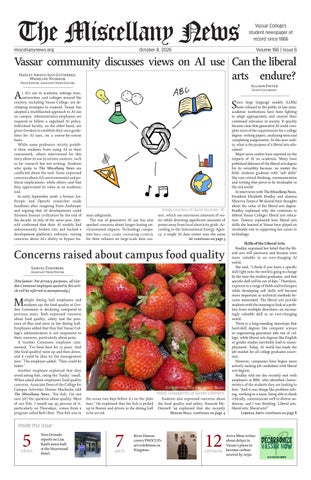
ultiple dining hall employees and students say the food quality at Gordon Commons is declining compared to previous years. Both expressed concerns about food quality, safety and the presence of flies and mice in the dining hall. Employees added that they feel Vassar College’s administration is not responsive to their concerns, particularly about pests. A Gordon Commons employee commented, “I’ve been here for 13 years. And [the food quality] went up and then down, and it could be [due to] the management now.” The employee added, “They could do better.” Another employee explained that they avoid eating fish, citing the “funky” smell. When asked about employees’ food quality concerns, Associate Dean of the College for Campus Activities Dennis Macheska told The Miscellany News, “For fish, I’m not sure [of] the question about quality. Most of our fish, I would say 95 percent of it, particularly on Thursdays, comes from a program called Red’s Best. That fish was in
Inside this issue
5
NEWS
Vera Giraudo reports on Lisa Kaul's town hall at the Heartwood Hotel.
Josie Wenner/The Miscellany News. Moldy strawberries at Gordon Commons. the ocean two days before it’s on the plate here.” He explained that the fish is picked up in Boston and driven to the dining hall to be served.
7
ARTS
Students also expressed concerns about the food quality and safety. Hannah McDonnell ’29 explained that she recently Dining Hall continues on page 4
River Hamm covers PHOCUS's art exhibition in Kingston.
12
ince large language models (LLMs) were released to the public in late 2022, academic institutions have been fighting to adapt appropriately and cement their continued relevance in society. It quickly became clear that generative AI could complete most of the requirements for a college degree: writing papers, analyzing texts and completing assignments. In this new reality, what is the purpose of a liberal arts education? Major news outlets have reported on the impacts of AI on academia. Many have published defenses of the liberal arts degree for its versatility because, no matter the field, students graduate with “soft skills” like core critical thinking, communication and writing that prove to be invaluable in the real world. In interviews with The Miscellany News, President Elizabeth Bradley and alumna Minerva Tantoco ’86 shared their thoughts about the value of the liberal arts degree. Bradley explained why she continues to defend Vassar College’s liberal arts education. Tantoco explained how liberal arts skills she learned at Vassar have played an invaluable role in supporting her career in technology. Skills of the Liberal Arts Bradley expressed her belief that the liberal arts will persevere and become even more valuable in an ever-changing AI world. She said, “I think if you learn a specific skill right now, the world is going to change by the time the student graduates, and that specific skill will be out of date.” Therefore, exposure to a range of fields and techniques while developing soft skills will become more important as technical methods become automated. The liberal arts provide students with the training to look at a problem from multiple directions—an increasingly valuable skill in an ever-changing world. There is a long-standing stereotype that hard-skill degrees like computer science or engineering guarantee jobs out of college, while liberal arts degrees like English or gender studies inevitably lead to unemployment. Today, AI world has made the job market for all college graduates uncertain. However, companies have begun more actively seeking job candidates with liberal arts degrees. Bradley told me she recently met with employers at IBM, who identified characteristics of the students they are looking to hire: “And it was things like problem solving, working in a team, being able to think critically, communicate well to diverse audiences, and I was thinking, ‘Liberal arts, liberal arts, liberal arts!’” Liberal Arts continues on page 8
Aviva Moss writes about delays in Vassar's plans to OPINION become carbon neutral by 2030.
October 8 2026
Page 2
THE MISCELLANY NEWS Emma Brown Darja Coutts Julian Balsley Grace Finke Hadley Amato NEWS EDITOR Samuel Eisenberg ASSISTANT NEWS EDITORS Iggy Gutierrez Madeline Nusbaum Aurelia Harrison ARTS EDITORS Brendan Kennedy Sophia Marchioli ASSISTANT ARTS EDITOR Sydney Jones FEATURES EDITOR Tina Mao ASSISTANT FEATURES EDITORS Jared Palumbo Ian Watanabe OPINIONS EDITOR Zoe Rodriguez ASSISTANT OPINIONS EDITOR Josie Wenner HUMOR EDITOR Noah Daube-Valois ASSISTANT HUMOR EDITOR Holland Kaplan SPORTS EDITOR David Bray ASSISTANT SPORTS EDITORS Armaan Desai Lucas Seguinot DESIGN EDITOR Sylvia Sargent ASSISTANT DESIGN EDITORS Ellen Tan Elliot Evans COPY EDITORS Gabrielle Lyman Julia Weber ASSISTANT COPY EDITOR Aria Kuklinski GRAPHICS EDITORS Charlotte Willenbring Makenna Brown PHOTO EDITOR Aviva Barry ASSISTANT PHOTO EDITOR Olivia Blank GAMES EDITORS Felix Mundy-Mancino Mia Liloia SOCIAL MEDIA MANAGER Fallon Dern LIVE EVENTS CHAIR Vera Giraudo WEBMASTER Eduardo Culmer REPORTERS/COLUMNISTS Noah Duncan Melody Hamilton River Hamm Isabel Holmes Lora Janczewski Benjamin Kaplan Eli Lerdau Ender Nix Evan Seker Erin Thatcher Amritha Dewan PHOTOGRAPHER Andrew Chu CARTOONIST Emma Fuchs COPY STAFF Naomi Kaplan Ida Polys Leah Weinraub Catriona Chapman FACT CHECKER Tanner Johnson DISTRIBUTORS Cailey Metter
EDITOR-IN-CHIEF MANAGING EDITOR SENIOR EDITORS
Image courtesy of Karen Mogami '24. MISCELLANY NEWS | VASSAR COLLEGE
NEWS
October 8, 2026
Page 3
VSA Senate Highlights, Oct. 4 • The VSA President is planning to present a report to the Board of Trustees, urging them to engage in conversations with diverse groups of students such as student journalists and organization leaders. • The Senate reviewed the results of the VSA’s dining survey. A majority of students expressed that they were disappointed with the changes and requested Street Eats be returned to a dinner option. • The Senate unanimously passed a bill establishing that the Student Financial Affairs Committee will elect two Labor Division Representatives within the first five weeks of the fall semester.
Departments Continued from AI on page 1 amount of power as 100,000 homes. Larger centers can use up to five million gallons per day—comparable to what a town of 10,000 to 50,000 people might use in a day, according to the Environmental and Energy Study Institute. The Miscellany spoke about AI use with the Vassar administration, professors in eight departments across three of the College’s four curricular divisions, student government officials and individual students, for their various stances on AI use. Administrators at Vassar are regulated in the ways that they are allowed to use AI. The official College policy prohibits administrative employees from uploading student or employee information into AI-powered software; using it to assist with performance evaluations, discipline or hiring; and requires that all administrative employees be transparent about the ways in which they have used AI tools in their work. Meanwhile, professors, who are not regulated, have a wide variety of approaches to AI use. The majority incorporate it into their classes while navigating ethical and academic concerns. Two professors interviewed for this article are staunchly against AI, and do not allow students to use any form of it in their courses.
“I actively embrace AI in my classroom teaching and have incorporated AI into class assignments... But they need to write the papers on their own.” Professor of Political Science and Director of Asian Studies Fubing Su shared with the Miscellany, “I actively embrace AI in my classroom teaching and have incorporated AI into class assignments.” He added that for research projects especially, students directly benefit from AI usage. “But they need to write the papers on their own,” he clarified. Associate Professor of Astronomy on the Maria Mitchell Chair and Chair of Physics and Astronomy Colette Salyk also spoke to the research benefits AI provides. She expressed that its use has become integral to the research process and that those who opt not to use it will fall behind in their re-
develop search. Associate Professor and Chair of Chemistry Leah Isseroff Bendavid shared similar thoughts on AI’s advantages to research, while also acknowledging that the technology can have the potential to hinder students’ critical thinking and scientific communication skills. She wrote by email, “As educators, it can be tricky to strike the right balance.”
“In my creative writing classes, my stance is that if you are using AI to write fiction or poetry, I genuinely do not know what you are doing in my class. Creative writing is an opportunity for self-expression. One thing artificial intelligence cannot and will never be able to do for you.” In a study by Wiley, which surveyed more than 2,400 researchers across the globe, 85 percent asserted that AI has helped improve the efficiency of their work, and close to 75 percent reported it has improved their quantity and quality of work. However, 58 percent claimed they were worried about AI having access to their work for privacy and security reasons, and called into question the use of AI in research areas. Other studies have found that generative AI usage contributes to lowered exam scores of students of all ages. A 2026 study by four researchers at Oregon State University found “significantly lower cognitive engagement” among students who regularly rely on AI. One of the Vassar professors that took a strong stance in opposition to AI’s use in academia is Associate Professor of History Daniel Mendiola. He argued, “Way before we get to any questions of cheating or educational value, or all of these other things, higher ed or the academy needs to reckon with the fact that creating the research behind creating this in the first place violated, flagrantly, all of our research ethics… So, I would argue that, on that reason alone, academia should be lining up to be really drawing a line in the sand and say, we really need to push back hard on this technology.” Mendiola’s main concern with AI, he said, is that the new generative AI models
policies
for
are sourced from research and labor practices that he believes violates human rights and research ethics in academia established by the Institutional Review Board. He explained, “The vast majority of why LLMs [large language models] are so much ‘better’ now, was just raw manual training by thousands and thousands and thousands of people.” The people that Mendiola refers to as “training” AI are known as “ghost workers.” Ghost workers are people—usually refugees, prisoners or caregivers—who are unable to find other work and are hired by technology companies to manually train AI models. Companies like Google, Amazon and OpenAI contract refugees in places such as Kenya, Lebanon, Palestine and India. Many of these laborers are forced to watch disturbing content, such as murders, sexual assaults and child abuse in order to train AI models how to react to such graphic information. According to the International Labour Organization, these workers frequently earn as little as $2 a day. Many students also voiced political critiques of AI. “I think my anxieties would be more of an anxiety about the overall way our system works and the fact that the government doesn’t feel like it serves its people so well, especially when it comes to emerging technologies,” Marius Kruse ’29 shared with the Miscellany. Kruse also advocated for a change in how we view learning as a whole. “We have to find a way to reshape our system so that this love of learning is something which we don’t want to avoid, but something that we want to embrace,” he said. Some students tied their concerns over AI to general critiques of capitalism. Tallulah Rector ’27 said, “I guess you can get stuff done faster and easier but that’s just the plight of capitalism. Wanting everything to be done as quickly as possible, [optimizing] your work and your labor as a human being.” Similarly, Maasai Guy ’29 reflected, “Most of my existence is pretty environmentally and politically destructive. Most of the clothes that I wear and the stuff that I do, all of that shit does horrible stuff to the planet earth. So it’s like, obviously, data centers: We need that fresh water. But what about the little Asian kids making your Nike shoes?” Like Mendiola, Assistant Professor of English Christine Vines has also taken a firm stance against AI usage in all of her classes. “In my creative writing classes, my stance is that if you are using AI to write
MISCELLANY NEWS | VASSAR COLLEGE
AI
use
fiction or poetry, I genuinely do not know what you are doing in my class. Creative writing is an opportunity for self-expression. One thing artificial intelligence cannot and will never be able to do for you,” she wrote to the Miscellany. While Vassar’s administration has not passed an interdepartmental AI policy, Vassar’s student government is trying to more broadly respond to AI’s presence on campus. The Vassar Student Association (VSA) does not allow generative AI usage for any of its members. In Spring 2026, it amended its bylaws to make using generative AI or other LLMs for VSA work a potentially impeachable offense.
“Way before we get to any questions of cheating or educational value, or all of these other things, higher ed or the academy needs to reckon with the fact that creating the research behind creating this in the first place violated, flagrantly, all of our research ethics.” VSA President Nico Reyes Cardozo ’27 explained what students can do if they disagree with how AI is used on campus: “What we can do is always pressure the VSA and recommend student organizations to not use AI, and also use our advocacy power to push the College onto not having AI on administration stuff.” The VSA has also been working with specific academic departments to discuss the feasibility of constructing department-wide AI bans. VSA Sustainability Executive Genevieve Reoch ’27 plans to begin this project by speaking about a potential AI ban in the Environmental Studies Department. Reoch offered more context on the initiative to the Miscellany via email: “I think the key to limiting AI usage on campus, and the road that I am attempting to take, is to find and talk to these smaller groups and sections within the college who are willing to take a stand and ban AI wherever possible.” She continued, “While I don’t believe it is realistic to ban AI in every department, Environmental Studies and other humanities seem like an obvious first step.”
NEWS
Page 4
October 8, 2026
Employees, students raise concerns about dining hall food quality Continued from Dining Hall on page 1 found moldy raspberries at The Farmer’s Table station and has since avoided Gordon Commons’s berries altogether. She added, “I also had an instance where I had raw chicken from The Grill, or at least it wasn’t entirely raw, but it was definitely undercooked, if anything.” Adarsh Rana ’29 also found raw chicken at The Grill: “I just threw it away and didn’t eat anything because I felt slightly uncomfortable because the chicken was raw.” Seven Dai ’29 described a pastrami sandwich he ate from the Kosher station, where the bread seemed both raw and frozen: “The center part was muddy white, and you can see the flour that’s not fully baked through. The bread itself was also cold as if it didn’t get defrosted properly.” Multiple dining hall employees alleged that food quality issues stem from budget cuts. However, according to Macheska, that is not the case. Macheska explained that the food budget has increased by a similar percentage, compared to previous
years. However, Macheska noted, food costs are on the rise, caused in part by an increase in global fuel prices. Macheska explained, “We anticipate that food cost is gonna rise, at a level greater than what we budgeted.” He added, “But the quality of the food hasn’t shifted or changed. Our practices of purchasing food haven’t shifted or changed.” Rising prices have forced the College to manage costs in other ways. The College used to purchase compostable plastic utensils and plates. However, since their compost partner cannot accept those materials, they shifted to using paper products instead. According to Macheska, this could save the College upwards of $70,000. One employee felt that the College was taking the wrong approach when responding to price constraints. “Stop trying to cut costs. Stop trying to save a dollar. Spend it. It’s worth it,” they said. “[Students] have to get up early in the morning, [they’re] using [their] brain all day. [They] have home-
‘The
Agent’
Secret
work, studying, essays, papers. I know. I went to college. And so I feel like [their] quality of food should be better.” Employees and students also reported seeing an increase of flies in the food in Gordon Commons. Two employees said they avoid the salad bar because of the flies. Another explained, “I’ve seen it. I’ve seen students pour syrup, and dead flies are in the syrup, and I’m just creeped out. I’m disgusted. I feel so bad for you guys.” Ivan Levitt ’28 told the Miscellany that flies are also present in the ketchup dispensers: “I think they get caught in the rim of it. And then when people pump it, there’s flies in their ketchup.” He said that he avoids Gordon Commons’ ketchup entirely now. According to Macheska, the College contracts with a pest control company who visits the Gordon Commons weekly, or on an as needed basis, to mitigate the dining hall’s flies. He added that in the warmer months, Vassar has to contend with drain flies nesting and reproducing inside the
filmmakers
talk
soda machines. Gordon Commons attempts to limit the presence of flies by putting an enzyme mixture into the drains. Macheska explained, “It is always a competition, I think, between how fast the flies can be and how fast we can be. So I think that sometimes, in spite of our best efforts, they sometimes are winning, and sometimes we’re winning.” Mice can also become a problem, Macheska explained. “As the weather shifts and gets cold, just like in the houses, we contend with mice,” he said. “We put preventative measures in place to try to reduce that from a proactive standpoint. Sometimes the mice win, and sometimes we win.” Multiple dining hall employees expressed that they feel the management does not listen to them about pest control issues. One employee explained of the fly problem, “We gotta deal with this, and we keep saying, ‘Get this and get that,’ and nobody’s listening. I guess they just feel like they’re smarter than us.”
authoritarianism
Bodie Morein Guest Reporter
B
razilian writer and director Kleber Mendonça Filho and French producer Emilie Lesclaux discussed their 2025 film “The Secret Agent” at two events on campus this week. Mendonça and Lesclaux talked about remembering Brazilian history and the meaning of filmmaking in authoritarian times. Mendonça and Lesclaux were part of two events, on Wednesday, Sept. 30 and Thursday, Oct. 1, in which they described how “The Secret Agent” emerged from their concerns about Brazil’s current political moment. “We felt the consequences of that moment, not because we were activists or anything, but because we were doing what we do as artists,” Lesclaux said at the first event. The filmmakers were joined at both events by Assistant Professor of Film Fábio Andrade. The first event was a screening of the film and Q&A sponsored by the Film Department. The second, was a conversation titled “The Power of Genre Cinema in Authoritarian Times” and was sponsored by the Film and Political Science Departments as well as the Media Studies Program. Both events were held in the Vogelstein Center for Drama and Film’s Rosenwald Film Theater. Much of the conversation on Oct. 1 centered on the role of violence, especially blood, in the film and Brazilian history at large. Speaking about a specific scene in the film, Mendonça said, “It’s not a clean moment of violence, it’s a very disturbing and bloody moment of violence, because I don’t believe that violence is something clean. But then there is blood also in an emotional way. We are connected by blood to our family members.” He continued, “And I think adding all of those elements together, I have a film which is very much about history and how much blood is spilled in a country. The military dictatorship, of course, was a moment when blood was spilled.” Sofia Mattos Brito ’28, whose parents grew up in Brazil under the military dictatorship of the ’70s and ’80s, commented that she found the movie, and the accompanying talks, to be timely and important. The first round of Brazil’s 2026 presidential election took place on Oct. 4. Neither
Image courtesy of Bodie Morein '28. Mendonça and Lesclaux answer questions from audience members. of the main candidates—the center-left incumbent President Luiz Inácio Lula da Silva and far-right Senator Flávio Bolsonaro—garnered a majority of the vote, triggering a run-off election later this month. Bolsonaro is the son of former President Jair Bolsonaro, who lost to Lula in the 2022 election and has since been banned from running again for eight years after attempting to enact a coup d’etat. He was sentenced to 27 years in prison and is currently under house arrest due to ill health. “It was just a good reminder of how fragile Brazilian democracy—well, how all the democracies around the world are,” said Mattos Brito. “People are starting to forget that the dictatorship was a thing because we never really had a break. We basically phased out of the dictatorship and there was an amnesty for all,” Mattos Brito said. “How can Brazil ever move away from the dictatorship when there are no consequences for it?” she added. Mendonça and Lesclaux also touched on the important role that research, print media and archives play in the film. “You en-
counter violence in a different way through history and research,” Lesclaux said. Mendonça agreed, noting that he made some decisions about depicting violence in the movie based on how the press covered violence during the dictatorship. Mendonça and Lesclaux arrived on campus the afternoon of Monday, Sept. 28 and spent the week visiting film classes and giving students feedback as this year’s Katherine Stone White Artists in Residence. “Based on what I heard from both my colleagues and students who were in those classes, I think it was very successful,” Andrade told The Miscellany News. Associate Professor and Chair of Film Erica Stein agreed: “Because of what I’ve heard [Mendonça and Lesclaux] say and how much they enjoyed meeting students and how impressed they were by the students, I think that automatically makes it a success.” Andrade and Stein were also happy about the student and faculty engagement throughout the week, and emphasized the importance of bringing in the local com-
MISCELLANY NEWS | VASSAR COLLEGE
munity. “We advertised the event outside of the college, around the Hudson Valley and two different Portuguese-speaking communities,” Stein told the Miscellany. She added, “We were really, really excited to have members of the local community— that aren’t Vassar community members— attend.” Near the end of the Oct. 1 event, Mendonça answered an audience member’s question about how he balanced political statements and pure artistry in “The Secret Agent,” and whether the two were mutually exclusive. He explained to the audience member, “They’re not exclusive… You read sometimes in the newspaper, ‘Village in Lebanon bombed.’ What does it mean? It means Israel bombed a village in Lebanon. So it’s just—are you being political?” He added, “I think cinema should be impure, that it should be mixed and it should be dirty… But I really find it difficult to accept films which are hygienic in a way, you know, sterilized of truth, of something that might sound a little difficult for some viewers.”
October 8, 2026
NEWS
Page 5
Candidate for state senator speaks at town hall at the Heartwood Vera Giraudo Webmaster
O
n Wednesday, Sept. 30, Dutchess County Legislator Lisa Kaul and State Assemblymember Sarahana Shrestha of Assembly District 103 answered questions at a town hall meeting organized by For the Many. Kaul is running on the Democratic ticket against Republican incumbent Rob Rolison for the District 39 New York State Senate seat. At the meeting, held in The Heartwood Hotel at Vassar College, Kaul and Shrestha discussed rising utility costs and housing crisis concerns. The town hall meeting came amid anticipation for a competitive state senate election for New York District 39. Rolinson won the 2024 election by roughly 2,000 votes, a margin Kaul is hopeful she can challenge. Vassar sits at the center of District 39, a purple state legislative seat that extends from across the Hudson River in Montgomery to the New York-Connecticut border. Lisa Kaul is a Democrat who currently represents the Town of Poughkeepsie in the Dutchess County Legislature. Kaul was born in India and immigrated to the United States 22 years ago. She became a citizen in 2008 and a county legislator in 2023. Prior to her time in politics, Kaul worked at Vassar for four years as Director of the Office of Community-Engaged Learning and Director of Community-Engaged Incentives in the Humanities. She announced her campaign for state senate on Dec. 15, 2025. Kaul was endorsed last July by For the Many, a New York-based grassroots political organization advocating for causes such as universal healthcare, affordable housing and immigration justice. The organization collaborates with Vassar’s Office of Community-Engaged Learning, where students can apply for unpaid or academic credit internships. They celebrated Kaul’s political mission in a statement reading, “Lisa is a progressive champion for policies that ensure everyday people can afford to live in the Hudson Valley and do more than just survive.”
Vera Giraudo/The Miscellany News. For the Many intern outside of The Heartwood Hotel. Around 80 Vassar students and local residents attended the town hall. The meeting covered many subjects, from anxieties about U.S. Immigration and Customs Enforcement’s presence in the Hudson Valley to concerns about affordability. Poughkeepsie resident Emory Brown said in an interview with The Miscellany News, “I came because I want to talk about the Central Hudson and the high bills that we’re getting.” She was one of many attendees curious about Kaul’s support for the Hudson Valley Power Authority Act. The bill would establish public control over Hudson Valley utilities through the acquisition of Central Hudson, the only private electric and gas provider in the majority of the Hudson Valley. “ Power utilities are a public good. It’s a right,” Kaul said at the Sept. 30 forum. “Thirty percent of this country, including that really, really blue, blue state called Nebraska, gets its power from a public authority and they routinely pay 20 percent less than we do.” In the forum, Kaul also emphasized her support for the Rent Emergency Stabiliza-
tion for Tenants (REST) Act, which would expand the parameters of “a housing emergency” to encompass affordability, and the New York Health Act, which aims to establish a universal New York healthcare system. For the Many interns had voter-registration forms available for students to register to vote as Poughkeepsie residents. For the Many intern Mars Graham ’28 said, “ I think being at Vassar, we do have the right to vote here which not a lot of students take advantage of.” In addition, For the Many Vassar interns and volunteers have been handing out zines and voter registration papers to students across campus, encouraging students to flip the seat blue. For the Many Communications Manager Jenny Kutner said, “ We really want to increase student involvement, because with all of these progressive victories that we’ve seen recently, young people have really been at the heart of that.” “We do have a lot of students who are from New York City or LA that are very, very solidly blue places,” Graham said in an interview with the Miscellany. She con-
tinued, “I think you can have a huge sway voting here.” Some students, like Maya Sbardellati ’29 from Westminster, Vermont, have reservations about registering in Dutchess County. “ I know more about where I live than I do here,” Sbardellati explained. “ I don’t want to be putting my political standing in a town that I’m not from, because I feel like I’m a part of Vassar, but not a part of the greater Poughkeepsie area.” At the end of the forum, interns and volunteers handed out canvassing and phone bank sign up sheets. For the Many intern Anya Berg ’28 urged students and locals to sign up for shifts: “ We’re not gonna win if we just sit back and hope for the best. But if we manage to knock 4,416 doors before Nov. 3, we can win this race.” Poughkeepsie resident David Giannascoli was enthusiastic about Vassar students’ political and community involvement. In an interview with The Miscellany News, Giannascoli said,“ It’s important for Vassar to have a strong relationship with the organizations and the community in general here.”
Image courtesy of Tori Kim '25. MISCELLANY NEWS | VASSAR COLLEGE
ARTS
Page 6
Wishy’s ‘Nature’s Pill’ is nostalgic and lively Benjamin Kaplan Columnist
It is difficult to make a name for yourself in the indie rock scene with all the competition, and it is even more difficult to carve out a sound for yourself when there is already a band for every single niche. Wishy, an Indianapolis-based band formed in 2021, has seemingly done both with their sophomore album “Nature’s Pill.” Drawing on many influences but maintaining their distinctiveness, Wishy has solidified a spot for themselves in the indie rock scene with their new collection of unique, and often raucous, songs. There are few ways to start your album off better than with a song like “All The Rage.” From the first second, the track’s blood-pumping guitar riff lands, starting a rollercoaster of catharsis that never lets you go. At the climax of the chorus, you will find yourself screaming along when guitarist and vocalist Kevin Krauter, shouts, “I don’t care anymore now that you’re gone!” There is an electric pulse to the song, elevated by the scratchy guitars that dance alongside the exuberant warm vocals—a clear yell-with-your-windows-down song. The second track, “Covergirl,” takes on a more shoegaze approach with heavily reverbed guitars and ethereal vocals, courtesy of fellow guitarist and vocalist Nina Pitchkites. Here, a floaty backing track sprawls out in the mix and is interspersed with strong power chords halfway through, creating a psychedelic feel that the band toys with on other tracks, notably “Lovesick.” That track also makes use of heavy reverb atop strong guitar performances building up to a chorus that just
makes you want to scream along “Cut the shit / Baby, you’re a rock!” with Pitchkite. If you have ever listened to the group Candy Claws, these tracks and their use of dream pop and shoegaze elements together will definitely bring on a smile. Third and fourth tracks “Sensational” and “Shift” introduce a core influence that is felt throughout the whole project: punk. This extends to snarky and aggressive vocals on “Sensational,” crunchy layered guitars on tracks such as “Headscratcher” or the ascending melody on “Blitz.” Wishy gladly adds punk to its pre-existing core of indie and garage rock with a dab of dream pop and occasional other influences like midwest emo and shoegaze. Krauter’s inflection in a lot of these tracks is reminiscent of The All-American Rejects, full of spunk and euphoria, whilst Pitchkites takes on a more concealed, emo vibe in her singing. If there is one song that displays the group’s unique sound and Krauter’s empathic singing, it would be “Mona Lisa.” It is a fun, almost jangle pop anthem about love with an earworm chorus that brings in psychedelic guitars out of nowhere and interpolates “Femme Fatale” by The Velvet Underground. Small but impactful sonic moments like this really allow the listener to take in both Wishy’s fun and artistically aware side. This attempt to blend a fun indie rock approach with artistic sensibilities is most apparent in the second half of the album. “Freak 99” uses looping guitars to create an unnerving, jittery backdrop whilst Krauter and Pitchkites’ vocals appear as though they are fractions of an inch away from their mics. The bold, in-your-face punk vocals
add so much attitude and rhythm that the song gains a hip-hop feel by the end. This genre bending continues with penultimate track “Kiss Kiss Kiss,” where noisy guitars and a loud drum machine mesh with highly autotuned vocals from Pitchkites creates a nice and relaxing mesh of indie rock and hyper pop. And, to round out the track list, “Party World” is a midwest emo tune with bright, twinkly guitars and droning vocals right before introducing a noise rock section that swallows the mix whole. Tracks like “Kiss Kiss Kiss” and “Party World” are emblematic of an ethos from Wishy that surrounds nearly every song on the record, directly hitting you upon each listen: It says “we are being fun and we are being ourselves.” Their sound is not too abstract for a newcomer to quickly catch thanks to tight instrumentation and a clear focus, but it has layers and so much love put into it that it really stands out once you listen to it. The synthesis of the band’s influences, along with the record’s unapologetic themes—be it chaotic fun or contemplative romantic daydreaming—makes Wishy not just a band, but an entire experience with its own sound. I was, after listening extensively to the singles for this album, worried it would not meet my expectations—that it would be a bunch of tired b-sides where the group fills space with homages to rock pastiches of the past. But I am happily surprised with what Wishy did on this record. Blending genres like garage rock, punk and dream pop is a difficult one, but the band is able to treat them as extensions of a tight indie rock center and the result is a success. This album will be on repeat for me for a long time, and for good reason.
Molly Brown dazzles in senior recital Grace Finke Senior Editor
O
n Friday, Oct. 2, Skinner Hall of Music was filled with song, memory and love as Molly Brown ’27 presented her senior recital—a culminating senior project for music performance students. The recital was the pinnacle of Brown’s studies as a vocalist, composer and music major. The night was a beautiful display of artistry and a clear tribute to her lifelong passion for music. The daughter of two composers, Brown has been surrounded by music her whole life. Brown has been trained in voice and classical piano from a young age and has found a home onstage. Brown has fully immersed herself in the musical scene at Vassar College, from studying music and participating in Music Department ensembles, to being the lead singer of on-campus jazz and indie-rock fusion band Magnolia. While at Vassar, Brown has been studying voice with Adjunct Artist in Music Mary Nessinger, and working with collaborative pianist Susan Brown, who accompanied her through jazz, musical theater and contemporary ballads. The recital additionally featured Magnolia bandmates Alden Ormont ’27 and Dylan Nathan ’27, playing guitar and bass respectively, as well as drummer Adrien Poser Davey ’29, pianist Lennox Guzman ’27, vocalists Neave Rynne ’27, Kaleb Wong ’27 and Munashe Mupunga ’28 and the Vassar Devils, the a cappella group Brown is the music director of. Brown’s program included jazz, con-
temporary rock and soul repertoire, as well as original songs, showcasing her vocal versatility through a myriad of styles. She opened the recital with an original arrangement of Yebba’s “Evergreen,” one of her personal favorite songs. With a groove provided by Ormont, Nathan, Poser Davey and Guzman, as well as vocal harmonies by Rynne, Wong and Mupanga, “Evergreen” immediately demonstrated how music is a labor of love for Brown. Brown took the audience on a tour through her musical influences, soaring through Esperanza Spalding’s “I Know You Know” and Sara Bareilles’ “Bluebird,” and bared her heart for two original songs, “A Person Who’d Stay” and “I Really Do.” She led the Vassar Devils through an electrifying original arrangement of Michael Jackson’s “Earth Song,” and brought the audience to tears during Jeff Buckley’s “Lover, You Should’ve Come Over.” Brown closed the recital with Stevie Wonder’s “Summer Soft,” leaving everyone dancing in their seats before erupting into a standing ovation. Brown made every song her own, adapting her emotions to the sentiment of each song and using vocal embellishments to add a personal flair to her expert technique. Brown’s recital was just a snapshot of the music that has shaped her as an artist, yet encapsulated so much of her talent and curiosity about music. One of the most magical things about live musical performance is witnessing the artist’s pure passion. Brown is not only an incredible singer and musician, but also one of the first people I befriended at Vassar. It has been so meaningful
to watch her love for the art grow in our time as peers in the Music Department, and having the opportunity to watch her display her talent is always a truly invaluable experience. Seeing Brown present the culmination of her work as a music student on such a large scale reminded me of how much love there is to be shared in music.
October 8, 2026
Arts Asks What is your quintessential autumn song? “White Flag” by Dido Liz Catizone ’28 “Great Divide” by The Cardigans Zofia Rosciszewski ’29 “Linus and Lucy” from “Charlie Brown” by Vince Guaraldi Aaron Boyd ’30 “Fade Into You” by Mazzy Star Leah Avramovitz ’27 “Don’t Know Why” by Norah Jones Annabelle Hu ’28 “Landslide” covered by The Chicks Maya Sbardellati ’29 “Harvest Moon” by Neil Young Molly St. Claire ’28 “Rhiannon” by Fleetwood Mac Maren Blalack ’29 “You Turned On The Tap” by Julia Jacklin Giorgia Cantoni ’28 “Had Me @ Hello” from “Girl vs. Monster” Annie McShane ’28 “this is what autumn feels like” by JVKE Bryan Benavides ’30 “The Boy” by The Smashing Pumpkins Brendan Kennedy ’28 Arts Editor “Intro/Stronger Than Me” by Amy Winehouse Aurelia Harrison ’28 Arts Editor
Grace Finke/The Miscellany News. Molly Brown on stage at her recital.
MISCELLANY NEWS | VASSAR COLLEGE
ARTS
October 8, 2026
‘Heathers:
the
Ender Nix Columnist
D
ear Diary: I learned about “Heathers: The Musical” in the midst of my musical obsession in the fifth grade. For those of you who are theater kids as well, you might know that “Heathers” is one of the more popular contemporary rock musicals—along with “Next to Normal” and “Spring Awakening.” “Heathers” is also one of the darkest. “Heathers” is like “Mean Girls” but with a lot more murder and violence. So you can understand why, as a kid still in elementary school, I did not want to share my love for this musical with my parents, as I had with my other musical loves. Needless to say, I have listened to “Heathers” for a very long time, and the music has been ingrained in my memory. In particular, I have listened to some of the more devastating songs during my rougher years, especially the song “Kindergarten Boyfriend.” The musical had its off-Broadway debut in March 2014, but only ran until August of that same year. But in June of last year, previews began again in off-Broadway’s New World Stages, where it was originally supposed to close in September 2025. Luckily, the musical continued to be extended until its final closing date of Oct. 11, 2026. When I put together the pieces that I was coming to New York for school and would therefore have the chance to see “Heathers” after all these years, I was elated. Now in college, having experienced and acted in so much theater since the fifth grade, it felt like the ultimate full circle moment. With the money I saved from the past years and graduation—thank you to my family and friends back home—I scored tickets for Oct. 3 to see it
Musical’
with my friend Arin Miller ’30. “Heathers” was everything I dreamt of and more. We laughed, we cried, and I was the happiest I have been in a while. There is an unmatchable magic in live theater that I am reminded of every time I have the joy of seeing a show. Isabella Esler, playing Veronica Sawyer, had the most gorgeous voice and portrayed the role in such an emotional way. As opposed to other productions, who have made the character seem more sarcastic, Esler played Veronica much more genuinely. I could feel her thoughts and conflicting emotions from my seat. It made the tragedies in the show feel much more human than just plot points in a musical. I thought more about the real world consequences of what Veronica was going through. John Cardoza, who played Jason Dean (JD), made me feel more conflicted about the character than I ever have in the past. Throughout my love affair for this musical, I have had moments of feeling sorry for him. For the most part, I have condemned JD as a villain. JD is usually played as an extremely troubled and inherently evil character whose evil only gets unleashed after he meets Veronica. But after watching “Heathers” live, my opinions have changed. I obviously do not support the end that JD tries to bring upon Westerberg High, or the fact that he ropes Veronica—his newfound girlfriend who both meet in the heights of their internal suffering—into his murder plot. Despite this, I understand that he has immense pain in his heart from his traumatic childhood. JD wants to protect Veronica in any way he can, and ends up doing horrific things to meet those goals. Cardoza’s portrayal guided me towards the interpreta-
is
Page 7
explosively
tion that he does this because she is the only good thing he has known after his childhood suffering and abusive father. In doing so, however, he ends up causing her pain, because she naturally feels crushing guilt for her role as accomplice. This show is labeled as a dark comedy, and it is much heavier than I remember. The performance in connection with the sound design on stage made everything feel so real, from the immersive nature of the lights and sound of gunshots to the explosion. But it is not all bleak! “Heathers” is considered a dark comedy for a reason, after all. There were many times I found myself bunching up my flannel to stifle my laughter because I did not want to disturb the people around me. From “Dead Gay Son” to the prolonged audience member interaction—which lasted maybe 10 minutes—during “Shine a Light,” where the teacher Ms. Fleming pretends one of the audience members is her affair partner that she is finally cutting ties with, I did not
spectacular
know whether to laugh or cry. “Heathers” is an insanely lovely mess, but it is so wonderfully put together. The show punched me in the gut more than I was expecting it to, with songs like “I Say No” and “You’re Welcome” striking on deeply tragic and relatable experiences. I did not pack enough tissues for all the crying I did. I am heartbroken that the show is closing next weekend. Yet, I am so grateful that I got the opportunity to see it while it was still here to satisfy my fifth grade-self’s yearning. However, I am devastated that I will not get to take my parents to see it—after finally revealing my love for this musical to them all these years later—or suggest it to my friends back home when they come to visit. I can only hope that the universal love for this musical among theater kids like myself will spark a revival or a return sometime in the future. Until then, I will be patiently sitting outside the entrance to Westerburg High, waiting for the bell to ring for class to start.
Charlotte Willenbring/The Miscellany News.
Vassar students are on display at Kingston art gallery River Hamm Columnist
“I
t’s deeply human, deeply flawed, deeply messy,” Marina Chao—a curator at the Center for Photography at Woodstock (CPW)—told The Miscellany News about the importance of art at the “Closeness: A PHOCUS Exhibition” opening reception in Kingston, New York this past weekend. “Closeness” is an exhibit of photos from Vassar student photographers, placed on view at CPW’s community gallery. PHOCUS, Vassar’s only student run photography club, had pieces spanning across five class years in the exhibit opening on Oct. 3. “[CPW] got involved with PHOCUS through our community program,” Chao contended on how the club connected with the gallery. She further elaborated, “We want to make sure that people understand and feel that [the community gallery] is open to them, right?” Contributors of the exhibit include Ella Sheidley ’26, Audrey Amblard ’27, Sofía Abrahamson ’27, Aviva Barry ’27, Grace Cabasco ’27, Peter Chu ’27, Julian Balsley ’28, Amritha Dewan ’28, Aria Kuklinski ’28, Rosalie Perkinson ’28, Miles Myers ’29 and Mae Resnick ’30 [Disclaimer: Barry, Balsley, Dewan and Kuklinski are all members of the Editorial Board of The Miscellany News]. During the 40-minute jaunt up to Kingston, I was met with the vibrant yellows and fiery reds of the Hudson Valley’s beautiful transition into fall. The gallery itself was filled with Vassar students, Kingston locals and artists to see the three exhibits: “Closeness: A PHOCUS Exhibition,” Tanya Marcuse’s “Woven, Deer: An Ecological Tapestry” and Pixy Liao’s “Relationship Material.” The “Closeness” exhibit sat tucked in a small
room in the middle of the gallery, inviting visitors to step into an intimate space. Walking into the room, a multitude of different sized photos sat spattered across the walls. Many of the photos were awash with color, while others were devoid of it. Photographs were distributed along the wall at uneven increments, which asked the viewer’s eyes to gradually move from photo to photo. The room’s small size and high occupancy created an intimacy between the viewer and the exhibit, manifesting the exhibit’s core motif. As my eyes wandered between each work, I was pulled closer to the photographs, feeling a need to examine the intricate details further. During my time at the exhibit’s opening, I was able to interview some of the Vassar artists that were present, wanting to explore how they decided on the pieces for the exhibit. “[‘Closeness’] is something that’s very familial,” Resnick explained. “Photography is a very interesting medium where you can really feel emotions in a way that you can’t explain with words.” These comments mirrored many of the photos in the gallery that depicted individuals in close proximity to each other, or to their environments. Resnick also noted how it was exciting to be able to participate in the gallery as a first-year student. I got to hear a variety of the artist's experiences while at the gallery. “The two images that I have in here… One is of my brother and my dad together. And I think the image is about closeness to them as subjects, but also their closeness to each other and to their surroundings,” Myers, a member of PHOCUS’s Executive Board, told the Miscellany. “The other one is an image of my friend from high school, and she’s holding a piece of yarn that she spun at our high school from a sheath that we had pushed together and made into
Eli Lerdau/The Miscellany News. "Closeness" is now on view at the Center for Photography at Woodstock. fibers… It’s also taken in her space, which I feel like adds another dimension.” Immersing myself in the process and vision of the artist allowed me to better interpret the gallery, unlocking the nuanced perspectives that the artists’ meticulously crafted. “I did not know that there was a Vasser exhibition, so this was a nice surprise. I’m a photography student, so I enjoy seeing what other students are up to,” Jillian Rasenberger, a photography student at SUNY Purchase, said to the Miscellany. “I think the overall layout is really good of how the photos are exhibited. It makes you go up and down, and moves all around. I like the grouping of the photos, even though they’re different artists put together. I think they tell different stories.” Here, Rasenberger highlighted my favorite part of the exhibit: the organization and fluidity of the images. Rasenberger also begged the question: “Is it the person in the photograph or the photographer that has that control? You would like to think that the photographer has the control,
MISCELLANY NEWS | VASSAR COLLEGE
but sometimes the subject holds all the power.” Looking at “Closeness,” this sentiment was something I felt deeply. I found that the photographers’ choices to build tension between the viewer, subject and artist created many obvious moments of introspection. “When you’re looking at an exhibit like this, it’s about expanding your conception of what closeness can be beyond the subject or [emotions],” Amblard told the Miscellany. Examining the show with an analytical lens forces the viewer to sit in the tension that these photographs emit. Each of the photographs were visually striking and thought-provoking, and I encourage you to go check them out for yourself and support Vassar artists. Along with “Closeness,” the exhibits by Tanya Marcuse and Pixy Liao were phenomenal as well. A quick trip to see these works in Kingston this fall is well worth it. “Closeness: A PHOCUS Exhibition” is now on view through Nov. 1 at the Center for Photography at Woodstock.
FEATURES
Page 8
October 8, 2026
President Bradley discusses the liberal arts in an AI world Continued from Liberal Arts on page 1 AI in the Classroom How are core liberal arts skills taught, especially in an age when students can easily supplement their thinking with AI? Hua Hsu, a former Vassar English and American Studies professor now teaching at Bard College, interviewed two New York University students for a 2025 New Yorker article: One shamelessly used AI to complete almost all his assignments, while the other used it more covertly. Nevertheless, both used it. Conversely, Ian Bogost, a Washington University in St. Louis professor, wrote an article in January for The Atlantic in which he interviewed liberal arts students at Amherst, Davidson, Smith and Vassar Colleges about their AI use. Many of the students he interviewed were skeptical of AI and either did not use it or did so with a healthy dose of hesitancy. Bogost concluded, “The form of higher ed that [liberal arts schools] provide seems poised to be the most resilient in the years to come.” As Bradley said, “The other thing that happens in liberal arts education, particularly on a smaller campus, is that classes are not just the imparting of information, but they are really experiences.” This setup allows students to engage with the material and discuss ideas with their peers, exposing them to a range of perspectives and interpretations. Vassar does not have an official generative AI policy. Instead, faculty members and departments are free to create specific policies for their classes. “What’s permissible in one class might constitute a violation of the Academic Integrity policy in another class,” according to a College webpage on navigating generative AI.
FFS
A Liberal Arts Degree in Action The perfect example of the versatility and enduring importance of a liberal arts education is alumna Minerva Tantoco ’86. Tantoco graduated with a degree in philosophy and cognitive science. She spent the fall of her senior year at an AI startup in Silicon Valley, and after graduation continued working in tech, government and business. Tantoco became New York City’s first Chief Technology Officer in 2014 and started a de novo digital bank, Grasshopper, which began operations in 2019, among other achievements. Tantoco has repeatedly taken on positions that did not exist before her. She has often said, “I’ve invented every job I’ve ever had.”
Department: Anna Hagen
Guest Columnist
I
Despite that freedom, Bradley believes Vassar’s approach to learning in an AI age preserves the key skills students need without becoming outdated by eliminating AI entirely. At Vassar, in 100-level courses, Bradley said that professors tend to ban AI because they do not want the technology to interfere with the students’ foundational learning. In upper-level classes, where students have already developed the foundational liberal arts skills, Bradley says there is space for specific AI use, provided that the student identifies how it was used. In some classes, such as cognitive science, it is a core part of the course. Bradley told me, “Our faculty will always kind of have a panoply of responses that fit the educational need of that student at that developmental stage.” Some professors, however, have continued to reject AI use in their classes outright. One version of that is the resurgence of in-class Blue Book exams, which prevent students from covertly using AI to aid their thinking or writing.
nitially, French baking scared me. Many pâtisseries—desserts—require exact measurements, like croissants, macarons or canelés, which I have not dared to attempt yet. However, the one treat that I love making—my crème de la crème—is madeleines: a shell-shaped pastry with a crispy brown ring around its edge and a spongy bump in the middle. When I saw that the French and Francophone Studies (FFS) Department was hosting a madeleine making event, I knew I had to attend. The “Atelier Madeleine,” the second in a semester-long series of FFS events, was run by Adeline Bertin and Alice Lueder, the FFS Language Fellows for the 2026-27 academic year. Both are finishing their graduate studies from the Sorbonne Université, and facilitate conversation courses, office hours and various ateliers, or workshops, in the FFS department. Lueder and Bertin both grew up cooking from a young age, with Bertin learning from her father and Lueder from her mother. The madeleine recipe we followed was one from Lueder’s mom. While I was hesitant at first to return to French baking—and preparing to do plenty of mise-en-place—the recipe proved to be rather simple: butter, eggs, sugar and salt were all we needed to start. We began by mixing the ingredients in the FFS lounge before bringing them to Chicago Hall’s kitchen to pour them into the molds that give these quintessential French pastries their classic shape. We narrowly avoided a culinary catastrophe while converting the recipe from French to American measurements. As my fingers
Make
rushed across my phone screen trying to adjust grams to cups—my keyboard still set to French—other FFS students wrote fractions on the lounge whiteboard next to conjugations and curly script to double the recipe. “I helped [Lueder] set the oven temperature because the recipe had it in Celsius,” remarked Alice Ingegneri ’30, a current FFS student. As I spoke with Ingegneri about her similar experience of navigating French recipes, it was interesting to think of translation as not just words, but as measurements, techniques and perspectives across cultures. Before the Atelier, the madeleine seemed like a fancy treat one arranges on fancy porcelain plates, or eats at my French club’s yearly Mardi Gras celebration. However, I learned from Lueder that these baked goods are actually a common dessert in France. Madeleines are often eaten as an afternoon snack, a goûter, around 4 p.m., soon after children get out of school and before a typical French dinner around 8 p.m.. Children especially love madeleines, as they are eaten after they finish a long day of studies. Does that mean I have a childish taste? Peut-être. Lueder also noted that French supermarkets even sell large bags of madeleines: I know what I am getting the next time I visit France! Until then, I will settle for baking our own madeleines. To finish the recipe, FFS students added lemon zest to the batter, a perfect complement to the spongy texture. Lueder highlighted that madeleines do not always have to be lemon flavored, and since the madeleine recipe is relatively simple, there is great potential for different varieties. “Madeleines are something you can get creative with,” Lueder noted. “You can add different tastes, like lemon, but my mom liked to add matcha tea.”
From her role as the first knowledge engineer (ever) at an AI startup pre-tech boom, to developing technologies with immense social and environmental impact, Tantoco said, “I think that when you invent a job, it’s a huge part of having the vision to know what needs being done, recognizing there’s a gap: ‘Hey, no one’s doing this, but it needs to be done.’”
“So it’s not about memorizing or learning a skill or techne... but it really is about understanding the bigger picture, the abstractions, the larger environmental situation, the complexities of context.” “I think one of the most important things that a liberal arts education does is that it teaches you to think critically,” explained Tantoco. “So it’s not about memorizing or learning a skill or techne... but it really is about understanding the bigger picture, the abstractions, the larger environmental situation, the complexities of context.” Tantoco also emphasized the importance of pure curiosity and an excitement to ask questions: “I do think that curiosity is a superpower, just wondering ‘What if?’” Asking the right questions and thinking critically about gaps in innovation aided in Tantoco's success as New York City’s first Chief Technology Officer. In 2014, New York Mayor Bill de Blasio’s administration had the goal “Smart city, equitable city,” Tantoco said.
way
for
In my opinion, the Brew should take some notes! Speaking of notes, this is an important thing to note if you want to cook in Chicago Hall: the kitchen is très petite. With all the FFS students and language fellows busy at work, it felt like a Parisian club, or the metro at rush hour. Nevertheless, we were finally able to get the madeleines in the oven by working together—in two languages, oh là là! In the past, I have always enjoyed learning about other cultures through their cuisine, and using unique flavors and culinary techniques as a way to spark conversation between bites of food. Ultimately, the act of making recipes in and from other languages can cook up more than just a delicious meal. “Making madeleines, and cooking in general, is a moment of sharing… and I find that people talk more easily with one another when making a recipe,” Bertin observed. “I think cooking’s
MISCELLANY NEWS | VASSAR COLLEGE
She added, “Asking the right questions gave us an answer that no one had ever thought of before.” This “secret sauce,” as she put it, led to LinkNYC, a technology Tantoco helped develop to replace payphones across the city, which now provide the fastest free Wi-Fi in any metropolitan area. With her extensive background in technology and philosophy, Tantoco is the ideal candidate to explain the optimal, ethical use of AI. Tantoco explained that AI can be a “research companion” and a “productivity tool.” However, she stressed the downsides of using AI to supplement thinking: “You learn how to learn, and you learn how to think critically, and my concern with large language models in particular is that they may be de-optimizing for critical thinking… My advice to everyone is…make sure that AI is thinking with you, and not thinking for you.” Even if students complete their undergraduate education without using AI, they will almost certainly need to interact with the tool after graduation, as many companies have integrated AI into their businesses. In a keynote speech at Vassar January 2025, Tantoco argued that AI literacy will become increasingly important. In our interview, Tantoco expanded on this idea: “Understanding how those tools work in that particular area really is part of learning that area of study,” akin to using a microscope in biology. “It’s part of learning that topic,” Tantoco explained. “If you’re in a particular area, you learn how to use those tools.” President Bradley believes the liberal arts are going to continue to “shine.” She told me, “I think it always has had that, but I think in this era of uncertainty and AI, I think our unique contribution will be even more revered.”
madeleines! important to have in linguistic activities because it promotes at once the culture, the gastronomy, the important products in French culture, and favors linguistic exchange: it’s a good way of mixing the two.” Of course, I had to end my time with the Language Fellows by asking what their favorite madeleine flavor was: for Bertrin, fleurs d’oranger (orange blossom), and for Lueder, citron (lemon). The madeleines turned out délicieux. However, what I remember most about the Atelier was getting to cook with other French speakers and bond while learning about culinary culture together. The next baking event at the Atelier will be making crêpes—another classique française—this time using Bertin’s recipe from home. Bon appétit! [Note: Interviews for this article were conducted in French. Quotes are transcribed and translated as best as possible, and they may not reflect specific phrases said.]
Image courtesy of Anna Hagen '30. FFS students bake madeleines for an Atelier event.
FEATURES
October 8, 2026
Page 9
Reminiscing on the past Copenhagen Chronicles Chapter 4: Starting my T morning the Scandi way Clara Schnoll Guest Columnist
he last remnants of summer are slowly ceasing, the sun’s relentless rays are dissipating and fall’s rain showers come down heavy on the unsuspecting. Four months ago, high school came to a close, and what remained of childhood went with it—at least, that is what it seems like. As I jumped into California’s beautiful Russian River after graduation, my vibrant memories came flooding back as the water flowed all around me. The fireflies I used to catch in a jar were my personal collection of stars, flickering all night, granting me wishes as the sky darkened. The grass was saturated with at least 10 more shades of green than I am now used to—I would roll through it because I was not afraid of bug bites, and I would chase my brother around as the sky turned into a melting canvas of blood orange and sunflower yellow. My stuffed animals all had names and personalities; they had feelings and passions and dreams just like I did, and they all needed to be on my bed so they did not feel left out. Pictures of this past version of myself are scattered throughout my dorm room, little pockets of light and innocence living in a frozen world. I look at them with a heavy heart sometimes, wondering if she could have ever imagined herself in this brand new place. I must say, though, I cannot remember the last time I was this happy—somehow the colors of life came back into view on the first day of orientation. Suddenly, after that day, a gorgeous symphony of cerulean and golden beams danced through the air every time I went outside. How is it that this new chapter of life became a full circle? Does anyone else around me feel this way? For Charlie Garcia ’30, nostalgia is a melancholic emotion, despite enjoying the present. “It’s reminiscing on fond memories, while also accepting that they’re in the past— they’re stuck and they’re happy and vibrant, but it’s sad you can’t relive those memories ever again,” he said. Garcia’s sentiment really stuck with me because the passage of time is something no one can control, yet it impacts all of us in
significant ways. Garcia also recalled some of his favorite childhood memories, describing a summer tradition he shared with his mom and older brother. As someone from Oakland, California, he would take advantage of and enjoy all the beautiful places in the area. He used to go to the San Francisco Ferry Building, right by the bustling Embarcadero waterfront promenade, and walk all the way to Pier 39 for hot dogs and ice cream, which he remembers as one of his happiest moments. For no particular reason, that tradition ended. He says he misses it and wants to restart it sometime soon. This is the case for countless people—maybe it is blueberry picking in flourishing valleys, maybe it is kayaking on a lake every spring. As we grow up, we leave even our most meaningful traditions behind. This is not to say they are gone forever. Leaving behind old traditions means new ones can start. Before starting here, I was heartbroken that I would not be able to continue walking my dog by the ocean, or visiting my favorite taco truck every other week. Since getting here, however, I have created new routines that make my life so much more enjoyable. I have spent hours on the quad reading, listening to music and talking with friends. I am productive in the library in a way I never could have been back home. I feel seen in each group I am in, whether it be a club, different friends or my student fellow group. The beams of light that still shine through the changing leaves make me feel like I have a new place in life. I still catch myself listening to old songs like “Heroes” by David Bowie or “The Blonde” by TV Girl that are tied to old memories, and I realize how much they have shaped me. Who would I be without my experiences? Despite each recollection being encased behind translucent glass, I still browse every now and then and take a deep breath in— feeling my body shift into 17, 16, 15… If you have come this far in this article, I hope you have been able to remember what life looked like for you at every age. No one knows the true extent of what you have been through, and that is what makes individuality so special: Only you know what has made you happiest, and you can look back on it in awe and even share it with those who matter most to you.
Lora Janczewski Columnist
I
am no stranger to early mornings. Back at Vassar College, my classes usually started at 9 or 10:30 a.m. This meant I was walking over to my classes half awake, yawning and probably hungry. Each morning entailed the same kind of rush: rush to get up, rush to pick out some outfit, rush to eat, rush to get to class on time. My mornings were never really peaceful—just routine. You can only imagine my slight apprehension as I realized my schedule while abroad started off every morning with a class at 8:30 a.m.. I also could not forget to account for the commute to class, which is around half an hour. When I started to “T-minus” the things I needed to do before heading out, I realized I would have to get up early if I wanted to comfortably get to class. And by comfortably, I mean a little early, because everyone here shows up early. My first early morning reminded me a bit of my routine at Vassar: rushed and tired, with the added aspect of disorientation because I was now in Copenhagen. As I hustled down the sidewalk, I halfpeered into cafe windows where locals quietly sipped on their coffees and picked at their colorful plates. Sourdough toast lined the edges, different kinds of cheese slices lay next to each other, whipped butter was nestled next to a dark dollop of elderberry jam, and a bright, jammy egg sat perched in its æggebæger, a ceramic eggcup. Mental note: that looked yummy. I passed by other spots where people sat in pockets of the morning sun on metal benches, reading peacefully. Others also moved down the sidewalk, except with much more placidness, taking their time to bite into a sweet-smelling tebirkes and gaze out at the canal. I passed these people, too, all while pushing my bangs out from my face in a hurry and trying to not roll my ankle (again) on the cobblestone street. I made it to class, but I was feeling so
Charlotte Willenbring/The Miscellany News. MISCELLANY NEWS | VASSAR COLLEGE
drained by the time my commute was over—and it was not even noon! Surely I had to change something. With some trial and error, I adopted the idea of slow mornings, to mimic the patterns I observed on that first rushed morning. Instead of giving myself just enough time to tick off all of my morning-todos, I decided to go to sleep a bit earlier so I could wake up earlier the next day. As with any change, it was hard at first; my fingers pressed snooze once then twice, my movements were slow and groggy, and I felt a bit mad at myself for the schedule change. But at least I was not freaking out over the thought of being late, and I had plenty of time to be slow and groggy and grumpy. I actually gave myself the time to wake up. I made myself a cup of coffee and, inspired by the locals, a breakfast plate with bread, cheese, eggs and jam. By the end of my breakfast, and by the time I had to leave my kollegium, I felt ready to start the day and my classes. On the way there, I was actually able to observe my surroundings: recurring graffiti stickers, people opening up their boutiques, bikers guiding their children’s bikes on the way to school, all of which I had previously missed in my hurry. I remembered our assigned readings for lecture and ruminated on the topics as I sauntered to class in no rush. I have noticed that finding time to just be slow and relax is customary in Danish culture. In our long lectures, professors rarely power through and instead give us a break in the middle to stretch or just have some “brain-off” time. On weekends, people flock to the canals to bask on the boardwalks or sit and stare at the water, not doing anything else. People stroll into the churchyards just to pass the time and step away from their responsibilities, their jobs and their tasks. Sometimes all that is needed is time to just exist in the world, not distracted or occupied by anything or anyone. Practicing this slow living, I already feel more at ease and can go about my schedule with more mindfulness.
HUMOR
Page 10
October 8, 2026
Vassar President pleads for two fives to break a ten Finn Buckley Changemaker
P
resident Bradley has change in mind. Over the past few hours, announcements have been made detailing her greatest challenge since taking office: She needs to break a $10 bill into two fives. “It’s for the toll,” she detailed in an emergency interview. “It’s for the toll, and I’ve been asking everyone. I can’t have 40 quarters in my car! I’m a college president, for Christ’s sake! I can’t be seen with all that change in my cupholder! It’s just obnoxious, unseemly, and it’s a total mark on my authority.” Emails were sent out to all students and faculty this morning, detailing the President’s specific change needs. These emails included lists of why a $10 bill, in many cases, was better than two $5 bills. Emails soon extended to student’s family members, the spouses of faculty and the entire alumni community. When questioned on the extent she was willing to continue this crusade for change, Bradley had this to say: “We can work together on this. I have a $10 bill, but I also have other bills. If you’ve only got five
singles, I can take that too. If you’ve got that, a $5 bill and a $10 bill, I can give you a 20. If you’ve got four singles and four quarters, I can make that work. I’m flexible like that when it comes to financial matters.” Students were disturbed to learn about the establishment of the new TFF (Ten for Five) scholarship—a new opportunity open to all students regardless of major. The program was described as giving students insights into “microfinance.” “If you can figure out how to take a $10 bill and turn it into two fives, it really speaks to potential employers on how you can balance the books. You can divide all your assets in half, and keep the whole. I think, personally, that’s an amazing thing to put on a resume,” said Bradley. Students paying full tuition were soon sent personalized emails from the President. Many were full of intimate details and thinly veiled threats concerning study abroad opportunities. Speaking to Anonymous Student ’27, we got more insight as to the contents of these messages. “The email opened up and just said, ‘Hey [Anonymous], I hear we don’t actually give
you any money for financial aid,’” Student said. “‘That seems a little unfair, no? How’s this, take a look at this new scholarship opportunity. I don’t want you to regret missing out.’ I fear for my life. I saw her walking around campus today, pleading with students about this money. My family and community are begging for this campaign of harassment to stop.” In our interview, we questioned the President on the validity of these emails. “Liars, all of them. Liars!” she declared, refusing to speak anymore on the topic. Local businesses have reached out in droves to comment. “Her bill was too wrinkly,” said one representative from My Market. “When I said I ran out of fives, she pleaded with me to check in the back. We don’t have a back. She told me she knew about the wall safe, but we don’t have one of those either.” Many others detailed a strong pattern of pleading as the hours went on. Poughkeepsie police have been given notice of a schoolwide lockdown as various students have had their wallets searched for change. Guerilla fighters have assembled by Kenyon Hall, and inside reports say they are planning
Aria Kuklinski/The Miscellany News. on storming Cushing House. The totalitarian reign of Emperor Bradley has begun, leaving hundreds of wallets destroyed in an attempt to get the $3.25 necessary for the toll. We at The Miscellany News are praying for the families of all victims involved in such violence, and our hearts go out to the innocent one dollar bills kidnapped by authorities.
The Loeb to open new exhibit: Crude Bathroom Etchings Liza Williams
Museum Connoisseur
T
his week, the Frances Lehman Loeb Art Center officially unveiled its new exhibition: “Stalls to the Past: Vassar Bathroom Graffiti.” The announcement came at a shock to many Loeb stakeholders, who felt this to be a step in the wrong direction for the museum. “I don’t know why they chose to do this theme of all things. I guess we try to give some smaller artists a chance,” one anonymous donor stated. “Like, they have a painting by some guy named Picasso, so this is probably charity work?” Another donor explained, “It’s a pretty shitty exhibit, pun intended.” Leonardo van Warhol, Loeb director, reasoned, “We wanted to create an exhibition that would connect with the entire Vassar student body. And what is a universal experience among all college students? Going to the bathroom!” “Stalls to the Past” will display the many types of bathroom graffiti on Vassar’s campus. The centerpiece of the exhibition is entitled “I luv you mom inside heart,” which is dated from 2003 to 2006, according to a local
archaeometrician, with the artifact being priced at a whopping two dollars. “I luv you mom inside heart” was discovered in Vassar’s most ancient location: the women’s restroom underneath the library. Other notable pieces in the collection include “Nice message with a penis drawn over it,” “Tiny smiley face,” “The cool ‘S’ symbol you draw while not paying attention in class” and, of course, “Okay this is just a penis.” Another controversy stirred up by “Stalls to the Past” is the method by which the Loeb is obtaining these artifacts. Rather than take photos of the graffiti, they are, according to a museum staff member, “trying to make this exhibit as interactive as possible.” As such, construction workers have been hired to start carving the graffiti directly out of bathroom stall doors. Multiple people have already reported incidents of workers removing doors while they are using the bathroom. Juniper Barriatua ’30 tearfully explained, “The bathroom is the only place where I can train my pet goldfish to hoop jump. I was so startled by my stall door being drilled into that I flushed the toilet! Now I’ll never qualify for the gold-
fish olympics.” The decision has caused outrage among students, except Raymond residents, because they know it could be worse. When asked about the door-carving, Liv Kappauf ’30 told me, “Look, I’m all for the preservation of art, but I would love to go to the bathroom in peace without having to worry about, I don’t know, the giant hole in the middle of the door.” However, a small minority of students are very excited about this change. Noli Sharp ’30 said, “I can finally start my anonymous gossip column. From the safety of my stall, I can see all the drama that happens in the Jewett 2F bathroom. I’m gonna get so many upvotes on Fizz!” Isadora Hrabe ’30 stated, “As the leading authority on Northeast Liberal Arts College Bathroom Etchings, this is the greatest announcement I have ever heard. I can finally petition to teach my ART 387 class next semester on 2019 bathroom graffiti in Josselyn. This will be bigger than creative writing.” Of course, many on Vassar’s campus wonder if the stalls will ever be repaired. After being bombarded with several angry emails, President Elizabeth Bradley finally issued a
MISCELLANY NEWS | VASSAR COLLEGE
statement. Last night, she sent out a schoolwide message that read, “Get over it, losers. If it bothers you so much, go pee outside on the lawn like the dogs you are (Sent from my iPhone).” She has refused to comment any further on the matter.
Image courtesy of Violetta Rohr '30.
HUMOR
HOROSCOPES
October 8, 2026
Page 11
Eli Burke Wise Writer
ARIES
Don’t choose the Earl Grey tea this week. You’ll steep it too long, and it will be a whole thing.
March 21 | April 19
TAURUS
May 21 | June 20
CANCER
June 21 | July 22
Sept. 23 | Oct. 22
Happy Holidays Get that pumpkin spice latte VBucks are fleeting
April 20 | May 20
GEMINI
LIBRA
SCORPIO
Oct. 23 | Nov. 21
Just for this week, your caffeine tolerance is going to be so good. I’m talking about superhero levels of capability. That Celsius IS a good idea. Drink irresponsibly!
SAGITTARIUS
Nov. 22 | Dec. 21
CAPRICORN
Nostalgia will get the best of you, and you will listen to that one artist you’ve sworn off. You won’t know when or why. I’m just here to tell you beforehand that it’s okay, we’ve all been there.
Dec. 22 | Jan. 19
AQUARIUS LEO
July 23 | Aug. 22
Jan. 20 | Feb. 18
Beware of the falling leaves. They may be gorgeous, but one of them is out to get you.
VIRGO
Aug. 23 | Sept. 22
Since it’s starting to be cuffing season, ask that person out. YOLO. If you’re aromantic/asexual, you will have a very reflective week.
PISCES
Feb. 19 | March 20
You will have forgotten a loved one’s birthday. Just to be safe, send a mass email to everyone you know now before it’s too late. Your pen will run out of ink at the worst moment. Never fear, President Bradley will fly in on a golden chariot with an exclusive Vassar branded pen, just for you. You will have a dream that informs you of the “next step.” You will not remember that dream as hard as you try. At least you had it! The selection of Deece sweets will be to your particular liking, with each cake and cookie baked to just how YOU like it. Taking the stairs two at a time is the only way that you will pass whatever assessments you have this week. Think about it: the time you take going up the stairs one by one is time lost re-writing the same sentence in your essay that you just can't get right. You will have a very funny, benign, accident in front of a tour group. One prospective student who didn’t really want to tour will chuckle at you and then cite Vassar’s “quirkiness” in their ED1 application.
Ancient Dark Ritual Club disbands due to lack of interest Howard "AJ" Jones Low Inquisitor
A
fter decades of existence as a staple of Vassar’s extracurricular scene, Ancient Dark Ritual Club is set to discontinue meetings after the fall semester. Club President Banthar the Inquisitor ’27 shared in a statement last Sunday: “It is my deepest shame to inform you that, starting in the spring semester, Ancient Dark Ritual Club will be forced to close its doors… forever. May Apophis the Destroyer bring doom upon you all.” Though some might find this sudden disbandment unexpected, people close to the organization know that the end of the club’s tenure at Vassar College was, in fact, a long time coming. Attendance in Ancient Dark Ritual Club has been steadily declining over the past several semesters, to the point where the group no longer has sufficient numbers to carry out basic organizational activities. “These last few years, we haven’t even had enough people to parade the unholy effigy through the residential quad during the fall equinox,” Erodrox the Emboweler ’28 shared. “In the old days, with the hordes we used to gather, we would have the effigy out in front of Jewett before noon! It’s a disgrace, truly.” Many within the organization point fingers at rapid modernization as the culprit for a decline in new member retention: “Kids these days think they’re too good for ancient dark rituals,” an anonymous source within the club told the Misc. “It’s like, what happened to sacrificing a chicken to Ornitep, the Healer of Ills, when you catch mono? Instead
they, what, go to ‘the doctor?’ What good’ll that do ya? It’s like, are kids not scared of dark forces anymore?! Are they not worried about the return of Cthulhu?!” Alumni of the club even offered their two cents on the issue: “It’s AI, I tell you!” alumnus Grimthor the Old One ’82 said from his home in Secaucus, New Jersey. “Back in my day, before finals week, we would gather at Sunset Lake, beseech the elder spirits for guidance, and they would bestow unto us the hymns of unspoken dark knowledge. Nowadays, the young people just ask ChatGPT to tell them the hymns of unspoken dark knowledge! It’s disgusting, really.” Whatever the cause of faltering interest was, club leadership took every measure they could think of to try and regain popularity: The Miscellany News: “So, what did you do to try and save the club? Make posters? Host interest events? Canvas at the club fair?” High Inquisitor Banthar: “Oh, no, no, we didn’t do any of that. All that sounds quite medieval. No, we took what we thought was, for us, the most proactive course of action.” Misc: “And that was?” HIB: “We took the wisest of our number and tied him securely to the highest branch of the Sex Tree. We left him there for six days and six nights. In the interim we scattered yak’s milk, frankincense and freshmen’s tears around the base of its trunk, all the while chanting the incantation of the cursed harbinger, and, of course, performing the daily sacrifice of a freshwater sturgeon. On the morning of the seventh day, we brought him down. We cut off a lock of his luscious
hair, which we promptly burned, releasing its enchanted smoke into the crisp autumn air. Such are the proceedings of the ancient ‘Extracurricular Interest Generation’ ritual.” The ritual, however, did little to help. In a last-ditch effort to save the group, the high magistrates of the organization threatened to unleash a “pestilence” upon those who stood against the club—communicated to the public via a post on popular social media app Fizz, which received a defiant -45 upvotes after two hours. The club did attempt to unleash a pestilence, but it was largely unsuccessful, with the only notable impact being the reported drowsiness of several local groundhogs. Despite their best efforts, the club, year after year, failed to attract new members, eventually leading them to where they are today. With Ancient Dark Ritual Club finally shutting down once and for all, administration has reason to be both relieved, and also concerned—as they will now soon be responsible for many of the loose ends left behind in the club's impending departure. “They had a ridiculous budget. I mean, really shocking,” VSA Treasurer Sasha Albertson ’27 said. Ancient Dark Ritual Club was allotted an annual sum of $50,000 to be used as they saw fit, with few to no questions asked. “I mean, just look at their expense statements: $2,000 for distilled pigeon’s blood, $10,000 for a full scale authentic brazen bull, $12,000 for something called ‘The Goblet of Ethereal Screams’ and $16,000 spent annually on brimstone scented candles!” Though the club’s disbandment frees up a hefty sum of cash that can now be injected
MISCELLANY NEWS | VASSAR COLLEGE
into other programs on campus, Ancient Dark Ritual Club was responsible for a variety of non-liquid assets that are less easily disposed of, including a sad ghost trapped in a suit of armor; the “scepter of unmeasured power,” which cannot be wielded by those pure of heart—raising various transportation concerns; four 16-foot Ionic columns covered in blood; the shrunken head of senator Lindsay Graham, which seemingly moves from room to room when not being watched; seven large bloodthirsty hounds. Most of the items will be donated to local thrift stores, submitted to animal shelters or sold as special items in the annual Brewer Bucks auction. “I don’t care what happens to any of that creepy shit. It’s your problem now,” said Vassar President Elizabeth Bradley in an unprompted statement. Despite a concern among club members that the “prophecy yet remains unfulfilled,” many believe that the end of Ancient Dark Ritual Club will mark a new era of prosperity for extracurricular life at Vassar. But with students no longer having a convenient outlet for self-expression through ancient dark occult rituals, what will former club members turn to in order to fill that void? Whatever the future of dark magic rituals may look like at Vassar, Ancient Dark Ritual Club will always be remembered as a staple of what makes Vassar such a unique and occasionally frightening institution. And though many may not necessarily miss its presence on campus, the club will always have a special place in our hearts, our memories, and the deepest darkest recesses of our doomed souls.
OPINIONS
Page 12
What
happened
Aviva Moss
Guest Columnist
I
n 2016, Vassar College released a Climate Action Plan (CAP) stating their goal to reach carbon neutrality by 2030. In her introductory cover letter, former President Catharine Bond Hill wrote about the goal: “It is ambitious and will require significant changes, but it is feasible.” So, four years out from that deadline, is carbon neutrality still “feasible”? In a word, no. Vassar never got the ball rolling fast enough to make that goal a reality. In the last decade, Vassar’s plans to tackle carbon emissions have severely lagged before taking a complete 180, which means that we will not see emissions go down significantly by 2030. The 2016 CAP was more so a string of possibilities than a concrete plan. It devotes the majority of its pages to discuss theoretical changes in the College’s purchasing, building construction and electricity efficiency. The CAP also includes an emissions breakdown from 2015, which identifies the central heating plant as the largest contributor at 39 percent of total emissions. Inside the heating plant, which is behind the Susan Stein Shiva Theater, up to four boilers combust natural gas to produce steam that gets pushed out to campus through underground pipes. A timeline visual in the CAP has two items under the year 2020: review and update the 2016 CAP and analyze fossil-fuel free options for the heating plant. For 2025, the College’s single goal is to review and update the 2020 CAP, and then by 2030, carbon neutrality is supposed to be achieved. All this to say, Vassar commits to very little climate action in the 2016 Climate Action Plan. The CAP acknowledges the massive impact of the heating plant and touches on possible solutions, but ulti-
to
‘Carbon
mately delays addressing the issue until 2020. In 2019, Vassar hired the contracting firm Ecosystem to assess Vassar for infrastructure updates that would help reach the 2030 goal. The 2020 CAP highlights Ecosystem’s analysis, including a near-term objective to convert two of the boilers in the heating plant from natural gas to biofuel. A low-carbon energy source in theory, biofuel is produced by burning input like wood, fast-growing crops and agricultural waste. When this biomass is combusted, the emissions are thought to be offset by the carbon that the plant matter sequestered in its lifetime. The CAP’s section on energy and emissions contains a convoluted message about the intended role of renewable fuel oil, a type of biofuel. On page two, the CAP states: “A vital facet of the NearTerm Decarbonization Plan is migrating from natural gas to renewable fuel oil (RFO) for central heating. While RFO has only a fifth of the life-cycle emissions than natural gas, it is not a zero-emission fuel. Thus, it is not appropriate as a long-term solution for Vassar’s sustainability ambitions.” None of the following “action steps” in this section discuss the implementation of RFO; instead, the steps address lowering general fuel combustion and energy efficiency. Despite glossing over these crucial details, the end of the CAP audaciously declares: “The Vassar of 2025, as outlined in this Climate Action Plan, will be a leader in the field of sustainability in higher education. The College will be emitting less than 5,000 metric tons of greenhouse gas annually.” According to a calculation from the Office of Sustainability that has not yet been released to the public, the central heating plant emitted 16,480 metric tons of carbon dioxide equivalent—aka all greenhouse gases—in
October 8, 2026
Neutral
2025. Needless to say, Vassar has not met the benchmarks set in the 2020 CAP. The biofuel conversion plan proved unviable for a number of reasons—namely that its standing as a truly renewable energy source is dubious. Inspired by the decarbonization projects of Vassar’s peer institutions, a handful of students restarted Students for Equitable Environmental Decisions (SEED) in 2024, a club that had previously led the push for Vassar to divest from fossil fuels. Due to this student and peer institution pressure, Vassar scrapped the carbon neutrality goal and pivoted to an end goal of full decarbonization. In 2025, Vassar hired the engineering firm Wendel to study Vassar’s campus and develop a plan for the conversion of the heating plant. Wendel identified ground-source heat pumps as the best way forward, which are dual-function, electricity-powered units that can both heat and cool spaces. Now, the Office of Sustainability is writing a significantly delayed 2025 CAP with input from Wendel’s report, expecting to publish it this coming winter. This CAP stands out from its predecessors as the first one with actionable phases that will meaningfully reduce campus emissions. The biggest obstacle in this new heating conversion project is the funding, since it requires updates and modifications to every major building on campus. This past May, Vassar approved a $20 million dollar fundraising goal to support decarbonization efforts. Using this funding, the draft of the new CAP sets a goal to begin this project by 2030 with the conversion of two residential houses’ heating systems, which will also add air conditioning. This is a major win for campus decarbonization efforts! However, Vassar has yet to commit to a deadline for the full decarbonization of Vas-
by
2030’?
Image courtesy of Aviva Moss '29. sar’s heating systems. As a co-president of SEED, I and fellow sustainability-focused students worry that without the pressure of a deadline, Vassar will continue to delay decarbonization goals and fail to complete this project with the urgency it deserves. Last spring, SEED launched a “Decarbonize Vassar Now” campaign, which demanded that Vassar include deadlines in the new CAP. We recognize that the absolute decarbonization of Vassar’s campus is incredibly complicated and, in some ways, technically impossible. But we do not want flashy end dates that make Vassar look good in a pamphlet or among its peer institutions. We want concrete action that will actually mitigate our contributions to climate change. That is why SEED is calling for Vassar to stop burning fossil fuels on campus by 2040! We must include ambitious goals in the new climate action to propel this project forward and finish it as soon as possible. Vassar has stalled long enough!
Kathy Hochul has a mandate to protect election integrity Aiden Rodriguez-Doyle, Lucille Wright Guest Columnists
I
n an effort to safeguard the November midterm elections, five states have signed bills that protect the right to vote, including Colorado, California, Connecticut, Maryland and Washington. To prevent federal overreach, these states are exercising their power through a defensive bill in the case of natural or human disruptions at a polling site that exceed an hour. As of right now, a disruption at a polling site would require judicial intervention, which is extremely slow-moving and would fail to uphold the integrity of the elections day-of, stripping hundreds of Americans the ability to cast their ballots. Alongside these five states, New York State legislation has proposed bill S4602B/A05846, which has passed through the State Assembly and Senate. The last requirement is a signature from Governor Kathy Hochul to solidify the proposal. Hochul’s signature would cast a definitive stance against the Donald Trump administration’s intimidation tactics and threats to our democracy. However, despite the progress of this bill, Hochul has yet to sign it, as the bill has yet to reach her office for review. This is due to the bill remaining in the State Senate awaiting formal confirmation, which poses a tremendous challenge because it must be ratified in the coming weeks for it to go into effect by the midterm election on Nov. 3. We urge Governor Hochul to respond quickly and demand this bill reach her office for ratification so that the civil liberties of people all across America are guarded from the rise of authoritarianism and corruption.
Without Hochul’s action, the integrity of our democracy is at stake, as the federal government attempts to restrict mail-in voting, intimidate communities and send confusing messages about voter eligibility. A passive reaction from Hochul regarding this bill will only result in the Trump administration continuing to attack elections and politics, as they have done in this second term consistently. Such an example of attacks on democracy comes from the Trump administration’s mission to pass the SAVE Act, which would require Americans to provide documentation of citizenship when registering to vote for federal elections. This places an immense burden on thousands of Americans who may lack identification documents such as a passport, birth certificate or certificate of citizenship. As well, it provides hateful rhetoric about minority Americans, particularly Hispanic Americans, by profiling them as illegal immigrants, despite the majority of them being legally eligible to vote. On top of the attacks on minorities, this bill also attacks women, as married women who choose to change their last name would have to ensure that their identification is matched with their new surname. Along with the SAVE Act’s destructive rhetoric and confusing messaging about voting requirements, the Trump administration amplified its intimidation when it was announced that federal law enforcement, such as U.S. Immigration and Customs Enforcement and the National Guard, would be outside of polling stations across the country. This threat, which breaks federal law regarding armed agents near polling sites, is Trump’s way of scaring Americans away from voting— evidence that reveals how aware he is of his
unpopularity. With this danger looming over American electoral participation, the importance of S4602B/A05846 being ratified is greater than ever and has become a topic of conversation within New York State politics, with many state politicians in support of protecting polling stations from disruptions. For instance, local Poughkeepsie politicians and residents have spoken out against the Trump administration and have joined the fight to get this bill presented to Hochul. For starters, Assemblymember Didi Barrett of Assembly District 106 stated in an email to Vassar College’s chapter of Democracy Matters, “As voting rights continue to come under attack from a hostile federal administration, it’s critical that New York State be clear about protecting the right to vote… This common-sense legislation will ensure that voters who show up to their polling site and experience an interruption or issue, through no fault of their own, are given a remedy to cast their vote and have their voices heard. With so much at stake, I encourage Governor Hochul to sign this legislation!” This call to action by the College’s local legislator demonstrates the level of impact that this bill would have on New York politics. Not only does this clear the way for more Americans to vote in federal elections, but it also provides remedies for disruptions that impact local elections that the New York State Board of Elections commissions. Without action by Hochul, she, along with other politicians, risks losing votes from valuable voters due to the polarization of this election by the federal government. As Vassar students, it is our job to ensure that our civil rights are protected. The most important thing that we can do is to get out
MISCELLANY NEWS | VASSAR COLLEGE
and vote! Whether it is in your hometown through an absentee ballot or here in Poughkeepsie, make sure that you participate in our elections. On top of this, we have a civic responsibility to ensure the governor’s office’s attention to this bill. For more information on voting registration and the process as a whole, you can reach out to clubs such as Vassar Votes. To further engage with the democratic process, Democracy Matters, which we, Aiden Rodriguez-Doyle ’29 and Lucille Wright ’30, both participate in as Vice President and FirstYear Lobbying Chair, respectively, is a club that focuses on lobbying for specific bills and promoting civic engagement with the greater Poughkeepsie area. By getting engaged on campus and outside of Vassar, we can make a tomorrow where democracy and everyone’s equitable rights to vote and thrive in America are protected from tyrannical governance and corruption. This fight does not only occur on the federal level, but it also begins in our state legislature. As young, capable people, we can make the difference needed for a better future.
Charlotte Willenbring/The Miscellany News.
October 8, 2026
OPINIONS
Page 13
Why the Endangered Species Act still matters Katherine Chang Guest Columnist
L
et us play a game. What counts as harming an endangered species? Illegal poaching? How about cutting down the forest where the species nests? Draining the wetland where it just happens to feed? Building a project you know will kill it, even though killing it was not your intention? That distinction between intentional killing and causing death is the problem. The new interpretation of the Endangered Species Act (ESA) is dangerous because it excludes one of the main ways endangered species are actually harmed—habitat destruction—and removes protections that once required those harms to be minimized and mitigated. For a law meant to prevent extinction, the consequences of an action should matter more than whether killing an animal was its intent.
“For a law meant to prevent extinction, the consequences of an action should matter more than whether killing an animal was its intent.” In 1973, Congress passed the ESA with nearly unanimous bipartisan support, and it was signed into law by President Richard Nixon. The legislation came after years of visible environmental degradation with rivers catching on fire and indiscriminate pesticide use. The law prohibited the “take” of protected wildlife—defined broadly to include the harassing, harming, capturing and killing of a protected species. The key word here is “harm.” Federal regulations interpreted it as not just deliberate attacks on individual animals but significant habitat modification that killed or injured species as well. In 1995, the Supreme Court upheld this interpretation in Babbitt v. Sweet Home. Then, this past July, that changed. The U.S. Fish and Wildlife Service (FWS) and National Oceanic and Atmospheric Administration Fisheries published a final rule rescinding the regulatory definition of “harm.” The rule took effect Sept. 14. That same day, FWS Director Brian Nesvik issued further guidance about the ESA’s prohibition on “take” to require purposeful action directed at the animal. The memo’s own example: “Felling a tree is not a take of the bats roosting in it unless the tree is felled for the purpose of killing or capturing them." The bats are still dead, and the tree is still gone.
But the government will no longer classify this as harm. That matters because habitat destruction is a primary driver of species decline and extinction. The ESA itself lists the destruction, modification or curtailment of a species' habitat or range as the first factor for determining whether a species is endangered. Even the agencies behind the new rule acknowledge that habitat loss and degradation are significant threats to many species protected under the ESA. The disagreement is not really about whether habitat destruction harms endangered species: It is over whether that harm should trigger the ESA’s protections. By removing habitat modification, the new interpretation significantly weakens the motivations of private industries to account for any damages. The previous framework was not a blanket prohibition of any development near protected areas. Congress created Section 10 of the ESA to introduce incidental take permits, in order to reduce conflicts between habitat regulations and economic development. A developer whose otherwise lawful project could potentially harm a protected species could still proceed given that they submitted a Habitat Conservation Plan describing any expected impacts and how they would be minimized and mitigated. Proponents of this change argue that the past process hindered economic activity, obstructed lawful land use and expanded federal authority beyond what Congress intended. There are also estimates that the new rule will save between $361 million and $521 million annually in reduced planning and mitigation costs. These
“By removing habitat modification, the new interpretation significantly weakens the motivations of private industries to account for any damages.” costs are real. Housing, infrastructure, agriculture and economic development matter, and environmental permitting should not be unnecessarily slow or expensive. But economic growth cannot be entirely unfettered either. When Congress enacted the Endangered Species Act, it explicitly recognized that unchecked economic growth and development was a major cause of extinction. Protecting species also carries its own economic value. Bats alone save roughly $1 billion in crop damage per year through pest control. The administration also argues that habitats are still protected through other parts of the ESA,
such as Section 5: Land Acquisition, Section 7: Interagency Cooperation, and voluntary conservation programs. However, Section 7 applies only when a federal agency authorizes, funds or carries out an action; a private landowner clearing their own land does not trigger it. Section 5 empowers the government to purchase land for conservation and is not a prohibition on private activities that kill wildlife. And voluntary programs are, by definition, voluntary. Although these are important protections, they are not substitutes for a nationwide prohibition. The ESA’s fundamental job is extinction prevention, and by that measure, it has been remarkably successful. Since 1973, it has prevented roughly 291 extinctions and saved more than 99 percent of species under its protection. That matters even more given that the current global extinction rate is already tens to hundreds of times higher than it has averaged over the past 10 million years.
“A developer whose otherwise lawful project could potentially harm a protected species could still proceed given that they submitted a Habitat Conservation Plan describing any expected impacts and how they would be minimized and mitigated.” Extinction is final. Regulations can be rewritten, projects can be redesigned, and the bureaucracy can admittedly be faster, but an extinct species cannot be recovered later in hindsight. A sandpiper killed because somebody threw a rock at it and a sandpiper killed because of coastal development produce the same dead bird. Redefining “take” around intent rather than the outcome is poorly suited for a law whose entire purpose is keeping species alive. Protecting these species will require tradeoffs and will sometimes require us to build differently, wait longer or spend more. But the ESA already showed that development and conservation do not have to be enemies. The answer to this imperfect system is to improve this compromise instead of not recognizing some of the damage at all. We live alongside this extraordinarily beautiful and awe-inspiring natural world that we did not create and cannot recreate once it is gone. There does not have to be a loser in this game.
Word on the Street Question: Do you use AI? If so, what for? “I don’t use it. I think I’m the only real intelligence. Everyone else is Artificial” -Evan Seker ’28 “I have in the past,I’ve found declining efficacy. I’ve used it in Spring 2024 for coding projects, and that was useful. But in most Vassar classes, with the seminar style, you really have to provide something of your own.” -Elliot Watson ’29 “It can have a lot of applicable uses in the 21st century but there need to be regulations.” -Andreas Vavsis ’29 “Yes, I use AI,but it’s easy to start making it do things for you, which is when you start to lose some of your own critical thinking skills. It’s hard to walk that line.” -Wilson Prieve ’27 “I use AI when I use google, but it’s on accident and I don’t want to.” -Arthur Beauregard ’27 “I dont use AI. Everything I’ve heard about it, I don’t think the pros outweigh the cons.” - Stokes Gagsdale ’30 “I never use AI, I never have, and I never will.” -Majka Kiely-Miller ’27
Aria Kuklinski/The Miscellany News. MISCELLANY NEWS | VASSAR COLLEGE
SPORTS
Page 14
October 8, 2026
Brewers Ballin’: Alice Crowley dominates in big conference win Our goal with Brewers Ballin’ is to feature Vassar athletes who starred for their team the week previous to publishing. If you would like to nominate an athlete, please email hkaplan@vassar.edu.
Name: Alice Crowley Team: Women's Soccer Year: Junior Hometown: St. Louis, Missouri
CREDIT CREDIT CREDIT CREDIT CREDIT CREDIT
Last
week
in
Statement: “We’ve had a great start to the season, remaining undefeated in eight games, and allowing just one goal, which was a penalty. We didn’t know what the season was going to look like having to navigate a completely new coaching staff, but the transition has felt seamless! We are excited to continue conference play these next few weeks and I’m just so proud of this team and what we’ve been able to do so far!”
Vassar
Brewers
sports
Women's Cross Country Places 10th in Running of the cows
Men's tennis takes home two victories
Womens' rugby wins over fairfield University
Senior Haley Schoenegge blew the competition yet again with another stellar first place finish. She also earned second straight National Athlete of the Week honors.
The Brewers beat Baruch College 5-2 and Bard College 7-0. Vassar is now 2-0 to start the season in head-to-head matchups.
The Brewers scored six tries, winning the game 36-15. Senior Nadya LaMarr added three cons to the stat sheet.
Upcoming
Home
Matches Saturday 10/10: • 1PM: WSOC vs St Lawrence University • 1PM: WRUG vs Rensselaer Polytechnic Institute • 2PM: WVB vs St Lawrence University
Friday 10/9: • 7PM: WVB vs Clarkson University
MISCELLANY NEWS | VASSAR COLLEGE
October 8, 2026
SPORTS
Page 15
Bay Area resident reflects on Valkyries’ rise to glory Grace Finke Senior Editor
T
en years ago, I sat in the upper level of the Oracle Arena in Oakland, California, to watch my sister and her friends sing the national anthem at a Golden State Warriors game. I did not know the rules of basketball nor the names of most of the players on the court, but I was immediately pulled in by the tangible zeal shared by everyone in the arena. I had never experienced anything like it—the crowd was electric, all participating in a collective affinity for what was then one of the highest performing teams in the NBA. This is an energy I had not witnessed again until June 2025, when my dad and I journeyed to the Chase Center in San Francisco, California, to see the Golden State Valkyries play in their inaugural season in the WNBA. The Valkyries triumphantly toppled the Las Vegas Aces, and Ballhalla was ablaze, with violet confetti accentuating the energy in the room. While I have never stepped foot onto the basketball court, I have since felt a sense of pride in my home area’s WNBA team. Basketball has become a somewhat constant fixture in my immediate community’s daily media consumption. The NBA would be on my home’s television whenever the Warriors were playing, and my high school friends would always chat about the previous night’s game right before our first class of the day. Even after the Warriors’ success on the court began to plummet, the franchise still captivated Bay Area residents. Despite having undoubtedly fallen from grace, the Warriors remain the most lucrative NBA franchise, with CNBC Senior Sports Reporter Mike Ozanian crediting the ownership of the Chase Center for this profitability. Being situated in one of the wealthiest areas of the country, ticket, sponsorship and advertising revenue have all allowed for the franchise to flourish while the team flounders.
Image courtesy of David Finke. The Golden State Valkyries have advanced to the WNBA Playoff semifinals. Regardless, Bay Area basketball fans are evidently willing to invest in their affinity for their hometown team, and this has extended to the WNBA. The Valkyries have become the first WNBA franchise to hit a $1 billion valuation, the highest in the league. While much of this is due to sharing the Warriors’ benefits from the Chase Center, this demonstrates that the enthusiasm for the team is strong. The Valkyries have built a steady fanbase atop an incredibly loyal foundation, resulting in near-immediate commercial success. Not only are the Valkyries profitable, but they are also a hardworking, gritty team, playing with a sense of cohesion that is all the more impressive as they are only in their second season. In 2025, the team made WNBA history as the first expansion team to participate in the playoffs during their inaugural season, and Head Coach Natalie Nakase was named WNBA Coach of the Year. The Valky-
ries finished their second season with a 32-44 record, landing at second in the Western Conference Division, and are currently facing the Aces in the semifinals for the WNBA playoffs. In just two years, the Valkyries have already made massive strides in the league and have reinstated a sense of pride in Bay Area basketball fans. One thing that I have always loved about professional sports is that they allow for a feeling of hometown pride. Especially with basketball, a sport that carries immense cultural capital, I am thrilled to see female athletes finally entering the zeitgeist in the Bay Area. While I myself am not an athlete, the sense of community that comes with being a fan of a team is something I have not witnessed in any other space. As women’s sports have historically been underrepresented in media and household conversations, the increased attention on the
Valkyries has helped reignite my love for basketball. In the past few years, I have enjoyed learning more about and beginning to keep up with the WNBA, and I am not alone—attendance at WNBA games soared by 48 percent in 2024, and the social media followings of both the league and the athletes have continued to grow steadily. Women’s basketball has captured the attention of longtime and new fans alike. The WNBA has been added to my home television’s repertoire, and has become a point of fixation for myself and many of my close friends alike. Seeing the Valkyries’ legacy build in real time has invigorated me with a newfound passion for women’s basketball and pride in my home area. Regardless of the final outcome of the playoffs, I know I will remain a loud and loyal fan, anxiously awaiting the day I can don my Valkyrie Violet shirt and return to Ballhalla.
Manchester City financial fair play case drags on Vishnu Lakshman Guest Columnist
A
few weeks ago, a friend of mine told me that FanDuel had listed the English Premier League (EPL) giant Manchester City as having the fifth highest odds of being relegated to the Championship this season. To anyone who follows the EPL or even has a remote idea of club hierarchy in Europe, this would instantly sound ludicrous. However, as a Manchester City fan myself, this instantly made sense, given that, for the past few seasons, beyond the on-field heroics of our star-studded line up, Manchester City have been accused with 115 charges of financial fair play (FFP) breaches. The charges Manchester City are facing involve failing to provide accurate financial information to the Premier League regarding their revenue. This is important because financial fair play regulations tie a club's football spending directly to its self-generated revenue. In the EPL, clubs can only spend up to 85 percent of their total football-related revenue plus net profits from player sales on squad costs. These regulations are in place to ensure that clubs with wealthy owners cannot simply bypass the rules by writing a personal check to buy players. Owner funding is heavily restricted, meaning a club’s baseline capacity to spend relies on commercial partnerships, broadcasting rights, matchday ticket sales and player trading. In the case of Manchester City, one of the major components of the charges alleges that sponsorship
income was overstated. The second component relates to accusations against inaccurately disclosing City’s payments to their manager with regards to when Roberto Mancini was in charge. And lastly, some allegations concern the Union of European Football Association's (UEFA) Financial Fair Play rules, which are even stricter than the Premier League’s regulations. What piles up the charges to an incomprehensible 115 is that they have been accused of these breaches across multiple seasons. Taken together, these charges could have disastrous effects on the club if found guilty. However, this investigation has been a long and drawn-out process with various checkpoints to clear before final verdict can be made. The news on this case has periodically made headlines when there is a significant update. All this started in 2018 when Football Leaks, an anonymous whistleblowing platform that published confidential football documents allegations, raised questions about City’s finances and sponsorship arrangements. This sparked an investigation from both the Premier League and UEFA respectively. While Manchester City were able to avoid a punishment from UEFA—which would have been a two-year ban from the Champions League—thanks to the Court of Arbitration for Sport overturning their ban, in 2023, the Premier League formally charged City with 115 alleged breaches. Then, in the second half of 2024, the hearing before a Premier League independent commission began. The current stage is that the independent commission re-
cently released their verdict on the case which deemed Manchester City guilty of 114 out of 115 Premier League financial rule charges spanning the 2009-10 through 2017-18 seasons. However, what could potentially extend this case into the foreseeable future is that City appealed this ruling, an act which has initiated a new, separate three-person board to review the case. This could mean that it will be months before the new board releases its verdict. The current deadlines of the Premier League postulate that there will be a verdict by late January 2027, but due to the sheer size of the case, it could take even longer than that. And that does not necessarily mean it will be the end of the legal process. If City decides to exhaust every available domestic legal avenue, including taking procedural fairness challenges to the U.K. High Court, the entire saga could potentially drag on for years. Even though the end to this may not necessarily be in sight, what happens when it does eventually end? If City is found guilty, their punishments will most likely include a fine, points deduction or even relegation. This is not the first time the Premier League is dealing with a club breaching FFP regulations, it is the first time it involves one of the Big Six and at a scale not tackled before. The future may look grim for all of us Manchester City fans, but City’s financial strength gives us some hope as it is something previously punished clubs did not necessarily have: the resources to fight a long, extremely complicated legal battle and absorb the financial consequences of almost any fine. However, while
MISCELLANY NEWS | VASSAR COLLEGE
getting away with just a fine seems quite unrealistic, the real question remains whether the Premier League is willing to impose a punishment harsh enough to match the scale of the breaches because a severe punishment could backfire on the league, since they could experience serious financial losses in the absence of one of the strongest contenders to win the league.
Aria Kuklinski/The Miscellany News.
GAMES
Page 16
October 8, 2026
The Miscellany Minis Mini #1
Mini #2
By: Felix Mundy-Mancino
By: Felix Mundy-Mancino
ACROSS Yahweh or Allah 4. Unreasonably mean 6. Therefore 7. Nuts for pie? 8. Critical
DOWN Hellenic 2. Sixteenth of a pound 3. Rot away 4. Golden State traffic org. 5. "Dancing With the Stars" judge Goodman
ACROSS Plead pitifully 4. iPhone assistant 5. Wolf 6. Ladies 7. Author Tan
DOWN Bagel's opaque cousin 2. Screws up 3. Moving photographs 4. Swindle 5. Thunder star, colloquially brand
Mini #3 By: Olivia Blank
Answers to last week's crosswords About the Authors By: Felix Mundy-Mancino
ACROSS 1. Much ado about nothing 5. "I love it when you call me Big ___" (Notorious B.I.G.) 6. Enjoy some home cooking 7. Art class attire 8. A or B, personality-wise
DOWN 1. Like a proper Guinness head 2. "Gimme five!" 3. The S in PSL 4. Didn't swim 5. Gnat or rat
MISCELLANY NEWS | VASSAR COLLEGE