The Miscellany News
miscellanynews.org
Vassar College’s student newspaper of record since 1866
October 1, 2026
Volume 166 | Issue 5
Public outcry reverses Flock camera initiative in Dutchess County Vera Giraudo, Madeline Nusbaum Webmaster, Assistant News Editor
O
n Friday, Sept. 25, Dutchess County District Attorney Anthony Parisi and Sheriff Kirk Imperati agreed to phase out the use of the 65 Flock cameras owned and operated by the county. The cameras were turned off that same day and will be removed over the next 30 days. Cameras owned by municipalities, cities, towns or villages have not been affected by this decision. The reversal came after a public forum, hosted by Parisi, Imperati and Dutchess County Legislator for District 25 Eric Alexander on Sept. 23, allowed residents to express their concerns about the cameras. Flock cameras are the nation’s largest brand of automated license plate readers (LPRs)—AI-powered cameras that record and collect data from passing cars—in the United States. According to a pamphlet handed out by town hall employees, the cameras located in Dutchess County record cars’ license plate numbers, colors, makes and models along with other identifying features like dents, stickers or markings. The pamphlet clarified that the LPRs did not have facial recognition capacities, nor did they collect data on the gender or race of any people within view of the cameras. The cameras are owned by the Dutchess County Analysis and Real-Time Crime Intelligence Center (ARTCIC), a joint public safety camera initiative between the
Fall
Fest
Sophia Marchioli Assistant Arts Editor
O
n Saturday, Sept. 26, the Vassar Outing Club (VOC) and Student Music Union (StuMU) put on their annual Fall Fest, despite the persistent threat of nor’easter winds and rain. On the day of the event, the clubs’ executive boards made the decision to move the event to Cushing House’s Parlor, instead of on the Blodgett Lawn, where it has historically occurred. For students and families alike, this event is a celebration to commemorate the weekend and the start of fall. VOC Co-President Jack Cellucci ’28 explained, “Traditionally, we host Fall Fest on parents weekend to show parents just how artsy the student body really is.” VOC and StuMU each contribute to Fall Fest using their unique talents to gather the resources necessary for a successful event. It is a team effort for VOC, with the entire executive board coming together to organize seasonally festive activities and snacks. On Friday, I spotted Cellucci wheeling a cart of eight giant pumpkins out of Adam’s Fairacre Farms for the event’s pumpkin carving table. The organization sent out a pie contest form to students to submit their best creations. They also purchased autumnal snacks to fuel attendees’ fall spirit. Addi-
Inside this issue
5
NEWS
Eli Lerdau covers the Department of Education's changes to the college accrediation process.
Dutchess County District Attorney and Sheriff's Office, run by Imperati and Parisi. ARTCIC was first established in November 2024 after the Dutchess County Legislature unanimously voted to allocate $200,000 in initial funding for the project. This in-
additional costs. “The ARTCIC will enhance the efficiency and effectiveness of law enforcement to facilitate a more data-driven approach to decision-making, improving response times and clearance rates,” Parisi argued
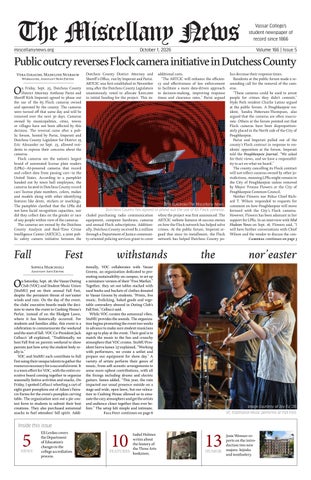
Aria Kuklinski/The Miscellany News. Dutchess County has agreed to phase out the use of 65 Flock cameras. cluded purchasing radio communication equipment, computer hardware, cameras and annual Flock subscriptions. Additionally, Dutchess County received $1.2 million through a Department of Justice community-oriented policing services grant to cover
when the project was first announced. The ARTCIC website features 16 success stories on how the Flock network has helped solve crimes. At the public forum, Imperati argued that since its installment, the Flock network has helped Dutchess County po-
withstands
the
tionally, VOC collaborates with Vassar Greens, an organization dedicated to promoting sustainability on campus, to set up a miniature version of their “Free Market.” Together, they set out tables stacked with used books and buckets of clothes donated to Vassar Greens by students. “Prints, live music, frolicking, baked goods and vegetable comradery abound in Outing Club’s Fall Fest,” Cellucci said. While VOC curates the autumnal vibes, StuMU provides the sounds. The organization begins promoting the event two weeks in advance to make sure student musicians sign up to play at the event. Their goal is to match the music to the fun and crunchy atmosphere that VOC creates. StuMU President Sierra Iames ’27 explained, “Working with performers, we create a setlist and prepare our equipment for show day.” A variety of artists perform their genre of music, from soft acoustic arrangements to some more upbeat contributions, with all the fixings including drums and electric guitars. Iames added, “This year, the rain impacted our usual presence outside on a stage and wide, open lawn, but our relocation to Cushing House allowed us to emanate the cozy atmosphere and get the artists and audience closer together than ever before.” The setup felt simple and intimate, Fall Fest continues on page 6
10
Isabel Holmes writes about the history of the Three Arts FEATURES bookstore.
lice decrease their response times. Residents at the public forum made a resounding call for the removal of the cameras. “These cameras could be used to arrest people for crimes they didn’t commit,” Hyde Park resident Charlie Latino argued at the public forum. A Poughkeepsie resident, Sandra Patterson-Thompson, also argued that the cameras are often inaccurate. Others at the forum pointed out that Flock cameras have been disproportionately placed in the North side of the City of Poughkeepsie. Parisi and Imperati pulled out of the county’s Flock contract in response to residents’ opposition at the forum. Imperati told the Poughkeepsie Journal, “We asked for their views, and we have a responsibility to act on what we heard.” The county cancelling its Flock contract will not reflect cameras owned by other jurisdictions, meaning LPRs might remain in the City of Poughkeepsie unless removed by Mayor Yvonne Flowers or the City of Poughkeepsie Common Council. Neither Flowers nor Police Chief Richard T. Wilson responded to requests for comment on how Poughkeepsie will move forward with the City’s Flock cameras. However, Flowers has been adamant in her support for LPRs. In an interview with Mid Hudson News on Sept. 16, Flowers said, “I will have further conversations with Chief Wilson and the vendor to discuss the conCameras continues on page 3
nor’easter
Image courtesy of Jay Fu '28. VC Traditional Music performs at Fall Fest.
13 HUMOR
Josie Wenner reports on the introduction two new majors: hijinks and tomfoolery.
October 1, 2026
Page 2
THE MISCELLANY NEWS Emma Brown Darja Coutts Julian Balsley Grace Finke Hadley Amato NEWS EDITOR Samuel Eisenberg ASSISTANT NEWS EDITORS Iggy Gutierrez Madeline Nusbaum Aurelia Harrison ARTS EDITORS Brendan Kennedy Sophia Marchioli ASSISTANT ARTS EDITOR Sydney Jones FEATURES EDITOR Tina Mao ASSISTANT FEATURES EDITORS Jared Palumbo Ian Watanabe OPINIONS EDITOR Zoe Rodriguez ASSISTANT OPINIONS EDITOR Josie Wenner HUMOR EDITOR Noah Daube-Valois ASSISTANT HUMOR EDITOR Holland Kaplan SPORTS EDITOR David Bray ASSISTANT SPORTS EDITORS Armaan Desai Lucas Seguinot DESIGN EDITOR Sylvia Sargent ASSISTANT DESIGN EDITORS Hannah Wells Elliot Evans COPY EDITORS Gabrielle Lyman Julia Weber ASSISTANT COPY EDITOR Aria Kuklinski GRAPHICS EDITORS Charlotte Willenbring Makenna Brown PHOTO EDITOR Aviva Barry ASSISTANT PHOTO EDITOR Olivia Blank GAMES EDITORS Felix Mundy-Mancino Mia Liloia SOCIAL MEDIA MANAGER Fallon Dern LIVE EVENTS CHAIR Vera Giraudo WEBMASTER Eduardo Culmer REPORTERS/COLUMNISTS Noah Duncan Melody Hamilton Isabel Holmes Lora Janczewski Benjamin Kaplan Eli Lerdau Evan Seker Erin Thatcher Amritha Dewan PHOTOGRAPHER Andrew Chu CARTOONIST Catriona Chapman COPY STAFF Cooper Jaffe Ren Nicolau Tanner Johnson DISTRIBUTORS Cailey Metter
EDITOR-IN-CHIEF MANAGING EDITOR SENIOR EDITORS
Emma Brown/The Miscellany News.
Correction (Sept. 24, 2026): Following publication, Professor and Chair of Mathematics and Statistics Jan Cameron notified The Miscellany News that the agreed edits on the quotation that was attributed to him were omitted. The clarified quotation is as follows: “First of all, it’s not a solution. It’s a claimed solution, and this is really important because the mathematics community needs to be able to decide whether or not it is correct.” The quotation has been updated online.
MISCELLANY NEWS | VASSAR COLLEGE
NEWS
October 1, 2026
Page 3
VSA Senate Highlights, Sept. 27 • The VSA President discussed a previously presented bill that prohibits any form of mass solicitation for student elections. This includes direct messaging on social media, contacting students through their school or personal email address, or posting to any forum controlled by a third party. • The VSA Senate unanimously passed a resolution to end VSA’s mandatory annual review committees. • Members of the Senate voiced concerns over the previously passed bill that prohibits organizations from purchasing items through Amazon. A few argued that the implementation of the bill did not give students enough notice.
Dutchess
County
Continued from Cameras on page 1 cerns that have recently been raised by members of the public.” She explained that the cameras had been beneficial, and that a replacement would be needed should the cameras be removed. There are no public records that cite the location or number of Flock cameras owned by Poughkeepsie. It is unclear if Poughkeepsie has its own contract with Flock or if all the cameras installed in the area are owned by Dutchess County. According to DeFlock, a national anti-Flock grassroots project that allows users to report camera locations on an interactive map, there are approximately 120 LPRs in Dutchess County, 34 of which are in Poughkeepsie. ARTCIC confirmed the installation of the county’s 65 cameras and released the location of 17. Of the confirmed LPR locations, 12 were in Poughkeepsie. Miscellany reporters confirmed the placement of two ARTCIC cameras near Vassar College campus, one on the corner of Main Street and Raymond Avenue and another along Hooker Avenue and Grand Avenue. Both have been deactivated. The informal installation of some LPRs has been controversial with Dutchess County residents. In some towns, residents had individual handshake agreements with the sheriff’s office to host a Flock camera on their property, allowing towns to experience surveillance without widespread ap-
reverses
proval. Earlier this year, former Pine Plains Police Sergeant Michael Beliveau signed a $80,000 contract with Flock without the Pine Plains Town Board’s approval. Some residents of the area discovered the cameras once they had already been placed. These informal agreements have allowed for at least one Flock camera to be placed in every county municipality. The Pine Plains Town Hall addressed these concerns by canceling the sheriff’s agreement with Flock. This controversy caused many other municipalities in Dutchess County to question the presence of these cameras, calling for a public forum so residents could express these concerns. The Sept. 23 public forum had a turnout that surprised some regular attendees. “This is crazy. I go to town hall meetings all the time. I’ve never seen anything like this,” Aaron Baldwin, a resident of Beacon and election coordinator for Dutchess County, told the Miscellany. Throughout the meeting, citizens presented their concerns with Flock cameras, including fears that police officials could misuse them for personal reasons. In an interview with the Miscellany, Madison Anthony, a resident of Hyde Park, said, “I don’t like how there isn’t really any oversight. Any sort of law enforcement officer can access where I’m going without needing a warrant. There’s been other instances of different officers using these cameras to
Vera Giraudo/The Miscellany News. Public forum attendees line up to speak.
Flock
camera
initiative
Vera Giraudo/The Miscellany News. Disabled Flock camera on Main Street. track their ex-romantic partners.” A senior investigator in Albany was recently arrested for allegedly using the Flock network to stalk her ex-girlfriend, allegedly searching her ex’s license plate in an LPR database over 3,000 times. According to the ARTCIC transparency website, there were three safeguards in place to avoid data leaks and the network’s abuse: a login system to enter the database and the assurances that individuals approved for access could only access data for “law enforcement purposes only” and there would be regular system audits to ensure proper use. In addition to fears regarding misuse, residents raised concerns about trusting Flock with access to the county’s data. Vassar student Nicholas McDonald ’29, who did not attend the forum but had heard of the recent reversal, shared, “ I just am reluctant because I feel that there’s personal data that’s being taken and then is being stored on like a third party database, and I don’t know how much I really trust this Flock database to keep this information safe.” According to Flock, all collected data gets deleted after 30 days. However, like McDonald, many are skeptical of the database’s security. “ We didn’t vote for the corporation, right? Sheriffs, county officials, these people get elected. No one voted for the corporation to come in here and surveil us,” Baldwin voiced. Hyde Park resident David Phelps, along
MISCELLANY NEWS | VASSAR COLLEGE
with other community members, also argued that Flock cameras violate their Fourth Amendment rights by enabling the government to track everyday movement. “Although [Flock’s potential constitutional violations] haven’t come out yet and had a case, because it’s a new technology, they’ve had precedent with U.S. v. Jones, Carpenter v. U.S. and, in 2026, Chatrie v. U.S., all stating that the police acquisition of data that tracks travel, you can’t do it. It constitutes a Fourth Amendment search. You can’t do it,” Phelps stated. This summer, a coalition of New York civil rights and legal advocacy groups filed a class-action lawsuit against the Westchester County Police Department claiming the network of 575 LPRs violated New York State’s constitutional right to “security against unreasonable searches, seizures and interceptions.” The defendant has filed a motion to dismiss the case under the legal precedent set by United States v. Knotts, a 1983 Supreme Court case that permitted law enforcement agencies to use radio transmitters to track vehicles traversing public roads. Residents who spoke at the forum expressed concerns that the system could be exploited and data could be leaked. Julia Wardell of Pleasant Valley voiced, “I’m sorry, and forgive me but I’m very lacking in trust right now... What happens if the next person [with access to the Flock network] has no integrity?”
NEWS
Page 4
Vassar
celebrates
40th
annual
ednesday, Sept. 23, marked the 40th annual Undergraduate Research Summer Institute (URSI) Symposium. Since 1986, the program has brought Vassar College students and faculty together to bridge important research gaps in a variety of STEM disciplines including, but not limited to, earth science, chemistry, biology and mathematics. This year’s topics sparked a wide range of interdisciplinary conversations, from studies on anthropogenic stress on tadpoles and equations to depict black holes to looking at statistics on U.S. Immigration and Customs Enforcement practices and finding ways to advocate for diversity in scientific communities. The symposium began with an introduction by URSI Director and Professor of Biology Justin Touchon, who spoke to the longevity of the program. Touchon shared that 2,177 students have participated in summer research over the course of URSI’s 40 years, with around 352 faculty members assisting with 1,607 projects. “It’s an absolute privilege to be at an institution that values undergraduate re-
search and, more importantly, funds it,” Touchon wrote to The Miscellany News by email. “I went to a liberal arts college and conducted research as a student, so I understand the transformative power of that experience.” He continued, “Getting to conduct your own project, to see something through from conception to data collection to analysis and writing, is just an incredible experience.” Following his introductory remarks, three student research groups gave more in-depth oral presentations in the Villard Room, with each providing a unique outlook on their research, experience and meaning of their project results. Before transitioning into the student research poster session, Vassar alumna and URSI participant Dr. Mina Cikara ’03, Fredric Wertham Professor of Law and Psychiatry in Society at Harvard University, gave her keynote address, “What Is a Group?” Researching how social group membership can psychologically disrupt empathizing with other people, Cikara presented on how different sociopolitical groups get pulled further or closer to each other in a divided society. The latter half of the event was devoted to student poster presentations, function-
Poet
Weinberger
Anna Little
Guest Reporter
W
Eliot Jared Palumbo
Assistant Features Editor
O
n Wednesday, Sept. 23, poet, essayist and translator Eliot Weinberger delivered the Elizabeth Bishop Lecture, an annual event sponsored by Vassar College’s English Department that brings poets to campus to lecture or read their works. Weinberger spoke about the history of poetic activism and his practices as an essayist, before reading two of his works. Weinberger began with an extended discussion of Vassar alumna Muriel Rukeyser ’34. A classmate of Elizabeth Bishop ’34, Rukeyser was a prolific writer and activist. Weinberger spoke of the political effect of her writing, noting how she, along with other writer-activists such as Alan Ginsberg, used poetry to humanize queer people in the public eye. Weinberger spoke of how Rukeyser was surveilled by the Federal Bureau of Investigation because of her activism. Surveillance of Rukeyser began in 1942. As of two years prior to her death in 1980, resulted in a case file 118 pages long according to “Modernism on File,” a book covering the surveillance of writers and artists in part of the 20th century. Weinberger wondered aloud if there were any poets left in the United States worth monitoring. After attending the lecture, Kerala Kim ’29 was most struck by how broad and varied Rukeyser’s creative life was.“When talking about different ideas of being an activist, and being an essay writer, and writing plays and screenplays and all of these different things while also being a poet, I think the idea that creativity isn’t a confined act is such an important takeaway,” Kim told The Miscellany News. Kim, who had never read Weinberger’s work before the lecture, walked away with one of his books in hand. Weinberger told the audience that he spent so much time discussing Rukeyser, in part, because of the influence her work has had on his own. Considering how multifaceted her life and work was, the influence
October 1, 2026
URSI
symposium
ing almost like a science fair, where interested students and faculty could visit the posters of their choosing. Students participating in the URSI symposium told the Miscellany that they enjoyed their research experience and found themselves becoming closer to the Vassar community over the summer. RJ Miller ’27 worked on “The Role of Astrocytic Glutamine Synthetase in Sustained Attention” as a part of the Psychological Science Department. When asked about his overall experience participating in URSI, he stated, “I really enjoyed it. I feel like our lab accomplished a lot of great things even outside the research part.” Miller went on to say, “Not only did I continue to build strong relationships with my professor and lab mate, but I got to learn about what other students are passionate about.” James Lee ’27 helped support the resurgence of the Alliance for Diversity in Science & Engineering (ADSE) at Vassar over the summer. The organization helps facilitate events that support underrepresented students in STEM. “Through URSI, I was able to make a positive impact on the STEM community here,” Lee stated. He continued, “One of my favorite memories from the summer was putting
together the ADSE slip and slide event for the other URSI students.” Taking place both on campus and abroad during the summer, URSI gives Vassar students a chance to expand the horizons of scientific research and whom it reaches. In her project “Twins: Foraminifera Fusion in the Sargasso Sea,” Anna McFadden ’27 had the opportunity to travel to Bermuda to conduct Ocean Alkalinity Enhancement research with Assistant Professor of Earth Science on the Mary Clark Rockefeller Chair Laura Haynes and her lab group. “My biggest takeaway from my URSI experience this summer was how unique and special this opportunity was,” McFadden wrote in an email to Miscellany reporters. “Getting the chance to research planktonic foraminifera is a rare gift as they are notoriously difficult to research, and being able to conduct this research in one of the most beautiful places in the world was duly unbelievable.” Though all three students who spoke on their experience had very different projects, each of them found that the value of URSI lies in giving its students the opportunity to conduct research and make their own impact in the scientific community.
talks
is apparent. “I thought it was terrific that he focused in on Muriel Rukeyser…who doesn’t get the attention she deserves,” Professor Emeritus of English Paul Kane told the Miscellany. “I think it’s an indication of what happens when you have writers who work in so many genres that they’re hard to pigeon-hole, and because they’re hard to pigeon-hole, they get overlooked,” Kane said. Weinberger, like Rukeyser, is no stranger to poetic activism. In 2005, he wrote the essay “What I Heard About Iraq,” which attempted to display what he viewed as the hypocrisy of President George W. Bush’s administration during the war in Iraq. He did so by comparing contradictory quotes from top officials. The essay also highlights the perspectives of Iraqi citizens and United States soldiers at the time. Many of the soldier’s quotes attempt to justify the war, while the Iraqi citizens are incredulous at these justifications. He began writing the essay after Sept. 11 as simple news updates with public information to friends, believing the mass media’s coverage to be insufficiently critical of the war in Iraq, but his writing began to spread over email. “It was a great way to publish because the readers voted with their ‘forward’ or their ‘delete’ buttons,” Weinberger told the Miscellany. Eventually, the essay reached The London Review of Books, before it was adapted across creative disciplines. “[It] turned into a hit play that ran in Los Angeles for nine months, and radio plays, dance installations. They had a worldwide reading of it in a hundred places,” Weinberger said. “What I Heard About Iraq,” like many of Weinberger’s essays, does not adhere to the traditional essay form. Along with its use of juxtaposing quotes, there is also little to no commentary from the author. This lack of convention is a feature of his writing. At the Bishop lecture, he moved from discussing Rukeyser to the evolution of his atypical essay format. By age 30, he said, he wanted to apply what he had learned about poetry writing essays. He thought that the essay form was underexplored and largely unchained from its European roots, which
activism
prioritized things like the first-person perspective. The only limit he gave himself was to never make anything up. “Reality is strange enough,” he told the audience. To conclude the talk, Weinberger read out two of his essay-poems. The first, entitled “Where the Kaluli Live,” began with representations of the soundscape of a Pap-
MISCELLANY NEWS | VASSAR COLLEGE
in
poetry
ua New Guinean forest, which included a reading of numerous bird calls written as “gubogubo” or “koo-halaideh” in the piece. The second piece, entitled “Abu al-Anbas’ Donkey,” was similarly genre-blending, beginning with nested frame narratives and ending with a poem written by an imagined donkey.
Jared Palumbo/The Miscellany News. Weinberger delivered a wide-ranging talk on poetry and activism.
October 1, 2026
NEWS
Page 5
Dept. of Ed. proposes major changes to college accreditation Eli Lerdau Columnist
T
he U.S. Department of Education on Aug. 19 proposed a rule that would require college accreditors to scrutinize faculty intellectual diversity, grading practices, graduate earnings and colleges’ enforcement of free speech. The rule could threaten the accreditation of colleges who have diversity, equity and inclusion (DEI) programs, employ a faculty the government deems overly liberal or do not meet the Department’s earning goals. “We propose to require a recognized accrediting agency to establish a policy that is designed to support, promote, and appropriately prioritize intellectual diversity and the free exchange of ideas amongst faculty,” according to the Federal Register notice announcing the proposal. The policy mandates measuring the range of students’ and faculty’s viewpoints on any particular campus. The rule implements Executive Order 14279, “Reforming Accreditation to Strengthen Higher Education,” signed April 23, 2025, by President Donald Trump. The stakes for the rule are financial, as colleges must be accredited by a Department of Education-recognized agency to be eligible for federal student aid, including Pell Grants and federal loans. Vassar College is currently accredited by the Middle States Commission on Higher Education (MSCHE), and the College is preparing for its 2027 to 2028 reaccreditation cycle. That timeline could overlap with the new rule’s first year in effect. The Vassar administration is not currently planning any changes in response to the proposed rule. “This proposal is still in the rule making stage, so it would be premature to speculate or make changes in response to it,” Associate Vice President of Institutional Research and Strategic Decision Support Biniam Tesfamariam wrote to The Miscellany News. He continued, “There could be substantial change to the proposal before the rules are finalized.”
However, Tesfamariam added, “If the proposed rule is finalized, we will review its requirements and MSCHE’s resulting standards, then make any changes required of Vassar.” The public comment period for the proposed rule closed Sept. 21. The Department received more than 4,000 comments but as of publication had posted only around 2,800 publicly. If the Department reviews and responds to the concerns in the comments by Nov. 1, the rule could take effect as early as July 1, 2027. Under the proposed policy, accreditors would have to confirm that colleges comply with federal and state law, including Title VI of the Civil Rights Act and Title IX of the Education Amendments of 1972. “We propose a prohibition of preferential treatment based on protected characteristics, such as race-based scholarships or programs, and preferential hiring or promotion practices,” the proposal reads. The proposal continues, “Some accrediting agencies have neglected their positions of public trust, improperly shifting their focus away from student achievement to compelling institutions to adopt illegal and discriminatory ideology and practices.” Tesfamariam and Professor of Religion Christopher White co-chair Vassar’s reaccreditation effort. A team split into seven subgroups is preparing a self-study for MSCHE. “Our General Counsel [Shay Humphrey], Prof White, and I track accreditation rule changes and we work in coordination with organizational affiliates, like ACE [American Council on Education], to make comments,” Tesfarmariam wrote. Vassar did not publish a public comment during the comment period. However, the American Council on Education, of which Vassar is a member, did file a public comment on the proposal opposing large parts of the rule. Administrators did not respond to questions about Vassar’s grade distribution or how the College might measure faculty intellectual diversity. “All programs that Vassar currently op-
erates comply with the law, and we do not discriminate based on protected classes,” Tesfamariam wrote. The College’s mission statement reads, in part, “Founded in 1861 to provide women an education equal to that once available only to men, Vassar is now open to all and strives to pursue diversity, inclusion, and equity as essential components of a rich intellectual and cultural environment in which all members, including those from underrepresented and marginalized groups, are valued and empowered to thrive.” “As for the emphasis on economic returns, though it is an important factor, focusing exclusively on economic returns can misconstrue what higher education contributes to students’ lives,” Tesfamariam stated. “We work to educate parents, families, and the public about the many contributions of a liberal arts degree to one’s life and to society at large.” According to the Department of Education, median earnings for Vassar graduates are currently $61,818, roughly 1.5 times the average amount students pay for tuition. Many worry the new rule will shift the role of accreditors into territory they were never meant to enter. “They’re not First Amendment police. Their job is to just determine whether or not a school has all its major curricular goals and everything,” Visiting Assistant Professor of Political Science Maxwell Fuerderer, who specializes in constitutional law, told the Miscellany. “But as far as free speech, that's a whole new realm. Leave that to the lawyers.” Vassar’s own accreditor, MSCHE, echoed these concerns in a public statement, writing,“While we recognize the Department’s statements during negotiated rulemaking indicating that it has no intentions to make accreditors the enforcement mechanism for these legal concepts, the actual language of the proposed regulations seemingly do just that.” Fuerderer pointed to the Supreme Court’s 2024 decision in Loper Bright Enterprises v. Raimondo, which ended judicial deference to federal agencies’ readings of the law, as a
way the Department’s rule might be taken to court. He further cited the Court’s 2023 Biden v. Nebraska decision, which struck down student loan forgiveness. The decision applied the major questions doctrine, requiring agency actions of vast economic significance to potentially require explicit approval from Congress.“This is billions of dollars here,” Fuerderer said. “This is a major economic question, and I don’t think anyone can deny that.” Religious institutions, defined as those with a religiously oriented mission, would be exempt from the rule. “It’s arguably violating the 14th Amendment,” said Fuerderer of the exemption. “There will be no distinction according to diversity, equity, and inclusion, but they’re permitting it based on faith.” Public comments have been overwhelmingly negative, but not entirely. Many conservative groups support the rule change. “For too long, accreditation has served the interests of a longstanding clique of agencies that have leveraged their Title IV gatekeeping authority to push woke criteria at the expense of academic quality,” wrote the conservative Defense of Freedom Institute’s president and co-founder Bob Eitel in a public statement of support for the new rule. The rule’s emphasis on viewpoint neutrality raises questions for Vassar’s Engaged Pluralism program, which encourages discourse across identities and political boundaries. The program is described on the College’s website: “A set of practices that invite people into dialogue across differences using four tools to organize, create, and build cultures of mutual respect, peace, and accountability.” “The main focus is that college campuses are more diverse than ever, and we want to celebrate that diversity,” Nathaniel Dozier ’27, an Engaged Pluralism intern, told The Miscellany News. Dozier acknowledged how the program could draw scrutiny should federal oversight expand. “[Engaged Pluralism] is very direct about diversity,” he stated.
Image courtesy of Tori Kim '25. MISCELLANY NEWS | VASSAR COLLEGE
ARTS
Page 6
Fall
Fest
moves
Continued from Fall Fest on page 1 with just a drum kit and some microphone stands for artists to breathe life into. Next to the kit sat two big, beautiful Fender amps stacked on top of each other beside a tall lamp that provided warm light to the space. The chairs were arranged so audience members had room to sit or stand and appreciate the music. Musicians such as Iames and Jack Frederick ’28, as well as Brynne Mershon ’27 and Naomi Sullins ’27 of Dovetail, contributed to the event’s collection of soothing sounds, each with a guitar in hand. During Dovetail’s set, a member of the crowd sketched the scene on a large drawing board, attracting their own audi-
Finding Sydney Jones
P
ence as people peered over their shoulder. The duo played mostly originals and covered “Twilight” by Elliot Smith. Dovetail has played at Fall Fest every year since the band’s conception. Mershon commented, “We really love the event because it’s the first chance a lot of folks get to perform at Vassar, so you get to meet a lot of new people and hear them play in front of people for the first time—it always feels like a very chill, welcoming environment.” Frederick’s set consisted of a song that was written the morning of the performance, as well “From the Morning” by Nick Drake and
musical
Features editor
op stars are losing their authenticity: It is a cliché, I know. Since the pandemic, it seems like many artists—including some of my past favorites—are placing more of their focus on creating brands that will bring in cash and sell out stadiums rather than produce or perform music which feels authentic, or, at least, feels like it says something. But, there is light at the end of the post-pandemic tunnel. Over this past year, I attended concerts from an unlikely pair of artists: Chappell Roan and Fontaines D.C. My takeaway is that musical authenticity seems to live somewhere in experience, and it is special to find artists who prioritize creating authentic experiences in live music when social media is constantly pushing us to place our attention anywhere but the concert floor. Take artists like Sabrina Carpenter, Benson Boone, Gracie Abrams or sombr (stay with me). Attending the concerts of big stars like these is a capital E Event; bows, cowboy boots, leather jackets and/or bedazzled leotards are essential to their uniforms. On social media, we see these concerts as locations to tag and opportunities for poses to post. I do not intend to shame any fans for their outfits or Instagram pages, or discredit these artists’ abilities to build musical empires. I dress up for concerts. I post about concerts. But outfits and atmosphere alone cannot make an artist authentic, musical or otherwise. If so many of these concerts are motivated by outfits and photo-ops, do we, as consumers of said music, still value authenticity? Or, better yet, talent? That depends on how you define authenticity. Most, and I mean most, of these artists have demonstrated their ability to make, or at least perform, good music. Carpenter’s 2022 album “emails i can’t send” was fun, witty and evidently persuaded enough people to lend some fuel to her skyrocketing career. I loved Abrams’ “Good Riddance,” and she obviously hit a chord with her young audience’s desire for melancholic yearning. sombr’s “back to friends” was, perhaps, at some point, a fine song. Place the emphasis where you will. As for Benson Boone—all of my Vassar readership might have just dissipated after reading that name, but I beg you again to stick with me—he has the capacity to entertain. Hiding under the shadow of his signature backflip, Benson Boone has a voice. Last year on
indoors
to
Cushing
“Seasons” by Chris Cornell. Parents and their students stood swaying in the back as other student musicians gathered close to the performing artists, sitting criss-cross applesauce on the floor. S i m u l t a n e o u s l y, parents and their students poked knives into pumpkins, carving friendly jack-o’lanterns. Attendees dug through the free clothing bins, and shuffled around the snack table, emptying the jugs of apple cider and containers of muffins. The top three creations in this year’s pie contest were named Mia’s pecan pie, South Commons number five’s granola pie and Cellucci’s cornelian pie. All of this activity was accompanied by the smoky scent of freshly popped popcorn wafting from the old-fashioned popcorn machine at the snack table. With the Cush-
authenticity
his “American Heart” tour, he did a cover of Adele’s “Rolling in the Deep,” in Adele’s original key, and “Iris” by The Goo Goo Dolls. But, unfortunately, Boone’s singing voice does not translate to his songwriting. Sadly, I do not think I can discuss fallen angels of musical authenticity without bringing up Taylor Swift. Early in high school, I listened to T. Swizzle often, but the modern Swift is not the same as my first impression of Swift at the “reputation” Tour of 2018, or even the pandemic “folklore” Swift of 2021. I understand the spoof on her changing personal aesthetic was the central point of the leviathan Eras Tour, but I, like many, have long been disenchanted. What happened to Miss Americana, and why is she married to Mr. “Viva Las Vegas”? A billionaire does not work at yogurt shops. When I attended Chappell Roan’s concert around this time last year, I realized that triumphs of popular success and genuine live music experiences do not need to be mutually exclusive. Roan’s stage was the most extravagant, her costumes the most bedazzled, her merch lines the most extended, her lyrics the most screamed. And yet, it all emanated the overwhelming scent of authenticity. And I remember entering Roan’s concert with a larger-than-life, neon-pink idea of what a Chappell Roan concert should be. There were aspects of her show which depended on concert-goers to come in with a general understanding of what to expect, like the unofficial outfit theme posted across fan accounts or the popular dancing trend of “HOT TO GO!” but the whole experience did not feel too neatly pre-packaged. Less popular tracks, like “California” and “Kaleidoscope,” were afforded equal, if not more, creative love as her biggest hits. The story of her album and personal journey as an artist sparkled alongside, and not in spite of, all the glitter. Songs did not come off as track titles made to sell deluxe editions. This past week, I was thrilled to see Dublin-born rock band Fontaines D.C. at the Kings Theatre in Brooklyn, New York. Advertised as an “intimate” show, the indoor venue was even smaller than Forest Hills Stadium where I saw Roan. Though the Fontaines have not reached Roan-level stardom (yet), when compared to many of the big-ticket festivals they have been playing since their last album “Romance” released in 2024, the space could fool you into the sense that you were discovering a novelty (so long as you put aside the
October 1, 2026
in
the
ing House front door propped open, people spilled in and out of the parlor all afternoon. This collaborative event is always a marker of the seasons changing at Vassar from the hot days spent with sticky legs glued to classroom chairs, to the cold mornings that turn into warm, sunny afternoons. I remember making connections at Fall Fest my freshman year that I still have today, meeting new friends’ parents and squeezing as many butts onto my picnic blanket as possible. VOC and StuMU have successfully built an iconic tradition for many members of the Vassar community in spite of the hecticness of Families Weekend.
Graphics by Charlotte Willenbring '29.
algorithm
memory of a two-plus hour online queue for tickets). Like Roan, my “Favourite” Irish lads reeked of authenticity. It may be unfair to include a so-called “post-punk” band in my argument about pop stars, but that genuine smell I got a whiff of from Roan seemed even more pungent last Monday night. Perhaps it was amplified by the performance of new songs from their upcoming album, “Dopamine Chamber,” or frontman Grian Chatten’s borderline goofy but undeniably cool stage presence. Every member of the Fontaines demonstrated talent and a certain level of unabashed realness. Maybe authenticity was also reflected by the fun and surprisingly unpretentious energy of the attendees, which ranged from young people sporting Fontaines-branded neon football kits and sipping High Noons to middle-aged couples, like the pair in front of me taking selfies and exchanging Facebook memes. While the Fontaines sit at the juncture of genres of-
MISCELLANY NEWS | VASSAR COLLEGE
Parlor
era
ten accused of “performative” followings (see The Strokes), it was refreshing to stand in a crowd that could chant back their punning, tongue-twisting, political and poetic lyrics while sharing in the simple collective experience of a good time. Plus, Chatten wore a t-shirt collaged with Rihanna’s face which read “Bad Gyal.” If that is not authentic, then I am not sure what is. In short: neither Roan nor my beloved Fontaines are afraid of making a statement. But they also know how to have fun. They exemplify that enjoying yourself and consuming good music do not need to be mutually exclusive aspects of the live music experience, or music generally. As musicians, they are talented. As influential people, they have things to say. The quality of their performances simply follow suit. To Fontaines D.C. and Chappell Roan: shine bright, like a diamond. To Benson, Taylor and those who I will not name again: I am not mad, just disappointed.
Sydney Jones/The Miscellany News. Fontaines D.C. performs in New York City.
October 1, 2026
ARTS
Page 7
Suffering and coping are braided together in ‘Minor Visions’ Ender Nix
Guest Columnist
I
never really knew much about Romania—I was never taught about the country in school. But recently, my eyes have been opened to how clueless I truly am about the country. This past Wednesday, I had the privilege of going to the screening for the 2001 film “Minor Visions” by Vassar Associate Professor of Film Denise Iris and the Russian Studies Department. The screening was new territory to me—I have never attended a screening at Vassar—but I was very interested because I have always loved history. “Minor Visions” takes place in Romania in the year 2000. The film is a documentary that blends in narrative elements about a fictional college student who goes to different Orthodox monasteries in the billowing mountains of the countryside. He is accompanied by miracle-working icons to conduct a field study on religion, specifically Orthodox Christianity, which includes many interviews of non-actors. Denise Iris did the actual filming, but framed the movie for people to view it as if it was a natural video diary from this fictional student. The viewing experience was deeply raw. I watched this young man
slowly unravel over the course of the film as he confronted a diverse expanse of ideas surrounding superstition, devotion and spirituality. The emotional whiplash of this film leaves the viewer reeling, in part due to the variety of people interviewed. One moment, a father would be humorously teasing his daughters, sun glinting off their faces, about how they have to love him more than their mother. Then, a girl would be ranting that she swears Mormons eat human blood. Abruptly, the shot would change to a man talking about his childhood experience of his brother’s near death, or a little boy discussing stealing from the nearby—extremely unsafe—rundown factory to sell for money to feed himself. The interviews felt very jarring, but also very representative of the oscillating human experience, and thus very revealing to life in Romania during this time. Part of the shocking nature—I learned after the film— tied into the fact that Romanian people used humor to cope with their suffering. Comedy was the only way they could think of to survive the horrors they were experiencing. At the screening, I learned about the Romanian people, their struggle through the collapse of communism post-revolution, and how they pulled themselves together
after being torn to pieces by totalitarianism in the ’40s. During the communist regime, food was rationed, and hot water was considered a privilege. Atheism was instituted and a promoted ideology, so any other kind of religion had to be discreet. You could be fired from an office job for being publicly Christian. Many monasteries and churches were hidden away in caves, so that people could be themselves and thrive without fear of being found out. Romanians had their liberties taken away from them overnight. Years later—once everything was being restored—they had no idea how to maneuver this newfound life: One that was once familiar, now foreign. This limbo is the time in which the film takes place, revealing the burning growing pains of coming back into something that was once theirs. In the Q&A afterwards, I learned how much Iris dedicated to this film that we did not get to experience during the screening itself. Whenever I go see a movie in theaters and I watch the credits, I always find it fascinating how much it takes to make a film. The effort poured into “Minor Visions” was tangible, but Iris as director took such a unique approach with her tools. She kept things frugal in terms of equipment, to maintain the illusion of an inexperienced person’s video diary instead of a high-defi-
nition movie you would see in the theater. This time, I got to hear directly from the creator about the behind the scenes magic I always marvel at in the theaters. For example, in a part of the film there was an Orthodox chant, and it sounded like a choir was singing a song from a church pew. At the end, we found out that Iris could not get the rights to the chant, so she learned it herself, recorded it and then layered the samples to make it sound like a real choir. It just goes to show how much work goes into movies that we never get to see, but we still must appreciate. A crucial part of “Minor Visions” is its interviews with real people. When asked how she earned these people’s trust, Iris smiled and said that coming to someone with an open heart and mind, and just being willing to listen to them can do wonders for getting people to trust you in return. This movie heavily revealed that there is so much the viewer does not know, so much they will never know, no matter how much they think they do. I know, despite my love for research, there is so much history out there that I will never learn. But at the “Minor Visions” screening, I got a taste of some of the culture and history across the pond that I’ve been missing. And I’m already craving more.
You see how this looks, right? ‘Primetime’ stuns and scares Ben Kaplan Columnist
C
an we destroy evil? And, if we can, what gives us the right? “Primetime,” directed by Lance Oppenheim and released in theaters on Sept. 25, asks these questions poignantly and aggressively. The film follows the events of the hit reality TV show “To Catch a Predator” and how the move to a new, prime cable timeslot pushed its eccentric creator and lead, Chris Hansen, to his limits. “Primetime” as a project is a must-watch for anyone who has been immersed, voluntarily or by force, in the recent cultural conversations around surveillance and intrinsic evil, along with the pervasive aesthetic movement that has been Y2K. Chris Hansen (Robert Pattinson), the head of the show “To Catch a Predator,” embarks on a mission to catch a “white whale” of an online predator after NBC moves the show to the coveted Wednesday night prime-time airing slot. If you don’t know, “To Catch a Predator” was a show where Hansen would lure online predators looking for relations with minors to fake homes where he would confront them before siccing the police on them. He was joined by decoys, actors he recruited to finish luring in predators once his team had set the trap through online message boards. Simultaneously, at the time of his hunt for this “white whale” in the film, Hansen tries to avoid the consequences of an extramarital affair. Pattinson as Hansen is intense in all the right ways. He brings the character alive with a jittery and on-edge approach in both voice and body language, making it appear that, at any given moment, his skeleton could burst out of his body. Pattinson seemingly pokes at the idea that Hansen is some alien creature wearing human skin with his jerky movements, soulless gaze and monologues to himself in front of mirrors. But the performance never fully crosses that line, leaving the audience on the edge of their seats watching this unpredictable
man’s soul sprawled out across the silver screen in an uncanny valley. His performance is the crown jewel of this film, and everything else builds out of it. The pure intensity and raw emotion Oppenheim evokes throughout “Primetime” could not work without Pattinson’s dedication to the role. Other notable performances include Skyler Gisondo as the awkward actor Dan Plum—brought on by Hansen as “Decoy Dan”—and musician Phoebe Bridgers as fellow predator decoy Del Harvey. Gisondo and Bridgers illustrate the discomforting nature of an adult actor pretending to be a preyed-upon child. Merritt Weaver gives a strong, authoritative edge to her performance as Hansen’s manager, Andie Bender. Plus, Matthew Maher does a solid job with his performance as the eccentric Xavier Von Erck, the man Hansen uses to track down predators through chat boards and other means of online stalking. Another highlight of “Primetime” is the editing and stylistic direction Oppenheim utilized. Fundamentally, this movie’s aesthetic is unabashedly Y2K-influenced. Sharp cuts with loud analog noises, fuzzy VHS effects and over-saturated neon colors reappear throughout the film, numbing the viewer in this heightened reality where the anxiety of the situations faced by Hansen and company becomes very tangible. Oppenheim also uses intense jump cuts to increase the tension, like when Xavier scopes out predators from his laptop. There is a particular scene where Hansen confronts a predator who reveals himself to be a rabbi, and the scenery outside of their faces abruptly cuts away. Their faces are then painted with thick shadows while their voice volumes are boosted greatly and the shot cuts between deep close-ups of the two. The scene was incredibly instense, creating an effect in the audience of uncomfortable terror simular to that of David Lynch’s “Blue Velvet” or “Mulholland Drive.” In a matter of seconds, the deep terror and anxiety of the situation becomes all consuming, and I, along with everyone else
Image courtesy of Wikimedia Commons. Robert Pattinson and director Lance Oppenheim attend "Primetime" premiere. in the theater, could not look away, as if we were witnessing a horrific accident. This is not a particularly long film, clocking in around 110 minutes, but it is fast-paced and intense. Throughout, Oppenheim tackles some incredibly relevant and often uncomfortable themes. Namely, surveillance and Hansen’s quest to destroy a seemingly intrinsic human evil are covered at great length. One of the best scenes is a pseudo-flashback of Hansen’s time covering child kidnappings in rural India, and it gives a great window into the mind of the protagonist. Hansen truly believes, to some extent, in the moral good of his show and his actions around it as a front against a deep, ancient evil that takes on a literal shape as pagan gods haunting him that continually reappear throughout the latter half of the film. The biggest and most impactful question asked by the movie is: “What gives someone the right to uncover and fight evil?” The scene centered on the rabbi asks this question outright: “Who gave you the right?” are his exact words. What gives Hansen the right to dole out these punishments when he himself cheats on his wife and is on the verge of a nervous breakdown?
MISCELLANY NEWS | VASSAR COLLEGE
Additionally, the prevalent banality of the end of the Iraq War is a consistent set piece in the background of the film, connecting our desires as Americans to uncover evil to imperialistic aims. Even if our mistakes are seemingly less intense, why do we—as personified by Hansen—think of ourselves as Americans or even just well-meaning people, capable of playing God? This is not to say that the predators get off easy in this film. They are portrayed as slimy and scummy. But these themes and questions raised about someone like Hansen are both fascinating and important to think about, and Oppenheim tackles them head on. “Primetime” will be talked about for years to come—a project that deserves to be dissected to death in film classes from UCLA to Vassar College. It is willing to ask difficult, uncomfortable questions about our culture in a way that few other films can. The themes of surveillance and intrinsic evil alone make this one of the most captivating films of our time, despite it being set across suburban lots in the mid-2000s. “Primetime” is an intense, beautifully shot and edited film that asks the viewer to reckon with the uncomfortable truths that, for better or worse, we often hide or ignore.
ARTS
Page 8
Discovering
jazz
t was a little before 7:30 p.m. I was sitting on a browned, elongated ottoman in Josselyn House’s piano parlor, casually known as “The Jarlor.” The heterogeneous furniture had been arranged into a rough semicircle. Behind it was another row of chairs pointed toward the entrance, where the piano sat. As the performers got ready, friends sprawled on the couch, with many opting to sit crosslegged on the rough pseudo-Persian rug. Assistant Professor of Political Science and Josselyn House Fellow Claire Sagan introduced Melanie Giselle and the musicians that accompanied her: pianist Ben Allen, bassist Knox Barber and drummer Corey Garcia. Sagan acknowledged the Harlem Flophouse as well, and emphasized that this event would be a part of a series. Moreover, she thanked the Raymond and Davison House Fellows that had helped her arrange this event: Assistant Professor of Anthropology China Sajadian and Associate Professor and Chair of Education Jaime Liborio Del Razo, respectively. Sajadian’s newborn was also present. Giselle took the center of the room, sporting a flowy red skirt, slight micro bangs and a philtrum piercing. The first song was bossa-nova inflected. Melanie took a step back and held both her mic and head low. Then the piano began, and I realized that an instrument I thought I had understood can sound completely unfamiliar. Allen’s playing seemed to move laterally beneath the song, filling spaces that I had not noticed were empty; a phrase would begin casually and then fold back upon itself. Allen would raise from the piano bench, slamming the keys, squeezing his eyes shut. Then came the bass.
Barber gave the music a foundation. The bass did something to the body of the listener, giving my foot a reason to tap. I had no idea when it had started. Thus began my introduction to jazz: involuntary movement. I came into the Jarlor with essentially no jazz vocabulary. I could not distinguish the conventions, nor could I have told you what made one solo technically remarkable. So I listened in the most primitive way possible. Giselle then introduced a song dedicated to the moon, which felt fitting considering Sept. 25’s waxing gibbous moon, phasing into the Harvest Moon weekend. There was a piano solo in which Allen seemed to take the melody apart. The rest of the band conceded their improvisations, becoming a kind of atmosphere around the piano. Then Garcia took over on drums, wielding a pair of brushes. He moved his brushes around in a continuous whisper, creating and dispersing sound at once. I became fixated on his foot as it kept thumping absent-mindedly—a small, repetitive motion underneath the kit, keeping some private time underneath the public one. And then I realized that I was doing the same thing. I was slouched on the ottoman, shoulders rounded, one foot thumping against the floor in time with his. For 30 seconds, the drummer and I had arrived at exactly the same posture from the opposite side of the room; it seemed absurdly intimate. He was performing, and I was merely seated there trying to understand what he was doing, and yet our bodies arrived at the same conclusion. The hauntings of the Jarlor had faded, and the music had finally taught me how to sit, unstiffened. There were moments when I felt like Sajadian’s newborn: unknowing yet having the pleasure of discovering something. A solo
Doodling
at
Guneet Hanjra Guest Columnist
I
Anna hagen
Guest Columnist
A
s an autumn chill fills the air and calendars fill with assignments, it is easy to fall into unhealthy cycles of nonstop studying, which often prove unsustainable in the long-term. When we try to relax by doing something artistic, for instance, our brains can still be constantly in “work mode”—speaking from personal experience. Thus, our creative pursuits quickly become yet another source of pressure and anxiety. However, two offices at Vassar College are building a community for intentionally unstructured art time. This past Thursday, Sept. 24, marked the first session of Doodling at the Greenhouse. The event was a collaboration between Vassar’s Counseling Center and Olmsted Greenhouse to use art as a medium to connect with nature and calm the mind. I had not been to the greenhouse yet, but doodling was the perfect reason to check it out. I always made art as a child, spending countless hours scouring books filled with blank images of cute animals, fairytales and places from around the world. I even brought my colored pencils with me to college, but they have remained in my desk drawer since the start of the semester. As I stepped into the greenhouse—nestled between Olmsted Hall of Biological Sciences, the Bridge for Laboratory Sciences and Skinner Hall of Music—I was hit with a wave of calmness before I even arrived at the doodling event section of the space. After winding my way past countless pots and plants that reached up to my waist, I felt fully immersed in how the glass building here
the
serves as a warm haven for its leafy residents. I stumbled upon a place where the plants cradled a central table and creatives with their lush shades of green. “There’s no rules when it comes to doodling,” said Assistant Director of Training at Metcalf House Alison (Ali) Krause Christensen, one of the organizers of “Doodling at the Greenhouse.” The table was replete with art supplies: Markers and colored pencils were scattered around alongside drawing prompts that participants could use if they needed a spark of inspiration. One prompt I remember fondly was to draw a “stress monster” that represented your anxieties, as well as your stress monster doing something to alleviate that agita. When I think of coloring, I imagine bound books with line art, where you work through each image at a time until there is a portfolio of neatly colored scenes. This event, wonderfully, was not what I imagined. Papers littered the table, both blank and with coloring patterns. I picked a page with plants, desiring to recreate a page that reflected the verdure around me to bring back to my dorm. For Greenhouse Manager and Science Support Technician Alicia Contelmo, it is wonderful to see regulars who come to Doodling as a monthly ritual, but also to encounter new faces every session. As a
in
October 1, 2026
the
would end, and the room would clap. I would look around half a second too late and join in. Someone would make an appreciative “oh yeah,” and I would wonder what, exactly, they had heard that I was unequipped to understand and, thus, missed. Gradually, my self-imposed embarrassment faded, and I began to understand that there was to be no musical singularity in my ears. Because the audience was facing the entrance, we had an accidental view of the world outside the concert. Every few minutes a head appeared behind the glass, which became a kind of fourth wall; they were in flux, between campus life and whatever was happening in the Jarlor. Right when I got into the groove, the first set ended. A 15-minute break had commenced. Eventually, Giselle seated herself on a stool and began a solo acoustic set. The room became quieter in a way that felt like sheer observation, as opposed to mere
Jarlor
silence; without the bass, piano and drums around her, there was no bridge between her voice and the room. She explained how she grew up in Uruguay and sang many songs about peace, meditation and the like. After it ended, many stayed back, flocking to Sagan and the performers. I did not stay to ask questions. I could have performed the little ritual that follows an intimate concert: That was beautiful. Where did you learn that? What was that last song? I love your skirt. Instead, I left. Not immediately: I stayed there for the strange interval where the Jarlor stopped being transformative, yet had not quite returned to its ordinarily haunted state. People gathered their things, chairs shifted and the spell began to disperse. I would like to think I have, unknowingly, loved jazz my whole life. Jazz musicians seemingly know something that audiences do not and that other musicians end up discarding.
Image courtesy of Jay Fu '28. Melanie Giselle performs in theparlor. Jarlor. Musicians perform in Josselyn House's
Olmstead newcomer, I felt welcome to join the circle of chairs around the coloring table, especially with the cart of tea and treats to complement our relaxing artistic endeavors. It was comforting to have a place that encourages you to slow down instead of generating a sense of competition. “Creativity is such an important part of people’s sense of wellness, and there’s such a drive towards productivity that can be anxiety producing,” Krause said. “Giving ourselves permission for play and creativity feels like such an important part to overall wellness." A 2022 scientific study entitled “The effects of coloring therapy on patients with generalized anxiety disorder” found that coloring therapy can help reduce symptoms of anxiety and depression and increase positive mood. During her career, Krause has recognized firsthand the emotional and mental benefits of engaging with artistic practices. For her, it affirmed the importance of a low-pressure environment like Greenhouse Doodling that facilitates creativity and community building on campus. “It could be very grounding when people thought it was hard to find the words to express their emotions... a way to almost release something through art,” she highlighted. Vassar’s mantra of “going to the source” passed through my mind as I doodled. Around me, I watched the sun’s rays flood
MISCELLANY NEWS | VASSAR COLLEGE
Greenhouse into the greenhouse, washing the leaves in a chartreuse glow. On paper, that nature manifested in the hues I chose to fill my page with. It was soothing to watch the paper soak up the saturated pigments, flooding empty ferns and ginkgo leaves with shades of green and yellow. Krause recognized that while it may seem counterintuitive to color when your to-do list is longer than the page you are filling in, it is vital to incorporate a healthy dose of an “anti-doing” philosophy into one’s life. Creative spaces and activities like Doodling at the Greenhouse provide ways to add this way of thinking into your daily routine. “These are tools to achieve that, but when you’re practicing it, it doesn’t feel like that motor [of productivity], it feels like [you] can just be there without a certain goal,” Krause said. “There was a therapist before me who started it,” Krause recounted when discussing the event’s origins. “When she left, I think she felt that it was something that I’d enjoy doing. It was a gift that I got to take it over.” Similarly, I am appreciative of the opportunity to visit the greenhouse and intentionally take a peaceful pause in a busy schedule. Even though we are often surrounded by verdure on Vassar’s campus, it is grounding to remind oneself of nature’s beauty through simple yet vital practices, like coloring and doodling. The next ‘Doodling at the Greenhouse’ sessions are Oct. 29 and Dec. 3 from 3 to 4 p.m. I would highly recommend going to let your creativity bloom! Until then, I am inspired to take out my own coloring books and turn to a fresh page.
Graphic by Quinn Stickney '30.
FEATURES
October 1, 2026
Brewer Featuring
of
Sarah
the
Week:
Huynh
Page 9
What's Brewing?
’29
A Weekly Advice Column by Leah
Flirting, Friends, or Mixed Feelings Hello! For the longest while, I thought myself aromantic. There were people I wanted to be friends with, but I never found myself interested in anyone romantically, whatever that meant. That changed at the end of last semester when I realized I couldn’t stop thinking about someone—let’s call them A—and proceeded to spend all summer agonizing over it. I came into this year figuring I’d try to get closer to them, but that hasn’t exactly been happening, partly because I’m extremely busy, partly because I don’t think we’re not friendly enough to just randomly do stuff together, partly because I think we’re just somewhat in different spheres.
Image courtesy of Sarah Huynh '29. Sarah Huynh poses with a Noyes banner at the 2026 Brewer Games. Welcome to Brewer of the Week, a series where Chip Downes-Le Guin interviews a random student around campus.Each issue, a student is selected for interview through randomly generated letters, a random number and Vassar College’s student directory. This week’s feature: Sarah Huynh ’29. This week’s featured student, Sarah Huynh ’29, arrived for our interview wearing her lucky number 22, having just completed her biology exam, and talked with me about her love of fencing, the joy of dissecting brains and her growth at Vassar. This interview has been edited for length and clarity. Q: Do you know what you want to study? What drew you to your major? I’m looking at a double major in neuroscience and behavior and Chinese. For Chinese, my pre-major advisor—he’s in the Chinese Department, so he was definitely very eager for me to keep learning Chinese.But I think learning Chinese is really fun. I’m Chinese Vietnamese, but we don’t speak Mandarin at home, so I took it in high school and I wanted to continue it here… And then, for neuroscience, I really like biology and I like psychology, and neuroscience is the perfect combination. Q: And was that something you liked in high school too? Yeah, for sure. I took AP psych in high school, and I took Intro Neuro [NEUR 105: “Introduction to Neuroscience and Behavior”] last semester, and that made me really interested in neuro because one of the labs was dissecting brains, which is really cool… Actually, the summer before I came to Vassar, I did a summer program at this one med school in my hometown, and we got to work in the anatomy lab there. We were working with cadavers and all that stuff… It’s really interesting to see how our bodies work and all the mechanisms behind it. Q: Do you think there is a class outside of your majors that you wish everyone had to take before they graduate? Honestly, my EMT course, or some basic life support or first aid class. I just think it’s really good life skills to have for everyone. I wish it was more accessible…It’s very expensive…I think especially once we’re in the real world and we don’t have CRC with us, having those skills to take care of each other and take care of ourselves, that’s really important. Q: Outside of academics, how do you enjoy spending your time? We have such a beautiful campus, so I love
to just take walks and stuff around campus. Even when it gets cold and even when it’s snowing. I knew that I wanted to be somewhere where I still had all four seasons, and so Vassar has it all. We have the most gorgeous fall weather and views. Q: You are also a fencer. If you were to pitch people to try fencing or watch one of your competitions, what would you say? I mean, what’s cooler than sword fighting? Honestly, we’re just out there stabbing each other. It’s more graceful than that…sometimes…Last year, we were trying to teach people to fence using blow-up lightsabers… The energy is just so great at tournaments and competitions, and I love my team so much. That’s really what I’m looking for in a sport. Because I also played tennis in high school, but I always felt like the fencing community felt like family. Q: What is a piece of media that has made an impact on you recently? I grew up on One Direction. I think that’s something that stuck with me for many years… I feel like a lot of people are haters. I don’t understand the hate. They put out some good songs, and for a little girl, what a boy band, you know? But yeah, before coming to Vassar, I reached out to a lot of people on Instagram after reading about their interests and stuff on the IGOTIN page on Instagram [a page designed to help incoming freshmen connect with their community], and a lot of people liked One Direction. Q: Having recently completed your first year at Vassar, what advice would you give to someone just starting theirs? First of all, I’m a StuFel at Noyes. I really love my house team, so I’d say everyone here at Vassar just really wants to support you… Also, put yourself out there! I joined a lot of clubs, and that’s how I met a lot of my friends. Shameless plug: I’m on the executive board for SEASA [Southeast Asian Student Alliance], and that’s where I met a ton of friends of mine, learned how to plan events, and advertise for people…My last piece of advice is that everything works out, truly. I remember the beginning of my first year. I was so worried I wasn’t going to make any friends…but it really all works out. You find your people, you find your friends you find the professors that you love.
However, I’m pretty sure that someone else—let’s call them B—is interested in me. They’ve just been extremely friendly and, I think, kinda flirty. B is a fantastic person, and I really admire them, but I just don’t find myself interested for some reason. A and B also know each other pretty well, which makes this whole thing extra weird and stress-inducing for me. What should I do? I’m not sure how I should proceed in both of these (not) relationships. Best, Vexed Ventricular Vessel Dear Vexed Ventricular Vessel, To start, romantic attraction is one of the most subjective qualities of the human experience. When it comes to matters of the heart, it’s normal to be incredibly confused, so don’t let where you thought you might’ve fallen on the spectrum of attraction in the past influence the way you are thinking about both of these (not) relationships. However, it seems to me that you have found yourself in a bizarre (almost) love triangle, so I think it’s best to look at A and B independent of their relationship to one another. Let’s tackle A first. I think it’s good to note that absence makes the heart grow fonder. I know I’ve spent a break or two over these past four years agonizing over someone, but in those situations, it became incredibly easy to toe the line between a crush and idealization, especially when I didn’t find myself in consistent contact with the object of my infatuation. You mentioned that you are hoping to get closer to A, which tells me that you could be at a higher risk of throwing on the rose-colored glasses. I think that the best way to combat this is by finding time for one another, which I know is a lot easier said than done given the schedules of most Vassar students. The tried and true method is asking to grab a meal. Many beautiful friendships of mine were born out of Retreat sushi or a Deece dinner. There’s also never any harm in suggesting a coffee at The Brew or The Crafted Kup. Who knows, maybe you need accompaniment to a show or concert or other event, and I encourage you to extend an invitation to A. All of this is to say that you can’t be sure about anything regarding your feelings for this person until you actually get to know them. Maybe your attraction will intensify, maybe you’ll spark a beautiful friendship, or maybe you’ll find out they’re actually really boring. Regardless, you’ll never really know how you feel until you know who they are. Now let’s look at this from the B side of things. Do you find that B acts this way often? More specifically, is this extreme friendliness something you have observed in their interactions with others? If the answer is yes, they may just have a case of the flirty personality. Some people are just naturally charismatic and warm, so I encourage you to assess whether or not this behavior is specific to their interactions with you. This isn’t to say that they’re not flirting with you, but it is definitely something to consider. Part of me wonders if you could be to B what A is to you in terms of having a crush, and although that can indicate an awkward situation further down the road, I encourage you to not stress over it. At the end of the day, what you don’t know—or what you haven’t been told explicitly— cannot hurt you. You can have your suspicions that B is flirting with you, but until their feelings are made apparent in terms of a conversation or confession, you have no reason to be concerned. And, if things are made explicitly clear, you should never shy away from being honest about how you feel. However, I believe my aforementioned advice still stands when looking at it from this angle, too. You can’t be sure about your feelings for this person, or their feelings for you, until you actually get to know them. And so, my dear Vexed Ventricular Vessel, you have found yourself in a classic “cross that bridge when you get to it” situation. In terms of how you should proceed, I actually wouldn’t think too much about the flirtation or romance of it all. I encourage you to see the value of friendship and platonic love over anything else. A is someone you would like to get closer to, B is someone who seems to want to be closer with you, and A and B are friends. The common denominator in your relationships with both of these individuals is a matter of friendship, and you are in control of whether or not you want to venture beyond the platonic and into the romantic. Go forth and explore these relationships in greater depth, and most importantly, have fun meeting new people and expanding your social circle! Best, Leah
MISCELLANY NEWS | VASSAR COLLEGE
FEATURES
Page 10
Following Isabel Holmes Columnist
T
hree Arts is Arlington’s small independent bookstore, tucked between Savona’s Trattoria & Bar and the Juliet on Collegeview Avenue. While this is the Three Arts that the Arlington and Vassar community knows now, it was not always here—and, with its tall windows giving view to shelves of colorful books, it did not always look this way. Today, when you venture into the cozy store, you might get your newest books checked out by Walter Effron, the man behind the operation. If Effron is not working in the front, you might find him behind the shelves, among excess stacks of books atop a small white table embedded in the back. Though Effron keeps the wonderful store going today, he was not always the face of Three Arts. The neighboring college store, the Juliet, did notn’t look the same either. Working alongside and often collaborating with the Three Arts, the college store was once an independent book cooperative run by a group of Vassar community members. The co-op no longer exists, and has since been replaced by the Barnes and Noble owned college store—but its long time partner in bookselling the Three Arts remains. Three Arts was originally opened in downtown Poughkeepsie on Cannon Street by Jesse and Lilian Effron—Walter Effron’s parents—in 1946. Another employee, Therese, ran an additional satellite store in Arlington, which set the foundation for the store’s complete consolidation and move to Arlington in 1964. The same year, the Effrons expanded their Arlington location, adding space for their art gallery in addition to the bookstore. “They always had an art gallery, and with the growth of the area, they wanted a separate space for it,” Walter Effron explained. While the store was run by both of his parents, Lillian Effron held a special interest in the art gallery side of the business. Effron explained, “My mother ran that gallery. The show changed every month. Artists showed every two or three years, some came in later. She had contacts in the artist field.” The art gallery was a part of the store’s history that I had never heard of before speaking with Effron this past weekend. In the ’70s, the business district of Arlington was growing, and the store grew with it. That is, until a fire destroyed the building in 1975. From the remnants of the fire, only the Juliet movie theater was rebuilt. The movie theater started with four screens before taking over the whole building, including what had been Three Arts and a neigh-
The
Three
Arts
October 1, 2026
through
time
boring linen store. The old Three Arts space was taken over, and the store had to move. “My parents moved what was left from the fire into the current building,” explained Effron. From the conglomerate art gallery-bookstore came the current Arlington staple in its quiet and nestled spot. In 1982, Effron joined his parents at the store’s new location. Effron still runs the store today, working with customers to help them find books or provide suggestions for those asking for recommendations. He stocks the store through “frontlisting,” which means collecting new and unknown books from publishers to promote recent and upcoming publications. “You try your best in anticipating what you think is a good book, what you think is important. It’s interesting, I don’t mind doing that work. I never have,” Effron remarked. The Three Arts and the Effron family’s dedication to the independent store also serves as a reminder of the importance of the unique and personal experience at a place like the Three Arts. The experience of receiving book recommendations from a local owner like Effron reinforces the feeling of community. In addition to the tasks and responsibilities of running the store, I learned from Effron about the history of the bookstores within the Arlington and Vassar community. Before the college store was owned by Barnes and Noble, it was a Vassar bookstore cooperative that was shared among the Vassar community though faculty, students and alumni. The co-op was run by Marion Bacon, who worked there for decades until its closure in the 90’s, and was once President of the American Booksellers Association. The co-op is important to the history of the college bookstore, and specifically to nearby independent booksellers like Three Arts. When I asked about the relationship between the co-op and Three Arts, Effron replied, “Marion Bacon encouraged my father to start the store. They would trade books back and forth. If something was needed there and vice versa here. She was happy to have a store here as well. They had a very collegial relationship.” Effron continues to run the Three Arts bookstore, and demonstrates the importance of small independent booksellers among the very quickly changing bookselling world. Three Arts survived a move between neighborhoods, a fire and the shift to conglomerate or online bookselling, yet it continues to provide for a community of readers. Next time you walk by, consider stopping in for your next read or an insightful conversation about the world of books.
Images courtesy of Mae Gesser '30. Some views of the Three Arts bookstore in Arlington. MISCELLANY NEWS | VASSAR COLLEGE
October 1, 2026
HUMOR
Page 11
Breaking News
From the desk of Noah Daube-Valois, Assistant Humor Editor
Student not sure whether professor forgot their name or just likes to call people “sport” Vassar leaves Seven Sisters, now identifies as brother Daphne Huffman Eighth Sister
A
t Convocation, President Elizabeth Bradley announced to the community that Vassar College was leaving the Seven Sisters. The Chapel’s audience reportedly writhed with excitement, shock and indignation. But according to Bradley, this change had been brewing for a long time. “It was a lengthy and difficult process,” Bradley claimed. “But this school was founded by a man. It’s high time we stop pretending that Vassar is something that it’s not. For over a century, we’ve identified as a sister, when perhaps we were always meant to be a brother.” So Vassar aims to reclaim its masculine heritage as the cis straight male population slowly infiltrates the campus’s curvaceous society of femininity. As the Admissions Office coalesces with Athletics, more and more jocks are entering the student circulation, straining what had previously been a harmoniously woke and artsy institution. According to an unnamed source from the Dede Thompson Bartlett Center for Admission and Career Education, admissions officers grew so weary of the monotonous task of reading applications that they began longing for a college party of their own. The source suggested that this desperation may explain Vassar’s influx of athletic admissions, which ostensibly serves to compensate for the Greek life that the college famously lacks. This has been an especially revolutionary development for Vassar’s heterosexual community, who shared that they originally felt like a minority in the face of the community’s impressive level of wokeness. “I used to feel like I didn’t have the support I needed,” shared Wren Alger ’30. “I’m a straight guy. I have a girlfriend. But everyone thinks I’m gay, just because I go to Vassar. Now I can finally accept my masculinity. It’s difficult to do that, you know, in a world so heavily geared towards all this feminist stuff.” Other male-leaning students have joined Alger in his sentiment, organizing peaceful protests to advocate for their masculinity and completely combat the ideals of the Sev-
en Sisters. The men’s lacrosse team, for example, recently arranged a series of demonstrations on the Nircle, domineered by their slogan “We Put the Men in Menstruation.” The push to abandon the Seven Sisters has not come exclusively from men; even the female-identifying community has emphasized their feeling restrained by Vassar’s sisterhood. “The idea really rooted in my mind when I lost my VCard,” shared Maddie Bontempo ’30. “I mean, what a way to objectify our literal ID card. So I started thinking about my own ID, like, my own identity as a Vassar student. And I think this whole female institution is getting really freaking pick-me.” Indeed, there have been more frequent reported cases of the epidemic of pick-me, including an anonymous sophomore faking imbecility at her flute in the chamber orchestra, all to get the male clarinetist to instruct her. “I think the only way to completely eradicate girls being bitches is to get rid of girls altogether,” continued Bontempo. “It’s the movement of the decade.” Vassar’s withdrawal from the feminist educational ideals of the Seven Sisters finally holds space for the male-identifying population, who, historically, have not had easy access to education. The rampant masculinity of demonstrations on campus has caught the eye of the other Seven Sisters, a betrayal against the union of woman-favored education. “I never trusted Vassar,” argued one representative. “It’s the only coeducational sister school. That’s pretty damn sus to me.” The remaining colleges, including Barnard, Bryn Mawr, Mount Holyoke, Smith and Wellesley, reportedly held an emergency convention to discuss Vassar’s future in the league. The institutions ultimately reached a consensus: Vassar no longer fit into the sisterhood. So, they blocked the school on Insta, unfriended on Snap and ultimately kicked Vassar out of the Seven Sisters. Smith College was so distraught over the decision to boot Vassar, the institution stated it would remain part of the sisterhood so long as their consistent weed supplier continued funding them. We sought out Barnard, but administra-
S A
R
S C K A U V S
S
!
Image courtesy of Violetta Rohr '30. tors only grew defensive of being involved in such a union in the first place. “What do you mean, Seven Sisters?” defended an admission agent. “We’re basically an Ivy League. Barnard’s affiliated with Columbia. As in, Columbia University. So yes, we’re technically Seven Sisters. It’s an all-women fraction of the larger Columbia community. Did I mention Columbia is an Ivy League?” Meanwhile, Bryn Mawr acknowledged that Vassar’s departure had created an unfortunate numerical discrepancy. “Obviously, Vassar’s withdrawal leaves a gap,” shared the admissions office. “The Six Sisters doesn’t flow off the tongue easily. But we had to do it. Vassar simply lost that touch of femininity that is integral for the functioning of the sisterhood.” The aforementioned institutions are currently assessing their options to fill the hole that Vassar so abruptly left behind. But Vassar’s withdrawal from the Seven Sisters has presented a deeper argument: Perhaps academia has grown too rigid. So, the remaining Six Sisters rebranded themselves: The Sex Sisters. However, this revision was met with immediate confusion. Administrators insisted that the new name was meant to celebrate the freedom to explore the sexuality of womanhood, but was met with backlash for its lewd implications. “We mean sex in the biological sense,”
MISCELLANY NEWS | VASSAR COLLEGE
clarified a Wellesley spokesperson. “Actually, no, that makes it worse.” Vassar, currently titleless and homeless, responded to the rebranding of its former union in a campus-wide debate about the future of the college’s branding. Last week, Strong House held an open mic for students to share their opinions on whether or not to start a new union. One idea was to recruit other colleges to start a new league called “The Seven Mothers.” “She’s just giving mother,” stated Joshua Kaminsky ’30. Another idea was whether Vassar should petition to join the Ivy League, merging with Yale just as Radcliffe College did with Harvard in 1999. However, the commute was too far. They ultimately conceived the Bisexual Brothers, encompassing much more landscape, both geographically and sexually, than the Ivy League or former Seven Sisters could ever. It comprises Penn State, UC Merced, Grinnell College, Tulane University, Lewis & Clark College and, now, Vassar. The new union aims to unite coeducational schools in favor of preserving the reputations of gay and straight men alike. So, Sept. 2, 2026 marked Vassar’s last day as a sister school before changing history. The institution received their hormone prescription the following day and, at the behest of the Sex Sisters, transitioned.
HUMOR
Page 12
HOROSCOPES
October 1, 2026
Liza Williams had an astrology phase in middle school
ARIES
March 21 | April 19
TAURUS
April 20 | May 20
GEMINI
May 21 | June 20
CANCER
June 21 | July 22
LEO
July 23 | Aug. 22
VIRGO
Aug. 23 | Sept. 22
Oh no! You have a big event tonight that you COMPLETELY forgot about. The only thing you have to wear is… Shaileine Woodley’s Balenciaga jumpsuit from the 2026 Emmy’s?! Yikes!!!
Enjoy what nature has to offer this week. Take the scenic route to class, sit outside with friends—you could even relax on a bench! But please, if you happen to be under a tree, try to avoid the squirrels above that will attempt to concuss you with nuts. They’re not your friends. They have an agenda.
Try making more friends! Here’s a tip: Go to the library and sit at the same table as someone. And I’m not talking JUST at the same table. Sit in the seat directly next to them and make unblinking eye contact while they do their work. Extra points if you stay completely silent. Soon, you’ll be the most popular kid on campus!
Have you ever noticed the giant puddle in front of Jewett when it rains? This week only, if you jump in, you’ll be transported to another dimension! To where? Who knows! Maybe it’s a wonderful place where Street Eats is open for dinner, or where VassarOne will remember your login info…
You need to join the Savannah Bananas. Who cares if you’ll have to drop out of school and move to the South? This is your chance to live out your dreams of doing the splits in bright yellow baseball pants and NOT you procrastinating on your English paper. Go Bananas!
Please stop pretending to be a squirrel by sitting in a tree for three hours and throwing nuts at people. Trust me, you don’t want to be the first person to send someone to the ER while cos-squirreling. Next time, do your character study on Patrick Bateman and not Surly from “The Nut Job.”
MISCELLANY NEWS | VASSAR COLLEGE
LIBRA
Sept. 23 | Oct. 22
SCORPIO
Oct. 23 | Nov. 21
Are you tired of eating lunch at the Deece every day? You should try photosynthesis! That’s right, just sit outside on the grass and soak up all those yummy sun nutrients. Have humans ever photosynthesized? Don’t look it up, it’s probably fine.
No, your research project into the first straight man who graduated Vassar with a degree in women’s studies isn’t “groundbreaking.” No, he’s not a “performative male final boss.” His name is Phil, he’s 48, and he lives in Kalamazoo with a wife and two kids.
This week, you should unleash your inner child. Have a pillow fight with your SAGITTARIUS roommate! Jump on your bed and annoy Nov. 22 | all your neighbors! Spend hours doing Dec. 21 your math homework while you imagine you’re sitting with your dad at the dinner table, and he’s yelling at you every time you get an answer wrong! Happy (week after) Families’ Weekend!!!
CAPRICORN
Dec. 22 | Jan. 19
AQUARIUS
Jan. 20 | Feb. 18
PISCES
Feb. 19 | March 20
Capricorn: Everything you read today will be in hieroglyphics. I guess the universe has decided it’s time for you to learn a new language! Who doesn’t want to learn how to spell their name with a bird in it? Look! Here’s my name: 𓃭𓇋𓊃𓄿. Now translate this for practice! 𓏏𓉔𓅂 𓊪𓅂𓂋𓋴𓅱𓈖 𓏏𓂋𓄿𓈖𓋴𓃭𓄿𓏏𓇋𓈖𓎼 𓏏𓉔𓇋𓋴 𓋴𓅓𓅂𓃭𓃭𓋴
Knock, knock! (Who’s there?) Lettuce! (Lettuce who?) Lettuce discuss the fact that you have a paper mache model of the solar system for your Observational Astronomy class due in two days. Put this article down and do it. Yup, sorry, I’ll tell you more (amazing, top-tier, comedy gold) knock-knock jokes when you finish.
If you see a cigarette butt on the sidewalk, DON’T pick it up. There is a CRC member waiting in the bushes, and if you do pick it up, they will chloroform you and send you to Naughty Student Jail for the night (AKA the Raymond Murder Room).
HUMOR
October 1, 2026
Page 13
Vassar to add new majors in hijinks and tomfoolery assar College announced plans to offer two new majors: hijinks and tomfoolery. Both majors will fall under the college’s recently established Shenanigans Department. The department will be developed further throughout the 2026-27 academic year. “It’s high time hijinks are recognized as an academic discipline,” said Zach Flisakowski ’27, wearing a clown nose. “I’ve goofed off in class for years and nobody’s ever praised my pedagogical approach to clowning. All they say is ‘stop blowing spitballs at the professor’ and ‘nobody wants to hear your armpit farts.’ Now they’ll see just how seriously I take silli-
ness.” Classes in the Shenanigans Department will include “Introduction to Clowning,” “The Art of the Pun,” “Slapstick in Society,” “Who Gets to Laugh?,” “Jesters of Time,” “Fools and Folly” and more. Both majors will dabble in theory and praxis. However, the tomfoolery major will focus more on the ideas behind shenanigans, while hijinks classes will be centered around applying practical knowledge to real life. “This announcement excites me beyond belief,” said Anna Beggren ’27, donning comically large shoes. “I’ve always said there’s nothing funny about tomfoolery. I’m hoping to take ‘Explorations of Tinafoolery’ in the spring. It’s examining the historical context
Interviewing
a
Josie Wenner
Clown Correlate
V
Jack Wimberley
Investigative Journalist
T
here is one question that Vassar scholars have struggled with for decades: Why does the rugby team always need new players? It seems like a simple question at first, but then scholars looked at the team makeup at the times of the requests. Fifty players during orientation week seems like plenty, so why do the jersey-clad salesmen retain their habit of knocking on doors begging for conversion to their lifestyle? We set out to answer that question, with finality, from a primary source: Steela Whigs. Whigs was a rugby player in the Class of 2006. Or, she would have been in the graduating Class of 2006, had she not dropped out inexplicably on Jan. 1, 2004. She sat with us yesterday for a formal interview, 22 years after her mysterious incident. When asked why she left Vassar College, she responded by blinking out the Morse code for “ask another question, dumbass.” The interview team was slightly offended, but we picked up and continued. A question was then asked about her last season on the rugby team, with a particular interest in what exactly went wrong. Whigs shivered in her chair for 33 seconds then croaked out a response: “It was awful, truly awful.” An interviewer, who has since been fired for misconduct, then sprayed Whigs with a water gun out of fear. Whigs cussed him out and then resumed her original, slightly creepy posture. “They
rugby
of tomfoolery through a feminist lens. Why does Tom always get to fool? What if Tina wanted to instead?” Bozo the Clown will lead the department as chair. He will be joined by professors Moe, Larry and Curly, with Abbott and Costello serving as visiting guest lecturers. All Shenanigans faculty and students will have a mandated uniform of polka-dot shirts and suspenders to maintain a focused and streamlined environment. Some students are concerned with the exclusion of certain comedic arts from the department. When asked to comment on the omission of mime history in next semester’s offerings, Bon Jour ’29 said, “ ” and gesticulated wildly.
refugee:
took us to Denver,” she said shortly, her scuffed Louboutin So Kates dancing shakily from her crossed leg. “The Denver Airport.” Another interviewer responded cheerfully: “I love it there! The horse statue is so cute. Neigh!” He winked nervously then snorted horsily. Instead of sympathizing with the man, or sharing the equestrian love, Whigs shot up in her chair, backhanded him across the face and spit into his toupee. “No! You don’t know what that thing does to people.” After calming herself down with a fidget spinner—which she had hidden in her bun— Whigs continued, “When they make you ride that horse, that evil, evil horse, it isn’t so cute anymore.” I took on the next question: “What did the horse do? Sorry, what did the demonic horse do?” Her eyes grew wide and her lip quivered as she made a couple of condescending clicking sounds. “Not demonic, buddy. No, something much worse.” She paused for exactly four minutes and 20 seconds, then leaned towards me like she was by a campfire, telling a silly ghost story—but this was real, I guess. “It swallowed us whole. Its insides looked like a Picasso painting, all fugly, you know.” She shook her head. “Anyway, it galloped and galloped and hovered a little, then took us somewhere dark, somewhere damp, somewhere that wasn’t Denver.” After taking another oddly long breath, Whigs continued to recount the experience, “The horses are cosplayers. Not demons, co-
A
harrowing
splayers. You know the turtles? The mutant ones? They aren’t cartoons and they aren’t turtles. They are real, and they are horses.” she sniffled. “Horses with Bowser-themed saddles and Naruto headbands! Oh, the horror!” Whigs shuddered so hard it seemed like lightning ran through her spine. “So real, you wouldn’t believe the way they talk, walk, smell. Their bodies are dusty and furry and smell slightly of Winter Candy Apple.” A tear fell from her cheek. “They played games with us.” My jaw dropped slightly in terror. “What kind of games…” I trailed off. “Oh, the worst games,” Whigs cried. “Operation, the Mario Kart version of Monopoly, Elden Ring.” She stops for a second. “They had it early, because they are aliens.” “What happened after?” I asked, genuinely interested as a fellow hater of Elden Ring. “Nothing. We went back to the hotel, and acted like nothing happened. That was winter of 2002,” Whigs recalled with shocking calmness. “And you didn’t quit until ’04? Why is that?” my toupee’d colleague asked. “Well, It was December 31st of ’03 that broke me,” she said softly. “We were invited to ‘The Ellen Show.’” She shook her head viciously, so viciously that she lost an extension. “Why would the Vassar rugby team pass up that opportunity, right? I mean, she hadn’t been canceled yet, so it was great!” She smiled then quickly flashed a harsh frown. “She wasn’t real. And I found out.
Sydney Jones/The Miscellany News. MISCELLANY NEWS | VASSAR COLLEGE
The Shenanigans Department will also offer an evil pathway available for both new majors, led by Professor the Joker and Professor Pennywise. Students on the evil pathway must take “Introduction to Scheming” as a prerequisite and will then have the option of classes like “Evildoers and their Evil,” “Sinister Silliness,” “Pranks and Death,” “Mechanics of Booby Traps” and more. The Shenanigans Department will host a series of events to celebrate the inauguration of their program. Tom Fool himself will be visiting campus in January to deliver a lecture on the significance of ridicule in modern politics as part of the Hee Hee Ha Ha lecture series. Refreshments such as snakes in cans of peanuts will be provided.
tale
I stumbled into her dressing room by accident. She didn't have her face on, and her hair was so short compared to her long face.” Tears poured from her eyes. “I mean, I thought it was cool she was gay, but a horse, that was too much for me.” “Did you stay?” I asked. “No, no, she chased me out. I used my rugby skills to trip up the security guards and rode away on a golf cart. After seeing what those horses truly were, I began to question even my teammates’ humanity. I’ve been in hiding ever since the Ellen incident.” She paused, dug into her purse and pulled out an entire bottle of Pink Whitney. She downed the whole thing in one gulp and threw it on the ground. “Except one time. I reached out once, to my friend, Anita Drinkawater.” She held back a belch. “I told her everything, and she was dead the next day.” She cries between hysterical hiccups of laughter. “And what’s even worse, the same day she died, Trisha Paytas was pregnant!” She started laughing maniacally and collapsed to the ground, unable to continue the interview. One thing can be said: We still do not know why the rugby team is always scouting for new members, but we can see why they are losing some members. But, without more testing, it is impossible to say if these seemingly magical horses hurt other rugby stars or if this was an isolated event. We ask readers to approach these topics with caution, as discussion could conjure you a brand new life within the Paytas family.
Submit your best captions for this illustration! What are those crazy squirrels up to? Our favorites will be printed in next week's issue.
OPINIONS
Page 14
October 1, 2026
You are a rat in a digital cage! Go to the park! Melody Hamilton Columnist
I
t is a common struggle nowadays: You sit down in the library to tackle your mountain of reading, when you are inexplicably sucked into the siren song of your choice of short-form video platform. Ten rounds of five-more-minutes later, the sun is beginning to set. You have not eaten, you have not talked to anyone and you definitely have not done that reading. How many days do you think you have lost to scrolling like this? How many weeks? Months? Of course, you already know firsthand that our generation is fighting an uphill battle against the algorithms that define our time. I do not feel the need to convince you that we have a problem—rather, I offer that our generation-wide addiction cannot be understood as a failure of willpower and therefore will not be solved by self-based growth. The mental health crisis of our time is a systematic issue and must be addressed in community with others.
"In a society marked by the privatization of mental health issues, it is easy to feel like a rat in a cage." The ’70s ushered in an era of popular psychology. The previous decade’s idea of self-actualization spread across the general public as they increasingly entered psychiatrists' offices, watching shows and reading books on the self. Today, the mental health industry has become deeply ingrained in our culture. A record number of adults are going to therapy, while self-improvement podcasts and videos fill For You pages. This blossoming of remedies begs the question:
We
are
enforcing
Grace Finke Senior Editor
W
Why are rates of mental illness still climbing? Surely, among the sea of cash-grabbers and millionaire gurus who bloviate on about willpower, there are genuinely dedicated psychologists with the best of intentions for their audiences. You may have even picked up some useful habits from your favorite self-help book, podcast or YouTube channel. Be that as it may, the existence of the self-help genre and its attempts to cure screen addiction imply that the issue lies with the individual. Even the most informative self-help book is a mere Band-Aid on much deeper social and political wounds. In their 1993 book, “Changing Our Minds: Lesbian Feminism and Psychology,” authors Celia Kitzinger and Rachel Perkins criticise the field of psychology for this exact reason. They argue, “Psychological approaches teach us to privatize, individualize, and pathologize our problems…rather than to understand these difficulties as shared consequences of oppression. Whatever it pretends, psychology…serves to obscure larger social and political issues (sexism, heterosexism, racism, classism), converting them into individual pathologies by an insistent focus on the personal.” Though their words are over 30 years old by now, I pose that the authors’ assessment rings more true than ever today. As patients increasingly bring their addiction-induced mental health challenges into the privacy of a therapist’s office, this culture-wide phenomenon is silently and falsely made into an issue of the individual, an issue of willpower. Though social media addiction may be a 21st century phenomenon, we have understood for decades that addiction in general may be less about the drug of choice itself and more about the user’s environment. In the ’70s, Dr. Bruce Alexander carried out a series of experiments that is now referred to as “Rat Park.” In previous experiments, researchers put rats in indi-
e were never meant to be this invested in everyone else’s lives. As much as the digital age may have fostered connection, the societal expectation to constantly feed our lives to the digital space is eating away at any semblance of privacy we once had. Where social media once allowed us to stay updated on our friends’ lives, it now serves as a scoreboard for our interpersonal interactions. Where instant messaging once allowed for more convenient communication, it now pressures “bad texters” to constantly check their phones. And where location-tracking applications like Find My allowed us to locate lost devices, they now encourage us to constantly be observed by the people in our lives. By recontextualizing datafication as connection, the technology industry is encouraging us to contribute to the constant monitoring of our lives that modern software allows, while falsely leading us to think that we are in control of how our information is shared. In this time, it is crucial to be aware of the sheer quantity of the data constantly being collected on us and how we may be normalizing such surveillance. In 2018, about two weeks into my sister’s first semester in college, she called me asking me to share my location with her. When I asked her why, she responded: “I want to stalk you!” While I know she
the
meant well—she had just moved across the country and wanted to stay updated on her 13-year-old sister’s misadventures—this marked the beginning of what had redefined digital social connection for me. In order to show someone they matter to us, we must let them in on every possible thing that could be happening in our life. Sharing your location has become a rite of passage in a friendship; it says, “I care about what you are doing.” Find My is not the only example of surveillance repackaged as interest: On my own phone, I can see who my friends are interacting with monetarily through Venmo and what song they have listened to on repeat on Spotify. Numerous applications tracking some random aspect of daily life have circulated as trends, normalizing the idea that staying connected entails sharing even the most mundane events of our day. One of the most pressing issues of this aspect of the digital era is the social pres-
Charlotte Willenbring/The Miscellany News. vidual cages with two water bottles: one with water inside, and one laced with heroin or cocaine. In isolation, the rats would consistently prefer the drugged bottle to the point of overdose. Then, Alexander’s team set up a Rat Park: a large enclosure complete with toys, puzzles and plenty of rats living together in rat community. When the subjected rats were presented with the same choice between normal water and drugged water, overdose rates fell. Residents of Rat Park would occasionally “indulge” in the drugged water, but never to the point of dysfunction and death. The results of the study are clear: One’s environment can easily make or unmake an
digital
surveillance
sure it puts on people to share. I myself have been criticized for frequently setting my phone to Do Not Disturb and have been asked on numerous occasions why I was at a certain location at a certain time. While in my life, these inquiries have come exclusively from a place of care, I know that not everybody is able to have the same level of a u t o n o my. The societal pressure to constantly document our lives can warp consent and coerce people to offer their entire lives to an algorithm that runs on surveillance. However, this issue is out of our hands. These software systems were designed so that data would constantly be collected on us—the popularization of social surveillance comes only from the allowance of access to a fraction of what is already being recorded. Giving us bits of data allows us to feel in control; it makes us think we have the power to document and share our information with whoever
MISCELLANY NEWS | VASSAR COLLEGE
addiction. In this way, we can come to understand addiction as a symptom of deeper mental and environmental issues, rather than an issue in itself. In a society marked by the privatization of mental health issues, it is easy to feel like a rat in a cage. For the generation raised with phone in hand, our drug of choice is apparent, and it is paralyzing. If you struggle alone, I urge you to consider the fallacy of willpower and the proven impacts of community on mental health. It is time that we bring our struggles into the light and endeavor not to change ourselves, but rather to change the systems that exist to isolate and pacify us.
state
we want. But such information has already been collected, and allowing us to believe we can share it only on our own terms normalizes this constant collection. By virtue of simply existing in the digital age, data will inevitably be collected on us. But we have become so eager to participate in digital trends that we rarely question the process behind how they can exist in the first place. The information lies buried in the fine print of terms and conditions documents, yet we cannot begin to comprehend the amount of clauses we may have missed or unintentionally agreed to. Being able to distribute online surveillance to our interpersonal circles seems to grant us a false sense of power. It is crucial to consider what systems allowed that power to manifest, and be aware of how we may be normalizing the use of technology to constantly monitor our lives. The solution here is not to remove ourselves from these digital social systems. I have my location shared with 37 people on Find My and do not plan to change it anytime soon—I enjoy being able to share aspects of my life with my friends and personally do not mind if people know where I am. More than anything, I think that being able to share such personal things, like our location, allows us to think critically about how our information is being used and be conscious of how our behaviors may be shaped by the ever-present surveillance in technology.
Graphic by Aria Kuklinski '28.
SPORTS
October 1, 2026
Page 15
Brewers Ballin’: Maura McAusland surpasses 1000 career kills Our goal with Brewers Ballin’ is to feature Vassar athletes who starred for their team the week previous to publishing. If you would like to nominate an athlete, please email hkaplan@vassar.edu.
Name: Maura McAusland Year: Senior Team: Women's Volleyball Position: Outside Hometown: Manhattan Beach, California Statement: “I couldn’t have gotten to this milestone without my teammates. I’m supported by very talented volleyball players and the energy we have on the court together is special. In volleyball you have to trust and rely on your teammates like no other sport, and this team makes it very easy.” Image courtesy of Maura McAusland '27. McAusland ’27 tips the ball for the point against Williams College.
Last
week
in
Vassar
Brewers
sports
Haley Schoenegge '27 breaks her own program record
Women's soccer opens Liberty league play
Men's Tennis finishes strong at ITA Northeast regional
Schoenegge continues to stun in her senior season and she breaks her own program 6k record by just three seconds.
Last Wednesday, the Brewers crushed Bard College 5-0 in an amazing home win. This past weekend they went toe to toe with Ithaca and ended in a tie.
Vassar had three players compete in the quarterfinal round of the event. First Year Eddie Zeng advanced to the semi-finals in the main singles draw.
Portland local reflects on growing up a Thorns fans River Hamm
Guest Columnist
S
tepping off the Washington D.C. Metro, I was hit with an intense bout of deja vu. Waves of people decked out in Portland Thorns jerseys and scarves poured from the metro doors, talking excitedly as they made their way to the National Women’s Soccer League (NWSL) game. Living and growing up in Portland, Oregon, soccer is a facet of many kids' weeks. Games on weekends with practices scattered throughout the week: Soccer culture in Portland is rampant, being colloquially known as Soccer City, USA. I participated in the soccer ecosystem in Portland growing up, playing club soccer and looking forward to potentially scoring goals in tournaments. But more so than my own games, what I looked forward to the most was going to Providence Park on the MAX’s orange line (Metropolitan Area Express), Portland's light rail that connects the city, to see the Portland Thorns play. My family and I would hop on a train from the east side of town and cross the Willamette River, which separates the city’s east and west sides, heading into downtown Portland whenever there was a game. With the season starting during the spring, the bright red roses planted throughout the city
bloom, shedding color across the city. The Rose City Riveters, the Portland Thorns’ devoted support section, can be heard several blocks away from the stadium echoing across the city. Being part of the red sea of Thorns fans in the Rose City is an experience unlike any other. The game I went to during spring break was in Washington D.C. had that same unbridled excitement and passion for soccer. The excitement was rampant amongst the Washington Spirit fans that surrounded me and the occasional person in a Thorns jersey. Being in a cramped metro car with strangers all sharing devotion to the local team, the air quivering with excitement, is an experience I hope all sports fans have. It was only because of readily available public transportation that thousands of fans were able to attend these games. Recently the MAX in Portland is taking a funding cut potentially taking away from the easy accessibility to Portland sports. As sports continues to become a hyperdigitalized industry focused on streaming and sports gambling, it is essential that we stay staunch in our support for our local teams, bringing city communities together in unparalleled ways. The Thorns were able to win the game I attended against the Spirit 1-0 thanks to a goal
from Olivia Moultrie, much to the dismay of the Spirit fans I was in attendance with. The NWSL is in for some fireworks in the closing month of the season. The standings are tightly packed with six teams within two games of each other, with the Thorns in fourth at 43 points leading the pack. Thorns have rallied this season after losing Moultrie, who suffered a season ending ACL tear during a training session in August. With only eight teams making the playoffs, the battle for seeding
MISCELLANY NEWS | VASSAR COLLEGE
will be a contentious one. The Thorns have four matches remaining before the quarterfinals kick off in early November. Notably, all of the teams the Thorns play—Bay Football Club, the Houston Dash, the North Carolina Courage and Boston Legacy—currently sit outside of the top eight. The Thorns have a fairly easy schedule to close out the rest of the season, potentially propelling themselves a couple seeds higher with wins in these games. “You can’t stop us! We are the Rose City!”
Image courtesy of River Hamm '29. Hamm attends Portland Roses game in Washington, D.C.
GAMES
Page 16
October 1, 2026
The Miscellany Crossword About the Author By: Felix Mundy-Mancino
ACROSS 1 Author's first name 6 Handle of a wine glass 10 Male parents 14 Asinine 15 Rikki-Tikki-___ 16 Birthplace of Zeno 17 One who disagrees habitually 19 Swindle, with flam 20 Greyish-pink color 21 Author's hometown, a Midwestern city 23 Charles Xavier's team 25 Disco diva Summer 26 Author's high school, or legendary running back 32 Forest moon teddies 33 Young beef 34 Handheld Sony console, abbr. 37 Burkina ___ 38 Kafka 40 Colorful Hindu festival
41 Cobb and Burrell 42 Sikh surname 43 Advice from Frankie Goes to Hollywood 44 Author's major, or the study of humans 47 Prickly plants 50 Italian Pixar film 51 Ancient Egyptian pyramid architect 54 First, or first and last 59 Precipitation 60 Thanksgiving dishes 62 Killer whale 63 Open wide 64 Straight ___ Compton 65 Anthracite 66 Post-Passover period 67 Artery opener DOWN 1 Credit analysis software
2 Organic compound 3 Hit the tarmac 4 Like some verbs, abbr. 5 Copies 6 Vassar's Meryl 7 ___ chi 8 Getaway op. 9 Ho Chi ___ 10 Military alert system 11 Poe's middle name 12 Stoop 13 Author's study abroad destination, or the Rock's Pacific homeland 18 Tingle-inducing vids 22 Object of worship 24 Pamplona province 26 Warp's weaving counterpart 27 Not at home 28 Defeat 29 Boxing decision, abbr. 30 Japanese currency 31 “Looney Tunes” devil, for short
MISCELLANY NEWS | VASSAR COLLEGE
34 Horseback sport 35 Industrial waste 36 ___ Stix candy 38 Portly 39 ___-roh 40 Daughter of Loki 42 Needle work 43 South African herbal tea 44 Lacking a key 45 Author's middle name, or pickpocketing musical 46 Like many air fresheners 47 Diddy's vodka brand 48 Italian cherry pit liqueur 49 Spanish girl 52 Frozen waffle brand 53 British baby buggy 55 Promote 56 Response to "are you hungry?" 57 Memo abbr. 58 Future atty.'s exam 61 Human family