The Award-Winning Journal of the Michigan Osteopathic Association S U M M E R 2018
PASSION PROFESSION ALSO INSIDE Spring Convention Highlights DO Spotlight: Dr. Jim Sylvain
MICHIGAN OSTEOPATHIC ASSOCIATION
w w w. D O M O A . o r g
michiganosteopathic
MichiganDOs
m i c h i g a n - o s t e o p a t h i c- a s s o c i a t i o n
MICHIGAN OSTEOPATHIC ASSOCIATION MICHIGAN OSTEOPATHIC ASSOCIATION MICHIGAN OSTEOPATHIC ASSOCIATION
14th Annual Autumn 14th Annual Autumn SCIENTIFIC CONVENTION 14th Annual Autumn SCIENTIFIC CONVENTION SCIENTIFIC CONVENTION Friday, Nov. 16 - Sunday, Nov. 18, 2018 Friday, Nov.AOA 16 Category - Sunday, 1-A Nov.Credits 18, 2018 23 -25 Friday, Nov.AOA 16 Category - Sunday, 1-A Nov.Credits 18, 2018 23 -25 23 -25 AOA Category 1-A Credits
SESSION HIGHLIGHTS: SESSION HIGHLIGHTS: • Sleep Health SESSION HIGHLIGHTS: • Sleep Health
• Sports Injuries •• Sleep Health Injuries • Sports Menopause •• Sports Injuries • Menopause Nutrition & Microbiome •• Menopause & Microbiome • Nutrition Serial Casting •• Nutrition & Microbiome Casting • Serial Provider Wellness •• Serial Casting Wellness • Provider Muslim Patients •• Provider Wellness Patients • Muslim Risk Management •• Muslim Patients Management • Risk Practicing Mindfulness •• Risk Management • Practicing EmergencyMindfulness Medicine •• Practicing Mindfulness Emergency • MindfulnessMedicine •• Emergency Medicine • Mindfulness Cardiology •• Mindfulness Cardiology • Adult Immunizations •• Adult Cardiology Immunizations Michigan LARA Requirements: • Adult Immunizations Michigan LARA Requirements: Human Trafficking Michigan LARArequirement) Requirements: (meets one-time Human Trafficking (meets one-time requirement) Human Trafficking Pain & Symptom Management (meets requirement) 3-hour requirement) Pain &one-time Symptom Management (meets requirement) Pain &3-hour Symptom Management
(meets 3-hour requirement) • Practice Managers Program available, •visit Practice Managers Program available, DOMOA.org/PracticeManagers for •speakers Practice visit DOMOA.org/PracticeManagers for &Managers topics. Program available, visit DOMOA.org/PracticeManagers for speakers & topics. speakers & topics.
Includes education required for Includes education Michigan Licenserequired Renewal.for Includes education required Michigan License Renewal.for Michigan License Renewal. CME SESSIONS: CME SESSIONS: CME SESSIONS:
F R I DAY 8:30 am - 6:30 pm FSATURDAY R I DAY 8:307 am - 6:30 pm FSUNDAY R I DAY 8:30 6:30 pm SATURDAY 7 am 7 am - 1-pm SATURDAY 7 am 6:30 pm SUNDAY 7 am - 1 pm - 4 PM EXHIBITS: SUNDAY SATURDAY 7 AM 7 am - 1 pm EXHIBITS: SATURDAY 7 AM - 4 PM Speakers,EXHIBITS: agenda & online registration SATURDAY 7 AM - 4atPM
Speakers, agenda & online registration at WWW.D O M OA.O RG/G R2018 Speakers, agenda & online registration at WWW.D O M OA.O RG/G R2018 Login required for member discount. By default, your username is set as your WWW.D Odiscount. Mdifficulty OA.O RG/G R2018 AOA If you experience in, please call 800-657-1556. Loginnumber. required for member By logging default, your username is set as your AOA If you experience difficulty in, please call 800-657-1556. Loginnumber. required for member discount. By logging default, your username is set as your AOA number. If you experience difficulty logging in, please call 800-657-1556.
SPONSORED IN PART BY: SPONSORED IN PART BY: SPONSORED IN PART BY:
A M WAY G RA ND PLA Z A 187 Monroe Ave. NW, Grand Rapids, MI 49503 A M WAY G RA ND PLA Z A 187 Monroe Ave. NW, Grand Rapids, MI 49503 RESERVATIONS 15, 2018 800-253-3590 • domoa.org/amway A M WAY G RA NDRate PLA$149 Z A by 187Oct. Monroe Ave. NW, Grand Rapids, MI 49503 RESERVATIONS Rate $149 by Oct. 15, 2018 800-253-3590 • domoa.org/amway RESERVATIONS Rate $149 by Oct. 15, 2018 800-253-3590 • domoa.org/amway
CONTENTS
IN EVERY ISSUE 05 President’s Page
FEATURES
17 Component News
07
Finding Passion for the Profession
22 Coverys
08
Highlights from the 119th Annual Spring Scientific Convention
12
When Patient Care Becomes a Calling
14
New Opportunity for Asset Protection Trusts
17
Retirement Savings: Debunking Common Myths
18
DO Spotlight: Dr. Jim Sylvain
20
Passion for the Profession: From Scrubs to Suit
26
Detroit-area High School Raises Nearly $150K to Help Homeless
24 Healthcare Partners of Michigan 27 Advertiser Index
MICHIGAN MOA OSTEOPATHIC ASSOCIATION 3
We’ve got plans to cover all of yours. At Blue Cross Blue Shield of Michigan and Blue Care Network, we appreciate our health care providers for all they do in helping us provide access to quality, affordable care for the people of Michigan. We’d like you to know that you can also rely on us for your health care coverage. Learn more at bcbsm.com. GROUP HEALTH PLANS | INDIVIDUAL PLANS | DENTAL | VISION | BCBSM.COM
“Highest Member Satisfaction among Commercial Health Plans in Michigan”
For J.D. Power 2018 award information, visit jdpower.com/awards. Blue Cross Blue Shield of Michigan and Blue Care Network are nonprofit corporations and independent licensees of the Blue Cross and Blue Shield Association.
R081363_Ad_SummerTRIADMagazine.indd 1
R081363
6/29/18 9:35 AM
PRESIDENT’S PAGE
W
hen asked to write this piece on why this profession is so very important to me, it seemed like a daunting task. As so many of us are, I am a promoter of our patients and our profession, not a self -promoter. So I started to think, “what gets us to this position?”
Prior to entering osteopathic medical school my father gave me some words of advice. He told me, “Remember your mother. She’s a good woman. She will teach you how to take care of people. But remember, you can be as benevolent as you want as long as Lawrence L. Prokop, DO, FAAPM&R, FAOCPMR-D, FAOASM MOA President
you can afford to keep your doors open.” Those words have stayed with me over the years. At Michigan State University College of Osteopathic Medicine we were taught to concentrate on the person with the illness not just the illness. For someone who grew up wanting to be an anthropologist concentrating on the individual with the illness came easy. It was logical. Understanding that lifestyles, activities, and social support groups have significant impact on illnesses and the consistency with following treatment was logical and obvious. In residency the concentration was on the diagnosis and treatment of the illness, but much less interest was paid to the individual with the illness. During my years in practice I frequently thought about my father’s words. As a hospitalemployed physician, when running a solo practice, and as an academic physician they’ve always been important. The essence of Osteopathic Medicine is to include the individual in the analysis of the illness. Attention to the psychosocial structure of that individual can improve chances for successful outcome in the patient treatment. Attention to the business of medicine improves the ability to deliver that care to the patient. The Michigan Osteopathic Association epitomizes these sentiments. From our education programs for students and residents, to continuing medical education, to lobbying efforts to aid our abilities to practice for the patients, to assistance of business needs, to expanding our social and professional contacts, the MOA works to build these for our members.
“Attention to the psychosocial structure of that individual can improve chances for successful outcome in the patient treatment. Attention to the business of medicine improves the ability to deliver that care to the patient. ” The practice of Osteopathic Medicine is a wonderful life. The Michigan Osteopathic Association exemplifies what makes us Osteopathic. Thank you, Mom and Dad. My passion for the profession started with you and continues to grow with my colleagues, associates and students.
TRIAD
| S U M M E R 2018
5
6
T R I A D | S U M M E R 2018
FINDING PASSION FOR THE PROFESSION JONATHAN LOVY, DO, FACOI
It doesn’t start with passion. Even though this is how most long term relationships begin, if we define passion as a strong and barely controllable emotion, then this certainly was not present for me at the beginning of my medical career. If you’re not driven by passion, it seems rather strange to embark on a field that promises a mountain of debt, eight to 12 years minimum of intense study, sacrificing family and hobbies until you’re close to the age of 30. Not to mention the large number of certifying exams, the political battles, the threat of lawsuits and the high stakes present with every day of practice. So what drives physicians from the start and through years of practice, if not passion?
Obsession? Sure, there is much of that. Interest? Of course. Enjoyment? Absolutely. But passion? No, not yet. Here is how it happened for me. Medical school was not an obvious choice for me. I thought medicine would be a field based on memorization of algorithms and recommended standards of care from expert panels rather then problem solving. In that way, I had felt that physicians were more like engineers then scientists; veritable actors with a script rather then designers of strategies.
By my third year of medical school, I found that I was wrong. I found an ever-growing surge of interest in how the body fit together in a holistic manner, where normal physiology morphed into pathophysiology. I discovered how the recognition of this could be procured from observations with the subtle skill of the history and physical exam. This deep fascination fueled me through medical school, but I wouldn’t call that passion as of yet. During residency, I was further intrigued by how the psychological and sociological perspectives and backgrounds affected a patient’s health. The acquired skills of resuscitating patients using procedures and coordinating a team further gave me a sense of purpose. But true passion for the profession was not quite there yet. This would come after 15 years of practicing. I gradually found myself spending long hours preparing lectures for residents and students and reviewing cases. I was joining more committees to enhance the safety of patient care and was about to expand my practice. With experience came a mounting desire to take more ownership of my practice and my field. Additionally, there were political battles that were sapping my energy and distracting me from my practice. It was consuming my thoughts in a way that was barely controllable; in other words, the definition of passion.
As positive and empowering as passion can be, it can also invoke strong negative emotions. It’s passion that compels doctors to expand into even more roles of leadership, and its passion that can drive doctors away, enraged at a system that throw challenge after challenge their way, leaving them feeling helpless and embittered. Ambivalence does neither of these things, but generally results in continuing to “do your job” with continued if not robotic professionalism.
If you find yourself spending long hours after the kids and your spouse have gone to bed preparing lectures, reviewing cases, and reading articles or if you find yourself joining more committees to navigate safer systems for your hospital and practice, then you have found true passion for your profession. My hope is that if you have just started out, you will continue to strive for the decade or more that it will take to experience this kind of drive, and if you have already discovered this, that it will not consume you and drive you away from your profession or from your family, but you will find the balance to give something incredible to the practice of medicine that only true passion for the profession can inspire. TRIAD
| S U M M E R 2018
7
PO S T- S P R I N G
CONVENTION HIGHLIGHTS "Thank you!" to all of the attendees, speakers and exhibitors.
T
he 119th Annual Spring Scientific Convention was once again filled with smiles, hugs and handshakes as the Michigan Osteopathic Association convened at the Westin Southfield Detroit. The convention kicked off with the annual House of Delegates. The ceremonies included presentations of awards and Presidential Citations, honoring Life Professionals and presenting the family of the late, Lawrence Abramson, DO, with a plaque officially naming of the 1st place award of the scientific research projects the "Lawrence J. Abramson, DO, First Place MOA Scientific Research Exhibit Award." The ceremonies culminated with the installation of Lawrence Prokop, DO, FAAPM&R, FAOCPMR-D, FAOASM, as the 120th President of the Michigan Osteopathic Association. The MOA would like to thank everyone who participated in the House of Delegates, as well as the CME sessions, SRE competition, receptions and events. From students to Life Professionals, the DO Family was well represented.
Opioid Prescribing: Safe Practice, Changing Lives The Pain Management program, "Opioid Prescribing: Safe Practice, Changing Lives," featuring William Morrone, DO, MS, FACOFP, DAAPM, ASAM, drew a crowd of over 500 Dr. Shane Patterson performs OMT at the Physician Wellness Center, here treating former NBA basketball player Gregory Kelser.
people, making it the largest REMS
Scientific Research Exhibit Competition
"This session was designed to
The 2018 Scientific Research Exhibit competition was a resounding success with over 70 submissions in poster and oral presentations. Congratulations to Than Nguyen, DO, and Reem Jarbou, DO, on winning the First Place, "Lawrence J. Abramson, DO Award." The honor included a check for $1,000.
Speaker Presentations For PDF files of the presentations that were made available by the presenters, visit: www.moaspring.com/#speakers Cheerful SRE participants at this year’s exhibits.
8
T R I A D | S U M M E R 2018
audience ever held in Michigan. protect you in the future regulatory environment, while offering strategies for successful pain and patient management," said Dr. Morrone. The session fulfilled the Michigan Department of Licensing and Regulatory Affairs (LARA) requirement for Pain Management.
Women of Excellence Honors Dr. Myral Robbins Reception featured Gretchen Whitmer on Leadership The Women of Excellence held their 3rd annual reception at the Spring Scientific Convention. The event featured former State Senator Gretchen Whitmer speaking on women in leadership and the challenges she has faced as a women in the legislative arena. As is custom, the Women of Excellence presented their annual award recognizing an outstanding female leader in the DO world. This year, Myral Robbins, DO, FAAFP, FACOFP, was honored as the 2018 Woman of Excellence. Dr. Robbins has served as an MOA board member and was the MOA president 2014-15.
A TRIBUTE TO
LAWRENCE ABRAMSON, DO BY HENRY E BECKMEYER, D. O, FAOCA, PROFESSOR AND CHAIR, EMERITUS, MICHIGAN STATE UNIVERSITY
O
ccasionally, we are blessed or fortunate or just plain lucky enough to be placed in a situation that allows us to interact with the more progressive of our species in ways that may give rise to the elucidation and (hopefully) intellectual advancement of us all, not only as individuals but as a profession. As such, a few years ago, Larry Abramson was asked to serve as co-chair of the scientific seminar planning committee of the Michigan Osteopathic Association. Larry’s enthusiastic and unrelenting passion for the osteopathic profession as well as his knowledge of scientific discovery, discussion and documentation gave rise to what ultimately became our most successful Scientific Research Exhibit, now an integral and anticipated part of our spring and fall educational endeavors. It was through Larry’s stewardship that the annual poster presentation developed strict judging guidelines that helped insure the scientific integrity of the process as well as allowed all presenters to verbally discuss and explain their valued work. Larry’s term as co-chair of the education committee ultimately came to its anticipated end but his dedication to the scientific method and output continued unabated. Initially, early on, three osteopathic clinical practitioners were both judge and jury of the posters that were presented each spring. Through Larry’s leadership, DO/PhD students were added to the judging roster as were student representatives with an interest and proven ability in clinical and/or bench research. Now, with six judging teams composed of clinicians, students, bench researchers and scientific educators, along with strict documentation of results presented as well as the studies applicability to present as well as future medical care, the MOA Scientific Research Exhibit has developed into the epitome of what is best within and about the osteopathic profession.
Women of Excellence Awardee Dr. Robbins and Senator Whitmer
So, where do we go from here? Larry once said, “We can always do better.” As such, it is incumbent upon those of us within the profession to continue to strive to follow his lead and “do better” and, if we can, embrace the passion for learning and research that exemplified Lawrence Abramson.
Drs. Hurst (L) and Beyers (R) award Dr. Robbins
SRE Judges at 2017 Autumn Convention, Drs. Lawrence Abramson, James Clinton, John Bodell, Anthony Ognjan, Lawrence Prokop, President
TRIAD
| S U M M E R 2018
9
Representative Edward Canfield, DO, presents a legislative tribute to incoming president Lawrence Prokop, DO, FAAPM&R, FAOCPMR-D, FAOASM.
Speaker of the House, Craig Bethune, DO, presents John Sealey, DO, outgoing President with an Honorary Life Professional Award.
10
T R I A D | S U M M E R 2018
R E S O L U T I O N S PA S S E D AT T H E
2018 HOUSE OF DELEGATES Thank you to all the delegates who served at this year’s House of Delegates, representing their component society from around Michigan. This process ensures that physicians remain active in shaping policy and the future of the osteopathic profession.
Resolution Name
Subject
Submitted by
Resolution 2018 C
Medical School Scholarship and MOA Insurance Department Loan Repayment Options
Resolution 2018 E
Eliminating Prior Authorization for Buprenorphine Maintenance Treatment Medications
Northern Michigan Osteopathic Association
Resolution 2018 G
OMED Education on Chromic Disease
MOA Membership Committee
Resolution 2018 K
Increased Support of the MOA ANDY Award
MOA Membership Committee
Resolution 2018 M
Expedite EHR Interfacing with MAPS
MOA Insurance Department
Resolution 2018 N
Clarification Of Legislation and Enforcement Regarding Controlled Substance Prescribing and Mandatory Maps Utilization
Oakland County Osteopathic Medical Association
Resolution 2018 O
Health Concerns in Homeless Populations
Oakland County Osteopathic Medical Association
Resolution 2018 P
Violence Against Health Care Workers
Oakland County Osteopathic Medical Association
Resolution 2018 Q Resolution 2018 R Resolution 2018 S
Direct to Consumer Advertising of Prescription Drugs Cost for Sharing Data with an HIE Michigan Automated Prescription System (MAPS) Use and EHR Enhancements
A
ny MOA member in good standing may author a resolution; however, introduction of resolutions to the House of Delegates is limited to delegates, alternate-seated delegates, component associations, MOA Departments, Councils, or Board of Trustees. The next deadline for Resolution submission is March 15, 2019. If you have any questions on this process please email Virginia at vbernero@domoa.org or call 517-347-1555. To see each resolution in its entirety, go to www.domoa.org/hod2018. Members must be logged in to access these documents.
Oakland County Osteopathic Medical Association MOA Insurance Department MOA Insurance Department
TRIAD
| S U M M E R 2018
11
W H E N PAT I E N T CA R E B E CO M E S
» A CA L L I N G « BY WILLIAM POWERS, DO
Turns out, the phrase, “If you build it, they will come,” really is true.
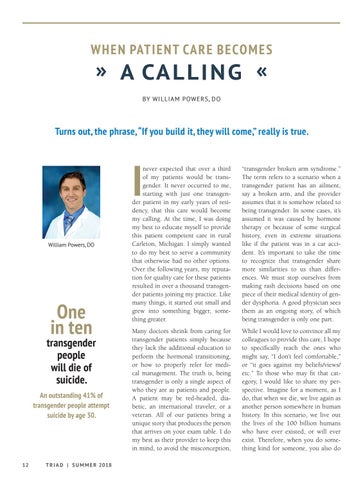
I William Powers, DO
One in ten
transgender people will die of suicide. An outstanding 41% of transgender people attempt suicide by age 30.
12
T R I A D | S U M M E R 2018
never expected that over a third of my patients would be transgender. It never occurred to me, starting with just one transgender patient in my early years of residency, that this care would become my calling. At the time, I was doing my best to educate myself to provide this patient competent care in rural Carleton, Michigan. I simply wanted to do my best to serve a community that otherwise had no other options. Over the following years, my reputation for quality care for these patients resulted in over a thousand transgender patients joining my practice. Like many things, it started out small and grew into something bigger, something greater.
“transgender broken arm syndrome.” The term refers to a scenario when a transgender patient has an ailment, say a broken arm, and the provider assumes that it is somehow related to being transgender. In some cases, it’s assumed it was caused by hormone therapy or because of some surgical history, even in extreme situations like if the patient was in a car accident. It’s important to take the time to recognize that transgender share more similarities to us than differences. We must stop ourselves from making rash decisions based on one piece of their medical identity of gender dysphoria. A good physician sees them as an ongoing story, of which being transgender is only one part.
Many doctors shrink from caring for transgender patients simply because they lack the additional education to perform the hormonal transitioning, or how to properly refer for medical management. The truth is, being transgender is only a single aspect of who they are as patients and people. A patient may be red-headed, diabetic, an international traveler, or a veteran. All of our patients bring a unique story that produces the person that arrives on your exam table. I do my best as their provider to keep this in mind, to avoid the misconception,
While I would love to convince all my colleagues to provide this care, I hope to specifically reach the ones who might say, “I don’t feel comfortable,” or “it goes against my beliefs/views/ etc.” To those who may fit that category, I would like to share my perspective. Imagine for a moment, as I do, that when we die, we live again as another person somewhere in human history. In this scenario, we live out the lives of the 100 billion humans who have ever existed, or will ever exist. Therefore, when you do something kind for someone, you also do
it for yourself. Conversely, if you do something unkind, you also did that to yourself. When you encounter a transgender patient, just like any patient, at some point in the span of eternity you’re going to experience their life.
What if, however you treated them on that day is a future personal experience you will have? I try to keep this philosophy in mind when I take care of my patients, transgender or not. It fuels my passion to keep going on the toughest of days, and to truly love the work I do.
Ultimately, transgender patients experience some of the toughest possible conditions that life can throw at you. On November 12, 2017, my house burned to the ground, killing my cats (both were Guinness World Record holders), destroying everything I ever owned, and nearly killing myself. Besides losing my family, I lost my livelihood as well; as I write this article I still have been unable to return to work due to the injuries I sustained that day. I’m just now beginning to understand, in part, some of the hardships a transgender person experiences. These patients “come out” and are ostracized, fired, and commonly end up broke and homeless. They suffer from no legal job protections in Michigan. They commonly lose their families, belongings, safety,
MICHIGAN MOA OSTEOPATHIC ASSOCIATION INSURANCE PROGRAM MOA members have the option to purchase a variety
security, and sometimes even their lives. I experienced a small portion of that suffering on only a single day. These patients experience it continually during their lifetime. I hope that you will consider making a difference in the transgender community. It is a network of beautiful people who have given me and my work so much purpose. They need our expertise, and so many times they have no where to go.
One in ten transgender people will die of suicide. An outstanding 41% of transgender people attempt suicide by age 30. They are a group begging for our help and I implore you to join me. Both as a state and as a profession, let us work together to do better for such a vulnerable community.
MOA will develop a customized program based on your individual needs. We offer: • Health Insurance • Vision service plan • Delta Dental options • Medical Malpractice, Professional Liability • Life insurance
of insurance plans directly through
• Long-term care insurance
the association at affordable rates.
• Long & short-term disability, group & individual options
Contact us today to recieve the latest insurance information.
• Home and auto insurance • MOA Prescription Rx Drug Card
DOMOA.ORG/MOAINSURANCE • JRUEDISALE @ DOMOA.ORG • 1-800-657-1556 TRIAD
| S U M M E R 2018
13
N E W O P PO RT U N I TY F O R A S S E T P ROT E CT I O N T R U S T S
BY DANIEL J. SCHULTE, MICHIGAN OSTEOPATHIC ASSOCIATION LEGAL COUNSEL
effectiveness by ordering the settlor of the trust to return the assets of the trust to the U.S. (or specifically to the State of Michigan) or holding the settlor, a trustee, or both in contempt (subjecting them to jail time for refusing to return assets).
Daniel J. Schulte MOA Legal Counsel
Q:
I have been told in the past that Michigan physicians have no reasonable way to shelter their assets from a malpractice plaintiff using a trust. Has the law changed? Is this now possible?
In the past, the effectiveness transferring assets to a trust to defeat the claims of malpractice or other creditors was suspect. So-called asset protection trusts were usually ineffective due to the significant restrictions on the ability of the physician to access principal or income that the trust agreements had to contain. In addition, asset protection trusts were typically expensive to set up and required assets to be transferred to foreign banks or other foreign financial institutions not subject to U.S. law. Courts have also been generally hostile to asset protection trusts, ruling in ways to minimize their 14
T R I A D | S U M M E R 2018
The law in Michigan changed in 2017 when the Legislature enacted the Qualified Dispositions in Trusts Act (the “Act”) enabling the creation of Domestic Asset Protection Trusts (DAPT). A DAPT is a new type of irrevocable trust that can be used by physicians specifically for shielding assets from malpractice judgements and other claims of creditors. The physician transferring assets to a DAPT may not be the DAPT’s trustee but any other individual (family member or not) residing in Michigan or a Michigan entity (limited liability company, corporation or partnership) may be the trustee. The physician transferring assets to a DAPT can be a beneficiary and may retain other rights over the DAPT’s assets, such as: • Directing investments; • Removing and replacing a trustee;
If properly established, the Act provides that a physician’s malpractice or other creditors may not reach assets transferred to a DAPT once a two-year period has passed since the date of transfer (there are exceptions applying when the transferor is in bankruptcy or there has been fraudulent concealment of the assets transferred). Therefore, planning is required. Transfers to a DAPT on the eve of a malpractice judgement being entered will not be effective. The Act provides Michigan physicians with a valuable way to shield assets from malpractice and other creditors. The use of a DAPT could be incorporated into a physician’s estate planning and asset protection strategy along with the use of investments in tenancy by the entities property, IRAs, 401(k)s and other qualified plans, the purchase of insurance, etc. To make the best use of this new opportunity a DAPT should be created and funded in advance of creditor claims, not after. Advanced planning in this area with the assistance of an attorney is a must.
• Controlling distributions; • Receiving income and/or principal distributions; and • Directing how the assets are to be distributed following the physician’s death.
Daniel J. Schulte of Kerr, Russell and Weber, PLC, is a Certified Public Accountant as well as an attorney, and serves as MOA Legal Counsel. Contact Daniel at dschulte@kerr-russell.com
MOPAC M I C H I G A N O ST E O PAT H I C POLITICAL ACTION COMMITTEE
THANK YOU!
MOPAC fights to elect and re-elect pro-physician candidates through direct contributions, voter education and targeted political activism. These efforts are funded soley by donations to the PAC.
Your contributions at the MOA Spring Convention helped reach our goal of
$20,000!
www.domoa.org/MOPAC
TRIAD
| S U M M E R 2018
15
MCOMA SUMMER BARBEQUE The Macomb County Osteopathic Medical Association (MCOMA) recently held it’s inaugural Summer BBQ for the 1st and 2nd year students of Michigan State University College of Osteopathic Medicine (MSUCOM) Macomb County Campus. The event was held at the home of James Clinton, DO and his wife, Denise. The students were treated to their choice of ribs, chicken, burgers, hot dogs or veggie burgers, all cooked by Robert Piccinini, DO on his huge Lang Smoker/BBQ. Attendees couldn’t stop raving about the falloff-the-bone ribs and the chicken smoked to perfection!
Yakes, James Clinton, John Floreno, Kathy Rollinger, Robert Piccinini and Anthony Ognjan took time to visit and chat with the students, sharing their student experiences from long ago. Everyone in attendance enjoyed spending time with MCOMA special guest, Dr. Kirsten Waarala, Assistant Dean of the Macomb County Campus of MSUCOM.
The MCOMA Board would like to thank all those who attended, especially Dr. Clinton and Denise for their hospitality, and of course to Dr. Robert Piccinini for spending 12 hours at the grill to make the barbeque a delicious success. Interested in joining MCOMA? Contact Cyndi Earles at 517-512-4307 or cearles@domoa.org.
The iffy weather didn’t dampen the spirits of those playing cornhole and volleyball between the rain drops. MCOMA board members Drs. Barbara
Spend Time on What Matters Most Financial matters can be distracting, but MSUFCU provides support through a team of business professionals. We offer customized accounts to fit your practice’s needs, which gives you the time to focus on what matters — your patients. • Savings and checking accounts • Cash Back Visa Credit Card • ACH and remote deposit services • Merchant processing Contact MSUFCU’s Business Services department today. msufcu.org/business 800-678-4968 • 517-333-2424 (Option 5)
Federally insured by NCUA. All loans are subject to credit approval.
16
T R I A D | S U M M E R 2018
R E T I R E M E N T S AV I N G S D E B U N K I N G CO M M O N M YT H S
BY WHITNEY ANDERSON - HARRELL, CHIEF COMMUNITY DEVELOPMENT OFFICER, MICHIGAN STATE UNIVERSITY FEDERAL CREDIT UNION
H
ow’s your retirement planning going? No matter what your
talk about—and debunk—some common retirement planning myths.
$2,500 of interest paid is tax deductible. If your loan rates are less than 5-7% after taxes, you could probably earn more by investing in your 401(k) than you would save in interest by paying down those student loans early. On the other hand, if you have credit cards or other high-interest debt above 5-7%, it does make sense to pay them off first.
MYTH #1:
MYTH #2:
MYTH #4:
Retirement planning is for older people.
I don’t have to think about retirement; my employer automatically enrolled me.
Investing is too complicated.
stage of life, this should be on your mind. There are many unforeseen challenges that could make retirement planning
difficult, including reduced Social Security and Medicare benefits, higher taxes and inflation rates, fewer traditional pension plans, lower market returns, and rising life expectancies and health care costs. Let’s
Retirement naturally feels incredibly far off for young people beginning their careers. This is only reinforced by communication from employers and the financial industry that’s aimed at those approaching retirement. In addition, this generation grew up during a time of instant gratification when you could find the answer to almost any question with a few thumb clicks, but retirement planning is a long, slow process that may not pay off for decades. The good news is that Millennials have time on their side. Starting early can have a dramatic impact on retirement preparedness, not only because it means saving more over your lifetime but also because those savings have a longer time to grow and compound. Even if you can only start with 1% of your income, it’s better than nothing and helps build the habit of retirement saving.
Automatic enrollment has helped many young people get started in their 401(k) plans, but it can also lull you into a false sense of security that you’re saving for retirement. That’s because the average automatic enrollment rate is 3%, far less than the 12-15% experts say a typical employee should be saving (including employer contributions). It’s even less than the 6% that employers will often match up to so many of them are leaving that free money on the table as well.
MYTH #3:
I need to pay off my student loans first. This is understandable. After all, no one likes having to make debt payments every month. However, student loan rates tend to be relatively low, and for many taxpayers the first
Many young employees may be intimidated by having to pick investments. Fortunately, a growing number of retirement plans offer investing advice tools and options to help simplify the process. These can be ideal for young people with little money outside their retirement accounts and little interest in researching and managing investments.
MYTH #5:
I’ll never be able to save enough for retirement. You may not be able to save much early in your career, but that can change as your income rises and your money management skills improve. If your retirement plan offers autoescalation, consider taking advantage of it. With this feature, you can have your contribution rate slowly increase over time. You may not even notice the difference in your paycheck, but pretty soon you could be saving more than you ever thought was possible.
Whitney Anderson-Harrell is the Chief Community Development Officer at MSU Federal Credit Union. MSUFCU's headquarters are located at 3777 West Road East Lansing, MI 48823. Contact Whitney at whitney.harrell@msufcu.org or 517-333-2424 ext. 2250.
TRIAD
| S U M M E R 2018
17
Passion for Profession: DO Spotlight
D R. J I M S Y LVA I N CONTRIBUTED BY ORIGAMI BRAIN INJURY REHABILITATION CENTER
W
ith a commitment to providing clients and their families with a holistic approach to rehabilitation in a natural, healing environment, Origami’s specialized programs and services are designed to exclusively support recovery following a brain injury. A Partnership of Michigan State University and Peckham, Inc., Origami offers an extensive continuum of care with the resources available to return people to productive and active lives.
Dr. Jim Sylvain received his DO degree from the College of Osteopathic Medicine of the Pacific, in Pomona, California and completed an undergraduate fellowship in Osteopathic Principles and Practices and a Physical Medicine and Jim Sylvain, DO
Rehabilitation Residency at Michigan State University. Dr. Sylvain currently
What inspired you to become a Doctor of Osteopathic Medicine? I came from a liberal arts degree, but with a strong interest in medicine. I was 38 years old when I started medical school. I really didn’t fit into the allopathic programs at which I interviewed. I serendipitously heard of Osteopathic Medicine and paid a visit to the Western University of Health Sciences in Pomona California... and I was hooked! I applied to only that school, and was accepted. It was during medical school that I conducted my first research project into the psychoneuroimmunology of behavior and stress. It was that research that led me to Physiatry: the medical specialty of Physical Medicine and Rehabilitation.
serves as Co-Medical Director of the Inpatient Rehabilitation Unit
“…I serendipitously
at Sparrow Hospital, Chair of the
heard of Osteopathic
Department of Physical Medicine and Rehabilitation, and as a
Medicine and paid a visit
member of the Origami Brain Injury
to the Western University
Rehabilitation Center Board of
of Health Sciences in
Directors.
Pomona California... and I was hooked!”
18
T R I A D | S U M M E R 2018
“Surprisingly, it is not the BIG advances in medicine that make the biggest difference in the rehabilitation of brain injury: it’s mostly attentive consistency and modeling of appropriate behaviors that lead to recovery. ”
Why did you choose to specialize in brain injury rehabilitation specifically?
What do you believe to be the most important trait that all DOs should possess?
During my Physical Medicine and Rehabilitation Residency at MSU, I had my first exposure to the complexities of brain injury and was very interested in this type of rehabilitation. Origami Brain Injury Rehabilitation Center opened the year I graduated and by the next year, I was Origami’s Medical Director.
Non-judgmental empathy.
What innovative treatments do you see on the horizon in the brain injury rehabilitation field? Surprisingly, it’s not the BIG advances in medicine that make the biggest difference in the rehabilitation of brain injury: it’s mostly attentive consistency and modeling of appropriate behaviors that lead to recovery. That having been said, we at MSU are involved in brain injury rehabilitation research looking at how the brain reacts to hemiparetic limb dysfunction and also how patients react/function following Osteopathic Craniosacral Manipulation (OMS). The OMS research is being conducted in partnership with Origami Brain Injury Rehabilitation Center, a partner of MSUCOM.
How do you foresee the industry changing in the next 5-10 years? Osteopathic Medicine continues to grow both in popularity and in the number of practitioners. Osteopathic medical schools are added almost every year. In response, the new merger of MD and DO residency programs, I anticipate an increase in Osteopathic research, scholarly publications and in the number of MDs who want to learn more about Osteopathic Practices and Principles.
What advances in medicine have had the greatest impact on how you’ve practiced medicine? Probably the advances in brain imaging. I now practice almost exclusively with acute brain injuries (before they arrive at brain injury centers like Origami). Brain imaging strongly influences how we diagnose, treat, and prognosticate for patients with brain injury.
TRIAD
| S U M M E R 2018
19
I am often asked these two questions: “What do you do now that you’re not a doctor anymore?” “Why would you leave a successful practice at the pinnacle of your career to go to the dark side?”
Passion for Profession
FROM SCRUBS TO SUIT BY GARY ROTH, DO, MBA, FACOS, FCCM, FACS, CHIEF MEDICAL OFFICER, MICHIGAN HEALTH & HOSPITAL ASSOCIATION
I
will admit, I have asked my colleagues those same questions when they assumed professional positions were more administrative than clinical.
Dr. Gary Roth
Well, the shoe is officially on the other foot. I am classified as a fulltime “suit.” However, I feel as if I am making a more profound difference in my role as the chief medical officer (CMO) at the Michigan Health & Hospital Association (MHA). As a cardiac surgeon, I was given the privilege of caring for people during one of their times of greatest need and most extreme vulnerability. It was very rewarding to know I made
20
T R I A D | S U M M E R 2018
a difference in a person’s life, one patient at a time. The returns were personally satisfying and professionally rewarding. As the CMO for the MHA, I am now able to help make a difference in hundreds, if not thousands, of lives at a time. The greatest opportunity I currently have is to partner with more than 100 MHA associates who have a common passion of working together to improve healthcare culture, make healthcare delivery safer and highly reliable, and ensure access to affordable coverage and care for all. Every initiative, collaborative, simulation, workshop and other event is a chance to share best practices and what the MHA has learned. Our hope is that this will, in turn, spread the knowledge to the bedside of patient care. We have witnessed several Michigan hospitals embark on a high-reliability journey, from striving toward benchmarks of harm reduction to now focusing on the goal of zero preventable harm. This mindset infuses all the work the MHA Keystone Center performs daily and is visible in activities of the MHA Keystone Center Patient Safety Organization (PSO), the progression of person- and familyengagement (PFE) and the sharing of sepsis expertise statewide. However, the greatest opportunity is to be the agent of change of hospital wide culture. Healthcare workers bring their passion to their work, hospitals foster that passion, the MHA engages the passion, and the cycle continues to improve patient safety and healthcare quality.
MHA KEYSTONE CENTER. MEMBER HOSPITALS & HEALTH SYSTEMS. STATE & NATIONAL PATIENT SAFETY EXPERTS. Together, we are part of something important. We’re changing healthcare and improving patient safety and quality by implementing evidence-based, best practices that are supported by data. Our person-centered philosophy fuels our purpose and work. It drives us to continually improve and build safer and more reliable healthcare. Michigan Health & Hospital Association (MHA) Keystone Center member hospitals are voluntarily participating in programs to improve the quality and delivery of healthcare by tackling big issues on a daily basis. Every day, we’re exploring new and innovative ways to prevent harm, reduce healthcare costs, and improve patient safety. TOGETHER, WE’RE MEETING THE CHALLENGES OF TODAY TO
Build a Safer Tomorrow and Beyond Read our 2017 MHA Keystone Center Annual Report and hear stories about how hospitals are improving patient safety and healthcare quality online at www.mha.org.
TRIAD
| S U M M E R 2018
21
CY B E RC R I M E S
Continue to Threaten Healthcare Industry BY MAT THEW C. BERTKE, CPA, MBA, PRODUCT DEVELOPMENT MANAGER, COVERYS
F
or the sixth consecutive year, data breaches in the healthcare industry have increased – not only in frequency, but in size, cost, and impact on the reputations of affected organizations. According to the Sixth Annual Benchmark Study on Privacy and
Security of Healthcare Data conducted by the Ponemon Institute, nearly 90 percent of the surveyed healthcare organizations experienced a data breach in the past two years, with 45 percent reporting more than five data breaches in that period.
Electronic Healthcare Data Creates New Risks New technologies have increased vulnerability to cybercrimes. With increased use of open wireless networks, as well as mobile and cloud environments, data has become more liquid and less controlled – particularly as it is migrated to an electronic health record or other digitized format. The problem is exacerbated as this data is processed, transferred, and shared between providers, clinics, hospitals, labs, treatment facilities, care homes, and billing entities. Recent trends reported in Experian’s Data Breach Response Guide forecast that healthcare organizations will be the most targeted sector in 2017 as new, increasingly sophisticated cyberattacks emerge. In response to that report, Ann Patterson, senior vice president of the Medical Identity Fraud Alliance, commented: 22
T R I A D | S U M M E R 2018
Key Drivers Behind Cyberattacks The healthcare cybersecurity market is segmented by type of threat: malware, advanced persistent threats, spyware, lost and stolen devices, etc. Currently, the global healthcare cybersecurity spend is forecast to reach nearly $10.84 billion by 2022, largely driven by increased incidences in cyberattacks involving: • The use of cloud services
“The consequences of a medical
• Unsecure networks
data breach are wide-ranging,
• Employee negligence
with devastating effects across the
• Lack of internal identification and security systems
board — from the breached entity to consumers who may experience medical ID fraud to the healthcare industry as a whole. There is no silver bullet for cybersecurity; however, making good use of trends and analysis to keep evolving our cyber protections along with forecasted threats is vital.”
No healthcare organization is immune from cyberattack. Despite the growing epidemic, the Healthcare Information and Management Systems Society reported that the majority of providers will continue to rely on a limited portfolio of basic security tools focused on antivirus, malware, and firewall vulnerabilities, as well as prevention, encryption, detection, authentication, and protection strategies.
• Stolen devices with unencrypted files • The misuse of electronic patient medical records
Types of Cyberattacks In the healthcare industry, criminal and malicious cyberattacks have been the leading cause of data breaches over the past two years. Fifty percent of respondents to the Ponemon Institute survey reported criminal attack as the most frequent type of breach experienced. Following is a list of various types of breaches…
TO CONTINUE READING CLICK BELOW: www.coverys.com/Resources/Articles/ Cybercrimes-Continue-to-ThreatenHealthcare-Indust
REACHING HEALTH GOALS Dedicated to Helping Patients
“I think it’s time to consider changing your diet.” “Why don’t we work on some healthy choices?” “Do you think we could lose a few pounds before our next visit?”
T
hese are phrases we utter countless times a day, gently urging our patients to realize, as we do, that their heart disease, diabetes, hypertension, hyperlipidemia, and countless other chronic health conditions could be greatly improved with simple lifestyle changes.
What happens when that patient walks out your door? Within the time constraints of a typical visit, most physicians can offer no more than a handout and word of encouragement, but studies show that even the most compliant and motivated patient likely does not have the knowledge or support they need to make a lasting change. The ongoing
guidance and accountability of a personal nutritional counselor would be the ideal solution, but unfortunately, it is a luxury rarely covered by insurance, making it cost prohibitive for many. What if there were another option? A free service, available to your patients 24/7, tailored to their needs, and dedicated to helping them reach their health goals? At Lettuce Live Well, this is exactly what we offer. The concept is simple: we match each patient with a volunteer health coach with whom they can meet as often as they would like for as long as they need. Our coaches are trained to be your patients’ partners in health- to provide ongoing accountability and practical health information, like how to read nutrition labels and prepare healthy recipes on a budget. We meet your patients wherever they are in their health journey and help them take small, sustainable steps in the right direction. Previously, our services were only available at select local clinics, but in order to reach as many people as possible, we have recently launched
an online coaching platform. Here, patients can be matched with a health coach, then meet with them via video chat or by phone from the comfort of their own home. We offer no gimmicks and refrain from selling “diets” or supplements. We are simply a grassroots nonprofit committed to giving your patients the education and support they need to create happier, healthier lives. Visit us at lettucelivewell.org to find out how to connect your patients with us. We are just a phone call or a click away. ____________________________________ ABOUT LETTUCE LIVE WELL Here at Lettuce, we encourage healthy lifestyles through our free community programs and by connecting people with additional resources in their area. We offer individual and group health coaching, grocery store tours, children’s programs, employee wellness programs, and more. Each community provides differing programs, contact us to learn about what is offered near you! 333 Albert Ave Suite 212 East Lansing, MI 48823 Phone: (517) 898-1870 E-mail: info@lettucelivewell.org
Partner with us today at www.lettucelivewell.org TRIAD
| S U M M E R 2018
23
https://domoa.rg/HCPM
USE IT OR LOSE IT APPLIES TO ASSET INVESTMENTS BY EWA MATUSZEWSKI
Don’t waste money on costly investments to your practice. Yes, you read that right – at least the right words. It’s the meaning that I’m focusing on. The establishment, maintenance and ongoing transformation of a physician’s practice or other healthcare concern is an expensive venture requiring myriad investments, not all of which have a quantifiable price tag.
Y
et how often do we fail to nurture our investments by withholding time to maximize or even understand them? As an example, I turn first to EHR systems that were introduced to revolutionize healthcare records and reporting. In many ways, EHRs have lived up to the hype. Their transformative properties are significant and tangible. But first, they must actually be used. Turning them on does not count as getting started. Nor does entering data that is never analyzed or reviewed, except for reference in a patient’s follow-up visit. Population health requires reporting that can target specific patient populations, identity patterns or gaps in care and lead providers to change or enhance course accordingly. Patients can benefit from such reports and investments in the physical asset of the software through more 24
T R I A D | S U M M E R 2018
comprehensive, focused care, and practices can obtain reimbursements available through the government or health plan partners. Too often when the EHR is in play, I see practices relying on their EHR vendors to run reports. While the vendors may appreciate the additional fees, this is not the intent of the system – nor is it efficient or effective. Instead, practice leaders need to invest in their investment. And that leads me to a broader investment… We need to go back to “school” to stay current on new and longstanding health initiatives, such as the PatientCentered Medical Home (PCMH), the Patient-Centered Medical Home Neighborhood (PCMH-N) and building care teams. Such education requires an investment of time and money, as does the investment healthcare providers make in their clinical and support staff. It goes beyond
wages and benefits, though. Investment in physician practice teams and teams in other clinical settings means, for example, allowing staff to be trained appropriately on the use of EHRs and other modern systems. We wouldn’t allow clinicians to operate medical equipment or perform procedures in which they were not properly trained. Why do we allow them to perform below their skill level when it comes to office efficiencies and population health? It’s when we use the variety of tools that we have invested in –especially our staffthat we create high performing teams and a high performing environment. Otherwise, why would superstar performers hang on, rather than seeking a career where their clinical and/or administrative skills are considered an investment worth nurturing?
Use it or lose it. The choice is ours.
Ewa Matuszewski, Senior Consultant for Healthcare Partners of Michigan (HCPM), will serve as a resource to provide information to members of the Michigan Osteopathic Association (MOA). Contact Ewa by phone at 844-363-6763, email hcpm@domoa.org, or visit domoa.org/hcpm
GROWTH
INNOVATION
PROGRESS
Moving forward with McLaren As one of Michigan’s largest and growing health care systems with more than 85,500 network providers and a delivery network covering the entire lower peninsula of Michigan, our strength can be attributed to our ability to excel at the very human element of medical care. We understand that health care must be provided by physicians and other medical professionals who are devoted to healing the sick, relieving pain and advancing research. We are thankful for the dedication and service of the more than 9,000 osteopathic physicians in Michigan whose contributions make a difference each and every day in the quest to bring the latest technologies and innovations to the communities we serve. Find out how you too can move forward with McLaren. To learn more about opportunities around the state, visit JoinMcLaren.org.
One of the largest health care systems in Michigan with 350 facilities, 14 hospitals and more.
TRIAD
| S U M M E R 2018
25
Detroit-Area High School Raises Nearly $150K to
HELP HOMELESS
BY LAURA PROBYN, DIRECTOR OF PUBLIC RELATIONS/COMMUNICATIONS, MICHIGAN STATE UNIVERSITY COLLEGE OF OSTEOPATHIC MEDICINE
DETROIT STREET CARE, AN OUTREACH ACTIVITY WHERE MICHIGAN STATE UNIVERSITY COLLEGE OF OSTEOPATHIC MEDICINE STUDENTS PROVIDE MEDICAL ASSISTANCE TO THE HOMELESS, HAS RECEIVED MORE THAN $148,000 FROM A MICHIGAN HIGH SCHOOL.
T
roy Athens High School in Troy, Michigan, chose Detroit Street Care as part of their annual charity week which included a variety of fundraising activities including a teacher dance-off and competitive volleyball tournaments. “Athens student congress was intrigued by Detroit Street Care and their outreach to those who need it most,” said Shawn DuFresne, who advises the school’s student leaders.
homelessness,” said Bryce, an assistant professor of family and community medicine and staff physician at the Community Health and Social Services clinic. “Also, due to the extreme generosity of our patients who share their amazing stories and medical histories with our students, we hope the future doctors can learn to become compassionate osteopathic physicians.” Detroit Street Care works with the Neighborhood Service Organization,
“Helping others has been a major part of our school culture for years now, especially aiding those who may be overlooked by society. Our student body was fired up and we saw the outstanding result. All students and staff at Athens take great pride in how the donation will impact others.”
which operates the Tumaini Center, a crisis-support facility for those facing homelessness.
Through Detroit Street Care, medical students at the College of Osteopathic Medicine’s Detroit Medical Center site offer clinical care to the city's homeless population with supervision from physicians Richard Bryce and Mary Jo Voelpel.
The MSU osteopathic students also work alongside Wayne State University School of Medicine’s Street Medicine Detroit organization.
“The mission of Detroit Street Care has always been to provide the best care possible for those facing
Bryce and the students are exploring the best way to use the donation for programming.
26
T R I A D | S U M M E R 2018
“We hope to find more ways to reach our patient population,” Bryce said. “We plan to get more medical and diagnostic equipment that could best take care of our patients and joining with Street Medicine Detroit to obtain a portable electronic medical record system. We have also looked at the possibility of getting a mobile clinic that would allow us to increase our outreach in Detroit.” “We had heard they raised almost $150,000 and were blown away by the support from Troy Athens and the community at large,” said Eil Eisman, a second-year osteopathic medical student and member of the Detroit Street Care e-board. “It’s so heartwarming to know your work is being recognized and supported.” Nearly 250 MSU medical students have participated in Detroit Street Care since it started. “We are extremely thankful for Troy Athens High School and to Arta Duda, the Wayne State University student who helped connect us with this opportunity,” Bryce said. “It will allow us to continue to find ways to improve on the Detroit Street Care mission.”
ADVERTISERS TRIAD STAFF
Beaumont..............................................................................6
Kris T. Nicholoff, CEO and Executive Director Lisa M. Neufer, Director of Administration Todd Ross, Manager of Communications Virginia Bernero, Executive Assistant & Marketing Coordinator
Blue Cross Blue Shield of Michigan.......................................4
2018-2019 BOARD OF TRUSTEES Lawrence Prokop, DO, FAAPM&R, FAOCPMR-D, FAOASM, President Craig Glines, DO, MSBA FACOOG, President-Elect Jeffrey Postlewaite, DO, Secretary/Treasurer John Sealey, DO, FACOS, Immediate Past President
Department of Business Affairs - Directors Lawrence Prokop, DO, FAAPM&R, FAOCPMR-D, FAOASM, President Craig Glines, DO, MSBA FACOOG, President-Elect Jeffrey Postlewaite, DO, MPH, Secretary/Treasurer John Sealey, DO, FACOS, Immediate Past President Bruce Wolf, DO, FAOCR, Past President
Coverys...............................................................................28 Kerr Russell.........................................................................15 McLaren Health Care...........................................................25 Michigan Health & Hospital Association.............................21 MSU Federal Credit Union..................................................16 MOA Autumn Convention....................................................2 MOA Insurance...................................................................13 MOPAC...............................................................................15 Origami Brain Injury Rehabilitation Center.........................19
Department of Socio Economics - Directors Kevin Beyer, DO Patrick Botz, DO
For advertising inquiries, please email Todd Ross at
Department of Education - Directors
tross@domoa.org or call 800.657.1556.
Emily Hurst, DO Samia Cheema, DO, Resident
Department of Membership - Directors Andrew Adair, DO, FACOFP Stephen Bell, DO, FACOI Matthew Meranda, OMS-II
Department of Healthcare Technology & Informatics - Director David Best, DO, MS, ABAM The osteopathic profession in Michigan is made up of osteopathic physicians, osteopathic hospitals and an osteopathic medical school. This TRIAD stands together to serve our patients and one another. TRIAD, the official journal of the Michigan Osteopathic Association, serves Michigan’s osteopathic community, including its osteopathic physicians, hospitals, medical school and patients. The Michigan Osteopathic Association will not accept responsibility for statements made or opinions expressed by any contributor or any article or feature published in TRIAD. The views expressed are those of the writer, and not necessarily official positions of MOA. TRIAD reserves the right to accept or reject advertising. The acceptance of an advertisement from another health institution or practitioner does not indicate an endorsement by MOA.
COMMUNICATIONS DEPARTMENT Michigan Osteopathic Association Communications Department 2445 Woodlake Circle, Okemos, MI 48864 Phone: 517.347.1555 Fax: 517.347.1566 Website: www.domoa.org Email: moa@domoa.org ©2018 Michigan Osteopathic Association TRIAD
| S U M M E R 2018
27
lawsuits
insurance coverage concerns accountable care
financial pressures
cyber security
patient demands
patient care
EHRs
big data
shifting FDA regulations
risk of medical errors
IN A WORLD FULL OF DISTRACTIONS, COVERYS HELPS YOU FOCUS ON WHAT MATTERS MOST–PROVIDING QUALITY CARE. With so many issues competing for your attention, it can be difficult to focus on the things that matter most. Coverys provides top-rated medical liability insurance combined with data-driven insights of where you may be at risk. Plus, proactive risk management and education solutions reduce liability risks and help you increase quality outcomes. All of which means you can stay focused on what matters most – ensuring that your patients and practice thrive. To learn more, visit Coverys.com or call our East Lansing office at 800.313.5888, and select option 3 to speak with a representative.
Medical Liability Insurance Business Analytics Proactive Risk Management & Education Insurance products issued by ProSelect® Insurance Company