about the playwright T e r e s a
Deevy
Teresa Deevy
was born on January 21, 1894 at Landscape, her family’s home in Waterford. She was the youngest of 13 children. Her father ran a successful draper’s shop in Waterford city but died when Teresa was only two. She was educated at the Ursuline Convent in Waterford and in 1913, enrolled at University College, Dublin. She wanted to become a teacher, but after a few months, was struck by a mysterious illness. Doctors eventually diagnosed her with Meniere’s disease, an incurable condition caused by fluid imbalance in the inner ear. By 1914, at the age of 20, Deevy had completely lost her hearing. Struggling to hear lectures, she left school and went to London to study lip-reading. While in London, Deevy often went to the theater—reading the plays first, when possible, then following them on the stage in order to practice her lip-reading. One night, while returning home from the theatre, she felt very strongly the urge to put “the sort of life we live in Ireland” into a play. About this same time, Deevy read a copy of Shaw’s Heartbreak House. Shaw had called it “a fantasy in the Russian manner on English themes,” and as she described in a 1952 autobiographical note: “I said proudly to myself my play will be ‘a fantasy in the Russian manner on Irish themes.’— But there was a long way to go…” It was an unusual ambition. Deevy had no theatrical connections. As a woman and as a person who was deaf, she didn’t fit the then-typical image of a playwright. However, she returned to Ireland undaunted and began writing. In 1925, at age 31, Deevy finally felt ready to send her plays to the Abbey, Ireland’s national theater. They were rejected, but one reader had been particularly impressed. This was Lennox Robinson, the Abbey’s managing director and a playwright himself. (Mint audiences may remember his Is Life Worth Living? from 2009). He encouraged her to keep writing.
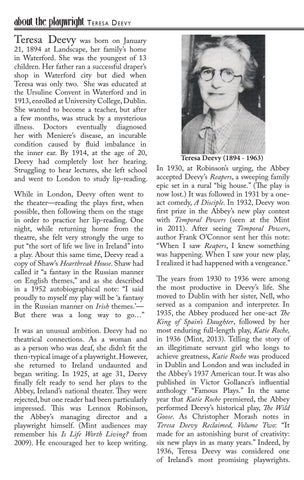
Teresa Deevy (1894 - 1963) In 1930, at Robinson’s urging, the Abbey accepted Deevy’s Reapers, a sweeping family epic set in a rural “big house.” (The play is now lost.) It was followed in 1931 by a oneact comedy, A Disciple. In 1932, Deevy won first prize in the Abbey’s new play contest with Temporal Powers (seen at the Mint in 2011). After seeing Temporal Powers, author Frank O’Connor sent her this note: “When I saw Reapers, I knew something was happening. When I saw your new play, I realized it had happened with a vengeance.” The years from 1930 to 1936 were among the most productive in Deevy’s life. She moved to Dublin with her sister, Nell, who served as a companion and interpreter. In 1935, the Abbey produced her one-act The King of Spain’s Daughter, followed by her most enduring full-length play, Katie Roche, in 1936 (Mint, 2013). Telling the story of an illegitimate servant girl who longs to achieve greatness, Katie Roche was produced in Dublin and London and was included in the Abbey’s 1937 American tour. It was also published in Victor Gollancz’s influential anthology “Famous Plays.” In the same year that Katie Roche premiered, the Abbey performed Deevy’s historical play, The Wild Goose. As Christopher Morash notes in Teresa Deevy Reclaimed, Volume Two: “It made for an astonishing burst of creativity: six new plays in as many years.” Indeed, by 1936, Teresa Deevy was considered one of Ireland’s most promising playwrights.