TERESA DEEVY ABOUT THE PLAYWRIGHT
She was sent to London to study lipreading. To practice, she went to the theater. Night after night, she sat in the front row, entranced. The plays of Shaw and Chekhov were her favorite. She admired their richly drawn characters, finely crafted dialogue, and serious themes. Long ago, her mother had encouraged her to write stories. Now Tessa knew how she wanted to tell them. She decided to become a playwright.
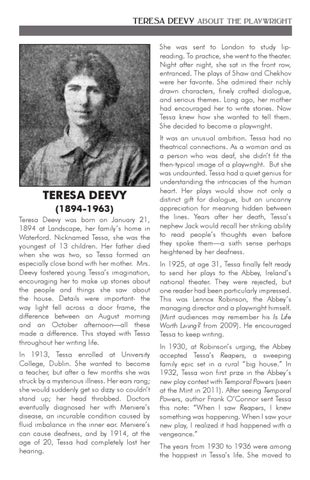
TERESA DEEVY (1894-1963) Teresa Deevy was born on January 21, 1894 at Landscape, her family’s home in Waterford. Nicknamed Tessa, she was the youngest of 13 children. Her father died when she was two, so Tessa formed an especially close bond with her mother. Mrs. Deevy fostered young Tessa’s imagination, encouraging her to make up stories about the people and things she saw about the house. Details were important- the way light fell across a door frame, the difference between an August morning and an October afternoon—all these made a difference. This stayed with Tessa throughout her writing life. In 1913, Tessa enrolled at University College, Dublin. She wanted to become a teacher, but after a few months she was struck by a mysterious illness. Her ears rang; she would suddenly get so dizzy so couldn’t stand up; her head throbbed. Doctors eventually diagnosed her with Meniere’s disease, an incurable condition caused by fluid imbalance in the inner ear. Meniere’s can cause deafness, and by 1914, at the age of 20, Tessa had completely lost her hearing.
It was an unusual ambition. Tessa had no theatrical connections. As a woman and as a person who was deaf, she didn’t fit the then-typical image of a playwright. But she was undaunted. Tessa had a quiet genius for understanding the intricacies of the human heart. Her plays would show not only a distinct gift for dialogue, but an uncanny appreciation for meaning hidden between the lines. Years after her death, Tessa’s nephew Jack would recall her striking ability to read people’s thoughts even before they spoke them—a sixth sense perhaps heightened by her deafness. In 1925, at age 31, Tessa finally felt ready to send her plays to the Abbey, Ireland’s national theater. They were rejected, but one reader had been particularly impressed. This was Lennox Robinson, the Abbey’s managing director and a playwright himself. (Mint audiences may remember his Is Life Worth Living? from 2009). He encouraged Tessa to keep writing. In 1930, at Robinson’s urging, the Abbey accepted Tessa’s Reapers, a sweeping family epic set in a rural “big house.” In 1932, Tessa won first prize in the Abbey’s new play contest with Temporal Powers (seen at the Mint in 2011). After seeing Temporal Powers, author Frank O’Connor sent Tessa this note: “When I saw Reapers, I knew something was happening. When I saw your new play, I realized it had happened with a vengeance.” The years from 1930 to 1936 were among the happiest in Tessa’s life. She moved to